October 14th, 973
On the afternoon of the 13th, the party met again at Barin’s smithy, their unofficial headquarters and the only place in the Hollow where the clatter of hammers was louder than the rumors about them. Barin greeted them with his usual expression of defensive suspicion now lightened with ironical good humor.
“You lot,” he said, wiping soot on his apron, “are the only people I know who can start a jail riot here, wipe out a tax collection party there, and get asked to save a hamlet over yonder—and all in less than a week. I can’t decide if the gods have chosen you for greatness or an early grave.”
He held up a folded letter sealed with a thumbprint of iron dust.
“A sinkhole opened near Brighton during the rain—right in the middle of a barley field. There’s a stone tunnel at the bottom—looks ancient. The farmers have been sensible enough not to poke around, but they’re losing sleep thinking something might crawl out and eat them. They’re desperate for someone who knows how to swing a sword or sling a spell to take a look.”
The group exchanged looks—half curiosity, half relief. Returning to Manchester was still out of the question until the jailbreak furor died down, and “investigate a hole in the ground” sounded much more interesting than “sample the nightlife in a village of 500 people.”
Shamus grunted. “As long as the hole doesn’t talk back.”
Cassyndra murmured, “Don’t jinx it.”
Ant, still nursing a headache from the events of the previous day, said, “Fine. But if it’s giant rats again, I’m setting the whole place on fire.”
Merrythought, straightening her cloak, smiled. “If it does talk back, perhaps it just needs a good listener. Preferably one with a knife.”
They accepted Barin’s letter of introduction, promised not to die too quickly, and set out the next morning.
The Road to Brighton
The fourteenth dawned bright and cool. The long rain had washed Cambria clean: the air crisp, the fields glistening. The road to Brighton wound through the richest farmland in all of Archea, a quilt of barley, flax, and green pasture that stretched as far as the eye could see. Here, the ground was dark with centuries of silt from Lake Thalmere, which shimmered faintly to the north. The lake’s waters gathered at Brighton before spilling south into the River Tareth, on their long, winding journey toward the sea.
The party’s boots squelched through ruts of drying mud as they passed plows returning to the fields. Crows perched on fenceposts, supervising the work like petty gods of agriculture.
“Hard to believe this was all a battlefield once,” Cassyndra observed, gesturing toward the distant ridges.
“Aye,” said Shamus. “Give folk a few centuries and they’ll turn graves into gardens. It’s their best magic.”
Merrythought adjusted her pack. “Cheaper than monuments, too.
A Pleasant Encounter
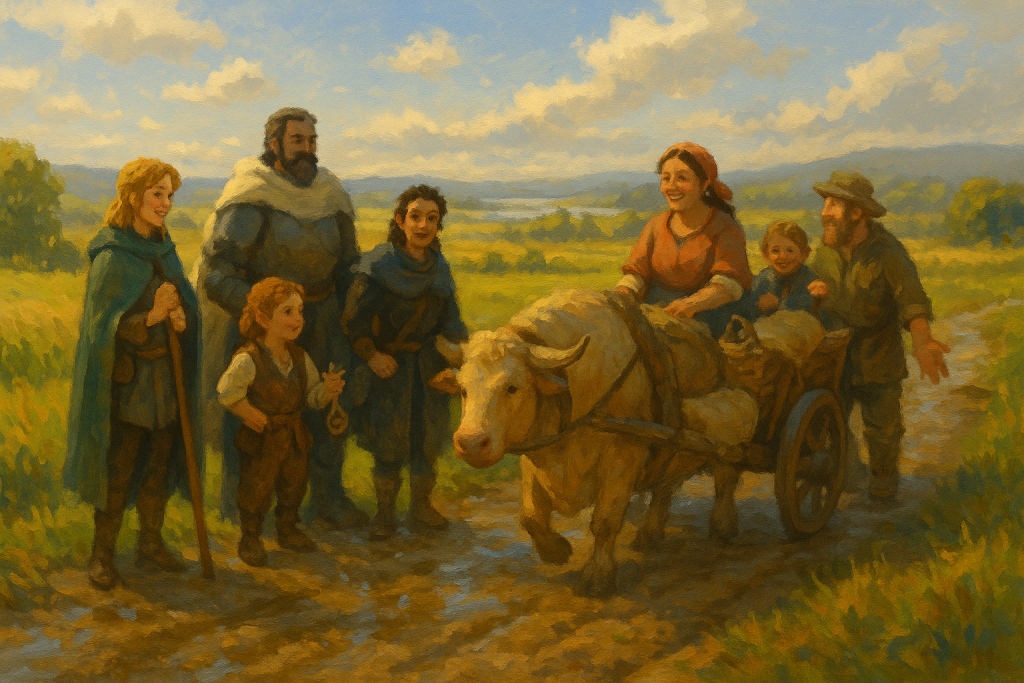
Near midday they came upon a wagon trundling west—a family of peasants bound for market in Dolven’s Hollow. Their cart creaked under sacks of grain, and the smell of damp straw followed them.
The matron on the driver’s bench eyed the travelers warily before calling out,
“Don’t often see swords on this road. You folks traders or trouble?”
“Depends on the day,” Merrythought replied. “Today, we’re just passing through.”
A boy perched on the tailgate piped up.
“Passing through to where?”
“Brighton,” Shamus said.
The peasants exchanged glances.
“Brighton?” said the father. “Wouldn’t go near there, not after what happened.”
“The sinkhole?” Cassyndra asked.
“That’s the one. Big as a house and deep as sin. Some say it opened clean to the underworld.”
Wolfgang leaned against the cart. “Underworld, huh? Guess we’ll find out how the rent is.”
When the farmers realized these were the adventurers that Brighton had been hoping for, their suspicion turned to relief. They offered bread, cheese, and a flask of cider as thanks in advance. Conversation turned lively—harvest gossip, a goat that could open doors, and the price of tools (“monstrous,” by all accounts).
As they parted, the youngest boy ran after them to hand Shamus a small clay charm.
“For luck,” he said, shyly.
Shamus tucked it into his gauntlet with a solemn nod.
“Thank you, lad. We’ll bring it back unbroken.”
The boy grinned. “Don’t bother. Luck’s yours to keep.”
Arrival in Brighton
They reached Brighton just before sunset. The fields around the village gleamed gold in the low light, and the last of the rainwater trickled toward the mouth of the River Tareth where it drained from the vast mirror of Lake Thalmere. Smoke rose from stone chimneys, and the smell of wet hay and woodsmoke mingled with the crisp scent of lakewater.
Barin’s letter opened every door. The farmers welcomed them with unfeigned gratitude and an enthusiasm that quickly turned into a feast. Chickens were chased, cider barrels were tapped, and though the tables sagged more with goodwill than with actual food, the meal was lively. Someone even produced a battered lute, which Merrythought borrowed to play a quick, wicked tune that earned a round of laughter and a few scandalized gasps from the elders.
Cassyndra found herself coaxed into telling fortunes for the children. Laveleen spent most of the evening listening politely to three competing theories about how deep the sinkhole went (“halfway to the underworld,” “no deeper than a cow,” and “depends on the cow”).
Hunkle made the rounds, winning arm-wrestling matches and a fair amount of cider before declaring himself “champion of the peasantry.”
By the time the moon rose, the laughter had faded to contented murmurs. Even Ant slept soundly that night, free of troubling dreams or unexpected midnight visitors.
The Morning of the Fifteenth
Dawn found the fields still slick with mud and glittering dew. Two sturdy farmers—Abe and Vern—waited at the edge of the village, boots caked, shovels in hand.
“We’ll show you,” Vern said. “Ain’t right close, but you’ll smell it before you see it.”
“Ignore him,” Abe added. “He says that about everything.”
They led the party through furrowed fields and the scent of turned earth until the sound of trickling water changed pitch. Ahead lay a yawning hole in the ground, thirty feet across, its edges freshly collapsed. Morning mist still curled up from the darkness below.
Abe spat. “That there’s new ground. Wasn’t no hole before the rains. Now it’s like the earth just… gave up.”
Vern nodded. “We threw a stone in. Heard ‘naught but silence. Figured that was a sign to stop throwing things.”
The light caught on something below—stonework, unmistakably deliberate. Ancient masonry, slick with mud.
The farmers crossed themselves in the local fashion.
“You’ll go down there, then?” Abe asked.
Gareth checked his swordbelt. “We’ll go. And if anything’s still down there, it’ll wish it hadn’t waited for us.”
The wind stirred, carrying the smell of wet soil and something older—cold stone and time.
Brighton’s fields stretched silent behind them, the first rays of sun catching on the sinkhole’s rim.
It was, at last, time to descend.