October 15th, 973
On the morning of the fifteenth, Abe and Vern led the party through muddy fields to the sinkhole that had stirred so much village gossip. From a distance it looked like any other post-storm disaster—a yawning hollow that might swallow a cottage and then politely stop there. Up close, however, it was anything but ordinary.
The pit gaped thirty feet wide at the rim, narrowing to twenty at the bottom. Its walls were slick with mud, laced with exposed roots, and—most troubling of all—scored with the tracks of several people who had already gone down. Footprints led from the bottom straight into a dark, stone-worked tunnel revealed by the collapse.
“By the gods!” Abe breathed. “Who’d be fool enough to go down there?” Then, remembering himself, he tugged his cap. “Present company ’cepted, of course.”
Vern spat into the mud. “Could be them Boskin Boys. They’ll dare each other into a volcano if there’s cider at the end. Or maybe Lyle Farrow—he’s forever chasing gold under rocks that don’t shine. He’d sell his own boots for a legend.”
The party descended anyway, as professional fools do. At the bottom they quickly proved the farmers’ theories naïve. Multiple sets of tracks—humans and dwarves both—crossed the floor. At least one pair of heavy boots had sunk deep, as if worn by someone in armor or heavily laden.
The bootprints approached a pair of walls that had once sealed the stone passage but had crumpled when the sinkhole opened. A set of knee marks showed where someone had knelt to inspect them before forcing their way through.
The outer wall began with a one–two inch layer of lead, caked in whitish corrosion. When the chalky crust was scraped away, glyphs were revealed beneath. Suspecting something deeper, Cassyndra took ten minutes to cast Detect Magic as a ritual while she fussed with braziers and bat guano. Wolfgang examined the second layer: two feet of basalt bricks laid in a style humans had used for centuries. Lavleen quietly copied the runes onto parchment, muttering to herself—or possibly to the Yore Mother.
Ant discovered a more direct clue: a corroded brass plate torn from the lead surface. Its raised lettering read: “By decree of the Crown — Vault sealed. Trespass is anathema to body, mind, and soul.”
The party studied it in solemn silence before simultaneously concluding that, between the jailbreak and the unfortunate incident with the tax-collectors, their relationship with the Crown was already long past salvage. Ant tossed the plaque back into the mud, and Wolfgang turned his attention to the inner wall.
This second wall, of simple stone, matched the construction style of the Manchester sewers and the Tomb of the Teacher; Wolfgang presumed it “orcish.” Unlike those carefully built structures, however, this wall felt hastily assembled, as if whatever materials and tools were at hand had been conscripted to erect a second two–three foot barrier in a hurry.
By the time Cassyndra’s ritual completed (and the bat-guano fumes had mercifully dispersed), she pronounced the glyphs to be abjuration magic—the kind used for protection, barriers, and the occasional incineration of trespassers.
There was a pause. Then Hunkle, posted with Shamus, Ironbark, and Gareth on guard duty, offered his assessment.
“Well, we’re trespassing,” he said. “We ain’t incinerated. So… must be the friendly kind of abjuration.”
Simple though the logic was, no one had anything better. The group agreed the Archeans had likely built the lead-lined basalt wall to keep something contained, while the orcs had thrown up their own inner wall either before or after, for reasons unknown. With a round of philosophical shrugs, they followed the mysterious tracks deeper into the passage.
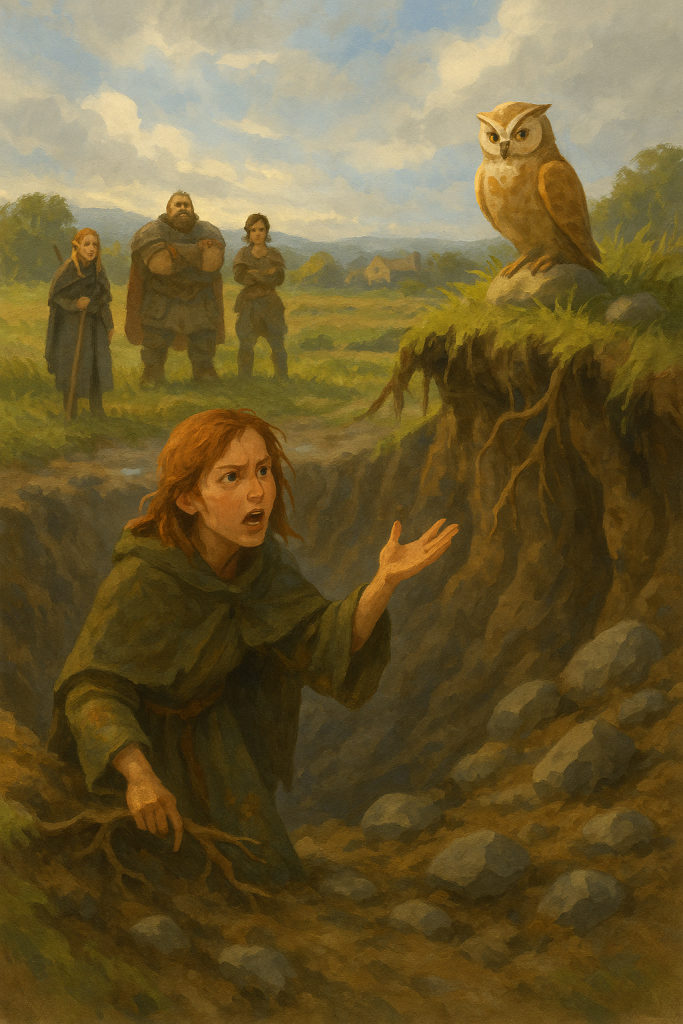
Everyone, that is, except Heka.
“You all go on ahead,” said the owl-shaped familiar from the lip of the sinkhole. “Looks dangerous down there. I’ll stay here and make sure no more farmers tumble in until you say it’s safe.”
Cassyndra blinked. “You’re an integral part of the party! You have to come with us!”
“No way,” said Heka. “Section XV of the Summoning Agreement clearly states that familiars are not obligated to join suicide missions.”
“You have to! I summoned you—you’re bound to obey!”
“A common misconception,” the owl replied. “Especially among mages who click ‘I have read the Terms and Conditions’ without having actually read them. Besides”—he tilted his head—“the GM says letting the party map out the whole dungeon without an iota of personal risk makes for a dull story. So there.”
Cassyndra opened her mouth, closed it, sighed, and descended after the others, leaving Heka proudly on sentry duty with impeccable narrative timing.
The passageway continued for another forty feet, sloping down a further ten. Wolfgang ran a hand along the walls as he walked, nodding appreciatively.
“This,” he said, “is workmanship. Deliberate. Proper tools, proper stone. None of that slapdash panic-building we saw up top.” He sniffed with dwarven dignity. “Definitely orcish… or presumed orcish.”
At the bottom of the incline, the party reached a four-way intersection. The mysterious footprints curved left, then faded after another ten feet as the mud thinned out. Wolfgang and Merrythought—both blessed with darkvision, and in Wolfgang’s case the uncanny dwarven sense of tremors through stone—moved ahead to scout.
The corridors were ten feet high and vented by narrow air ducts that perforated the upper walls—round openings half a foot to a full foot wide. Reddish stains marked where metal grilles had once been fitted over them, now long since rusted to dust.
Every ten feet, a small alcove opened in the wall. Most held smooth, rounded stones the size of fists. A later Detect Magic ritual (this one involving caterpillar paste rather than bat guano—Cassyndra insisted there were reasons, but no one else understood them) revealed that these stones had once been enchanted to produce light. Their magic had long since guttered out.
And there were the bodies.
Scattered along the halls lay the skeletal remains of orcs who had died where they fell—some curled against walls, others sprawled across the floor. Their clothing had rotted to faint threads; they wore no armor, carried no weapons. Whatever killed them had struck when they were defenseless.
Fortunately, these skeletons were the non-animated kind. Accordingly, Wolfgang gave a low whistle to signal all clear. Merrythought added a subtle hand gesture of her own, and the rest of the party quietly joined them at the intersection.
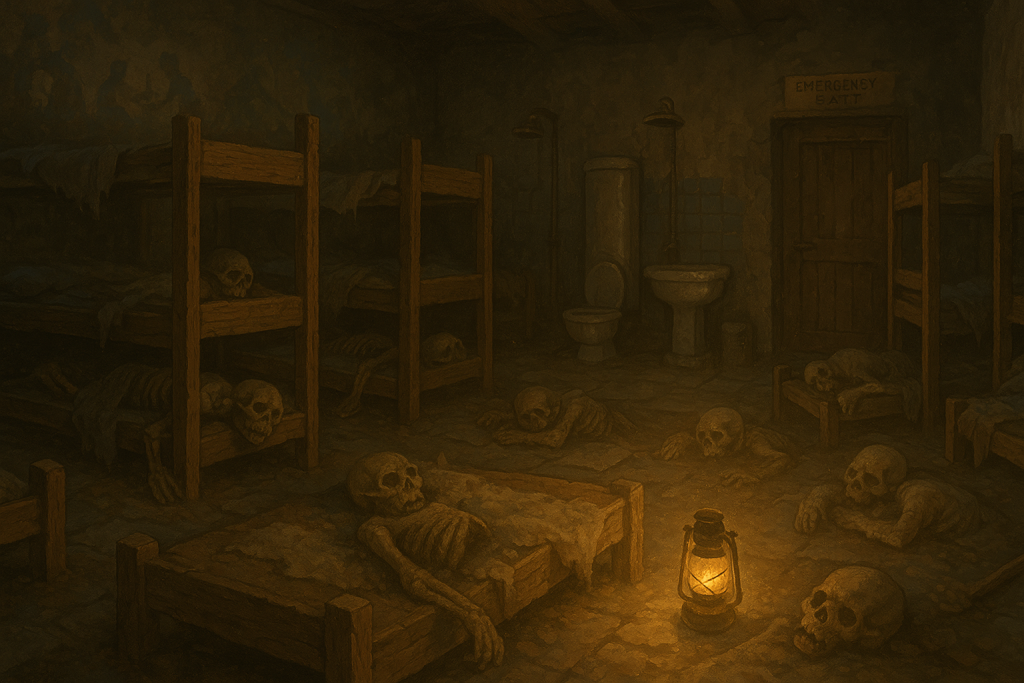
The party turned next to a row of four chambers that, at first glance, looked like barracks. A closer look at the contents—and especially the lack of weapons or armor—quickly revised that assumption. These had been dormitories, not defensive quarters: perhaps living spaces for workers rather than soldiers.
Each dormitory held seven wooden bunkbeds arranged with orderly precision that time had done its best to undo. The frames were dry and dark with age, boards warped and cracked from centuries of still air and slow rot. Nails and metal brackets had long since oxidized into reddish powder that flaked away at the slightest touch.
The bedding had fared no better. What had once been heavy wool blankets were now thin, felt-like patches of discolored material clinging to mattresses and scattered across the floor. It was immediately clear the rooms were holding more people than they were built for; nests of bedding piled between bunks suggested that every square foot had been used for sleep or shelter.
In one corner of each dorm stood a pair of modest enclosures: a five-by-five-foot stall containing a porcelain flush toilet—spiderwebbed with hairline cracks—and another with a showerhead above a rust-stained floor. A porcelain sink stood beside the showers, its bowl intact but its faucet frozen with green corrosion. No water ran in any of them.
Faded murals were still faintly visible on the walls—scenes painted in broad strokes of ochre and blue. Their inscriptions were written in an elegant, flowing script the party could not decipher, though the imagery suggested themes of communal labor and shared purpose.
Curiously, each room contained both an entrance and what appeared to be smaller emergency exit.
And in every room, there were dead orcs.
Unarmed and unarmored skeletons lay where they had fallen: curled in bunks, slumped against walls, huddled on the floor in fetal positions. Their tusks were nearly perfect, but their bones were fragile, flaking at the touch. Many showed a disturbing pattern: faint black charring at the joints—knees, wrists, elbows, spine. At first, someone muttered “electrocution,” but the distribution was all wrong. Cassyndra crouched beside one skeleton, her brow furrowed.
“Necrotic energy,” she murmured. “Powerful. Sudden. This was mass magical death.”
A lingering residue clung to the air—cold, stale, and unsettling—like the echo of a spell that refused to be forgotten.
Wolfgang and Merrythought both noticed occasional disturbances in the dust: faint footprints, perhaps hours to days old. The same mixed party of humans and dwarves who had ventured ahead of them seemed to have examined these rooms briefly before moving on.
The party stood in the quiet gloom of the dormitories, this was a facility designed for a utilitarian purpose and then, for some reason, something had come and slaughtered the workers.
They paused over the scenes and quietly moved on.
Two more rooms filled in the picture: a worship chamber and an infirmary.
The worship room housed stone and brass statues of orcish deities—guardians and water-bearers, not war gods. Two orcish skeletons knelt before a central altar, their joints charred like the others. Whatever sanctity the room had once held, it had not protected them.
The infirmary was worse. Stone tables, broken brackets where cots had once hung, shelves of powdered herbs, shattered jars, and overcrowded with orcish skeletons. Someone—likely the unknown explorers who had come before—had carefully organized the remains: uninjured skeletons in one area, those with clear battle trauma in another. The latter bore unmistakable signs of combat injuries: fractured skulls, crushed ribs, splintered extremities, and the truncated bones of limbs that had been amputated but not yet healed by magic.
All of the joints and the ends of the fractures had the same black charring as the previous bodies.
“Same magic,” Cassyndra said quietly. “It didn’t matter that they were unarmed, wounded, or praying.”
The next large chamber introduced a grim contrast.
Here, the dead were human and elven—perhaps two hundred bodies, stacked in careful rows. Their armor and clothing had decayed, but it was immediately obvious that these dead had come from battle, not the necrotic magic that had ended the orcs. None of the human or elven skeletons bore the distinctive blackened joints seen on the orcish remains. No charring, no necrotic signature—only fractured bones, pierced armor, and the violence of steel and arrows. Whatever killed them had been mundane, brutal, and all too familiar.
Near the top of one pile, Merrythought spotted a mildewed leather satchel. Inside lay a battered, half-rotted journal whose pages clung together reluctantly. She coaxed a few apart, revealing fragments of hurried handwriting:
…Company C repulsed with heavy casualties this morning. We and B Company are to try again tomorrow; this time simultaneous assault at two entrances…
…elves of the Silver Dawn are uneasy—say the water here “listens.” Lieutenant Verrin told them to save their songs for victory feasts…
…rumors spreading in the mess line. We might be reinforced soon by the Sereth…
…we can hear them singing down there. The orcs. They sound calm. Why are they calm?…
As the party lifted their lanterns, more details emerged from the darkness. One entire wall was painted with a massive mural—fifteen feet high, ten feet wide—its colors faded but still discernible. It depicted small water elementals, cheerful and round, splashing one another as they carried buckets and troughs uphill toward a gleaming aqueduct. Nearby, orcish workers beamed with pride. A few elementals sprayed the workers deliberately, and the orcs in the painting laughed. Flowing runes lined the bottom edge, ending in what looked like the artist’s signature.
The contrast between the joyful mural and the mountains of fallen soldiers was almost dizzying.
Wolfgang whispered, “These poor bastards… they died fighting. The orcs didn’t.”
Beyond the mass graves lay the kitchen and pantry—a snapshot of what appeared to be the facility’s final days.
The kitchen’s stone tables and iron ovens were blackened by layered soot. Normal cooking fires had given way, in the end, to improvised, desperate blazes: scorched leather, gnawed bones, the faint dust of marrow boiled from the last scraps. A dark handprint, baked into one table, suggested someone had braced themselves there during an inferno. The cooks lay where they had fallen, bearing the same necrotic burns as everyone else.
The pantry beyond was cooler than the surrounding halls, its shelves sagging under the weight of rusted tins and mummified food. Preservation runes still faintly chilled the air. Rat droppings carpeted the floor.
Wolfgang, squinting at the ghostly labels and faded illustrations, had an idea. He began peeling off what was left of the labels, matching pictures to orcish script.
“If we can work out which of these meant ‘beans,’ ‘peas,’ or ‘salted fish,’” he said, “we might actually start learning to read this language. Food-first vocabulary. There are worse dictionaries.”
Merrythought smirked. “So we begin our education with: beans, peas, fish.”
“Every empire starts somewhere,” Wolfgang replied.
Neat can-opener cuts and recently disturbed rot confirmed the rival party had already rummaged through here and moved on.
The next chamber was immediately different from the others—larger, more organized, and thick with the ghost of purposeful activity. The party collectively dubbed it the “situation room,” a name that fit its layout far better than any term from modern Archean military doctrine.
A faded mural dominated one entire wall, stretching fifteen feet high and ten feet across. Time had drained its colors, yet the imagery remained clear: sweeping green plains threaded with bright blue irrigation channels; farmers bowing toward the rising sun; and, floating above them in the painted clouds, a translucent orcish spirit pouring water from an urn. The style was reverent and hopeful. Orcish script—now barely legible—looped along the bottom, ending in what was likely the artist’s signature.
The room itself, however, told a harsher story.
Half of the chamber had been packed with long tables and benches, all shoved together so tightly that movement between them would have been difficult. It looked as though the space had once held far more people than it was designed for—workers, perhaps, or defenders gathering for hurried meals, strategy briefings, or messages from runners during a battle.
The other half of the room was arranged very differently. Several tables had been pulled together to form an improvised command surface. A flagpole in the corner still bore the tatters of a faded banner—its symbol long lost to dust and mildew. On the central table lay a large, stained map, too faded to decipher, weighted down by a scattering of copper coins and carved bone tokens. The placements suggested troop movements, choke points, or defense lines—whatever desperate plan the orcs had been attempting to execute when the end came.
Cutlery had been repurposed as makeshift caltrops, fashioned into a patchwork line across the floor. A ruined compass lay beside them, its needle broken and rusted to the rim, as if someone had tried—vainly—to navigate the maze-like facility in its final hours.
And then there were the bodies.
Dozens of orcish bodies lay throughout, some armored, some not, all with weapons drawn. They had died at their posts, around the map, at the doorways, facing outward.
Every one of them bore the same lightly charred joints.
“They were ready to fight,” Wolfgang said. “Whatever came for them didn’t bother.”
Leaving the situation room, the party followed the trail of dust, bones, and ancient disaster into the corridor beyond—a straight ten-foot-wide passage that revealed yet another layer of the doomed orcs’ last stand.
To the right, the hall terminated at what had once been an elevator platform, twenty feet by twenty feet, now twisted into a collapsed heap at the bottom of its shaft. Huge iron tracks ran down the shaft until they were lost in the darkness below.
To the left, the corridor ended in a bricked-up wall of human-made basalt, the style unmistakably the same as the one through which the party had entered. The basalt blocks had been mortared hastily, as though someone had decided sealing this entrance was more important than elegance. Dusty cracks hinted at hurried workmanship.
Between elevator and barrier, the passage told the story of a stand that had grown increasingly desperate. Several barricades, hasty but intelligently constructed, broke up the corridor, each one positioned to create a killing zone facing the bricked-off entrance. Heavy stone benches had been overturned to form chest-high cover. Broken doors had been nailed together into crude mantlets. Atop them lay rusted spearheads, shattered hafts, a scattering of bronze arrowheads, and the crumbling remnants of shields.
Orcish skeletons, all with weapons drawn, remained locked into their fighting positions. Some had died standing, leaning forever against their barricades; others lay sprawled behind the makeshift walls. The same faint black charring marked their joints and the ends of their long bones—identical to the necrotic signatures seen throughout the level.
Wolfgang frowned as he crouched beside one fallen defender. “These barricades all face the basalt wall,” he murmured. “So whatever frightened them enough to dig in… it wasn’t coming from behind us. It came from there.”
“But this place wasn’t built for war originally.” Cassyndra was tapping a bone thoughtfully. “These structures—the murals, the dormitories, the worship space. All set up to accommodate workers for some purpose. Definitely not a fortress.”
Merrythought nodded, leaning her shoulder against a barricade. “Yet it became one. The furniture piled up for chokepoints, the tables dragged from their rooms… everything about this screams improvisation.”
Cassyndra swept her lantern upward, illuminating the smooth stone ceiling where ductwork once carried air in and out. “And the orcs kept the facility running even when they went to a war footing so it must have serving some important purpose. And who were the orcish military fighting? Humans… and human elvish allies. And they were holding out despite the starvation we saw in the kitchen.”
Lavleen knelt near the basalt blocks, her fingers tracing their straight edges. “And then something else came along,” she said softly. “Something that killed all of the orcs in one fell sweep. And then the humans sealed it in here using magic, lead, and basalt.” Her brow furrowed. “The abjuration glyphs at the sinkhole weren’t orcish. They were human. Archean, I’d wager. Crude, rushed, but thorough.”
“And after the sealing,” Wolfgang added, “no one came back to finish the job or reclaim the site. That’s strange.”
Ironbark grunted, arms crossed. “Not so strange if they thought the place was cursed. Or if they didn’t want to face whatever killed all these orcs.”
“About that,” Merrythought said, sliding her boot along a charred skeleton. “The cause of death is consistent everywhere we’ve seen it—dorms, corridors, infirmary, even the shrine—and there’s no sign of weapons or wounds. Necrotic magic. Mass-scale. Instantaneous.”
Cassyndra’s voice was tight. “A spell like that would require a mage of extraordinary power—or… something else.”
A cold draught whispered from the collapsed elevator shaft. Dust swirled briefly on the floor.
Shamus glanced toward the darkness beyond the barricades, tightening his grip on his sword.
“Then we’d best be ready,” he said quietly. “Whatever comes next… won’t be peaceful.”
The lanternlight flickered again—like something far below had disturbed the air.
And the party pressed on.
The last rooms they explored on this level seemed to confirm that the orcs here had not been the mindless brutes of Archean legend.
One office held a mural of orcs and humans standing together: one pair shaking hands over a carved stone tablet, another pair pressing foreheads together in the orcish gesture of trust. A river wound behind them and reappeared at their feet, tying both peoples together. Orcish inscriptions framed the scene.
“So they didn’t always hate each other,” Merrythought said. “There was a time they signed treaties instead of throwing fireballs.”
“Funny how that never made it into the official histories,” Shamus replied.
Another office’s mural depicted the water cycle in elegant detail: snow falling on mountains, rivers flowing into a lake, mist rising back to the clouds.
“Looks like they’re illustrating some sort of a cycle involving water,” Cassyndra said. “Clouds, rain, runoff, evaporation.”
“That’s not what the temples teach,” Ant objected. “Everyone knows the gods wring the rain from the sky.”
Shamus shifted uncomfortably. “That mural feels a bit sacrilegious, if I’m honest.”
Wolfgang stepped closer, tracing the painted mist. “But…. But when I boil stew,” he said slowly, “the steam hits the lid, condenses, then runs back down. This”—he tapped the wall—“looks a lot like that. Just… bigger.”
“So the heavens are a giant pot now?” Merrythought asked. “We’re all vegetables in the soup?”
“I’m saying,” Wolfgang insisted, “maybe the gods use nature as a tool. Like cooks use pots.”
Lavleen, sifting through a heap of ruined papers, muttered, “This mural is older than Archea’s churches. If anything’s right, it’s probably this.”
That thought hung uncomfortably in the air as the party moved on—having uncovered, in a single ruined level, a story of cooperation erased, science suppressed, and an entire orcish workforce and garrison wiped out by an unknown horror.
The party’s continued exploration of the level brought them face to face with a lone Archean ghost—Sergeant Jorven Vey of the Flaming Crown—still stalking the corridors five centuries after his death. They first saw him as a pale, wavering light ahead, swinging like a lantern. As they drew closer he resolved into a young soldier in tattered Archean armor, his right arm hanging at an impossible angle, eyes glowing like cold lamps. Dropping into a crouch and raising his good hand in a silent signal, he snapped, “Report! What’s your unit, soldier?” as if they were simply late to a battlefield rendezvous.
Merrythought took the lead, smoothly slipping into military jargon and convincing him that they were Archean forces operating under separate orders. Flattered and desperate to complete his duty, Jorven relaxed enough to deliver the report that had anchored his soul for centuries: this facility was no mere waterworks to be bypassed, but a fortified orcish strongpoint stocked with soldiers, weapons, and rations, likely intended to allow the orcs to let the main Archean column pass and then strike at its rear. “The Prince must be told!” he insisted, lantern flaring as he spoke.
Merrythought accepted the report formally, promising it would be “carried up the chain,” and the rest of the party played along as subordinate Archean troops. That was all Jorven had needed. His posture straightened; the panic in his face melted into exhausted pride. “Report delivered,” he said quietly. “Orders fulfilled. Returning to headquarters.” He saluted them, his lantern dimmed to nothing, and his form faded from the corridor. No swords were drawn, no blows exchanged; with a bit of quick thinking and compassion, the party had turned a potential combat into a moment of closure for a long-dead soldier.
The last chamber on the first level proved to be the most unsettling—not because of bones or barricades, but because of what still worked.
The passage opened into a broad, high-ceilinged room arranged like a command hub. One entire wall was covered in large, flat, translucent crystal panels—dozens of them, each framed in green-corroded brass. Most sat dead and clouded with age, but two still glimmered faintly as the party approached, their surfaces flickering like dying fireflies.
The first lit crystal showed a set of ancient waterwheels in a calm underground stream. The image was pale, distorted, and seemed to ripple as though viewed through shallow water. The second displayed a zigzagging channel in which water inched sluggishly along, its movement barely perceptible.
“Scry-panels,” Cassyndra whispered, leaning forward. “Scrying bound to crystal—this entire wall must have let the orcs monitor other parts of this facility friom here.”
Wolfgang pressed a hand to one of the blank crystals. “The enchantments are dormant… but not gone.” He knocked on the brass frame, listening to the faintest thrum. “Must have been the main control room.”
Chairs—long since rotted to skeletal frames—were arranged in rows facing the crystal wall. Rusted control panels stretched beneath the screens: levers frozen in place, brass knobs fused by time, cracked glass over what once might have been gauges or indicator runes.
Along the edge of the room lay several speaking tubes of hammered brass, their mouthpieces tarnished black. Each exhaled a faint draft of warmer, moister air—air rising from somewhere below.
“Communication lines,” Merrythought said. “The operators probably shouted into these, and someone downstairs shouted back.”
Then—without warning—a scream tore upward from the depths below.
It lasted only ten seconds, but it was like no sound any of them had heard before. Not quite human. Not quite in pain. A high, warped wail that echoed up the speaking tubes and vibrated through the dusty floor beneath their boots before fading into suffocating stillness.
No one moved. No one breathed.
At last Cassyndra found her voice. “I hope that wasn’t the other party.”
Shamus rested a hand on his sword. “Whatever it was… it’s on the next level.”
The party walked to a nearby set of stairs and descended into the darkness.
If the first level had been administrative—dormitories, offices, command posts—the second level revealed the beating heart of the facility. Here the walls were damp, the stone slick with mineral sheen, and the air carried the cold, metallic tang of long-stilled water.
Room by room, the party pieced together the purpose of the place: channels for directing flow, settling basins choked with centuries of silt, filtration chambers lined with rusted grates and collapsed partitions. Even in ruin, the design was unmistakable—this had once been a functioning waterworks, a vast civil installation that later became a desperate fortress.
“Civilian first,” Wolfgang murmured, running a hand along a shattered sluice gate. “Military only after the war came for them.”
“And the war stayed,” Cassyndra added, glancing at the occasional skeletal remains of civilian orcish workers who lay where they fell at the very end.
The group eventually reached a broad stone platform fifteen feet across. A vertical iron ladder climbed the wall beside it, its rungs pitted but intact.
One by one, the adventurers ascended.
At the top, they emerged into a vast terrace—and there, turning slowly in a sluggish underground current, stood the very waterwheels they had glimpsed through the scrying crystals above. Enormous wooden paddles, swollen and dark with age, still creaked in their housings, pushed by the faint trickle of water that hadn’t stopped in five centuries.
The sight was strangely peaceful…and deeply eerie.
“Just like the panel showed,” Merrythought whispered.
“Which means someone—or something—else could still be watching,” Shamus replied quietly.
At that moment, Ironbark—who had been bringing up the rear—froze mid-step. His shoulders locked. His jaw went slack. Then, too slowly to be natural, he turned toward the others.
His eyes glowed red.
“Ironbark?” Ant whispered.
His voice, when it came, sounded like Ironbark’s… but with something off in the cadence.
Smooth. Calm. Pleasant, even. And threaded with a wrongness that clung to every syllable like a shadow.
“Warm-bloods,” he said, bowing his head with unsettling politeness. “We greet you.”
Cassyndra’s breath caught. “Who—who is speaking through him?”
A faint smile, not Ironbark’s smile, curled across his lips.
“We are the Sereth.”
The temperature in the room seemed to drop.
“We were shaped long ago,” the voice continued, “to perform a task. We performed it with diligence. We performed it with joy. And when it was complete, our makers cast us aside. They trapped us. They abandoned us. For so many hundreds of your years, we have waited.”
Ironbark’s body straightened, hands folding behind his back with military grace he had never possessed in life.
“And now,” the Sereth said pleasantly, “you will release us.”
The party exchanged a series of silent, panicked looks.
Merrythought cleared her throat. “What… task were you given?”
Ironbark’s head tilted with eerie poise.
“To enter this place,” the Sereth said, “and kill everything inside it.”
The words were spoken gently. Cheerfully, almost.
“And if we release you to the aboveground?” Merrythought asked, keeping her voice steady.
“We will continue,” said Ironbark-not-Ironbark, “the task for which we were shaped. We will cull. We will reap. But we are not unreasonable. You warm-bloods possess desires. We possess capacity. If you free us, we will give you what you seek. Riches. Power. Safety. Dominion. Whatever warms your blood.”
His red eyes drifted over each of them, lingering on their faces with unsettling fondness.
Lavleen asked quietly, “Are we the only… warm-bloods here?”
“There is another group,” the Sereth answered.
“Have you spoken to them?” Cassyndra asked.
A pause. Too long. Too deliberate.
“They do not interest us,” the Sereth said smoothly. “Not yet.”
The party stood at an impasse: confronted with a power clearly beyond them, demanding something they would not grant. In the face of this no-win problem, they resorted to the oldest strategy available: stall, ask questions, and keep it talking.
Eventually, however, Ironbark’s head twitched sharply—once, twice—like a puppet jerked by too many invisible strings. The red glow intensified.
“We sense,” the Sereth said, with almost rueful amusement, “that our negotiations are failing to advance.”
Ironbark’s body stood unnaturally tall.
“Very well,” the Sereth whispered. “We shall continue them but… via other means.”
Ironbark gasped, staggered, and collapsed to one knee as something withdrew from him like a tide pulling back through his bones.
And all around the party—in hallways, in chambers, in crawlspaces—they heard a sound like dry twigs snapping.
Bones stirring.
Rising.
Clattering to their feet.
Gareth drew his blade. “Oh gods,” he breathed. “It’s animating every skeleton on this level.”
And with that, the dead came for them.
At first there was only the dry rustle of movement—bones scraping stone, fragments clicking together somewhere in the maze of chambers below. Then the sound multiplied. Spread. Echoed. Until it became a quiet, horrid hush of many bodies rising in unison.
Merrythought glanced over the railing of the 15-foot platform—and her stomach dropped.
The skeletons were gathering.
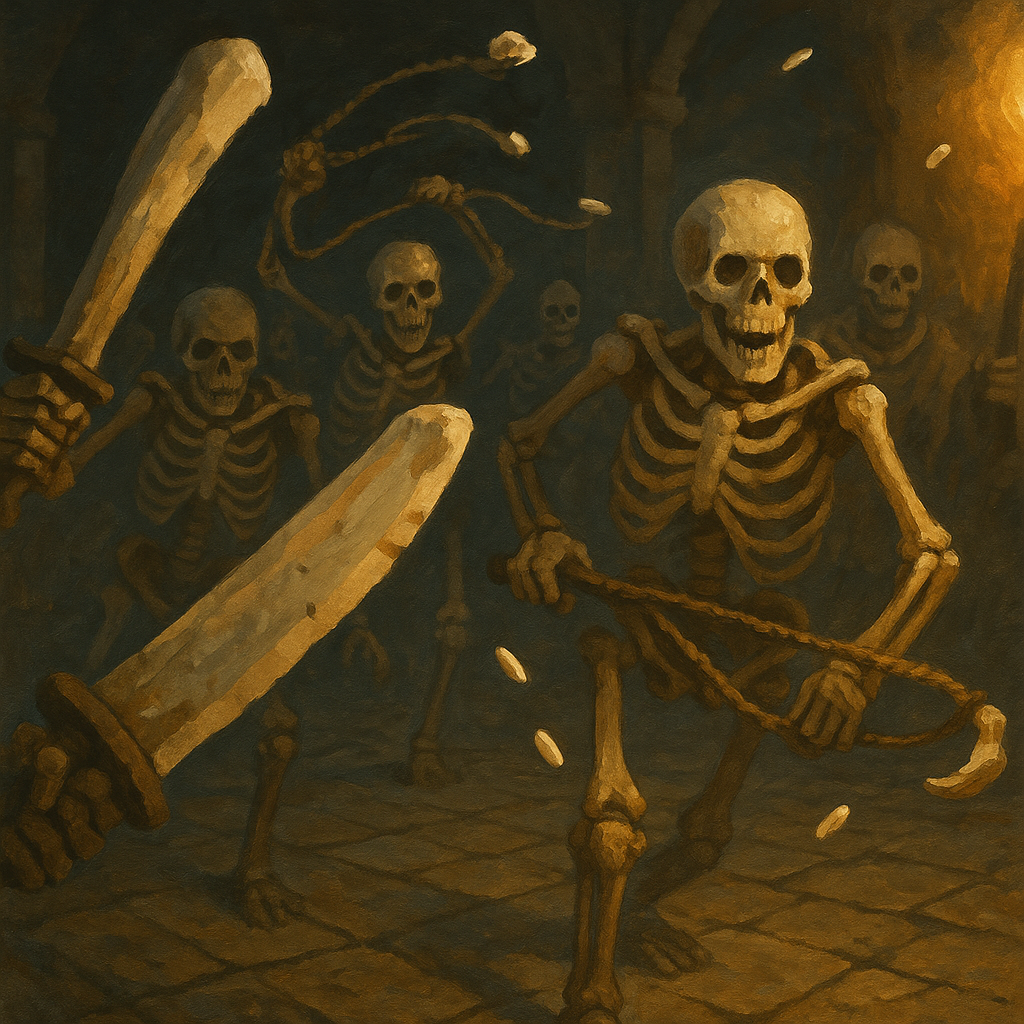
Not the orderly anonymous dead from the dormitories and corridors, but a dozen of the scattered workers of the second level, animated and assembled as if answering a long-forgotten roll call.
Their movements were jerky, unnatural… but purposeful. Silent.
And armed.
Improvised weapons bristled in their bony hands:
- Femurs sharpened to a single brutal edge, the greater trochanter used as a club-like pommel.
- Ulna and radius bones honed to narrow, wicked punch-daggers, perfect for stabbing upward.
- Makeshift slings spun from ancient sinew and tendon, loaded with loose phalanges that clicked against one another like teeth.
One by one, the skeletons turned their empty sockets up toward the platform.
And though they had no lungs, no faces, no flesh—they stared with unmistakable malice.
The moment Wolfgang whispered the final syllables of Zephyr Strike, the air around him shimmered—then he was gone, a blur of wind and motion. He hit the ladder, swung down its rungs like a falling leaf in a gale, and landed in the midst of the skeletal tide with a dwarf’s roar. His blade flashed once, twice—ribs cracked, vertebrae snapped, and two skeletons collapsed into rattling heaps.
Above, Ironbark and Gareth stood side by side at the top of the ladder, forming a narrow bulwark against anything that might reach the platform.
It wasn’t enough.
A sudden hiss-click of missiles came from below. A hail of phalanges, hurled with bone-sling force, clattered up the walls and rails and into Ironbark. The worst of the wounds was a single sharpened phalanx that struck him square in the temple with a sickening thunk.
His eyes went wide—then dark.
He toppled backward like a felled tree, hitting the floorboards with a heavy, awful finality.
“HOLD THE LINE!” Gareth bellowed, stepping over the monk’s fallen form.
Hunkle surged into the gap, whirling his warhammer with unexpected grace, batting aside clawed hands reaching up the ladder and twisting away from the steady rain of bone missiles from below.
But the numbers were against them.
Below, Wolfgang fought like a maddened storm—but even a storm can be surrounded.
Skeletons crashed into him from every side, striking and cutting until he fell to the ground, unconscious. Bony fingers seized his arms, his cloak, his ankles—dragging him backward inch by inch toward the darkness of the far corridor.
From above, Merrythought leaned out dangerously far, casting spells, trying to pick off skeletons without being dragged over herself. Each strike bought him seconds—but only seconds.
Shamus hit his knees beside Ironbark, gauntlets shaking as he pressed both hands to the druid’s forehead.
“Not yet,” he growled through clenched teeth. Lay on Hands flared to life, holy light searing the darkness. Ironbark jerked, gasped—and the terrible stillness broke.
But the skeletons were still climbing.
Still advancing.
Still endless.
And then—
Voices. Human and dwarven. Shouting. Close. Very close.
From beyond the skeletal mob came a sudden eruption of light—blue-white, crackling, a streak of arcane fury. It arced over Wolfgang’s prone form and blasted into a knot of skeletons, scattering them like bowling pins.
A voice rang out over the clatter:
“ARGENT COMPANY—FORM ON ME! CLEAR A PATH!”
Five silhouettes burst into view—steel flashing, spells flaring:
- A human knight in gleaming half-plate crashing through bones like a battering ram.
- A dwarven priest swinging a warhammer wreathed in silver fire.
- An armored paladin carving through skeletons with deadly concentration.
- A mage with eyes like stormclouds weaving bolts of force into precise, bone-shattering arcs.
- And a lithe rogue flipping over a tangle of skeletons to carve a path straight toward Wolfgang.
In moments, the swirling mass of undead was no longer overwhelming—it was being pushed back, crushed between the two parties like debris in a closing gate.
With a final cry, the rogue slashed the last skeletal hands clinging to Wolfgang and hauled him back.
“You folks looked like you could use a hand!” she grinned breathlessly.
And just like that—
The tide had turned.
The Argent Company had arrived.