October 15th, 973
It was early afternoon—somewhere comfortably between one and two o’clock—when our heroes reached the small farming village of Miley, home to the legendary Broken Handle Tavern – famed for being the place in town to get a drink, largely because it was the only place in town to get a drink.
Despite its convenient location just off the main road, the tavern looked as if it had quietly given up on life. The windows were smudged, the front door leaned at an angle suggesting long-term disapproval, and the sign depicting a cracked mug creaked mournfully in the breeze, as though confessing to past mistakes.
Inside, the party was met by Tilly Hopsworth, daughter of the tavern’s proprietor.
She was polite—heroically so—but her bloodshot eyes, pale complexion, and painful flinch at sudden movement suggested a hangover of mythic severity. And at this hour of the day, no less.
The heroes, who had seen worse and been worse, exchanged glances and took seats near the door. Their instinctive tactical survey revealed a simple layout: taproom to the side, kitchen in back, outhouses detectable by… unmistakable signs, and high ceilings with chandeliers hanging ten feet overhead like gently swaying fire hazards.
Everything seemed normal—except the patrons. They were slumped and glassy-eyed, the collective mood of people who were not merely drunk but existentially drunk. It was as though the entire room had been drinking itself steadily toward despair.
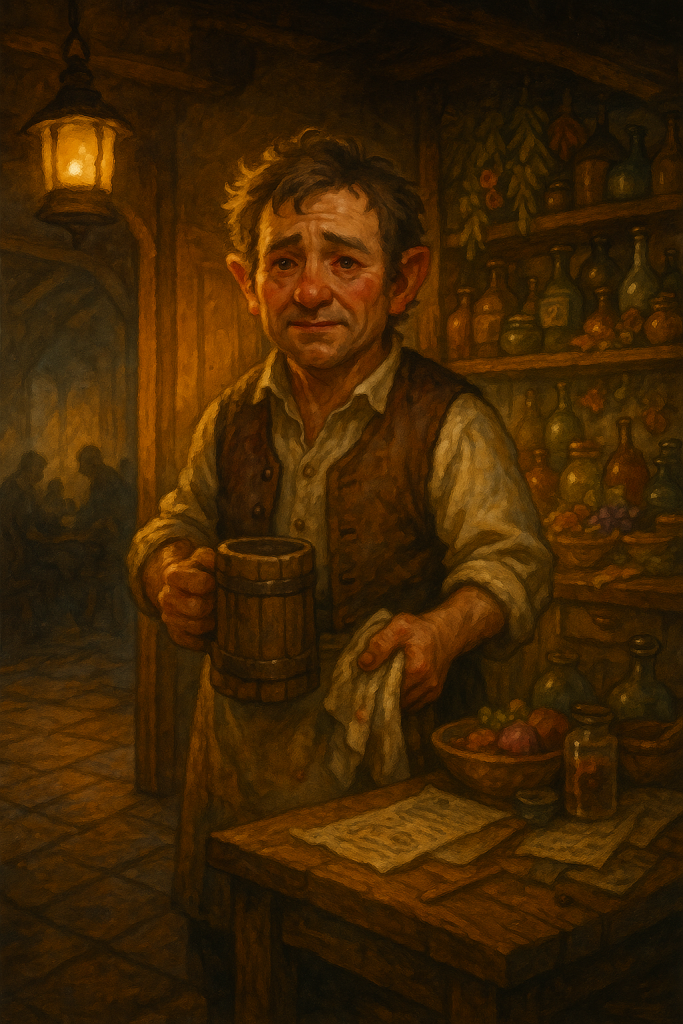
Tilly carried their orders to the back, and soon Finnan Hopsworth emerged. He looked just as worn as his daughter, but he still managed the cheerful greeting of a man who had been keeping a tavern alive through sheer force of habit.
The sight of another halfling brought immediate warmth: Finnan recognized Ant’s family name, revealing that he had once known Templeton Bramblebee. He spoke of one night when Templeton had predicted, with unsettling conviction, that, despite his best efforts to the contrary, Archea would destroy itself within a few generations—a statement Finnan now wondered might have had some magical backing.
The memory of Templeton’s end – hanging at the hands of the Crown – hung between them like a ghost. Finnan offered condolences with gentle tact, and Ant received them in kind.
“But what in the nine hells is going on here?”
Eventually, the party could stand it no longer. “What,” one of them asked plainly, “the hell is going on here?” That was all the invitation Finnan needed. The dam broke.
Three months ago, he said, the tavern had been “blessed”—and the despairing curl of his lip made clear what he meant—with the arrival of rum gremlins. They were small things, two or three feet tall, green-scaled, sharp-toothed, and possessed of the raw chaotic energy of drunken toddlers mixed with frat house mascots, poltergeists, and minor demons suffering major personal crises.
They stole liquor as fast as Finnan could pour it. They bullied staff and patrons alike, hurled insults at any moving target (and occasionally unmoving ones as well), smashed objects out of boredom, and took inexplicable joy in dumping drinks over people’s heads. Worst of all, their mere presence caused everyone nearby to become rapidly and unpleasantly drunk, bypassing all the cheerful middle stages and plunging straight into sullen nausea.
His employees had fled months ago. The tavern stayed alive purely because there was no competition in town. Violence hadn’t worked – an adventuring group who tried to drive the gremlins out early on had been thoroughly humiliated and chased off the property.
But there was hope.
Finnan had heard rumors of a clurichaun wandering the countryside—a fey creature distantly related to leprechauns, but with an infinitely greater devotion to drink and to the taverns that served it. Clurichauns hated rum gremlins on principle. They were known to adopt taverns, provided they were offered enough alcohol and a sense of belonging, and once settled, they protected the place with fierce, joyful loyalty.
If the wandering clurichaun could be enticed to make The Broken Handle his home, the gremlins would be driven out, the tavern restored, and the town’s spirits—literal and metaphorical—lifted.
Finnan had even collected exotic ingredients in hopes of mixing a unique drink to win such a creature’s heart. Unfortunately, he had no way to leave the tavern to search for the fey in person.
He offered the party 200 gp to take up the quest. The heroes, never ones to refuse a sob story – or gold, for that matter – agreed at once.
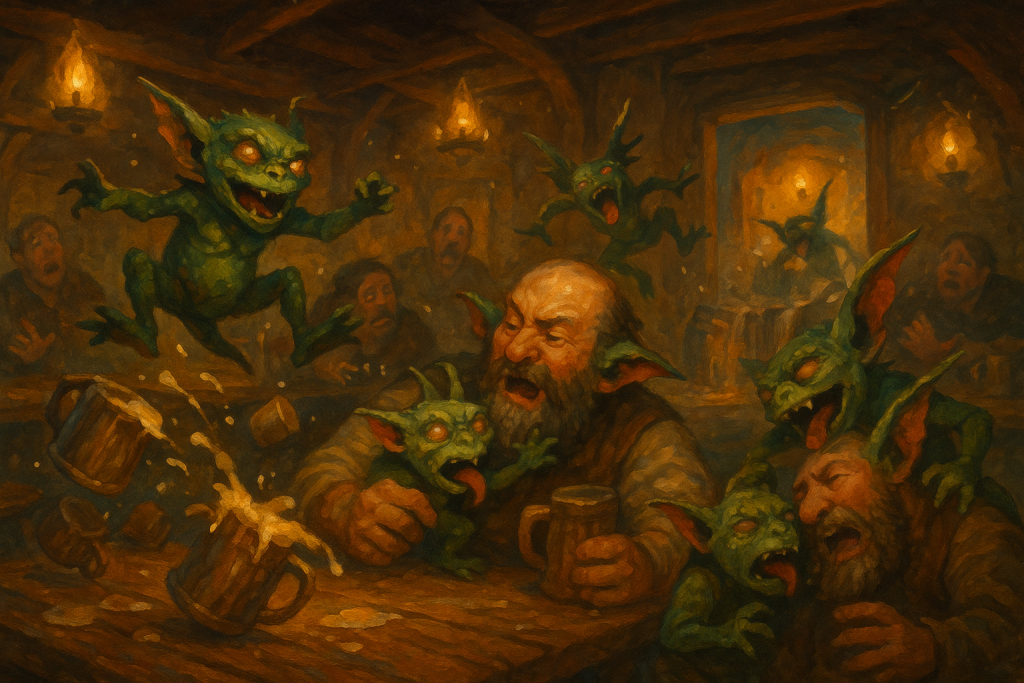
Naturally, this was the precise moment the rum gremlins made their entrance. Five of them seemingly appeared in the middle of the tavern like a troupe of drunken circus performers and three immediately began swaggering among the patrons, snatching mugs, pushing people off benches, and shouting insults,
- “You smell like unwiped human!”
- “Your face called! It wants a refund!”
- “Hey dipbucket! Your shoelaces are tied together. AGAIN!”
- “Nice beard! Shame you’re a woman… wait, what?”
- “Oh wow, your pores are huge. I could hide in there!”
- “Did you order that outfit from the lost-and-found?”
Meanwhile, the other two barreled into the taproom, ripped the taps clean off two kegs, and lay beneath the rushing streams of rum like toddlers under a cascading fountain of chocolate syrup.
Somehow, they all also found the breath to sing a drunken song,
“Do your balls hang low?
Do they waddle to and fro?
Can you tie them in a knot?
Can you tie them in a bow?
Can you sling them over your shoulder,
Like a Continental soldier?
Do your balls hang low?”
As the rest of the party gaped in horror, Wolfgang worked his way out of the back door and back around to the front of the building, seeking to surprise the two gremlins in the tap room.
The rest of the heroes confronted the trio in the main hall and demanded they leave the patrons alone. This, naturally, only made the gremlins turn their attention fully toward them. Finnan and Tilly seized the opportunity to shuffle their stupefied customers toward the side door, though “shuffle” was generous—herding that many drunken villagers was more akin to slowly relocating sacks of potatoes that occasionally groaned in complaint.
The gremlins jeered, postured, and began to threaten the party. Laveleen, recalling her earlier performance with the Argent Company, responded with a swift Eldritch Blast, officially opening hostilities.
Outside, Wolfgang reached the taproom door, found it locked, pounded on it, and taunted the gremlins within. Their response was immediate and enthusiastic: the door flew open, claws and teeth lashed out, and suddenly the fight was on—Wolfgang, his newly adopted wolf companion, and two furious rum gremlins tangled in a melee of slashing claws, drunken shrieks, and lupine indignation.
Inside, the remaining heroes discovered—much to their disgust—that rum gremlins were far more dangerous than their size suggested: magically slippery, resistant to spells, irritatingly hard to hit, and absolutely relentless with their insults.
The room filled with the sound of tiny, drunken voices shouting things like:
- “HA! I GOT YOU! YOU GOT GOT!”
- “Quit blocking these shots with your FACE!”
- “UNHITTABLE! UNTOUCHABLE! UNEMPLOYABLE!”
- “Swing and a miss! Try using the pointy end next time!”
The heroes, not for the first and surely not for the last time, realized they might be in for a very long afternoon.
Eventually the ones in the main room, battered but resolute, gained the upper hand through equal measures of experience, stubbornness, and sheer numerical advantage.
One gremlin, still bellowing insults through a split lip, was silenced by Shamus, whose Smiting Strike carved through the creature from right clavicle to left pelvis in a brilliant arc of light and righteous fury. Another met its end at the hands of Hunkle, who administered a beating with such methodical precision that even the gremlin seemed briefly impressed before collapsing.
Their victory could not have come a moment later.
Outside, both Wolfgang and his newly acquired wolf companion had fallen beneath the claws and teeth of the two gremlins in the taproom. Their bodies lay in a heap near the doorway, slick with spilled rum and gremlin bile. Wolfgang still breathed—barely—but the wolf was unmistakably gone.
A hurried Healing Word from Merrythought dragged Wolfgang back from the precipice, and reunited once more, the party overwhelmed the last of the rum gremlins. Unfortunately, no amount of magic could undo what had happened to the wolf. The party carried the creature out behind the tavern and laid it gently beneath a sturdy elm tree. The ground there looked as if it had seen burials before; perhaps it would see many more.
Finnan and Tilly, still helping the last of the sluggish patrons stumble home, paused to thank the heroes with quiet sincerity. These gremlins were slain but more remained. Yet now, at least, there was hope.
The party took an hour to rest—to bandage wounds, catch their breath, and give Wolfgang a moment of private grief. Tilly brought out what little food they could spare, and Finnan offered a few stiff drinks that, thankfully, did not appear to be gremlin-tainted.
Wolfgang wanted to cut the gremlin heads off and mount them on poles in front of the tavern but the Hopsyards were afraid that this would prompt more violence. The rest of the party talked Wolfgang down, reminding him that this almost certainly would be a violation of the local zoning ordinances. Grumpily, he took the ears of the gremlins and made a necklace of them instead.
By late afternoon, with the sun lowering over the fields, the heroes set off down the southern road in search of the clurichaun believed to be wandering the countryside. Their first lead was the Vargas ranch, a half-day’s walk across gently rolling farmland.
The ranch came into view just as the last chores were being wrapped up for the evening. Weathered fences traced the property lines like lines in an old farmer’s palm. Horses snorted and pawed at the dust in their pens, while a windmill turned lazily above them, its creaking vanes marking the slow rhythm of rural life.
On the porch sat Gizi Vargas, the family matriarch. She was a wiry woman with sun-browned skin, muscles hardened by decades of honest work, gray-streaked hair braided down her back, and a wide sombrero tilted to shield her eyes from the dying sun. Her sharp gaze took in the adventurers with polite wariness. Two hired hands were still putting things to rights—coiling ropes, securing feed bins, leading the last horses in from pasture. The rest of the Vargas family, Gizi explained, was away on a sales trip.
She listened as the heroes introduced themselves and explained their purpose, tapping one boot absently against the porch planks. Travelers so far from the main road generally came with one of two things—questions or trouble—and she was trying to gauge which sort this company represented.
When they finally mentioned the reason for their visit—a fey creature with a drinking habit and a tendency to wander from homestead to homestead like a one-man disaster—Gizi’s stern face cracked into an expression halfway between amusement and exasperation.
“Well now,” she said, “sounds like you’re lookin’ for Oban Bryne.”
According to Gizi, Oban was not necessarily a bad sort. In fact, under the right circumstances—usually when sleeping—he could be downright pleasant. But in her view, and in the view of many families before hers, Oban carried a tragedy with him that no amount of drink had ever quite drowned. Whatever had happened to him, it had left him wandering the land, drifting from stead to stead like a storm cloud looking for a roof to thunder under.
Alcohol dulled the edge of his grief, but not his personality. When drunk—and he was nearly always drunk—Oban became:
- loudly sentimental,
- aggressively opinionated about livestock,
- prone to shouting unsolicited advice,
- and capable of keeping an entire household awake until well past dawn.
“Now, the worst thing about him,” Gizi added, “isn’t even the drinking. It’s that he’s a damn obnoxious drunk. He’ll talk your ear clean off—your horse’s ear, too—then cry about somethin’ you didn’t hear right, then try to fix your roof while fallin’ through it. He means well. The problem is that well-meaning fools tend to cause twice as much trouble.”
He would settle at a ranch or homestead for a few weeks, resist every attempt to move him along, and then—just when everyone had resigned themselves to lifelong fey torment—he would pack himself up and wander to the next place without explanation.
One family insisted they drove him off using a ritual involving an onion, an old sock, and a sunset incantation. The Vargas family had tried the very same ritual when Oban came to their property.
“It did,” Gizi said dryly, “absolutely nothin’. Except annoy him. And an annoyed clurichaun is somethin’ the gods invented to test mortal patience.”
She and her people quickly learned what every household eventually discovered – always leave alcohol out for the clurichaun at night.
Any variety would do—ale, rum, wine, mead, vinegar that used to be wine, paint thinner one regrettable uncle tried once. Oban lacked discrimination.
He would drink it, make a spectacular ruckus—stomping on roofs, singing mournful love songs to inanimate objects, giving shouted lectures to fence posts—then finally collapse into a heap and allow the rest of the ranch, humans and animals alike, to sleep for a few hours.
If he was not provided alcohol, however, he would throw what Gizi described as a “twenty-four hour epic shitfit.”
When pressed for clarification, she only said, “You’ll know it if you ever see it, and trust me, you don’t want to.”
When the heroes explained their plan—to mix the finest drink ever crafted in hopes of enticing Oban Bryne to settle at The Broken Handle—Gizi surprised them with a heartfelt, almost relieved laugh.
“Well, bless your souls,” she said. “If anyone deserves a second chance at life, it’s that fool. And if anyone deserves a break from him, it’s the rest of us.”
She couldn’t offer clues about his exact tastes; Oban drank everything with equal enthusiasm and lamentation. But she wished them luck with unmistakable sincerity and offered the use of her barn for the night.
“It’s clean enough,” she said. “Just mind the chickens. They’re nervous on account of Oban tryin’ to teach ’em how to dance last month.”
And with that, the heroes prepared for the next step of their quest—to track down a clurichaun with a broken heart, a legendary thirst, and a destiny waiting for him at a beleaguered little tavern called The Broken Handle.
The party slept in the barn that night—if “slept” is the right word for what followed. Gizi Vargas had not exaggerated. In the middle of the night, the silence of the ranch was shattered by the unmistakable sound of a drunk fey taking livestock to task.
Somewhere near the chicken coop, a slurred voice bellowed, “You can’t judge me!! You don’t even know me!! You don’t know what I’ve BEEN THROUGH!”
There came a crash, a flurry of grunts and soon after the heroes stumbled outside and found Oban Bryne riding a goat, wearing a battered vest, a wine-stained scarf, and the philosophical expression of someone who had absolutely no idea why the goat was taking this so badly.
His hair—what little of it he had—stuck up at odd angles. His nose was gloriously red. His eyes shimmered with that unmistakable combination of ancient wisdom and catastrophic hangover.
It took considerable effort but eventually they managed to hold his attention long enough to explain their mission.
They spoke of The Broken Handle, of the gremlins plaguing it, and of the one thing that might convince him to adopt a tavern as his home once more a drink so extraordinary he had never tasted its like.
Oban blinked at them slowly.
“A drink I have never tasted,” he murmured. “My friends… I have lived three hundred years. I have tasted everything. Including a few things I regret deeply.”
But when the party insisted they wished to craft something new—something unique, something worthy—Oban clapped his hands together with inebriated delight.
“Very well! Amaze me.
Astonish me.
Make me feel again.”
The challenge was accepted. Oban sat in the barn, nestled with two chickens whom he promptly named his “best friends Henrietta and Wanda” despite no evidence whatsoever that these chickens had ever heard these names in the past.
The heroes launched into their first attempt with gusto… and, perhaps, a slight lapse in judgment.
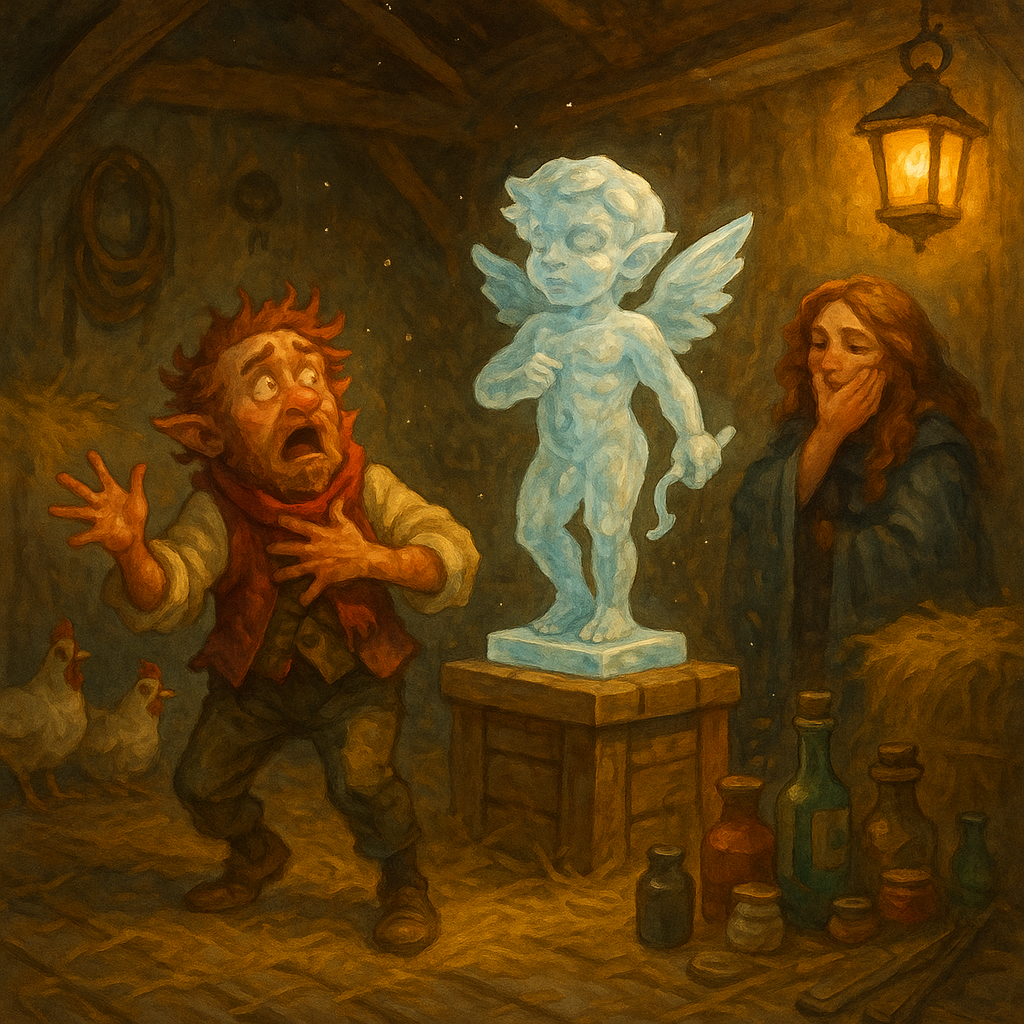
Cassyndra stepped forward and, with a flourish, used Shape Water to create a hollow block of ice sculpted into a perfect cherubic Cupid—complete with improbably lifelike and meticulously detailed genitalia.
Oban stared, mouth open, face slack, as the party completed the presentation with magical illusions: fluttering hearts, pink light, a soft cooing sound from Laveleen’s thaumaturgy, and a glittering halo conjured by Ant.
“It’s called,” Cassyndra announced, “Cupid’s Piss. Like Cupid’s Kiss… but different.”
Oban gazed at the sculpture in silence for a long moment before saying, in a tone of grave respect, “You absolute lunatics.”
But when Cassyndra tipped the vessel toward him, he recoiled with a gasp.
“Oh—no. No, no, no, I am not drinking directly from his— From that. Pour it into a glass. I may be a drunk, but I am not a degenerate.”
Once the drink was decanted, he swirled it, sniffed it, sipped it… and frowned thoughtfully.
“Hmm… points for innovation, certainly. The finish is terribly shy. Not… bad. Not good either. Very… experimental.”
The party’s collective expression suggested they took “experimental” personally.
But Oban wagged a finger, smiling generously.
“I’ll allow a second attempt. Creativity deserves encouragement.”
The next concoction was a collaboration of all their strengths—artistry, magic, intuition, and the sort of desperate determination that only appears when faced with a fey whose help you absolutely need.
When they presented it, Oban took the glass with ceremonial reverence. He sniffed. He sipped. And then he froze.
His eyes widened. His hair crackled with faint, rising static. The air hummed. He whispered,
“You have… astonished me.”
Slowly, he lowered the glass and looked at them with something like wonder.
“You brought this for me.
You made this for me.
Travelers rarely give gifts without strings…
but you—you bring generosity. Creativity. Passion.”
He took another sip, and this time tears gathered at the edges of his eyes.
“Magnificent,” he whispered. “A work of art.”
He closed his eyes and concentrated like a sommelier divining the future from fermented grapes.
“I taste… courage. Winter sunlight. Notes of wistful regret. And a mischievous afterthought that dances on the tongue.”
“I taste wanderlust. Hope. A hint of rebellion. You magnificent creatures!”
He lowered the glass again and stood straighter than he had in years.
“You have reminded me of joy.”
And with that, Oban Bryne—former guardian of better taverns, veteran of forgotten heartbreak, drunk oracle of rural Cambria—gave a deep, formal bow that somehow still managed to wobble at the end.
“I shall follow you anywhere. Take me to this Broken Handle. We will drive out your gremlins. And together with the proprietors there, I shall build a tavern worthy of legend.”
It was the first time in decades that his voice held purpose. The first time he had looked truly alive.
And so, with Oban Bryne in tow, the heroes began their journey back to Miley— armed with hope, renewed purpose, and one very enthusiastic clurichaun who could not wait to make a tavern whole again.