Excerpt From a Recent Edition of The Royal Standard
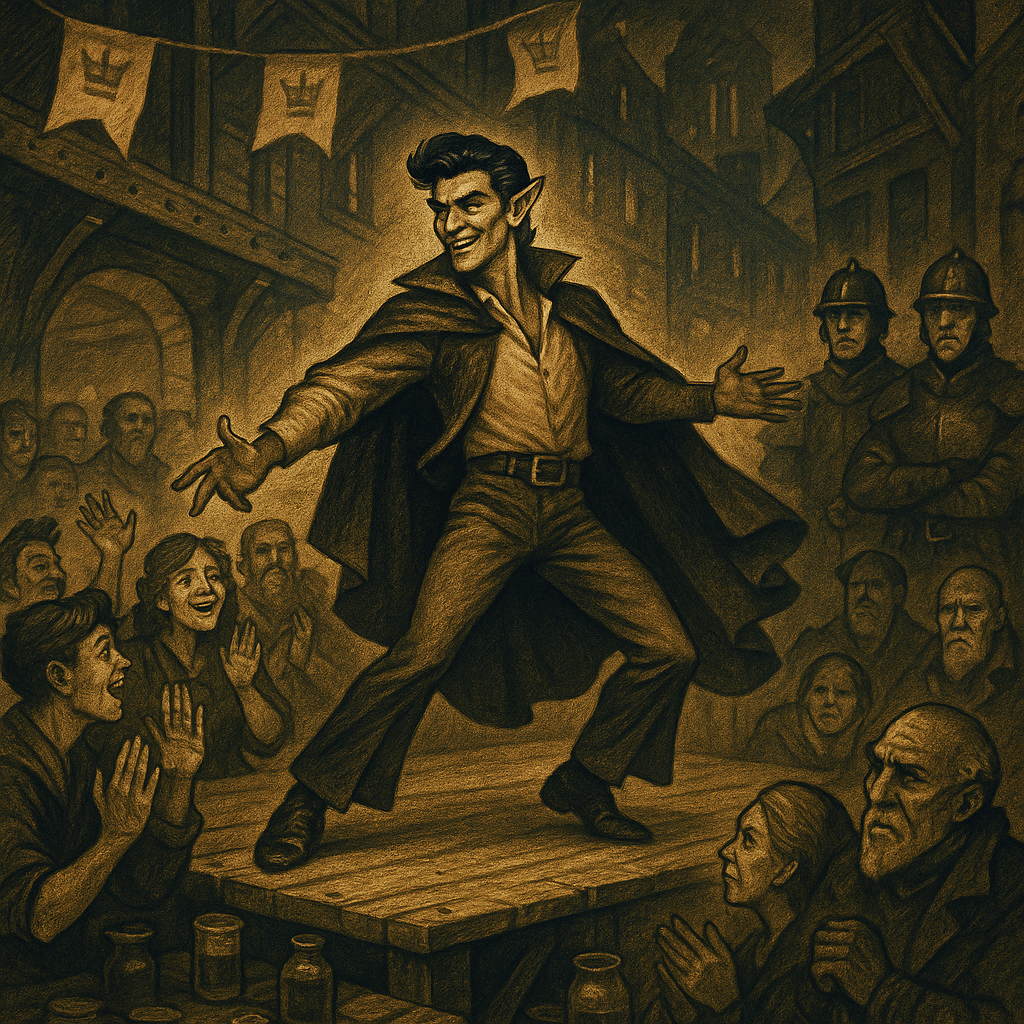
A Most Wholesome Phenomenon in Copperside – On Mr. Elvys Pressley, His Unusually Agile Hips, and the Sudden Rise of Licensed Joy
By Mr. Pfinder, Special Observer of Public Sentiment, for The Royal Standard
It has been observed—by those of us who bravely keep our eyes upon the streets—that Manchester, despite her many virtues, is not a city prone to frivolity. We are, by temperament and by prudent instruction, a people of industry. We rise, we labor, we cough politely into our sleeves, and we express our delight in measured quantities, as befits citizens of a stable realm.
And yet.
And yet.
Something has happened.
It began, I am told, as these things always do: with a voice in a low-ceilinged alehouse, a cheap stage, and a crowd of young adults behaving as though they had discovered—quite suddenly—that their bones belonged to them.
The voice belongs to Mr. Elvys Pressley, a dark-eyed half-elf with a lacquered grin, a mane of black hair styled as if gravity were merely a rumor, and a wardrobe that looks as though a tailor fought a duel with a curtain and the curtain lost. He has taken Manchester by storm in the precise way a storm would prefer to be taken: loudly, rhythmically, and with the unmistakable implication that tomorrow may do what it likes, but tonight belongs to the living.
The elders, of course, are appalled—many of them on principle, some of them on reflex, and a few of them because they have not forgiven their own youth for being stolen by duty.
One matron of admirable moral posture informed me, “He makes the young ones wiggle. WIGGLE.” She pronounced the final word as if it were a contagious illness. “If the Crown wished us to wiggle, it would have issued a pamphlet.”
A more generous gentleman—an elderly cooper who claimed he had “seen fads come and go like toothaches”—conceded, after a long pause, that the boy could sing. “But then,” he added darkly, “he does… that thing. With the pelvis.”
It must be said: the pelvis does indeed occur.
At Pressley’s most recent performance (held at a venue of modest structural integrity and excellent stew), young people packed shoulder-to-shoulder, their faces lit with the dangerous glow of unregulated delight. They clapped. They shrieked. They sang along. They behaved—if one can believe it—as though their lives contained more than work and weather.
And Mr. Pressley, smiling as if he had personally invented joy, launched into his newest hit: a spirited number concerning a person of questionable loyalty and a dog of questionable species.
I am permitted, by the strictures of print decorum, to reproduce only a brief excerpt. The refrain, as bellowed with alarming enthusiasm by several dozen adolescents who will one day, I presume, become taxpayers, goes something like:
“You ain’t nothing but a kennel-mutt, prowlin’ ’round my door…”
The remainder was, regrettably, catchy.
It is not merely that his melodies are infectious. It is that Pressley performs with a kind of theatrical conviction that suggests he is not singing at the audience, but for them—as though he has arrived bearing a message from some distant, less exhausted version of the world: that it is permissible to feel alive without first filing a request.
Naturally, the Civil Guard has taken a professional interest in the matter, and I offer my sincere thanks to the officers who have attended these performances with commendable vigilance. Their presence provides a reassuring reminder that joy, like fire, is safest when observed.
A junior Guardsman—whose name I will not print, as he blushed when I asked—confided, “He’s not… dangerous, sir. Not like riots. It’s just singing.”
Then, after a beat: “But my sister won’t stop talking about him, and my mother said if he swivels like that again she’ll write to the Ministry.”
Progress takes many forms.
Now: it would be irresponsible not to acknowledge the controversy. There are rumors, of course. There always are. That Pressley’s voice is magically enhanced (it is not; I stood close enough to be deafened honestly). That he has a patron (I have heard worse theories, many of them printed in competing papers). That his hair is a curse or a blessing or a private agreement with a demon of pomade. That his hips are, in fact, a weapon.
Let the record show: no hips have yet been convicted in a court of law.
Still, walking home after the performance, I found myself with a peculiar sensation—one I hesitate to name, for naming things gives them power, and certain institutions prefer that power remain properly allocated.
The sensation was this: that Mr. Elvys Pressley is going to matter.
Not merely as a performer. Not merely as a fashion catastrophe. Not merely as a civic irritant to stern uncles everywhere.
Matter… as though he were a nail in a beam, a rivet in a bridge, a small shining fastener holding something far larger together while everyone argues about the paint.
It is not uncommon, in Manchester, for a man of sudden fame to attract sudden enemies. One thinks of Mr. “Cut-Me-Own-Throat” Dibbler—an individual who, through no fault of the Crown, has found himself entangled in the machinery of public consequence. One thinks of Governor Kanwal—whose leisure has become, in its own way, a kind of public spectacle. And now one thinks of Pressley, whose rise is so swift and so loud that even those who pretend not to notice him nevertheless find themselves humming.
Such figures—unwanted, undeniable, strangely connective—have a habit of drawing attention from… organizations.
I will not speculate irresponsibly. That is the privilege of less reputable papers.
I will simply say: the air around Pressley feels charged, as if the city itself has leaned closer to listen. And in a world where listening too closely sometimes invites things that whisper back, it would be wise for Manchester to keep its doors locked, its candles lit, and its admiration—like its love—carefully monitored.
In the meantime, young adults continue to flock to his shows. Old adults continue to disapprove. Merchants continue to sell imitation cloaks. Tailors continue to mutter about “ruinous lapels.” The city continues, as it always has, to work itself sick and then seek relief in whatever form it can find.
If Mr. Pressley can provide that relief—within the bounds of decency, law, and a pelvis that knows its place—then perhaps his presence is not a threat at all, but a small mercy.
And if he is destined to make a splash in everyone’s lives soon…
Well.
Manchester has weathered storms before.
But I have noticed, with some concern, that when certain songs begin, the world itself seems to keep time.