November 1st, 973
Reaching Out to Old Friends
Laveleen’s pseudodragon circled once overhead, a quick flash of iridescent wings against the pale sky. It gave the party one last appraising look, let out a sound that might have been farewell or might have been judgment, and then turned south, winging off toward Pfinder in Manchester with its message and whatever opinions it had formed along the way.
The road was quiet for a time.
It did not stay that way.
Soon enough, the question arose: what, exactly, should one name a pseudodragon?
Wolfgang Spicebeard was the first to speak, suggesting something hearty and dignified—“Emberbrew,” perhaps, or “Cindersnout.” This was rejected almost immediately by Cassyndra, who pointed out that neither fire nor snouts were among the creature’s defining characteristics.
Hunkle proposed “Wingnut,” on the grounds that it was short, memorable, and accurate. Laveleen responded with a look that could have curdled milk, and the suggestion was withdrawn.
Merrythought, after some consideration, offered “Sir Pseudington the Third,” which she insisted had a proud, aristocratic ring to it. Ant vetoed this on the basis that naming a magical familiar like a minor noble was “tempting fate in several jurisdictions.”
Shamus suggested something simple and reverent—“Watcher,” or perhaps “Sentinel.” Gareth Alven nodded thoughtfully at this, but Laveleen hesitated, clearly unconvinced that her familiar should sound like a stationary piece of architecture.
Then Ant, with entirely too much innocence, suggested “Laveleen Junior.”
There was a long pause.
Laveleen informed Ant, in no uncertain terms, that if her familiar ever bore that name, Ant would be personally responsible for explaining it to the pseudodragon.
The debate grew warmer, louder, and increasingly theatrical as the party descended the ridge en route to the Adventurer’s Guild in Bastionstead. Arguments were raised. Counterarguments followed. At least one proposed name was rejected on moral grounds, and another on the basis that it would “absolutely get someone killed.”
The discussion was still unresolved when the town came into view—a cluster of stone buildings, low walls, and the looming presence of the prison beyond. As the party drew close enough that townsfolk might reasonably overhear them, discretion finally prevailed.
The matter was tabled. Temporarily.
The pseudodragon’s name remained undecided.
The Adventurer’s Guild
The Bastionstead Adventurer’s Guild outpost was a squat stone building with a reinforced door and a weathered sign bearing the familiar sigil. It lacked the bustle and bravado of larger Guild halls; this one felt more like an office that had learned not to expect excitement.
Inside, the air smelled faintly of old paper, leather oil, and tea left too long to cool.
Behind the counter stood a man in his late fifties or early sixties. His hair was graying, his clothes practical, and his posture relaxed in the way of someone who knew exactly where everything was and how quickly it could all go wrong.
He looked up as the party entered.
“Morning. Harlan Vetch,” he said calmly. “Guild business?”
As it happened, he was the only Guild representative in Bastionstead.
As Harlan helped the party resupply—measuring armor straps, checking fittings, laying out gear with practiced efficiency—he listened more than he spoke. His eyes tracked movement. Nothing about the group seemed to surprise him.
While Wolfgang and Gareth discussed rations, Cassyndra casually mentioned that they weren’t from the area.
Ant followed that up, glancing around the modest hall. “No offense,” she said, “but this doesn’t exactly strike me as a bustling hub of adventuring.”
Shamus, more direct, added, “And why put a Guild outpost next to a prison?”
Harlan paused, hands resting on a half-fastened buckle.
“There’s always been a village here,” he said at last. “Used to be called Waymere.”
He resumed his work as he spoke.
“This land’s full of caves. Some natural—ancient passages carved by water and time. Others not quite as old. Pre-Orcish, from what scholars can tell. Whoever those folk were, they had villages here and expanded the caves to suit themselves. Eventually they faded away, and then the Orcs came.”
He glanced up briefly, gauging reactions.
“They built a city. Turned it into a fortress during the Righteous War. Expanded the caves—supply routes, storage, fallback positions. When they fell, the city was torn down. Anything useful went south to Manchester and to other human cities. The rest was dumped back over the ruins.”
Merrythought asked what happened after that.
“A small Archean village cropped up,” Harlan continued. “Maybe a hundred people. Caravan waypoint, mostly. Traders heading north toward Devon needed a place to rest.”
He gave a faint shrug.
“Adventurers came through, too. Monsters in the caves meant bounties. Old tunnels meant buried junk people liked to call treasure. Some came to smuggle. Others came to prey on smugglers. Every few years, someone decided there had to be a fabulous ancient hoard down there somewhere.”
The corner of his mouth twitched.
“No one ever found anything like that, though.”
Gareth gestured vaguely toward the prison looming outside. “And that?”
“That came later,” Harlan said. “Crown decided this was the right spot for a new facility. Cheap land. Natural defenses. They folded some of the old passages right into the design. The village grew to support the laborers, then the guards, then the clerks.”
He finished adjusting a piece of armor and finally looked up properly.
“They renamed the place Bastionstead. Out of pride.”
There was a brief silence.
Harlan studied the party for a moment longer, then asked evenly, “You looking for work?”
Wolfgang answered yes before anyone else could object, nodding once as if the matter were settled for everyone.
Harlan did not object.
The Offer
He hesitated, just briefly.
Then he gestured toward a side door.
“My office,” he said. “This isn’t for the counter.”
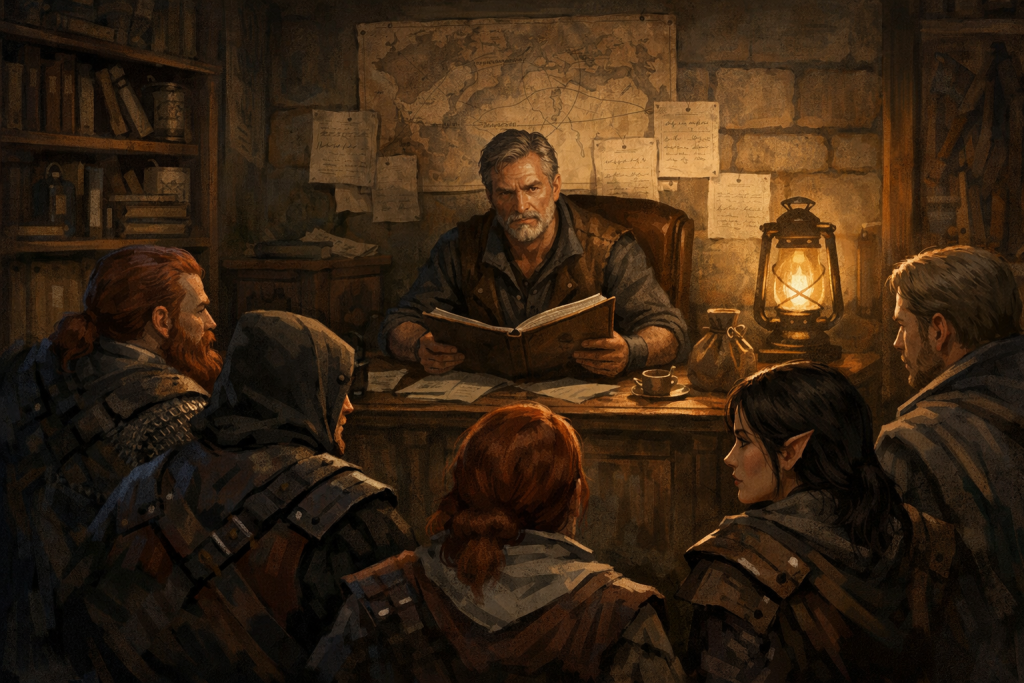
The room beyond was small but orderly. Ledgers were stacked neatly. Maps were pinned and annotated. There was no clutter. The door closed behind the party with a soft, deliberate click.
“This job,” Harlan said, settling behind his desk, “isn’t meant for Level One members.”
He let that sit.
“Someone slipped me a bribe to make sure this job got taken as soon as possible. It’s large enough for me to bend the rules.”
He folded his hands.
“The prison is still surveying all the cave entrances in the area to understand the underground passages. It’s slow work because of all the cave-ins and dead ends down there. The only way to be sure nothing leads into the prison grounds is for every known entrance to be thoroughly mapped.”
He pulled a thin folder from a drawer.
“A Crown-contracted survey team called the Plumbline Four was handling part of it. Edrin Hale led them—cartographer. Maris Quell handled structural assessments. Tovan Ise was their natural philosopher. Rhea Calder kept the records.”
He opened the folder.
“They went into a cave on the twenty-fifth. Came out on the twenty-sixth. Filed their report. On the twenty-eighth, they were ordered back in—this time with an army patrol.”
Someone asked what they had been sent back for.
Harlan shook his head.
“They said they weren’t allowed to discuss it. Expected to be back the same day.”
He closed the folder.
“They weren’t.”
A beat.
“On the thirtieth, an anonymous party brought a contract in. They’re offering two hundred gold to find out what happened. Two hundred for every live surveyor brought back. Fifty for each deceased. Plus a little something extra for me to get it staffed as soon as possible.”
Harlan looked at each of them in turn.
“Now,” he said quietly, “What questions do you have for me?”