November 1st, 973
Questions, Answers, and the Shape of a Patron
Gareth and Laveleen were left at the campsite on the ridge with explicit instructions to keep the rum gremlins in a state of just enough drunkenness to keep them safe and contained. Somewhat alarmingly, the party was getting to know this level quite well.
The rest headed into town and made their way to the Adventurer’s Guild, where Harlan Vetch finished laying out the job and asked, evenly, “So. What questions do you have for me?”
For a moment, no one spoke.
Then the questions came—carefully.
The party’s first concern was not the missing surveyors themselves, but the hand that had paid to have them found. An anonymous patron, a bent Guild rule, and a prison bristling with Crown authority made for an uncomfortable triangle.
Harlan Vetch listened without interruption, fingers steepled, eyes thoughtful.
“No,” he said at last, shaking his head once. “This isn’t the Crown. And it isn’t anyone acting on their behalf.”
Crown contracts, he explained, were never coy. When the Crown wanted something done, its seal sat squarely atop the page, its authority plain and unavoidable. There was no need for intermediaries, secrecy, or quiet inducements. Even when discretion was required, the Crown was not shy about being the one requesting it.
“This job,” Vetch continued, tapping the folder lightly, “was posted like someone didn’t want to be seen asking for it. That alone rules out the Crown. In fact, it reads like someone who doesn’t want anyone to know they’re meddling in Crown business at all.”
The structure of the payment told its own story. Two hundred gold for answers. Two hundred more for each surveyor returned alive. A lesser sum for their bodies.
Nothing for soldiers.
“Whoever paid for this,” Vetch said, “cares about the surveyors. Or at least about what the surveyors know.”
Merrythought leaned back, considering. “So various people think the surveyors found something,” she said. “Someone in the Army thought it was important enough to send soldiers back in. And our mysterious patron thinks it’s important enough to spend up to a thousand gold finding out what it was.”
Vetch gave a thin smile. “That would be my read.”
She nodded, satisfied enough. “Sounds like they might be an enemy—more or less—of my enemy,” she said lightly. “Which could make them my friend. Or at least useful.”
That framing seemed to ease the room. The party’s earlier suspicion softened further as they recalled the Adventurer’s Guild’s long-standing and loudly advertised policy: Guild business stayed Guild business. The Guild did not turn adventurers over to law enforcement, magistrates, or Crown inquisitors—no matter how uncomfortable the questions became afterward. Seen through that lens, Vetch’s refusal to betray his patron’s confidence felt less like menace and more like professionalism.
Pressed about the surveyors themselves, Vetch could offer only what was already public. Their mandate had been straightforward: map the caves surrounding the Northmarch site to identify any subterranean routes that might threaten the prison’s security. The work was slow, methodical, and dangerous in the quiet way such things often were.
What they had discovered on their last descent—and why the Crown had chosen to send them back in with an armed escort—Vetch did not know.
“I wasn’t told,” he said simply. “And they weren’t allowed to say.”
He did, however, suggest a direction for those inclined to listen where official reports ended.
“The Nymph’s Kiss,” he said. “Local tavern. Guards drink there. Soldiers too—when they’re off shift and pretending they aren’t soldiers. If anyone’s heard something they weren’t supposed to repeat, that’s where it’ll surface.”
As the discussion wound down, Merrythought mentioned, almost offhandedly, their last venture underground—a tale involving ancient puzzles, previously unknown creatures, and a rival adventuring party whose ambitions had far outpaced their good sense.
Vetch winced.
“Yes,” he said dryly. “That would be about when I decided I preferred ledgers to tunnels.”
He closed the folder, slid it back into the drawer, and looked at them steadily.
“The offer stands,” he said. “If you take it, you’ll be paid. If you walk away, someone else will go in after them.”
The party snapped it up.
After all, it was a chance to be heroes, earn some money, and quietly probe the weaknesses of a major Crown installation.
Which of them, really, could pass that up?
The Nymph’s Kiss
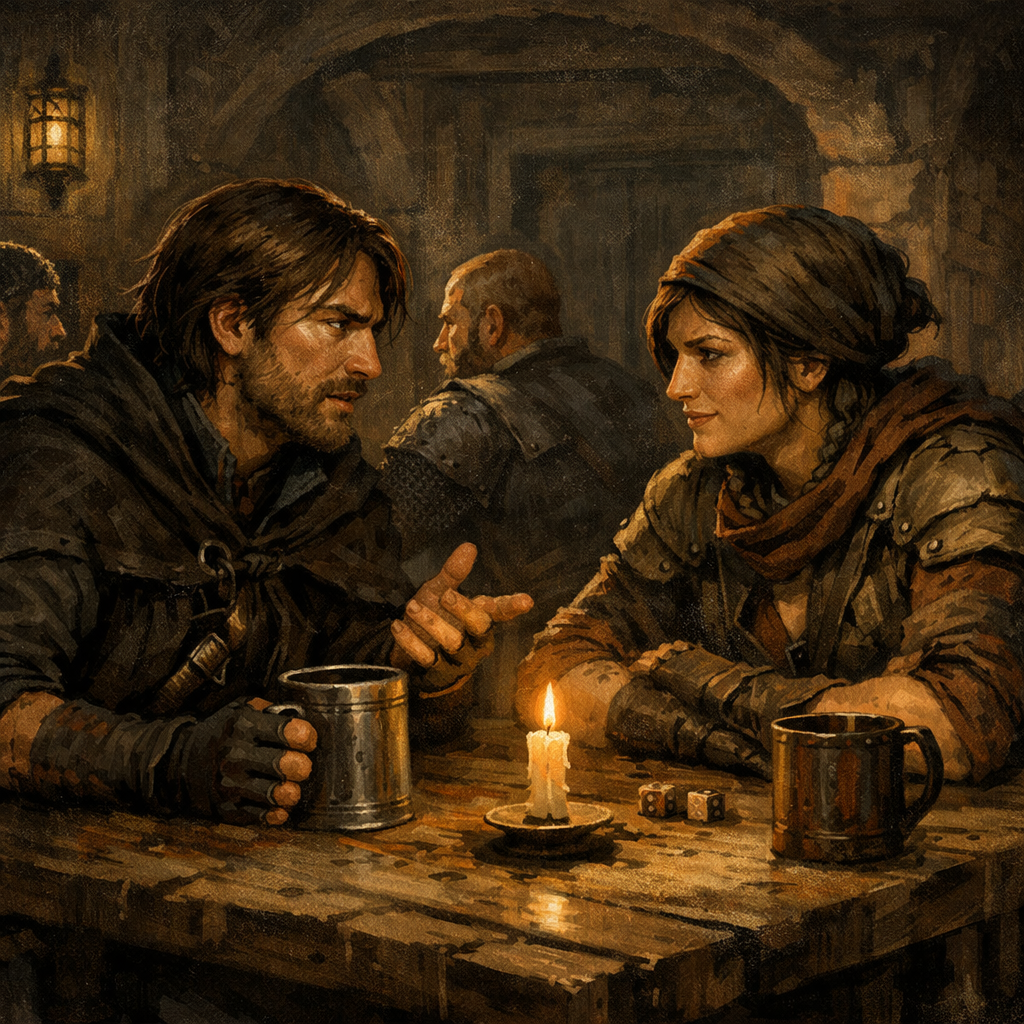
The Nymph’s Kiss served Bastionstead as its only tavern, inn, brothel, gambling hall, and general-purpose venue for entertainment and poor decisions. As anyone with even a passing familiarity with adventurers could have predicted, it stood only a short walk from the Adventurer’s Guild—close enough for convenience, far enough for plausible deniability.
Shamus, Merrythought, Ant, and Hunkle headed there together.
Wolfgang did not.
Recent editions of The Royal Standard had developed an unfortunate habit of featuring his face beneath words like WANTED and DANGEROUS, and he judged—correctly—that a tavern frequented by prison guards and off-duty soldiers was not an environment in which his presence would improve anyone’s evening. He chose to investigate elsewhere and Cassyndra went with him.
Inside the Nymph’s Kiss, the air was warm, dim, and thick with smoke, ale, and optimism. Townsfolk clustered at most of the tables, but one table held three guards—clearly off duty, their helmets resting at their feet. Laughter rose and fell in uneven waves.
Shamus made for the brothel side of the establishment with the quiet determination of a man who had rehearsed this conversation in his head and did not intend to deviate from it.
One of the women looked him over, smiled slowly, and leaned in.
“Well now,” she purred, eyes flicking briefly to the holy symbol at his chest, “I’ve always wondered what it feels like to be forgiven after.”
Shamus cleared his throat.
“Thank you,” he said politely. “But no. I’m actually here about a friend.”
She blinked, reassessed, and nodded once. “Ah. One of those nights.”
He introduced himself, explaining that he had been meant to meet an acquaintance—a member of the Plumbline Four—a few days earlier. The man had not arrived, and Shamus was concerned. He asked gently whether she might know anything.
Anne listened carefully.
“Ann with an E,” she corrected kindly when he addressed her without it. “The E’s for engagement. Or enthusiasm. Depends on the client.”
She smiled, but there was genuine sympathy behind it.
“Edrin Hale was one of the Four,” she said. “He came to see me regular. Once a week, sometimes every other. Always polite. Always on time. Brought maps once.” She shook her head fondly. “Apologized for it, too.”
Her expression sobered slightly.
“Last time I saw him was just before that job they were sent on. Didn’t seem worried. Didn’t seem rushed. If anything, he seemed relieved to be getting back to the tunnels.”
Shamus asked whether she had seen him since.
“Not in person,” Ann said. “But everyone heard about it. They came back from the caves, filed their report, and then went out again—this time with soldiers. That’s what the guards were saying.” She frowned. “Didn’t make sense to me. If a job’s done, it’s done.”
She met Shamus’ eyes.
“If something was wrong,” she added quietly, “he didn’t know it when he left here.”
Shamus thanked her sincerely. She squeezed his hand once—a gesture that was professional, human, and not for sale.
“Hope you find him,” she said. “He tipped well.”
Rumors, Ranks, and Working Stiffs
While Shamus worked the quieter corners of the establishment, Ant took a different approach.
She joined three guards at a scarred wooden table near the wall, their mugs already half-drained and their posture relaxed in the way of men off duty—but not off alert. One of them—Eric—looked up as she approached, gave her a quick once-over, and gestured to an empty chair.
Ant introduced herself as an underground surveyor, newly arrived, and let just enough professional interest creep into her voice as she mentioned the Plumbline Four. She explained—carefully—that once she’d heard a survey team had gone missing, she began to wonder whether there might be work available.
It was the sort of question that sounded practical rather than prying.
The guards exchanged glances.
Eric snorted. “Well, if you’re looking for that kind of job, it’s probably best you know the full story.”
The others introduced themselves—Jas and Corvin—and between sips of ale they began to talk.
All four members of the Plumbline Four, they said, had gone back into the caves together. This time they were accompanied by twenty soldiers—two full squads—under the command of Lieutenant Armand Kessler. The name was offered with a particular tone.
“Always on the move,” Jas said. “Ambitious. Likes to act before anyone can tell him not to.”
“Decisive,” Corvin added, without enthusiasm. “Sometimes twice.”
None of the twenty-five had returned.
Around this time, Merrythought joined them, having quietly altered her appearance with Disguise Self into that of a human surveyor: practical boots, dust-stained clothes, and the faintly harried look of someone who had spent too much time underground and not enough time being paid for it. She and Ant improvised a story about having worked together on previous jobs and being pleased to run into one another here by chance. Merrythought added that she, too, was in town after hearing rumors of the Plumbline Four.
The guards shook their heads at how quickly such rumors had spread beyond Bastionstead—then admitted it was no different among the brotherhood of prison guards.
Which was how the next subject arose.
Rumors of the patrol’s fate had rippled through the prison like cracks in ice. Monsters. Cave-ins. Sorcery. Betrayal. Discoveries best left undiscovered. The guards made it clear they endorsed none of these stories—only that something had gone wrong badly enough to make everyone above their pay grade nervous.
“What is true,” Eric said, lowering his voice, “is that the bosses have been meeting. A lot.”
He ticked them off on his fingers.
- Warden Celene Rauth.
- Colonel Bastian Holt, commander of the army detachment.
- Chief Arcanist Maelis Thorne.
- Administrative Prefect Lucien Vare.
“Closed doors,” Jas added. “Raised voices. Everyone trying to figure out what to do.”
“And how to blame someone else,” Corvin finished.
They also confirmed why the surveys mattered to the Crown.
The prison, they explained, had been built to incorporate some of the old underground passages—sealed, reinforced, warded. The Crown wanted certainty that there were no other routes leading anywhere near the facility. No surprises. No forgotten tunnels. No clever ways in or out.
Pressed gently about what lay underground, the guards hesitated—then shrugged, candid about their own limitations. They had no access to secure areas, no insight into classified decisions, and no desire to find themselves reassigned to night watch in a trench somewhere unpleasant.
“Storage,” Eric said. “Supplies. Old stuff.”
“And the high-security lockup,” Jas added. “For magic users. Way down. Dampening field or something. Makes spells… not work right.”
None of them had ever been there.
“Just working stiffs,” Corvin said with a grin. “We guard doors. We don’t ask what’s behind them.”
Before taking their leave, Ant and Merrythought obtained the name of the official they might approach about a newly available underground survey contract: Administrative Prefect Vare.
“Go to the prison,” Eric advised. “Say why you want to see him. They’ll escort you to an administrative area, take your name, where you’re staying. If Vare’s interested, he’ll get in touch.”
Throughout all of this, Hunkle contributed in his own way.
He sat in the corner of the tavern, nursing his drink, radiating a sullen gravity that discouraged casual conversation and encouraged people to reconsider their life choices. He glowered at passersby with such intensity that one guard changed tables mid-sentence.
No one approached him.
No one lingered near him.
And he was therefore not obliged to smite anyone.
Parallel Lines of Inquiry
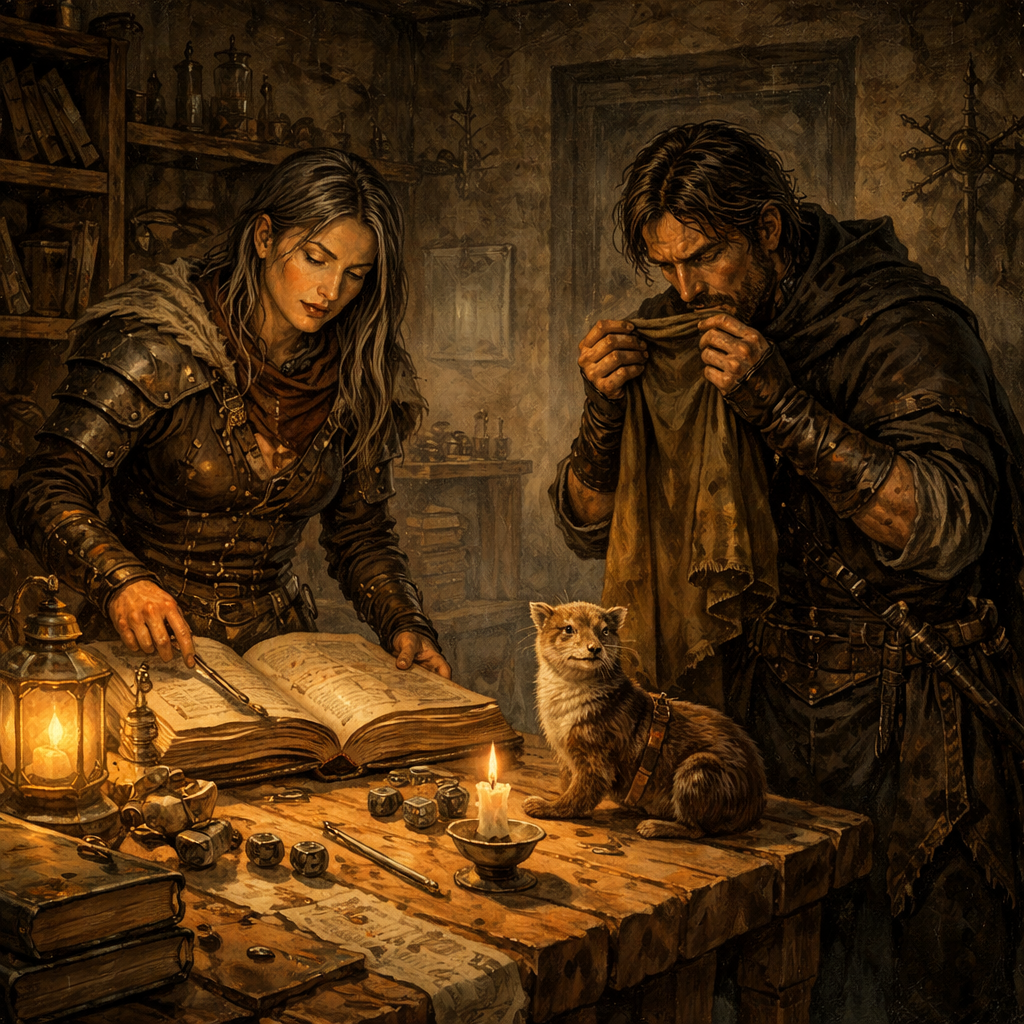
While the others worked Bastionstead from the inside, Cassyndra and Wolfgang pursued a quieter, more direct line of inquiry—one that involved fewer questions and more trespassing.
They set themselves a three-part mission.
First: acquire berries suitable for the casting of Goodberry. This proved straightforward, dull, and entirely without incident. Berries were found. No one died. Expectations, having been kept modest, were fully met.
Second: locate and assess the cave entrance used by the missing surveyors.
This was rather less comforting.
The entrance lay in a remote field well away from the town proper—no road nearby, no structures, no witnesses. Just a raw wound in the earth: a narrow hole dropping away at a steep forty-five-degree angle. The floor of the tunnel was composed almost entirely of loose stone, treacherous underfoot. Descending it without preparation would have been reckless. Ascending it under pressure would have bordered on suicidal.
Someone, at least, had recognized this.
Iron stakes had been driven into the surrounding ground, with ropes threaded from them down into the darkness below. The setup bore the unmistakable marks of professional survey work—temporary, functional, never intended to be permanent.
And never retrieved.
Wolfgang tested one of the ropes with a careful tug. It held.
“Surveyors,” he muttered. “Or soldiers. Either way, no one came back to clean up.”
They did not go down.
Not yet.
The third objective required more discretion.
The Plumbline Four, it turned out, did not maintain an office in Bastionstead. Instead, they kept modest sleeping quarters—functional rooms rented in town, close enough to the prison to be convenient, far enough to avoid attention.
Cassyndra handled the lock with practiced ease while Wolfgang kept watch. The door yielded quietly, as if aware that resistance would be both futile and undignified.
Inside, the rooms told a story—but not the one they had hoped for.
Personal belongings suggested that at least one of the four was a wizard and another a cleric. Components were stored carefully. Holy symbols were kept wrapped and clean. Bookshelves held dense technical volumes—cartography, structural theory, subterranean hydrology—none of which offered anything immediately useful without time, tools, and considerably more patience.
There were no mission notes.
No maps.
No journals.
Nothing from the last expedition.
Nothing from any expedition.
Clothing, however, was plentiful. Each surveyor’s gear was kept neatly folded, practical and worn in the particular way of people who expected to need it again. Cassyndra selected a few pieces with care, sealing them away in the hope that Wolfgang’s familiar, Chorizo, might be persuaded to serve as an improvised bloodhound.
Finally, they found orange chalk—thick, waxy, and unmistakably meant for marking underground passages. Wolfgang broke off a small piece and pocketed it.
When they left, the rooms looked exactly as they had before.
Nothing broken.
Nothing disturbed.
And no answers to the questions that mattered most.
Quiet Things, Dangerous Things
With the town offering no further answers that could be gathered without inviting attention, the party withdrew to their campsite on the ridge to compare notes.
Information was shared. Threads were aligned. Patterns began to emerge—none of them comforting.
Attention soon turned to two objects that had been traveling with them quietly, carrying more weight than their size suggested.
The first was Getty’s bracelet.
Shamus held it carefully, turning it in his hands. He had recognized it instantly when they first came across it. It had been a birthday gift from his parents to Getty on her fifth birthday—simple, well worn, and unmistakable. She had treasured it. Worn it constantly. She would have been wearing it on the day she vanished.
Time had aged it, but there was no mistaking it for anything else.
That recognition brought no comfort.
If it truly was Getty’s bracelet, then its presence here raised impossible questions. And if it was not—if it had been altered, copied, or repurposed—then it might be something far worse. A lure. A listener. A marker meant to draw Shamus in, or to track the party without their knowledge.
They treated it accordingly.
Detect Magic revealed nothing. Either it was mundane—or its magic lay far beyond anything the party could sense.
Neither possibility was reassuring.
The second object was Wolfgang’s newly acquired Ring of Dawn.
It was unassuming: a simple brass band, warm to the touch, inscribed plainly with its own name. Wolfgang had not worn it since acquiring it, and for good reason. Detect Magic confirmed that the ring radiated it—primarily conjuration, with a secondary thread of enchantment woven through it. Whatever it did, it was not subtle. And it was not inert.
Wolfgang threaded it onto a cord and wore it as a necklace instead, where it could not activate by accident or habit. Plans were made to acquire a pearl worth one hundred gold so that Cassyndra could properly Identify it. Until then, it would remain close—but controlled.
With that, conversation returned to the matter that could no longer be postponed.
The party turned to Cassyndra.
She retrieved her tarot deck and laid it out with care, the firelight catching the worn edges of the cards as she shuffled. One by one, she drew.
For the present: The Moon.
A dark passage. Dim light. Illusion, uncertainty, and hidden threats. No one argued with the relevance.
For the near future: The Ace of Wands.
New tools. New opportunities. Possibilities opening—but not yet understood.
For the future: The Magician.
A figure standing at a table, tools laid before him. Power. Agency. The ability to shape one’s own fate—but only if the right choices were made about how, and with what.
The reading settled over them quietly.
There was brief discussion of returning to town—specifically to see whether Lieutenant Kessler had a wife or family who might be approached for information. In the end, the idea was set aside. Time felt thin. Whatever had happened underground had already been unfolding without them and delay would not improve the outcome.
Preparations were made. Gareth and Laveleen were once again entrusted with the care of the rum gremlins, along with instructions that were firm, specific, and doomed to partial failure. Packs were checked. Straps tightened. Gear adjusted.
Then the others—along with Pabst and Heka—turned away from the camp.
Downward
On the way to the field, the party made one final stop at the Adventurer’s Guild to inquire about a pearl worth one hundred gold. Vetch agreed to place a special order through Manchester, with delivery expected in one to two weeks and payment due upon arrival.
It was a problem deferred.
They returned to the field and the waiting ropes. At the edge of the hole, the wind moved differently—cooler, carrying the faint smell of wet stone and old water. Ropes were checked. Knots tested. Final adjustments made.
Pabst hugged Wolfgang hard.
“I’ll hold the ropes,” he said, voice thick. “I won’t let them slip.”
Wolfgang crouched, met his eyes, and rested a heavy hand on the gremlin’s shoulder.
“Good,” he said. “That’s important work.”
Pabst nodded fiercely, wiping his eyes with his sleeve.
Wolfgang went first.
He descended carefully, boots scraping against loose stone, hands steady on the rope. Merrythought followed, then Cassyndra, Ant, Hunkle, and Shamus, each vanishing into the earth in turn. Above them, Pabst and Heka remained on the surface, watching the ropes and listening to the quiet hum of responsibility.
Below, the caves opened into natural passages—winding, irregular, shaped by water and time rather than design. Stalactites hung overhead. Stalagmites rose like blunt teeth from the floor. Moisture slicked the stone, and the air carried the steady echo of distant movement.
Evidence of the Plumbline Four appeared quickly, and it was unmistakable. Bootprints pressed into softer patches of sediment, each marked clearly with the outline PL4. Chalk marks traced along the walls at human eye level, clean and deliberate, indicating explored passages and safe routes.
The chalk was the same orange they had found in the surveyors’ quarters—but here, in the dark, it revealed its true nature. Mixed into the pigment was a phosphorescent compound, glowing faintly and steadily, just enough to be followed with minimal light.
Professional.
Thoughtful.
Careful.
The party paused to decipher markings as they went, gradually learning the shorthand of the surveyors’ work.
Then they found one that did not match the others.
S1 (–22 ft) ~~
They stopped. From ahead came the unmistakable sound of rushing water. Beneath it, something else—a gentle, irregular metallic clinking.
Alerted, they advanced with exaggerated care until the passage opened abruptly into a vertical drop. The darkness below was complete, swallowing light. From it rose the roar of a fast-moving stream, accompanied by the faint, rhythmic knock of metal against stone.
Merrythought volunteered to make the descent.
A rope was secured. Hunkle, Shamus, and Wolfgang braced themselves and lowered her slowly into the void. The sound of water grew louder as she descended, the air damp and cold against her skin.
At the bottom, the shaft opened onto a roaring underground stream, water surging through a broad opening before splitting into two or three smaller drainage channels beyond. Caught among them was a body—tumbling in the current, battered, but unable to wash further downstream.
A soldier.
Dead.
The water bent his limbs in ways limbs should not bend, knocking them rhythmically against rock. Merrythought fought the pull of the current long enough to get a grip, and with careful coordination she and the body were hauled back up.
The chain shirt bore a name, stamped clearly despite the wear.
Private Ahab.
His injuries were extensive. Long bones broken. Portions of his skull and face crushed inward. Prolonged submersion had macerated the flesh, but there were no signs of spellwork—no burns, no necrotic rot, no radiant scarring.
Just blunt force, water, and time.
His possessions were few. Five gold pieces in a belt pouch (promptly and discreetly looted). A small dice set. And a sodden bundle of papers—perhaps a journal once, now reduced to wet fiber and bleeding ink.
The party concluded that he had died elsewhere in the caverns, fallen into the stream, and been swept downstream until the narrowing channels finally stopped him.
They dragged what remained of him back toward a nearby junction. Whether this was done to aid eventual recovery or to mark their own path was left politely unspoken.
Wolfgang declined—firmly—the suggestion that any part of the remains might be repurposed for later meals, insisting, not entirely convincingly, that even he had limits.
Behind them, the stream continued to roar and whatever lay ahead waited patiently.
The Loop
Some distance on, the chalk markings changed.
Where before they had been linear—arrows, measurements, confirmations of explored ground—this symbol was different: a circle, with two arrowheads traced along its circumference.
The meaning became clear only as they followed it – a loop.
The passage curved back on itself, splitting and reconnecting in a circuit. The Plumbline Four had not marked it as a warning, but as an explanation: this route went somewhere, and then came back again.
The party followed the downward limb, the passage sloping more steeply as it went, until it opened into a natural chamber nearly a hundred yards across.
The space was still.
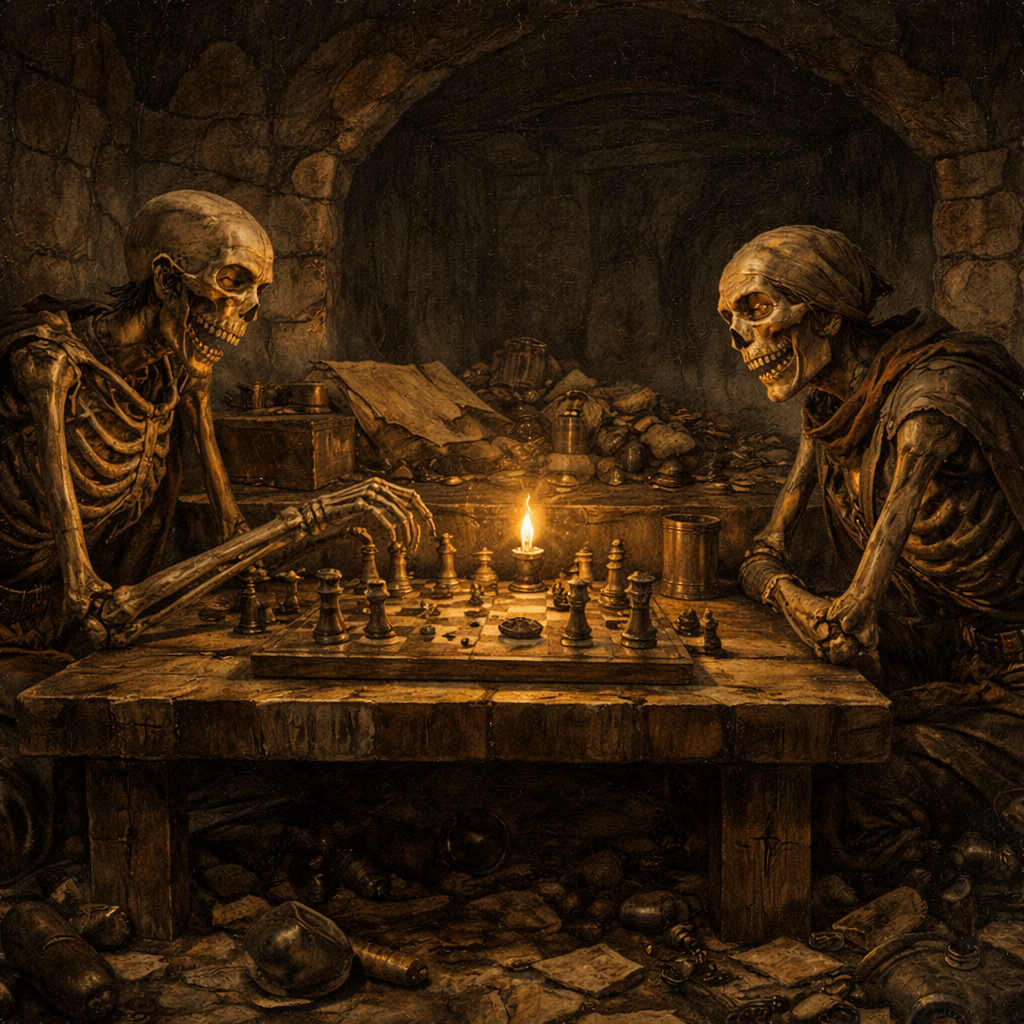
At its center stood an old table. On it sat a dragonchess board mid-game. Two skeletons were seated opposite one another on plain wooden chairs, positioned as if neither had ever risen again. One skeletal hand was frozen in the act of reaching for a piece. That piece lay knocked over on the board, as though the game had been interrupted at the exact wrong moment.
Around the chamber lay the debris of long abandonment: broken crates, smashed bottles, scattered detritus softened by time.
Nothing about the central scene appeared ceremonial. The table, chairs, board, and pieces were ordinary—sturdy, practical items of the sort owned by working people. The dragonchess position itself was legal and coherent, the sort of middlegame that suggested familiarity rather than casual play.
Tally marks had been carved into the table’s edge.
Three to two.
The skeleton on the left had been winning.
The crates told a different story. Their bottoms had been false, carefully constructed and later smashed open. Whatever they had once concealed was long gone. The bottles bore labels from a variety of well-known spirits, shattered and scattered indiscriminately across the stone.
Smugglers, then.
No weapons lay nearby. No arrowheads. No visible fractures. The skeletons bore no obvious signs of violence or trauma. They had not been bound. They had not been struck down where they sat.
They had simply… remained.
While the others examined the chamber, Ant moved more slowly, eyes tracing stone rather than objects. Eventually she found it: a narrow, hidden passage tucked into the rock away from the main space. Chorizo entered first and seemed unharmed so Ant followed.
The passage led to a small recess where a modest treasure chest sat undisturbed. Inside were one hundred and fifty gold pieces—overlooked by whoever had looted the rest of the site.
The party regrouped, weighed what evidence they had, and arrived at the only conclusion that fit.
This chamber had once been a smuggling base. Its occupants had passed time here, kept score, and waited—for a contact, a signal, or an opportunity. At some point, they had died. Later visitors had left the bodies untouched, but helped themselves to the contents and moved on.
What no one could say was why the smugglers had never stood up from the table.
With no further answers to be found here, the party followed the second arm of the loop, climbing gradually uphill until the air shifted and the passage rejoined the main caverns.
Behind them, the frozen game remained unfinished.
Ahead lay only more tunnels.
And more unanswered questions.
Old Stone, New Teeth
Beyond the loop, the natural caverns narrowed and straightened.
What began as irregular stone gave way abruptly to intention. The passage walls were smooth, linear, and precisely fitted—constructed rather than carved by chance. The style was unmistakable to anyone who had spent time underground near civilization: reminiscent of the older Manchester sewer lines, and even more so of the Orcish waterworks near Brighton.
Ancient Orcish, almost certainly.
Five rooms opened off the main passage in orderly succession. Each bore the marks of a storeroom—functional spaces meant to support life rather than war. Shelving niches. Stone bins. Faded markings indicating foodstuffs, tools, and supplies.
Nothing valuable remained.
Wolfgang lingered over the labels, comparing ancient Orcish terms with the long-gone contents, muttering quietly as he added fragments of vocabulary to his growing understanding. The others took note of what had replaced the original stores.
Life.
Fungi spread across the stone in layered mats, feeding on the last traces of organic matter. Small oozes crept slowly along the floors, digesting what the fungi left behind. Cave beetles and centipedes skittered in and out of the growth, preying on both. Somewhere deeper in the dark came the unmistakable sound of scurrying feet—rats, claiming their place higher up in the local food web.
The system felt old, stable, and undisturbed.
Chorizo scouted ahead and just as he considered the sixth room, he vanished.
There was a sharp, startled sound, a sudden violent tug, and then nothing.
The party reacted instantly.
They formed up and surged forward, weapons drawn, spells ready, and burst into the chamber as one.
Four giant spiders occupied the space, dropping from walls and ceiling with predatory speed. The fight was brief and brutal. Blades flashed. Magic cracked. The spiders fell one by one, their bodies collapsing into stillness before they could drag anyone else away.
Too late for Chorizo.
What the spiders had been feeding on lay scattered about the chamber: bones and scraps from various cave-dwelling animals—and one small, unmistakably humanoid corpse.
A kobold.
He carried little of interest. A sling. A handful of copper coins. Nothing that suggested leadership, planning, or purpose. Not even worth looting.
Merrythought studied the body, then straightened.
“No clues,” she said. “But information.”
The others looked to her.
“There are kobolds somewhere down here.”
Only then did the party notice the marking on the wall just before the last storeroom: a chalked oX, deliberate and clear. A warning, left by the unseen surveyors.
Chorizo, unfamiliar with the shorthand, had gone ahead anyway.
The Quiet Room
After resting from the spider fight, the party continued onward through the caverns for some distance, following the surveyors’ markings as they threaded back into older, quieter stone.
It was in a narrow connecting passage that they heard it.
A hum.
Low. Steady. Wrong.
It seemed to emanate from the rock wall to their right. At first glance, the stone there appeared collapsed—a rough pile of rubble pressed tight against the passage. But closer inspection revealed intention beneath the disorder. The stones had been placed, not fallen. Someone had worked to fill in and conceal an opening.
Working slowly, carefully, and quietly, the party dismantled the rockfall piece by piece.
Behind it lay a constructed entrance, and beyond that, a square chamber roughly thirty feet on a side—built using modern Archean practices rather than ancient Orcish ones. The contrast was immediate and unsettling.
The room was abandoned.
Iron brackets remained bolted to the walls where, perhaps, instruments had once been mounted. A pair of cages stood against one side, doors ajar, rust creeping along their bars. Manacles were fixed into the stone nearby, positioned above a shallow drain cut into the floor.
Whatever had been kept here had not been meant to stay long—or comfortably. And the limited corrosion suggested that whoever had been held here, it had not been very long ago.
Sigils were painted along the walls, faded and inert. They no longer functioned, but their geometry spoke clearly to Cassyndra. Divinatory magic. Observation. Measurement.
Someone had wanted to watch what happened here.
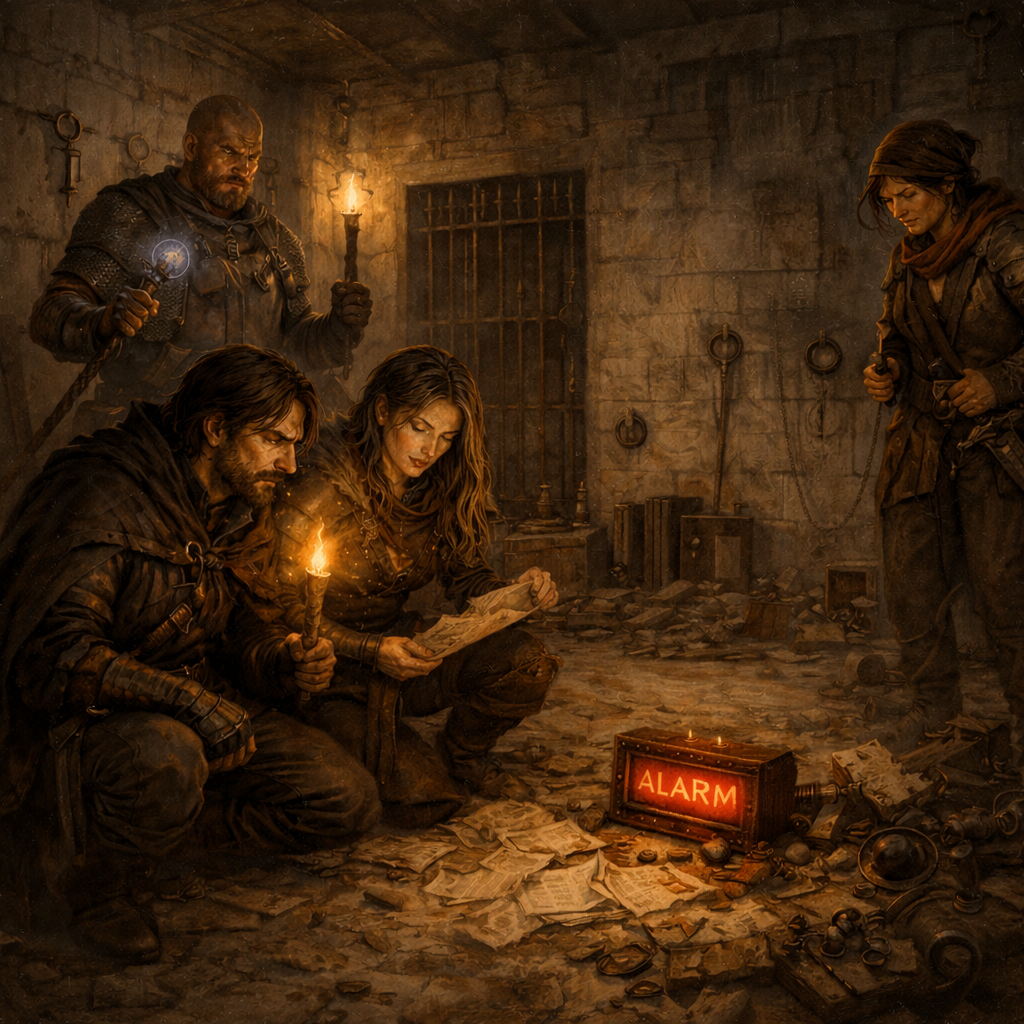
In the center of the room lay the remains of records—documents gathered into a pile and burned hastily. The fire had not been thorough. Charred fragments remained, just legible enough to disturb.
“…live trials to be paused pending review…”
“…magical loads dissipate rather than showing the expected rebound…”
“…to be dismantled and classified…”
Magic in the room felt sluggish, as if it resisted being moved. A test cantrip worked—but with a faint sense of effort, like pushing through thick water rather than air.
The hum persisted and led them into an adjacent chamber.
Here, the walls were bare, the floor cluttered with refuse. A pile of magical debris filled the space: warped and cracked spell foci, burned-out rods, scrolls reduced to useless ash and pulp. Items once capable of channeling power—now broken, spent, or, perhaps, deliberately ruined.
At the center of it all sat a rectangular object about the size of an alarm clock.
It pulsed faintly, hummed, and flashed a single word in red.
ALARM.
Moving it changed nothing. Distance made no difference. The sense of magical drag remained constant no matter where the device was positioned.
Also, notably, there were no chalk marks here. No PL4 bootprints. No surveyor notation near the concealed entrance or within the rooms themselves.
The Plumbline Four had passed by without ever knowing this place existed.
Speculation followed. Had the hum been absent when they passed? Had the alarm only activated recently? Was it reacting to the party’s presence—or signaling something else entirely? And, perhaps most unsettling of all: who, exactly, was it meant to alert?
No firm conclusions were reached.
Cassyndra suggested that, at some point, they would need to correlate tunnel maps with surface landmarks—to understand where these chambers lay in relation to Northmarch itself. The idea was noted and set aside for later.
In the end, the party settled on a working theory.
This had been a Crown facility. An interrogation room for magic users. Prisoners held in cages and manacles while they were questioned. Their possessions examined—then destroyed—here.
Nothing among the debris could be clearly tied to Grelda, at least not by anything Cassyndra could identify.
That was a relief.
It was also not reassuring.
With the hum still thrumming softly behind them, the party withdrew—leaving the alarm flashing in the dark, unanswered, and very much awake.