Excerpt From Fizzbuzz’s The Everybeing’s Guide to Traveling the Seven Continents and the Eight Seas
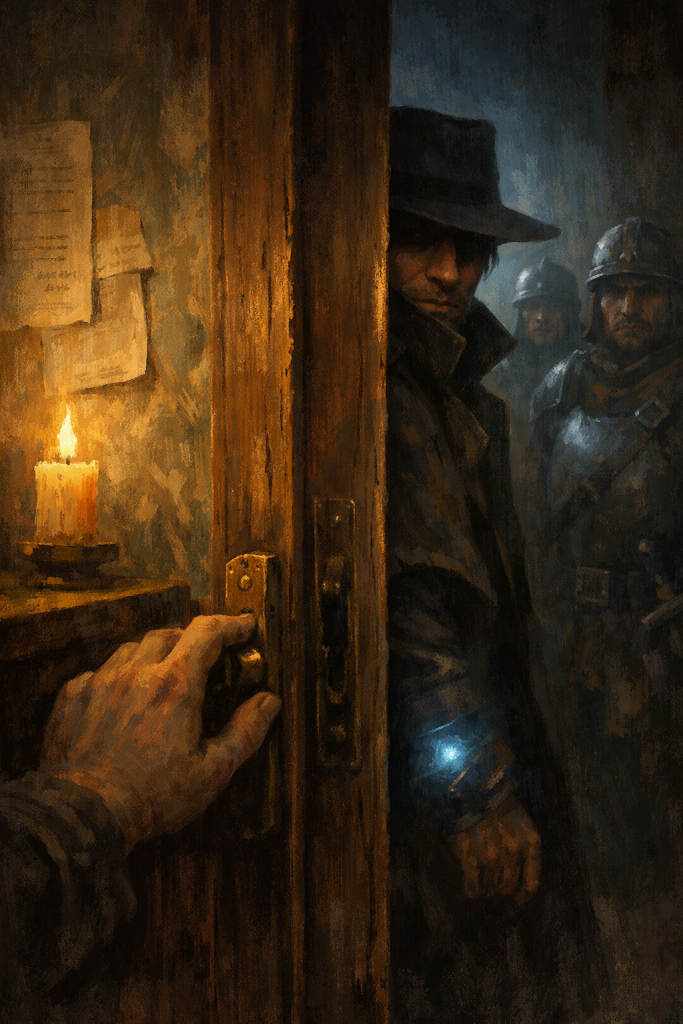
The Crown’s Investigative Service
(An excerpt that will not necessarily get you arrested… provided you do not read it aloud)
If you spend more than three consecutive days in Archea without hearing the phrase “Imperial Inquisitor” spoken in a whisper, you are either (a) deaf, (b) sheltered, (c) residing inside a barrel, or (d) you have already been interviewed, tagged, and released back into the wild.
The Crown’s Investigative Service is the Crown’s intelligence and internal security organ. Its chartered purpose (as proclaimed in pamphlets printed on paper far nicer than anything the peasantry is allowed to touch) is to safeguard the realm from foreign enemies, internal conspiracies, moral rot, and other hazards that tend to appear whenever ordinary people begin asking certain questions.
Its practical purpose, as understood by the population, is simpler:
- To learn what the Crown wishes to know.
- To ensure everyone remembers that the Crown’s curiosity is boundless.
In private conversation, they are known as the Imperial Inquisitors, a name with a pleasantly antique ring that suggests holy purpose, moral certainty, and the ability to justify anything after the fact.
You will also hear them called:
- The Crown’s Eyes (poetic; said by people who then stop talking)
- The Quiet Men (unwise; they are not all men, and they are not always quiet)
- The Listening Department (humorous; humor is not a shield in Archea—at best it is a coping mechanism and at worst a target painted upon one’s back)
- Those People (universally understood and strongly recommended)
Traveler’s Note: Inquisitors are one of the few things in Archea that become more dangerous the more accurately you describe them.
Organization: “Every Region Has One” (And No One Knows Where)
Inquisitors are widely believed to be assigned geographically, with every province and major city having a secret office staffed with secret officers conducting secret work funded by taxes that are not secret at all.
The public knows three things with absolute confidence:
- There is an office near you.
- You do not know where it is.
- If you discover where it is, you will immediately wish you had not.
As a result, every Archean town possesses at least one building that everyone suspects is the local inquisitorial office. This is typically whichever structure has too many locks, too few windows, and a clerk whose smile suggests he has recently learned something about you and is finding it instructive.
Sometimes the suspected office is an abandoned townhouse. Sometimes it is the courthouse basement. Sometimes it is the third floor of a tailor’s shop, which explains why the tailor is always “closed for inventory” and looks ten years older every winter.
Recruitment: Ability, Loyalty, and the Price of Comfort
Inquisitors are said to be selected for:
- Intelligence
- Adaptability
- Charisma
- Seductiveness
- Deception
- And a special talent for hearing a moral objection and reclassifying it as “administrative.”
They are also selected for loyalty, which the Crown ensures via the oldest technique in statecraft:
- Pay them extremely well,
- Grant privileges that make them socially untouchable,
- And ensure their lifestyle cannot exist without continued Crown favor.
An Inquisitor is not a noble, but is often treated as if they were—especially by people who enjoy keeping their faces attached to their skulls. The arrangement also makes defection difficult. If an Inquisitor turns against the Crown, they do not merely lose employment; they trade status, identity, and comfort for a sharply reduced life expectancy.
To resign from the Service is therefore, according to popular belief, possible in the same way it is possible to resign from gravity.
Mandate: They Answer Questions (And Also Invent Them)
Unlike most Crown organs—which must at least pretend to obey law, budget, and local politics—the Inquisitors operate under a mandate that is both simple and limitless:
- They investigate what the Crown asks them to investigate.
- And they investigate whatever they think the Crown would want to know.
This is not as redundant as it sounds. The first function makes them useful. The second makes them terrifying.
It means an Inquisitor does not require a case. A case requires only an Inquisitor. It also explains why other institutions resent them: the Civil Guard, the Army, provincial offices, and even the ministries all dislike any entity with enough autonomy to make them feel mortal.
Investigate vs. Act: Do They Only Report, or Do They Arrange Outcomes?
Here Archeans disagree. (Quietly.)
Some believe the Inquisitors merely gather information and deliver reports, and that the heavy-handed work—arrests, punishments, “accidents,” and administrative disappearances—is handled by the more quotidian instruments of violence.
Others believe the Inquisitors undertake covert action themselves.
A common compromise theory holds that the Inquisitors do not personally do the dirtiest work, but instead employ deniable agents—criminals granted immunity, mercenaries paid through false ledgers, or adventurers who are told they are doing “a patriotic (and remunerative) job.”
This explanation is appealing because it allows nearly everyone to be guilty in a pleasingly distributed manner.
Appearance: Light Armor, Light Weapons, Heavy Confidence
Imperial Inquisitors are often described as physically unimposing. They do not typically wear heavy armor. They do not swagger around with weapons. If they carry a blade, it is usually understated, like a threat that doesn’t need decorating.
And yet they behave with complete confidence and utter fearlessness.
They can walk unescorted into a hostile tavern, a mutinous barracks, a riot, or a noble’s estate with the calm of someone entering a bakery. They do not posture. They do not hurry. They do not raise their voice. They do not ask twice.
They simply stand there—hands relaxed, voice mild, expression attentive—like a person waiting for a slow animal to remember it is trapped.
This demeanor has produced a lively debate among citizens regarding why, exactly, they act as though no one could possibly harm them.
- The “Backed to the Hilt” theory: no one attacks an Inquisitor because the Crown will respond, not immediately, not proportionally, but inevitably. Killing an Inquisitor is not merely a crime; it is a convenient way to schedule your own suicide for the near future.
- The “All High-Level Spellcasters” theory: they are not lightly armed at all; they are armed in ways you cannot see—wards, contingencies, charms, and spells that activate the moment you think the word stab.
- The “Both” theory: most popular, because it is most discouraging.
Whatever the truth, their calm does not read as courage. It reads as certainty
Inquisitors are not generally thought of as frontline fighters. They do not need to be. They are widely believed to have the authority to take command of:
- Civil Guard units
- Army detachments
- Provincial officials
- And any number of Crown personnel who were hoping to have a quiet day
Their power is not personal combat. It is institutional leverage. An Inquisitor does not carry a battalion. An Inquisitor requisitions one.
The Forearm Jewel: A Cultural Obsession
Now we reach the part where everyone leans in.
It is commonly rumored that Inquisitors possess a glowing jewel embedded in the forearm, visible (at least sometimes) and said to pulse during interrogation. No one agrees on what it does. Everyone agrees it is bad.
Popular theories include:
- It makes lying impossible
- It tells the Inquisitor when you lie
- It records your words
- It records your thoughts
- It extracts memories
- It brands the soul
- It marks you for later
- It feeds on guilt
- It allows the Crown to watch through the Inquisitor’s eyes
Less restrained tavern talk asserts:
- The jewel can stop a heart
- It can make you confess to crimes you haven’t committed yet
- It stores your name somewhere names do not die
- It “tags” your bloodline so your grandchildren answer questions for you
Naturally, the Crown has never clarified the matter. This is wise. The jewel’s actual function may be less important than its function as a national imagination engine.
“But how do they operate undercover?”
It is also believed that Inquisitors can conceal the jewel when necessary—by illusion, glamor, some kind of suppressive magic, or the simpler and more Archean mechanism of social intimidation. Many people can’t see what they refuse to acknowledge.
If you believe you can reliably spot an Inquisitor, you almost certainly cannot.
The Lich Rumor (Do Not Say This Near Mirrors)
There is a rumor so persistent and so blasphemous that it has reached the status of “obviously false, therefore never denied.”
It goes like this:
Imperial Inquisitors are liches.
Or something close enough that the distinction becomes academic in the worst way.
In this telling, the forearm jewel is:
- a phylactery
- a fragment of a phylactery
- a key to a phylactery
- or a “node” connected to a Crown-held vault of souls
The rumor persists not because it is proven (it is not), but because it explains too much: their fearlessness, their patience, the lack of confirmed inquisitorial funerals, the absence of retirees anyone can name, and the way certain identities vanish from records as though they were never inked.
More elaborate versions insist the Crown does not merely employ Inquisitors—it owns their immortality. Loyalty is enforced not only through money and privilege, but through metaphysical leash. An Inquisitor who displeases the Crown doesn’t resign. They simply… fail to return.
The most heretical variant claims all Inquisitors share a collective phylactery, or that souls are stored centrally and redistributed like paperwork—an idea that is ridiculous, impossible, and therefore perfectly suited to Archean governance.
If you hear the lich rumor, do what Archeans do: laugh lightly, say “Of course not,” and never speak of it again.
Midnight Knocks and Administrative Vanishing
Rumors of citizens disappearing after a midnight knock are common throughout Archea, and they tend to follow a consistent pattern:
- A door opens,
- A conversation happens quietly,
- Someone leaves without packing,
- And the neighborhood learns a new hobby: pretending nothing happened.
Sometimes homes are sealed. Sometimes names are removed from rolls. Sometimes relatives are “relocated.” Sometimes an entire life appears to be edited out of the public record.
The disappearance itself is frightening. The communal denial afterward is worse. It teaches the population a crucial lesson: not only can the Crown remove your body, it can remove your social existence.
In other countries, the government fears public outrage. In Archea, the public fears administrative disincorporation.
Practical Advice for Travelers
Foreign visitors are at lower risk than citizens, but do not confuse this with immunity. The Crown does not need to arrest you to ruin your itinerary. It can:
- Revoke permits
- Delay travel papers
- Assign inspections
- Arrange a “helpful escort”
- Or lose your luggage in a highly philosophical manner
Do:
- Keep your paperwork immaculate
- Let locals handle political commentary
- Adopt an air of cheerful ignorance
- Praise the architecture, complain about the damp, and ask about festivals
Do not:
- Ask where the inquisitorial office is
- Ask whether the jewel is real
- Speculate about lichdom anywhere with reflective surfaces
- Tell jokes that require listeners to demonstrate they understood them
In Archea, cleverness is a currency best spent sparingly.
Final Note: Why They Matter
The Imperial Inquisitors are not frightening because they are everywhere. They are frightening because you cannot know where they are.
They are not frightening because they drag everyone away. They are frightening because they drag away just enough people that everyone else learns to drag themselves.
They are, in the end, not merely investigators. They are a social mechanism by which the Crown converts uncertainty into obedience—an elegant instrument that turns rumor into compliance and silence into policy.
Which, if you are King Harold III, is a marvel of governance.
If you are anyone else, it is best described as a climate.
And like all Archean climates, it is damp, persistent, and very hard to escape.