November 10th – 11th, 973
Warned that the road to Fort Arcadia would climb steadily into colder, thinner air—and that November in the foothills and mountains was no mild affair—the party made prudent preparations before departing Bastionstead. They visited Harlan Vetch at the Adventurer’s Guild, securing heavy cloaks, lined gloves, and proper winter bedding. The mountains, they knew, would not forgive carelessness.
Colonel Holt had also cautioned them about reports of undead activity near Willowhollow. The warning was taken seriously—but not fearfully. After Rudric’s midnight assault and their encounter with the Sereth’s skeletons, the party had grown accustomed to the peculiar advantages of the restless dead. Steel, discipline, and preparation had thus far proven sufficient answers.
Armed to the teeth, they felt ready.
The first day’s journey to Marineve passed without incident, as did the quiet night spent there. The following day’s march to Willowhollow was similarly uneventful—until their late afternoon arrival revealed something unexpected.
In the village square, eight uneasy villagers drilled with spears under the watchful eye of a retired Army sergeant. A ninth—Torren Vale, the blacksmith—awkwardly practiced with a warhammer more accustomed to anvils than battle. Their instructor, Sergeant Bram Halver, greeted the party with the measured assessment of a career soldier. Two missing fingers and a stiffened gait testified to decades of service. Retirement had brought him back to family and farmland, but now his old skills were required once more.
He was training the militia well but they were far from ready.
Through conversations with Bram, Torren Vale, and the village schoolteacher and record-keeper, Mistress Elowen Marr, the party pieced together the truth: Willowhollow had been dealing with the dead for nearly a year.
It had begun subtly—disturbed soil in the fields, occasional graves opened in the cemetery. Then came fleeting glimpses at dusk and dawn: skeletons, sometimes a shambling corpse, never in great number. Most appeared human; at least one had unmistakably been Orcish.
The Army had responded several times, destroying what they found. Since then, patrols between Fort Arcadia and Bastionstead had become roughly weekly. The soldiers appeared sincere in their concern. They fanned out into the fields during visits and questioned villagers carefully. Yet their officers also cautioned discretion. Officially, there were no undead roaming the countryside of Cambria, and the Army was in no position to contradict that narrative.
The patrols were appreciated—if clearly insufficient. The villagers understood that no additional resources had been allocated. These inspections were performed atop the regular duties of the Fort Arcadia and Northmarch garrisons.
Then, three nights ago, the situation changed.
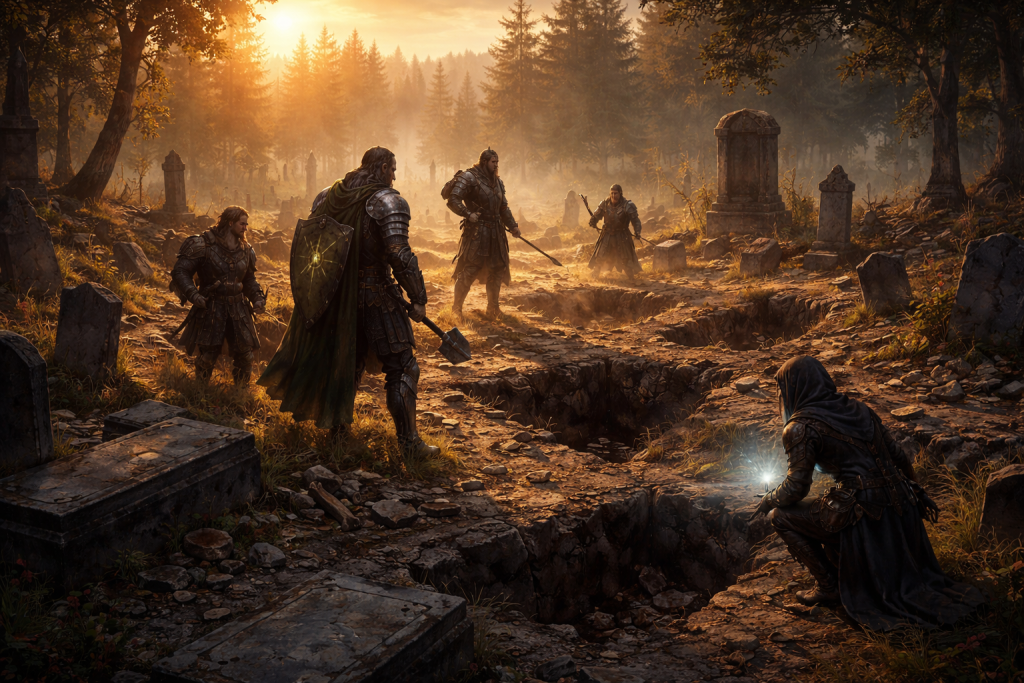
In the darkness west of town, sounds carried from the cemetery—earth shifting, wood splintering, something heavier than wind. At dawn, the villagers found every one of the roughly two hundred graves opened and emptied.
The dead were gone.
Though previous encounters had never molested the living, this wholesale exhumation shattered any illusion of containment. That same day, the militia formed. They had been training for only two days.
Also, that morning, a young man of about twenty—Tomas Rook—followed the tracks leading northwest away from the cemetery. He had not been seen since. Although the whole village was worried, no one worried more than his mother, Hessa Rook.
Careful inspection of the cemetery convinced the party that the graves had been excavated from above rather than clawed open from within. Tracks—mostly skeletal—led northwest out of the village. Among them were prints that may have belonged to Tomas.
A visit with Mistress Marr provided further historical context. Willowhollow lay at the point where the gentle rolling plains gave way to hilly and then mountainous terrain. It stood at the mouth of a natural passage through rough country—a chokepoint of undeniable strategic value. The area had been fought over multiple times in recorded history: during the Righteous War, during the Devonian Incursion some 250 years ago, and during various rebellions, the last crushed roughly fifty years past. And who knew how many conflicts had occurred before records were kept.
She showed them the village shrine. Its base was unmistakably Orcish stone, bearing an Orcish inscription.
“Although the farmers don’t much care,” she observed, “this tells me that even before Willowhollow was an Archean village, there were Orcs living here.”
The villagers knew the land had a bloody past but seldom dwelled on it. When plows unearthed bones, they made gallows jokes—that ancient blood had watered the fields, accounting for their fertility.
That fertility, however, was confined to the west, south, and east of the village. To the north lay the North Fields—land long abandoned as futile to cultivate.
The party investigated this area and found numerous disturbed sites consistent with the dead having been dug up over the course of several months. Lavleen’s Detect Magic ritual revealed lingering traces of destructive spellwork. The consensus formed naturally: this had once been a battlefield and the spell resident was strong enough that little larger than moss and weeds would grow.
More recently, however, someone had been methodically returning to disinter the fallen.
Back in town, villagers gathered to share what they knew—and to hear what the adventurers thought. Torren Vale displayed metal artifacts recovered from the fields: broken blades, rusted buckles, fragments of armor and spearheads—detritus spanning at least five centuries of warfare and at least four factions. The road through Willowhollow was a well-used trade route from Devon to Manchester, but no one recalled suspicious travelers. Village oddities were plentiful, but none suggested necromantic conspiracy.
A careful watch established northwest of the cemetery revealed no activity that evening. Seeing nothing in motion at the moment, the party elected to turn in for the night and search for Tomas at first light.
At dawn, the party and the militia followed the tracks roughly seven miles before finding Tomas lying in a shallow ditch. He bore a bruise to his temple and a laceration at the hairline. Confused from head injury and exposure, he stabilized enough under Shamus’s Lay on Hands to share what he knew.
As his mother had said, Tomas had followed the tracks intending only to observe and report to the next Army patrol.
Instead, soon after nightfall, he stumbled upon what he described as a “work party” of skeletons digging in the earth under the supervision of “some kind of zombie orc” bearing a sigil on its chest. The area was patrolled by skeletal warhorses. When they spotted him, he panicked, fled blindly, and apparently blundered into the ditch and struck his head in the fall.
He remembered enough to sketch the sigil in the dirt.
It was unmistakably the same sigil found on Rudric’s forearm.
Two militia members were deputized to escort Tomas back to the village. The party pressed onward.
Further along, they discovered impressions suggesting one hundred skeletons had stood in a precise ten-by-ten square before marching away in single file. Beyond that, tracks became more dispersed—numerous skeletons passing through at various times, no longer all heading in one direction.
This was no random haunting.
It was purposeful activity deliberately undertaken several miles into the countryside.
By afternoon, the militia returned home to defend their families before sundown. The party elected to remain and observe the night.
They chose a defensible saddle-shaped hill rising fifty feet above the ground, pocked with old excavation holes. Laveleen, Hunkle, Ant, and Shamus took the high ground. Wolfgang, Gareth, and Chorizo maintained a fire to the east of the hill, hoping to draw attention where missile fire from the hill could answer it.
The undead, however, care little for the plots and machinations of the living and the skeletons approached the hill in line abreast from the west side, forcing the party to scramble. Two ranks of skeletons, armed with sharpened spades, advanced. Behind them strode a zombie-like orc bearing the sigil Tomas had described.
The first clash was brutal. Hunkle shattered skulls and spines with his maul; skeletons continued functioning until reduced to fragments. Shamus’s Divine Smite obliterated one skeleton in an explosion of osseous shrapnel. Ant’s Mirror Image saved her when pressed hard.
Then something else arrived.
From the north emerged a figure mounted on a skeletal warhorse clad in plate barding. The rider wore immaculate plate beneath a cloak parted just enough to reveal the familiar sigil emblazoned upon his chest. His hood concealed his face save for two burning embers where eyes should be.
He easily struck Laveleen down and took the high ground she had held.
There, he tilted his head slightly to the right and surveyed the battle.
Three party members lay unconscious. The rest were near collapse.
The rider made a sharp, silent gesture.
Every undead unit disengaged immediately.
Orderly. Disciplined.
Deliberate.
Gareth and Wolfgang attempted to cut down the sigil-bearing orc as it retreated, striking true with crossbow bolts and magic missile. Black ichor marked its path, but it escaped. Wolfgang considered pursuit, suspecting the creature might serve as a controlling nexus for the skeletons—but prudence prevailed.
By morning, the pattern was clear.
What they had seen with Rudric—a lone wight digging one grave at a time—was now occurring on an industrial scale. And unlike Rudric, who had attacked them mindlessly, this larger force appeared uninterested in slaughter. They avoided the village. They withdrew when commanded. They attacked only when obstructed.
One thing was certain. Someone was raising an army from an ancient battlefield. The only question was: for what purpose? After all, who raises an army of the dead and does not use it?
With that question unanswered, the party resolved to continue north to Fort Arcadia and deliver both Colonel Holt’s letter and this warning to Inspector Fenworth.