November 11th – 17th, 973
Closed, But Open
After breakfast with their guide and minder, Private Tomas Rell, and after a brief but earnest perusal of the official history of the Royal Third Infantry Brigade, the party was escorted to their appointment with Inspector Fenworth.
The Inspector received them alone which, in itself, was informative.
He proved to be a bookish-looking man, mild in manner and neatly turned out and polite throughout. The letter they carried, he observed, was a rather irregular means of Army communication and, therefore, one that naturally invited the gathering of additional information. He wished to hear from them directly regarding events at Bastionstead and the current condition of affairs at the Northmarch Correctional Bastion.
He was a patient and methodical questioner with several of his questions asked more than once, though never in quite the same form. He directed them to different members of the party in turn, quietly testing whether their shared account had seams.
It did not, at least not in any places he chose to tug.
At some point early in the exchange, he and Merrythought arrived at a phrase for the interview itself which they noted was proceeding in a “closed, but open” manner… which, of course, might reasonably be expected for conversations occasioned by mysterious unsigned letters.
With patience—and aided by the party’s prior decision that Fenworth was someone they might prefer as an ally rather than an obstacle—the Inspector eventually obtained nearly everything they thought he needed to know.
Not quite everything, of course.
The party tactfully omitted their side adventures with kobolds so as not to, as one member delicately phrased it, “complicate the Inspector’s life with irrelevancies.”
This left a great many things they did explain.
They explained that the Plumbline Four, a cave-surveying group, had been in regular Crown employ due to the need to map the cave systems beneath the newly constructed prison. They entered one such cave, emerged early, made a report, and then returned underground with a military escort.
None of them came back.
The party, having taken an Adventurer’s Guild contract to locate the missing expedition, had succeeded in rescuing the surveyors along with several surviving soldiers. The expedition, as best the party could reconstruct it, had been undone by a combination of underground flooding and a subterranean stone creature of deeply antisocial temperament.
They described the cylindrical chamber beneath the prison—the one they believed to be the source of the antimagic field used by the Crown to confine high-magic prisoners.
They offered, cautiously but clearly, the opinion that the Crown did not truly understand the phenomenon it was exploiting.
Fenworth did not appear offended. Instead, he nodded once and said, with a restraint that suggested experience, that this sort of arrangement was not unknown in Archean government.
They then turned to the prison’s leadership, and here the picture became less geological and more political.
The party recounted the visible disorder among the authorities at Northmarch: overlapping jurisdictions, unclear chains of command, and the general impression that important people were pursuing different plans in close proximity to one another while pretending otherwise.
They described the death of Warden Celene Rauth, apparently lured onto the road to Manchester and murdered shortly after departure by men who seemed hardly competent enough to have arranged their own boots, much less a successful assassination.
Fenworth listened to this in silence, then observed that divided command at sensitive installations was a recurring motif in Crown governance. Which was not quite a defense. Nor was it, exactly, a criticism. It was simply the sort of sentence a man learns to say after a lifetime of Crown service.
The party also explained how their own actions had earned, or appeared to earn, the trust of Major Eldric Valmorne, who had in turn introduced them to Colonel Bastion Holt, the officer who commissioned them to carry the sealed letter to Fort Arcadia.
Here Fenworth’s attention sharpened and he asked directly whether the party knew of the contents of the letter. They swore, convincingly that they did not. Pressed further on whether they had ever opened the letter to read it, they kept their straight faces up.
He accepted their assurances, or at least chose not to contest them directly.
Instead, he quoted a brief passage from the message indicating that Holt wished a prisoner to be freed, after which Fenworth himself was to make a formal request for that prisoner thereby setting in motion the sort of scandal from which the Colonel and the Army might emerge better anchored than before. The difficulty, as he pointed out, was that the letter did not specify which prisoner ought to be released.
He therefore asked, carefully, whether the party had any recommendations.
Here the party became a model of caution and did not volunteer a concrete name.
The Inspector made no visible issue of this. He merely noted the omission, filed it somewhere behind his eyes, and eventually brought the interview to a close with the remark that he wished to consider matters further before seeing them again the following morning.
The party withdrew with the distinct impression that they had survived some sort of examination, though it remained unclear whether they had passed or failed.
Undead, Officially Absent
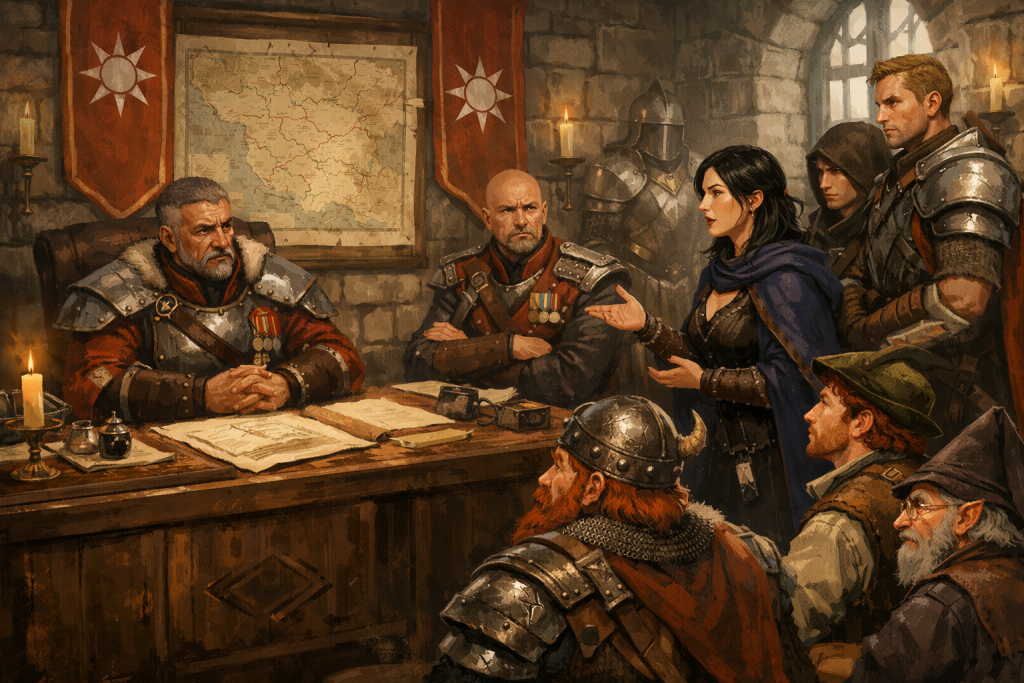
Their subsequent interview with Brigadier Malrec Vorn possessed none of the Inspector’s delicate ambiguities.
It took place with two staff officers present. It was direct, practical, and military in the way such conversations become when everyone involved has already agreed that the problem is real and now wishes only to determine how lethal it may prove to be.
The officers wanted details and the party supplied them in abundance.
They described Willowhollow. The graves. The disinterments. The overwhelming skeleton attack that had pressed the party to the brink of death before an armored undead rider arrived, struck Lavleen down in mere seconds, and then—for reasons still unknown—silently ordered the skeletons to withdraw.
The brigadier and his staff listened closely.
They were, it turned out, not strangers to all of this.
Reports of undead activity near Willowhollow had reached them intermittently for about a year—exactly as the villagers had told the party. Those reports had been forwarded to higher headquarters, where they were handled in the traditional manner: by being calmly contradicted.
There were, they had been assured, no undead roaming the countryside.
Since then, the brigade, working with the Northmarch garrison, had patrolled the region as best they could without the aid of either clear authority or official acknowledgment.
The officers readily agreed with the party’s assessment that someone appeared to be excavating an undead army from the ancient battlefields around Willowhollow. They were equally puzzled by one central feature of the matter – the undead did not seem interested in molesting the villagers and had shown only limited interest in killing the party.
Indeed, it almost seemed as though they had been engaged in some other mission entirely, had encountered the adventurers by chance, attacked as a matter of reflex, and then withdrawn upon realizing the interruption was not worth the effort.
This was odd. Undead are many things, but subtle and restrained are not usually among them.
The party reflected that the dead had seemed almost uninterested in them—as if they were beneath notice; one asking, rhetorically, “What concerns of the living do the dead have?”
One of Vorn’s staff officers, Balreth Korn, stirred.
“This,” he said, “sounds like a Bone Chorus.”
The party gave him the sort of look one gives a man who has just introduced an alarming noun without explanation.
Which, to be fair, he had.
The officers obliged.
War Plan Bone Chorus, they said, was the Crown’s strategic response plan for the raising of an undead army within the kingdom. It had been drafted in response to similar events in foreign lands, though it had never actually been required in Archea itself.
Which was to say: it existed, it was official, and it was old enough to have been revised chiefly in principle.
The party, who had by now developed a lively interest in sabotage both official and unofficial, asked whether the officers had observed any recent actions that might suggest someone was attempting to undermine Bone Chorus before it could be employed.
The officers said no. Or at least, not to their knowledge.
After some further discussion, it was decided that the brigade would dispatch the Selene Scouts, a reconnaissance detachment, to Willowhollow to gather further intelligence. The party would accompany them as far as the village before continuing on their own course.
This was, in several respects, a pleasing outcome.
They had delivered their messages, acquired serious listeners, and managed not to be attacked.
By their standards, the day was going rather well.
Ring Appraisal
As the meeting broke up, Balreth Korn followed the party out into the corridor.
His interest, however, was no longer strategic. It was sartorial. Or, more precisely, magical. Specifically, it was fixed upon Wolfgang’s ring.
“I couldn’t help but notice this during our discussion? May I see it?” he asked.
Wolfgang surrendered it, and Korn examined it with the air of a man who had once attended lectures too specialized to be socially useful and had never entirely regretted it.
After a moment he gave a small nod and handed it back.
“Ah,” he said. “A Hospitality Ring. Illegal in three nations but, fortunately, not in Archea.”
He tapped the ring once with a fingernail.
“This compels a local service-worker spirit to attend you. Use it sparingly. They unionized after the Second Conjuration Crisis.”
He then raised a finger.
“Three pieces of advice. First – Always thank her. Second – Tip generously. I cannot stress this enough. Third – If she complains about back pain, cease summoning immediately.”
With that, he departed, having improved Wolfgang’s understanding of the ring while raising several rather concerning questions about the labor history of conjured spirits.
Murder, Quietly
Requested to return to Fort Arcadia the following morning, the party retired to their rented quarters and reviewed the day.
Given the nature of their chosen profession, this naturally led to paranoia.
Shamus raised the possibility that the Selene Scouts might be assigned the task of assassinating them on the road to Willowhollow.
The others pointed out that if the army—or the Inspector—had wished them dead, there were much simpler places to accomplish the task than an open trail. A fort, for example, provides an abundance of useful hallways and a remarkable number of closed rooms with no windows.
Gareth, ever committed to optimism of a particular flavor, suggested that assassination in the field did in fact offer one significant advantage: a clean disappearance.
No arrest. No public execution. No paperwork visible to the wrong eyes.
Simply a missing party of adventurers, last seen riding toward trouble.
This, he added thoughtfully, would be especially suitable for a hypothetical Quietly Evil Inspector.
The group considered this.
In the end, however, the general atmosphere of the fort did not strike them as one of imminent murder. There had been caution, concern, and a certain amount of bureaucratic strain—but not the particular chill that precedes a state-sanctioned disappearance.
Indeed, the consensus gradually shifted in the opposite direction.
The party felt they had been welcomed with sufficient warmth that they might reasonably prevail upon the Inspector to provide them with certain supplies that could, in theory, assist with a prison break.
Optimism accumulated rapidly.
Soon the proposed requisition list included a barrel of gunpowder, grappling hooks, a ballista, several other expensive military items, and enough transport to haul the entire enterprise back to Northmarch.
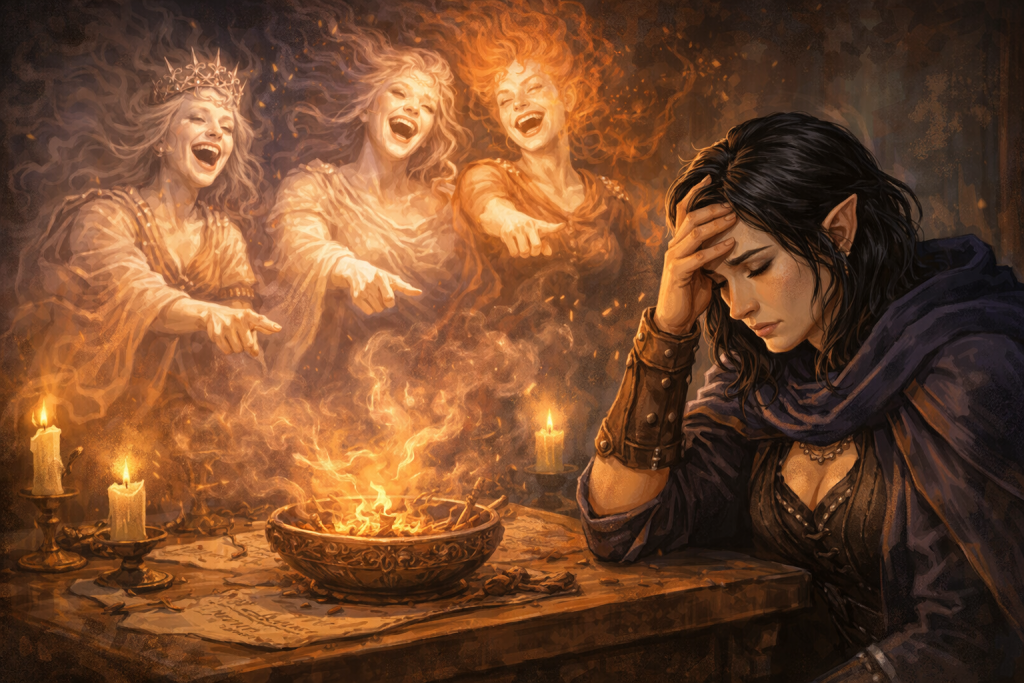
These expectations were unfortunately curtailed when Cassyndra cast Augury to determine whether such a request would be received favorably.
The response from the fates was immediate and unmistakable.
They could not stop laughing.
A Dream of Daggers
The following morning, Cassyndra reported a dream.
Not an ordinary dream, but the sort that arrived with too much shape and too much coherence to be dismissed as stray mental debris.
She had seen a rain of daggers. Then a man with bird tattoos striding past her. Then Grelda, weak and wounded.
The image of the tattooed man caught at the party’s memory. Something heard before. Something half-buried.
Then they had it. In the very first of Captain Nelson’s encrypted letters, there had been mention of a major with bird tattoos.
The letter was produced and reread.
Whatever connection lay there remained uncertain, but uncertainty, by this point, had become one of the more reliable features of their lives.
A Traveling Inspector
When they returned to the fort, they found Inspector Fenworth ready with a decision of his own.
He wished to accompany them back to Northmarch Correctional Bastion so that he could meet personally with Colonel Holt. From there, he would return to Fort Arcadia with the next army patrol heading north.
This was not what the party had expected but they recovered from their surprise with admirable speed and welcomed his company.
Then, together, they proceeded to the courtyard, where they met the 3rd Brigade Reconnaissance and Forward Observation Detachment (Mounted)— better known as the Selene Scouts.
The Scouts
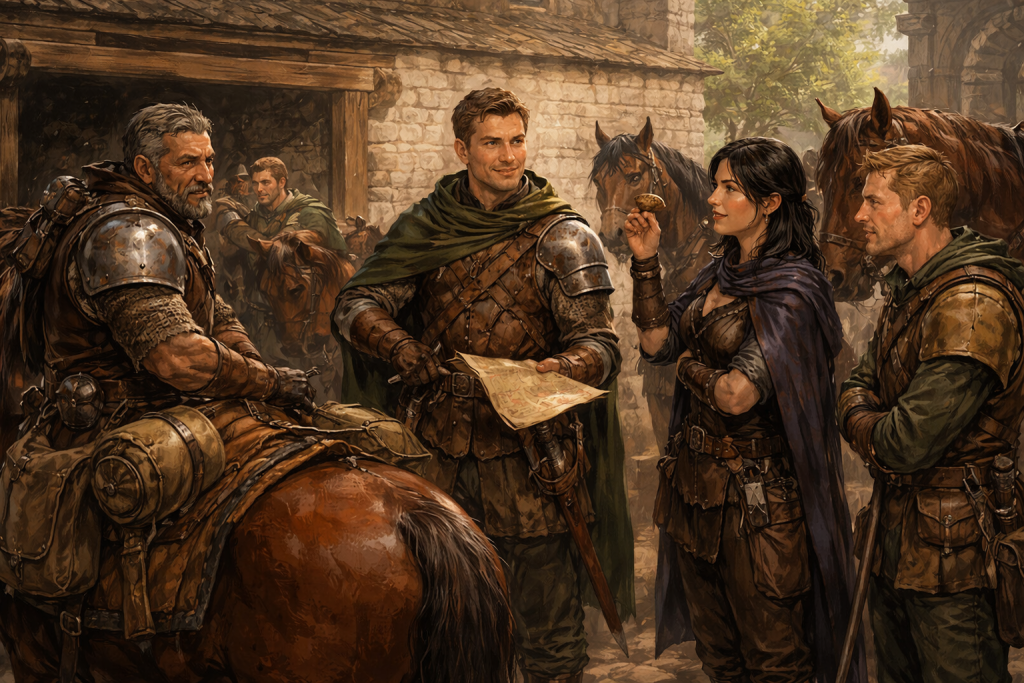
They found the Scouts already gathered in the courtyard.
Or rather, nearly gathered.
Their horses were saddled. Their packs were cinched. Their gear was in evident order. But the men and women themselves had not yet fully committed to the fiction that they were solemn military professionals. They still stood in that narrow interval before departure when soldiers, having completed every useful task, turn naturally to teasing one another.
A broad-shouldered corporal was adjusting a strap with the air of a man personally offended by poor tack.
Nearby, one of the scouts was holding up a small brown mushroom between two fingers while another regarded it with open suspicion.
“I’m telling you,” the first said, “this one is definitely safe.”
“That,” said the second, “is exactly what you said about the last one.”
“Yes.”
“And Corporal Dunholt was sick behind a tree for half the afternoon.”
The first scout considered this.
“Very well,” he said. “Then I amend my claim. This one is probably safe.”
That seemed, somehow, to settle nothing.
At the center of the scene stood a young officer doing his best to look as though all of this were occurring under his deliberate supervision.
When he noticed the party approaching, he straightened at once and stepped forward.
“Lieutenant Percival Harrow,” he announced. “Commanding officer of the Selene Scouts.”
He gestured with measured dignity to the older soldier standing just behind him.
“And this is Sergeant Rowan Vale, who assists me with certain practical matters.”
Sergeant Vale inclined his head politely.
“What the lieutenant means,” he said, “is that he gives the orders and I concern myself with whether reality intends to obey them.”
Lieutenant Harrow cleared his throat.
“Yes,” he said. “More or less that.”
The party was introduced in turn, and the scouts received them with easy curiosity rather than reserve. These were not parade-ground soldiers. They had the loose, watchful confidence of people accustomed to distance, weather, and small-unit trouble.
One, upon learning that Wolfgang did some cooking, immediately asked whether he knew how to make something edible out of dried peas, salt pork, and regret.
Wolfgang, taking the challenge seriously, said that he probably did.
“Good,” said the scout. “Because Harker’s been making a strong case for starvation.”
From somewhere near the horses came an offended voice.
“My cooking keeps morale grounded.”
“It keeps morale humble,” another replied.
Even Lieutenant Harrow, though determined to preserve a certain officerial bearing, proved unable to maintain full dignity under the circumstances.
At one point he began, “As commanding officer, I feel compelled to note—”
And Sergeant Vale, without missing a beat, added, “—that the lieutenant objects to levity in principle, though he has not yet succeeded in abolishing it.”
That earned a brief laugh from the squad and, after a valiant struggle, a reluctant smile from Harrow himself.
The scouts, it quickly became clear, liked one another and that alone recommended them.
Corporal Dunholt examined the party’s mounts and equipment with the grave expression of a man who trusted neither horses nor amateurs and found, in this case, both present in tolerable condition. Sergeant Vale asked a few practical questions about the road, the weather, and whether the party had any habit of wandering off after suspicious noises in the dark.
The answer, if honestly given, would have been unfortunate. Before that bridge could be crossed, however, one of the younger scouts asked whether the stories were true that the party had fought a stone monster underground.
“Yes,” someone said.
The scout frowned thoughtfully.
“How does that work, exactly? What part of a rock do you stab?”
There was a brief pause.
“All of it. Repeatedly,” said Gareth.
That answer seemed to satisfy him.
Another scout, after hearing a little of their journey, shook his head and said, “And here I thought we had drawn the troublesome assignment.”
“Have you?” asked one of the party.
The scout glanced toward Willowhollow, or at least in the general direction of future unpleasantness.
“We’re riding toward a village with undead problems in weather that hates cavalry, under a plan older than my grandfather, to investigate reports headquarters spent a year disbelieving.”
He shrugged.
“So. Possibly.”
This was, evidently, the sort of humor the Selene Scouts favored: dry, resigned, and just cheerful enough to suggest they intended to survive it.
Then Inspector Fenworth entered the courtyard.
The transformation was immediate.
Laughter ceased.
A scout who had been sitting on a crate stood at once. The mushroom vanished into a pouch. Straps were checked one final time. Shoulders squared. Faces settled into disciplined neutrality.
It was not the nervous stillness of men afraid of authority. It was the efficient stillness of soldiers who understood precisely when levity ended.
Lieutenant Harrow stepped forward, now every inch the officer he wished to be.
“Selene Scouts ready for departure, sir.”
Fenworth acknowledged the salute and gave the squad a brief, appraising look.
“Very good, Lieutenant.”
Sergeant Vale said nothing. He did not need to. The squad was prepared, the horses were ready, and whatever ease had animated them moments earlier had been folded away as neatly as a cloak before rain.
The party, seeing this, took the measure of them more fully.
These were not fools.
They were competent men and women who joked because that was preferable to brooding, and who snapped to business the moment business appeared. If the road to Willowhollow was to be traveled in military company, the party could have done much worse than the Selene Scouts.
Irregular Business Ventures
The road out from Fort Arcadia was cold, clear, and steadily descending toward lesser altitudes and greater ambiguity.
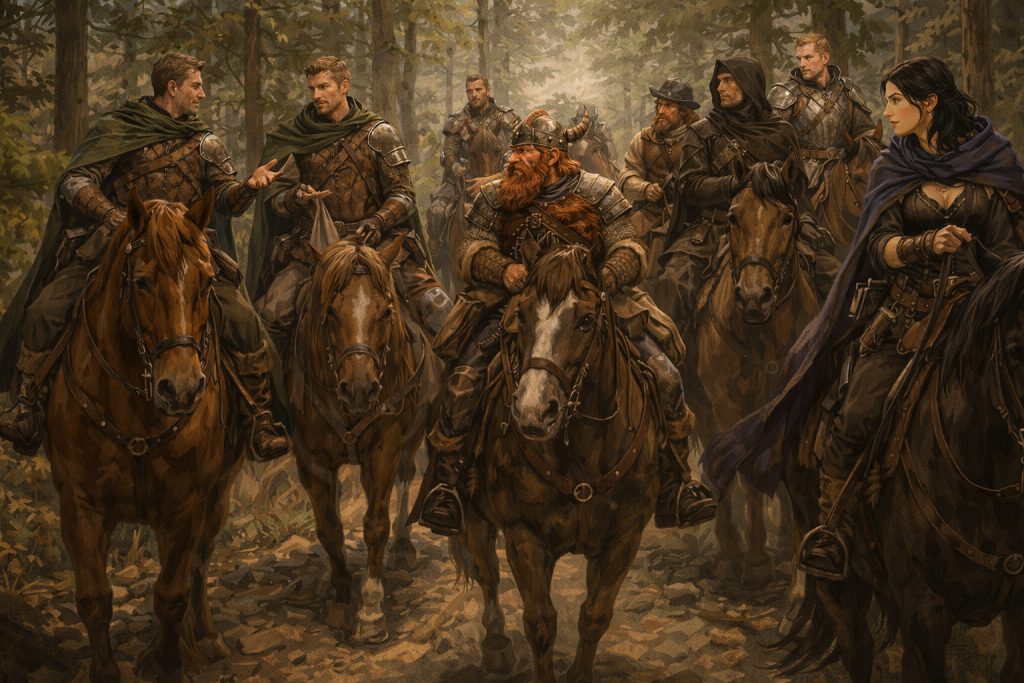
For a time the ride was companionable rather than conversational. Hooves struck the road in a measured rhythm. Tack creaked. Breath smoked faintly in the air. The Selene Scouts rode with the relaxed alertness of professionals who knew how to conserve energy without ever quite ceasing to observe their surroundings.
Eventually Wolfgang, who had by now decided that military escorts were best made useful if one had to endure them, guided his horse a little nearer to Sergeant Vale.
“You spend much time chasing smugglers through these hills?” he asked.
Vale glanced sideways at him.
“Enough to know they rarely carry anything worth the trouble of hauling uphill.”
One of the scouts farther ahead snorted.
“That depends,” said Kettering. “If it’s brandy, it’s worth hauling anywhere.”
“Not on your pay,” said Dunholt.
Lieutenant Harrow, who had been trying to look commandingly attentive while also not falling into a rut, took this as an invitation to contribute.
“Smuggling across the border is persistent,” he said. “The passes make it difficult to stop entirely. We intercept what we can.”
“What sort of things?” asked Gareth.
Private Alder answered without turning around.
“The usual luxuries. The usual poisons. The usual paper.”
“The usual paper?” Merrythought echoed.
Inspector Fenworth, riding slightly behind them, spoke for the first time in several minutes.
“Never underestimate paperwork as contraband,” he said. “Armies, ministries, and rebellions are all held together by documents. The difference lies chiefly in the letterhead.”
That earned a brief smile from Sergeant Vale.
Harrow continued, pleased to be on a topic both official and concrete.
“From our side into Devon, or through Devon into Cambria, one sees the expected traffic. Aged brandy out of Edicaria. Silk dyed with regulated pigments. Pepper, saffron, cinnamon—elite spices, heavily tariffed. Devonian perfume. Fine steel blades from Crown forges.”
“Dreamleaf,” added one of the scouts. “Always dreamleaf.”
“And Black Sap,” said another. “If there’s misery anywhere, someone will try to bottle it and move it across a border.”
Fenworth nodded faintly.
“Black Sap. Widow’s Milk. Ghostsalt. Refined spell-ash. Things purchased either to forget reality or to perceive too much of it.”
“What’s Ghostsalt?” asked one of the party.
A younger scout answered with relish.
“Lets you see faint undead silhouettes, so I’m told.”
“So naturally,” said Vale dryly, “people take it for entertainment.”
Harrow, gamely pressing on, ticked items off almost as though reciting from a report.
“Spell components that are illegal without Ministry approval. Crown-issued wands that have somehow fallen off caravans. Forged tax seals. Blank Ministry writs. Stolen census ledgers. Unstamped land deeds.”
“Nothing so dangerous,” Fenworth said mildly, “as a document that says someone owns something he does not, or does not owe something he does.”
“Or does not exist,” added Ant.
Fenworth gave her a sidelong glance.
“Yes,” he said. “That as well.”
For a little while the party absorbed that.
It was Wolfgang who spoke next.
“All right. Luxuries, vices, forged papers. That all makes sense. But you mentioned this has changed?”
At this, the mood shifted—only slightly, but enough.
Sergeant Vale looked toward Lieutenant Harrow, who gave the smallest nod. The sergeant answered, but more carefully now.
“The pattern has altered over the last several months.”
“Not disappeared,” said Harrow. “That would have been easier. Smugglers who stop smuggling are usually planning something.”
“Or dead,” muttered Dunholt.
“Also true,” Vale conceded.
Harrow continued. “The ordinary traffic remains. Brandy. Silks. Components. False documents. All of that. But lately we’ve also been seeing consignments that don’t fit the old pattern.”
“What sort of consignments?” asked Shamus.
“Military and political ones,” said Vale.
The word sat there for a moment.
“Weapons,” Harrow said. “Armor. Crates of arrowheads. Shield blanks. Water flasks. Tack fit for organized mounted travel, not private riding. Tents. Cook gear in quantity. Rope. Nails. Oilcloth. Proper supply goods.”
“Not the sort of thing one buys for a discreet vice,” said Fenworth.
“And printing press equipment,” added Kettering.
That drew a few looks.
“Printing press equipment?” Gareth asked.
“Aye,” said Vale. “Not books. Not pamphlets. Press parts. Type trays. Plates. Ink rollers. Cases of paper when paper would have been suspicious enough already.”
“Broken down and packed separately,” said Alder. “Moved like they didn’t want the cargo recognized until it was reassembled somewhere else.”
“Which suggests competence,” said Fenworth.
“Or instruction,” said Vale.
Wolfgang frowned.
“Coming from Devon into Cambria?”
“Yes,” said Harrow.
“That seems… pointed,” said Merrythought.
“It does,” said Fenworth.
For a few moments only the sounds of the road remained.
Then Cassyndra said, “That’s not ordinary smuggling at all. That’s preparation.”
“Precisely,” said Fenworth.
“For what?” asked Hunkle.
No one answered at once.
At last Sergeant Vale said, “If it were only weapons, one might say banditry. If it were only paper and press parts, one might say sedition. If it were only armor and supplies, one might say a private lord preparing for trouble.”
“But taken together,” said Fenworth, “it begins to look less like profit and more like infrastructure.”
Lieutenant Harrow sat straighter in the saddle.
“A force can steal food as it goes,” he said. “It can improvise shelter. It can make do with bad boots and poor blankets for a while. But if someone is moving arms, supplies, and printing capacity together, he may be preparing not merely to fight, but to administer.”
Gareth blinked.
“To administer?”
Fenworth looked almost apologetic.
“My dear fellow, rebellion is a profoundly bureaucratic activity. One requires weapons to seize power, but paper to justify it, coordinate it, and persuade idiots to die for it in the proper districts.”
“That,” said Kettering, “is the most senior officer thing I’ve ever heard.”
Fenworth accepted this without visible offense.
One of the scouts ahead spat into the roadside brush.
“Devon’s stirring the pot,” he said. “Simple as that.”
“Perhaps,” said Fenworth.
Vale shook his head.
“Maybe. But I don’t like simple answers arriving this neatly.”
The party looked at him.
He shrugged.
“Smuggling’s normally greedy. This feels organized. Directed. Somebody’s deciding not just what crosses the border, but what Cambria is supposed to become once it gets there.”
Merrythought considered that.
“So what does the brigade think? Are we looking at Devon backing rebels? Smugglers stumbling into politics? Or someone in Cambria building a private little war?”
Lieutenant Harrow opened his mouth, but Fenworth answered first.
“Yes,” he said.
That got a short laugh, even from Dunholt.
Fenworth continued.
“The brigade’s difficulty is not merely stopping smugglers in rough country. It is that smuggling has ceased to be only smuggling. When a mule train carries brandy and saffron, one may call it vice. When the next train carries spearheads, press screws, forged seals, and land records, one begins to suspect intent.”
“Have you caught any of them?” Shamus asked.
“A few,” said Vale. “Enough to confirm the pattern. Not enough to see the whole shape.”
“And the prisoners?” asked Cassyndra.
Vale grimaced.
“Teamsters know little. Guards know less than they claim. The useful men tend not to survive being cornered.”
“Or they survive very selectively,” said Fenworth.
Wolfgang looked from one to the other.
“So what are you expecting?”
This time Harrow answered, and though he was still young, his tone had lost some of its earlier brightness.
“We are expecting,” he said, “that sometime soon all these separate inconveniences will discover that they belong to the same problem.”
Nobody had much to add to that.
The road bent southward. Wind moved through the grass. Somewhere far off, a hawk turned in the pale sky.
At length Kettering sighed.
“Well,” he said, “on the bright side, if the kingdom falls into coordinated insurrection, perhaps the paper quality will improve.”
“Optimist,” said Vale.
“I pride myself on it,” said Kettering.
And the column rode on.
Fog, Friction, and Other Causes of War
The road south toward Willowhollow wound between low, grassy hills and stands of thin pine. By midmorning the weather had settled into one of those stubborn mountain fogs that seemed less like weather than a local habit.
Sound carried poorly.
Shapes appeared late.
The sort of conditions, in short, that encourage misunderstanding.
At roughly ten in the morning, said misunderstanding arrived.
Two of the Selene Scouts had ridden ahead of the column, as was their custom—far enough to see trouble early, but not so far that help could not reach them in time. The rest of the detachment, along with the party and Inspector Fenworth, followed the winding road a few hundred yards behind.
At the same moment, by a combination of bad luck and worse timing, a smuggling party emerged from a narrow side track and entered the same road between the lead scouts and main body.
They were traveling north.
Fifteen of them in all, walking alongside three donkeys that pulled small four-wheeled carts. The loads were tarped and tied down with the sort of care that suggested valuable cargo and limited patience for inspection.
The smugglers never saw the outriders.
The outriders never saw the smugglers.
The fog saw everything and commented on nothing.
It was therefore inevitable that the smugglers and the main body of the Selene Scouts would meet one another precisely where the road curved sharply between two hills.
They did.
Both groups came around the bend at the same moment.
For one suspended instant the road contained thirty-odd people, several horses, three donkeys, two carts, and a great deal of uncertainty.
Then someone fired a crossbow.
Later, after the matter was sorted out, it was determined that the shot had come from one of the smugglers and that it had been fired almost entirely out of panic.
This explanation did not improve the situation.
The bolt struck the road near one of the scouts’ horses. The horse screamed.
And the fight began.
A Short Engagement
The smugglers had numbers.
The scouts had horses, discipline, and an unpleasant amount of practice.
The party had, as usual, enthusiasm.
The two groups collided on the road with the abrupt violence that tends to characterize fights that nobody planned.
Sergeant Vale barked a command and the scouts spread instinctively, horses wheeling outward to create space and lines of sight. The smugglers, by contrast, reacted in the more traditional smuggler fashion of shouting contradictory things and trying to decide simultaneously whether to fight or flee. No leader emerged among them.
By contrast, the scouts responded with professional efficiency.
Crossbows came up. Swords cleared scabbards. A pair of smugglers went down almost immediately under accurate fire.
Meanwhile the party had already begun doing what adventurers do best: improvising from inconvenient terrain.
Several of them scrambled up the low slopes on either side of the road, gaining the sort of high ground that tacticians recommend and travelers usually avoid.
From there they began sniping downward into the confusion below which improved the state of affairs among the smugglers at all.
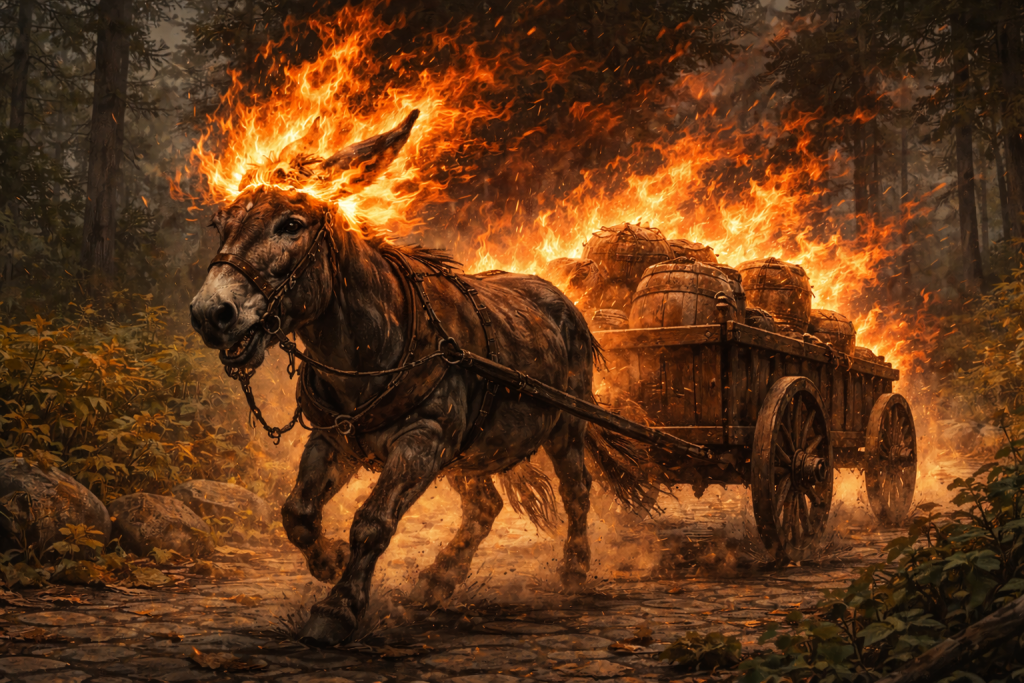
Cassyndra, seeing the donkeys and the carts clustered in the road, made a brief calculation and then placed a spell where it would cause the most disruption.
A sudden bonfire erupted beneath one of the donkeys.
The donkey reacted in the predictable donkey fashion of attempting to exist somewhere else immediately. The cart behind it did not share this ambition and was dragged violently forward into the scrum. Moments later the cart itself caught fire, filling the fog with smoke, sparks, and the unmistakable smell of burning canvas.
Some smugglers attempted to return fire. Some attempted to untangle the donkeys. Some attempted to run. All of these efforts interfered with one another.
Within a minute the fight had collapsed into a collection of small, desperate skirmishes, and even those ended quickly as the scouts and the party pressed forward.
One smuggler dropped his weapon. Another followed. Then a third. Five ran down south down the road but were run down quickly by the scouts while the party secured the others.
Accounting
When the smoke cleared and the fog began to thin, the results were tallied with the weary efficiency of soldiers who had done such things before.
One Selene Scout, along with his horse, lay dead in the road.
Seven smugglers had been killed in the fighting.
Eight more were captured, two of them unconscious.
The donkeys, once separated from their burning cart, proved unharmed and deeply resentful of the entire experience.
Inspector Fenworth, who had wisely remained well behind the fighting and contributed primarily by not being shot, rode forward only once the prisoners were secured.
The scouts set about the routine business of disarming and searching their captives.
Boots were removed. Cloaks were turned out. Belts were checked. Pockets were emptied.
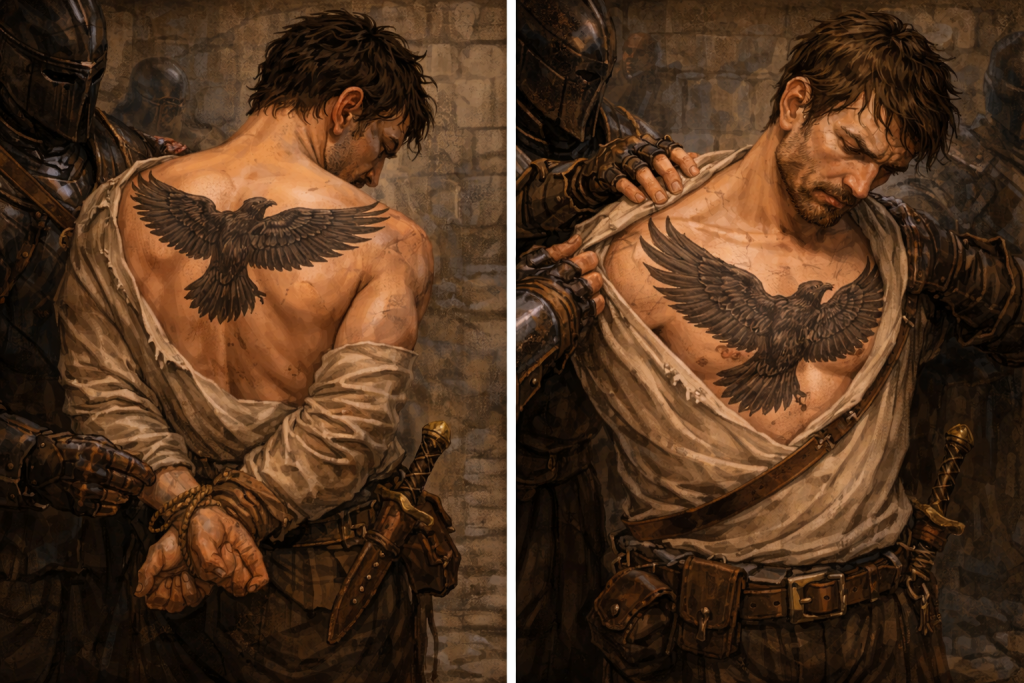
Then the prisoners were strip-searched which revealed things of interest, most of which were related to concealed knives. One of them involved an unusual tattoo.
When one of the prisoners’ shirts was removed, a large stylized bird spread across his chest—its wings stretched wide, the lines bold and unmistakable. A matching design covered most of his back.
Cassyndra, who had been standing nearby, went still. She knew that bird and, in fact, had seen it last night.
Meet The Irregular Businessmen
The Selene Scouts handled the aftermath with the steady professionalism of soldiers who understood that battles rarely ended when the shooting stopped.
Wounds were bandaged—first their own, then the prisoners’. The dead were checked with quiet thoroughness to ensure they were not merely pretending to be dead, a tactic smugglers had attempted often enough to justify caution. The surviving prisoners were bound with proper restraints rather than improvised rope, which made escape less likely and the atmosphere more dignified.
Questions followed.
The smugglers answered them in the manner of men who had been caught very clearly in the middle of smuggling.
Their cargo, once the burning cart was extinguished and the tarps were pulled back, proved to contain the usual suspects many well-packed casks of aged Edicarian brandy destined, by all available evidence, for thirsty nobles in Devon. And there, in a hidden compartment under one of the carts, bolts of silk dyed in Crown-regulated pigments.
This admission was delivered with the weary honesty of men who understood that denial would require more imagination than they possessed.
Shamus took another approach. He Laid Hands on one of the unconscious prisoners and just as the prisoner woke up, asked why he had been doing what he had been doing. The question, timed perfectly for that moment of confusion when people wake up from life threatening injuries, elicited a raw and unadorned response – “For the good of Archea.” Then the moment passed and the prisoner joined his companions in their closed-mouth ways.
Meanwhile Cassyndra approached the prisoner with the bird tattoo speaking aloud in a manner appropriate for interrogating suspected smugglers but also reaching gently with her magic and letting her voice arrive inside his thoughts.
We are not your enemies, she told him quietly. Cooperate and you may yet walk away from this.
The man did not startle—always an interesting sign. Instead he glanced at her once, briefly, with the expression of a man who had been approached by stranger things than telepathy.
Perhaps, his thoughts seemed to say. Out loud he merely shrugged, gave the expected answers, and looked away.
For the moment, cooperation remained theoretical.
A Practical Difficulty
Once the prisoners were secured and the carts inspected, a new problem presented itself.
Sergeant Vale studied the line of bound smugglers with the same thoughtful expression one might give an inconvenient piece of furniture. “We cannot execute them just for smuggling,” he said.
This was said calmly and with no particular regret, merely as a statement of military fact.
“We also cannot take them back to Fort Arcadia,” Lieutenant Harrow added. “Our urgent orders are to investigate Willowhollow.”
“And taking eight prisoners into a tiny village beset by a potential undead army,” Vale said, “would be… ambitious.”
Inspector Fenworth regarded the captives thoughtfully. “We could confiscate their contraband and release them.” The scouts nodded. Given how much they’d sacrificed to capture them, was clearly the worst possible outcome – one that promised that their comrades would have to sacrifice once again in the future to take them back into custody.
The party watched the exchange with growing interest.
At last Vale looked toward them. “You are traveling toward Northmarch, are you not?”
“What are you suggesting?” Merrythought asked.
“That you take custody of the prisoners,” said Vale.
There was a short silence while everyone imagined the logistical implications of escorting eight bound smugglers along with a clearly non-combatant Inspector for another couple of days and nights.
Then Wolfgang noticed something more important.
“The brandy,” he said.
Everyone looked at him.
“The smugglers clearly do not need it anymore,” Wolfgang continued with patient logic. “And it would be a shame for such fine contraband to go to waste. I propose the party takes custody of one barrel for… personal use.”
Sergeant Vale blinked and Lieutenant Harrow looked faintly scandalized. He spoke first, “No.”
Wolfgang looked wounded.
“Not even a small one?”
“No.”
“Half a barrel?”
“No.”
“Purely for morale purposes?”
“No.”
Harrow folded his hands behind his back with the calm of a man who had denied such requests from the troops many times before.
“All captured contraband,” he said, “must be delivered intact to the appropriate authorities.”
Wolfgang sighed the deep sigh of a man whose faith in civilization had once again been disappointed.
“Very well,” he said. “But history will judge this decision harshly. In addition to my harsh present-day judgement.”
The others ignored him and the practicalities were quickly settled.
The party would take custody of the prisoners and their surviving donkeys and carts. They would escort both to Northmarch Correctional Bastion, where the smugglers and their cargo could be turned over to the proper authorities for processing, interrogation, and—most importantly—documentation.
The Selene Scouts would continue south toward Willowhollow.
It was, everyone agreed, the most sensible solution available. Even if it meant the brandy would survive the journey untouched. Wolfgang bore this patent injustice with visible impatience, mitigated only when he received permission to carve up the already partly roasted donkey for steaks.
Parting at Willowhollow
The column reached Willowhollow late in the afternoon without further incident.
The fog had burned away by then, leaving the village exposed beneath a pale sky and a watchful silence that seemed to hang permanently over the place. The Selene Scouts dismounted in the square and quickly set about the work that had brought them there: speaking with villagers, examining the surrounding ground, and assembling a clearer picture of the undead disturbances that had troubled the area.
The villagers, who had long ago learned to greet armed patrols with a mixture of gratitude and fatalism, provided what information they could. Sergeant Vale spent much of the evening listening more than speaking. Lieutenant Harrow took careful notes and occasionally attempted to look as though he had already anticipated the contents of those notes.
Inspector Fenworth observed all of this with quiet interest, contributing little but remembering much.
The party, meanwhile, spent the evening guarding their prisoners and reflecting that adventuring life often involved as much logistics as heroism.
In the morning, their paths diverged. The Selene Scouts remained at Willowhollow to begin their reconnaissance in earnest. The party, along with Inspector Fenworth and their reluctant cargo of smugglers and contraband, continued south toward Northmarch Correctional Bastion.
Farewells were brief.
Sergeant Vale clasped forearms with Hunkle.
“If you get into any more scraps, give us a chance to join in before you finish the fight,” he said.
“No promises,” he replied.
The two groups separated shortly thereafter.
Conversations on the Road
Once clear of the village, the journey settled into a slower rhythm.
The prisoners walked under guard beside the carts. The donkeys resumed their earlier occupation of stoic resentment. The party took turns riding ahead, falling back, or walking beside the captives in what quickly became a series of conversations that were not quite interrogations.
Inspector Fenworth, for reasons carefully arranged by the party, proved unexpectedly occupied for much of the morning. At one point he was assisting Wolfgang in an extended discussion of the proper handling of onions over a campfire. At another he was escorted off the road briefly on what Merrythought described as a matter of botanical education.
These and many other intervals of absence were arranged and quietly exploited. At first, however, the smugglers proved less forthcoming than one might expect from men whose lives were entirely in the hands of their captors.
Their explanation was simple. “Yes,” one of them said after a long silence, “you can kill us.” He shrugged phlegmatically. “But there are things more important than that.”
This was said without bravado. It was simply a fact.
Time passed. The road wound southward. Guards changed positions. Water was shared. Food was passed along the line of prisoners as readily as along the line of guards.
Gradually, something shifted and the turning point came almost accidentally. Ant, speaking to the tattooed prisoner, remarked offhandedly, “Strange business. But I suppose the Ember never goes cold.”
The man’s head turned slowly. For the first time since his capture he looked at the party with something resembling genuine interest.
After a moment he nodded once.
“No,” he said quietly. “It never does.”
Trust, or something close enough to serve, began there.
Adrien Valcour
The tattooed prisoner eventually gave his name.
Adrien Valcour. Her had once been a caravan scout, riding throughout Cambria and nearby lands and acquiring his distinctive tattoo. Later he had joined the underground network known as the Ebon Blades.
His second to last assignment had been to pose as a major in the Crown army. “My work,” he explained, “was to learn how the Army addressed the Crown’s Ebon Blade problem and also to watch the officers.”
Specifically, he had been instructed to determine:
• who was corrupt, and therefore, potentially subornable
• who was cruel, and therefore, had to be killed first
• who was incompetent, and therefore, should be left in their current positions
• and, most importantly, who might actually care about what was happening in Cambria and care enough to do something about it.
“Most of them,” he said mildly, “failed that last category.”
One officer had not.
Captain Nelson.
Valcour leaned back against the cart wheel as he spoke. “Captain Nelson asked too many questions,” he said. “He rode patrols himself instead of trusting reports. He noticed things.”
“What sort of things?” Gareth asked.
Valcour shrugged.
“Ruined villages no one explained. Documents that disappeared. Movements near old Orcish ruins that made no sense. Fields going black that no one else was interested in.”
At first Valcour had tested him. The message Nelson later mentioned in his letter— Tell the blacksmith in Dolven’s Hollow the hourglass is leaking —had been exactly such a test.
Valcour had wanted to know what Nelson would do. Would he report the strange message up the chain of command? Or would he simply pass it along?
Nelson had passed it along and the subsequent black feather was the signal from Dolven’s Hollow that it had been received exactly as sent; the feather, of course, ending up Nelson’s door rather than Valcour’s as a simple precaution.
“That told me two things,” Valcour said.
“First, that he was curious enough to follow the thread.” He paused. “And second, that he was cautious enough not to interfere with something he didn’t yet understand.”
At that point Valcour had decided Nelson was not an enemy but unfortunately, that was when matters began to unravel.
The Disappearance
Valcour realized two things at nearly the same time.
First, Nelson was getting closer to discovering the Ebon Blades network operating in the region.
Second, Crown authorities had begun examining the garrison more closely in search of a suspected mole.
If Valcour were arrested, Nelson might eventually be drawn into an investigation.
And Nelson would tell the truth and expose far more than the Blades could afford to lose. So Valcour vanished.
“I erased myself,” he said simply. That was the sanitized room Nelson had described in his letters. Everything removed.
The conversation paused there. At length someone asked the obvious question.
“Did you know,” Merrythought said quietly, “that Nelson is dead?”
Valcour looked up sharply. “Dead?” There was a long silence.
At last he said, “…Then the wrong man vanished.”
No one spoke for a while after that.
A Smuggler’s Trade
Once he had disappeared from the garrison, Valcour continued to be valuable to the Ebon Blades.
He now knew patrol patterns and military logistics. From before, he remembered all of the old roads that no one else had bothered to record. Smuggling was the perfect next assignment.
Contraband already moved quietly across the border. One more cart rarely attracted attention.
But the Ebon Blades were not interested getting brandy or silk to Devon. Those activities were merely to raise money. The cargo that mattered was always the thing things that they brought back to Cambria.
Weapons. Printing presses. Political pamphlets. Encoded correspondence. Things that, in the long run, would shape the world far more than trivial brandies and silks.
A Complicated Enemy
Late that afternoon, as the column paused to water the animals, the conversation returned briefly to the earlier fight.
“The scouts treated you fairly,” Shamus observed.
Valcour nodded. “Yes,” and was thoughtful for a moment.
“That,” he said slowly, “is the part I haven’t quite made peace with.” He glanced toward the road north where the Selene Scouts had remained behind.
“The system is rotten,” he said. “It deserves to be destroyed.” He gestured in the vague direction of Willowhollow. “But the people inside it… that’s another matter. Some of them are good men.”
He paused. “And some of those good men will have to die if this evil system is ever going to end.”
The wind moved through the grass along the roadside and the road to Northmarch continued south.

The Question of Alliances
With the prisoners now somewhat less prisoners and somewhat more conversationalists, the matter that had been circling the Merrythought’s thoughts finally surfaced openly. “You know,” she said conversationally, “our views of the Crown are remarkable aligned.”
Valcour looked up from where he walked beside a cart. “Oh?”
“Yes. And in fact, in the proper circumstances, we might actually seek to join you.”
The statement hung in the air with the pleasant clarity of a thrown knife.
Valcour did not react immediately. He had spent enough time among conspirators to know that the first reaction to such a suggestion was rarely the honest one.
Instead he looked at the rest of the party. “What do your friends think of that?”
What followed was less an answer than an off and on discussion conducted in those furtive moments when the Inspector was not in earshot.
Merrythought herself saw little difficulty with the idea. Ant was openly enthusiastic. Cassyndra regarded the notion with the thoughtful curiosity of someone who had already spent a part of her life acting on her own resentments toward the government.
Shamus considered the matter in silence for a time before admitting that the Crown’s recent behavior had not improved his opinion of its moral authority.
Gareth, after careful thought, concluded that he could be persuaded either way depending on which path brought him enough money to save up for his breastplate and to send home.
Wolfgang and Hunkle required considerably less deliberation.
“No,” said Wolfgang immediately.
“No,” said Hunkle shortly thereafter.
Both men elaborated. The party was already juggling several ongoing crises, a handful of enemies, and was deeply enmeshed in yet another jailbreak attempt. Adding organized rebellion to the list seemed unnecessary.
“We have plenty of our own problems,” Wolfgang said firmly.
“Quite enough,” Hunkle agreed.
“More than enough,” Wolfgang elaborated.
Valcour watched it all with visible amusement as the party came to its conclusion. They would not join the Ebon Blades but they would part company as friends with the hopes that perhaps their paths would align better in the future.
Valcour then directed the party to retrieve a small signet ring from his captured possessions. The device engraved into it was simple: a stylized ember, its edges sharp and angular, the shape suggesting heat more than flame.
He handed it to Merrythought.
“This may be useful,” he said.
“What does it do?” Gareth asked.
“Nothing. It’s entirely mundane,” said Valcour.
He nodded toward the symbol. “But members of the Ebon Blades will recognize it. They won’t trust you just because you have it because, after all, the Crown could discover it and make copies of it for use against us. What it will do, however, is to open a careful conversation. What happens after that conversation depends on what degree of trust can be established afterwards.”
He met Merrythought’s eyes briefly.
“No one in our network is foolish enough to trust a stranger simply because he carries a symbol.”
“Wise,” said Merrythought before adding a detail of her own. “The next time you are in Manchester,” she said, “you may wish to look up an Elven newspaperman named Pfinder.”
Valcour raised an eyebrow. “Pfinder?”
“Yes,” she said, lips curling in fond memory. “And the P is silent, as in ‘pshirmp’ and ‘phalibut’. Former adventurer. Current journalist. Sympathies that run very warm to ours… but perhaps in a better place to work with you than us.”
“And if we find him?”
“Tell him you know Merrythought,” she said. “And show him this bracelet. And let him know you already know about the silent P.”
Valcour nodded.
Bandits in the Night
And because friends help friends escape Crown custody, the remainder of the day’s ride was spent developing a plan which, when it was finally put into motion, won the Ebon Blades their freedom.
Late that night, well after the camp had settled and Inspector Fenworth had retired with the peaceful confidence of a man who believed his prisoners securely restrained, chaos erupted.
Shouts. Running footsteps. The unmistakable sound of imaginary bandits attacking the camp.
Someone—never clearly identified—cut the prisoners’ bindings and during the resulting confusion the Ebon Blades operatives escaped into the darkness.
They also departed with the party’s four horses, which had been very thoughtfully saddled beforehand with a selection of supplies that a fugitive might find useful.
Of course the heroes awoke during the disturbance and pursued the escaping figures with great determination.
Cassyndra even illuminated the chase with a well-placed light spell, allowing them to glimpse the fleeing bandits as they vanished into the night. Although they weren’t able to catch the bandits, they did catch excellent sight of their faces which they provided to the Inspector.
And, as it happened, those faces looked remarkably like that of the members of their rival adventuring party, The Argent Company, because, as Cassyndra carefully explained during the planning, “Fuck those guys.”
Inspector Fenworth, when he arrived at the scene shortly thereafter, listened carefully to the party’s report.
He asked several questions, examined the tracks carefully, and looked thoughtfully at the road.
Then he nodded and said, “Unfortunate.”
Whether he actually believed the explanation entirely remained unclear but he accepted it.
And by morning, the road south held only the party, the Inspector, the donkeys, and a number of barrels of brandy that Wolfgang still coveted. “A perfect pairing,” he commented wistfully, “with twice roasted donkey.”
Evidence, Selectively
The journey back to Bastionstead concluded without further ambushes, uprisings, or culinary debates over contraband brandy.
Inspector Fenworth, once returned to the administrative comfort of the prison complex, proved considerably more relaxed about the handling of evidence than the Selene Scouts had been. He agreed that a representative sample of the seized weapons, contraband silk, and brandy casks would be entered into the evidence locker. The remainder would be quietly redistributed into the broader and far less traceable ecosystem of Crown and adventurer logistics.
No one suggested writing that sentence down.
The prisoners themselves were transferred into the custody of the Bastion’s administrators, who received them with the cautious relief of people who had expected to have been summoned to handle something far worse.
Once that business was concluded, Inspector Fenworth withdrew for a private meeting with Colonel Bastion Holt.
The party, momentarily without supervision, made their way to visit Harlan Vetch.
Vetch listened with growing interest as the story of the road encounter unfolded. He was particularly attentive to the mention of smugglers, captured carts, and burning donkeys.
He was noticeably less enthusiastic when the subject of gunpowder came up.
“How is the quest for explosives progressing?” he asked carefully.
The party assured him that it had not progressed at all.
Vetch visibly relaxed.
“Good,” he said.
He removed his spectacles, polished them slowly, and replaced them.
“You are all,” he continued with polite gravity, “excellent people. I simply fear that none of you can be trusted to use explosives in a socially constructive manner.”
He also confirmed that there had been no word from the Plumbline Four expedition in the cylindrical chamber, nor any further reports regarding kobolds in the cave systems.
This news did not improve anyone’s mood.
A Matter of Responsibility
Later that afternoon the party was invited back into the prison to meet once more with Colonel Holt and Inspector Fenworth.
Holt came directly to the point.
“In our previous conversation,” he said, “you expressed interest in a particular prisoner.”
He did not say Grelda’s name immediately. Instead he slid a thin dossier across the table.
“I have taken the liberty of reviewing her record.”
He paused. “The charges against her are… substantial.”
Neither Holt nor Fenworth appeared particularly surprised when the party did not dispute that description.
Holt continued, “I am prepared to arrange her release,” he said. “But I would like to be very clear about the circumstances.”
Fenworth folded his hands.
“Our duty,” he said calmly, “remains to the Crown.”
His eyes moved slowly across the party.
“We are willing to facilitate this release because it serves certain… practical purposes.”
Holt nodded.
“But it is our expectation,” he continued, “that her freedom will not result in additional crimes against the Crown.”
There was a brief silence.
“Furthermore,” Fenworth added mildly, “we intend to hold you personally responsible for ensuring that it does not.”
This responsibility was formalized in a way that was simultaneously official and unofficial.
The party’s fingerprints were taken.
Their physical descriptions were recorded in careful detail.
At the party’s request, both Holt and Fenworth signed the record themselves to confirm that it would be stored outside the normal administrative channels.
The document, in other words, would exist—but not in the usual places.
There it would remain quietly forgotten so long as Holt and Fenworth continued to believe the party was keeping its word.
If that confidence were ever lost, however, the document would undoubtedly reappear… and not in the service of ordinary bureaucracy.
With that matter settled, arrangements were made.
Grelda would be released the following day. The meeting point would be the lone oak tree—the same quiet landmark where the party had previously conducted one of their many unofficial discussions with First Sergeant Thatch.
Some traditions, it seemed, were worth maintaining.
Rum Gremlins, Delivered
Meanwhile the party quietly executed another plan.
The rum gremlins, after considerable debate, were indeed delivered to the Northmarch Correctional Bastion but in a manner carefully designed to avoid attracting the personal displeasure of Colonel Holt.
A magically disguised Merrythought arrived at the prison gates driving a modest cart stacked with barrels of alcohol and bearing Silas Venn’s exceptionally convincing forgery authorizing delivery.
The guards inspected the paperwork, inspected the barrels, and inspected Merrythought’s entirely convincing expression of bureaucratic boredom.
Satisfied, they allowed the delivery inside.
What they did not inspect were the three rum gremlins riding invisibly atop the cart.
These small agents of chaos crept quietly away as the barrels were unloaded. Their plan was simple: infiltrate the prison kitchens and later arrange for their remaining compatriots to join them from inside.
It was, by gremlin standards, a remarkably well-organized operation.
One Gremlin Remains
Not all of the gremlins chose to remain behind.
Pabst, after considerable reflection and several rounds of deeply unserious debate, elected to continue traveling with the party.
This decision came with certain… complications.
According to Pabst, rum gremlins who remained too long in the company of mortals risked “developing narrative responsibilities.”
This, he explained with visible horror, could eventually lead to something far worse, “Character growth.”
To prevent this alarming fate, Pabst would be required to relinquish several of his more disruptive fey abilities—most notably the Aura of Drunkenness, which tended to escalate local situations beyond manageable levels.
“This is a perfectly normal regulation of the Fey Union of Minor Mischief Entities,” Pabst explained gravely.
“Clause twelve: prolonged association with protagonists requires temporary reduction of chaos output in order to prevent… plot imbalance.”
No one was entirely certain what that meant.
But Pabst seemed satisfied.
Farewell to Chaos
The remaining gremlins prepared to depart with visible excitement.
In fact, they appeared to be conducting what could only be described as a small and deeply disorganized celebration.
“Part the Third!” one of them shouted triumphantly, waving a tiny stolen spoon like a ceremonial baton. “Part the Third accomplished!” another agreed. “Delivered to the prison!” cried a third.
“Which means,” a fourth announced grandly, “that Part the Fourth is imminent.”
At this point several gremlins began chanting with increasing enthusiasm:
“PART THE FOURTH! PART THE FOURTH! Party Hearty! Party Hearty!”
They shook hands enthusiastically with several members of the party and stole small, meaningless items from others in what appeared to be a gesture of affection.
One of them paused before leaving. “If we see you again,” he said brightly, “we’ll probably steal from you.” Then, more quietly, “But maybe not right away.”
Despite their usual manic energy, the gremlins appeared genuinely fond of the adventurers. Traveling with them had been exhilarating. But it had also been exhausting.
“Honestly,” one admitted, “we thought we were going to have to learn life lessons.”
Another shuddered. “Or mature.”
A third waved dismissively. “Blessedly short character arcs; that’s always the way to go,” he said.
They were already looking forward to their new lives among the prison mess halls, the town taverns, and the endless opportunities for subtle and not-so-subtle mischief that both environments promised.
“Mess halls,” one gremlin sighed happily.
“So many unattended mugs.”
“And taverns,” said another.
“Which are basically prisons that sell alcohol.”
At the last moment they presented the party with a small stoppered bottle.
A label hung from its neck.
It read simply – FOR LATER
Naturally the party attempted to open it immediately after the gremlins left.
Even Hunkle, whose talents in matters of stubborn containers were widely respected, could not get it open.
The bottle, it seemed, had very strong opinions about the meaning of the word later.
Due Diligence
While the party waited for the hour of Grelda’s release, Shamus undertook what, in another world, might be called due diligence.
He approached Cassyndra quietly. “Cassyndra,” he said, “we have been working together long enough that your burdens to carry are also my burdens.”
He paused, glancing toward the road that led back toward the prison. “However,” he continued carefully, “given what we heard from Holt and Fenworth… I would like to know the full story of what happened with your aunt.”
Cassyndra regarded him for a moment and then she nodded. “I suppose,” she said, “it would only be fair.”
What followed was a story that began with what Cassyndra described as bureaucratic terrorism; a phrase that caused Shamus to stop walking. “Bureaucratic… what?”
Cassyndra explained. She had been interfering with the Crown’s administrative machinery: falsifying records, redirecting correspondence, creating phantom requisitions, misfiling orders, duplicating documents, and otherwise using a combination of magic and paperwork to gum up the smooth functioning of the kingdom’s governance.
Shamus listened to this description in silence and eventually, more relaxed, said “That sounds less like terrorism and more like… mischief. Of the sort favored by our friends the rum gremlins.”
Cassyndra considered this. “Yes,” she admitted. “It did feel rather mischievous at times.”
The trouble had begun when the Crown intensified its pressure on the wandering band of mystics among whom Cassyndra and Grelda traveled.
Kasian had decided to strike back and while his plan had been clever, it had also been doomed.
When it became clear that the authorities were closing in, Grelda had intervened. She cast a spell intended to permanently alter her appearance, allowing her to escape detection.
Grelda had been captured shortly afterward. To prevent the Crown from extracting information from her about Cassyndra, she cut out her own tongue before interrogation could begin.
Since that day Cassyndra had pursued three goals.
To free Grelda.
To restore her own original form—if that proved possible.
And, perhaps most importantly, to continue the quiet war against the Crown that she had already begun.
Shamus listened without interruption.
When she finished he nodded once.
“That seems,” he said thoughtfully, “a very reasonable list of objectives.”
The Lone Oak
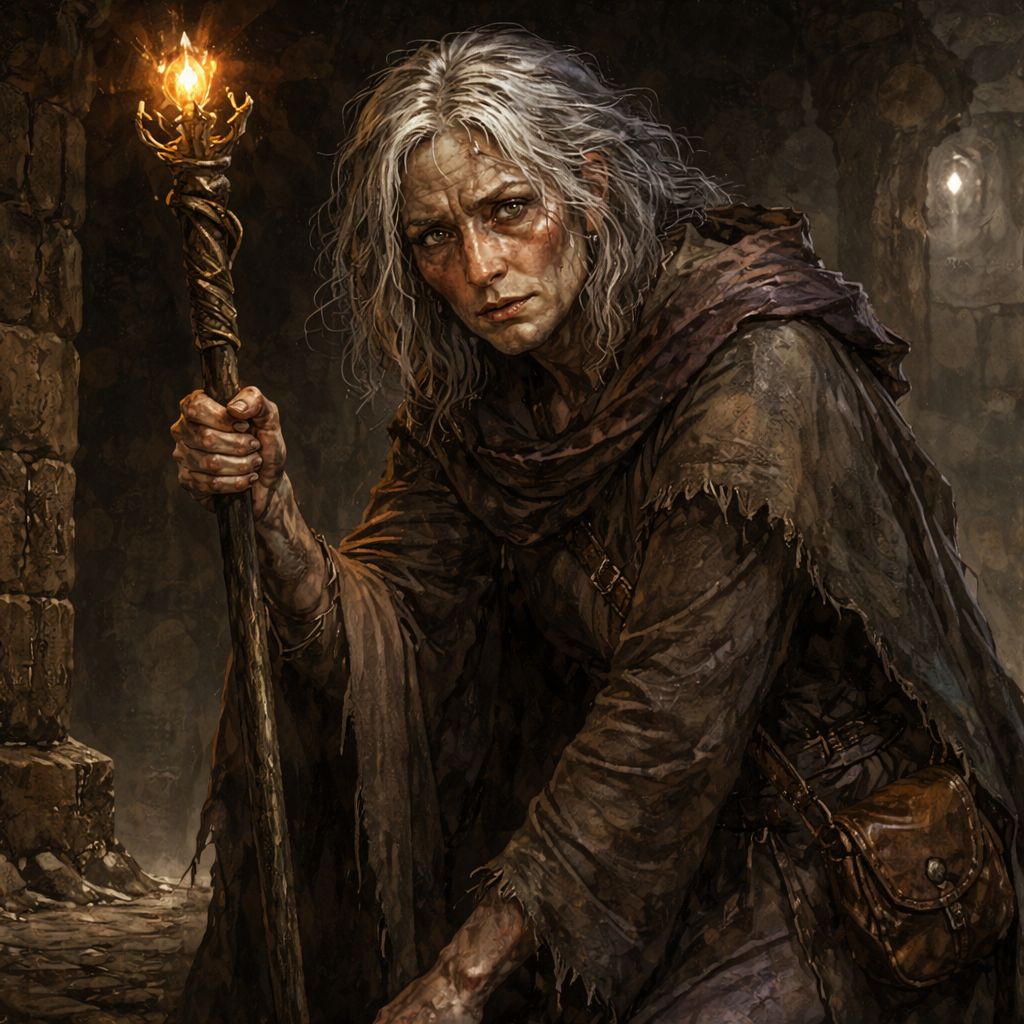
The meeting itself took place shortly after midnight with Colonel Holt and Major Valmorne escorting a thin, pale figure down the road from the prison toward the lone oak tree.
Even at a distance it was clear that Grelda was in poor condition.
Her hair had gone almost entirely gray. Her movements were slow and deliberate, as though each step required conscious effort. The years of confinement had carved deep lines into her face.
When the officers departed and left her standing beneath the oak, Cassyndra approached first.
For a moment neither of them spoke. Then Grelda smiled weakly.
Communication proved… complicated. Without a tongue, Grelda’s speech was little more than breath and broken sounds. With some patience—and the aid of writing materials—she was able to explain what had happened to her.
She had indeed cut out her own tongue to avoid interrogation. Unfortunately the Crown possessed ample resources and cast regenerate, restoring the missing organ.
The interrogation that followed had been thorough and when they were finished, they removed her tongue again.
She was imprisoned under difficult circumstances and then, when the Northmarch Correctional Bastion was opened, she was transferred there where conditions worsened considerably – the prison’s antimagic field not only forbid magic but, with prolonged exposure, it also ate away at the very fiber of magical beings. It was, she conveyed, an experience she did not recommend.
During this explanation she also managed to reveal something else because aunts, as is well known, are entirely incapable of keeping secrets. She had scribbled something quickly on a scrap of paper – I tried to help my nephew Kasian escape – she glanced at Cassyndra.
Spell backfired. Now my niece.
The party absorbed this revelation with admirable composure. After all, everyone knew that magic was like that sometimes.