November 20th, 973
The Big Four
The journey south began, as many worthy journeys in Archea do, with paperwork.
Unfortunately, the matter before the party was not the comparatively civilized business of visas, tickets, lodging, or the quiet indignities of currency exchange at usurious rates. Instead, it was tax season.
This presented a question of immediate and personal significance: whether any among them intended to file Form 1040–A (Adventurer).
Shamus, moved either by conscience, caution, or some private theological theory regarding the afterlife’s treatment of unpaid civic obligations, elected to do so.
The rest declined.
Some did so on principle. Others on habit. And a few, having spent sufficient time operating several paces outside the ordinary structures of state and society, no longer felt especially beholden to them.
During the day’s travel, conversation turned more than once to Grelda and to the possibilities that might open if she could be restored to something like her former strength and mind. Chief among these was the question of Cassyndra’s own transformation. If Grelda recovered sufficiently, might she be able to reverse the magic that had once turned Kasian into Cassyndra?
Cassyndra, whose imagination remained admirably resistant to unwarranted optimism, pointed out that her prior experience with the spell had showed that it was difficult to control. Repeating the spell did not guarantee restoration to her prior self. It might simply produce a different outcome.
“A dwarf, for instance,” she observed.
Wolfgang did not appear delighted by the example.
Thimbleton, Properly
On the second night of travel the party arrived at Thimbleton, a village of perhaps three hundred souls.
They had, technically speaking, been here before. On their previous passage through, however, they had been escorting a quantity of rum gremlins too rambunctious for ordinary lodging and had therefore spent the night in an outlying barn rather than among the respectable inhabitants of the town itself. This had deprived them of a closer look at the place.
It was, upon inspection, doing remarkably well for itself.
Thimbleton’s prosperity showed in the clean lines of its buildings and the relative freshness of its construction. Nearly everything in sight appeared to have been built within the last seventy-five to one hundred years. This gave the village an air not merely of success, but of success recently attained and competently maintained. There were few signs of picturesque antiquity, but many of practical comfort.
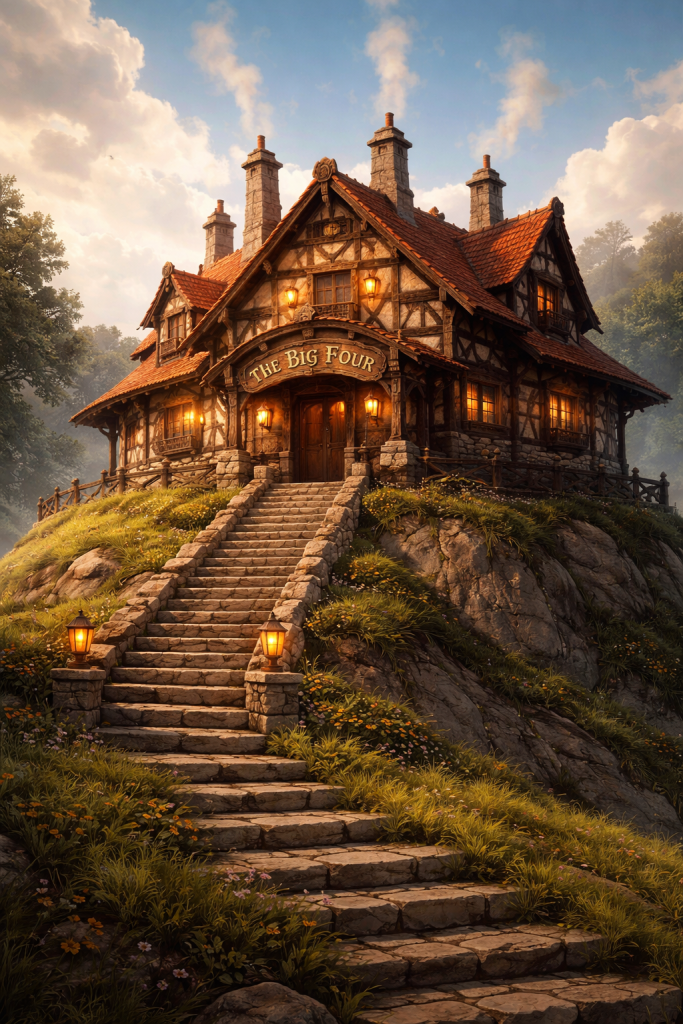
The chief local establishment was a tavern and inn called The Big Four.
This was an unusual structure even by the standards of prosperous rural inns. It sat atop a broad mound, with two stories above and a cellar built not underground, exactly, but into the mound itself. The arrangement was odd enough to invite notice but not, at first glance, odd enough to demand explanation.
The inn itself was warm, orderly, and hospitable. Rooms were secured without difficulty.
Grelda, still greatly weakened by travel and her long ordeal, was taken upstairs to rest, where Pabst brought her dinner and attended to her with the natural ease of someone who had, over the course of the journey, quietly become her nurse, assistant, and in some respects rather fussy guardian.
Hunkle also dined in his room, having suffered an injured neck during a rear-end accident earlier that day. Fortunately, a Computed Thaumographic Scan revealed nothing serious, and he was expected to recover.
Laveleen, meanwhile, was feeling under the weather and elected to retire early as well.
Gareth, after seeing that Grelda, Hunkle, and Laveleen were all made comfortable, occupied himself with writing letters and sending money home—an activity which, though less dramatic than the slaying of tax collectors or freeing of prisoners, had the advantage of being difficult to classify as a felony.
This left Ant, Merrythought, Wolfgang, Shamus, and Cassyndra free to descend to the bar in search of drink, gossip, and whatever other forms of intelligence civilized establishments might happen to produce.
The Painting
The bar was comfortable and well-appointed, with the particular sort of settled warmth that suggests long habit rather than recent decoration.
Behind it, however, hung a painting.
It showed seven figures standing in front of the bar in what might have been a celebratory first-day-of-business portrait. The faces were indistinct—whether from age, smoke, artistic limitations, or some less ordinary cause was not immediately clear—but there was something about them that tugged at the edge of recognition.
It was not, perhaps, the first time the party had encountered unsettling ambiguity in a piece of wall décor.
Thomas Reed and the Letter
The bartender, one Thomas Reed, took an immediate and sustained interest in the five of them.
He remained nearby while his staff attended to the rest of the room, making conversation with the careful attentiveness of a man who wished to seem merely sociable while also plainly waiting for something. The party answered politely but did not greatly encourage the exchange and, after a little while, Reed judged it time to explain himself.
The inn, he said, had belonged to his former employer and friend, Edric Hale, who had left it to him upon his death. With the property had come a sealed letter, together with strict instructions regarding when it was to be opened and what was to be done afterward.
The conditions, Reed explained, appeared now to have been met.
He showed them the letter.
Thomas,
If you are reading this, then I am gone. I am sorry for that, though I suspect you knew this day would come long before I admitted it to myself.
I leave the inn to you freely and without condition, save one.
You have poured its drinks, mended its beams, carried its burdens, and kept its fires lit longer than any man living. You know its moods better than I ever did. If this place is to endure, it must be in the hands of someone who listens when a building tells him it is tired.
There is, however, something beneath it that you must never treat lightly.
In the cellar, behind the old storeroom door, there is a room I never showed you. Inside it is an object I pray you will never have cause to think about again. I will not describe it here. Some things grow stronger the more they are named.
You must not show it to anyone.
Not a priest.
Not a wizard.
Not a king.
Not a friend.
If it is ever seen by another soul, the costs will be very high. I accepted the burden of concealing the object willingly, and I have borne it these many years so that others would not have to.
Yet hear me carefully, Thomas, for this matters more than all the rest:
When—not if, but when—a group comes to the inn one day:
– A dwarf of culinary ambition whose beard has been so aggressively mistreated by dye and enthusiasm that it seems engaged in a personal dispute with his face,
– A solemn warrior who carries himself like a man in conversation with ghosts, and who looks at the dark as though it owes him something,
– A halfling woman of noble bearing but common clothing who speaks with the confidence of one accustomed to winning arguments and as often as not knows what you will say next,
– A scholar whose gaze drifts slightly ahead of the present moment, as though the world insists on arriving late to meet her expectations,
– And another—well dressed, quick of word and quicker of hand—who seems equally capable of composing a song about the evening or quietly relieving it of its valuables, depending on which proves more interesting—
—and you may notice they are not alone. There will be with them five others whom they will see to bed safely before attending the bar below. One of them will be an older woman, worn thin by hardship. Treat her kindly. She has endured far more than I can write here.
—Then you must show them the room.
You will not understand why. That is as it must be.
Trust the inn. Trust the moment. And trust that I would not ask this of you unless there were no other way.
Whatever happens after, know this—you were a better keeper than I deserved, and a truer friend than I ever said.
Keep the hearth warm. Mind the cellar steps. And do not blame yourself for what was always going to come.
— Edric Hale
Reed, having allowed them time to absorb this, observed with some understatement that he believed they were the people described in the letter.
The party, after brief consideration, agreed that this was difficult to dispute.
The Storeroom
Reed proved entirely cooperative thereafter. He answered questions freely, showed them all parts of the inn not currently occupied by paying guests, and allowed Wolfgang to compare exterior and interior dimensions in case the building concealed some more obvious spatial absurdity.
It did not.
Nothing in the inn appeared especially strange beyond the matter of the letter, the painting, and the room in the cellar.
Of the inn’s history Reed knew little beyond this: Hale had built it, and the rise of Thimbleton’s prosperity seemed to begin after its construction. Whether the inn had merely benefited from the town’s growth or had somehow caused it remained uncertain.
At length Reed led them to the cellar, set within the mound rather than dug beneath the earth. There he removed the padlock from the storeroom door. The hasp mechanism immediately caught Merrythought’s attention, and Reed was obliged to demonstrate its operation several times before progress resumed.
Inside the room stood a tall mirror in a simple but handsome stone frame of mixed human and dwarvish style.
The frame itself was ordinary enough but the mirror was not.
It hummed faintly. It glowed with a low blue light. And it possessed that unmistakable quality shared by certain magical objects, dangerous people, and questionable foodstuffs—namely, the quality of seeming to know more than was being said aloud in its presence.
The party examined it carefully and learned nothing useful.
Eventually the moment arrived that such situations always require: someone would have to touch it.
Wolfgang did the honors.
905
The transition was abrupt.
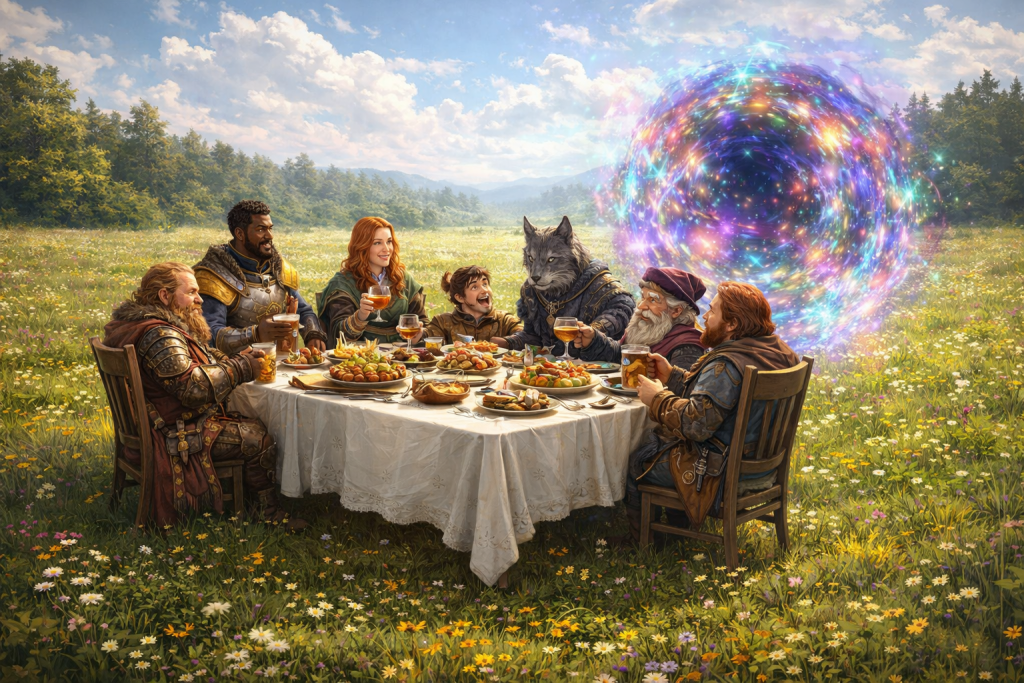
One moment the party stood in the storeroom. The next they found themselves in a pleasant meadow beneath the early afternoon sun, surrounded by scattered trees and a quiet entirely at odds with the previous cellar.
Directly before them stood a dining table laid for seven.
The food upon it was covered by polished metal domes. The party, briefly at a loss for the proper word, was rescued by Cassyndra. “Cloches,” she said.
Beside the table stood two figures; one was a young human man with a strong build and keen, practical eyes.
The other was Kardan.
This, naturally, produced a reaction.
Wolfgang, startled beyond restraint, spoke Kardan’s name aloud. Kardan himself appeared surprised to be recognized. He recovered quickly, however, and replied with perfect courtesy.
“You appear to have the advantage over me, Master Stonecutter. And whom might you be?”
Names were exchanged.
Kardan’s companion proved to be Edric Hale.
And the two of them, they explained, had been waiting.
Lunch in 905
They were, it turned out, in the year 905, in precisely the same place from which they had departed in 973. Only in 905 there was no mound, no cellar, and no inn.
As for Thimbleton, it was not yet prosperous.
It was, in fact, in dire condition.
A quartet of ogres visited roughly once a week. Their habits were simple. They smashed houses, looted property, ate livestock, and when opportunity permitted, villagers. Resistance had been attempted. The most memorable result, Hale said, involved a man named Sven being torn into four pieces, each ogre taking away its share as though participating in an unusually brutal form of rationing.
Since then the people of Thimbleton had adopted the policy—common among the prudent and underarmed—of fleeing when the ogres came and returning afterward to see what remained standing.
Behind the party shimmered the temporal anomaly itself: a volume of distorted air perhaps three feet across, moving and wavering in ways no honest patch of atmosphere ought to manage. This, Hale explained, had appeared before the ogres and had eventually led him to seek help from Kardan.
Kardan, studying the thing, had determined that it was a temporal tear with one end in 905 and the other in some date yet to come. He had also determined two further facts.
First, the tear did come to a definite end in the future.
Second, something—or, more likely, someone—was going to come through it at this precise hour on this precise date.
These observations, taken together, suggested that whoever arrived through it might have some relation to the tear’s eventual closure. Kardan and Hale had therefore done the only sensible thing available to civilized men faced with an unstable hole in time.
They set a table and waited for guests.
There was urgency in this hospitality. They had discovered that the more people looked upon the tear, the larger it became. Left unchecked, it might begin expanding through both space and time in 905 and in its future terminus as well.
Kardan, who was in one of his more explanatory moods, suggested that the passage of time might in some way depend on the consciousness required to perceive it. This, he speculated, was why observation seemed to feed the anomaly.
The meal concluded shortly thereafter, and the villagers who had laid it out returned to clear away the table, the chairs, the cloth, and the cloches.
Surveying the Problem
The party toured Thimbleton and found it much as described: older, rougher, and visibly damaged from repeated ogre raids. Nothing in the village yet resembled the prosperous settlement they had visited in 973.
From what Kardan and Hale knew—and what the party could infer—it became clear that several things would be required.
The tear would need to be stabilized.
Then contained.
Then fixed within a mirror.
Then the mirror would need to be oriented correctly.
Then the structure that would become The Big Four would have to be built around it so that the anomaly remained hidden until 973. And it would have to be secured against ogre raids.
Finally, if something traveled from 973 to 905 and back again through the same breach, the loop would close and the tear could be safely sealed.
This was a remarkably neat solution, and therefore almost certainly correct.
Preparations Against Ogres
The village, though frightened, proved willing enough to provide labor once it became apparent that the newcomers intended not merely to theorize about ogres but to kill them.
After some discussion, the party recognized the great strategic advantage presented by an enemy foolish enough to attack on a schedule. If the ogres came regularly, then they could be received properly.
And so preparations began.
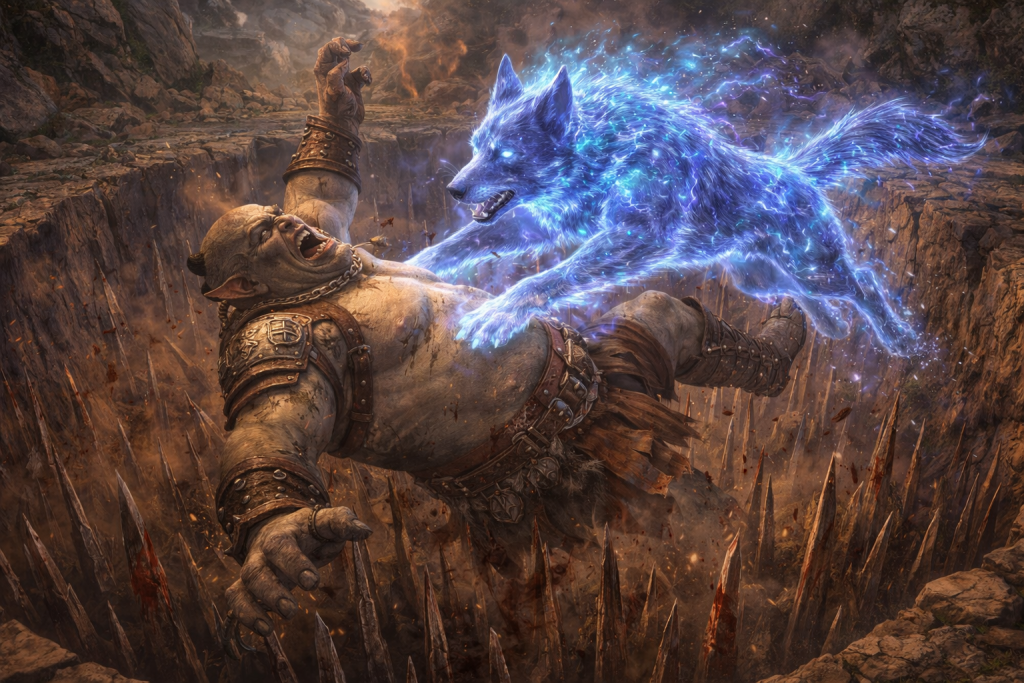
Pits were dug and lined with spikes. Oil was laid and fires prepared. Tripwires were set. The ground was shaped to channel the attackers. Bait—both raw and cooked meat—was arranged with care.
Wolfgang, meanwhile, began constructing a stone frame modeled on the one the party remembered from the cellar in 973. Peasants were sent to a larger nearby city to obtain a mirror. Others began work on the future inn itself, focusing first on the storeroom and the mound that would eventually form the cellar basement.
In the spirit of experimentation, the party surrounded the anomaly with a ring of stones. This appeared to halt its further expansion.
In the further spirit of experimentation, Cassyndra devised a test to determine whether time flowed differently beyond the tear. She mounted two candles on opposite ends of a stick, lit them simultaneously, inserted one candle into the anomaly, and waited thirty minutes.
When the stick was withdrawn, everything that had gone into the tear was gone.
This result reduced enthusiasm for further experimentation.
The Big Four Meet The Hanging Men
The ogres returned in due course, and acting for the convenience of others for once, they did so only after the party and villagers had completed their preparations.
As was their habit, they approached from the north. And, as was their corresponding habit, the villagers fled south.
Heka provided ample warning, and the party met the threat with all the ingenuity they had spent so much of the previous day arranging.
The ogres, for their part, displayed all the intelligence and tactical subtlety for which ogres are best known, meaning none whatsoever.
The result was not a battle so much as a demonstration.
They were harried with spells: dissonant whispers, sleep, command, suggestion, eldritch blast, and—always a crowd favorite—divine smite, one use of which split an ogre dramatically from the right side of the neck through the left axilla.
They were peppered with crossbow bolts, fell into pit traps, and were roasted in the same.
And by the end of it, the future prosperity of Thimbleton had, in a very practical sense, been made possible.
It was after this victory that the name of the inn—already known to the party in its future form—became clear in its origin.
There had been four ogres and the inn would be called The Big Four.
Subtlety, after all, is often easiest to appreciate in retrospect.
Solving the Mirror
The party had by this point solved most of the problem except for one important detail: how, precisely, to get the temporal anomaly into the mirror.
This difficulty proved, for a time, resistant.
Fortunately, the party had access to an extremely unusual resource: the Internet Maze and the future version of Kardan who resided, or at least commented, within it.
Making use of this advantage with minimal embarrassment, they entered the Maze and simply asked him how they had solved the problem.
Future Kardan, whose ironic detachment remained gratifyingly intact, informed them that they had carefully moved the mirror so that the anomaly stood centered within it and then rotated the mirror until the image displayed was that of the storeroom.
This was, as it turned out, exactly right – once done, the mirror showed the storeroom in 973 and the tear was ready for closure.
Historical Tidiness
With the solution in hand, the party prepared to leave.
Hale’s path from here had become clear: build the inn, guard the secret, and one day pass both property and instructions to Thomas Reed.
To help preserve the historical record—and because they had, by this point, become accustomed to collaborating with causality rather than merely suffering under it—the party left Hale their copy of the very letter he would later write and Reed would later show them.
They also suggested that Hale commission a painting of the seven of them to hang on the rear wall of the future bar, which explained several things at once.
In a similar spirit of temporal housekeeping, they explained to Kardan the details of the Internet Maze as they knew it in the future. Kardan, for his part, pledged that he would acquire a copy of the Red Ledger in due time.
Finally, with characteristic optimism, they invited him to join them for drinks at The Big Four in November of 973.
Return
The party passed back through the mirror.
From Reed’s point of view, they had been gone only an instant.
The painting behind the bar was now entirely clear. It showed Hale, Kardan, and the five adventurers standing together.
There are moments when history settles into place with a distinctly audible click.
This was one of them.
Kardan, Again
And then, because timing obeys Kardan in ways it does not obey other men, he arrived at the bar soon afterward.
Drinks were had and explanations, comparisons, and exchanges of information followed.
True to his nature as a broker in dangerous knowledge, Kardan listened to what the party had learned in Cambria and in return provided information of his own, letting them know that the thing beneath Northmarch, contained within the anti-magic field, was a balrog.
Apparently, the ancient culture that preceded the orcs in the area had trapped the balrog underground and created the anti-magic field to keep it there. After their civilization collapsed, the orcs came along and eventually discovered the field.
They were able to figure out why the field was there and to set up a self-perpetuating system to make sure that it was always maintained. Unfortunately, knowledge of this was lost during the destruction of the Orcish civilization during the Righteous War but, fortunately, the system continued unmolested until recently when the Crown discovered the field and made use of it by building a prison right on top of it.
As for what the end result of the Crown’s renewed interest in the field might be, Kardan could not say other than to confess that he, too, was worried.
He also provided further information concerning Hollowmere, which was likewise useful and likewise did very little to improve the emotional climate of the conversation.
Still, the evening ended with all parties alive, time repaired, ogres dead, and the inn standing exactly where history required it to stand.
Which, by the standards of recent events, counted as a very successful few days indeed.