December 14th, 973
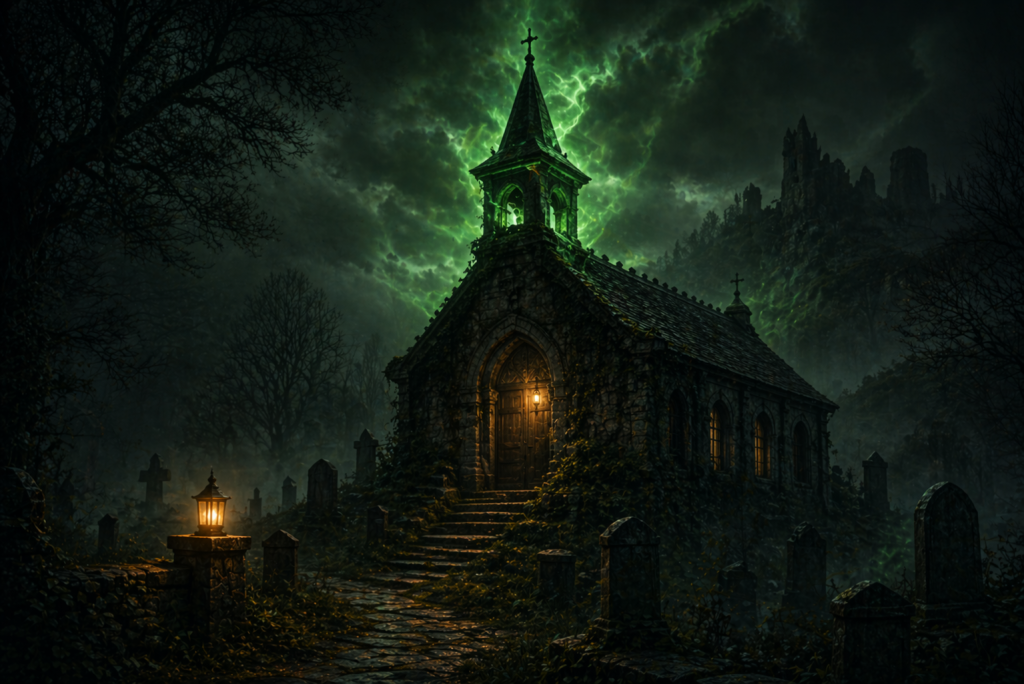
On December 1st, in the crypts beneath the chapel at Nareen’s Hill, the heroes and Warg Squad had faced one another in a brief but tense standoff. That it did not escalate into irreversible violence was due in no small part to the intervention of Shamus and Captain Varric, who were able to negotiate a ceasefire that addressed the most immediate concerns of both groups.
From that precarious beginning, Cassyndra—and, in time, the rest of the party—were able to win Warg Squad’s confidence. They presented evidence that, despite Colonel Varnes’ assurances that they were engaged in the liberation of Cambria, they had in fact been operating, unknowingly, in support of an undead force being raised across the region.
Confronted with this, Warg Squad renounced any further allegiance to Varnes. When told of the Ebon Blades, they expressed cautious interest in the possibility of an alliance.
Before any such introduction could be arranged, however, a more immediate problem asserted itself.
The chapel was surrounded.
The entire village of Nareen’s Hill had gathered, drawn by curiosity and the promise of answers regarding whatever had transpired below. If Warg Squad was to sever ties with Varnes and remain free of his notice, their existence could not be widely known. What the villagers did not know could not later be reported.
Several plans were considered.
Cassyndra, at one point, proposed setting fire to the village’s main turnip store, allowing Warg Squad to escape while the villagers were occupied. Shamus objected immediately, citing both the party’s reputation—“We have a brand to uphold”—and the rather obvious harm such a plan would cause. Somewhat unexpectedly, Wolfgang agreed, expressing a similar reluctance to endanger the villagers. Confused at the unusual solicitude on the part of his master, Chorizo briefly appeared to be concerned that Wolfgang had taken ill, but was reassured shortly thereafter.
In the end, a quieter plan prevailed.
Warg Squad would remain concealed within the crypts until nightfall. The party emerged and informed the villagers that:
- A poltergeist had been dealt with below the chapel.
- Malign spirits might attempt to escape during the night, and each household should draw a protective sigil upon their doors and remain indoors.
- The party would keep watch through the night to ensure the village’s safety.
- By morning, all would be well, and normal services could resume.
To lend weight to the story, Cassyndra used Minor Illusion to conjure a faint, unnatural green glow about the bell tower. The party’s spellcasters stood ready to use Suggestion as needed to keep the villagers from approaching too closely.
As it happened, no such intervention was required. The villagers followed their instructions to the letter and Warg Squad made their escape under cover of darkness without incident.
The following two weeks were spent arranging cautious contact between Barin and Warg Squad by means of encrypted dead drops. Only once that process was underway did the party set out northward toward Briarfell, intent on meeting the Circle of the Second Growth—the druidic foresters whose situation had so concerned Barin.
During the journey, Cassyndra conducted a divination. She produced a small assortment of objects from her pack—seemingly chosen at random—and cast them upon the ground. After a moment’s consideration, she offered her interpretation:
“The oak leaf flies over the obsidian and obscures a secret.”
It was generally agreed that the oak leaf likely referred to the druids they were about to meet.
On the approach road to Briarfell on the 14th, under a clear and pleasant sky, the party encountered a merchant cart traveling in the opposite direction—a man and his son, both well accustomed to the route. As was customary, both parties paused to exchange news.
From them, the party learned that:
- They had been hauling goods from Briarfell for the past five or six years and had found the arrangement consistently profitable. The druids provided lodging while carts were loaded, and the surrounding routes were considered safe.
- Over the past three months, however, they had observed strange lightning over the forest which unsettled the foresters’ animals far more than ordinary storms.
- Curiously, at times, these animals would become similarly agitated even in the absence of such lightning.
- On occasion, their own pack animals would refuse the road entirely, requiring the merchants to dismount and seek assistance from the druids to convince them to move forward.
- Water levels in the creeks, canals, and ponds had begun to fluctuate in unusual ways—generally trending downward, though without clear pattern. The druids, curiously, did not seem greatly concerned.
- To their knowledge, there had been no recent changes among the druidic staff.
After parting ways, the party briefly discussed their approach to the druids. Cassyndra’s vision suggested they would encounter people of fundamentally decent character who were nevertheless concealing something. While some considered the possibility that the druids themselves might be responsible for the disturbances, this seemed unlikely given Barin’s endorsement. The group resolved to approach openly, offering assistance rather than scrutiny, while making it clear they were capable of discretion.
They found the druid settlement to be much as described: constructed with evident care for the surrounding forest, yet comfortable and well-appointed. There was space not only for the workers themselves, but for visiting merchants and their animals, which could remain while carts were loaded.
They were greeted promptly and warmly by Thalen Rootward.
Curiously, however, she showed no recognition of Barin’s name. Even after the party assured her they understood and respected his preference for privacy, she remained uncertain, guessing that perhaps he might have been a client from some time past. She fetched Mara Fenwillow, who, unfortunately, proved equally unfamiliar with him.
They said they would consult a more senior druid—Bramble Vey—and, while they waited, proved willing conversationalists.
What they described, when asked about their work, was not logging in the usual sense, but something closer to long-term cultivation.
Trees were selected years in advance—sometimes decades—and some of them were guided, rather than cut, into the shapes required of them. Some were coaxed into gradual curves suitable for ship ribs; others were encouraged upward in near-perfect lines for mast timbers; still others were shaped into broad arches for structural use. When harvested, it was done selectively and with care, leaving the surrounding forest largely undisturbed.
The work extended beyond the trees themselves.
Animals moved through the operation as collaborators rather than labor. Elk and deer maintained the paths, their reluctance to tread certain ground taken as a sign that something was amiss. Bears assisted in moving heavy timber, their strength applied with steady deliberation. Along the waterways, beavers – both giant and ordinary – maintained dams and subtly adjusted the flow of canals, serving as the engineers of the entire system.
The waterways, in turn, carried much of the burden. Streams, supplemented by a network of canals, transported timber, powered mills, and fed the paperworks. Wood unsuitable for structural use was reduced to pulp and transformed into paper of notable quality—some of it possessing minor magical properties such as resistance to damp, unusual durability, or an affinity for holding ink tightly enough to make subsequent alteration impossible.
Taken together, it formed a system that, kept the forest healthy, supplied necessary goods for people, and kept the druids themselves well-fed and comfortable.
They acknowledged the recent irregularities without much hesitation.
Water levels had been inconsistent, though not, in their view, alarming. The river occasionally ran low, and while the present pattern was troublesome for business, it remained manageable.
Animal behavior was under investigation, though no clear cause had been identified. In addition to the periods of restless behavior noted by the merchant, at other times, certain routes were being avoided without obvious reason, and at times the animals reacted as though something were present that could not be seen.
The “lightning” described by the merchants, they believed, was not lightning at all. It appeared only at night, irregular and unsettling. Unlike natural storms, it provoked a disproportionate response from the animals. More concerning, that animal response was not always tied to the lights themselves; there were nights when the animals grew equally restless without any visible cause.
No unusual patterns of illness or injury had been observed amongst druids or animals.
There had, however, been one incident of violence.
Two or three weeks prior, a merchant cart had been ambushed along one of the outer routes. The Civil Guard had investigated, finding the cart destroyed and its cargo missing. There was evidence of significant bloodshed, but no bodies. The horses, too, were gone. From the description, the party realized they had passed the location themselves—though whatever remained of the attack had since been removed.
Bramble Vey soon joined them.
Unlike the others, she did recognize Barin—though both she and the party spoke of him in careful, indirect terms. She confirmed he was a friend rather than a client, and agreed that the attack on the cart was highly unusual for a region known for its relative safety. She did not appear to recognize the Ebon Blade reference to the ember never going cold.
Ordinarily, outsiders were not permitted beyond the public areas of the forestry. Given their connection to Barin, however, she allowed the party access in the hope that they could shed some light on recent occurrences, provided they were accompanied by a guide: Edrin Mossfall.
A discreet Detect Thoughts from Laveleen revealed a quiet tension beneath the surface of both Bramble’s and Edrin’s composure,
“I hope they figure this out.”
“I hope they don’t discover that other thing.”
Dawn, of the Ring of Dawn, was summoned, and the druids welcomed her into their kitchens without hesitation. Wolfgang, in an act of considerable generosity, supplied them with enough turnips to sustain the camp for the next month or two, and quietly asked Dawn to keep her ears open for anything of interest.
Edrin accompanied the party through several key areas of the operation: the animal enclosures, one of the groves where shaped timber was cultivated, and a stretch of waterway where sabotage was suspected. Over the course of the walk, the party gathered a considerable amount of information—some of it volunteered, some of it offered more reluctantly.
Edrin confirmed what others had suggested regarding the strange lights. He did not believe them to be lightning. They appeared only at night, irregularly, and lacked the predictability of natural storms. In his view, they were some manner of magical phenomenon—though of what kind, he could not say.
Each appearance of the lights was associated with widespread animal restlessness. There were also episodes of similar agitation in which no lights appeared at all. These disturbances, lightning associated or not, always occurred at night, and, given that the last had taken place on Sunday, Edrin judged it likely that another would occur soon. Whether it would be accompanied by the lights could not be said.
When such episodes came, the animals required the attention of every druid on site. By morning, the worst of it would have passed. By midday, the animals would return to something approaching normal—though often visibly and understandably fatigued.
More troubling, perhaps, were the smaller incidents.
At irregular intervals, unrelated to the nighttime occurrences, individual animals would simply refuse to go certain places. There was no clear pattern to when or where this would occur. When pressed, the animals communicated impressions rather than explanations: “It’s wrong.” “Feels wrong.” “I won’t go there.” The behavior was not limited to the domesticated animals; wildlife in the surrounding forest showed similar reluctance.
Fortunately, these incidents were localized. Unlike the nighttime disturbances, they affected only a handful of animals at a time. They did, however, occur at all hours of the day.
When asked about ongoing work, Edrin reported no major new initiatives. There was an experimental grove where the druids conducted long-term research into new growth patterns and techniques, but this had existed since the early days of the operation and, to his knowledge, nothing particularly unusual was being attempted at present.
Nor were there any meaningful internal divisions among the druids—at least, none that rose to the level of conflict. There were differences of opinion, certainly, particularly regarding how heavily the forest ought to be relied upon. Some favored more aggressive use of its resources, others more restraint, but all shared the same underlying goal: sustainability. The difficulty lay in interpretation. Their methods of monitoring the forest rarely yielded clear answers, only gradations—gradations that reasonable people might assess differently. Orric Greenmantle was the druid who was most in favor of dialing back on demands on the forest although Edrin reported that his own views leaned somewhat in that direction as well.
At the animal enclosures themselves, nothing appeared overtly amiss. Druids tended to a handful of animals suffering from ordinary ailments, the sort one would expect in any large operation.
Laveleen took the opportunity to use Speak with Animals to communicate with some of them directly.
She learned that a bear named Big Johnson was currently preoccupied with matters of the heart—specifically, his unreciprocated affection for another bear, Susie. The druids, it seemed, were already well aware of the situation and noted that Susie, for her part, had no interest in him—being both disinclined in that direction and recently recovering from a heartbreak of her own. Big Johnson, unfortunately, had yet to fully grasp either fact and the druids felt it best to let matters play out naturally.
Other conversations proved more immediately relevant.
The dogs, in particular, conveyed a sense of unease. They had, for some time, been aware of unfamiliar scents and presences moving through the forest—people who did not belong, and who did not pass along the usual routes.
Still other animals spoke of the “bad lightning”—a term they used consistently as it bore little resemblance to natural storms to them. It was wrong, in a way they could not articulate, and not confined to any single location in the forest.
Edrin’s own responses, when the subject turned to unfamiliar people in the forest, were notably less forthcoming.
When asked directly whether he had seen anyone new, he deflected. When pressed about signs of camps or movement among the trees, he redirected the conversation. When rumors were mentioned—of figures moving from branch to branch, or shadows where none should be—he offered no confirmation.
The pattern was consistent enough to be noticeable.
He, like the other druids, knew more than he was willing to say.
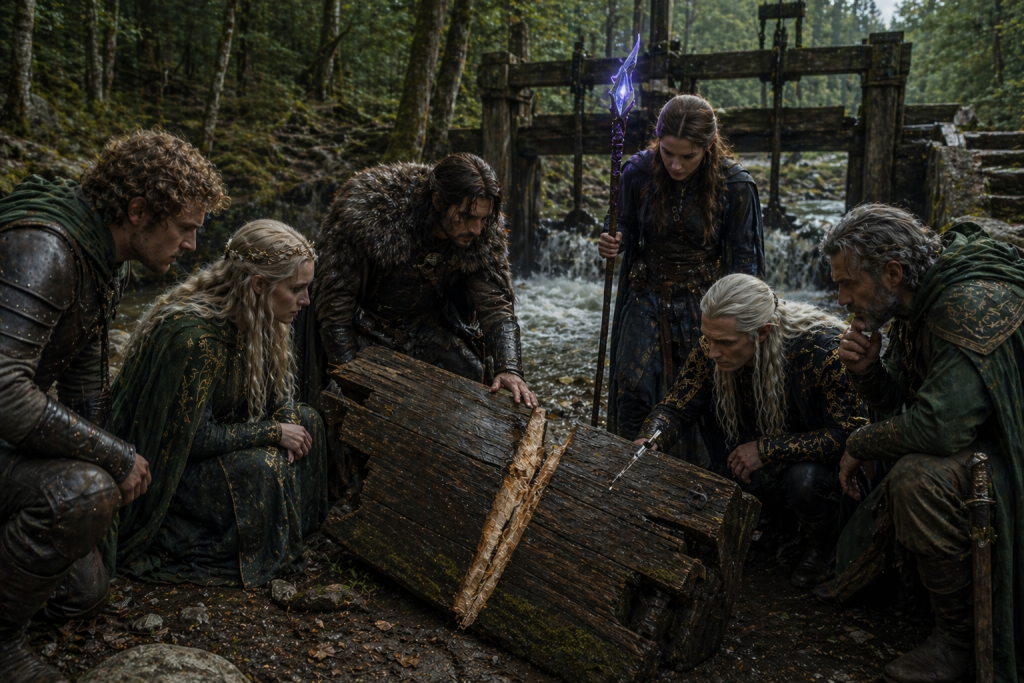
The party next examined the site of a suspected act of sabotage along one of the waterways.
A sluice gate in a small dam had been broken open, releasing a significant volume of water. At first glance, the damage might have been attributed to a collision—a floating log lodged against the mechanism—but closer inspection told a different story.
The design of the dam, shaped in part by both druid and beaver engineering, made such an accident highly unlikely. More tellingly, the damaged wood bore the marks of deliberate cutting. Clean edges, tool work. A fragment of the gate remained, and the party examined it closely.
The loss of water had had practical consequences. With reduced runoff already affecting supply, the druids had relied more heavily on controlled storage—holding water behind dams and releasing it as needed to float timber downstream. The destruction of the sluice gate had prematurely drained one such reserve, halting transport along that branch until sufficient water could be accumulated again.
Heka and Eloise scouted upstream but found nothing of note—no encampments, no additional structures, nothing to suggest a nearby base of operations.
When the question of responsibility arose, Edrin admitted he did not know who was behind the sabotage.
There were, he acknowledged, competitors.
Rothwell Timber Concern was the largest and most established of the three—well connected, disciplined, and not above applying pressure where it proved effective. Their operations were efficient, not at all gentle to the forest, were focused on mundane forestry, and they had long viewed druidic competition as a barrier to their growth
The Hearthwood Cooperative represented something closer to the opposite extreme: smaller operators, joined in a cartel, who attempted to follow sustainable practices but lacked the druids’ skill. They were generally well regarded but not doing well of late and perhaps might be desperate enough to try something otherwise uncharacteristic of them.
The Argent Mast Consortium occupied a very similar business space as the Circle of Second Growth. They dealt in specialized timber—mastwood and other high-value materials—and were known for their exacting standards. Their interest in rare and unusually shaped wood brought them, from time to time, into quiet competition with the druids.
None, Edrin noted, had ever before engaged in anything so overt as this and none of them were neighbors..
Finally, with the party’s help, he assembled a rough timeline of events:
- Water level irregularities had begun approximately six months prior.
- The first confirmed act of sabotage—the destruction of the sluice gate—had occurred roughly three and a half months ago.
- The strange lights and widespread nighttime disturbances among the animals had begun about three months ago.
- The smaller incidents—individual animals refusing certain areas—had followed shortly thereafter.
- The ambush of the merchant cart had taken place two to three weeks ago.
- The most recent appearance of the strange lights had been about a week prior.
- The last major episode of animal unrest had occurred three to four nights ago but came without the lights in the sky.
In addition, he was aware of issues with bad batches of paper occurring from time to time but would need to check in with the druids operating the paper mill to determine the exact timeframe.
Individually, each of these might have been easily explained. Taken together, they were more difficult to dismiss.
The party next expressed interest in seeing the Experimental Grove, and Edrin immediately agreed to take them there.
The grove itself was as orderly as the druids could make it. Trees stood in evenly spaced rows, their growth clearly guided, each one subtly distinct from those the party had seen elsewhere. Some bent at gentle, deliberate angles; others rose in near-perfect lines. It had the feeling of a place where the forest was not left to chance, but shaped—carefully, patiently—toward specific ends.
It was only at the far side of the grove that the pattern broke. Two of the trees—if they could still be called that—had collapsed inward upon themselves. Their trunks had split and sloughed apart into dense, rotting masses of vegetation: roots, vines, bark, and soil fused into something that no longer held a fixed shape. The mass, illuminated faintly by flashes of light within, shifted slowly, as though breathing, tendrils of fibrous matter dragging across the ground. What might once have been branches now lashed outward in heavy, deliberate motions, testing the space around them.
There was no clear boundary between plant and creature. Only movement.
At first, the party held.
They did not immediately recognize what they were seeing, though it was plainly wrong. They took defensive positions and watched carefully. It was only when Edrin cast a spell and realized the danger that the group understood that they were in for a fight.
By then, it was too late to keep distance. The two masses had surged forward with surprising speed, closing the gap before the party could reposition. What followed was brief, violent, and chaotic.
Ant and Laveleen struck repeatedly with Eldritch Blasts tearing open chunks of sodden plant matter and leaving dark cavities where the mass seemed to collapse inward before slowly reforming. Cassyndra conjured a field of spinning blades, forcing one of the creatures through a storm of cutting force, while Merrythought’s magic flickered against the writhing surface, seeking something within that might still be called a target.
Edrin was not so fortunate. Early in the fight, one of the creatures lashed out, striking him with crushing force before drawing him inward—his form vanishing into the shifting mass as though swallowed by the forest itself.
Shamus advanced without hesitation. Closing to point-blank range, he struck with a blow powered by divine force, his blade cutting deep into the creature’s core. For a moment, it seemed to falter—but in doing so, he placed himself between both of them.
It was enough. The second mass turned on him, and within moments he too was overwhelmed—struck repeatedly, entangled, and drawn inward.
By the time the fight ended, both creatures had been reduced to sagging heaps of foul, half-liquefied debris—reeking of rot and stagnant water. The lifeless bodies of Shamus and Edrin tumbled out.
The return to the main settlement with their bodies was made in silence.
Along the way, other druids were encountered. They needed only a glance to understand the tragedy. They helped carry the bodies and dispatched birds ahead, carrying word faster than the party could travel, and by the time they reached the living area, the entire Circle had gathered.
The reaction was immediate and unguarded. Shock first. Then grief. Then grief set aside in favor of what was immediately required.
Bramble Vey and the other senior druids spoke quietly among themselves before addressing the party. They confirmed, after only brief examination, what the party had faced. Two of their experimental growths had degraded into something far beyond their design—into shambling mounds that, under ordinary circumstances, should not have been possible.
The magic employed in the grove, they explained, was controlled, bounded, and well understood. It did not create life in that form. It could not—under any known condition—produce something so aggressive, so unstable.
Which left only one possibility – something else had acted upon it.
One druid, Sable Rowen, turned her speculation, almost reluctantly, toward a particular place. The Sacred Grove of General Sherman.
At the party’s evident confusion, the druids elaborated.
The name, they explained, did not originate with them. It was far older—believed to be derived from the ancient orcs who had once inhabited this region before the Righteous War. The meaning of the name was not understood, and no record existed of any figure—orcish or otherwise—who might have borne it.
What was known was stranger.
During the war, when Archean forces moved through this region, it was widely noted—though rarely explained—that the orcs did not contest this forest at all. Despite terrain that would have favored defensive action, despite the strategic value of the location, the forest had been… avoided.
At the time, this was taken as either a miscalculation but in retrospect, some had begun to question that assumption. It was now realized that General Sherman was the largest tree, by volume, in the world, standing some 275 feet high and 100 feet wide. It was thought to be about 3,000 years old and, as such, might well be the oldest organism in the world. Unlike the other trees in the forest, all efforts to communicate with General Sherman had failed and the druids could not say whether this was because it couldn’t be bothered to talk with them or whether it was because the tree had a totally different experience of time compared to the relatively short-lived druids.
Sable described how the Circle had, from time to time, encountered unusual markings within the forest. Not the familiar symbols of the Circle, nor anything that could be easily attributed to natural causes. These markings appeared sporadically—isolated, easily overlooked.
Except, perhaps, near the Sacred Grove. There, she had noticed, the markings seemed to appear more frequently. And, within the Grove itself, still more densely.
Several of the other druids, thinking back, nodded thoughtfully.
The party set out with Sable Rowan toward the grove she had mentioned.
They knew they had arrived before she said anything.
The trees changed first.
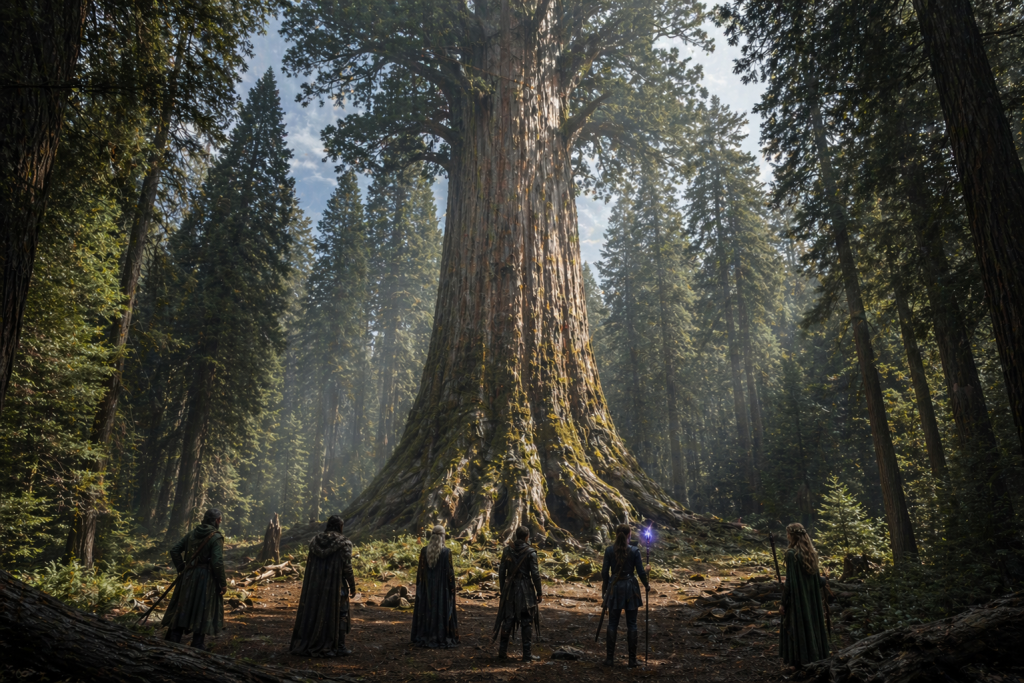
Where the rest of the forest had been shaped, guided, or at least understood, this place felt… older. Less persuaded. The trunks grew wider here, their bark thick and deeply furrowed, their roots pressing up through the earth in slow, immovable waves. The canopy above gathered itself into a height that seemed disproportionate to the surrounding forest, catching the light differently—holding it, rather than letting it pass.
And at the center of it all stood the tree.
General Sherman.
It rose beyond anything the party had yet seen—vast in both height and breadth, its trunk so wide that perspective failed when trying to take it in all at once. The bark bore the marks of age not measured in years but in eras: deep seams, fire-darkened scars, growth layered upon growth in a way that suggested not resilience alone, but endurance.
It did not feel like a tree that had grown.
It felt like a tree that had remained.
The change came gradually. The air thickened—not physically, but perceptibly. Sound dulled at the edges. Light lost some of its clarity, as though filtered through something not entirely visible. There was no single moment where it began, only a growing sense that the space no longer behaved quite as it should.
And then—
There were people.
Two figures were strolling a short distance away, as though they had always been there and had simply gone unnoticed. Their clothing was… unfamiliar. Not foreign in the sense of another culture, but out of place in a way that was harder to articulate. One wore a brightly colored outer garment marked with a stitched emblem—letters arranged in a style none of the party recognized but clearly spelled out “Patagonia”. The other carried a translucent vessel filled with water, the material catching the light in a way that suggested glass, but without the weight or thickness one would expect. This one was inscribed with the equally puzzling communication of “Nalgene”.
The two men, for their part, seemed entirely at ease. “Whoa,” one of them said, looking around with evident delight. “This is incredible.”
“Seriously,” the other added. “The production value alone—this is next level. I’ve never seeing LARPing like this before!”
They approached without hesitation, smiling, looking the party over with the kind of casual interest one might reserve for something impressive, but not unexpected.
One of them gestured toward Merrythought.
“Hey—do you mind? This is perfect.”
Before much could be said, he produced a small, flat object—smooth, dark, and faintly reflective—and held it out at arm’s length while putting his other arm around Merrythought and smiling broadly. There was a brief moment where it seemed to capture something—light, perhaps, or an impression—and then it was done.
Merrythought had been included in the image.
“Fantastic,” the man said, glancing down at the device with satisfaction.
The other had turned his attention to Gareth.
“That is a solid look,” he said, nodding appreciatively. “Honestly, the only thing that would really complete it? Breastplate.”
Gareth, after a brief pause, nodded in return. “I am, in fact, saving up for one.”
“Nice,” the man said, clearly pleased. “Total commitment to the bit. I love it!”
Laveleen’s expression, on the other hand, had shifted. Without speaking aloud, she reached into one of their minds and asked, simply:
What are you doing here?
The effect was immediate – both men froze. Their expressions changed—not gradually, but all at once. Confusion gave way to alarm. They stepped back, eyes darting, no longer focused on the party so much as on something they could not locate.
“Did you—”
“—what was that?”
They retreated further, and as they did, something else began to happen.
Their outlines softened.
Not blurred, exactly—but less certain. As though they were no longer fully occupying the space they had been standing in. Their forms thinned, lost definition, and then, without any clear transition—
They were gone.
The air shifted again.
The pressure eased. Sound returned. The light regained its clarity. Whatever had settled over the grove withdrew just as gradually as it had arrived.
For a long moment, no one spoke.
Then, inevitably:
“Did that device take your soul?” Ant asked Merrythought.
She considered this.
“…I don’t believe so,” she said after a moment. “Though, to be fair, I have no prior experience with having my soul taken, so it is difficult to make a definitive comparison.”
This was accepted as a reasonable assessment.
Sable Rowan, who had watched the events without interfering, proved to be just as confused about it as the party was. Not only had she never seen anything like this, none of the other druids had ever mentioned anything like it before. Her eloquently shocked expression did more to convince the party of her truthfulness than anything else.
The adventurers, perhaps because of the nature of their chosen profession, recovered quickly from their confusion and pushed it to one side as they asked Sable to show them the inscriptions she’d described.
They were carved into the bark of several nearby trees—subtle at first glance, but unmistakable upon closer inspection. These were sharply defined. Angular. Composed of straight lines and hard intersections: squares, triangles, hexagonal forms arranged with a precision that felt deliberate and… unfamiliar. There were no curves, no organic flow. Only structure.
Cassyndra and Laveleen examined them closely and what they found was not comforting. The markings were not concerned with growth, or balance, or transformation instead, they spoke—so far as such things could be said to speak—of termination. Of ending. Not the raising of the dead, nor the manipulation of life, but something more direct.
They spoke of bringing death.
Laveleen, perhaps emboldened by the earlier encounter—or unsettled by it—turned her attention to Sable Rowan and reached, quietly and without announcement, into the druid’s thoughts.
This time, the intrusion did not go unnoticed. Sable’s reaction was immediate and sharp – a tightening of posture, a slight turn of the head, and a glare that passed briefly over Laveleen with unmistakable clarity. There was no confusion in it.
Only recognition. And anger. The controlled, deliberate kind—the sort reserved for breaches of trust rather than simple mistakes.
She said nothing but escorted the party out of the clearing and back toward the encampment.
Merrythought made an effort—light remarks, an apology for the rudeness—but the words seemed to fall into the space between them and settle there without effect. Sable did not respond, and the rest of the party, sensing the change, allowed the silence to persist.
It stretched on longer than was comfortable but was broken, eventually, by observation rather than intention.
One of the party noticed a marking on a nearby tree.
Carved into the bark, rougher than the druidic symbols they had seen elsewhere, was a set of unfamiliar characters:
ਜਨਰਲ ਸ਼ਰਮਨ
The lines were uneven, the strokes repeated as though the carver had worked the same grooves multiple times; a clearly different style than the angular symbols around General Sherman.
They paused to examine it closely and as they did so, Wolfgang, moving slightly ahead, crouched to examine the ground nearby. “There’s something here,” he said.
What he indicated was not immediately obvious, but once pointed out, it resolved into a pattern: a track, faint but deliberate, leading away from the marked tree and deeper into the forest.
Sable spoke before anyone else could. “It’s nothing,” she said. “Just animal movement. You’ll find no shortage of it out here.”
Her tone was even, but there was a slight quickness to the response.
Wolfgang did not look up. “Not the kind I’m used to,” he said.
The party lingered and Sable exhaled, just slightly.
“There are larger matters at hand,” she continued. “The disturbances you’ve seen—the animals, the lights, the damage to our waterways. That is where your attention would be best spent.”
No one moved. The track remained. So did the inscription.
When it became clear that the suggestion had not taken hold, she adjusted.
“There are… others in the forest,” she said at last. “People who keep to themselves. They are not connected to what is happening here. Whatever concerns you think this might raise, I assure you—they are separate.”
That, too, failed to redirect them and the party began to follow the trail.
There was a brief moment—so brief it might have been missed—where Sable seemed to consider intervening more directly.
Instead, she reached to her side, drew a small horn, and sounded it. The note was low and carrying, not loud but penetrating—meant to travel, not to startle. Then she followed.
The trail did not lead far.
The forest shifted subtly as they moved, the undergrowth thinning in a way that might not have been immediately noticeable if not for the tracks that guided them. And then, quite suddenly, the space opened.
They had arrived too late. The encampment was still there—but only just. Whatever life had occupied it had withdrawn moments before their arrival.
The signs were unmistakable.
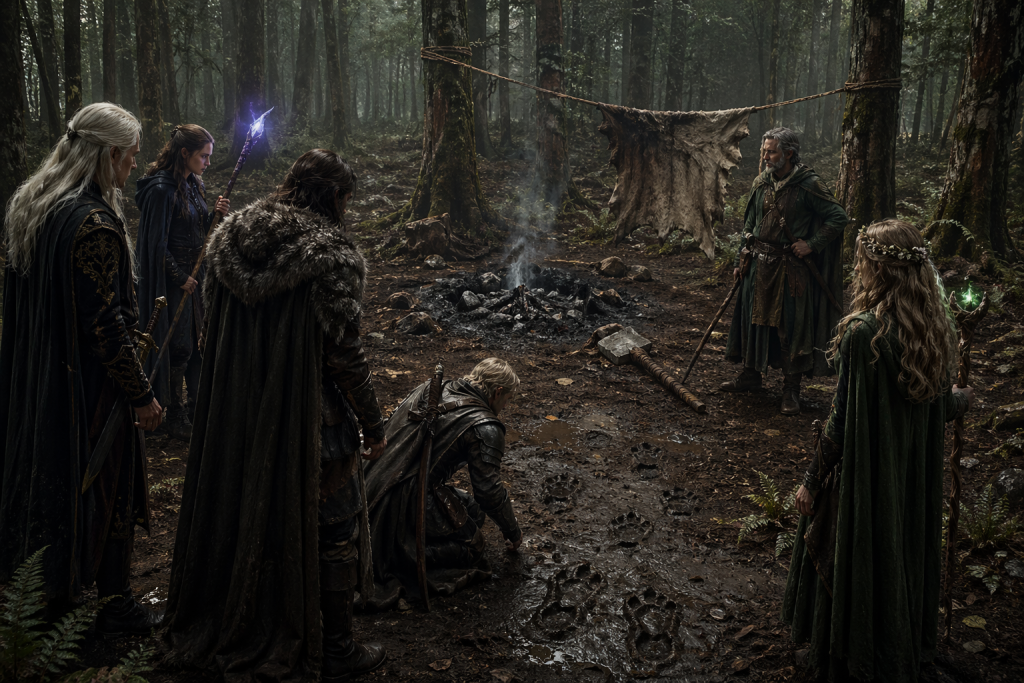
At the center of the clearing, a small fire had been hastily extinguished. The embers still smoked faintly, water having been thrown over them with more urgency than care. A thin thread of steam rose into the air.
Around it, the remains of habitation—subtle, easily missed unless one knew what to look for.
A cord had been strung between two trees, a pelt hung over it to dry. It still dripped in places, as though it had only just been set there. Nearby, leaning against a root, was a crude stone axe, its head roughly shaped and bound to a wooden haft.
Wolfgang approached it, crouching once more. He examined the edge, the binding, the wear. “This wasn’t used on the sluice,” he said after a moment. “Too rough. No clean bite. This is… skinning work. Field use.”
He set it back carefully. Then he turned his attention back to the ground for the tracks were clearer here.
Multiple individuals. Moving quickly, but not chaotically in an organized retreat. The impressions were lighter than expected—whoever had made them had not lingered long nor had they left enough clues to determine where they went. One thing, however, was quite clear.
“Orcs,” Wolfgang said.
Sable stood at the edge of the clearing. She did not deny it. But neither did she elaborate. The horn, it seemed, had done its work.
There was a pause before anyone spoke.
The clearing still held the shape of absence—evidence of lives interrupted, but not destroyed. The faint smoke from the doused fire drifted upward, thinning as it rose. Whatever urgency had driven the orcs away had already passed.
Ant was the first to turn back toward Sable. “You warned them,” she said—not accusingly, but as a simple observation.
Sable did not answer immediately and for a moment, it seemed she might deflect again. Or refuse the question entirely. But something in the tone—something in the way it had been asked—left little room for either.
“Yes,” she said at last with neither apology nor defiance. Just a statement of fact.
The party did not react as she might have expected. There was no demand for explanation. No sharp turn toward suspicion. No calculations as to how they might profit from this discovery. Instead, there was a quiet understanding.
“They’re not the problem,” Merrythought said. “They’re trying to live. Same as anyone else. And in a place where that’s… not exactly permitted for them.”
There was a brief silence. Then, more plainly, “We’re not going to tell anyone. They deserve to be left alone just like everyone else.”
Sable studied them then, more directly than she had at any point before and something in her expression shifted as she nodded
The walk back was… different.
Still quiet, but no longer strained.
Where before there had been a careful distance—measured steps, guarded words—there was now something closer to acceptance. Sable no longer moved as though she were guiding outsiders through something fragile, but as though she were walking among people who had, at least in part, chosen to understand.
When they returned to the main settlement, Sable spoke briefly with the others.
Whatever she said, it traveled quickly.
The reaction was subtle, but unmistakable. Shoulders that had been held just a little too rigid began to relax. Conversations resumed with less hesitation. Eyes that had watched the party with quiet calculation now regarded them with something closer to trust.
It did not take long for the party to understand. The presence of the orcs was the secret that the druids had been keeping from them and from the rest of the world.
What followed was not a formal explanation so much as a gradual unfolding—details offered in conversation, in passing remarks, in answers that no longer needed to be deflected.
The druids believed the group numbered perhaps twenty to thirty individuals. A single tribe, small and cautious, moving lightly through the forest and rarely remaining in one place for long.
They had known of them for a year now. Knowing that to do so would be to spook the orcs into more dangerous territories, the druids had decided not to approach them. They did not announce themselves, nor attempt to establish contact in any way. Instead, they allowed the orcs to believe they remained unseen.
And within that space of uncertainty, they helped, subtly. Fruit-bearing plants were encouraged to flourish along known foraging routes. Small shifts in growth patterns ensured that food was available without appearing cultivated. On occasion, animals were… persuaded—guided, gently—into areas where they might be hunted.
Only small adjustments. Quiet assistance. When asked why, the answers were simple. “They are alive and looking after living things is what we do,” one of the druids said.
Another elaborated, after a moment. “They are part of the forest. No less than the deer. No less than the trees. Their presence is a sign of a healthy system.”
The party took the opportunity to reaffirm their position. They would not speak of what they had seen. Not to the Crown. Not to the Guard. Not to anyone who might bring harm to those who had chosen only to remain unseen.
In the end, most of the party resolved to return to the Sacred Grove of General Sherman before nightfall.
The timing seemed… appropriate.
The druids had made it clear that another night of unrest among the animals was likely imminent. Given what they had seen—and what they had not yet understood—it seemed possible that the grove itself, and the strange angular glyphs carved into the surrounding trees, might play some role in these disturbances. If the lights, the agitation, and the failures in the forest shared a common source, then this was the place where those threads appeared most tightly drawn.
Not all of them chose to go, however. Laveleen remained behind with the druids.
She’d suffered wounds in the fight with the shambling mounds, and while that alone might not have delayed her, there was something else that held her attention. The presence of the orcs—no longer merely suspected, but confirmed—had opened a different line of inquiry. The druids, it seemed, had spent the past year observing them from a distance, learning what they could without revealing themselves, and in that time had collected a number of inscriptions carved into trees throughout the forest.
There was, perhaps, something to be learned there. Something quieter but, perhaps, no less important.
Much, it seemed, had been uncovered.
The presence of the orcs was now understood to be the reason for the circle’s secrecy and, once revealed, proved to be just as noble a motivation as the party could have hoped. The irregularities in the water, too, appeared less ominous than they had at first—strange, certainly, but within the bounds of natural variation.
But these answers did not resolve the puzzle. Other questions remained—less easily dismissed, and less comfortably explained:
- The sabotage of the waterways—deliberate, precise, and unlike anything previously seen in the region.
- The occasional failure of the paperworks, where materials that should have behaved predictably instead produced flawed and inexplicable results.
- The appearance—brief, impossible—of the two strangers in the grove, and the device they carried, which seemed to capture something that could not easily be named.
- The strange lights in the night sky, and the agitation they provoked.
- The growing unease among the animals, not limited to the nights of disturbance, but present in quieter, more persistent ways.
And, perhaps most curious of all—
The matter of Barin. That a man so clearly known to some among the druids should be entirely unfamiliar to others suggested something that had not yet been addressed. Not secrecy, exactly. And not deception. But a gap. A discontinuity. The sort of anomaly that, while not malicious, nagged at the relentlessly inquisitive minds of the adventurers.