December 22nd, 973
Hollowmere – Hive of Scum and Villany?
GM Note – this is the preparation you did for Hollowmere when you were back in Dolven’s Hollow and before you visited Barrow’s Edge, Nareen’s Hill, and Briarfall. I’m just putting it here in Session 23 to help keep things well organized.
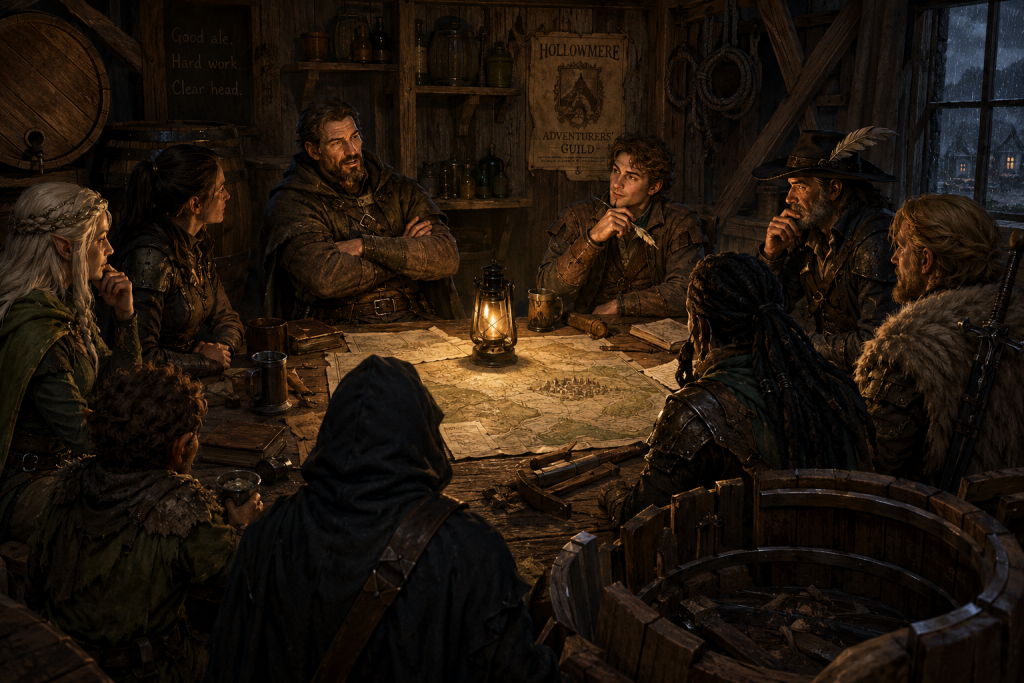
They found Barin and Phineas in the back room of the cooper’s shed behind the brewery, where the smell of sawdust, yeast, and damp barley hung thick in the air. A single lantern burned low between them atop a scarred worktable cluttered with tools, mugs, and the half-disassembled remains of a brewer’s vat that appeared to have lost an argument with both gravity and optimism.
Barin looked up as the party entered.
“There they are,” he said. “Cambria’s future martyrs.”
“Comforting,” Merrythought observed.
“Mm.” Barin gestured toward the benches. “Sit down. The speech improves eventually.”
The room creaked softly as everyone settled. Beyond the walls, rain whispered against the roofs of Dolven’s Hollow.
Phineas leaned back in his chair. “Right. Hollowmere.” The word itself seemed to lower the temperature in the room.
Barin folded his arms. “Most people think of Hollowmere as a sleepy agricultural village,” he said. “That’s because most people are about seven years behind.”
A faint smile crossed Ant’s face.
“Before all this,” Barin continued, “it was quiet. Barley fields. Breweries. Hunters. Trappers. The sort of place where nothing happened quickly and no one saw much reason it should.”
“It mostly survived by renting beds to people with poor judgment,” Phineas added.
Wolfgang nodded solemnly. “A historically profitable demographic.”
Phineas pointed approvingly at him. “Treasure hunters. Adventurers. Bounty seekers. Scholars. Men who heard there was gold in the hills. Men who heard there wasn’t gold in the hills and decided that sounded exactly like something said by people hiding gold in the hills.”
“The foothills and mountains have been mined for centuries,” Barin said. “Copper. Tin. Quartz. Mostly old Orcish workings. Long before the Righteous War.”
Cassyndra tilted her head slightly. “I’ve heard the area saw heavy fighting during the war.”
Barin nodded, “Certainly more there than most everywhere else.”
“People have theories as to why,” Phineas said. “Some say the mines became fortresses. Some say there was an underground city beneath the mountains.” He scratched at his beard. “A few locals swear the Orcs considered the place sacred.”
“Any of those true?” asked Shamus.
Barin gave him a level look. “Almost certainly.”
That earned a quiet laugh around the table.
“The point is,” Barin continued, “the area was considered mostly played out afterward. Never quite worthless. There was always enough left in the hills for stubborn men to scrape together a living.”
“Or a funeral,” Phineas added.
“Mm.”
Barin tapped the table. “Then about seven years ago, the Crown announced it was reopening large-scale mining operations and everyone became suspicious. Correctly so, in my opinion.”
“Their spending up there doesn’t make any sense for mining,” Phineas said. “Neither does the manpower. You don’t flood a nearly exhausted copper region with engineers, surveyors, soldiers, and enough equipment to invade a small country.”
“And all that security’s the strangest part,” Barin added quietly. “Even gold mines don’t get treated this carefully.”
“What kind of security?” Hunkle asked.
“Restricted zones. Patrols. Sappers. Anti-scrying wards.” Phineas scratched at his jaw. “I heard one wizard complaining his familiar got forcibly dispelled for flying too close to a survey camp.”
Barin continued. “Now Hollowmere’s become a proper boomtown. Inns expanded. Barns turned into bunkhouses. Every attic rented out to miners and drunks.” His gaze remained on the table. “Merchants. Gamblers. Courtesans. Laborers. Prospectors. Black-market brokers. Grave robbers pretending to be historians.”
“Scholars,” Laveleen offered mildly.
“Dangerous addition, those.”
“There’s money there now,” Barin said. “Or at least the promise of money. That attracts everyone. Especially people convinced they can find whatever the Crown’s after before the Crown does.”
“And what is the Crown after?” Merrythought asked.
Barin was quiet for a moment while the lantern crackled softly between them.
Then, “If I knew that,” he said, “I’d either be richer or dead.”
Nobody spoke for a few seconds after that.
“There’s a harder edge to the place now,” Barin continued. “Old Hollowmere was rough the way frontier towns usually are. New Hollowmere…” He shook his head slightly. “Too many armed men. Too much money. Too many secrets. Too many people watching themselves while they speak.”
“Law enforcement?” Shamus asked.
Phineas barked a laugh. “Oh, there’s law enforcement somewhere under the pile, certainly.”
“The local constables are overwhelmed,” Barin said. “And the Crown’s mostly interested in protecting its own operations.”
He glanced once toward the shuttered window.
“One other thing.”
That got everyone’s attention.
“We think there might be an Ebon Blades cell operating up there.”
“Think?” Ant asked.
Barin nodded once.
“It isn’t my job to know that,” he said evenly. “Which means if I did know, I wouldn’t say.”
Phineas pointed at him approvingly. “Professionalism.”
“But if they are there,” Barin continued, “they’re keeping very quiet.”
“What does that tell you?” Laveleen asked.
Barin’s expression didn’t change. “Either they’re deeply embedded,” he said.
A pause. “Or they’re frightened.”
The room went still. Even Phineas stopped fidgeting with the broken vat.
Finally Wolfgang cleared his throat. “Well,” he said, “that sounds tremendously unhealthy.”
“Mm,” said Barin. “That’s Hollowmere.”
Briarfall to Hollowmere
The party was of one mind when it came to warning Elvys Pressley of the Cult of the Unmaking’s interest in his expedient demise. Unfortunately, Laveleen’s pseuodragon disagreed having refused the mission no less than three times.
The first refusal came in the form of offended silence.
The second involved climbing onto Laveleen’s shoulder, wrapping itself around her neck like an elaborate scarf, and pretending to be asleep whenever either Manchester or Pfinder was mentioned.
The third refusal involved biting Wolfgang.
“See?” Wolfgang announced, clutching his finger dramatically. “The creature recognizes revolutionary sentiment when it sees it and fears the consequences.”
“It bit you because you smelled like garlic sausage,” Ant said.
“A martyr’s seasoning.”
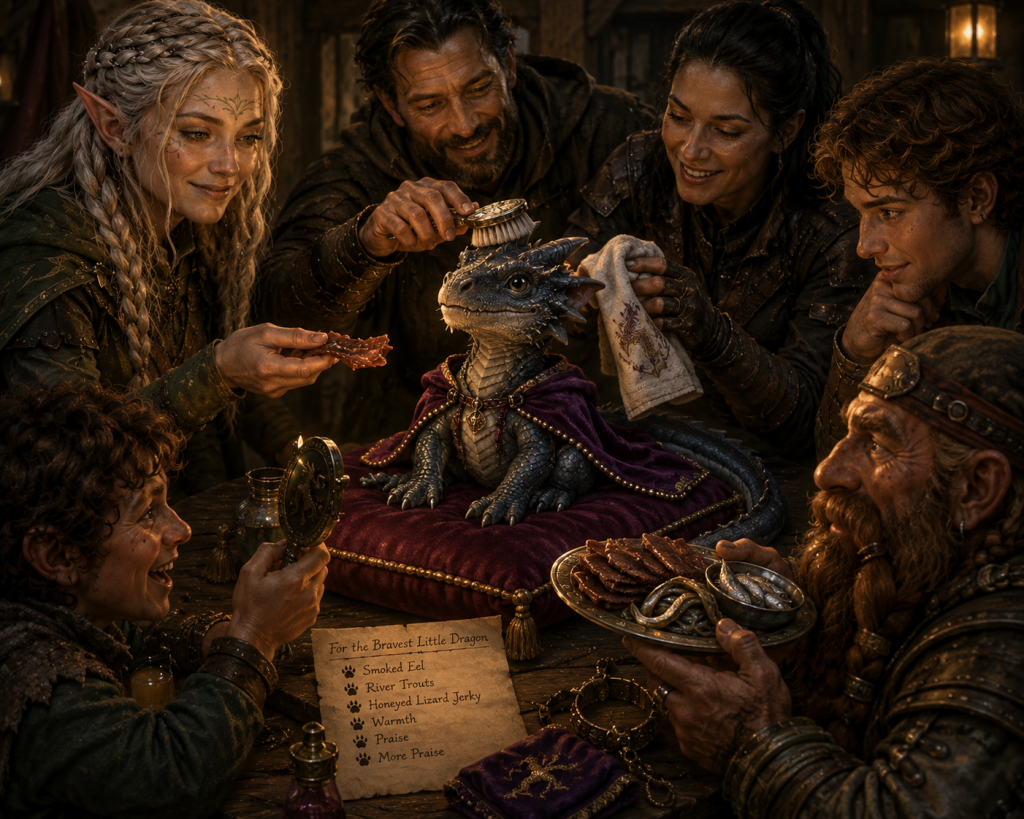
Eventually the matter was settled through bribery, emotional manipulation, and what Merrythought later described as “a level of ceremonial pampering usually reserved for unstable royalty.” The pseudodragon was fed strips of smoked river eel, brushed repeatedly with a silver-backed comb borrowed from the druids, wrapped briefly in a velvet scarf “for warmth,” and assured no fewer than seven times that it was “the bravest and most irreplaceable little creature in all of Cambria.”
Only then did it finally agree to carry Laveleen’s message east to Pfinder.
The tiny creature perched atop a fencepost at the edge of Briarfall Forest, wings folded, staring at the party with an expression of deep personal betrayal.
“You understand,” Laveleen told it gently, “that this may save a life.”
The pseudodragon blinked dubiously.
“And there will be more eel when you return.”
A pause. With an indication of greater interest.
Then, with the air of an underpaid bureaucrat accepting impossible working conditions, it launched itself into the cold gray sky and vanished southward.
The road north from Briarfall Forest proved uneventful in the way only winter roads could be: gray skies, bare trees, cold wind, and long stretches of silence broken only by boots, wagon wheels, and the occasional profanity directed at mud.
The farther north they traveled, the harsher the country became – the forests thinned, the hills steepened, and the air itself seemed sharper somehow.
Conversation came and went in patches, but increasingly one subject dominated the journey – CMOT Dibbler.
Or more specifically – the Crown’s responsibility for CMOT Dibbler’s death.
Wolfgang had entered what Merrythought privately termed the dangerous philosophical stage of grief.
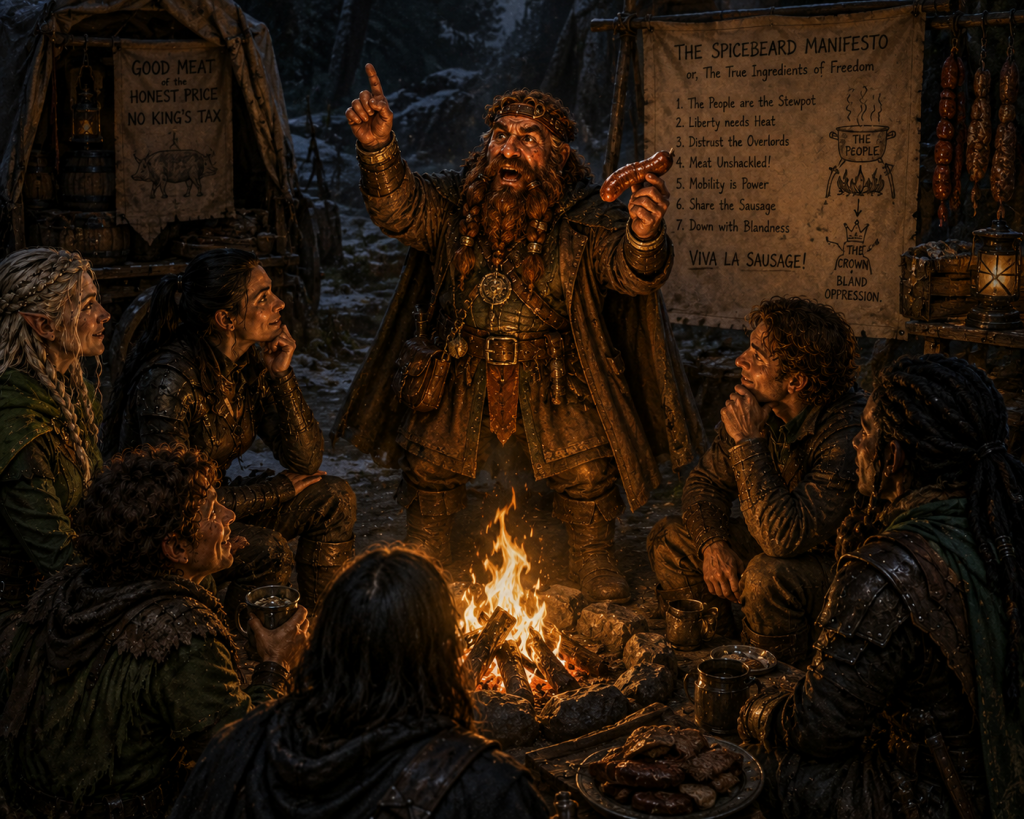
“This,” the dwarf announced one evening beside the roadside fire, “is what happens when governments fear flavor.”
“Flavor,” Ant repeated.
“Precisely.”
Wolfgang stabbed the air with a sausage for emphasis.
“Dibbler understood the common man! He understood the working man! He understood that civilization itself rests upon the sacred bond between hungry people and meat-adjacent products sold with all expediency!”
“An argument difficult to refute,” Cassyndra murmured.
“He sold hope,” Wolfgang continued. “Hope wrapped in bread!”
“Mostly grease,” said Hunkle.
“GREASE IS A FORM OF HOPE.”
The dwarf had, over the past several days, begun developing what he referred to as a coherent revolutionary framework, though to outside observers it resembled a collision between political theory, tavern economics, and extremely aggressive catering.
According to Wolfgang,
- Oppressive systems were “over-seasoned hierarchies,”
- Revolutions required “heat and proper timing,”
- The common people were “the stewpot of history,”
- And the Crown had become “a rotten sausage casing around the future of the nation.”
He had also become increasingly convinced that traveling sausage vendors represented “the purest form of economic freedom.”
“Think about it,” he insisted. “No fixed address. No dependence upon the aristocracy. Meat of whatever origin the market will accept. Constant mobility. True liberty!”
“Wolfgang,” said Ant carefully, “I genuinely cannot tell whether you’re describing a political movement or food poisoning.”
“The distinction,” Wolfgang replied gravely, “is often historical.”
Even Calder eventually gave up trying to redirect the conversation.
The Bureaucracy Responds as Bureaucracies Will
Several days later they reached Harrowden, the last village before Hollowmere.
Harrowden sat crouched beneath the gray northern hills like a town expecting bad news. Its buildings were squat and weather-beaten, its chimneys smoking steadily in the cold evening air. Teamsters, miners, and traders crowded the muddy streets while tired horses steamed in the chill.
The party secured rooms at an inn whose virtues included warmth, functioning locks, and an only mildly alarming soup.
Naturally, the first thing they did afterward was check the courier office.
The clerk—a narrow man with watery eyes and the exhausted expression of someone who spent his days explaining bureaucracy to travelers—searched the cubby shelves behind the counter twice before shaking his head apologetically.
“Nothing yet for Bramblebee,” he said.
Ant’s jaw tightened only slightly.
“You’re certain?”
“Yes, miss. Sorry.”
He hesitated.
“Post from Manchester’s been irregular lately. Weather in the passes.”
“That’s comforting,” Wolfgang muttered. “Nothing says stable governance like losing the mail in winter.”
The clerk wisely chose not to respond.
For a few moments the group stood quietly beneath the dim lanternlight of the office while snow hissed faintly against the windows outside.
A week earlier, in Redmill, Ant had sent her petition to the heart of Cambria:
Petition to the Governor of Cambria
Submitted by Antoinette Bramblebee, in Good Faith and Under No False Name
By Hand and Witness, Before the Chamber of Messengers
To His Honor Governor Gill,
I, Antoinette Bramblebee, do hereby present myself in petition before the Crown, not as one who defies its authority, but as one who seeks to uphold it where others have faltered.
It has come to pass that the individual known as Wülfgang Spicebeard, presently entered into the Imperial Rolls of Wanted Persons, stands within my reach and—by his own word—declares a willingness to surrender himself into lawful custody. Yet such a surrender, if made without recognition or protection, risks collapse into bloodshed, fear, or opportunistic violence before the law may properly take hold.
I therefore seek from the Crown not pardon, nor absolution, but clarity of process and assurance of lawful conduct, so that I may deliver this man alive, unbroken, and answerable before the proper court.
To this end, I humbly request,
That the Crown issue formal written judgment acknowledging this petition, bearing my full and proper name, that there be no doubt as to who stands accountable for this act.
That the Throne extend its word—freely given—that lawful hearing shall precede any final sentence, so that surrender is met not with chaos, but with order.
That I be permitted to bind myself to this task by oath, and to carry that oath in visible and undeniable form, my blood, that all who witness may know I act under solemn obligation.
That I be granted authority, under seal, to enact such measures as are required to see this surrender completed—even where such measures may weigh heavily upon me or mine.
That the Crown recognize that I undertake this burden with full knowledge of its moral cost, and that I affix my name to it without coercion, compulsion, or ignorance.
I do not claim righteousness. I claim only resolve.
If the Crown finds merit in this petition, I ask that its response be issued in clear and binding terms, that neither I nor the accused may mistake its meaning. Should I fail in this charge, I accept that the consequences shall fall upon me as surely as upon him.
I place this request before the Throne with open eyes and an unguarded name.
So witnessed, so written, and so bound,
Antoinette Bramblebee
By her own hand, freely given
[A mark in dried blood is pressed beside the signature]
The memory of it lingered unpleasantly.
Not because the letter lacked courage.
But because everyone understood that courage and wisdom were often very different things.
“Well,” Merrythought said at last as they stepped back into the cold street, “if the Crown intends to ruin our lives, it appears they’re taking the scenic route.”
“We’ll check again on the return trip from Hollowmere,” Ant said.
No one pointed out that this assumed there would be a return trip.
They reached Hollowmere near dusk two days later.
The road curved around a final ridge of dark pine and broken stone before the settlement revealed itself below them.
At first glance, it scarcely resembled a village at all.
It sprawled across the valley floor and climbed halfway into the foothills beyond in a chaos of old farmhouses, new construction, muddy streets, scaffolded buildings, smoking chimneys, and lantern-light beginning to bloom against the coming dark.
The original Hollowmere still lingered beneath it all somehow – low stone cottages, weathered breweries, crooked barns, and frozen barley fields.
But those older bones had been swallowed by something larger and harsher.
New barracks crouched against the hillsides, watchtowers overlooked the roads, long crane arms and winchworks rose black against the mountains beyond.
Smoke drifted upward from dozens of chimneys into the heavy winter clouds overhead.
Even from a distance they could hear hammering, wagon wheels, raised voices, machinery, the barking of orders. Movement everywhere. Much too much movement.
Patches of old snow clung stubbornly to shaded ground and rooftops, gray with soot and mud. The wind that came down from the mountains carried the smell of coal smoke, wet timber, animals, cheap cooking, and something faintly metallic beneath it all.
Ahead of them, beyond the clustered rooftops and rising smoke, the northern mountains loomed like dark teeth against the evening sky.
Wolfgang stared down at the settlement for several long seconds.
“Well,” he said at last, “that appears to be an absolutely catastrophic place to attempt civilization.”
“Mm,” said Ant quietly.
Lanterns flickered to life one by one below them as darkness gathered over Hollowmere.