January 1st, 974
The Battle of Mira’Thar
The party’s stay in Hollowmere began with a missing person’s case. It ended with two armies at the brink of all-out war.
When the party finally escaped from Mira’Thar after the destruction of one of the Sereth, they were no longer adventurers exploring forgotten ruins but reluctant participants in a conflict that had been quietly building for centuries. Before the day was over, they would cooperate with enemies, fight alongside unlikely allies, and cross a line from which there could be no easy return.
The final act began with the arrival of an Inquisitor.
The Inquisitor
The sound of marching boots and distant fighting echoed through the excavated halls as Crown soldiers spread through Mira’Thar under the command of Major Thorne. While the soldiers secured the complex, one man seemed in no hurry at all. Inquisitor Lucien, whose calm demeanor contrasted sharply with the chaos outside, devoted his attention not to issuing orders but to understanding exactly what had happened.
Colonel Varnes, Lieutenant Colonel McAllister, and Captain Billings were escorted into a makeshift interrogation room together. Their interview occupied the better part of an hour, suggesting that Lucien intended to understand every detail before deciding upon his next move.
Throk and his surviving companions were summoned next. Their turn proved considerably shorter, though no one waiting outside could say why.
While awaiting their own interview, the party had been escorted into a nearby chamber to wait. They expected little more than another armed guard and another long delay. Instead, they stopped short.
Professor Harrow looked up from a rough wooden bench, weary but apparently unharmed. Beside him sat the surviving members of Blackvein Company. The relief of seeing familiar faces lasted only a moment before it gave way to confusion.
How had they gotten here? Had they ventured into Mira’Thar of their own accord? Had the Crown recruited them? Or had they, too, been swept into events far beyond their control?
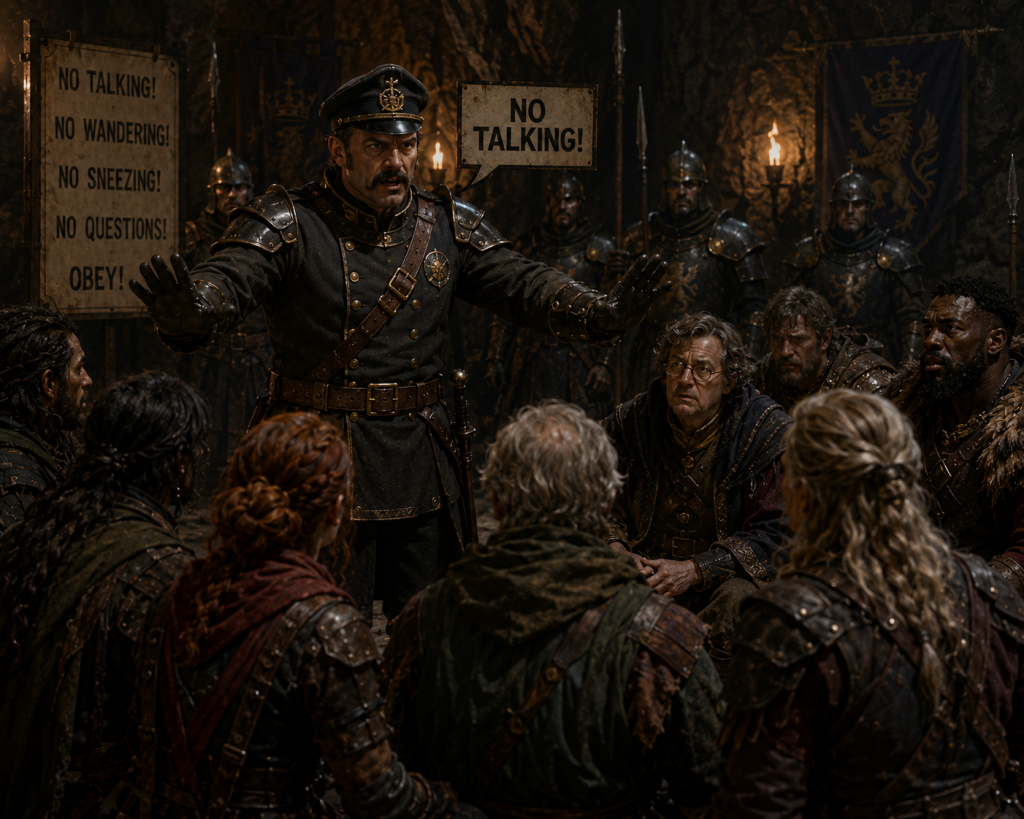
The two parties scarcely had time to exchange relieved smiles before their minder, Lieutenant Officious, made his presence abundantly clear.
“No talking!”
The room fell silent.
A few moments later someone leaned toward Professor Harrow.
“NO TALKING!”
The attempt was abandoned.
Someone took a step across the room.
“No wandering!”
Another uncomfortable silence followed.
A sneeze broke it.
Lieutenant Officious snapped around.
“NO SNEEZING!”
Whether sneezing actually violated Crown regulations remained uncertain, but no one seemed eager to explore the matter further.
So the party waited, limited to little more than exchanged glances and silent nods with their unexpected companions while Lieutenant Officious vigilantly protected the room from conversation, unnecessary movement, and, apparently, unauthorized respiratory activity.
By the time Lucien finally emerged to summon them, the Lieutenant appeared entirely satisfied that order had been maintained.
Questions and Answers
When Lieutenant Officious finally ushered the party into the interrogation room and closed the door behind them, they found themselves alone with Inquisitor Lucien.
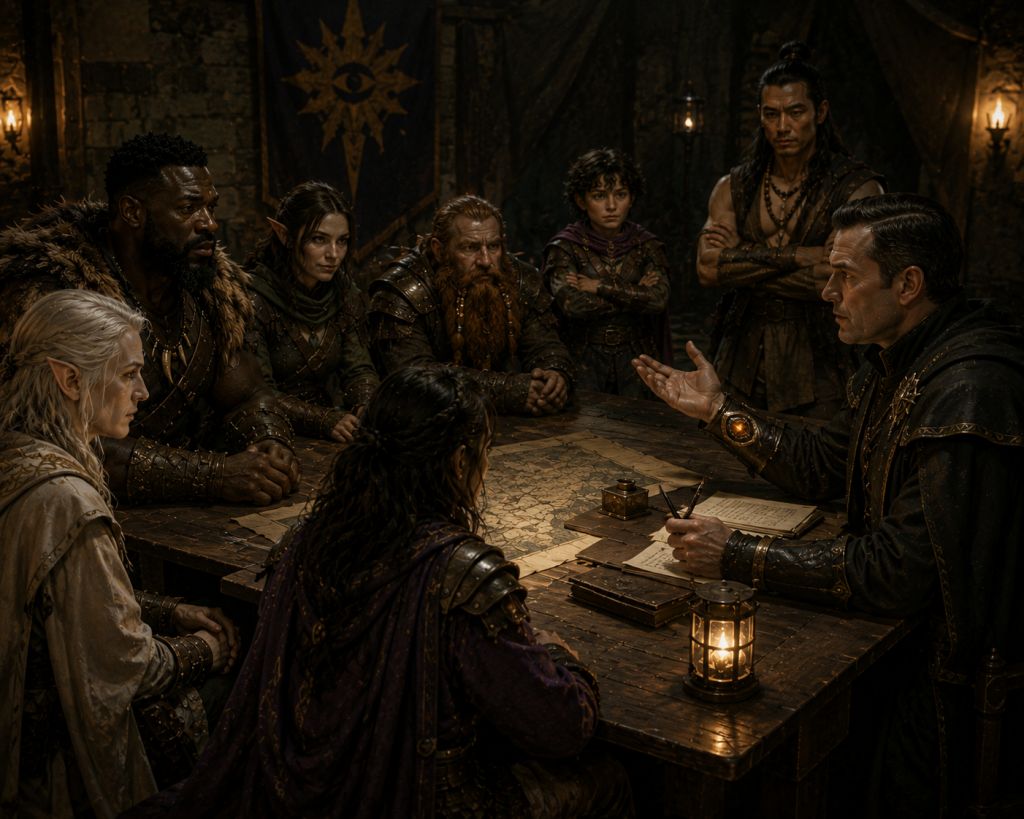
The room itself was unremarkable: a rough wooden table, a handful of mismatched chairs, and a stack of hastily assembled notes. Lucien rose as they entered, greeted them courteously, and invited them to sit.
He wasted little time.
The first questions concerned only with facts.
Patiently and methodically, Lucien reconstructed the party’s journey from their arrival in Hollowmere to their descent beneath Mira’Thar. He interrupted only to clarify details, reconcile conflicting accounts, or establish the order in which events had unfolded. It quickly became apparent that he had already spoken with the other survivors and was carefully fitting each account into a larger picture.
Only after satisfying himself that he understood what had happened did he begin asking a different sort of question.
What had the party made of Corvin?
What did they think of Colonel Varnes?
What, in their judgment, ought to be done with the Sereth?
The party answered all of his questions as honestly as they could while taking care not to reveal either Varnes’ secret allegiance or the presence of a large orcish, hobgoblin, and goblin installation in the area. On the final question, however, there was little hesitation. The party was unanimous in expressing their opinion that the Sereth must be destroyed; that they were too dangerous to attempt to control them.
At one point the party attempted to turn the conversation around.
Lucien smiled politely. “I believe,” he observed, “that it is traditional in these matters for the Inquisitor to be asking the questions.”
For the moment, that was the end of the matter.
Only after the interview had run its course did Lucien relax the formality and allow the party its curiosity.
He explained that Major Thorne’s report had brought him to Hollowmere and that, before departing, he had been briefed on everything the Crown knew of the Sereth. His orders were clear. If the Sereth could be recovered and securely contained under the authority of the Crown, they were to be preserved. Such power, however dangerous, might one day prove essential to the defense of the kingdom. Only if recovery proved impossible—or if there was any real danger that the Sereth might escape or fall into another’s hands—were they to be destroyed.
The distinction was not lost on the party.
Lucien did not merely wish to eliminate the danger. He intended to ensure that the danger remained firmly under the Crown’s control for whatever future contingency might arise.
Finding Common Ground
When the party emerged from their interview, they were not returned to the waiting room they had left. Instead, Lieutenant Officious escorted them into a larger chamber already occupied by nearly every surviving faction in Mira’Thar.
Professor Harrow sat beside the weary members of Blackvein Company. Across the room stood Throk and his companions. Colonel Varnes, Lieutenant Colonel McAllister, and Captain Billings occupied another corner, their interview evidently having concluded some time before. Corvin Hale sat huddled in the corner, silently preoccupied with his own thoughts.
Lieutenant Officious surveyed the room with his customary air of absolute authority. “Remain here.” Without another word, he stepped into the corridor and closed the door behind him.
Silence settled over the room. For several long seconds, no one moved. Eyes drifted toward the closed door as everyone listened to the sound of Lieutenant Officious’s footsteps fading into the distance.
Had the Crown truly left soldiers, adventurers, mercenaries, scholars, and goblins unattended in the same room? The thought that the Crown might be this incompetent was tempting but the second thought came almost immediately. Perhaps they had not been left alone at all.
Whether anyone beyond the door was listening was impossible to know. No one searched for hidden peepholes or pressed an ear against the wall. They simply accepted the possibility and adjusted accordingly. When conversation began, it did so with remarkable caution.
Questions were asked carefully. Answers were measured. Certain topics could be discussed openly, while others were approached obliquely, with half-finished sentences and meaningful glances. More than one speaker seemed to weigh each word before allowing it to leave their lips.
Even so, the opportunity to speak—however cautiously—with others who had found themselves caught up in the events at Mira’Thar proved too valuable to waste.
The party’s first question was directed toward Blackvein Company. “How did you end up here?”
Professor Harrow and the mercenaries exchanged weary looks before Serik answered.
It had all begun, he explained, with what the Crown described as an invitation to report to the excavation camp at their earliest convenience.
Merrythought nodded knowingly.
“Ah,” he observed. “Military.”
Serik gave a dry laugh.
“We misunderstood. We assumed earliest convenience meant after breakfast—perhaps after gathering our gear. Apparently, it translates more accurately as right the hell now.”
The misunderstanding proved remarkably short-lived. Before long, Blackvein Company—and Professor Harrow, whose archaeological expertise had suddenly become indispensable—found themselves being escorted to the Crown encampment. Serik insisted that dragged by the ears would be a more accurate description.
To be fair, no one claimed the soldiers had been rude. On the contrary, they had been unfailingly courteous throughout. They had simply never entertained the possibility that anyone might decline.
The party found the account uncomfortably familiar. Whatever their differences, they and Blackvein Company had arrived at the same conclusion -when the Crown politely requested one’s assistance during a military emergency, the distinction between volunteer and conscript became remarkably difficult to discern.
As the conversation continued, the room gradually shifted from exchanging stories to comparing conclusions.
Everyone had emerged from Lucien’s interview with only part of the picture. Piece by piece, they reconstructed what the Inquisitor had shared with each group. They confirmed that Major Thorne had summoned Lucien after recognizing the gravity of the situation, that the Inquisitor had arrived already briefed on the legends surrounding the Sereth, and that his mission was to bring them under the authority of the Crown if possible—or destroy them rather than permit them to escape or fall into other hands.
That final point prompted quiet reflection.
The party admitted they had argued for a simpler solution. Whatever the Crown might hope to gain by preserving the Sereth, they believed the creatures represented too great a danger to exist at all. Even while professing their loyalty to the Crown, they had urged Lucien to destroy them outright.
Others around the room proved more guarded.
Colonel Varnes listened more than he spoke, allowing the party to infer for themselves that he had said nothing about his affiliation with Soulreaper to Lucien. Throk and his companions remained similarly reserved, listening through Kesh’s translations and communicating only that they had greeted Lucien’s interrogation with stony silence. No one forgot that every sentence might carry consequences beyond the walls that enclosed them.
It was during this careful exchange that Cassyndra found a way around the room’s shared caution.
Rather than risk asking certain questions aloud, Cassyndra announced that she intended to seek divine guidance through an Augury. As the others naturally turned their attention to the ritual, she quietly concealed a Message spell within the preparations, allowing her to speak privately with Varnes without drawing notice from anyone in the room. Away from curious ears—whether beyond the walls or seated only a few feet away—she asked him what he intended to do next.
Varnes’ answer was brief and unequivocal.
If the opportunity arose, he intended to escape, make contact with Soulreaper, and return with reinforcements before the Crown could consolidate its hold on Mira’Thar. He still intended to bring the Sereth to his own side.
The revelation confirmed what the party had begun to suspect. Whatever cooperation existed between those gathered in the room, it was temporary. Once the immediate crisis had passed, the struggle for Mira’Thar would begin in earnest.
With the hidden exchange complete, Cassyndra continued the ritual she had appeared to be performing all along. This time the Augury was genuine. Laying out her cards, she sought divine guidance on a different question: if they entrusted the matter to Lucien, what outcome lay before them?
She spoke the answer aloud.
The cards offered no judgment upon the Inquisitor’s intentions, nor did they promise that all would end well. They revealed only that Lucien, if left to his own devices, was, in all likelihood, capable of controlling the Sereth. When Cassyndra shared that conclusion with the others, it confirmed what several had already suspected. The Crown would hardly have dispatched an Imperial Inquisitor into Mira’Thar unless it believed he possessed both the authority—and the means—to contain the ancient weapon they had unearthed.
The conversation gradually drifted from exchanging information to debating what ought to be done.
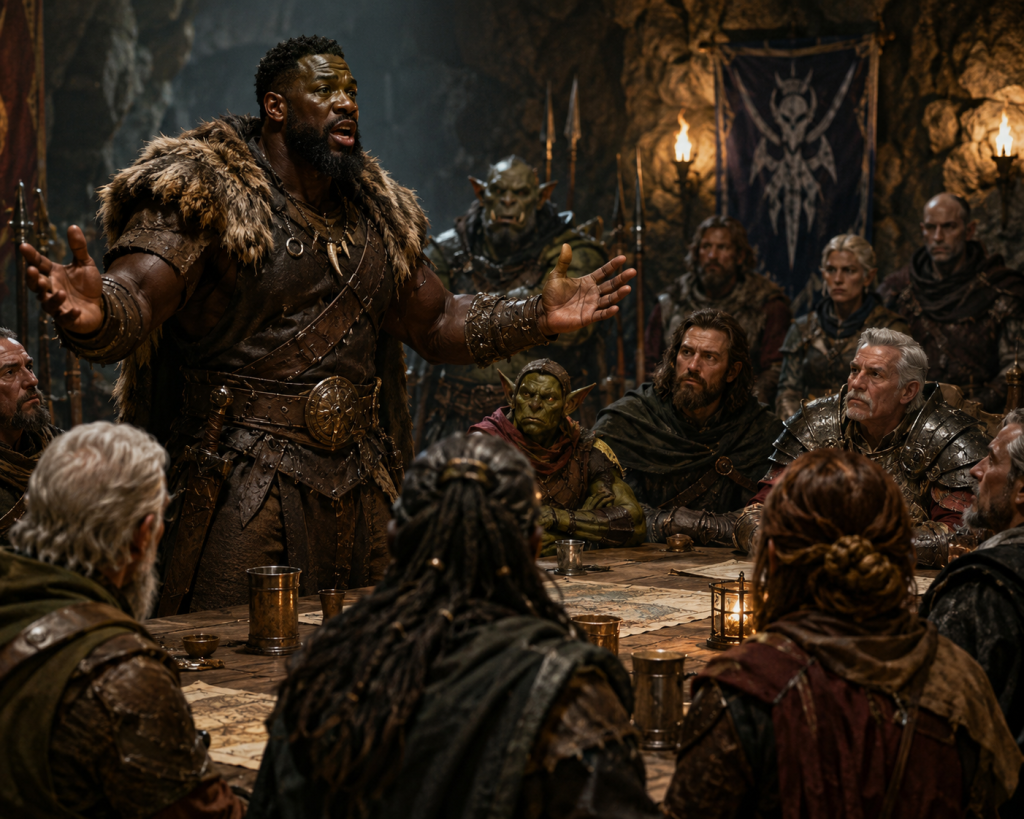
Hunkle, to the surprise of everyone present—including, perhaps, Hunkle himself—became unexpectedly philosophical.
Ordinarily content to express himself in single words and prolonged stares, he, for the first time in anyone’s memory, spoke in complete paragraphs, wrestling aloud with a question that had begun to trouble him. If the Sereth truly could be contained, why did that automatically make them the Crown’s to possess? Was returning these ancient weapons to the same institution that had once employed them really a solution, or merely an invitation for history to repeat itself?
No one dismissed the questions. Indeed, several seemed to share the unease, even if they lacked any better answer.
Blackvein Company, however, viewed the matter from a rather different perspective.
Their profession had taught them that the world contained no shortage of ancient evils, impossible moral dilemmas, and catastrophes postponed rather than prevented. They had not come to Mira’Thar to settle the political future of the Crown or determine the rightful ownership of weapons five centuries old. They had come to survive, collect the payment they had been promised, and, if fortune proved unusually generous, leave with the same number of limbs they had arrived with.
As Serik dryly observed, sometimes the best one could hope for was not to solve every problem forever, but simply to postpone disaster for another five hundred years. Compared with the alternatives presently before them, that seemed an entirely respectable outcome.
It was an answer Hunkle found equally unsatisfying and difficult to refute.
As the discussion continued, Gareth’s attention shifted from the individuals in the room to the alliances that bound them together. Everyone spoke of the Crown, the Sereth, or the goblins as though each were a single, unified actor. Gareth was not so sure.
His first question seemed almost unrelated to the discussion at hand. Turning to Blackvein Company, he asked whether Major Thorne and his soldiers had actually been told what lay beneath Mira’Thar, or whether they were simply carrying out orders. Blackvein’s answer was illuminating. The soldiers, as far as they could tell, had received instructions but no explanation whatsoever. They knew where to march, what to secure, and what to attack, but not the larger purpose behind those orders.
That observation immediately suggested possibilities.
If Major Thorne’s command was acting under Lucien’s direction without fully sharing his objectives, then perhaps the army itself need not be treated as inseparable from the Inquisitor. Major Thorne might prove willing to support actions that Lucien himself would never authorize. The Crown, Gareth realized, might not be a single faction after all.
Nor, he argued, should they assume the Sereth were of one mind.
The creatures consistently referred to themselves as we, but Gareth questioned what that pronoun truly meant. Was it merely the habit of an individual using, in Merrythought’s words, “the Royal We”, or evidence of a genuinely unified intelligence? No one knew. If the Sereth possessed individual ambitions, perhaps one could even be persuaded to turn against another in exchange for the promise of freedom. The idea was speculative, but it illustrated a larger principle: every apparent alliance deserved to be tested before being accepted as fact.
Once Gareth began thinking in those terms, the problem before them looked considerably less daunting.
There was, he observed, an extraordinary concentration of fighting power already gathered beneath Mira’Thar. Major Thorne’s soldiers, Blackvein Company, the party, Varnes and his officers, and perhaps even Lucien himself all possessed the means to confront the two awakened Sereth if their efforts could somehow be coordinated. If necessary, they could even release and kill the six imprisoned Sereth one at a time rather than attempt to fight them all at once.
The challenge, Gareth concluded, was no longer one of strength.
It was one of organization.
Somewhere within the tangled web of competing loyalties, overlapping objectives, and temporary alliances lay a coalition powerful enough to defeat the Sereth. Their task was simply to discover it before the Sereth discovered them.
The War Council
Once Gareth had reframed the problem, the room ceased to resemble a gathering of suspicious strangers and began to resemble a military staff meeting.
No one changed sides.
Colonel Varnes still intended, if circumstances allowed, to return to Soulreaper. Blackvein Company continued to regard surviving the day as a more realistic ambition than solving five centuries of political history. Throk’s loyalty remained firmly with his own people.
None of that changed.
What changed was the realization that none of those long-term ambitions would matter unless the two awakened Sereth were dealt with first.
The discussion therefore turned away from politics and toward capabilities.
Who could stand against the Sereth?
Who was best suited to delaying the skeletons?
Which spells should be conserved for the greater threat rather than spent upon lesser foes?
How could the limited strength gathered within the room be brought to bear where it would matter most?
Ideas accumulated rapidly.
Some were practical. Others were speculative. Gradually, however, the room settled upon a more straightforward plan.
The combined talents already assembled were formidable. Blackvein Company brought seasoned mercenaries. Throk and his companions knew the tunnels better than anyone. Varnes and his officers contributed military experience, while the party itself possessed both the magical and martial power to challenge the Sereth directly. Each group would do what it did best, trusting the others to do the same.
It was an uneasy alliance, assembled from people who trusted one another only as far as necessity required. Yet, for perhaps the only time in Mira’Thar’s long history, mercenaries, goblins, Crown officers, archaeologists, and adventurers found themselves planning not for victory over one another, but for survival together.
Destroy the immediate threat.
Leave tomorrow’s disagreements for tomorrow.
Lucien’s Approval
By the time Lieutenant Officious returned to collect them, the disparate gathering had accomplished something few would have thought possible only an hour earlier.
They had a plan. Escorted back to the Crown’s makeshift headquarters, the coalition presented its proposal to Lucien.
The Inquisitor listened patiently as they outlined the strategy. The adventurers, Blackvein Company, Throk and his companions, and Colonel Varnes’ officers would operate together to confront the awakened Sereth, each contributing according to its own strengths. The plan relied upon speed, coordination, and the willingness of temporary allies to trust one another for just a little longer.
To the surprise of many, Lucien offered remarkably little objection.
He neither dismantled the proposal nor replaced it with a plan of his own. Instead, he accepted it with little more than a handful of practical adjustments. Lieutenant Officious would accompany the expedition, both to represent the Crown and to ensure that the group could move freely through the army’s positions without misunderstanding or delay. With that, Lucien authorized them to proceed.
Relief spread quickly through the room.
After so much effort spent forging a coalition from competing interests, no one was eager to begin the negotiations anew. Lucien’s approval felt less like a victory than a reprieve.
Only much later did anyone pause to reflect upon how readily the Inquisitor had agreed.
Had he simply recognized a sound plan and wisely chosen not to interfere?
Or had he seen something more?
The coalition’s proposal would carry nearly every independent actor in Mira’Thar away from the heart of the complex: the adventurers, Blackvein Company, Throk’s followers, and Colonel Varnes with his officers. Should they succeed, the awakened Sereth would be drawn away with them, leaving Lucien free to secure the excavation, attend to the imprisoned Sereth, and observe where Colonel Varnes’ loyalties ultimately led him.
Whether that outcome had been Lucien’s intention from the beginning, or merely a fortunate consequence of an otherwise sensible plan, remains impossible to know.
What is certain is that, at the time, no one gave the question much thought.
They had a battle to fight.
The Sereth’s Bargain
The coalition’s carefully arranged approach proceeded almost exactly as planned. The Sereth was waiting where they expected, drifting languidly into view, its voice carrying effortlessly through the ancient corridors.
“Warmbloods,” it called. “You are here. Time to release us.”
The party played for time and, for a few moments, the conversation took an unexpectedly surreal turn.
The Sereth attempted its usual persuasion – promising treasure beyond imagination, power, and freedom from danger. None of these offers seemed to produce the enthusiasm it expected.
Then, apparently reaching a new conclusion about the psychology of warm-bloods, it tried another approach.
“You require mates.”
The declaration carried all the confidence of someone announcing an important scientific discovery.
The Sereth had observed enough of mortal life to conclude that humans, elves, dwarves, and goblins devoted remarkable amounts of time and energy to finding suitable companions. Why this should matter remained entirely beyond its understanding, but clearly it mattered.
Very well.
It could provide mates.
Of whatever variety proved desirable.
“Same gender? Opposite gender? Both genders? All of these can be had.”
The offer was made with perfect sincerity and complete incomprehension. To the Sereth, companions appeared to be simply another resource—no different from gold, power, or territory—something to be distributed in exchange for cooperation. It never occurred to the ancient spirit that relationships might involve affection, choice, or mutual devotion rather than simple acquisition.
The party, meanwhile, continued the charade with every exchange buying a few more seconds. Every promise delayed the inevitable realization that no prison would be opened that day.
Eventually, however, the Sereth’s patience wore thin.
“Come,” it demanded. “Set us free.”
When no one moved, the Sereth ceased bargaining and demonstrated why so many armies had once feared its kind.
The Battle of Mira’Thar
The Sereth attacked and skeletons poured from the darkness but the coalition was ready.
Calder raised his holy symbol and unleashed a wave of radiant power that crashed through the advancing dead. Dozens of skeletons simply ceased to exist, reduced to drifting fragments of bone before they could close with the defenders. Gareth followed with a well-placed Ice Knife, and McAllister, recognizing that the undead ranks had been softened, answered with a perfectly judged Fireball. Within moments, the overwhelming tide of skeletons had become a scattering of isolated survivors. The strategy they had spent the last hour devising had survived its first test.
While the spellcasters shattered the horde, the rest of the coalition concentrated upon the true threat.
Hunkle charged directly for the Sereth, his enchanted maul cutting through its ghostly form with surprising effect. One by one the others joined him, steadily closing every avenue of escape. The battle that everyone had feared—a desperate struggle against an endless army of undead—was rapidly becoming something altogether different – the methodical execution of a single ancient enemy.
The Sereth adapted immediately. A whisper echoed through the minds of those nearby.
To Colonel Varnes, the message was irresistible. “They know your secret. Come to us. Only we can protect you.”
Without warning, Varnes crossed the battlefield. “I stand with the Sereth!”
For a terrifying moment, the fragile coalition appeared ready to collapse from within. Before anyone could stop him, Varnes turned his formidable magic against his former allies, striking Hunkle with a devastating Blight spell that dropped the barbarian in his tracks. Billings, too, fell under the Sereth’s influence, forcing the coalition to fight not only the ancient spirit but allies whose minds had been stolen from them.
Everyone understood, intellectually, that Varnes was no longer acting of his own free will.
Understanding, especially for Hunkle, however, was not the same as forgetting.
The battle raged on.
As the last of the skeletons crumbled into lifeless heaps, Throk, his companions, Wolfgang, Ant, Zborch, and the remaining goblins broke for the tunnels, carrying out the escape plan they had agreed upon before the fighting began.
The Sereth had an answer for that as well. It turned and unleashed a terrible wave of soul-rending energy down the passageway. The blast swept through the fleeing goblins with horrifying effect, cutting them down almost where they stood. In the chaos, there was no opportunity to count the fallen. Survival demanded that those still standing keep moving.
Yet the Sereth’s desperate gambit achieved only a momentary reprieve.
As Varnes and Billings emerged from the creature’s influence, the coalition closed ranks once more. Whatever suspicions had existed an hour earlier were forgotten beneath the urgency of the battle. The adventurers fought shoulder to shoulder with Blackvein Company. Throk, the lone survivor of the Sereth’s devastating assault upon his companions, returned to the fray without hesitation. Varnes and his officers, shaken by what the Sereth had compelled them to do, threw themselves back into the struggle with equal determination. A hobgoblin, Crown officers, and wandering adventurers—groups that, under almost any other circumstance, might have found themselves on opposite sides of a battlefield—now stood united with a single purpose. Every spell, every arrow, every swing of a blade was directed toward the same ancient enemy.
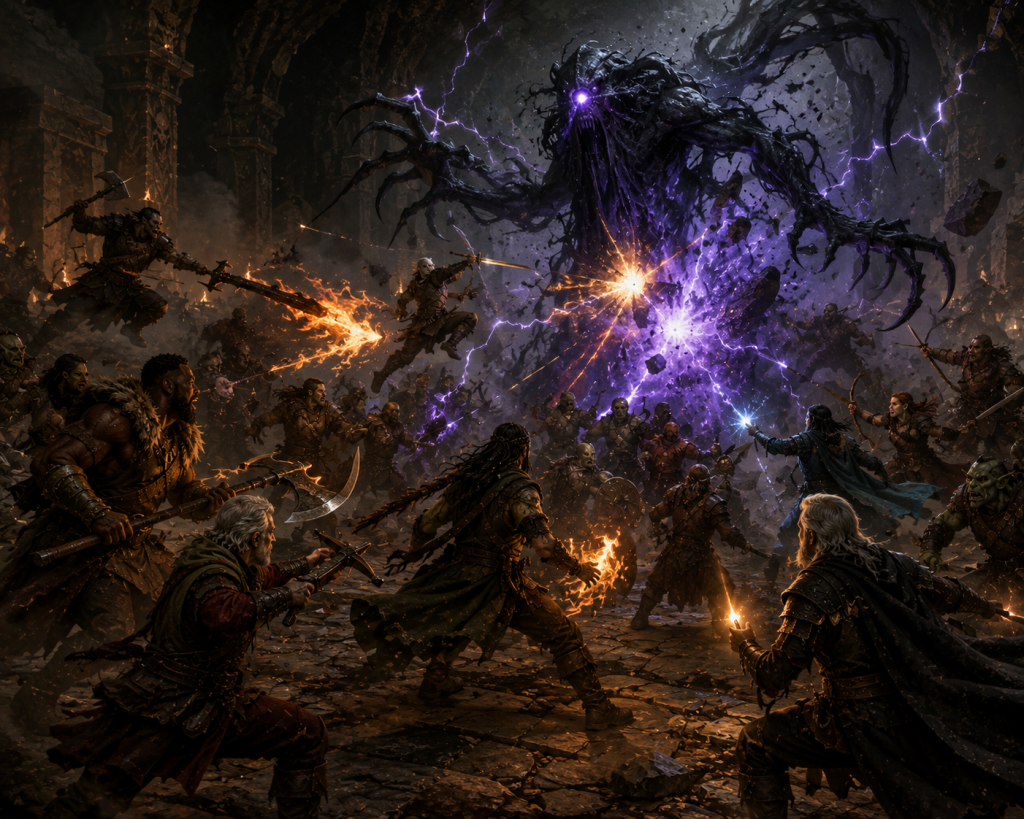
By now the Sereth understood that the battle had been lost and abandoning any pretense of victory, it attempted the only course remaining: escape.
The coalition refused to allow history another chance to repeat itself.
Hemmed in from every side, battered by spell and steel alike, the ancient spirit was finally overwhelmed before it could flee into the deeper reaches of Mira’Thar. After five centuries, another one of the Sereth had fallen at the hands of the living.
No one remained to celebrate.
The creature’s destruction had removed one danger, but the ancient city still held others beyond counting. Given the choice between lingering beneath the mountain or escaping while they still could, the decision required no debate.
The coalition turned as one and ran for the exit.
Beyond the Barrier
The ancient tunnels that had so recently become a battlefield now served as an avenue of escape, every step carrying them farther from the prison chambers and closer to the basalt-and-lead barrier that had confined the Sereth for centuries.
Lieutenant Officious did not accompany them. After the Sereth was destroyed, the Crown officer had turned back, presumably to carry news of the battle to Lucien while the others continued toward the only refuge still available.
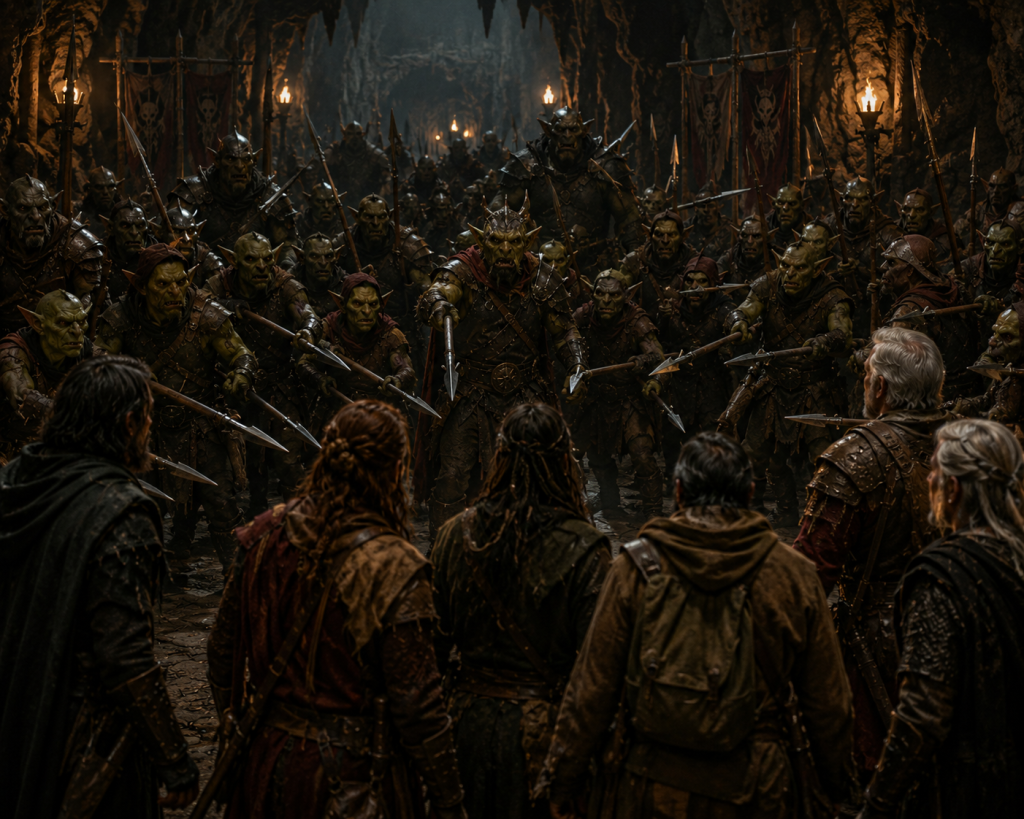
Beyond the barrier, they found themselves staring into a forest of leveled spears.
Orcs, goblins, and hobgoblins occupied carefully prepared defensive positions, weapons trained upon the newcomers as shouted challenges echoed through the cavern. For a tense moment it seemed entirely possible that the coalition had escaped one battle only to stumble directly into another.
Then Colonel Varnes stepped forward and Throk added his voice.
Recognition spread through the defenders. Weapons lowered, though only slightly. Suspicion remained, but so too did discipline. The survivors were admitted into the encampment—not as friends, but as guests whose fate had yet to be decided.
The first order of business was information. Varnes, Billings, McAllister, and Throk were escorted away to brief Soulreaper’s commanders on everything that had transpired in Mira’Thar. The adventurers, Professor Harrow, Corvin Hale, and Blackvein Company, by contrast, were shown to quarters where, at long last, they might rest.
Only then, as the urgency of survival finally began to ebb, did anyone have the opportunity to think about who had not emerged from the tunnels.
Kesh was gone.
It was an oddly difficult fact to process. The goblin had lied to them, manipulated them, and, after earning his freedom, promptly warned his own people that they were coming. Thanks to Kesh, the walls of the hobgoblin/goblin base had greeted the party with an astonishingly well-informed collection of insults aimed at each of them personally. Any affection they might have developed for him had been tempered by a healthy measure of exasperation.
And yet, somewhere along the way, the frightened goblin who had wanted nothing more than to survive had become their interpreter and, when it mattered most, their ally. He had chosen to stand beside them against the Sereth, and he had died doing so.
There would be time enough later to decide whether Kesh had been a friend, a nuisance, or something that defied either description. Tonight, there was only exhaustion.
Even before the weary survivors could fully settle, however, horns echoed through the caverns and orders rang out. Companies of orcs, goblins, and hobgoblins assembled with practiced efficiency before disappearing into the tunnels leading back toward Mira’Thar.
The heroes never learned precisely what had been decided during the commanders’ council but they did not need to. The sight of an army advancing was explanation enough. One Sereth had fallen, one remained free, six remained imprisoned, and a Crown contingent stood ready to take command of all of them. Soulreaper’s coalition would not allow the situation to stand.
As exhausted sleep overtook the survivors, the struggle for Mira’Thar entered an altogether new phase, one with a certain degree of irony.
If Lucien had approved the coalition’s plan because it removed every troublesome independent actor from the heart of Mira’Thar, leaving him free to secure the imprisoned Sereth on his own terms, events had taken a turn he could scarcely have anticipated. The coalition had not simply withdrawn from the field—they had escaped into the heart of Soulreaper’s largest forward base.
The Inquisitor appeared to have believed that those beyond the breach amounted to little more than a scattering of goblin miners and camp followers: an inconvenience perhaps, but hardly a strategic threat. He did not know what the adventurers had already learned—that those workers were merely the visible edge of a disciplined army waiting beyond the basalt barrier. By carrying firsthand knowledge of the Crown’s disposition, its losses, and the remaining imprisoned Sereth directly into that encampment, the adventurers may have transformed what Lucien expected to be a tactical convenience into the catalyst for a full-scale counteroffensive. Whether he had foreseen many possible outcomes or only a few, this one was almost certainly not among them.
For several long moments, no one spoke.
The ancient underground city was on the brink of changing hands and armies were marching to seize the Sereth for their own ends. Historians, had they been present, might have recognized the opening moves of a conflict that would shape the future of Archea.
One of Blackvein Company’s mercenaries had no such ambitions.
He looked around the unfamiliar camp, sighed wearily, and asked the only question for which he still possessed the strength to care.
“So… are we ever actually going to get paid for this?”