Excerpt From a Recent Edition of The Royal Standard
THE CROWN STANDS, AND CAMBRIA SHALL STAND WITH IT
THE THREATS
There are moments in the history of a nation when troubles arrive singly, permitting government and citizen alike the luxury of considering each in isolation. Clearly, this is no such moment.
Within our own borders, the Cambrian Compact has taken up arms against the Crown, bringing violence and disorder to a nation already sorely tested. Elsewhere, the Orcish rebellion which began in Hollowmere has spread far beyond the district of its origin. Its leaders have bestowed upon their enterprise the grandiose title of “the Reclamation,” apparently believing that a rebellion steeped in the foul humors of necromancy becomes legitimate if one gives it a sufficiently impressive name.
In western Cambria, plague continues its grim work, taxing physicians, magistrates, clergy, families, and the resources of the Crown. Beneath Manchester itself, Crown forces continue the difficult struggle against the so-called Druid of the Sewers and the dangers gathered around that enemy.
To the north, Devon calls up its reserves. Its ministers protest peaceful intentions. We trust that those intentions shall continue until Devon finds them unprofitable.
And amid all this come persistent reports of a clandestine association styling itself the Ebon Blades: masked conspirators who apparently believe that the proper answer to rebellion, pestilence, necromancy, and foreign threats is to weaken the lawful authority attempting to resist all four.
Beyond Cambria, the Kingdom has troubles of its own. Poor harvests, disrupted trade, rising prices, unemployment in some districts and shortages in others have produced hardship and, in places, serious unrest.
These facts should neither be concealed nor exaggerated. They must be understood. And then they must be answered.
THE RESPONSE
There is another fact which the enemies of the Crown would prefer Cambrians to forget: Cambria does not stand alone.
The Kingdom is much larger than this province, its resources deeper than those presently visible from Manchester, and its institutions were not constructed on the assumption that every crisis would courteously wait for the previous one to conclude.
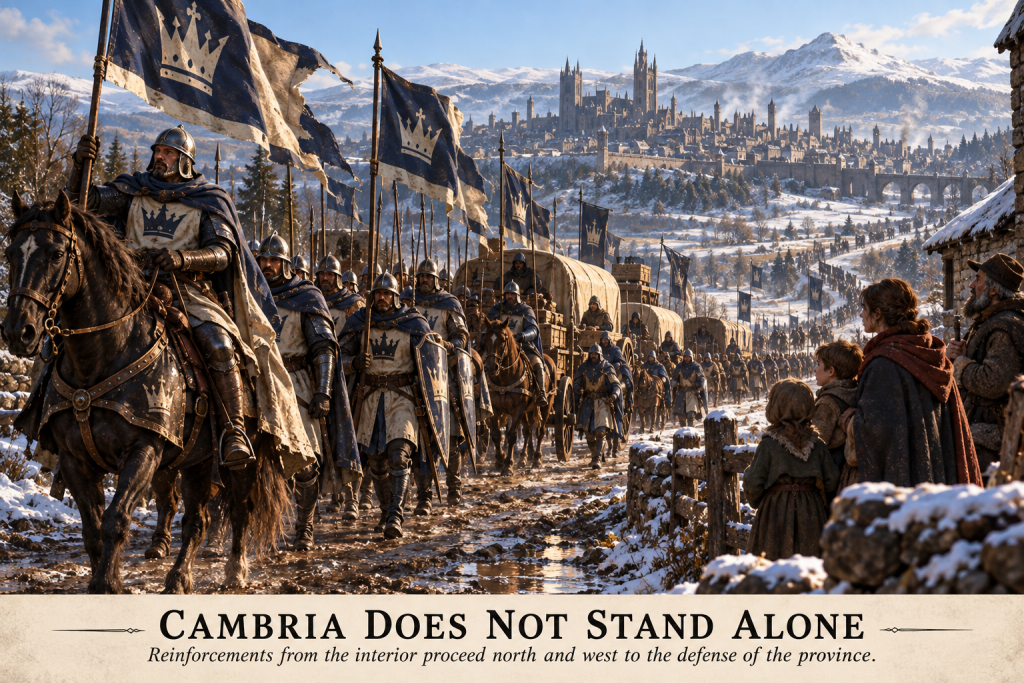
Orders have already gone forth. Additional troops are being assembled for movement into Cambria. Military stores, horses, wagons, healers, engineers, magical personnel, and supplies are being drawn from districts not presently threatened. Extraordinary funds have been authorized. Roads and transport are being placed at the disposal of the emergency effort. Crown offices throughout the Kingdom are being instructed to provide Cambria with the men and material required to restore security.
The reinforcements now beginning their journeys will not arrive everywhere tomorrow. But they are coming.
Nor will soldiers alone answer the present emergency. The strength of the Kingdom lies also in the magistrate who remains at his desk, the farmer who brings his crop to market, the carter who yields the road to a military column, the physician or cleric who tends the sick, and the citizen who performs an inconvenient duty because the alternative is to make his neighbor perform a dangerous one.
That duty now extends even to the treatment of our dead.
THE ROLE OF THE CITIZEN
There is one danger about which the public must now be particularly well informed. The so-called Reclamation, slavishly following in the harsh footsteps of the late and unlamented Goghnol Mogh, has employed animated dead in organized military formations.
There will inevitably be rumors, and the resultant panic will serve the foul masters of the Reclamation considerably better than it serves Cambria. The Crown therefore asks every citizen to remember several facts. Most importantly, just as was the case five centuries ago, the present undead can be destroyed.
They are not invincible. An animated corpse which has been destroyed cannot be raised again. Every such creature destroyed is therefore a permanent reduction in the enemy’s strength.
The dead who have not yet been raised, however, remain potential soldiers for the Reclamation. The rebels have already demonstrated their willingness to make weapons of the dead. We must consequently deny them the ammunition.
This unpleasant truth requires unpleasant precautions. Deaths in districts designated by Crown authorities must be reported promptly. Citizens discovering opened graves, disturbed crypts, missing bodies, suspicious activity around cemeteries, or any other unexplained interference with human or humanoid remains must inform the nearest magistrate, constable, military officer, or other Crown authority without delay.
Some communities will shortly see guards posted at burial grounds. Others may receive instructions concerning the custody or disposal of the newly dead. Cremation may be requested or required where circumstances demand it. Citizens may also be called upon to assist local authorities with transport, supplies, the care of refugees, the maintenance of roads, or other necessary work. Such requirements will be burdensome. They will also be temporary, and they will be infinitely less burdensome than defeat.
We know what some of these orders will ask of grieving families, and they will not be issued lightly. But no mother should be required to see her dead son marching beneath the banners of the Reclamation because sentiment prevented the living from doing what necessity required.
The Crown’s instructions may be reduced to a simple principle: Protect the living. Deny the enemy the dead. Destroy those who have risen.
Citizens should not attempt to recover bodies from territory occupied by hostile undead, nor should they interfere with soldiers, clergy, magistrates, or authorized laborers carrying out emergency measures concerning burial grounds. The citizen who obeys such instructions is not standing aside from the defense of Cambria. He is participating in it.
HOW MANY COINCIDENCES ARE REQUIRED?
It would be comforting to believe that each of Cambria’s present troubles is entirely unrelated to the others. Certainly some must be. Plague does not require a conspirator. Five centuries have apparently done little to moderate certain Orcish political traditions. Devon does not command the dead that rise in our fields, and even the editors of this newspaper hesitate to credit the Ebon Blades with the rebellion rising beneath Manchester’s streets.
But one coincidence in particular deserves the attention of every Cambrian.
The Compact’s violence and the Reclamation’s rebellion arose at almost precisely the same moment. We do not presently claim that the two movements are directed by the same hands. The Crown’s investigations continue, and responsible authorities will establish the facts.
But neither should Cambrians be expected to possess the credulity of children.
Two armed movements attack Crown authority within Cambria at the same moment. One creates precisely the disorder in which the other may flourish. Each draws soldiers away from the fight against the other. Each strains roads, communications, magistrates, supplies, and the public purse. Each profits from every difficulty inflicted by the other.
This may be coincidence, but the editors of the Royal Standard have lived too long to place great faith in such things.
There is, moreover, a darker connection whether the Compact intends one or not. Every Cambrian whom the Compact kills is another corpse which must be guarded, destroyed, or risked as a recruit for the Reclamation. Every battlefield it creates leaves behind precisely the resource the necromancers require. If the Compact and Reclamation are allies, this is monstrous. If they are not, then the Compact is doing its fellow rebels’ work for them without even possessing the wit to know it.
Plague presents the same grim arithmetic. Every death in the west is a tragedy to Cambria and, unless properly dealt with, a potential addition to the enemy’s strength. Thus necromancy powers rebellion, rebellion magnifies plague, and plague in turn furnishes necromancy with fresh opportunity. Our enemies need not all sit around the same table to profit from one another’s work.
Other threats require no common hand at all. The Druid of the Sewers threatens Manchester from beneath its streets while Devon calls its reserves in the north. The Ebon Blades encourage resistance to Crown authority precisely when that authority is most necessary. Economic distress elsewhere in the Kingdom provides every agitator, demagogue, foreign agent, and common criminal with a ready-made audience.
The Cambrian Compact and the unspeakably foul Reclamation may yet prove to be acting in concert. Nonetheless, we do not suggest that one hand controls every threat now ranged against Cambria. We suggest something more modest:
Every enemy of the Crown can read a calendar.
Each looks upon the difficulties created by the others and concludes that now is the moment when the Crown may safely be defied.
They are all making the same mistake.
A government is not proved strong because nothing ever goes wrong. No such government has existed outside children’s stories and ministerial speeches. A government is proved strong when many things go wrong at once and it continues to function.
Taxes continue to be collected. Courts still sit. Orders still travel and soldiers still march in response. Food still enters Manchester. Clerics and physicians still tend the sick. Magistrates still administer the law. The dead that rise are still put down.
And from provinces whose citizens may never have seen Cambria, men, money, horses, supplies, and magic are now moving toward us because an attack upon one portion of the Kingdom is the concern of the whole.
That is what the Crown means. Not a palace, not a particular minister, not even the person who presently wears it. It is the promise that when danger comes to Manchester, someone in a town three hundred miles away whom we have never met will nevertheless be told to load a wagon, shoulder a weapon, open a treasury, leave his family, or surrender something he would rather keep because Cambria is part of his country too.
Our enemies have chosen their moment. So must we.
Obey lawful instructions. Report suspicious activity. Assist the sick. Give soldiers the roads they require. Report disturbances of the dead. Accept that some ancient customs must temporarily yield to military necessity. And when rumor arrives ahead of fact—as rumor invariably does—remember that fear is also a weapon and decline to wield it on the enemy’s behalf.
Above all, reject the counsel of those who insist that because the Kingdom is under strain, this is the moment to tear it apart.
There will be time enough, when the Compact has been broken, the Reclamation defeated, the plague contained, the dead returned to their proper repose, the sewers made safe, and the ambitions of our northern neighbors disappointed, for Cambrians to resume the ancient national pastime of complaining about the Crown.
For the present, we suggest preserving it.
—The Editors