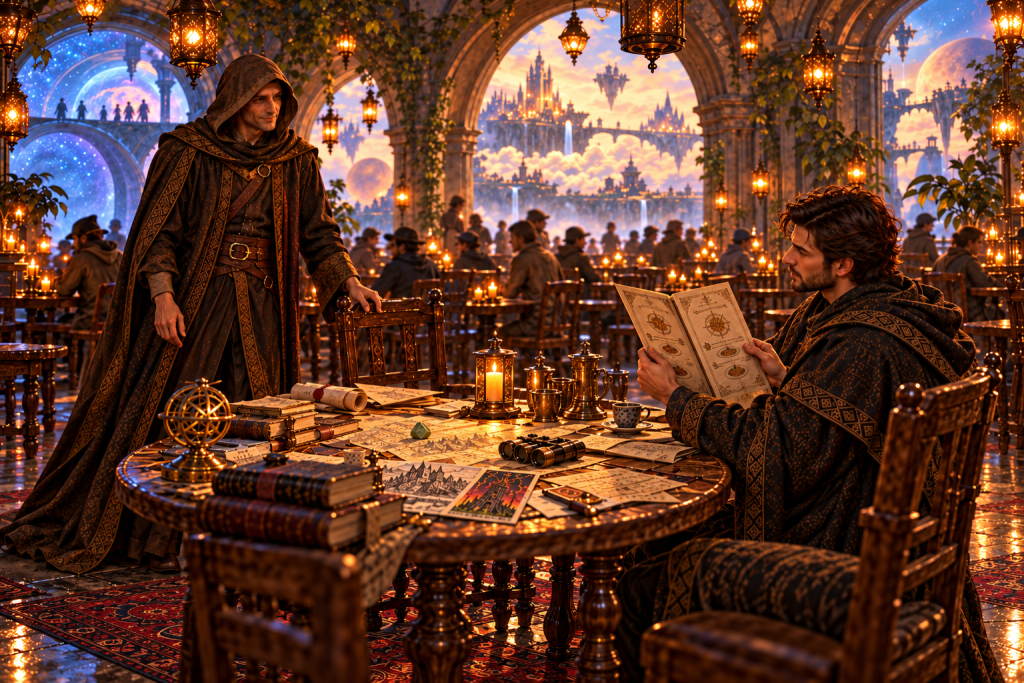
The café occupied a corner where three streets met, although only two of them belonged to the same city.
Through one window, rain fell upon a respectable avenue of printers, apothecaries, and discreetly unsuccessful solicitors. Through another, a violet sea climbed a flight of marble steps. The third window had been curtained since something outside began recognizing the customers and making faces at them.
Kardan approached his usual table to find that his friend was already there, holding a menu at arm’s length. “They’ve added tomorrow’s specials,” he said.
“Avoid the soup,” Kardan advised.
“Have you tried it?”
“I will have done so by tomorrow.”
The friend folded the menu. His face was visible, perfectly ordinary, and difficult to remember even while one was looking at it. This was either a useful accomplishment or the consequence of exceptionally good lighting.
Kardan took the opposite chair. His clothes were quiet, his movements precise. In his wholly black eyes the candlelight seemed to arrive and then reconsider.
A server approached on six jointed legs, carrying two cups in hands that appeared to have been selected for the purpose rather than inherited. She set down Kardan’s usual drink and something his friend had once enjoyed in a country that had subsequently denied existing.
“You promised me a story,” his friend said. “A particularly interesting group of adventurers.”
Kardan lifted his cup.
“It began with a job posting at the Adventurers’ Guild in Edicaria.”
“Archea’s capital. A promising place to find employment.”
“The timing was unfortunate.”
The group had decided to become adventurers just as the economy had decided it had worked hard enough and was ready for a prolonged vacation. Jobs grew scarce. Employers insisted on experience. The one posting the party eventually accepted wanted experience too, initially. Then less experience. Then the appearance of experience. Eventually it wanted people who could reach the meeting without being carried.
“They qualified,” Kardan said. “A circumstance exciting enough that they never stopped to ask why no one else was willing to touch the posting.”
M. Crezia, an extremely minor official with a basement office and a budget best described as aspirational, supplied letters from a Captain Nelson stationed in Manchester, Cambria. These were reports of undead, blighted farmland, a wasting disease called the Withers, sedition, missing investigations, and a governor whose genial disposition had, thus far, survived every opportunity to become concerned.
The adventurers were to travel north, consult Nelson, put matters right, and restore Crown authority.
“Salary?”
“None.”
“Expenses?”
“Transport to Manchester.”
“And back?”
Kardan allowed a small silence.
“A useful early indication of the government’s confidence.”
They could keep whatever they earned along the way. The Crown was purchasing a provincial rescue operation with a one-way ticket and permission to find a second job.
Some of Nelson’s letters were encrypted. The party worked through them before setting out for Cambria, the northern province once known as the Orcish kingdom of Goghnol Mogh. One letter, however, required a restricted military manual: Standardized Use of Magic in Archean Battlefield Contexts.
“The title alone ought to qualify as a defensive enchantment,” the friend said.
“SUMABC. The Red Ledger. Wolfgang obtained a red-covered diary from the Monpierre family, which was a promising color attached to the wrong book.”
The search eventually brought them to Kardan in an Edicarian speakeasy.
“You ordered them their favorite drinks, I assume.”
“One should prepare for a meeting.”
“And said something unsettling about history?”
“One should also make an impression.”
At the meeting, Kardan supplied a gem opening a pocket-dimensional Maze. At its center lay an artifact he wanted. If they recovered it, he would provide the manual.
“You couldn’t obtain the artifact yourself?”
“I could not.”
“And these were the people you selected.”
“Yes.”
His friend cocked an eyebrow.
“I look forward to understanding that decision.”
“You will. It concerns an encounter sixty-eight years before this story starts.”
His friend glanced at the menu.
“Perhaps I should order something that has already happened.”
That evening, Ant encountered a hooded figure through a mirror. It knew more about her than she had agreed to disclose and appeared to consider her future a matter in which it had a substantial personal interest. Ant had acquired a patron without the usual preliminary step of deciding that she wanted one.
“Recruitment is becoming remarkably casual,” the friend observed.
“She told the others. They researched warlocks. Over time the figure would speak of the party’s place at the hinge of history, predict Archea’s fall, and direct them toward Hollowmere.”
“Did it introduce itself?”
“No.”
“An unidentified patron supplying information of questionable veracity but issuing curiously specific directives,” his friend said. “I can see why you take an interest.”
Kardan regarded him over his cup.
On the journey to Manchester, goblins led by a hobgoblin astride a warg attacked the caravan. Such cooperation was sufficiently unusual that the survivors’ report mattered. Other caravans in the area had been attacked recently; this one had lived to explain how.
Much later, the coalition behind the Reclamation as well as the Reclamation’s desire to undermine Cambria would make that encounter easier to understand. At the time, it was chiefly understood as an attempt to eat the new employees before they began work.
In Manchester they learned that Nelson was dead.
“An unfortunate start to the consultation.”
“They questioned him anyway.”
“Initiative.”
With forged authorization and an accommodating official, they obtained access to his corpse. Nelson confirmed that he had cut his own throat to prevent something within him from using his hands and voice. He repeated his warnings. The investigation continued, with its chief witness already buried and his remaining letter still unread.
“Most interrogators prefer the interview before the death,” the friend said.
“These people have never been slaves to convention.”
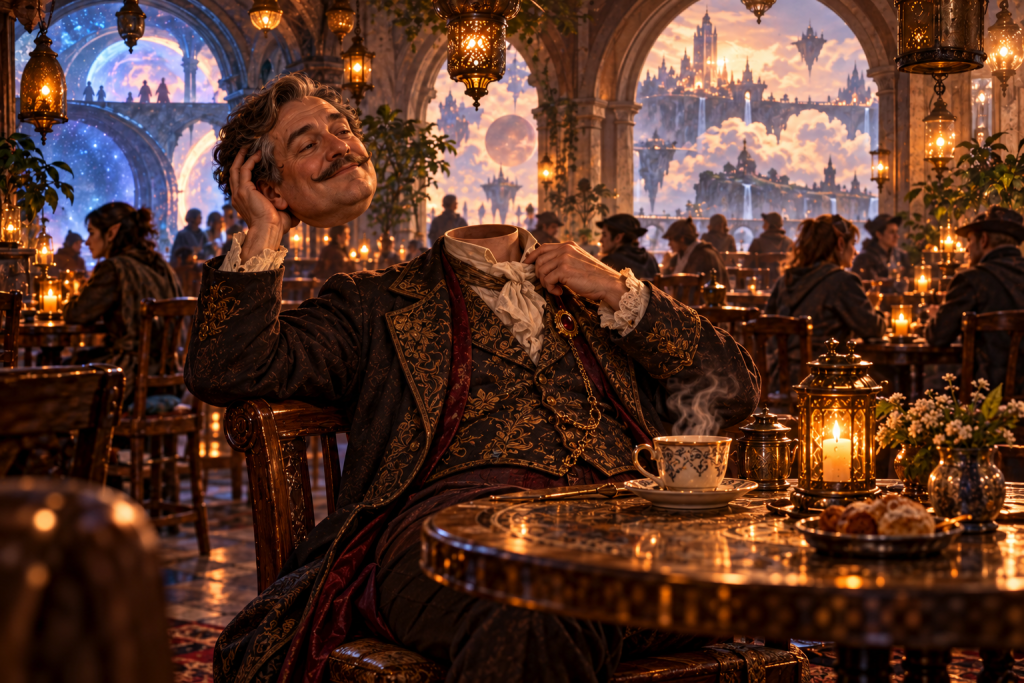
A gentleman at the next table quietly removed his head to loosen his collar. The server offered to put it somewhere safe. He declined; last time someone had used it to reserve a seat.
“From there, the party found itself in Manchester’s sewers. On paid work, this time,” Kardan continued.
“A step up.”
Abnormally aggressive giant rats were coming to the city’s surface. In days past, Manchester had been built on the ruins of an ancient Orcish city and inherited its sewer system, later expanded by human hands. The party went down to deal with the rats and found the tomb of a Teacher.
“An Orcish scholar,” Kardan said. “Respected. Literate. Buried among inscriptions that did very little to support the kingdom’s preferred account of Orcish depravity.”
Copies reached academics in Manchester. The official history had presented a savage people whose defeat required no troublesome reflection. The actual dead had left engineering, learning, and rather inconvenient writing.
“It’s unkind of conquered people to keep records.”
“Extremely.”
The expedition cost Vren her life. A giant snake killed her, and Ironbark recovered her remains.
Kardan set his cup down before continuing.
They met the Druid of the Sewers, a lizardfolk guardian who considered the waterways an ecosystem. Together they defeated the abnormal rats and their Broodfather, an enormous rat-like creature transformed into intelligence and psychic power by illegal waste from the Phlogiston Works.
“A factory supplying the army,” Kardan said. “Its unwanted products were developing opinions.”
The Druid asked the party to address the dumping upstairs but other pressing matters intervened. Eventually he lost patience and led the sewer creatures up to destroy the factory themselves. The Crown responded by sending troops, security officers, and mercenaries underground. The fighting was still going on.
“A rat contract became a sewer war.”
“The scope expanded. Unexpectedly, as sometimes happens.”
Soon thereafter, Pfinder left active adventuring. By day he worked for the Royal Standard; by night he contributed to the Ragged Quill, undermining the government in print. He introduced Merrythought to the party. Gareth joined too, hoping to send earnings home to a family in difficulty.
“It appears Pfinder found a profession with fewer snakes,” the friend said.
“Journalism. That remains to be established.”
Nelson’s letters led them to nearby Dolven’s Hollow, where they met Barin the blacksmith and his apprentice Phineas. The pair would become their principal contacts with the Ebon Blades, an underground group engaged in overthrowing the very government the adventurers had been sent to assist. By now, the party had had ample opportunity to reconsider the terms of their initial contract.
Barin asked them to free Kenning from a Manchester prison. For reconnaissance, Wolfgang employed CMOT Dibbler, itinerant meat peddler and proponent of a rather flexible understanding of meat. They purchased a hundred pies from him and, with his assistance, presented themselves as wholesalers distributing samples to the prisoners.
The scheme let Wolfgang inspect the prison and locate Kenning. The ensuing jailbreak freed him, Silas Venn the forger, and several other prisoners whose subsequent contributions to public life were less reassuring.
Silas owed them a favor. Some escaped prisoners belonged to a cult intent on destroying reality. At least one was a murderer.
“A broad commitment to self-supervised rehabilitation.”
“They also destroyed prison records. Administrative restraint was not the evening’s governing principle.”
Dibbler was later captured, interrogated, and died in Crown custody. News of his death would finally harden Wolfgang’s opposition beyond any prospect of reconciliation.
The friend’s smile faded a little.
“For helping them?”
“The man who sold the pies paid rather more for the jailbreak than the people who bought them.”
For a moment the café’s small sounds filled the space between them.
Then Kardan continued. Barin next directed the party against brutal tax farmers. The ambush went perfectly. The paperwork included apparent evidence of forbearance; the party concluded that those documents were false and Barin’s account correct.
“They had gone from restoring royal authority to ambushing its tax collectors.”
“There had been a period of adjustment. A fairly rapid one, as it turns out.”
On the return journey they met Rudric Thorn, an undead former adventurer with a recently used shovel and a red-and-blue jagged sigil. Later grave discoveries would explain what he had been doing: Soulreaper was quietly assembling an army from people no longer in a position to decline enlistment.
Subsequently, a sinkhole outside Brighton, near Dolven’s Hollow, exposed ancient Orcish waterworks. The party was hired to determine whether anything dangerous lay within. The complex contained advanced engineering, communal rooms, murals, religious spaces, and evidence of its last use as a refuge during the Righteous War.
Archean assaults to reduce the refuge had failed, bloodily. The attackers eventually sent in a Sereth, a summoned weapon with an appetite for indiscriminate killing. It killed the inhabitants and the victors paid it back by sealing it behind basalt and lead and leaving.
“A thorough solution,” the friend said. “Provided no one ever comes back.”
“History repeatedly finds that provision difficult. This instance would prove to be no exception.”
The long-abandoned Sereth initially spoke through Ironbark to seek its release. The party, understandably, was uneasy about returning an angry and unrepentant demonic killer to society. It responded with persuasion, rewards, and eventually overwhelming numbers of animated skeletons. Argent Company arrived during the desperate fighting and saved them.
Together they explored the deeper facility, discovering a water elemental that had worked freely with the Orcs. Its former partners had hidden it when the siege began and, after their deaths, the Sereth had kept it from leaving for hundreds of years.
The adventurers wanted to free it. Argent wanted to bind it for industrial use.
“There was money in the latter proposal,” Kardan explained.
“There usually is.”
The two groups agreed to postpone the argument until they had killed the demon.
“Sound meeting procedure.”
The combined companies prevailed. During the battle, Ironbark fell down an elevator shaft onto sharp wreckage and died in circumstances suggesting a degree of divine attention no one should seek.
Then the postponed argument resumed. Laveleen answered Argent’s hard line with violence. Argent’s wizard answered with a fireball. Both sides rapidly approached the point at which the water elemental would be the discussion’s only surviving witness.
Alaric, Argent’s leader, stopped the fighting and agreed to withdraw. By then, however, the panicked elemental had damaged the waterways. The complex began collapsing, and the adventurers found themselves trapped in the sinkhole.
Argent pulled them out.
The friend counted on three fingers.
“Rescued them. Fought them. Rescued them.”
“A complicated acquaintance, to say the least.”
The elemental escaped into the river. Its subsequent conduct was benign and occasionally helpful to local residents and fishermen.
After a period of rest, the party elected to set out for Hollowmere and paused for lunch at Miley; a pause that would eventually take them on a rather long detour to the Northmarch Correctional Bastion.
“Please tell me it was a quiet inn.”
“It was. Until the rum gremlins discovered it.”
The creatures abused the patrons and spread miserable drunkenness. Their leader, Spillgut, intended to found Rumistan and, eventually, aspired to conduct a ritual of perpetual intoxication across the surrounding countryside.
“Nation building,” the friend said.
“With unusually clear fiscal priorities.”
At the tavern, Ant learned more of her ancestor Templeton Bramblebee, executed by the Crown after predicting the kingdom’s destruction. The party also met Oban Bryne, a clurichaun whose heartbreak had kept him wandering for centuries.
“Centuries?”
“Some people take time to recover.”
They helped him find a new drink, renewed purpose, and a tavern worth protecting. Oban stayed as guardian of the Broken Handle. The party defeated Spillgut’s ritual, freed captives, and accepted the surrender of eight gremlins, with extensive conditions.
Cassyndra imposed rules governing travel, drinking, behavior, and obedience. The plan was to transport them to Northmarch Correctional Bastion and smuggle them inside to make the Crown miserable.
“They solved the tavern’s infestation by adopting it and forwarding it to a prison.”
“They considered institutional care appropriate.”
The party traveled under assumed names; the gremlins traveled in beer barrels. Their transport required a steady supply of alcohol and careful attention to the distinction between placidly drunk and operationally useless.
“I have served on committees with the same requirement,” the friend said.
The prisoners began with an appropriately antagonistic attitude toward their captors. Over time, both sides softened, and the gremlins began helping on watch, sympathizing with Shamus, and developing attachments. Pabst decided Wolfgang was his father.
“Wolfgang had acquired dependents.”
“Without the customary preliminaries.”
“Neglect of the customary preliminaries would become a recurring feature of this company.”
Invisible attackers brought another matter into focus: Shamus’s sister Getty. Long, long ago, a vampiric creature had killed their parents, taken her, and left him alive. Now a message invoked their names, and the party recovered Getty’s bracelet.
“Magical?”
“No.”
“Useful?”
“To Shamus, immeasurably.”
Kardan waited while the server refilled their cups.
“Just outside of the Northmarch Correctional Bastion, they found the village of Bastionstead,” he said. “And the immediate difficulty of rescuing Cassyndra’s aunt.”
Grelda, Cassyndra’s aunt, recently transferred to the Northmarch prison, had cut out her tongue rather than submit to interrogation. The prison’s lowest levels—and Grelda herself—lay within an antimagic field. Above them were defenses sufficient to discourage any sensible direct assault.
“Did the party notice?”
“Yes. They continued their reconnaissance and took a rescue contract while considering alternatives.”
The Plumbline Four, surveyors working under Crown contract, had disappeared in the caves around the prison. Troops sent after them had disappeared too. Underground, the adventurers rescued Corporal Isembard Pike and Private Renn Ivar, survivors of the military expedition. They encountered kobolds who had already suffered at the soldiers’ hands and reached an accommodation rather than continuing the slaughter.
They found the surveyors alive and properly supplied, but lost after a catastrophic flood disrupted their route. Following that disaster back to its source, the adventurers discovered a vast cylindrical chamber directly beneath the prison. A sphere floated within it as six-legged caretakers maintained magical inscriptions on the walls. The installation generated the antimagic field the prison exploited. The Orcs had maintained it, but the original construction predated even their civilization.
The soldiers had attacked its caretakers. A defensive flood had killed most of them.
“An underground machine of unknown age, conducting unknown work,” the friend said. “And they attacked its attendants?”
“They had weapons and had arrived in a disagreeable mood.”
“A universally dangerous combination.”
The party brought the surveyors and surviving soldiers out. The Crown arranged a larger expedition and the Four were required to return.
“The institution did not learn from its failure?”
“It had learned to send more people.”
As that larger expedition prepared, First Sergeant Elowen Thatch was ordered to take a platoon back into the caves and wipe out the kobolds. Privately, she asked the adventurers to relocate them first. If their presence offended the Crown, their absence should satisfy it. She would delay her platoon as long as possible to buy the adventurers time. An enemy mother’s mercy in an earlier campaign had taught her something her superiors had not thought to include in training.
The party found a possible home already occupied by ettercaps and giant spiders. Negotiation failed; fighting followed. The kobolds moved in, sick members and eggs included. A proposed tunnel collapse to ensure the Crown would never find them again was abandoned because its noise might attract umber hulks.
“One appreciates a planning process in which the demolition is canceled because it might summon something worse.”
They staged a massacre at the old settlement with kobold and ettercap bodies so the Army could find evidence that its objective had already been accomplished.
“Mercy,” the friend said, “supported by fraudulent paperwork and a convincing arrangement of corpses.”
“Thatch had provided the mercy. The adventurers supplied the presentation.”
The relocated colony’s present safety remained unknown.
At Northmarch, military, prison, administrative, and magical authorities disputed responsibility with the commitment of people absolutely certain someone else should have it. Warden Celene Rauth was murdered on the road, an event possibly related to that dispute. The party tracked and killed the hired assassins, who had preserved her severed hand as proof for their employer.
“Did they discover who paid?”
“No. But they did recover the hand.”
“Something to show for their troubles, one supposes.”
Colonel Holt, frustrated by civilian interference and the experiments surrounding Grelda and others, hired them to carry a secret letter to Inspector Fenworth at Fort Arcadia. The party, at their very first opportunity, arranged to read the sealed correspondence.
Kardan’s friend watched his expression.
“You disapprove.”
“A messenger’s curiosity is not among the contracted services.”
“Their curiosity seems difficult to confine to a contract.”
“Yes,” Kardan said. “Or to confine to anything else for that matter.”
Having found the message reasonably consistent with their personal values, the party undertook to deliver it without editorial interference.
Before leaving Northmarch, however, Ant found a note in her pocket. Her handwriting. Her ink. Her manner of expression. She did not remember writing it.
“A useful economy on the part of her patron,” the friend said. “Sending instructions without postage.”
“And leaving Ant to wonder who has been borrowing her handwriting.”
The note required six ingredients for a ritual she would learn later. A Crown judgment bearing her full name and its seal. Orcish writing older than the Conquest. A freely given promise to someone who would subsequently betray her. Blood willingly taken from her own hand. A document intended to erase someone she cared about. Her signature on a document she knew was wrong.
No substitutions. No early casting.
The friend considered that carefully. “One generally expects powdered gems. Bat guano. Something a supplier can put in a bag.”
“These requirements were rather more personal.”
“And more difficult to obtain from a reputable apothecary.”
On the road north, Willowhollow supplied another encounter with disturbed graves—many more than could reasonably be attributed to the lately once-again deceased Rudric. The party expected undead excavating bodies but was surprised to find them organized into work parties. Seeking more information, the adventurers arranged a fight with one of those parties. Mid-combat, a mounted commander arrived, demonstrated how readily the adventurers could be destroyed, and ordered the undead to withdraw instead.
“A demonstration followed by a reprieve,” his friend said.
“The lesson was available to anyone paying attention.”
The party later understood the work parties as another of Soulreaper’s preparations for war. At that stage, she and her subordinates appeared willing to tolerate some disruption from the living to avoid attracting attention.
At Fort Arcadia, Inspector Fenworth heard their reports, read Holt’s letter, and took the problems seriously. Army officers dispatched the Selene Scouts for more information despite shortages of personnel and ongoing official denial of any problem. The party heard of Warplan Bone Chorus, the Crown’s existing contingency for organized undead warfare.
“Competence again,” the friend said.
“An important complication. They had met cruelty, corruption, and negligence. Now they were meeting Crown officers attempting to do useful work with insufficient resources.”
“Harder to overthrow an institution once you have met its reasonable employees.”
“Indeed. But it does lead to useful thoughts about what should replace the institution in question.”
Returning south, they encountered the Blades’ cross-border smuggling network. Routes through Devon supported weapons purchases, printing, and resistance infrastructure. Adrian Valcour, the bird-tattooed officer mentioned in Nelson’s correspondence, belonged to it.
The adventurers helped Blades escape Crown custody with a staged attack and illusions implicating Argent Company.
The friend stared.
“The company that saved them twice?”
“That one.”
“A third rescue may require an unusually persuasive explanation.”
The party declined formal membership in the Blades but accepted a recognition ring and recommended Pfinder as a Manchester contact.
Holt and Fenworth’s pressure eventually secured Grelda’s release. Threatened scandal and conflict within the Crown accomplished what an attack on the prison could not. As it happened, not all of Grelda was released. Her captors had regenerated her tongue to question her, then, after questioning her, removed it once again. Furthermore, prolonged exposure to the antimagic field had damaged her as a magical being.
“She came out at midnight,” Kardan said. “The party accepted responsibility for her future conduct. The prison retained records.”
Soon after, the party learned that Cassyndra had once been Kasian, a thorn in the Crown’s side. As Crown personnel closed in, Grelda’s magic had transformed Kasian into Cassyndra, her niece rather than nephew. Whether the original form could be restored remained unresolved.
Silas Venn’s forgery repaid his rescue debt and enabled the delivery of seven gremlins into Northmarch. Pabst surrendered his drunkenness aura and stayed with Wolfgang.
“His father.”
“By determined assertion.”
They also retained a bottle from the rum gremlins marked for later use, under instructions not to open it yet. Wolfgang’s Maze reward, the Ring of Dawn, proved able to summon a barmaid spirit.
The friend looked thoughtfully at the server.
“Do you sell those?”
“No,” she said, without approaching. “And if we did, you couldn’t afford our terms.”
A bell sounded from behind the counter. Outside the second window, the violet sea reached the top step and politely withdrew.
“Now,” Kardan said, “for the Big Four.”
“The inn?”
“What will eventually have become an inn, yes.”
At The Big Four Inn in Thimbleton, a painting and a letter left by Edric Hale specifically anticipated the adventurers. A concealed mirror carried them from 973 into 905.
There they met the young Hale, four ogres terrorizing the settlement, and Kardan.
His friend leaned back.
“There you are.”
“There I was.”
“Had you met them?”
“Not yet.”
“But they had met you.”
“Yes.”
“And you had hired them for the Maze because—”
“By 973 I remembered them from 905.”
The friend closed his eyes briefly.
“I see why the soup is dangerous.”
The party killed the ogres and made the future inn possible; its name commemorated the four creatures whose removal had improved the neighborhood considerably. The temporal tear that allowed their journey grew with observation. It needed containing and concealing to limit its subsequent growth. The adventurers arranged for it to remain hidden within the future inn until their arrival in 973, when they would travel back and arrange its concealment. Their return to the inn from 905 would serve to seal the tear for good.
“They consulted my later self through the Maze,” Kardan said.
“Did you find your advice helpful?”
“It was well informed. The speaker had the advantage of remembering how it had all been done.”
“A standard you must find difficult to meet during ordinary consultations.”
The letter and painting that brought them there became part of the arrangements they made. While attending to causality, they also invited Kardan to join them at the inn for drinks sixty-eight years later.
“And you kept the appointment?”
“But of course. I keep all my commitments, even the ones that stem from the bending of reality.”
“So the people you hired in 973 had already proved themselves in 905. You knew their qualifications before they had acquired them.”
“The situation allowed me to obtain their services at, shall we say, lower than market value?”
Over drinks at the Big Four Inn, Kardan explained to the party what the ancient machinery beneath Northmarch contained.
“A Balrog.”
His friend put down his pastry.
“Under the prison?”
“Under the antimagic field under the prison.”
“And the Crown was conducting experiments on said antimagic field?”
“Yes.”
“One begins to appreciate the dangerous neighborhood the kobolds found themselves living in.”
The installation predated the Orcs. Their caretaking had preserved something the later occupants did not properly understand. Northmarch’s convenient prison foundation was a much older and more consequential containment problem.
Barrow’s Edge came next: agricultural blight, ancient barrows, and Barin’s account of an Ebon scout who had observed four people working nearby and withdrawn after judging them harmless.
The party found roughly a thousand warriors’ graves emptied and a huge necrotic mass poisoning the land. Upon destroying it, the blight began receding. Soulreaper’s symbol suggested that her agents had been there to gather bodies for her army and weaken Cambria before the war. Whether the symbol itself helped animate the mass remained uncertain.
The four people observed by the Ebon scout appeared to have been Crown agricultural investigators examining the same blight. The party found their bodies in the barrow, unnaturally arranged, their left ears removed. Ordinary violence had killed them before their bodies were moved.
“The mass?”
“Did not explain those deaths.”
“The scout?”
“Reported having seen harmless workers. The party has no established killer.”
The friend nodded. Kardan left the uncertainty where it belonged.
At Nareen’s Hill, Nelson’s letters led them to a chapel that had once housed the Brethren of the Veiled Bell. Behind an unremarkable religious exterior, the Brethren had preserved suppressed history in underground archives and communicated through coded bells. Before the party arrived, Varnes had disbanded the group, removed material, and destroyed other records, including information useful against undead. Defensive magic and mechanisms left behind explained the apparently haunted chapel and its persistent ringing.
“He emptied an archive and left the alarm running,” the friend said.
“Visitors were discouraged.”
Below the chapel, in the former archives, the party encountered the Cambrian Compact’s Warg Squad. Its fighters thought they served a human revolutionary cause. They were scouting and preparing to receive commandos from Marybelle’s Ambition, whose task would be to destroy Manchester’s port at the outbreak of war.
After inconclusive fighting with the Squad, Shamus negotiated. The party showed the squad evidence of the undead and their sigil. Its members realized Varnes had concealed something fundamental, rejected him, and asked for an introduction to the Ebon Blades.
“So the Blades and the Compact were separate.”
“Separate groups. Similar purposes. Different information.”
“But both opposed the Crown.”
“A crowded category. It does not guarantee that everyone in it wants the same future.”
Encrypted exchanges through Barin arranged the introduction. Its lasting consequences remained unclear.
The party resolved once again to leave Dolven’s Hollow for Hollowmere. At Barin’s request, they stopped in Briarfell on the way.
“A brief stop?” Kardan’s friend asked the question with the resigned courtesy of someone watching a door labeled ABSOLUTELY NOT A TRAP.
The druidic Circle of the Second Growth in Briarfell practiced sustainable forestry, papermaking, and the shaping of living trees. Commercial sabotage threatened its work; rival timber interests were suspects, but suspicion did not identify a sponsor. The druids, as it happened, also secretly sheltered an isolated Orc tribe. The party promised secrecy and Laveleen stayed to study its language and culture.
“Living people,” Kardan said. “To accompany the evidence furnished by dead ones.”
During the visit, corrupted experimental shambling mounds killed Shamus and Edrin Mossfall, their guide.
The friend looked at Kardan’s untouched cup.
“Getty?”
“Still missing. Calder Voss joined them and took up Shamus’s concern for her.”
Kardan waited a moment before continuing.
Briarfell’s other crisis involved the Cult of the Unmaking. Its adherents worshipped Zaldru, intended to destroy enough Rivets—the anchors holding the multiverse together— to unravel reality, and become gods in the replacement.
“An ambitious grievance procedure,” the friend said quietly.
General Sherman, a great tree, was one of those anchors and the cult had attacked him with ritual machinery.
The party tracked the attackers to a camp, defeated a frog-shaped idol firing magical beams, and recovered a list of further targets.
“A frog?”
“Fortunately, understanding its theological significance was not required to stop the beams.”
The recovered target list included Sherman, Governor Kanwal, Elvys Pressley, Dibbler, the Titanic, and people and things outside Cambria.
“The governor?”
“A Rivet.”
“An indispensable anchor of reality whose principal known talent is leisure.”
“Reality does not explain its personnel decisions.”
The local ritual was stopped, but Sherman’s injuries could not immediately be healed. The druids vowed to help his recovery in every way possible.
“The party was meant to investigate a province,” the friend said. “Now the province appears to be attached to the multiverse with an unreliable tree and a governor in his pajamas.”
“To be fair, their briefing had been quite informal.”
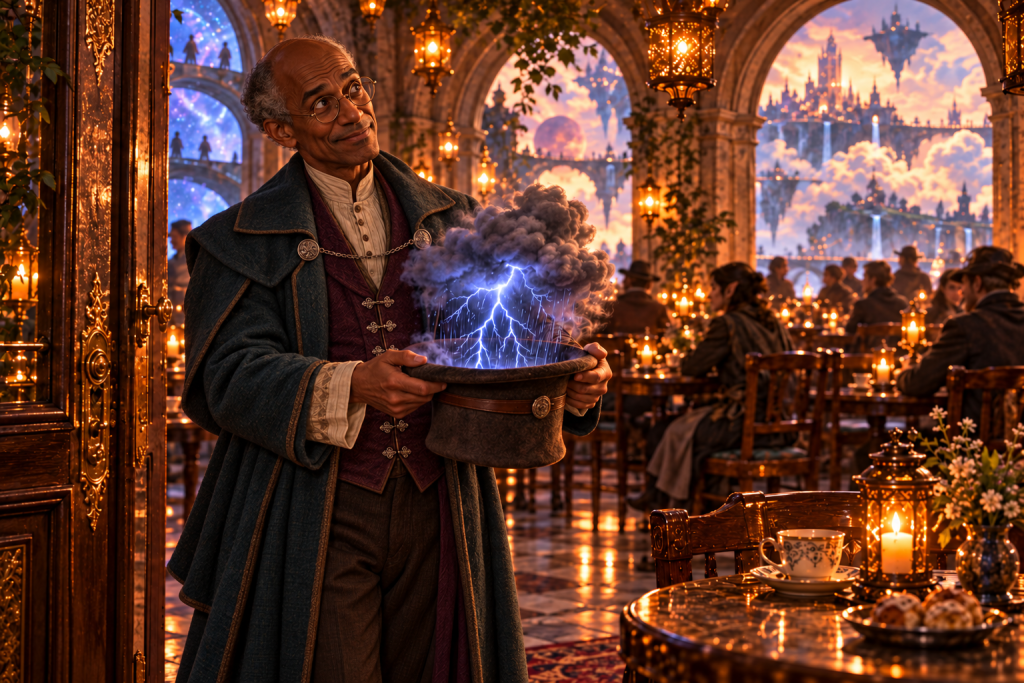
At the doorway, someone arrived carrying a small thunderstorm in a hat. Kardan lifted his cup in greeting. The newcomer bowed and asked for a table where the weather would not disturb anyone.
The server directed him toward a gentleman already dripping seawater.
“Ant’s ingredients,” Kardan’s friend said. “Did she ever find them?”
“Wolfgang had an idea.”
“Those words seem to precede a substantial proportion of this story.”
“He suggested asking the Crown.”
The friend waited for the qualification. None came.
“For the ingredients?”
“Several of them. Through a petition concerning his own proposed surrender.”
At Wolfgang’s urging, Ant wrote to Governor Kanwal. Wolfgang, she said, was within reach and purportedly willing to submit to lawful custody. She requested formal judgment, assurances of lawful treatment, permission to bind herself by a blood oath, and authority to carry out measures whose moral cost she acknowledged.
She signed it. A blood mark accompanied the signature.
“They tried to procure ritual materials from a government that wanted to arrest them.”
“Wolfgang has a gift for recognizing and reallocating resources.”
“And for arranging situations in which he is one.”
The Crown’s reply, as expected, took time. Meanwhile, the party headed north to Hollowmere and became ensnared in an investigation into two missing people: Lysa Harrow, who had gone searching for the Crown surveyor Corvin, and Corvin himself.
Hollowmere’s old copper mine had become a busy Crown operation. Officially, rich new veins had been discovered. The townspeople found this explanation unconvincing. Rumors flourished.
“Before we descend,” Kardan said, “you should understand why so many people were digging.”
His friend set down his cup.
“I assume it wasn’t copper.”
“The paperwork notwithstanding, no, it wasn’t.”
As the party eventually pieced it together, beneath Hollowmere lay Mira’Thar: an Orcish research complex later turned wartime refuge. Soulreaper’s people had established a secret underground base nearby and were recovering its surviving knowledge—historical, cultural, magical, military.
The Crown later discovered that someone was excavating in the area and developed a rather specific concern. At the end of the Righteous War, it had left Sereth imprisoned beneath those ruins.
“And remembered where?”
“Approximately.”
“A difficult word to find beside ‘imprisoned Sereth.’”
The precise location had been lost in the archives. The Crown began its own excavation, fearing that someone else might reach the weapons first. The revived copper workings provided a cover story.
“Two competing excavations,” the friend said. “One recovering a civilization. The other looking for weapons it had misplaced. One hopes they don’t collide.”
“One hopes in vain.”
According to his later account, Colonel Varnes met Soulreaper while commanding the Crown excavation. She identified herself as Arashka, the last Orcish queen, surviving from the Righteous War. Convinced of her cause, he accepted transformation and continued ostensibly serving the Crown while secretly working for her as RAPTOR.
The party’s own investigation brought them into contact with constables, Professor Harrow, Blackvein Company, a fence dealing in artifacts, and an entirely too garrulous employee of the Adventurers’ Guild. They also explored part of Soulreaper’s installation, finding archives, supplies, artifacts, religious and civic remains, and undead performing labor. The evidence increasingly identified the designation RAPTOR with Varnes and confirmed Nelson’s suspicions about his allegiance.
Blackvein found Lysa’s body. Zeppie’s bandits had killed her while she searched for Corvin. The party brought her back to her family.
“And Corvin?”
“Still missing.”
Ant’s next patron visitation supplied a different sort of concern. Usually the hooded figure appeared against darkness. This time she could see behind it.
Broken crates served as furniture. Patched canvas covered scavenged frames. Wind sounded outside. A crate desk held maps of Cambria: differing armies, borders, roads, and battles.
“A makeshift refuge,” Kardan said. “The sort of shelter someone being hunted might assemble because there is nowhere else to go.”
His friend leaned forward.
“She asked?”
“The figure noticed her looking and turned the maps over. Then it told her they would encounter Varnes and should not attack him immediately.”
“Because?”
“‘That doesn’t work.’”
The rain beyond the first window grew softer.
“An unusually specific objection.”
“Yes.”
“What did she make of it?”
“Questions. What circumstance could leave her patron living like that? Why those maps? What kind of knowledge allows someone to describe a proposed action as though its result has already disappointed them?”
Kardan turned his cup a fraction upon its saucer.
“She has no answers yet.”
Meanwhile, Major Thorne supplied a more immediate demand. Two groups of Crown soldiers had vanished through a newly opened passage. Varnes and two trusted officers had gone after them and disappeared as well. The adventurers were compelled to make the ruins safe and find the missing personnel.
“The usual method,” the friend said. “Put another group through the hole.”
“With adventurers, one can sometimes dispense with the expense of recruitment.”
Beyond a basalt-and-lead barrier like the one at the waterworks lay the sealed part of Mira’Thar: the ancient national laboratory turned wartime redoubt turned into the prison of eight Sereth.
The first soldiers had succumbed to the voices and released two. Those could wander the complex but could not pass the outer barrier. The next group had agreed to help them escape in exchange for promised rewards, very likely releasing the other six as well.
The party called them Cat Company.
“Why?”
“I suspect their official designation had ceased to be useful.”
Underground, the adventurers encountered trapped goblins, hobgoblins, and Orcs. Both groups had endured ceaseless demands to release the Sereth, and both preferred death to compliance. This shared outlook provided a basis for cooperation. They also found Corvin alive, but badly traumatized after weeks of voices and demands.
“A copper mine,” the friend said. “On the surface.”
“Its prospectus had been selective.”
They found Varnes with McAllister and Billings. He told them a story that transformed the meaning of much they had seen.
According to Varnes, Archean King Harold III and Vizier Ergon had survived for centuries by moving into their children’s bodies, killing the heirs whose succession purportedly preserved the dynasty.
“An unusually literal attachment to hereditary government.”
“It remains his testimony,” Kardan said. “The party has not independently established it.”
Varnes described the conquest of Goghnol Mogh as an Archean war for land and resources, concealed beneath the title “Righteous War.” An intended quick conquest became a fifty-year slog. The Orcs resorted to undead; the Crown deployed demonic Sereth under Option Black, used them for mass killing, and subsequently imprisoned them.
Soulreaper, he said, was Queen Arashka, the last queen of Goghnol Mogh, preserved through undeath. He had learned the truth from her, defected, and accepted transformation himself. Her coalition joined living Orcs, goblins, hobgoblins, an army reclaimed from graves and battlefields, and the unwitting humans of the Cambrian Compact.
“The ruins corroborated civilization and the weapons,” Kardan said. “The waterworks had already demonstrated what a Sereth could do. Neither discovery independently established the queen’s identity or the King’s method of succession.”
“You are distinguishing between evidence and an extremely persuasive conversation.”
“Someone should.”
As Varnes described it, Soulreaper wanted the Crown overthrown by force and Goghnol Mogh restored, governing humans and Orcs fairly under Orcish rule. Varnes proposed controlling the Sereth to make the war shorter and less bloody.
“The demons inclined toward indiscriminate killing.”
“The party remembered.”
“A useful objection to preserve in one’s notes.”
They also questioned permanent Orcish domination and the use of undead. Sympathy with overthrowing the Crown had not become consent to the proposed tactics and results. The party’s skepticism was heightened when Varnes made an attempt at controlling a Sereth and failed.
Crown reinforcements arrived under Inquisitor Lucien, with Blackvein Company and Professor Harrow in tow. He intended to recover and control the Sereth if possible, or destroy them if they might escape or fall into enemy hands.
“The government and its enemy agreed that they should possess the weapons,” Kardan said. “The party favored the rather narrower proposal that no one should.”
Gareth helped assemble a temporary coalition: Crown officers, Varnes’s people, the trapped workers from Soulreaper’s coalition, Blackvein, and the adventurers. They could oppose the creatures together without first agreeing upon every question of sovereignty.
“A practical man.”
“Increasingly so.”
During the battle, a Sereth took control of Varnes and Billings and turned them against their allies. They eventually recovered. One loose Sereth was destroyed. Many of the Orcs, goblins, and hobgoblins died, but their leader, Throk, survived.
The survivors escaped through the barrier into Soulreaper’s forward base. Its army counterattacked and captured Mira’Thar. Varnes later reported Lucien, Thorne, and nearly all the Crown expedition dead.
Of the eight Sereth, four were destroyed and four came under Reclamation control. The one killed at the waterworks was a separate creature. Soulreaper deferred combat use of the captured Sereth pending further study.
The friend raised a finger.
“Four imprisoned weapons. Under study. Controlled by a man whose control has already failed.”
“Yes.”
“I was merely checking whether I had found the reassuring part.”
Lucien’s forearm jewel had transmitted word of the events to the Crown before his death. As secrecy was gone, Soulreaper’s war began early, and her coalition publicly took the name Reclamation.
Varnes also acknowledged deceiving approximately a thousand human Compact fighters into the Reclamation’s opening attacks. They expected support from a broader human revolutionary alliance. In fact they were clearing the way for the Reclamation. Heavy losses had been anticipated; those losses would reduce the number left to subsequently resent the deception.
His friend did not immediately answer.
“He regretted his decision?”
“No.”
“And the adventurers?”
“Objected. Raised restitution and reconciliation with survivors.”
Kardan let the café move around them for a while. A chair scraped. Somewhere behind the curtained window, something tapped once and was ignored.
“Varnes supplied the Reclamation’s Soldier’s Articles,” he continued. “Preserve peoples and history. Honor promises. Record debts. Protect prisoners through judgment. Punish guilt rather than ancestry.”
“Fine principles.”
“Useful ones. They give the party something to hold him to.”
The adventurers declined an offer to become undead members of the Reclamation, accepting independent-agent status instead: assignments could be refused, confidences must be honored. Their first task was to introduce the coalition to the isolated Briarfell tribe and raise the possibility of an alliance without committing it. At Wolfgang’s suggestion, an Orc was sent to be a direct representative; Mukden volunteered.
On leaving the caves, the party found Hollowmere under occupation: a curfew, surrendered weapons, requisition receipts, retained local constables, and undead labor the townspeople were obliged to tolerate. An adventuring company had refused disarmament and been killed. Refugees feared both the occupiers and the Crown’s return.
“And receipts make a difference?”
“They record a debt. They do not feed someone whose stores have been taken. Both observations can be true.”
Mukden explained to the party that a body could be animated only once. Destroyed undead could not simply be raised again and again. Corvin went home. Professor Harrow accepted books, instruction, and a role as an academic intermediary; Blackvein received a contract to escort him to Manchester. The party returned their previously captured Orcish artifacts.
And the Crown’s reply to Ant finally arrived.
“Ah,” the friend said. “The ritual ingredients.”
The government supplied a sealed administrative judgment bearing her full name, directed her to present herself and Wolfgang before Manchester’s magistrate, declined advance guarantees, offered no escort or protection, and assumed no responsibility for injuries.
“A generous response.”
“It also noted that neither had filed the required income declaration. Should either survive the present matter, the deficiency should be rectified and taxes paid. Any bounty would be subject to deductions.”
The friend stared for a heartbeat, then laughed.
“They asked for magical assistance and received a tax notice.”
“They asked for official correspondence. The Crown delivered its expertise.”
Ant now had the sealed judgment and her signature on a document she knew was wrong. A copy of an inscription from the Teacher’s tomb might satisfy the ancient-writing requirement, but the originals were with academics in Manchester. Whether a copy sufficed was unclear. Blood willingly taken from her own hand could be obtained whenever necessary.
“Two secured,” the friend counted. “One uncertain. One readily available.”
“And a promise freely given to someone who later betrays her, and a document intended to erase someone she cares about, still outstanding.”
“I should be reluctant to shop deliberately for the first.”
“They have made a considerable number of acquaintances.”
“That,” the friend said, “is a thoroughly unpleasant reassurance.”
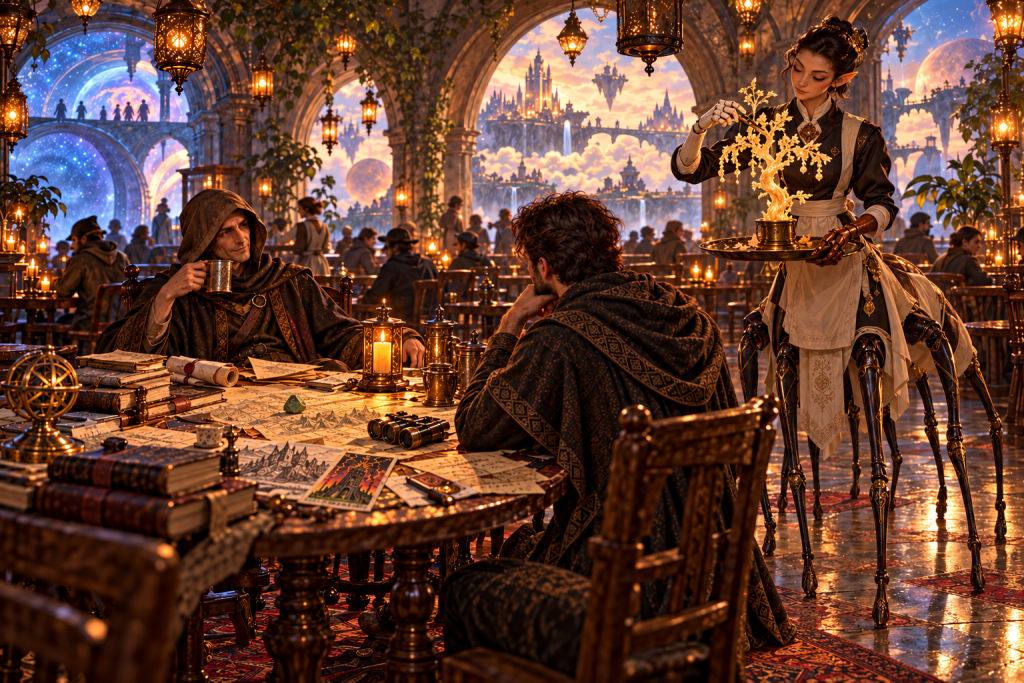
The server replaced the candle. The old one had burned upward into a small wax tree, which she pruned before carrying away.
“Cassyndra received a message from Grelda in Dolven’s Hollow,” Kardan continued. “Something important was ready; she should return as soon as possible. The party headed south from Hollowmere, planning to stop in Briarfell on the way.”
They traveled amid refugees and reports of war. At Wolfpine, tax farmer Horace Bell used emergency powers and patriotic language to confiscate property, imprison people, and enrich himself.
“An adaptable man,” the friend said. “War had found him ready.”
The party infiltrated his operation and overthrew it. Captain Wilkes died after withdrawing with his guards to the smithy. Bell survived.
Then the villagers asked the adventurers to decide what happened next.
“A natural question. Who should recover which property? Who should be punished? How should confiscated wealth be distributed? Who would govern? The party had removed the answers everyone was forced to accept and the villagers now wanted answers they might actually prefer.”
The adventurers declined to govern. They left the prisoners in local custody and continued on to Briarfell.
On a later return, they discovered the villagers’ solution: Bell performed hard labor by day and served as mayor from the stocks in the evening.
Kardan’s friend stopped with his cup halfway to his mouth.
“From the stocks.”
“His administrative abilities had been retained. His opportunities for departure were more limited.”
“Government where one can always find the responsible official.”
“The residents had devised it themselves.”
“Were they pleased?”
“It was their arrangement. Imperfect, practical, and considerably more accountable than the previous one.”
The friend considered that.
“I know several cities that could begin with the stocks and work backward toward a constitution.”
At Briarfell, the settlement stood deserted in stark contrast to the party’s last visit. The druids were nowhere to be found, the Orcish tribe had scattered, and awakened trees were attacking the forest’s inhabitants.
The damage left in General Sherman persisted. “Their earlier victory had stopped the people doing the harm,” Kardan said. “It had not removed all the harm already done.”
As Sherman’s Rivet function deteriorated, people from another world appeared more frequently. Three United States Forest Rangers—Tom, George, and Judy—found themselves trapped in Briarfell and joined the investigation.
Their firearms, radios, equipment, materials, and knowledge performed remarkable functions without magic.
“No enchantments?”
“None.”
“Then how did the devices work?”
“The Ebon Blades are now asking that very question with a mixture of enthusiasm and caution.”
The party also encountered a Crown patrol searching for Helen, a missing operative. Soon thereafter, General Sherman uprooted himself, captured the adventurers, the Rangers, and the patrol, and imprisoned them underground.
“The tree walked.”
“Yes.”
“And kidnapped the investigators.”
“Yes.”
“A difficult development to include in a year-end investor report.”
They woke without any equipment made from non-plant materials. With them were the druids Oakbeard and Mossyrock, Laveleen, five tribal Orcs, Helen, and two supposed merchants, Heward and Sister Eliria. Root Tenders brought food and care while preventing escape. The awakened trees had attacked and scattered both the druid foresters and the Orcish tribe. Some had died, others had been captured by Sherman, and the rest were presumably still hiding on the surface.
Sherman’s conduct seemed contradictory because he was struggling against corruption within himself. The party eventually understood their captivity as a damaged guardian’s attempt to keep them safe from the corruption of the awakened trees.
“An important distinction,” the friend said. “Although I imagine it became more comforting after they were allowed to leave.”
Cassyndra’s magic let them excavate toward the Root Nexus, the source of the corruption that created the awakened trees. They crossed a shark-filled river, passed peacefully through a Myconid colony, and fought more corrupted trees.
“Underground sharks. Walking hostile trees.”
“The route had its difficulties.”
En route, Helen gathered intelligence and offered Crown protection to the Rangers in exchange for their knowledge. Merrythought noticed that Heward’s account of his merchant travels was fabricated.
Just when the Root Nexus had been found and the group was forming up to attack it, Laveleen heard her patron’s summons and went to the surface with the five Orcs as protection. They would later learn that she had been instructed to gather the scattered Orcish tribe and leave the Nexus battle to the party.
The adventurers initially fought beside the Crown patrol. Mukden and George died. Gareth kept returning to the line after being healed, until a tree killed him outright.
Kardan stopped. His friend waited before asking, “The man sending money home to his family?”
“Yes.”
The server approached, saw their faces, and left the new pot without asking anything.
“He had worked at keeping people together,” Kardan said. “At Mira’Thar. In their disagreements afterward. He wanted a peace ordinary people could live in.”
“Did he leave instructions?”
“Letters. Sell his equipment for his family. Return the family portrait and his father’s Guard token. Remember the people who would have to live with the choices.”
His friend looked down at the table.
“And someone is taking them?”
“Ant. To Gozneth.”
Outside, the respectable street had become snowy without anyone seeing the rain stop.
“Helen used the confusion for her own ends,” Kardan continued. “She, Heward, and Eliria dragged the injured druids out of the fight and bound them, then subdued Tom and Judy. The Crown troops pulled back from the adventurers’ side to cover the withdrawal. The party expected the soldiers to return and take them prisoner once the Nexus had exhausted them. Cassyndra sealed the passage to prevent that. The adventurers then destroyed the subsidiary spheres protecting the Nexus.”
The Nexus itself resisted their attacks but then Sherman reached the cavern. He drew the corruption into himself, destroyed the Nexus, and died.
The pressure lifted. The forest’s blight subsided. After learning that the Crown had withdrawn in response to Cassyndra’s gambit, they recovered their equipment. In Sherman’s old grove, they planted a cone, which Calder blessed.
“A successor?”
“A beginning. They do not yet know what will come of it.”
They pursued Helen with an uncommon wrath. At Wolfpine they learned that her convoy also held Laveleen and two of the Orcs who had accompanied her. Helen had presumably captured them while leaving the caverns; three of the five Orcs had died during capture. Cassyndra sent Heka to Barin and Phineas asking the Blades to intercept or delay it.
On the road, a Crown sergeant recognized the adventurers and deliberately avoided a fight, indirectly warning them that the government knew they were pursuing the prisoners.
“Thatch. Holt. Fenworth. Now this sergeant,” the friend said.
“People with discretion. The party continues to meet them within the institution it opposes.”
At King’s Rest, Cassyndra poisoned the convoy’s breakfast. It caused limited illness, including illness in one captive Orc, but did not stop the march.
“An unfortunate result.”
“The Crown concluded that the cooking was bad and requested a refund from the innkeeper.”
His friend closed his eyes.
“An attempted ambush resulting in a catering complaint.”
“The village was not punished. That was something.”
The Blades prepared two possible ambush sites, twelve fighters at each. The adventurers followed the convoy into one of the sites and attacked from behind. Nine of the twelve engaged Blades died.
When defeat approached, the Crown denied rescue of the Rangers. Their elite cleric killed Tom and the Orc beside him. Helen killed Judy. All three Rangers were now dead.
Merrythought captured Helen alive. Oakbeard, Mossyrock, Laveleen, and one Orc were freed while the Crown’s elite rogue and cleric escaped. Crown reinforcements were approaching; the survivors had to retreat immediately.
“They won the prisoners back,” the friend said.
“Some of them. Incomplete victory seems to be something of a constant in this land.”
Kardan’s friend took a fresh cup. He did not drink from it immediately.
“Surely the group would have had to hide after that victory.”
“The Ebon Blades had anticipated that necessity. Near Saint Mercy there is a remote farmhouse that had burned down after a lightning strike ten years earlier. The local Blades had secretly rebuilt it.”
The survivors of the ambush hastily removed heads and hands from the fallen Blades to frustrate identification, traveled discreetly to the farmhouse, and then burned and buried those remains. Barin, Phineas, and the fighters from the unused site rejoined them. The intention was to hide for roughly two weeks.
“Intention,” the friend repeated.
“The Crown has expressed reservations.”
There, Oakbeard and Mossyrock revealed their plans to return cross-country to Briarfell with the rescued Orc, avoiding roads where he might be enslaved. Laveleen meant to go with them to reunite the tribe, then investigate the Withers in western Cambria at her patron’s direction, tracing the plague to its first case.
Ant was away with Gareth’s effects. Cassyndra was ill after divination. Wolfgang watched outside.
Inside, the party questioned Helen with Laveleen’s Detect Thoughts assisting. “She admitted she was a spy,” Kardan said. “Her original mission had ended before Briarfell. She would not explain it, but said it was unrelated to the forest, cult, Reclamation, or war.”
“A province with enough emergencies that one must specify which ones one’s espionage does not concern.”
Helen explained why the Rangers had been killed. Their otherworldly knowledge was likely to confer a decisive military advantage in the newly begun war. Getting them to Manchester would have served the Crown; preventing their rescue denied that advantage to an enemy.
“So they were valuable alive,” the friend said, “until someone else might have them.”
“Her stated reasoning.”
“A neat explanation of an ugly act.”
Helen also described Heward and Eliria’s concealed identities, separate mission, and pleasure at learning Sherman had died. They declared their work complete and left. Combining that with the cult’s earlier attack, the party inferred that the supposed merchants were members of the Cult of the Unmaking sent to finish destroying the Rivet. Their precise identities and present location remained unknown.
“The interrogation was giving Helen information too,” Kardan said. “She listened, tested accounts, and sought to learn what her captors knew.”
“A true professional.”
“Yes.”
When asked about Varnes, she denied knowing him. Merrythought challenged her. She began conceding ground. At that moment, Laveleen telepathically asked Hunkle to snap her neck. He did nothing.
Then Laveleen cut Helen’s throat.
The friend went still.
“At that moment?”
“At that very moment.”
“Why?”
“The conversation was too long. It yielded too little. She was bored. Helen was dangerous. Her explanations varied. Merrythought suspected something behind the timing, but no betrayal was established.”
The party, however, could not escape the fact that the questioning had ended precisely where they believed it was becoming particularly useful. What the motive could have been, none could say for certain.
Barin argued that motive, however poorly established, was not the main issue. Laveleen knew the insurgency’s people and secrets, acted dangerously and unpredictably, and owed obligations to a patron whose purposes they could not assess. In Barin’s judgment, recent events showed that releasing her posed too great a risk.
Hunkle favored execution. Merrythought reluctantly agreed. Calder and Zborch opposed it, but would not fight the others over the decision. Barin took responsibility. He went downstairs and killed Laveleen privately. His method was not disclosed.
Kardan’s friend rubbed a finger along his cup’s handle.
“They trusted her enough to help question the prisoner.”
“Yes.”
“And by the end of the conversation she was dead too.”
“Yes.”
“What will they tell the druids?”
“That remains to be decided. The tribe has lost another person who could speak with it. Mukden is dead. In addition, her proposed plague investigation will not proceed through her.”
Wolfgang came back from his watch to learn that both Helen and Laveleen were dead.
His friend drew a slow breath.
“One expects a watch rotation to involve a report about the fields.”
“His colleagues had rather more to report.”
“Does he regret having gone outside?”
“Perhaps. On the other hand, while he was outside, he noticed ravens unknown to the area passing back and forth at altitude in a manner suggestive of a message network.”
Worse yet, word came that Crown troops and a sharp-eyed woman in civilian clothes had arrived in nearby Saint Mercy, apparently searching for the party. One dead Blade was a local grocer; missing remains did not disguise a prolonged absence. Both retreating groups had used the same bridge, potentially allowing someone to reconstruct their movements.
A giant owl searched the countryside. It could see at distance and at night. Four-person patrols visited farms. Familiars scouted beyond the soldiers’ immediate line of sight.
“The group felt increasingly unwelcome and considered leaving discreetly. At night, for example,” Kardan said.
“Against an owl.”
“Among other suggestions. Splitting up. Disguises as penitents. False trails toward Alderwick. Diversions at crossings.”
“Penitents seems unusually economical.”
Kardan’s mouth shifted very slightly.
“No plan had been chosen.”
After escaping, they intended to go to Dolven’s Hollow. Grelda’s message, relayed by Barin, was that the lucid dreams were ready.
“Did Barin ask what that meant?”
“She said he would not understand.”
“A conversation-ending confidence I rather envy.”
Cassyndra’s recent divination had shown Grelda absorbed in her work and a pale young woman standing behind her: dark, travel-stained clothes, blood on her hands and wrists. The woman looked directly through the divination and compelled Cassyndra to give her name.
She called herself Getty.
“Shamus’s sister.”
“Grown up. And coming for Cassyndra.”
“In what sense?”
“Unspecified.”
“Naturally.”
The Tower appeared in Cassyndra’s cards. Upheaval. Destructive revelation. Not necessarily death, which was a distinction people could appreciate without finding it comfortable. Grelda’s current safety, Getty’s nature and intentions, and the meaning of the lucid dreams all remained unresolved.
After visiting Grelda, the adventurers planned to return to Hollowmere as representatives of the Ebon Blades. The Blades wanted separate self-governing human and Orcish states. They opposed the Crown but did not accept replacing human domination with permanent Orcish domination. The Reclamation sought restored Goghnol Mogh over both peoples.
“The party is to open communication,” Kardan said. “Present the Blades’ position. Explore the possibility of cooperation between them and the Reclamation. No final alliance or territorial settlement is to be agreed to at this time.”
“And four Sereth sitting behind the conversation.”
“Under study.”
His friend gave him a look.
“I haven’t forgotten.”
The convoy losses had shown the Blades what they could and could not accomplish alone. They could harass the Crown. They were not yet able to defeat its armies. Cooperation might let them influence the future; it also required speaking to people whose methods they opposed.
The Rangers’ equipment had gone to the Blades for study, except for Merrythought’s binoculars and Ant’s compass and other noncombat items. Barin and Phineas hoped to learn useful nonmagical principles.
“Possessing a device,” Kardan said, “does not supply the science, materials, or manufacturing required to reproduce it.”
“Still, something to do at the forge between revolutions.”
The mission to the isolated tribe remained unfinished. Its members had made no collective commitment to the Reclamation. Refuge and enlistment were different choices, especially for people still trying to find one another.
Pabst would take an active adventuring role after Gareth’s death.
“Wolfgang’s son?”
“By continued determined assertion.”
“Has Wolfgang accepted the designation?”
“He has had other matters requiring his attention.”
“A familiar account of fatherhood.”
Beyond the party’s immediate route, the Withers continued in western Cambria. The sewer war continued in Manchester. Devon was mobilizing; its intentions remained uncertain. The Crown could draw upon other provinces, competent officers, and Warplan Bone Chorus. The Royal Standard was making confident promises about that capacity.
“Their governor may be asleep,” Kardan said. “Their kingdom is not.”
His friend nodded.
“And all the things they have left behind?”
“They remain things.”
The kobolds. The murdered agricultural investigators. Rauth’s unknown employer. The cult’s remaining targets. Northmarch’s experiments above its ancient containment. Seven gremlins inside the prison. An unopened bottle. Ant’s ingredients, her unidentified patron, and the strange glimpse of a life it had not intended her to see.
“Quite a list.”
“They have been busy.”
The server arrived with the bill. Kardan read it. His friend watched him.
“A problem?”
“No.”
“You looked displeased.”
“I have been charged for the atmosphere.”
The server pointed toward the curtained window.
“Keeping that out costs money.”
Kardan considered this, then paid.
“Fair.”
His friend settled deeper into his chair. “They began with a job to restore Crown authority and now they’re evading its troops, representing an insurgency to an undead queen’s lieutenant, and trying to work out what freedom would actually mean for the people involved.”
“Among other commitments.”
“One likes to see young people develop and take on responsibilities.”
Kardan looked toward the snow falling beyond the first window.
“They are learning that removing a ruler does not settle a property dispute. That allies can save your life and be wrong. That enemies can show mercy. That a fair principle can be written beside a very unfair decision. That the people on whose behalf history is being changed should occasionally be consulted.”
His friend lifted his cup.
“Gareth would approve of that last one.”
“I believe so.”
For a moment, Kardan’s expression softened into something his clients would never have recognized.
Then his friend said, “And your artifact?”
Kardan looked back.
“Still in the Maze.”
“How much remains?”
“One puzzle.”
The friend began to laugh. Quietly at first; then enough that the gentleman at the next table replaced his head to see what he was missing. Kardan waited with the practiced stillness of a man who honored both the letter and the spirit of his bargains, however long the other party took to satisfy them.
“One puzzle,” his friend repeated.
“One.”
“And then the manual.”
“As agreed.”
“And then they can read Nelson’s last letter.”
“Precisely.”
His friend wiped his eyes.
“After everything they’ve learned, they still haven’t finished reading the briefing.”
For once, Kardan laughed.
It was brief, low, and unmistakable.
The server glanced over. Somewhere outside, a street returned to the city it belonged to.
“No,” Kardan said. “But they have developed several useful questions.”