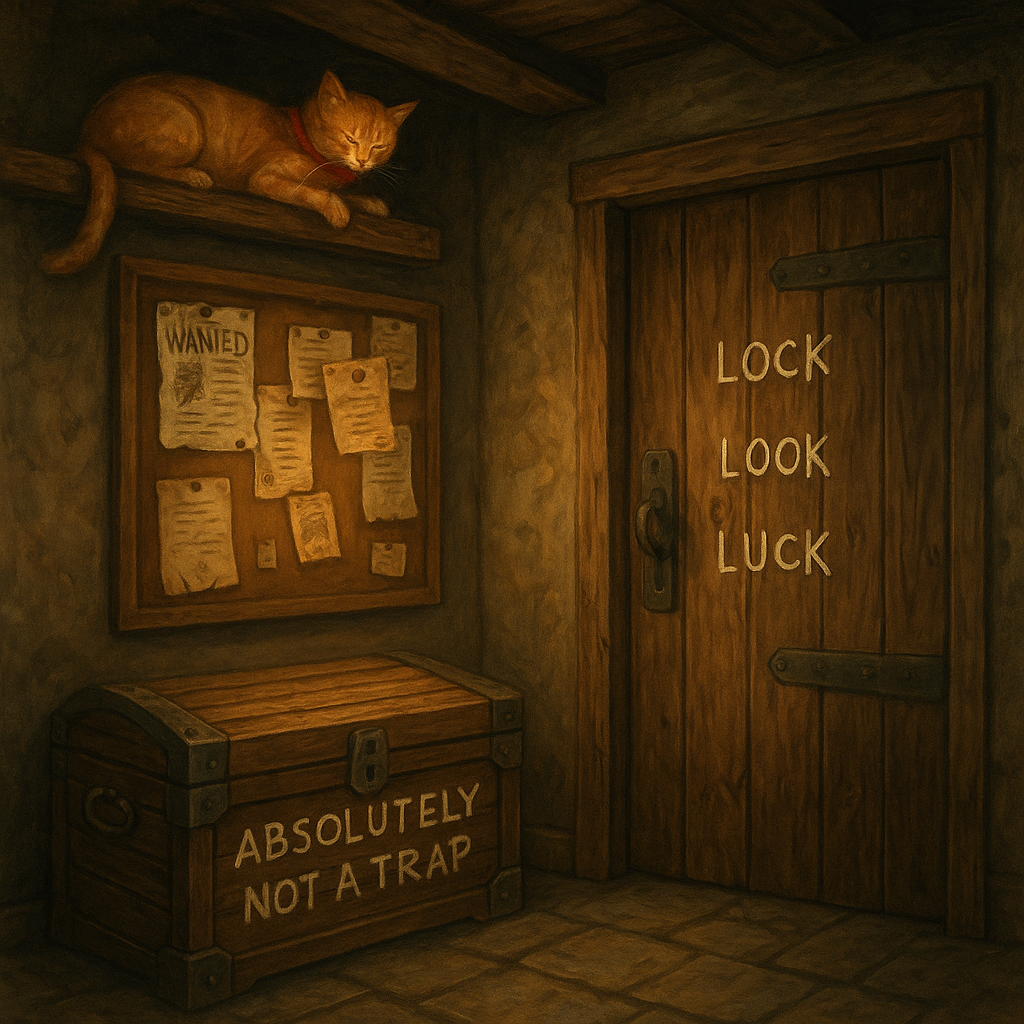
This is a a dim, low-ceilinged back corridor that smells faintly of ale and lamp oil. Shadows here are less “darkness” and more “privacy.” You notice,
- A cork notice board with overlapping handbills: WANTED posters, job chits, and a stained tavern receipt.
- A crooked door with three separate keyholes, each labeled in chalk: LOCK, LOOK, LUCK.
- A battered footlocker under the notice board; its lid says “ABSOLUTELY NOT A TRAP” in friendly paint.
- A small cat asleep on a beam, tail twitching; a ribbon is tied to its collar.
The notice board looks like a scrapbook made by a very busy conscience. The three-keyhole door creaks whenever you stare at it, as if trying to decide whether to open or demand a tip.
Pinned foremost on the board is a tidy handbill—far nicer than its neighbors:
- Enter only if you intend to leave by a different door.
- Vanish when watched and appear when ignored.
- Always take the last coin that no one will miss.
- Stand where the light is dim and the exits are many.
- Inquire about locks before you meet them.
- Offer apologies only if the listener is armed.
- Never explain, unless the story improves the purse.
A stained tavern receipt peeks out from beneath it: “1 ale (watered), 1 onion pie, 3 locks oiled — put it on Kardan.”
Kardan, toneless: “I have always refused to pay for hypothetical services.”
From here can you go,
- Back to the Entrance
- Clockwise to the Wizard’s Room
- Counter-clockwise to the Barbarian’s Room