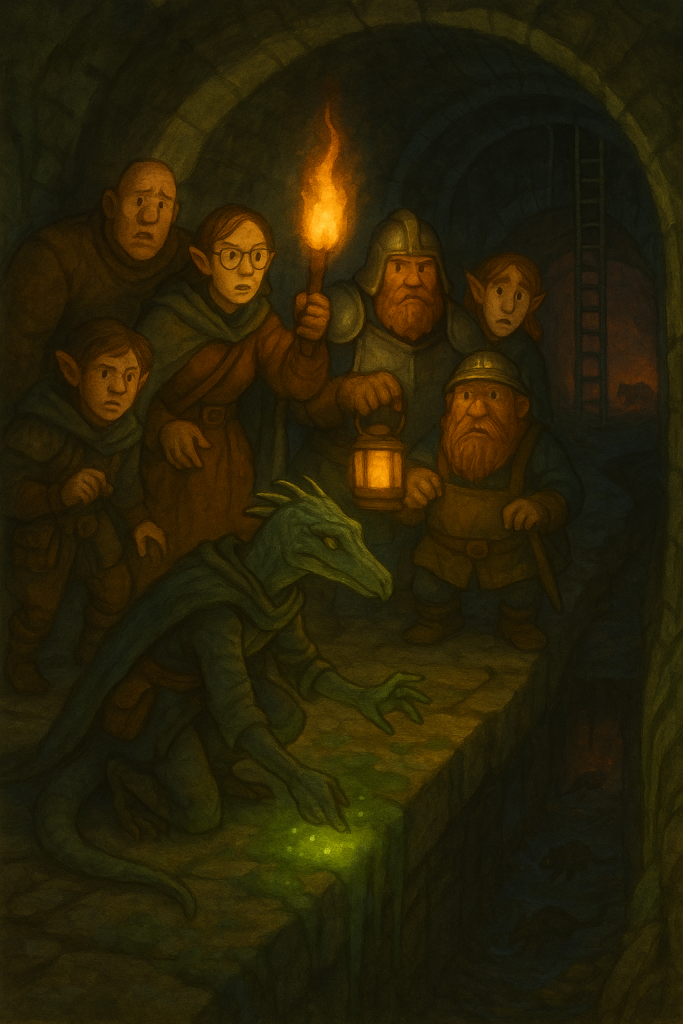
October 3rd, 973 – the giant rat hunt in the sewers of Manchester
The air grew thicker and warmer as the tunnels sloped downward. Muck coated the walls in slick veils, and what little light remained came from the druid’s handful of phosphorescent moss, glowing a faint patient green.
The Druid of the Sewers moved with practiced grace, tail brushing the stones like a pendulum. They paused at a corroded junction where several tunnels met, kneeled, and traced clawed fingers through the slime.
“Here. The scent of blood and bile thickens. Those ones—the aberrant rats—nest below. Too many teeth. Too much hunger. They chew what the city throws away…and what it forgets.”
They pulled a scrap of tanned fungus-paper from a pouch sketched a rough map with a bit of charcoal scavenged from some earlier fire. The markings formed a web of circles and channels—the old sewer design, before the plague of rats occupied it.
“This one remembers the flow as it was. These tunnels once drained northward, into the settling cistern. Now the aberrants rule it. The map tells where stone lies—but not where death waits. The rats changed the pattern; the water speaks different now.”
They glanced up at the party, their amber eyes reflecting torchlight like coins beneath water. They licked a drop of water from the tunnel wall, then rose and gestured toward the darkness ahead. A low, rhythmic chittering carried through the pipes—too deep and too many to be normal rats.
“The nest stirs. The mother of the aberrants calls her children to feed. Ready your claws, above-folk. Let balance be restored.”
The mosslight faded to a murky amber as the tunnels opened into a narrow chamber with a ladder leading down. The Druid gestured, “There. There is where these ones” – its gesture encompassed itself and the heroes – “will arrange the future of the flow.”
A beat of silence followed. The dripping of water. The far-off scrape of claws.
Then Vren muttered, “Does anyone… actually know the way back?”
Hunkle’s voice with uneasy laughter: “I was following the Druid. Thought you were.”
Cassyndra – “Wait, I thought you were.”
The group glanced at the Druid—already halfway down the ladder, mosslight bobbing like a will-o’-wisp.
“If the Druid dies,” Ant said quietly, “we’re lost down here. Forever.”
The sound of chittering grew louder, echoing up through the grate. The ladder waited, slick and cold beneath their hands.
And with that realization heavy between them, the party descended into the dark.
October 5th, 973 – directly after breaking up the ambush on the government carriage
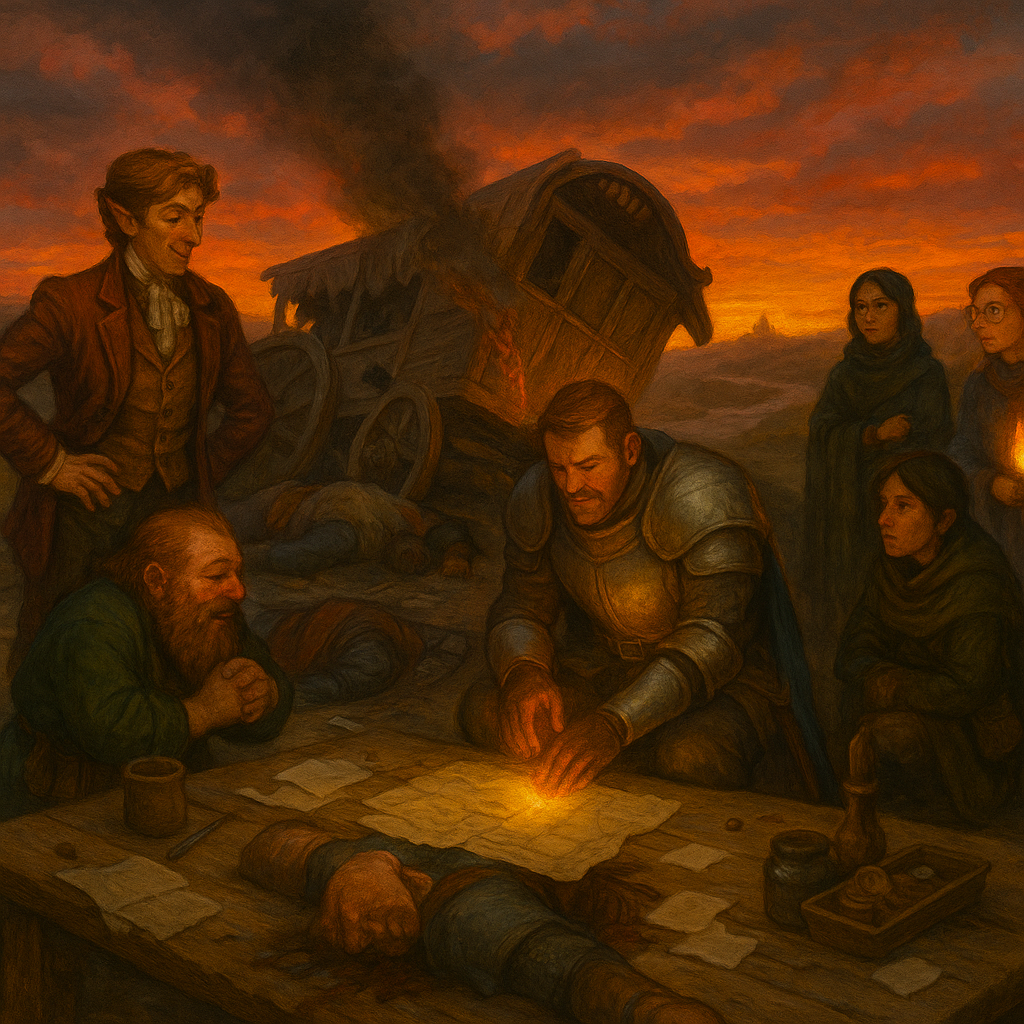
The path still smelled of smoke and iron.
The sun had dropped low enough to bleed along the horizon, throwing long bars of red light across the wreckage: a carriage half on its side, horses tangled in the harness, four guards laid out like punctuation marks to a sentence no one wanted to finish.
Shamus knelt beside the last survivor — Private Ellison, the harried clerk who only days ago had pleaded with them to ask no more questions.
His uniform was soaked through; a crossbow bolt had found his ribs. His breath came thin and wet. His eyes fluttered open briefly and he groaned, “Oh. You lot. Again.”
“Hold on,” said Shamus, placing a gauntleted hand over the wound. A faint glow pulsed from his palm — divine light, or stubborn conviction, or both. Ellison gasped, arched, and coughed once before color began to creep back into his face.
When his eyes finally focused, he blinked at the group. “You—” he rasped, “You came along just in time.”
“Coincidence,” said Pfinder. “We specialize in it.”
They moved quickly: hauling the shattered carriage to the roadside, cutting the dead horses loose, covering the guards with cloaks.
Wolfgang muttered a prayer under his breath, more for the horses than the men. “Such good cuts gone to waste,” he sighed, before the others glared him into silence.
At Ironbark’s suggestion they gathered the guards’ belongings along with the dispatch satchels and sealed mailbags — and hid them in a nearby gully.
“Better no one stumble across these,” he said, “until the army can send someone with fewer stab wounds.”
When the worst of the work was done, Ellison, still pale but steady on his feet, insisted on walking. “Talking helps,” he said.
And talk he did. “You should know,” Ellison began quietly, “about Captain Nelson.”
That caught everyone’s attention.
Ant was first to speak. “Go on.”
He glanced over his shoulder, as if afraid the hedgerows might be listening. “You know he’s buried in the garrison yard, yes? That’s standard practice for officers who die on detached duty. Efficient. Discreet. But word came down this morning — his family sent coin and a request that he be exhumed. They want him home. Proper burial in the family plot, somewhere south of Edicaria. We’re to cast Gentle Repose on him, bundle him up, and send him with the next caravan south.”
Pfinder’s tone was light, but his eyes were sharp. “And how, pray, did a modest clerk such as yourself come by such forbidden knowledge?”
Ellison smiled faintly — the kind of tired smile reserved for men who have long since stopped pretending to believe in coincidence. “Because I write the manifests. I know what leaves Manchester and when. And because you saved my life today. I owe you a truth.”
Lavleen tilted her head. “You think we can get to him before the caravan leaves.”
“I think,” Ellison said slowly, “you’re better off meeting the caravan along the road. Pretend you’re passing through. Maybe a cart wheel breaks, maybe someone’s suddenly feeling faint. Or maybe you sneak up on the caravan when it stops to rest at night. If you had a caster who knew their way around Speak With Dead…” He let the rest hang in the air.
Shamus crossed his arms. “You’re saying the dead still have something to say — and that we should be the ones to ask.”
“I’m suggesting,” said Ellison evenly, “that you speak to a man who might not have taken his own life. And that you let him rest after — quietly, properly. You’d be doing more good than harm, sir paladin.”
Pfinder looked skyward with exaggerated solemnity. “A conspiracy, a corpse, and a clandestine conversation at dusk. Truly, Cambria provides.”
Cassyndra’s voice was measured. “It could confirm everything — or nothing. But if Nelson was murdered, he deserves his voice.”
Lavleen nodded. “Then we’ll give it back to him.”
A silence settled among them — the kind that binds people tighter than oaths.
Then Ellison raised his hand, trembling slightly. “Swear to me none of this reaches another ear. If this comes out, it’s my name on the paperwork and my neck in the noose.”
Each of them gave their word. Pfinder even made a little show of it, pressing a hand to his heart. “Upon my honor as a gentleman, a bard, and a man with no respect for official secrets, I swear.”
“Which,” Wolfgang said, “is somehow both reassuring and not.”
They laughed quietly — the kind of laughter meant to keep ghosts at bay.
Moments later, the sound of hooves was borne on the wind from up ahead. A lone civilian rider appeared, cloak snapping in the wind. He reined in, eyes wide at the sight of the bloodied private.
“What happened here?” he asked.
“Ambush,” said Shamus. “Ebon Blades, most likely.”
The rider swore softly. “I can get to Manchester faster than you on foot. I’ll send word to the barracks.”
“Tell them Private Ellison lives,” said Cassyndra, “and that four guards died fighting to save him and his carriage.”
The man nodded and galloped off toward the city, the echo of his hooves fading into the gathering dark. The party sat down to wait.
An hour or so later, the distant rattle of wheels and the jangle of harness announced a fresh arrival: two military wagons, lanterns already lit, barreling down the road from the direction of Manchester – the cleanup crew.
They pulled up short, eyes widening at the sight of the adventurers escorting Ellison. The lead sergeant jumped down, boots sinking in mud.
“Private Ellison! Thank the gods you’re not dead!”
“Nearly,” Ellison said, managing a weary salute. “Thanks to these citizens, not entirely.”
The sergeant nodded at the party with brusque respect. “We have orders to recover the bodies, effects, and the contents of the carriage. Might we beg you to lead us back to the ambush site?”
The trip back to the site was brisk, thanks to the energetic horses and together they loaded the fallen guards, retrieved the hidden satchels, and began the slow, solemn return to the city. The horses were buried in a shallow roadside grave, over Wolfgang’s heartfelt protest.
“I could have made something beautiful out of them,” he lamented.
Pfinder clapped him on the shoulder. “Consider it an offering to the great kitchen in the sky.”
By the time the convoy reached Manchester, night was well along.They were met at the barracks gates by Major Halvern, a man who turned out to have the bearing of a decent soul laboring under an indecent amount of paperwork. His hair was regulation-short, his posture regulation-stiff, and his imagination—by all reports—regulation-absent.
He listened carefully to Ellison’s account and thanked the party handsomely for their services. Then, in a tone of mild embarrassment, he added, “As for the matter of your prior investigation… I’m afraid the directive still stands. These things are delicate—security, privacy, the good name of the service, and so forth.”
Pfinder bowed with just the right mixture of grace and insolence. “But of course, Major. We wouldn’t dream of obstructing an internal review. We’ll merely be… observing from the side. Perhaps at dawn. Near the north gate.”
Halvern blinked, uncertain if he was being mocked. “Yes, well… see that you don’t interfere.”
He dismissed them with polite finality.
As they turned to leave, Ellison caught Pfinder’s eye. The private gave a subtle nod — gratitude, warning, and perhaps a trace of mischief all at once.
Then the party stepped back into the Manchester night, the sound of the garrison gates closing behind them like the punctuation mark at the end of a secret.
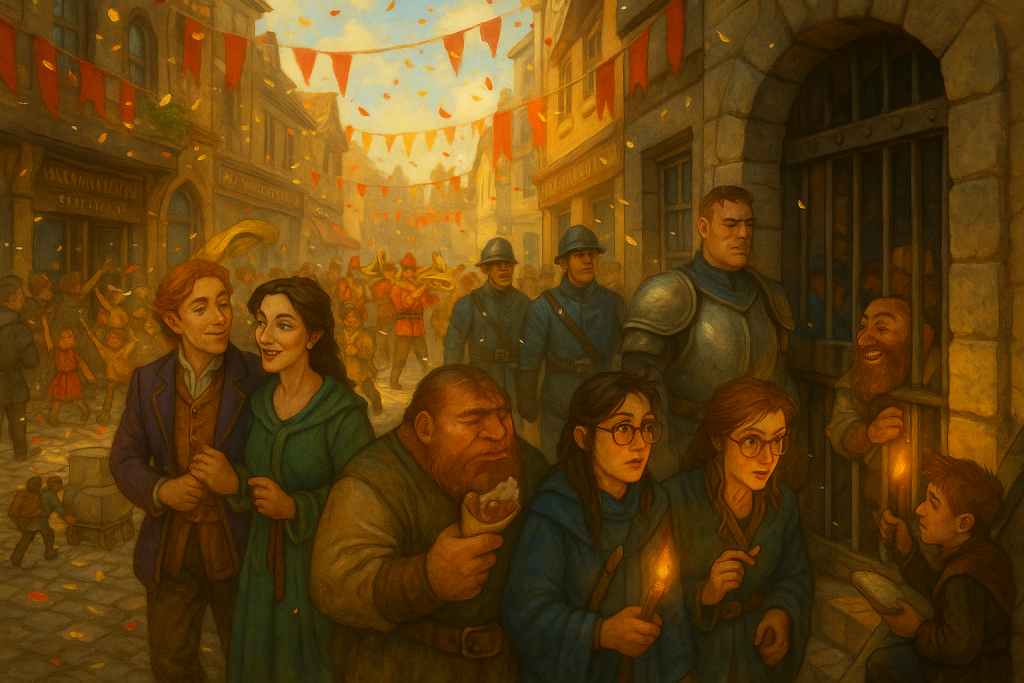
October 6th, 973 – Victory Day
Morning sunlight slanted through the warped glass of the Hero’s Respite, catching the motes of dust and pipe smoke like a slow-motion snowfall. The tavern’s common room was already half-awake — the usual mix of traveling merchants arguing over ledgers, hung-over adventurers arguing with gravity, and one bard (Pfinder) arguing with his tea… and, given the mental handicaps imposed by the early hour, losing.
Ant sat at the end of the long table, sleeves rolled up, a stack of parchment before her and a look of mild irritation that suggested she had been losing an argument with the alphabet since dawn.
“I’ve been working on the last of Nelson’s letters,” she said, tapping a quill against the page.
“Still can’t make sense of it. But the letter frequencies match Common — almost perfectly. No doubled letters where there shouldn’t be, no missing vowels. It’s… orderly. Too orderly.”
Cassyndra leaned over her shoulder. “So not a substitution cipher.”
“Right. The letters themselves aren’t changed — they’re just out of order.”
“A transposition, then,” said Pfinder, perking up like a cat hearing the word audience. “Excellent. A puzzle of arrangement rather than replacement! My second-favorite kind, after ‘how many cravats can one reasonably wear at once.’”
Wolfgang blew on his coffee and muttered, “And my least favorite, after ‘why is the stew on fire.’”
Shamus rubbed his chin. “So if the words are just scrambled, we could—”
“—reconstruct the pattern by looking for rhythm,” finished Cassyndra. “Common phrases, repeated structures. It’ll take time, but not magic.”
Ant sighed. “Time we don’t have today. The city’s already filling up for the parades. I could hardly hear myself think this morning for the sound of drums.”
Pfinder lifted his cup in mock salute. “Indeed! Nothing says reverence for victory like overpriced pastries and flags produced in the very provinces we conquered.”
Lavleen gave a small smile. “So… we postpone the cipher.”
“Until after the rats, the dead captain, and the jailbreak,” said Ant, gathering the pages. “Which, at this rate, means never.”
Wolfgang leaned back, folding his arms behind his head. “Cheer up. At least today we’ve got a festival to hide in. Easier to move when everyone else is drunker than I am — or thinks they are.”
“Ah yes,” said Pfinder, “Victory Day: when the people of Archea celebrate five centuries of enlightenment, peace, and civic pride by setting fire to things and blaming the orcs.”
“Tradition,” Shamus said dryly. “Wouldn’t want to spoil it.”
Soon after, the party spilled into the streets, and Manchester was already in full delirium. Banners of red and gold hung from every balcony. Children waved miniature spears made of painted wood. Bakers shouted over the crowd, hawking “Righteous Rolls” and “Victory Puffs.” Somewhere, a brass band battled a chorus of off-duty soldiers who believed volume compensated for pitch.
The air smelled of roasted nuts, spilled beer, and gunpowder — the scent of patriotism, bottled and served lukewarm.
The adventurers wove through the crowd toward the Manchester City Lockup, a squat, square-shouldered building on the corner of Sovereign Street and Hammermill Lane — the sort of intersection that once held warehouses but now hosted small bureaucracies and big egos.
From a distance, the lockup looked like an afterthought of wood and iron shoved in amongst more cheerful architecture: a perfumery on one side (Madame Eloise’s Essences, currently shuttered for the holiday) and a stationery shop across the Sovereign Street (Davenport & Sons — Forms for Every Purpose). Across Hammermill Street stood a cobbler’s shop with a wooden sign in the shape of a boot and, on the opposite corner, a tavern called The Brass Standard, already spilling patriotic drunks onto the curb.
Perfect cover.
They split naturally into pairs, blending with the throng of revelers. Pfinder and Lavleen strolled arm-in-arm like gossiping gentry; Shamus, in uniform polish, passed credibly for an off-duty officer; Hunkle and Cassyndra lingered near a street vendor selling sugared almonds, pretending to debate the merits of rose versus cinnamon while quietly counting windows.
There were two entrances — one on each street the building faced. The main door on Sovereign Street was broad, iron-bound, and flanked by a pair of sleepy constables more interested in the parade than their post. The smaller service door on Hammermill Lane was half-hidden by a coal chute and stack of empty barrels.
Wolfgang, adopting his favorite role as “tipsy but charming,” wove through the press of onlookers until he found himself swaying near the lockup’s barred windows. He squinted, hiccuped artfully, and leaned close enough to peer inside.
“One room and four cells on the ground floor,” he murmured later when they regrouped. “Right one’s a desk and a ledger — one guard inside, bored. The cells are darker but there’s at least two prisoners per cell – don’t think any of them is Kenning. The cell doors are made of bars but it was too dark to see past them. I heard someone coughing. Deep voice. So at least one male in those cells.”
“Windows barred?” asked Shamus.
“Thickly. New iron, too. But the hinges on the cells —” Wolfgang grinned. “—they’re old. Rusted. Someone forgot that corners rot faster than fronts.”
Pfinder nodded approvingly. “Ah, the eternal lesson: never neglect one’s corners.”
Across the street, a cheer went up as the parade passed — priests in white, soldiers in red, children tossing petals. Brass horns blared the March of Righteous Triumph, and for a moment the entire city seemed to shout its own self-importance to the heavens.
The adventurers used the noise to retreat unnoticed, circling back through side alleys toward the Hero’s Respite.
Back in their rented rooms, they spread a rough map across the table — a patchwork of notes and sketches scrawled on napkins, receipts, and the back of one of Pfinder’s fan letters.
“Two entrances to a three-story building,” Cassyndra summarized. “One main, one service. A coal chute near the service entrance that leads to the basement and might be small enough for Ant or Wolfgang to get through. At least four ground-floor cells, maybe more toward the back and certainly some above. Guard rotation unclear, but the crowd outside will thin after sundown.”
“Shops nearby,” said Ant, marking them. “A perfumery and a paper store. Could use those as cover.”
“And the tavern on the far corner,” added Wolfgang. “No one notices drunks stumbling in or out of a tavern.”
They fell quiet for a breath, then the practical theatre began — ideas volleyed like knives, half serious, half theatrical, all useful.
Pfinder flicked a crumb from his sleeve and peered at the map as if it were a stage set. “We could, of course, burst in at dawn with cold steel and warm hearts,” he suggested, tone deliciously absurd. “Heroic, swift, terribly good for one’s reputation.”
Wolfgang gave a theatrical belch that might have been a laugh. “Or we could be civilized: find the guards at The Brass Standard, plumb their courage with ale until one sings the rota like a lullaby. Low risk, high merriment, and with the reward of some information to make our approach safer.”
Cassyndra tapped the corner of the sketch with a methodical finger. “If Wolfgang’s way gives us the shift details, we can pick our hour. Or we can bribe a city clerk to give us a copy of the lockup’s floor plans. Paper gives you leverage.”
Ant’s pen paused over the map. “Or pursing the paper theme in a different direction – maybe we blackmail a magistrate to sign Kenning’s release paperwork? Or forge it ourselves? Or bring forged orders commanding us to transfer him to Northmarch early?”
Wolfgang leaned back and steepled his hands, “Or we embrace the chaos? Set a fire in the lockup and during all the confusion make sure Kenning leaves the scene with us?”
Hunkle folded his arms. “Any other options?”
“The most glorious one, of course,” Pfinder said, eyes bright, “is the dramatic solution: we crash the party and extract Kenning by force. Fewer words. More sword.”
They all considered it. Cassyndra’s eyebrow rose. “Fewer words means more consequences. If we don’t succeed on the first go round, the guards will certainly be doubled and Kenning’s scheduled transfer to Northmarch moved up.”
Ant looked up from her notes and met each face in turn. “Which do we want more: a quick rescue that could get messy, or a smart plan that keeps other options open? Because we can’t have both.”
A small silence, then a scatter of practical comments — who could bluff best, who could lift a seal, which of the shops might have a clerk with a loose tongue, whether Pfinder’s charm could buy them a signed requisition, and how well Wolfgang could fake his way into being three sheets to the wind. The map lay between them like a promise. Outside, the city shouted its triumph. Inside, over cheap tea and better intentions, they chose their next small treason.
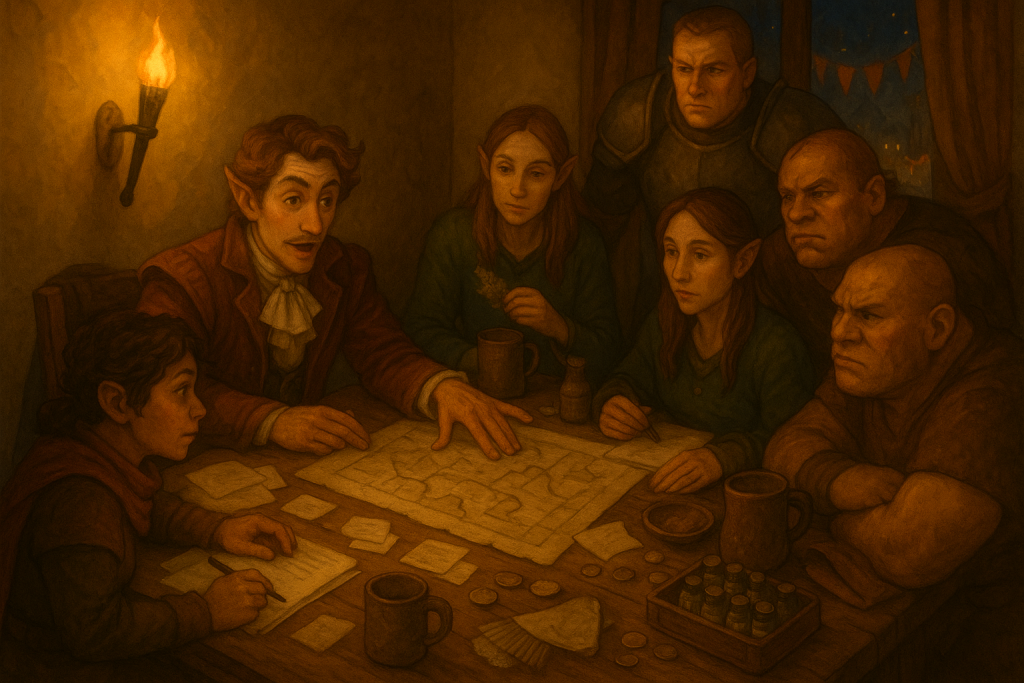
October 7th, 973 – The GM breaks the fourth wall!
We’ll pick up play on 10/3/973 with the finish of the Manchester sewer fight we didn’t have time for last session. Bring your torches, your patience, and whatever prayers/seasonings you trust most — the nest is deep and loud.
After the rats, we’ll fast-forward to 10/7/973 and move straight into the next decision point: you’ll choose whether to go after Captain Nelson’s corpse first or spring Kenning from the lockup. I’ll have both scenes ready, so you pick the order in play — and if time allows, we’ll do both.
Each of the jobs is wide open for the party to approach as they see fit – you can do some investigating first or just hatch a plan on the spur of the moment and charge on in! I recommend the former but if your hearts are set on the latter, the constables will happily meet you at the door of the lockup.
With regard to Captain Nelson, two approaches suggest themselves,
First, you could flag the caravan down soon after it leaves Manchester with a manufactured emergency (broken wheel, “sick” driver, whatever), and use the distraction for someone to get close enough to cast Speak with Dead on the body. Quick, theatrical, but messy if the escort gets suspicious.
Second, from your own recent journey to Manchester, you know that outgoing caravans will spend their first night at Morganthal. Morgenthal is nothing more than a fortified inn on the cleared top of a hill. The clearing offers excellent sightlines in all directions and, for this reason, it was the site of an orc fort some 500 years ago.
The fort is long defunct, of course, but the ruins were used to construct a fortified inn/stables. Caravan wagons park outside and horses, mules, and caravanners spend the night safe within the redoubtable walls while guards keep watch from the roofs of both structures.
You’ve drawn a sketch of the area from your recollections of your own night there and might be able to use it to creep up on the wagons in the middle of the night, find Captain Nelson’s body, cast your spell, and sneak away without anyone becoming the wiser.
As for poor Kenning, you already have a rough map from your Victory Day reconnaissance. The information is incomplete — who’s on shift, where they’re posted, which entrance is weakest, etc. — so your job is to decide how you’ll get that intel. Options include bribery/forgery, social engineering (drunk guards), a clerk with loose lips, or a covert night infiltration via the service door / coal chute. Each approach has tradeoffs: noise vs. information, speed vs. safety. I trust that you’ll choose wisely!