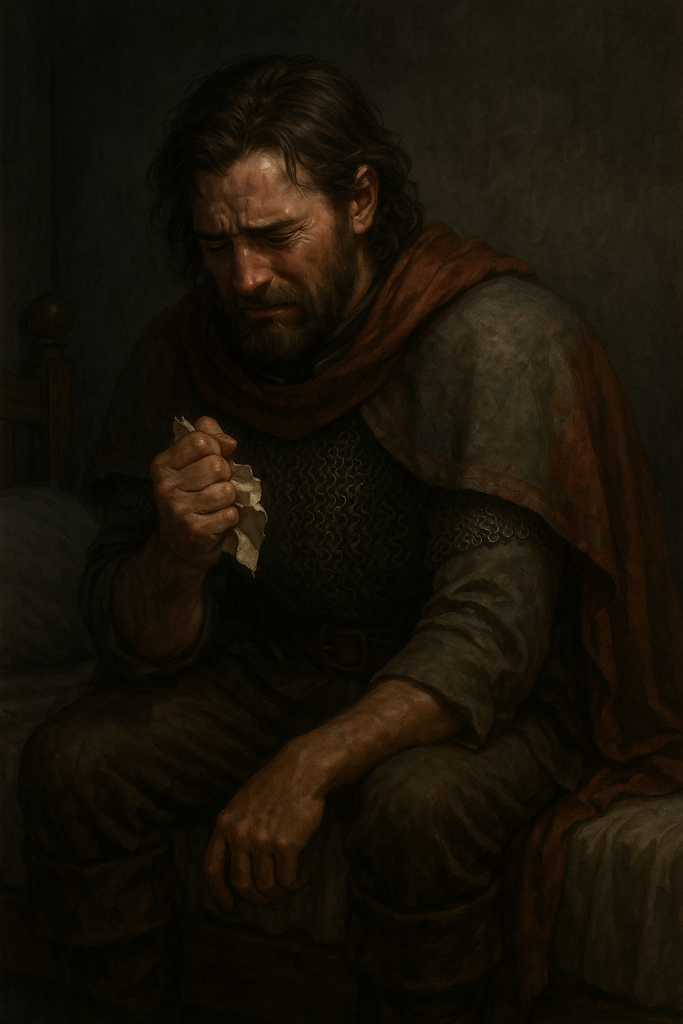
October 8th, 973
The morning of the 8th dawned gray and sour, the clouds leadenly promising the rain predicted by The Royal Standard. The Hero’s Respite smelled faintly of spilled ale and damp wool as the party gathered in the common room—everyone, that is, except Hunkle, Ironbark, and Shamus.
When Cassyndra went upstairs to look in on them, she found the trio febrile, pale, and sluggish. Their skin shone with sweat; their movements were stiff and pained. All three complained of aching joints and tender lumps beneath the skin near their recent giant rat bites. The magical healing they’d received had closed their wounds but done nothing to stave off the infection now smoldering beneath.
The rest of the party crowded at the doorway, glancing uneasily between the beds. It didn’t take a diviner to connect the dots—rat bite fever.
All three had been on the front lines of the sewer fight and suffered multiple bites. And now, the price was coming due.
Only Wolfgang was lucky—bitten just once, and spared for now. The others watched him with a mixture of envy and suspicion, half expecting him to start sweating by sundown.
The party did some grim arithmetic: at least three Lesser Restoration spells would be needed. If none of them had learned the spell recently, they were looking at 600 gold pieces in service fees from either the Adventurers’ Guild or the Society of Our Sister of Endless Sorrow and Self-Limited Hemorrhage—both notorious for their exorbitant interest rates and sanctimonious bookkeeping.
(GM Note – Until cured, the victim can’t regain hit points except by magical means, and their hit point maximum declines by 1d6 every 24 hours. If this reduction brings the character’s hit point maximum to 0, the character dies.
The disease can be cured by Lesser Restoration or similar magic.
Since several party members have just leveled up, it’s entirely possible one of them has learned the spell. If not—start counting your coins.)
October 9th, 973
The promised rain had begun overnight but, despite that, it seemed this morning dawned in a far more agreeable light. The treatments obtained the previous day had worked with gratifying speed, and the three ailing members of the party were now sitting upright at breakfast, rosy-cheeked and already offended by everyone’s hovering concern. Truly, magical healing proved itself immeasurably superior to the earnest but largely symbolic efforts of that sorry, leech-loving class of peasants who called themselves “physicians.”
Those perhaps less-than-worthy souls might drain a pint or two, apply a compress of questionable herbs, and offer an encouraging prognosis such as “the crisis will come tonight.” Of course, the crisis usually came as predicted… as often as not, courtesy of the ministrations of the physician himself. By contrast, a single pulse of divine energy from a properly trained cleric restored color, appetite, and faith in the gods within seconds. It really was astonishing that physicians had managed to keep their profession alive at all; perhaps they simply reproduced faster than their patients expired.
After breakfast, the party dispersed to their various errands with perhaps the most curious assignment falling to Cassyndra.
Since their arrival in Manchester, she had been quietly probing the city’s underworld, speaking with tavernkeepers, dice-players, and other citizens of flexible morality in hopes of finding an introduction. So far, her efforts had met only polite indifference and stony silence.
That changed the previous evening, when one of her more sullen contacts—a lean, wary man named Erez—approached her in the taproom and murmured that “the Perfumer wants to meet you.”
Even more curious, the meeting place was to be Eloise’s Essences, the perfumery adjoining the city lockup where Kenning was being held.
Not wishing to alarm her companions, Cassyndra said only that she intended to spend the morning at The Brass Standard, observing the jail’s comings and goings.
Now, standing before the perfumery’s pastel facade, she began to question the wisdom of that omission. The shopfront’s windows were steamed, the air beyond faintly opalescent with fragrance. She could hear the clink of glass and the low murmur of a woman’s voice somewhere within.
Pushing her doubts—and the lingering scent of camphor poultices—firmly to the back of her mind, Cassyndra squared her shoulders, adjusted her cloak, and stepped inside Eloise’s Essences.
A little brass bell chimed overhead as Cassyndra stepped inside. The shop was a haze of warm amber light and fragrant steam; glass decanters lined the walls in orderly ranks, each bearing labels in looping script—rosewater, ambergris, musk of the southern fen. Behind the counter stood a prim young clerk in lace cuffs and an expression of practiced discretion.
“I have an appointment,” Cassyndra said quietly, glancing at the other patron browsing near the front. “With the Perfumer.”
The clerk’s expression didn’t change, but his eyes flicked to the window shutters. With a discreet twist of a knob, the front display darkened. “Of course, madam,” he murmured. “If you’ll follow me.”
He led her through a curtained doorway at the rear, past shelves stacked with tiny bottles, parchment rolls, and the faint odor of sealing wax. The air grew cooler, the scents shifting from floral to chemical. A single oil lamp burned over a desk strewn with folded papers and a brass burner sending up a slow curl of lavender smoke.
Seated behind the desk was Maris Vell, the Perfumer herself—elegant, patient, and unsettlingly composed. Her silk gloves gleamed faintly in the lamplight; her smile did not.
“Miss Cassyndra,” she said softly, as though testing the name for flavor. “I am told you have been observing the city jail with great interest.”
Cassyndra inclined her head. “I prefer to think of it as a scholarly inquiry.”
“How admirable,” said Maris. “Curiosity is a virtue so often mistaken for intent. The watch, for instance, might assume you were plotting an escape. I, however, prefer to think well of people—until they disappoint me.”
She gestured to a chair. “Please. Sit.”
Cassyndra did so. Maris poured two cups of pale green tea from a ceramic pot, its steam carrying a scent faintly reminiscent of ozone and ink.
“One of my associates currently resides in that jail,” Maris continued. “A man named Silas Venn—an exceptionally tidy hand, regrettably poor at discretion. He was detained two months ago for the dreadful crime of selling freedom to men who could no longer afford discipline.”
“A deserter-forger,” Cassyndra said.
“Quite. A craftsman of signatures, travel permits, and official fictions. Harmless, except to the pride of the bureaucracy.”
She folded her gloved hands. “Now, I believe our interests align. I suspect you seek to remove someone from that same building. I don’t care who, and I don’t need to know. But I can provide you with information—guard rotations, a floor plan, even a key that officially doesn’t exist. You use that information to accomplish your task, and ensure that Mr. Venn departs at the same time.”
Cassyndra regarded her evenly. “And in return?”
“In return,” said Maris, “you owe the Black Lily a favor. A simple, professional understanding. One day, I will ask something of you—nothing unconscionable, nothing tedious. But I will expect it done.”
A quiet moment passed between them, filled only by the delicate tick of a clock and the soft crackle of the burner.
Cassyndra nodded slowly. “That is a generous offer, Mistress Vell. But I must confer with my colleagues before committing the party to any agreement.”
Maris inclined her head, visibly pleased. “Of course. I find deliberation a refreshing trait among potential partners. You will have three days to consider. On the evening of the third, send word to Eloise’s—a simple yes or no will suffice.”
She rose and extended a gloved hand in a gesture more formal than friendly. “I trust you will choose wisely. The fragrance of opportunity fades quickly, and it is so difficult to bottle twice.”
Cassyndra thanked her and took her leave. As the clerk guided her back through the curtain and into the perfumed haze of the shop, she could still feel the faint trace of lavender smoke clinging to her clothes—sweet, elegant, and faintly unsettling.
While Cassyndra was stepping cautiously into the perfumed shadows of Eloise’s Essences, Wolfgang and Lavleen were crossing the sunlit flagstones of the Adventurers’ Guild. The Guild Hall at mid-morning was its usual chaos of steel, parchment, and argument—clerks shouting over one another at the job board, hirelings polishing weapons that looked too large for them, and a bard somewhere in the rafters tuning a lute in a way that suggested long practice and minimal talent.
Wolfgang adjusted his pack, glanced around the hall, and rumbled, “We’re supposed to ask for a lad named Gareth. Second-level fighter. Looking for a crew.”
The clerk on duty nodded toward one of the tables where a broad-shouldered young man was eating something that might once have been stew. His armor was well-kept, his sword serviceable, and his expression that of a man who had learned to meet life’s misfortunes with a grin and an extra helping of bread.
Wolfgang and Lavleen approached, and the young man rose at once, wiping his hands on a rag. “Gareth Alven, of Gozneth Province,” he said brightly. “You must be the lot looking for someone who can stand in front of things and get hit repeatedly.”
“That’s the general idea,” said Wolfgang, extending a hand. “Our last one got eaten by a snake.”
“Occupational hazard,” Gareth said cheerfully, shaking his hand. “Snakes, goblins, collapsing roofs—pay’s better than the Civil Guard, though. I used to work for them back home. Spent a few years keeping the peace, collecting fines, and pretending to respect people I didn’t. Then my cousins started school, my uncle lost his leg in a mill accident, and my aunt came down with something that made her cough up blood. So here I am—earning hazard pay for the family while there’s still enough of me left to collect it.”
Wolfgang gave a low whistle. “That’s… honest.”
Gareth shrugged. “No sense lying about it. I’ll pull my weight, I’ll watch your backs, and when we get paid, I’ll take my fair share, buy myself a new breastplate, and send the rest home. That’s the arrangement I’m after.”
Lavleen, who had been silent until then, tilted her head. “That seems… reasonable,” she said softly.
“Reasonable’s my middle name,” said Gareth, grinning. “Well, actually it’s Tarl, but you take my meaning.”
Wolfgang laughed, and the tension around the table eased. They spoke for a time about weapons, tactics, and the peculiarities of Cambria’s terrain. Gareth listened more than he talked, but when he spoke, his manner was earnest and quick-witted.
At one point, Wolfgang mentioned an uncracked transposition cipher recovered during their travels. Gareth furrowed his brow thoughtfully. “Could be a railfence cipher,” he offered.
Wolfgang blinked. “You know ciphers?”
Gareth grinned. “Not a bit. That’s the only transposition cipher I’ve ever heard of. I’m just a dumb fighter—thought I’d better say it before someone else did.”
Lavleen’s lips twitched in amusement, and even Wolfgang chuckled. “Well, you may be a dumb fighter,” he said, “but you’re our kind of dumb fighter.”
They shook hands all around, sealing the bargain in the pragmatic fashion of adventurers everywhere. The Guild’s clerk appeared moments later with the standard paperwork—shares, death indemnities, and the usual clause about the Guild not being liable for acts of gods, demons, or unusually clever rodents.
As Wolfgang and Lavleen stepped back out into the daylight, the dwarf glanced at his new companion and said, “Welcome to the crew. Try not to get eaten.”
Gareth grinned. “I’ll do my best. But if it happens again, I’m haunting the snake.”
Still elsewhere in the city of Manchester, Pfinder and Lavleen made their way through the ivy-choked gates of the Royal Collegium of Cambria, one of several institutions of higher learning clustered in the city’s Lyceum Quarter. The air was full of the smells of parchment, pipe smoke, and overconfidence.
They had come at the suggestion of their friend Vreynar, a veteran adventurer whose cheerful cynicism was matched only by his ability to find someone who “knew a guy.” After hearing of the strange runes and relics the pair had uncovered in the Tomb of the Teacher, Vreynar had leaned back in his chair at the Hero’s Respite and said, “You want answers, talk to the Society for the Study of Orcish. Don’t expect a sign on the door, though—they keep quieter than a tax collector in confession. Studying Orcish ain’t illegal, mind you, just… unpopular. Makes the neighbors nervous when you start humanizing their slaves.”
The Collegium’s corridors were tall, echoing, and only moderately infested with scholars. After some discreet inquiries, the two were ushered into the office of Professor Aldren Marseth, a lean, silver-haired man in a waistcoat that looked as though it had once been fashionable, then disreputable, and had now come back around to fashionable again.
He peered at them through a pair of brass-rimmed spectacles. “You’re the adventurers Vreynar mentioned, yes? Come in, come in. And please, close the door. We don’t advertise our interests too loudly here—Manchester’s tolerance, you understand, is of the arm’s-length variety.”
Pfinder spread a roll of oilcloth across the desk, revealing the hammered bronze scrollwork they had recovered. The professor’s demeanor shifted instantly from wary courtesy to hungry fascination.
“By the Aether,” he murmured, fingertips hovering above the metal. “These inscriptions… you said they came from a tomb?”
“In what we named ‘Tomb of the Teacher’, a heretofore untouched circular room in the sewers under the city,” said Pfinder. “The murals on the wall suggested that the tomb was that of a beloved educator… not the tomb of a conquering hero or wealthy noble that we were expecting. This piece in particular caught our eye. We couldn’t tell if it was ceremonial or pedagogical in nature…”
“It’s alphabetic,” Marseth interrupted, voice rising with excitement. “This—look here—these Orcish characters are paired with phonetic marks that correspond to sounds in Common. Perhaps it was used to teach Orcs how to speak Common but now… now… it’s a pronunciation key for us! Until now, we’ve had no reliable idea how Orcish was actually spoken. We’ve guessed, extrapolated, invented—but this, this is language reborn!”
His hands trembled slightly as he adjusted his spectacles, still staring at the scrollwork as though afraid it might vanish if he blinked. “Remarkable. Simply remarkable. The rest of the Society will want to see this—and whatever else you brought back from the site, of course. Notes, sketches, fragments?”
Pfinder smiled faintly. “A few, yes. Certainly, more than enough for us to puzzle over… and perhaps interesting enough for you to puzzle over as well?”
Lavleen added dryly, “We’d be happy to meet with your Society. I imagine they’ll be interested in what we found and perhaps will have a few questions of their own.”
Marseth tore his gaze away from the bronze piece long enough to beam at them both. “Questions, yes—quite a few, I expect! We’re a cautious lot, but open-minded where discovery is concerned. I warn you, though, that the Society may ask you… beg you, really, to lead a small number of us back to this Tomb of the Teacher for further study. We’re not blessed with many members who can tell one end of a sword from the other, and I gather the sewers of Manchester are not… entirely pacified.”
“They’re improving,” said Pfinder, “but not exactly scenic.”
The professor gave a sympathetic chuckle. “Quite. We couldn’t offer much in payment, I’m afraid. The Society’s funds are modest—endowments tend to favor subjects with fewer political implications—but we could provide a stipend sufficient to cover your expenses. And, of course, we would share anything we learn with you. Translations, cross-references, histories. If we can begin to read Orcish as it was truly spoken…” He trailed off, a kind of reverence creeping into his voice. “It could change everything we think we know.”
Lavleen folded her arms. “You’ll forgive us if we keep that quiet. Some people might not be ready to hear that Orcs had teachers worth burying.”
Marseth sobered at once. “Yes. Quite right. Discretion is the mortar of scholarship. We’ll keep this between ourselves—and your… associates, of course.”
“Of course,” said Pfinder. “We’ll talk with the others. If they’re willing, we’ll arrange the expedition. Quietly.”
“Splendid,” said Marseth, the enthusiasm returning to his voice. “And should you happen upon any other runes or inscriptions in your travels, please make rubbings or copies—whatever you can manage. Even the smallest fragment could prove invaluable. Bring them to me directly. No intermediaries.”
Lavleen inclined her head. “Understood.”
Marseth leaned back, exhaling as though he’d been holding his breath since they unveiled the scrollwork. “You’ve done something extraordinary here, you know. And if anyone asks what brings you to the Collegium—say you’re inquiring about civic drainage. That’s dull enough to discourage conversation.”
Pfinder gathered the scrollwork back into its wrapping, and the two rose. “Drainage it is,” he said.
Lavleen’s boots clicked on the marble floor as they descended the stair. “Do you think he realizes what this means? That the first words ever spoken in Orcish again might come from a man who can’t walk across campus without wheezing?”
Pfinder smiled. “History’s always written by the least athletic.”
They stepped into the courtyard, where the morning fog was already lifting off the Collegium roofs. Bells tolled the hour somewhere in the distance. Pfinder glanced back once toward the high windows. “Still,” he said, “if he can teach us to read what the Orcs really said, not what Archea pretends they said—that’s worth more than a little physical discomfort.”
Lavleen nodded. “And worth a return trip through the sewers, apparently.”
Pfinder sighed. “Yes. Our reward for unearthing enlightenment: another bath in filth.”
They exchanged a small smile and started toward the courtyard, already rehearsing how they’d explain this latest discovery to their companions—and how, precisely, they’d convince them to return to the Tomb of the Teacher.
For now, though, it was enough to know that they’d found allies who cared more about knowledge than politics. Allies who would help them understand the runes that wound through Cambria’s buried history—quietly, carefully, and very much on the downlow.
That night, the party gathered in the common room of the Hero’s Respite and talked about the day’s events; Cassyndra drawing frowns from the others when they heard she visited Maris without any backup.
Opinions were offered as to whether to accept Maris’ help and theories about what line of “business” she might be in were batted back and forth without any firm conclusions being reached. On the other hand, the party was in unanimous agreement with Wolfgang and Lavleen’s decision to bring Gareth aboard and found themselves favorably disposed toward the Society for the Study of Orcish.
As the conversation died down, however, Shamus cleared his throat meaningfully and when he had everyone’s attention, said “Brothers, Sisters, I would like to have a word. I feel compelled to share with you more of my past as it seems it may affect OUR future.
“Two days ago, I received a simple note from a messenger… actually, not such as simple note… it was more of a threat or a taunt. It seems that I was seen spotted by someone at the Victory Day Celebrations and a monster, an abomination from my past reached out to me.”
Shamus opened his fist and read aloud from the note clenched within,
“So good to see you at the Victory Day celebrations, Shamus!
My, how you’ve grown!
Such a shame you couldn’t see me, however…
Getty says ‘Hi.’ — or does she?”
The table fell silent. Wolfgang set his mug down with a dull thud. Hunkle’s fingers tightened on the rim of his cup; Cassyndra’s eyes flicked sharply toward Shamus, studying his face.
“I can’t rightly recall all that I’ve shared over a pint or two in the time that we’ve all known each other,” Shamus went on. “I’m sure you all remember that I received my training as a Paladin from a generous elderly benefactor whom I met thru my Uncle, a monk. However, I don’t think that all of you know that I was originally born to a poor farming family. We were a small family consisting of my parents, my younger sister, and myself. While lacking material wealth, we loved each other and we all worked hard.
“That happiness was shattered when one night my parents didn’t return from a trip to the village market. I awoke the following morning in our small cottage, alone with my sister. I went out in search of my parents, only to discover that they had been killed by a savage beast on their way home. Their pale corpses lay next to our cart and mule, who was spared the savagery. Nothing was taken and a few coins still lay within my mother’s coin purse. I was only eleven years old. I brought their bodies home and buried them behind the cottage, unbeknownst to my sister, Getty. I told her they had gone to visit my uncle. She was seven and my responsibility now.”
While many in the party knew that Shamus’ family had been killed by undead creatures, this was the first time he had ever spoken of Getty in detail. Even Pfinder’s natural flamboyance was dimmed.
“I was grief stricken and overwhelmed,” Shamus continued. “I wasn’t sleeping well so I was already awake when late one night there was a knock on our door. A well-dressed but very wet gentleman stood at the doorway and asked for time by the fire. But before he had even finished uttering his request, I was overcome with foreboding. I immediately felt EVIL emanating from this man. Getty had already awoken and approached me from behind, so when I firmly told this man that he couldn’t step foot in our modest home, I could hear her start to object. I lied and stated that we had some sick family members whom we didn’t want disturbed. This stranger accepted my story and threw some compliments towards Getty as he backed away. “Oh, what a beautiful girl, and so polite!” Then, just before he turned away, his face changed — almost like a curtain had fallen — and I saw hatred and evil and spite manifest on his face for just a split second before he resumed his facade. I closed the door. I locked the door. I sat silently while Getty scolded me for being rude.”
No one spoke. Wolfgang’s hands were clenched on the table; Ant stared into the fire, jaw tight.
“Getty and I would start our days immediately at sunrise and tend to the farm while the sun was up. Immediately at sunset, we would confine ourselves to the cottage with dinner and sleep. We used chamber pots to minimize trips to the outhouse. Unfortunately, about three days after the “stranger” visited us, I awoke morning to discover that she was missing and our only lantern was still burning next to the outhouse. I spent the entire day looking for her to no avail. I made a crude drawing and presented it to the village constable as well, but no one had seen her. It was then that I discovered that others about the town had gone missing as well. Multiple families had experienced a similar loss. The village had even established a roving night force, but it was confined to patrols within the inner walls.
“The next night, I heard another knock at the door. Standing there before me was the ‘stranger’ and Getty. ‘Look who I found!’ The stranger sang with a demonstrative flourish. I would have rushed towards her, but I was overcome once again with the sickly smell / taste of evil. The stranger sensing my anguish, stated ‘Oh, there’s no fooling you, is there?’ Hearing this, Getty giggled and took his hand in hers. When I looked in her eyes, I found nothing of her there. Both of them laughed together and turned to walk away from the door and out into the darkness. I was still in shock but as the two disappeared into the darkness, I muttered “I’ll kill you someday” under my breath. The stranger, hearing this despite a good 30 feet of distance, turned and picked up Getty. With that same condescending smile, “I’m sure you’ll try.”
Hunkle’s voice was low and rough. “We’ll find him.”
Shamus nodded once. “Chain and ring mail are heavy. Plate mail is even heavier, but NOTHING is heavier than the guilt and shame I’ve been carrying since that night many years ago. I only had a kitchen knife and I wasn’t anywhere close to ready. I’ve matured and grown since then and I no longer fear death. I only fear a premature death. I will sit with God and my family in the afterlife, but only after I’ve cleansed this earth of the evil within my reach.
“This note was clearly written by my nemesis. He referenced my sister Getty in the note. But Getty is no longer the Getty that I knew and loved. She’s vampire spawn. I need to vanquish them both.
“I know this isn’t your fight. I also know that I’m not strong enough for this fight…at the moment. The “stranger” may just be toying with me. Or, he may want to finish what he started. I just thought you should all know.”
For a long time, no one spoke. The fire crackled, the only sound in the room. Cassyndra was the first to break the silence. “Then it is our fight,” she said quietly.
Ant nodded, eyes hard. “You’ve fought for us,” she said. “We’ll fight for you.”
Wolfgang gave a grim smile. “And if your vampire wants a rematch, he’s picked the wrong damn tavern.”
Lavleen, still pale, added softly, “I’ve seen darkness that hides in the world. I’ll help you chase yours.”
One by one, the others murmured assent until the room felt smaller, the air heavier with purpose. What had begun as a night of conversation and ale had become something else entirely—a silent oath spoken over empty mugs and flickering firelight.
The laughter that had filled the Hero’s Respite earlier that evening was gone now, replaced by a solemn understanding. For the first time since arriving in Manchester, the party was not merely a collection of travelers sharing a table. They were bound by something darker, older, and far more enduring than coincidence.
October 10th, 973
The next morning found the party gathered around their usual corner table at the Hero’s Respite, the smell of fried bread and coffee drifting through the common room. Conversation began quietly—lower voices than usual, careful pauses between words.
Shamus was already seated when the others arrived, polishing a buckle on his gauntlet with a square of linen that had seen better days. There were no signs of exhaustion or brooding—only the same disciplined calm that marked all his mornings—but when Wolfgang clapped him once on the shoulder in passing and Ant wordlessly slid the butter dish toward him, he gave a brief nod that said more than thanks.
Lavleen murmured a blessing under her breath as she took her seat; Shamus pretended not to hear, but his expression softened.
Moments later Gareth arrived—fresh-faced, well-scrubbed, and slightly overdressed for breakfast. He hesitated at the edge of the table, reading the quiet like a man stepping into a room mid-sermon. “Morning,” he said cheerfully but not too loudly. “Hope I’m not intruding on sacred rites or anything.”
Wolfgang grinned. “Only coffee. Join us. The rites come later.”
Gareth slid in, taking note of the subdued tone and the few sidelong looks between companions. He didn’t ask; whatever had been said last night wasn’t his to pry into. Instead, he poured himself coffee, tasted it, and muttered, “Civilization. At last.”
Ant broke the silence first. “You’ll all be glad to know that my boyfriend came to visit last night. No announcement; just showed up without a by-your-leave right before bedtime.”
Lavleen’s spoon froze halfway to her mouth. “Your what?”
“My patron,” said Ant airily, waving her hand. “But it’s basically the same relationship dynamic, just with more existential dread and no flowers.”
Wolfgang leaned an elbow on the table. “So, did he knock, or just appear in the mirror again?”
“Oh, straight into the mirror,” said Ant. “He loves a good jump-scare. I’d barely finished brushing my hair when he materialized to tell me that we’re, and I quote, ‘a hinge of history.’”
Cassyndra blinked. “A hinge of history?”
“Yes. Apparently the entire fate of nations and millions of beings now depends on whether we creak properly. We’re to open and close on command, no questions asked.”
Wolfgang grunted. “I prefer jobs that come with schematics.”
Ant sighed. “So do I. But the message was clear: the patron will guide us along the ‘correct path,’ provided we’re willing to do as we’re told without necessarily understanding why.”
Cassyndra raised an eyebrow. “Ah. The world’s worst boyfriend indeed.”
“Exactly,” said Ant, brightening. “Shows up uninvited, gives you cryptic instructions, disappears before you can ask questions, and expects total devotion. Honestly, I could write a pamphlet.”
Shamus allowed himself a quiet chuckle. “At least he talks to you. The gods I serve prefer long silences and obscure metaphors.”
Lavleen smirked. “You could always trade. I’m sure Ant’s mirror has room for another face.”
“Absolutely not,” said Ant. “One moody cosmic presence per glass, thank you.”
Laughter rippled around the table, the tension of the previous night finally giving way to something lighter. Even Shamus cracked a grin before returning to his eggs.
Cassyndra dabbed her mouth with a napkin. “Speaking of unpleasant correspondence,” she said, “I received a letter this morning. My aunt, Grelda, is being transferred from her current cell to the new Northmarch Correctional Bastion—within a week or two.”
Ant set down her cup. “Who’s Grelda?”
Wolfgang added, “And who thought to tell you that?”
Cassyndra’s eyes lingered on the folded letter beside her plate. “That,” she said after a moment, “is a rather complicated story. I’ll tell you the whole of it at the next in-person session—before we plan Kenning’s escape.”
The table exchanged curious looks but didn’t press her. Outside, the morning bustle of Manchester was already rising—vendors shouting, cart wheels clattering, sunlight spilling through the windows in thin, bright stripes. The mood at the Hero’s Respite had lightened, though something like expectation hummed beneath it. The world was turning, and—hinges or not—they were caught squarely in its swing.