November 21st – 26th
The Road Out of Thimbledon
The heroes left Thimbledon early—earlier than strictly necessary, as though distance itself might soften what lay ahead.
Morning mist clung low to the fields, reluctant to lift, and the road stretched on in that quiet, indifferent way roads have when they know more than they say.
Conversation was sparse.
Not absent, mind you—Wolfgang made a valiant attempt at a light anecdote involving a magistrate, a goose, and a regrettable misunderstanding of titles—but even he seemed to sense that the story might be better saved for a less… commemorative stretch of road.
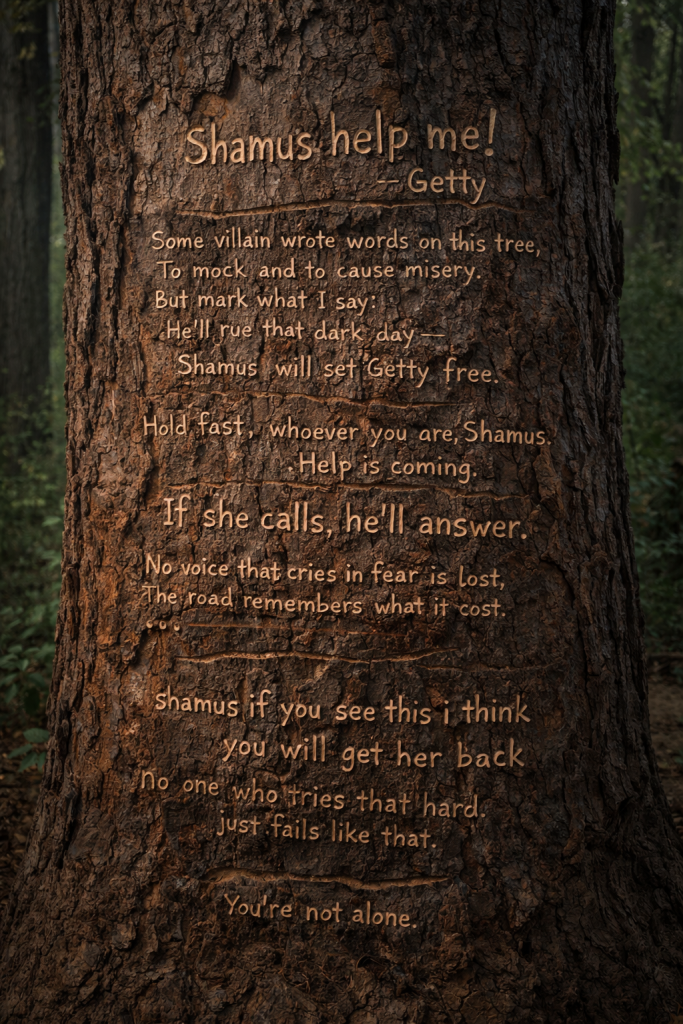
Because today’s journey would take them past the tree. The tree in the forest. Where the message had been carved with a precision no ordinary hand could manage:
Getty says, “Shamus help me!”
They had searched. They had fought. They had slain the invisible Watchers lurking nearby. They had found Getty’s bracelet but nothing else.
No trail. No explanation. No resolution.
Just a message, carved too cleanly, too deliberately, and left behind like a wound that refused to close.
And they walked toward it..
The Tree
It came into view gradually, as such things always do—first a shape among others, then the shape, and finally the unmistakable landmark that none of them had truly forgotten.
The carving was still there. Untouched and unweathered. As sharp and precise as the day it had been cut, as though time itself had decided not to interfere.
Getty says, “Shamus help me!” No more. No less.
For a long moment, no one spoke. And then—almost as one—they noticed the rest.
The message had not remained alone for long.
Where once there had been only those single, cruel, precise, and cutting words, there were now others—cut in rougher hands, uneven depths, wandering letters. The sort of carvings made with pocketknives, with time, with hesitation.
The sort of carvings made by ordinary people.
Beneath the original message, someone had added,
Some villain wrote words on this tree,
To mock and to cause misery.
But mark what I say:
He’ll rue that dark day—
Shamus will set Getty free.
A little lower, in a cramped but determined hand – Hold fast, whoever you are, Shamus. Help is coming.
Another, deeper and more forceful, as though carved by someone who preferred action to phrasing, If she calls, he’ll answer.
A short couplet, neat but slightly slanted,
No voice that cries in fear is lost,
The road remembers what it cost.
And, in letters that wandered unevenly and bore the unmistakable marks of someone less practiced with both knife and script,
shamus if you see this i think you will get her back
no one who tries that hard just fails like that
Near the base, almost an afterthought – You’re not alone.
The carvings overlapped in places. Some had been cut carefully to avoid the others; some had not. A few attempts had been started and abandoned, leaving only the faint ghosts of intention.
None matched the precision of the original but all of them roared their defiance.
Onward
They lingered only briefly.
Not out of indifference—but because there are some places where staying too long feels like yielding ground to something that has not earned it.
When they finally turned away, the road ahead seemed… lighter.
Not safe. Not solved. But lighter.
And as they continued on, the tree remained behind them—no longer a solitary cruelty, but a small, stubborn monument to the fact that even in Archea, where history is often written in sharper tools than kindness, people will still stop, carve a few uncertain words, and insist—quietly, imperfectly—that the story is not yet finished.
The Road, Made Lighter
If the morning had been marked by a certain gravity, the afternoon—having passed its small trial of memory—took on a different character entirely.
Not jubilant, exactly. Archea rarely permits that for long.
But easier.
The road widened as it left the thicker stands of trees behind, giving way to rolling fields stitched together with low stone walls and the occasional stubborn copse of pines. A breeze had found its way into the day, carrying with it the smell of turned earth and distant water.
Conversation returned, cautiously at first, and then with growing confidence—as though it, too, had needed permission.

A Scholar at Rest (Under Supervision)
Grelda, for her part, had been installed in the cart with all the ceremony of a visiting dignitary and all the practical considerations of someone who might, at any moment, attempt to stand up when she very much should not.
Pabst took this responsibility to heart.
“No, no, no,” he murmured, adjusting a blanket that had not meaningfully shifted since the last adjustment. “You are to rest. Rest. That is the entire assignment. We are doing very well at it so far.”
Grelda regarded him with the faint, patient expression of someone who had endured far worse than attentive caretakers.
At one point, she made a vague motion as though to sit up.
Pabst froze.
“Ah,” he said carefully, “I’m going to interpret that as a theoretical interest in sitting up, rather than a practical one.”
A pause. “…Yes,” he concluded, gently re-tucking the blanket. “Let’s keep it theoretical.”
From the front, Wolfgang observed that if Pabst applied the same rigor to provisioning, the party would never again run short of blankets, whether needed or not.
Pabst did not respond – he was busy ensuring Grelda did not attempt any unauthorized recovery.
The Matter of the Tear
It was perhaps inevitable that the conversation would turn, sooner or later, to the events of the previous day.
The tear.
Even now, the word felt insufficient—too small for something that had behaved as though reality itself had misplaced a stitch.
“It wasn’t random,” Ant said at last, with the quiet certainty of someone who had already had this argument internally and won it.
This, it turned out, was not a universally accepted position.
Theory One: The Deliberate Hand
“It was placed,” Ant continued, gesturing lightly. “A couple of feet above the ground. Not ten, not twenty—right where a person might stand. That’s not chance.”
Wolfgang nodded from the driver’s bench. “Right height to step through, if that’s what it was for.”
“Exactly,” Ant said. “If it were natural—truly random—you’d expect them anywhere. High in the air. Middle of the ocean. Deep underground. But this one?” She shook her head. “This one was convenient.”
Merrythought, after a moment’s consideration, added mildly:
“Convenience is rarely a feature of naturally occurring catastrophes.”
Theory Two: The Weakness in the World
Cassyndra folded her arms, thoughtful.
“Or it formed where it could,” she said. “Not where someone put it—but where the world was already thin.”
A small motion of her hand, as though indicating something stretched too tightly.
“Places where too much magic has been used. Or too many… significant events. If reality has seams, it would tear along them.”
Gareth frowned slightly. “And we just happened to find one of those seams?”
Cassyndra’s expression did not change. “Or someone else did first.”
Theory Three: The Failed Attempt
Wolfgang leaned back slightly, considering.
“What if someone tried to make it—and got it wrong?” he said. “Not where they meant to. Not how they meant to.”
He tapped the side of the cart.
“You miss a step, you don’t land where you planned. You land where you can. Maybe that tear was… the landing.”
Laveleen, who had been listening closely, nodded once.
“That would explain the instability,” she said. “And the… lack of structure.”
A brief silence followed that and, in the end, no agreement was reached. Which, in its own way, felt appropriate. They had seen something that did not fit neatly into the world as they understood it. And while each theory gave it shape, none quite contained it.
Kardan’s News
It was Merrythought who shifted the conversation.
“While we are on the subject of things that do not fit neatly into the world,” she said, “we should perhaps inform the rest of you what Kardan had to say last night.”
Hunkle looked up immediately. “That sounds like the sort of sentence that ends badly.”
“It does,” Ant said. “Quite consistently.”
Cassyndra took a breath.
“The thing beneath Northmarch,” she said. “The one contained within the anti-magic field.”
Gareth straightened slightly.
“Yes?”
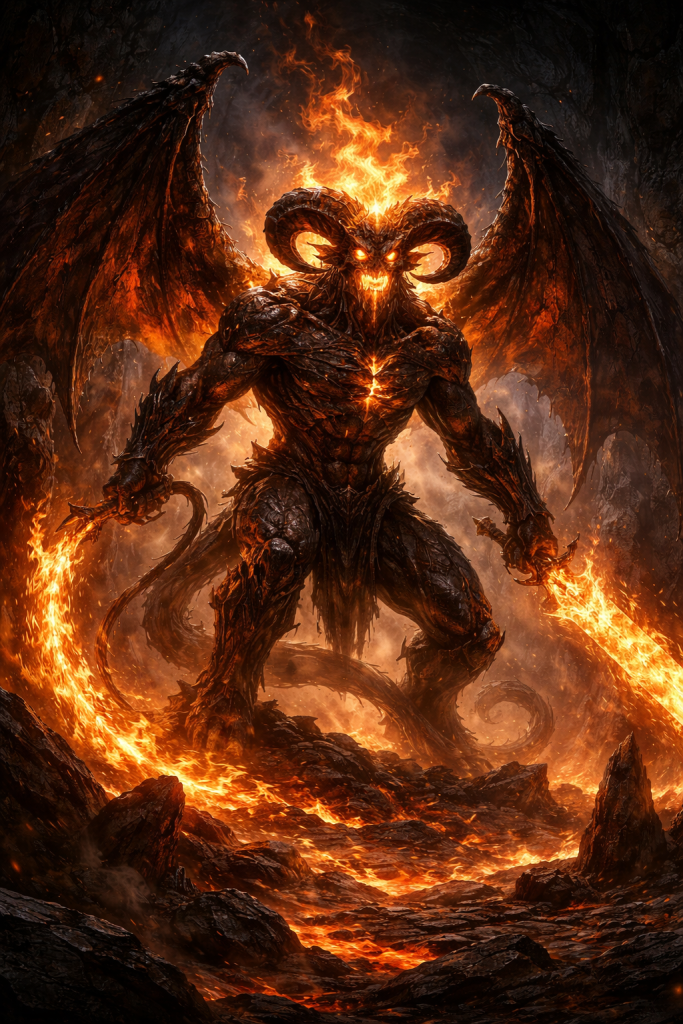
“It’s a balrog.”
There was a brief pause.
Then, very calmly:
“…Ah,” Gareth said.
Laveleen exhaled through her nose. “Of course it is.”
The History Beneath the Prison
Merrythought continued, in the tone of someone reciting a particularly unpleasant lecture.
“According to Kardan, the civilization that preceded the orcs in that region trapped it there. Built the anti-magic field to contain it.”
“Which is impressive,” Laveleen murmured. “And concerning.”
“After the collapse of their civilization,” Cassyndra went on, “the field lasted long enough for the orcs who came later to find it still functional. They figured out what it was for and reinforced it with a self-perpetuating system to keep it operational till the end of time… or at least as close to the end of time as makes no difference.”
Shamus nodded slowly. “A duty passed down. Until it wasn’t.”
Ant picked up the thread. “The knowledge was lost when Archea destroyed the Orcish civilization during the Righteous War. But the system was unharmed and kept running on its own.”
“And then the Crown,” Wolfgang said.
“Yes,” Ant said. “Discovered the field. Built a prison on top of it.”
A pause. “Because of course they did,” Wolfgang added.
Implications (Uncomfortable Ones)
Hunkle frowned.
“So… we’ve got a balrog. Under a prison. Held in place by something no one fully understands anymore.”
“That is an accurate summary,” Merrythought said.
“And the Crown is poking at it now? For what purpose? Hopefully to maintain it still longer…” Gareth asked.
Cassyndra hesitated.
“Kardan didn’t know what they were up to,” she said. “And that worried him.”
Laveleen tapped her fingers lightly against her arm.
“If the system is self-perpetuating, the Crown may figure it out and simply leave it alone. They could benefit from it without understanding it,” she said.
“Or,” Wolfgang said, “they’re studying it to try to control it so they can do the same thing elsewhere.”
“Or weakening it in an effort to enslave a balrog,” Shamus said quietly.
That settled over them.
Grelda continued to sleep and Pabst kept watch with the solemn vigilance of a man guarding against both external threats and unauthorized uprightness.
The wind moved gently through the fields.
And the party—lighter of heart, if not of question—continued on toward Miley, carrying with them not answers, but a growing sense that the world was deeper, older, and more precariously held together than they had previously assumed.
And that somewhere beneath it all, bound in darkness and patience, something waited.
For now.
Return to Miley
By the time Miley came into view, the light had taken on that mellow, late-afternoon quality that flatters almost everything: fields, fences, modest villages, and even roads that have spent the better part of a century disappointing carts.
The little crossroads town looked much as they remembered it. Gardens sat in tidy rows. Smoke curled lazily from chimneys. The wooden swan on the well continued its lifelong commitment to pretending not to be weather-rotted.
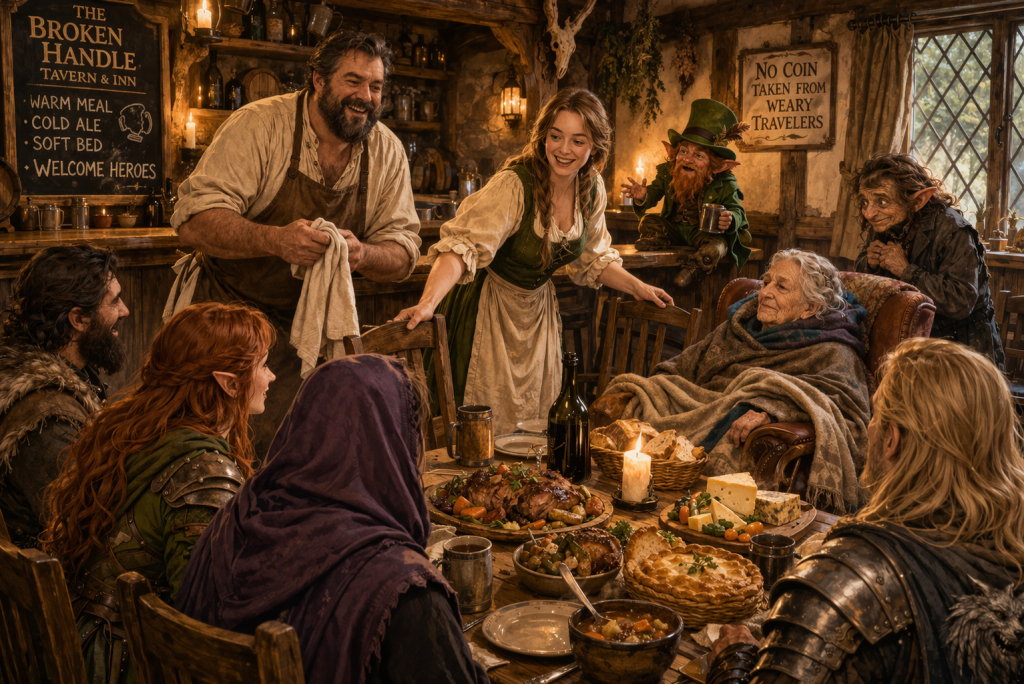
And there, at the crossroads, stood The Broken Handle.
But where once it had looked like a tavern reluctantly surviving out of spite and monopoly, it now looked… alive.
The windows were clean. Not perfectly clean—this was still a working tavern, not a temple—but clean enough to suggest effort. The bent-iron mug sign had been repaired and rehung, and though it still leaned slightly, it now did so with character rather than despair. Laughter drifted through the open door along with the smell of frying onions, baking bread, and whatever Oban had most recently declared to be “medicinal.”
Inside, the change was even more striking.
There were patrons—upright ones. Talking, eating, drinking, and displaying the reassuring signs of ordinary intoxication rather than magical collapse. The room was warm, busy, and cheerfully loud. Someone had put fresh rushes on the floor. Someone else had evidently wiped down the tables with enough vigor to remove several historic grievances.
And the moment the door opened, three people looked up at once.
Tilly Hopsworth gasped.
Finnan Hopsworth broke into a grin so wide it nearly qualified as architecture.
And Oban Bryne, resplendent in his battered vest and wine-stained scarf, flung both arms into the air as though the gods themselves had just arrived to settle a bar tab.
“You!” he cried. “My saviors! My artists! My deranged little alchemists of destiny!”
Several patrons turned to stare and Oban ignored them with practiced ease.
A Hero’s Welcome
Finnan came around the counter at once, wiping his hands on his apron though it was already clean enough for company.
“Well, I’ll be damned,” he said warmly. “Look at you lot. Back again. In one piece, more or less.”
Tilly was already pulling out chairs.
“You’re staying,” she said, in the tone of someone brooking no argument. “No discussion. No paying. You’re staying, you’re eating, and if any of you try to object, Da will pretend to be insulted and Oban will make a speech.”
“I have several prepared,” Oban said gravely.
“We know,” said Tilly.
Within moments the party found themselves ushered inside, relieved of packs, pointed toward the best tables, and informed with increasing firmness that food was coming whether they claimed hunger or not.
Grelda, once the Hopsworths understood both her condition and her general importance, was treated with a kind of brisk rural tenderness that bordered on military logistics. Cushions appeared. A chair with arms was found. Someone put a blanket over her before anyone had fully agreed she needed one. Pabst hovered nearby with the proprietary anxiety of a man who had appointed himself her official custodian against all reasonable odds.
“You sit,” Tilly told Grelda kindly. “You don’t lift a finger.”
Pabst nodded approvingly.
“Yes,” he said. “At last, a household with standards.”
A Drink of Distinction
It did not take long for Oban to arrive at the true point of celebration. With dramatic solemnity, he set a glass down before them.
The drink inside shimmered pale gold with a faint blush of pink at the edges. A twist of citrus rode the rim. Something sparkling and mischievous caught the candlelight from within.
Finnan rested both hands on the table. “We named it after you,” he said.
A beat. Oban spread his arms.
“The Cupid’s Piss.”
There was a short, respectful silence in honor of destiny fulfilling itself.
“It’s our most popular specialty,” Tilly said, with a straight face that deserved formal recognition. “Travelers ask for it by name now.”
Finnan nodded. “Half the folk ordering it don’t know the story behind the name, and the other half think they do, which is somehow worse.”
Oban drew himself up. “We have refined it, naturally. Preserved the spirit of the original while removing the part where one must drink from an ice sculpture’s… expressive anatomy.”
“A concession to civilization,” Merrythought observed.
“A concession to glassware,” said Tilly.
A round was poured and it was, to the party’s likely mixed emotions, genuinely excellent.
Bright, surprising, a little ridiculous, and far better balanced than the name had any right to imply.
Wolfgang looked at the glass, then at Oban.
“You made this popular?”
Oban placed a hand to his chest, wounded by the question.
“My dear fellow,” he said, “I make everything popular. I am a curator of appetites.”
News from the Road of Rum
Once food had begun to arrive—stew, bread, cheese, roasted carrots, onions softened to sweetness, and something Finnan described only as “sausage, probably”—the questions began in earnest.
Finnan leaned in first.
“So,” he said, eyes bright and gaze encompassing the entire party including Pabst, “what did happen after you left here with the rum gremlins? And how did you manage to misplace all of them but one?”
Tilly set down another dish and joined them without even pretending she had not fully intended to eavesdrop. Oban sat as well, folding himself into the chair with theatrical attentiveness.
“Yes,” he said. “Tell us how my hated enemies fared in the wide and pitiless world. Preferably badly.”
The tale, once begun, had to be told more or less in full.
The herding of the gremlins in the general direction of Northmarch. Their courage in the face of both the Watchers and the bandits. Wolfgang’s adoption of Pabst. The continuous efforts to keep the gremlins properly entertained and intoxicated while the party addressed the secrets of the cave and prison. The fact that the party had, through some combination of inspiration, exhaustion, and moral improvisation, managed not merely to survive the Rum Gremlin problem but to repurpose it.
The Hopsworths’ expressions shifted steadily as the account continued from curiosity, to disbelief, to alarm, and finally to the sort of laughter one produces only when reality has abandoned all pretense of order.
“You did what?” Tilly said at one point, staring.
Finnan had to sit down halfway through.
Oban, by contrast, went very still in the manner of a man revisiting an old trauma from a position of relative safety.
“When I said this was new,” he murmured, “I had hoped history would prove me melodramatic.”
“It did not,” said Ant.
“It so rarely does,” Oban replied.
When the full story had finally been laid out, Finnan wiped at his eyes.
“Well,” he said, “I’ll give you this—nobody can accuse you of solving problems halfway.”
Tilly shook her head in admiration and concern.
“I honestly can’t decide whether that was brilliant or criminal.”
“Archea,” Merrythought said gently, “has long resisted the temptation to distinguish too sharply between the two.”
That seemed, if not satisfying, at least accurate.
An Evening in Miley
The remainder of the night at The Broken Handle unfolded as good nights ought to—without urgency, without catastrophe, and without any entities attempting to achieve eternal drunkenness through ritual geometry.
Food continued to arrive in waves, as though Finnan had made a private wager with himself about how thoroughly a group of adventurers could be fed before they protested. Tilly managed the room with quiet efficiency, steering conversations, refilling mugs, and intercepting Oban before he could begin what he described as “a soliloquy about loss, redemption, and poultry.”
The tavern breathed. Laughed. Lived. And for a few hours, the world felt—if not safe—then at least contained.
Morning Comes, As It Does
They slept well.
Not perfectly—adventurers rarely do—but well enough that when morning came, it was greeted with stretches, quiet conversation, and the sort of practical readiness that comes from being both rested and aware that such states are temporary.
Breakfast, despite not having been requested, was served along with more than one mug of something suspiciously similar to Cupid’s Piss appeared “for balance.”
Finnan clasped hands, Tilly issued final instructions regarding “coming back alive,” and Oban, standing in the doorway like a man sending ships to sea, raised his glass in salute.
“Go forth,” he declared, “and if you must, once again, meddle with forces beyond comprehension, do so with style.”
“That,” Merrythought observed, “appears to be our guiding principle regardless.”
And so they departed Miley once more—fed, rested, and much the better for having been there.
The Matter of the Smugglers
The road to Brighton was a gentler one—well-traveled, lightly rutted, and lined with the quiet evidence of trade: wagon tracks, discarded rope ends, the occasional broken crate that had not survived its journey.
It was perhaps inevitable that the conversation would turn, as it often did, to recent violence… specifically the encounter with the Ebon Blades. “They fought as well as they could,” Gareth said, after a time. “I’ll grant them that.”
A pause. “They did,” Ant agreed. “But meaning well and surviving contact with reality are… distinct skills.”
“They panicked,” Wolfgang said plainly.
“They were outmatched,” Laveleen corrected.
“Both,” Wolfgang allowed.
Shamus walked in silence for a moment before speaking. “They believed in what they were doing,” he said. “That counts for something.”
“It does,” Merrythought said gently. “But belief does not replace training.”
Cassyndra nodded. “They weren’t coordinated. No clear chain of command. No fallback. No discipline under pressure.”
“And no understanding of who they were up against,” Gareth added.
“They can’t fight the Crown,” Ant said at last.
No one contradicted her. “Not like that,” she added. “Not in the open. Not in a pitched battle.”
“They’d be slaughtered,” Wolfgang said.
“Again,” Merrythought amended.
A silence followed. It was not a comfortable one. Because the Ebon Blades were not villains. They were… aspirational. Idealistic. And, as it turned out, deeply unprepared.
“If they try it again,” Gareth said quietly, “it won’t just go badly.”
“No,” said Cassyndra. “It’ll go decisively.”
Shamus exhaled slowly.
“Then they must learn,” he said. “Or they must change how they fight.”
“Or they’ll be ended,” Laveleen said.
No one disagreed.
Arrival in Brighton
By early afternoon, the land began to shift.
The air grew heavier with moisture. The soil darkened. The road sloped gently toward water that could not yet be seen but made itself known through scent, sound, and the subtle broadening of the horizon.
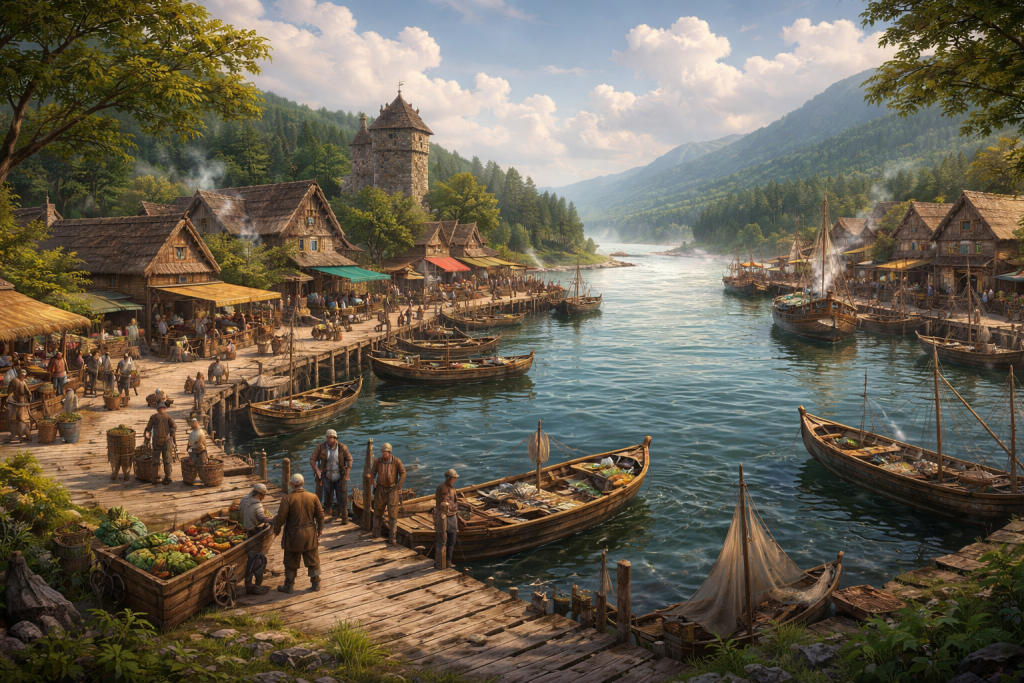
And then—Brighton.
Where Lake Thalmere gave itself to the River Tareth, and the world rearranged itself around water.
Boats lined the banks—fishing skiffs, trading barges, small ferries creaking at their moorings. Nets hung drying in the sun. Voices carried easily over the water, layered with the slap of waves against wood and the steady, familiar rhythm of work.
It was not a large town. But it was a busy one. And it was, unmistakably, alive.
The River, Changed
The stories began almost immediately. They were not offered as warnings nor told in hushed tones. Instead, they were shared in that casual, practical way people discuss changes that have proven themselves useful.
“You’re travelers, yeah?” one fisherman said, squinting at them from beneath a sun-faded hat. “Then you’ll want to know—the river’s different.”
“Used to be,” another added, “you had to fight her a bit. Bad eddies, tricky banks.” He shrugged. “Now? She helps.”
Boats no longer grounded as they did before; instead, currents shifted—subtly, but reliably—guiding vessels away from trouble.
“You miss your line, she corrects it,” the first fisherman said. “Not always. But enough you notice… Like she’s paying attention.”
The Unseen Bargain
Near a mooring post, someone had left a small offering: a heel of bread, a carved bit of driftwood, and a splash of something that had once been respectable ale.
“You leave something for the river,” a dockworker explained, noticing their attention, “you get something back.”
“What kind of something?” Ant asked.
The man grinned. “Enough. More than enough.”
The Presence
The most animated stories were the simplest. “A boy fell in,” someone said. “Couldn’t swim.”
“And?”
“And he didn’t drown.” A gesture toward the water. “Came right back up. Like something pushed him.”
“No waves,” another added. “No thrashing. Just… lifted.”
No one claimed to have seen it clearly. But everyone had almost seen it. A ripple against the current. A shape beneath the surface that moved too deliberately to be natural. A patch of water that caught the light differently, as though remembering something.
“It’s there,” one woman said, with quiet certainty. “Don’t bother it, it won’t bother you. Help it a bit, it’ll help you.”
The stories overlapped and reinforced one another to build, piece by piece, into something unmistakable.
A presence. A pattern. A quiet intelligence moving beneath the surface of everyday life. And though no one in Brighton spoke its name—
The party did not need them to for they had seen it and they had freed it and they had watched it choose, in its own alien way, to be what it wanted to be.
Return to Brighton
The following day’s travel brought them, at last, back to Brighton.
If Miley had greeted them with warmth, Brighton greeted them with something quieter—but no less genuine. Recognition, first. Then relief. And finally, the steady, practical gratitude of people who had lived through something strange and come out the other side of it without losing too much.
Word traveled quickly.
“They’re back,” someone said near the docks.
“The sinkhole lot,” said another.
“The ones who went down.”
And so, before long, they found themselves once again surrounded—not by panic, not by pleading—but by curious villagers eager to hear the tale retold, polished, and made slightly less alarming in the telling.
The Story Retold
It began, as such stories often do, with the part that everyone could agree on.
“Yes,” Ant confirmed, “we went down into the sinkhole.”
A murmur of approval.
“And yes,” Gareth added, “it wasn’t just a sinkhole.”
That earned a few knowing nods.
Because even before the party had arrived to explore the sinkhole, Brighton had suspected as much. Sinkholes did not usually come with stone tunnels, carved walls, and the unsettling sense that something had been waiting beneath the earth for a very long time.
“It was an old structure,” Merrythought said. “Very old. Orcish, by the look of it.”
That part was met with a mix of curiosity and discomfort.
Orcs, after all, were not a subject Brighton discussed often—and when they did, it was usually with the benefit of distance, time, and a certain… selectiveness of memory.
“A waterworks,” Wolfgang said, with the faint pride of someone who had spent a great deal of time appreciating the craftsmanship of it. “Ingenious, too. Designed for flow, filtration… a whole system.”
“A buried one,” Laveleen added.
“And not empty,” Shamus said.
And from there the rest of the part took up the story one after another. The skeletons, the Argent Company, and the Sereth.
But not all of it. By unspoken consent they left out the final confrontation with the Argent Company and the water elemental that had sparked it… for why plant the idea that the newfound force in the river might be harnessed for profit and, in so doing, tempt someone to try it?
The Collapse and the Lake
“At the end of it,” Wolfgang said, “the whole place gave way.”
That part required no embellishment.
They described the collapse—the ground giving way, the structure sinking, the cavern swallowed.
And the aftermath.
“It’s a lake now,” Ant said. “Nice and quiet when we left it.”
The villagers were eager to fill in the rest.
“Been just like you said,” one fisherman offered. “No trouble.”
“No bones coming up,” another added. “Not a one.”
“And no… what did you call them?” a third asked. “Those things?”
“Nothing like that,” said Gareth.
“Good,” the man replied firmly. “We’ve had quite enough of ‘ancient sentient weapons summoned from another plane,’ thank you very much.”
A general murmur of agreement followed.
The new lake, they explained, had settled quickly. No strange lights. No sounds in the night. No wandering skeletons climbing out of the mud to complain about historical grievances.
Just water.
Still and ordinary.
Even, one might say, a reasonable place to pass an afternoon with a fishing line in the water.
The Road to Dolven’s Hollow
The road from Brighton bent gently away from the water and back into the quiet, stubborn heart of the countryside.
If Brighton had been a place of motion—boats, trade, shifting currents—then this stretch of land was something else entirely. Fields. Fences. Wind moving through tall grasses with no particular urgency. The kind of place where events took time to become stories, and stories took time to become truth.
Dolven’s Hollow revealed itself gradually, as it always did. A roof here. A chimney there. A garden tucked into a fold of land that did not advertise itself from the road. Paths that were not quite roads. Smoke that rose only when necessary.
And people. People who noticed.
The first to spot them did not shout. He simply turned, said something low to the person beside him, and within moments the quiet signal had spread.
By the time the party reached the center of the Hollow, Barin was already there with Phineas half a step behind him.
Both of them taking in the sight of the group with the careful, practiced assessment of men who had learned that returning adventurers were best greeted with equal parts relief and verification.
Barin’s eyes moved quickly – all present and more or less intact.
“Well,” he said at last, voice steady but not unaffected, “you’ve managed not to get yourselves killed.”
Phineas nodded vigorously. “Statistically impressive,” he added.
Then, after a beat—
Barin stepped forward and clasped arms with the nearest of them.
“Welcome back,” he said.
A Place to Heal
Grelda was taken in immediately. Not ceremonially. Not formally. But with the efficient, unquestioning acceptance of a place that had long since decided what it was willing to protect.
A bed was found, a room prepared, and someone produced herbs. Someone else broth. A third person—unseen, but clearly effective—arranged matters such that Grelda was not to be disturbed unless necessary, and never alone unless she preferred it.
Pabst attempted to assert custodial authority over the process and was gently—but firmly—absorbed into a system that had been doing this sort of thing long before he had opinions about it.
“She’ll be safe here,” Phineas said quietly.
The next morning came with clear air and practical purpose and Barin and Phineas had already set aside time.
They met the party near the forge—quietly, as always, though the forge itself was cold. No hammering today. No need to draw attention with noise.
Barin leaned against the anvil and said, “So, what’s next?”
The party laid it out plainly – Barrow’s Edge, Nareen’s Hill, and then Hollowmere.
Names drawn from Nelson’s letters. With an additional mysterious endorsement of Hollowmere from Ant’s patron.
Phineas nodded along, committing the sequence to memory. “Hollowmere,” he repeated. “Yes. That one we discussed before. Still don’t like it.”
“No one does,” Barin said. He rubbed at his jaw. “Barrow’s Edge and Nareen’s Hill… we’ve heard things…”
They spoke for some time with Barin offering what he knew—terrain, distances, rumors that had persisted long enough to be worth repeating. Phineas adding details—routes, seasonal changes, the sort of small logistical notes that often matter more than grand warnings.
Nothing was presented as certainty, nothing was dismissed outright, and each place carried its own shape of unease.
Each, in its way, had found its way into Nelson’s letters for a reason.
“The man doesn’t seem to have been given to imagination,” Barin said. “If he wrote it down, it mattered.”
Phineas nodded.
“And if he wrote it in code,” he added, “it mattered more.”
A Favor, If You’re Willing
There was a pause then and Barin shifted slightly.
“While you’re moving through that direction,” he said, “there’s something else.”
Phineas looked up. “A circle,” he said. “Forester druids.”
Barin nodded.
“Good folk,” he said. “Or were, last we heard. Keep to themselves mostly. Manage a stretch of forest that’s… better for having them in it. They’ve done the movement a few favors… looked away when it counted… lent us a hand when we were down.”
“Been trouble up there now,” Phineas added.
Barin looked at the party. “You’ll be passing near enough,” he said. “On your way from Barrow’s Edge or Nareen’s Hill up toward Hollowmere.”
A beat. “If you’ve the time to look in on them… we’d take it as a kindness.”
Not an order. Not even quite a request. Just a recognition of overlapping paths and shared interests.
The meeting ended as such meetings do in Dolven’s Hollow – without either ceremony or finality. Just a quiet understanding that the next steps had been chosen, and that the road would take them where it would.
Grelda rested.
And the party—once again—stood at the edge of departure.
GM NOTE – RATHER THAN WRITE EVERYTHING BARIN AND PHINEAS HAD TO SAY ABOUT YOUR VARIOUS DESTINATIONS, I’LL TELL YOU JUST PRIOR TO YOUR ARRIVAL IN EACH ONE.