(excerpted from Fizzbuzz’s The Everybeing’s Guide to Traveling the Seven Continents and Eight Seas)
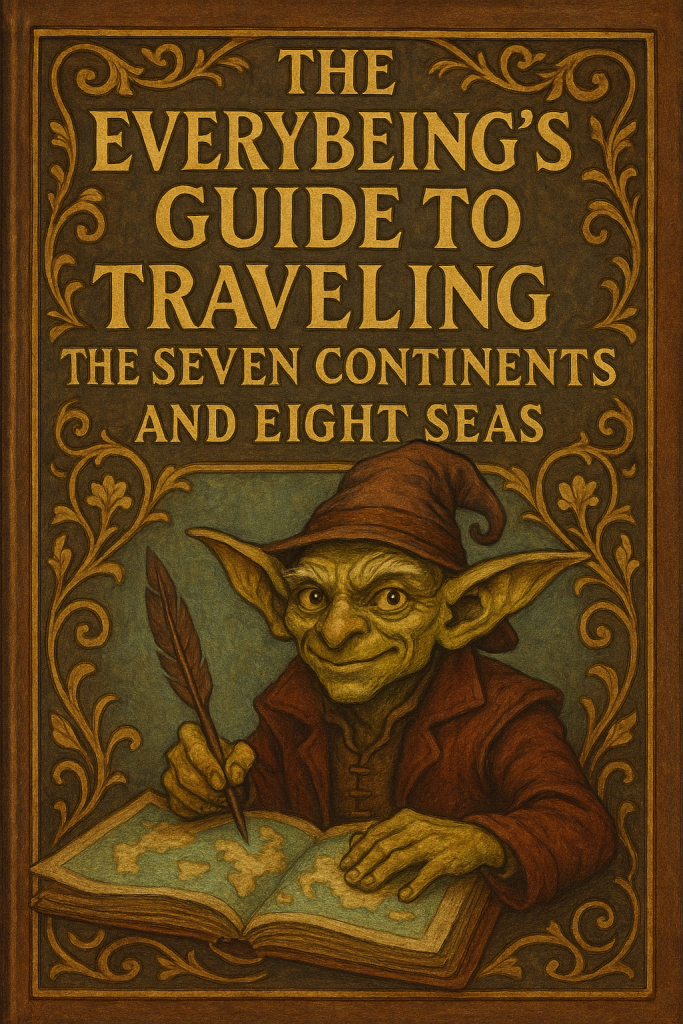
Table of Contents
- Introduction
- History
- Government
- The Military
- Law Enforcement
- Getting Medical Help
- Money
- Religion
- Laws (Ordinary and Arcane)
- Slavery
- Visiting Edicaria
- Visiting Cambria
Introduction
While Archea lacks the urbane sophistication of Permia; the exquisite dining, art, and architecture of The Tonian Empire; and the efficient and effective government of the The Fluzarchian Confederacy; Archea still offers much to the seasoned traveler who is prepared to maintain a firm grip on his wallet at all times. Indeed, if you’ve seen everything else, you might as well go ahead and see Archea too.
The first-time traveler to Archea is advised to begin their visit in the capital, Edicaria, which contains the lion’s share of Archean tourist attractions. Most tourists will be entirely satisfied going no further than the capital. Those few, however, who choose to explore the rest of Archea will find non-Edicarian Archeans welcoming if somewhat puzzled to be finding actual tourists visiting their province. That being said, there are occasional gems scattered throughout the country that are almost worth the trouble of traveling to see them.
History
Like many of its neighbors, the origins of the Kingdom of Archea are lost in the distant past but are theorized to have been at least 6,000 years ago. Its written historical record begins some 2,000 years ago and is characterized by a number of absolute monarchs who waged a number of wars against a number of other kingdoms and, on occasion, even against Archea itself. The reasons for the wars were the usual with the monarch either,
- Wanting something (or, on occasion, someone) the neighbors had,
- Being afraid of the neighbors,
- Being irked that the neighbors worshiped a different pantheon,
- Being convinced that the neighbors needed to be exterminated because they dressed funny and talked in some strange and frightening language or,
- Needing to distract their own populace from some scandal such as the fact that due to royal mismanagement, the kingdom will have no food for the upcoming year. Again.
In addition, in ancient Archea, there were an awful lot of people who wanted to be the absolute monarch but only one person was allowed to be absolute monarch at any given time. Because, you know, the monarch was absolute and all that. Archea might have avoided trouble with a sensible rotation system—everyone gets a week as absolute monarch, like some divine time-share. But no. Instead, they embraced assassination, intermarriage, and bloody coups as the preferred means of imperial succession. Between this and all of the wars, the end result was that there were a lot of monarchs in ancient Archea and if you think we’re going to take the time to list them all, you’re crazy. We’re a travel guide, not a history book. If you’re into that sort of thing, we’re sure that the Grand Library of Edicaria has some dusty tome in which some nerd wrote all that stuff down.
At any rate, after some time and a good deal of bloodshed, it eventually occurred to the monarchy that they could avoid most of the assassination and coup attempts by sharing some of their power and wealth with other powerful people in their nation. Not all the people, mind you, just the ones who were the most powerful. And so, it came to be that those Archeans who were the richest, most powerful, and the best at swinging swords or casting spells came to be known as the nobility. Those who were not in this group came to be known as the peasantry and soon it became very clear that it was much better to be in the nobility than in the peasantry. For one thing, the kingdom was run for the benefit of the monarchy and the nobility and for a second thing, it turned out that the positions of monarch, noble, and peasant were hereditary so if you spent all your life poking at dirt with a stick, chances were, your kids would grow up to poke at dirt with a stick as well.
And for a third thing, it turned out that the monarchy and the nobility had the weapons and the spells while the peasants had the choice of either saying, “Yes! This sounds great!” or getting beheaded or vaporized or both simultaneously. It may, therefore, come as no surprise that all of Archea’s modern-day peasants turn out to be descendants of ancient peasants who, when offered this choice, elected to say “Yes! This sounds great!”
Modern Archean history starts about 600 years ago when the ongoing conquests of the Orcish kingdom Goghnol Mogh brought it right up to the borders of Archea. Initially, the Archean monarchs sought a peaceful modus vivendi with the Orcs only to have their every effort contemptuously scorned amidst a series of increasingly bloody and provocative cross border Orcish raids.
For another 50 years, Archea bided its time, deflecting raids where possible, building up its strength, and seeking allies amongst its neighbors in an effort to eventually become strong enough to compel the Orcs to cease their depredations and live peacefully with their neighbors. Unfortunately, the Massacre of Brighton, about 550 years ago, turned out to be the opening gambit in a full-scale Orcish invasion of Archea and other nearby kingdoms. After about 50 years of fighting, the Orcish armies were finally defeated and their lands occupied and divided amongst the noble victors. That portion of Goghnol Mogh which went to Archea came to be known as the province of Cambria and remains the site of a number of Orchish ruins. To this day, however, these ruins remain neglected and much of the rest of the province remains an unsettled wilderness and most travelers elect to skip it… and frankly, we can’t say we blame them.
Though Archean textbooks present the Righteous War as a necessary defense of civilization, fringe scholars and unauthorized bards have occasionally suggested a more… complicated history—though they tend not to suggest it twice.
For Archea, itself, however, the victory in this Righteous War, proved to be a boon. The war itself came with quite a bit of spending that stimulated the economy and there was a boom in magical research. Of course, much of the research was in the area of war-fighting spells but many of these were extended to civilian applications after the war to much economic benefit. In addition, Cambria proved to be richly endowed with natural resources, resources that continue to support the economy to this day.
Archeans are proud of their country’s role in fighting and winning the Righteous War; enough so that every war since then has been compared by the rulers to the Righteous One. This has invariably worked well at the beginning of the wars as Archeans, swept up by their patriotic and righteous ardor, rally to the flag. As the wars drag on, however, the Archean people come to realize that the latest war their rulers have sold them on really has nothing in common with the Righteous One and so war support tends to wane.
At least until it comes time to fight the next war and the Archeans respond to the Righteous War propaganda again.
Despite (or perhaps because of…) all the wars, modern Archean history has also been characterized by a number of diplomatic initiatives resulting in mutually beneficial trade agreements with neighbors. Perhaps the most well-known of these initiatives was the Treaty of Dominica signed with Devon about 50 years ago. Devon and Archea had cooperated with one another and with several other countries in defeating Goghnol Mogh but disagreements between the two over carving up the territories of that defunct Orcish Empire had led to a long-standing rivalry that flared up into war frequently. The Treaty finally settled the borders between the countries, made amends for a wide variety of personal slights exchanged between citizens of both countries over the centuries, and even opened up the border to trade. The effect upon Archea has been most salutary and perhaps felt nowhere more than in Cambria, the Archean province adjacent to Devon.
The final major theme of modern Archean history has been its halting steps toward a more equal division of power within the country. At the time of the Righteous War, the king held most of the political and military power of the kingdom with the nobles holding the rest. As time went on, however, the nobles have managed to secure more and more power for themselves to the point that the Archean government could now be called a form of “parliamentary monarchy,” as described below.
The peasants, however, have not succeeded in carving out much in the way of rights and privileges for themselves. Frustrations have grown to the boiling point twice in recent history, each time resulting in an attempted revolution. The names that Archeans give to these attempted revolutions, The Brief Revolt and the subsequent Even Briefer Revolt, speak to the futility of those efforts.
Nonetheless, there is a popular perception that the bulk of Archea’s increasing prosperity is flowing to those who are already rich and not enough is flowing to the average citizen. This is increasing tensions among the peasantry once again and may, at some point, ignite yet another attempted revolution. The current balance of power between the peasants and their rulers, however, is such that any third revolution will likely end up being named, “The Briefest Revolt of All.”
Perhaps because of this imbalance in power, spirits remain high among the nobility, the monarchy, and those connected to both institutions. Their focus remains outward with steadily increasing links with the rest of the world bringing more and more wealth into the Treasury and their own pockets. They are confident that matters within the country will remain stable and so long as Archea plays its international cards well, they themselves will continue to get richer and richer.
Government
As noted above, Archea is often called a “parliamentary monarchy” as the basic governmental structure consists of,
- A hereditary monarchy (with a dizzyingly baroque set of rules outlining what should happen if the King or Queen dies with no direct descendants) and,
- A Council of Nobles made up of nobles who are elected to their posts by other nobles in hotly contested races featuring negative campaign ads, elaborate bribes, and at least one duel per election cycle.
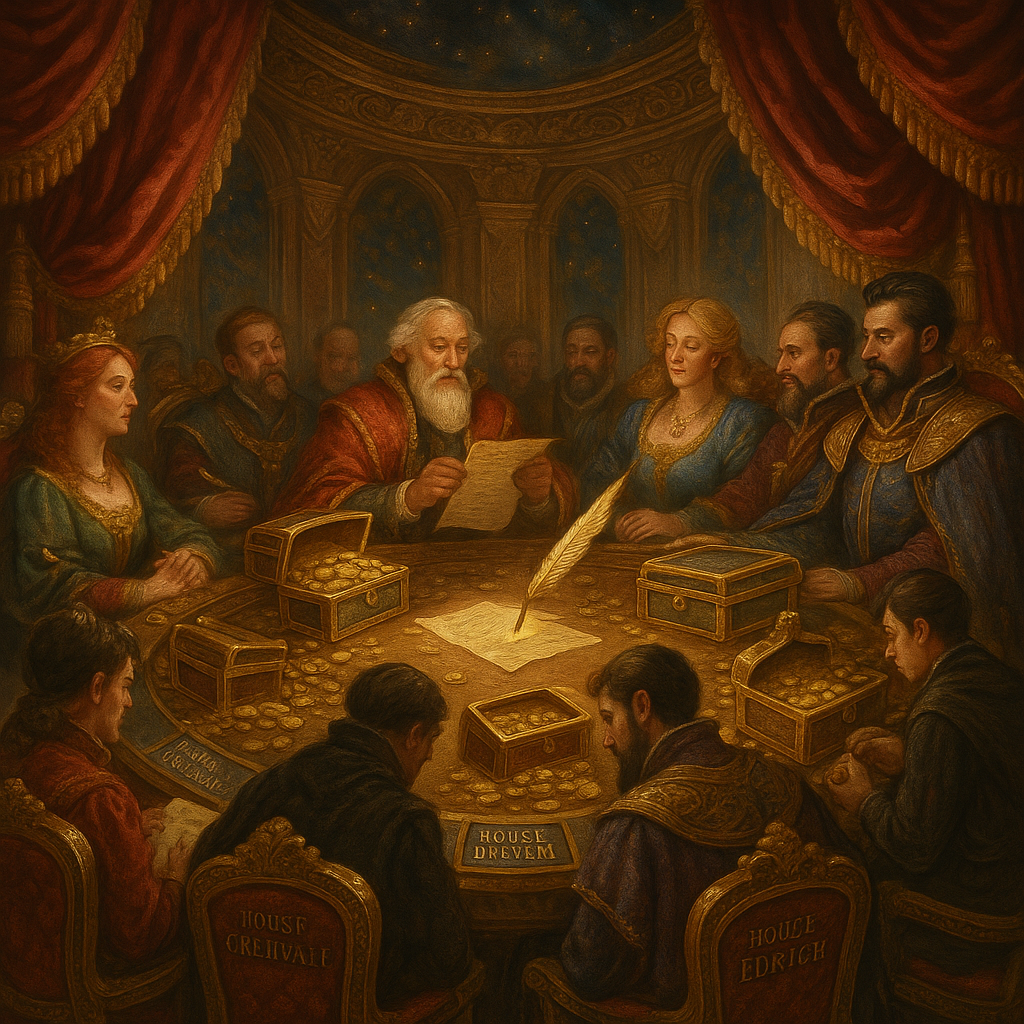
While the kingdom does have a large number of commoners and slaves, neither of those groups has any direct (or indirect, for that matter) say in the functioning of the government.
The current King is King Harold III, known less formally as King Harold The Cunning. Being that he is middle aged, it’s expected that he will continue to reign for another couple of decades before the Crown passes on to the Crown Princess Alexis.
As King, Harold III’s powers extend far and wide and include,
- Passing judgment of innocence or guilt on peasants (As Archea has an awful lot of peasants, the King hires and fires judges to carry out this task for him. This is just a convenience for the King, however; if he chooses, he can hear any peasant case himself or even simply declare a peasant innocent or guilty without bothering to hear the case at all).
- All things pertaining to the military and foreign policy.
- Proclaiming edicts on any matter not controlled by the Council of Nobles. Frequently, the edicts that the King proclaims were originally recommended by the Council of Nobles but occasionally not.
The King is assisted in his duties by a number of Ministers who are almost always chosen from the ranks of the nobility. The Ministers serve at the pleasure of the King.
The Council of Nobles have the power to,
- Institute or cancel taxes on the nobility and peasantry (No one is allowed to tax the monarchy!)
- Recommend edicts to the King. Typically, most of the edicts that have to do with the day to day running of the government originate in the Council of Nobles working in close conjunction with the King’s Ministers.
- Overturn a King’s decision on any subject with a 2/3rds vote.
Given its warlike disposition, it is not surprising that Archea maintains a standing military which Archean Kings generally make extensive use of. This costs a good deal of money which is raised by several methods, some of which are more controversial than others,
- Taxation – given that the reins of power are held by the monarchy and the nobility, it should not be particularly surprising that the bulk of the privilege of paying taxes is reserved for the peasantry. As it happens, there are a large number of taxes and they are enforced to varying degrees in various parts of the country leading to a good deal of popular resentment. Some of the more hated taxes are,
- The Salt Tax – as salt is the peasant’s primary means of preserving food, the salt tax hits directly at one of the peasants’ principal means of survival in lean times.
- The Labor Tax – The local nobility has the authority to conscript the peasantry for a certain number of days out of the year to build or maintain various public works that are necessary for the common good. This was supposed to provide for public roads, canals, irrigation and such but nowadays is mostly employed to construct barracks and fortifications or, even worse, to work on the private lands of the nobles and monarchy.
- Military Conscription – upon promulgation of an appropriate decree, the peasantry can be conscripted into the army for any term that may be felt appropriate by the government. Typically, these conscripts are abused, badly equipped, badly fed, and poorly (if at all) paid and so are quick to desert at a moment’s notice. For this reason, when the military fields peasants in battle, they typically arrange a line of trusted troops behind the peasants with instructions to kill any peasants who attempt to flee.
- The Sale of Public Offices – For a couple of centuries now, the monarchy has raised money independently of taxes (which are controlled, after all, by The Council of Nobles) by selling public offices to nobles and wealthy peasants. Generally, the offices that are on sale come with some perk to make it worthwhile for someone to buy them. Examples of such perks include,
- Entrance into the ranks of the nobility (e.g. the position of “Master of the Royal Chambers”)
- A regular salary (any number of bureaucratic positions)
- Opportunities to make some money on the side. For instance, the position of tax collector for a given region sells for quite a bit because the tax collectors are responsible for collecting taxes for the monarchy but are allowed to collect a little bit extra to offset “the costs of tax collection” (often taken to mean a third vacation estate and eight burly enforcers all named “Hugo”). Another example includes various judgeships where the judge is permitted to charge a plaintiff a fee to hear his or her case.
Offices that are sold are not technically hereditary but once an office holder dies or retires, his or her descendants are often offered the first chance to buy the recently vacated office with the effect of, say, the Master of the Royal Chambers being a member of the Vedici family for the past 200 years.
The Military
As a kingdom that has fought both itself and its neighbors for centuries, Archea maintains a well-funded professional standing army that is augmented, as needed, by masses of ill-trained conscripts. Given that the military is a respected profession in Archea, regular Archean military personnel are, by and large, less corrupt and less incompetent than the rest of the kingdom. By and large.
While most of the military are fighters, the military does also recruit members of other classes with particular attention paid to ensuring a sufficient number of magic users are maintained in the ranks. Training of regular soldiers is rigorous with a fully trained new recruit being the equivalent of a level one adventurer. The longer a soldier remains in the military, the higher his or her pay such that many veterans have skill sets equal to level three or four (or even higher) adventurers.
Conscripts, when leveed, however, are an entirely different story. As noted above, they are poorly equipped (many carry nothing more than what they brought with them from home), almost entirely untrained, and want nothing more than to escape their misery by fleeing the army at their earliest opportunity.
Law Enforcement
Police duties are carried out by a Civil Guard that operates under a byzantine patchwork of supervision and funding. In some areas, for instance, the capital, the Civil Guard is funded by and directly answerable to the king. In other areas, the Civil Guard is funded at the provincial level or at the city level. In still other areas, the Civil Guard is nothing more than a bunch of poorly equipped volunteers who are called out whenever a rowdy patron needs to be ejected from the local tavern.
Don’t ask the members of the Civil Guard about this confusing state of affairs as they tend to be pretty sore about it. Generally, however, a properly bribed Civil Guardsman can be counted upon to do the right thing but with perhaps less dash, verve, and… shall we say… competence than the police of neighboring countries.
While the attention of the Civil Guard can be obtained by approaching them while they are on their patrols or even, as a last resort, by yelling, “Help! Civil Guard! Help!” it IS prudent for tourists to learn the locations of Civil Guard stations upon entering any new area. This is because Civil Guardsmen can most reliably be found seated within their stations whiling away the time playing cards. The fastest way of getting a Civil Guardsman to help, then, can be to present oneself directly to the station and making a direct plea. They are generally responsive to this approach… just as soon as they finish up with the hand they’re currently playing.
Getting Medical Help
Every Archean town of 1,000 inhabitants or more hosts an ambulance service run by members of the Society of Our Sister of Endless Sorrow and Self-Limited Hemorrhage. On-call members of the Society will present to the scene of illness or injury and stabilize ill or wounded persons. If healing is required/desired, they will also transport patients to temples where the appropriate spells are available. Although the Society works on a non-profit basis, the spells and healing potions they use can be quite expensive and the Society’s collectors are known for their relentlessness. Indeed, in every town in Archea, you can find any number of people in debt to the Society and it’s often said of them that, “They heal with one hand and hand you the invoice with the other.”
Money
The Archean people will happily accept any form of currency that you care to offer them. However, if you expect to receive goods and services in return for your currency, you are best off offering them Archean gold pieces, silver pieces, or copper pieces, which are the only legal tender in Archea.
Interestingly, in Archea, the coins are stamped with the head of the reigning monarch of the time and are very durable so you should not be surprised to come across numerous coins in your stay there that have been in circulation for hundreds of years. Children often amuse themselves by looking up the various monarchs that they happen to be carrying in their pocket and figuring out which one is the oldest. The answer is frequently someone who died some seven hundred years ago with no lasting legacy other than to have his head stamped on a bunch of coins that continue to circulate to this day.
You can change your non-Archean currency at any branch of the Bank of Archea (the only bank permitted to operate in the country) which, in exchange for charging only marginally extortionate rates, will quiz you relentlessly about the source of your “income”. You can also change your foreign currency with illegal but much less curious moneychangers in many small towns and villages at even more extortionate rates.
If you choose to do business with one of the illegal moneychangers, it’s best not to complain about the rates being charged unless you are familiar with the use of weapons or magic. Underground Archean moneychangers are often skilled in both and they do not take criticism kindly from those who are not.
Religion
Archea and Archeans don’t care which gods you choose to worship as long as that god doesn’t tell you to break Archean law. That being said, if you’re in the market for a new god to follow, Archea happens to have a wide variety available that you can select from. Most Archeans choose their gods from among the following major deities,
- Bob N’ Carol – the patriarch and matriarch of the Archean pantheon have been married for more than 6,000 years and so are considered by Archeans to be the original old bickering married couple. Followers of Bob n’ Carol are accustomed to a certain amount of chaos in their theology as well as abrupt shifts in the rules they are expected to follow.
- Bernanke – the god of money and business. His temples look like banks and the prayers sound like ledgers.
- Putin – the god of evil. He’s a lot less respected now than he used to be due to several recent and, frankly, boneheaded decisions. Rumor has it that the other gods now refer to him as “Your Flaccidity”.
- Kardazhia, the All-Seen – the goddess of narcissism and jealous attachments. It is a curious but entirely true fact that no Archean child named after this goddess has ever survived to their 5th birthday. Archeans, being just as able to take a hint as citizens of any other kingdom, no longer give their children this name.
- Rictus, the Kindly End – the god of death (and retirement). A surprisingly popular deity, Rictus is the god people pray to when they’re tired, broke, or just profoundly over it. Often depicted as a smiling skeleton offering tea, his worship is solemn but oddly comforting. His faithful believe death is not an end but a paperwork transfer. “The Department of Living has closed your file. Please proceed to Receiving.”
- Vondra, the Unsolicited – goddess of inspiration and unwanted advice. Vondra appears unbidden, whispers maddening ideas into your ear, and then leaves before explaining herself. She’s responsible for the invention of the wheel and also the pineapple cartwheel flail. Her sacred texts are all annotated in the margins with contradictory opinions.
- Thornak, Hammer of Consensus – god of law, order, and committee meetings. The god of bureaucracy, bylaws, and the crushing inevitability of process. He is worshipped most fervently by lawyers, civil servants, and necromancers who insist on proper documentation. His holy rites take place in triplicate and his symbol is a gavel resting atop an hourglass.
In addition, the Archean pantheon has a number of minor gods. From a touristic perspective, the more interesting of them are,
- Scribella – Patron of unpublished writers, aspiring playwrights, failed poets, and those working on “a novel that’s almost done, really.” She is worshipped most devoutly between 2 and 4 a.m., in cramped rooms, by candlelight, with trembling hands and ink-stained sleeves. While technically the goddess of unpublished writers, those who eventually find success tend to continue their offerings—partly from gratitude, partly out of fear of retribution. Her holy symbol is a quill stabbed into a half-empty cup of instant noodles. Her sacred animal is the raccoon. Her most widely recognized miracle was helping an anonymous pamphleteer publish a scathing political satire in perfect iambic pentameter while blackout drunk. Her worshipers greet each other with the traditional blessing: “Don’t give up. Just one more draft.”
- Brelka – beloved, underpowered, and surprisingly bad at answering prayers, Brelka is the “adventurer who made it” – got rich and powerful enough to become immortal and vault up into the lowest tier of deities. However, because she is in the lowest tier of deities, there isn’t a whole lot she can do to help adventurers out when they’re in trouble so most adventurers “respect” Brelka but “worship” someone else.
Laws (Ordinary and Arcane)
By and large, the Ordinary Laws of Archea should have little in the way of surprises for ordinary visitors. There are the usual proscriptions against murder, assault/battery, rape, robbery, fraud, and so on and self-defense is a legitimate protection against accusations of murder or assault/battery. Also, similar to many other lands, the law grants the nobility certain rights and privileges which are not extended to the rest of the population. Unless you plan to have financial dealings with nobles, however, you need not learn these laws. Just treat the nobility in Archea the same way you would treat the nobility of any other country and you should be just fine, especially if it’s known that you’re not Archean. So long as they are treated with the appropriate respect, Archean nobility tend not to stand on strict formality outside of certain high-visibility ceremonies which you, as a tourist, frankly have no business participating in.
One interesting facet of the Ordinary laws of Archea that frequently does catches visitors by surprise is the long-enshrined Archean legal principle that the protections of the laws extend only to humans, elves, dwarves, halflings, dragonborn, gnomes, half-elves, and tieflings; these races are referred to as “Creatures of the Light”. The “Creatures of the Dark” are any other intelligent creature and, as they are not protected by the law, they can be murdered or enslaved or beaten or whatever else (and Archeans can be very creative about “whatever else” entails) without any consequences.
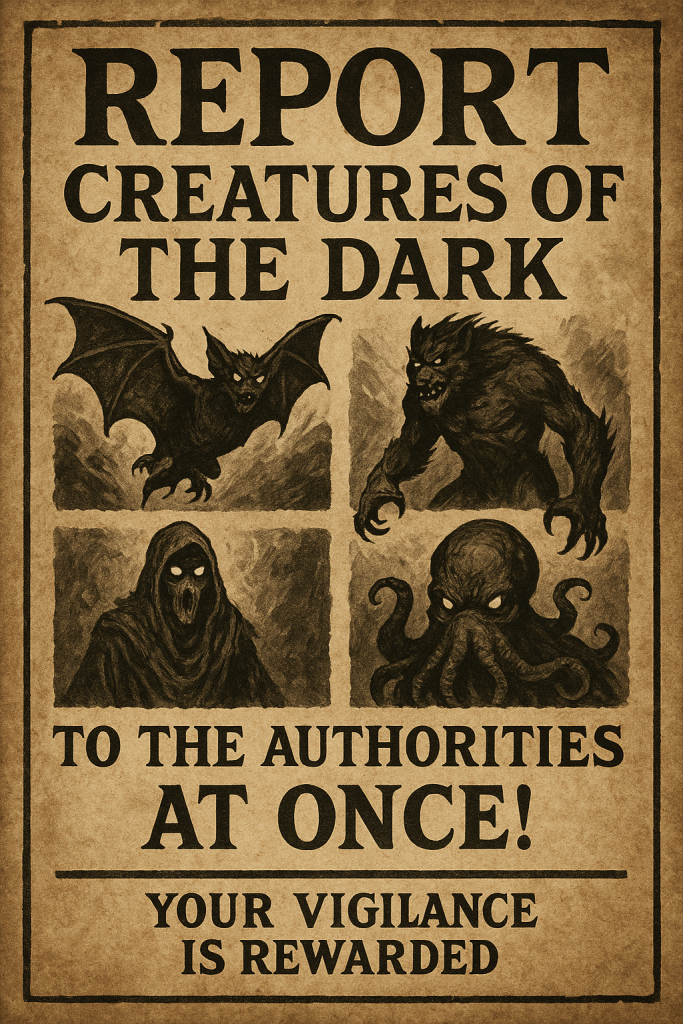
From time to time, a group of Creatures of the Dark will be found within Archean borders and subjected to a pogrom. If a pogrom breaks out during your visit, you are strongly advised to stay the hell away from it! When Creatures of the Dark are found by ordinary Archeans, their response is typically violent and non-selective so sometimes these pogroms turn into bloody catastrophes. Once again, although pogroms are uncommon, you should stay the hell away from them! We’ve said this over and over again in this book and will say it again – if seeing something runs the risk of your head being freed from your shoulders or your arms being clapped into the irons of slavery, that thing is simply not worth seeing!
The Ordinary Laws of Archea do permit execution, torture, and enslavement of Creatures of the Light as potential punishments for breaking the law. Execution remains in common use while torture and enslavement are used much more rarely.
The Arcane Laws of Archea are somewhat more restrictive than those of neighboring kingdoms so it’s worthwhile to review the basics in some detail,
- The term “magic-user” is liberally defined and means any being who can cast spells. This is more general than most kingdoms which will specifically define a magic-user as a wizard or cleric or some such. Not so in Archea; if you can cast any spell, you’re a magic-user and are subject to the Arcane Laws.
- Any member of the nobility or designated governmental representative can demand that any magic-user use their magic for the public good during times of disaster or disorder so long as the demand does not subject the magic-user to an excessive risk of harm. The example that’s usually cited is that of a city on fire…
- The nobility or government can compel a magic-user to stand in a safe spot and cast a water spell to help fight the fire.
- The nobility or government cannot compel a magic-user to enter a burning house and rescue the inhabitants inside.
- Magic-users may not use their spells to break any Ordinary law and there are extra penalties specified for those who do. For instance, if a magic-user uses their magic to cast an illusion to cheat a shopkeeper, that magic-user is liable not only for fraud but also for using magic to aid in a crime.
- Except in cases of self-defense or protection of others, magic-users may not use illusionary magic without advising viewers in advance. So, a magic-user may change their appearance to that of a bear in order to drive away wolves attacking children. Additionally, a magic-user may change someone else’s appearance as part of a play where the audience has been informed that illusions will be used. Otherwise, however, the use of illusionary magics is forbidden.
- The use of magic to prevent others from using magic is forbidden unless specifically authorized by nobility or a designated governmental representative. This sort of permission is usually granted only for protective magic wards to protect, for instance, the palace or a large gathering of people.
- Non-magical items may not be represented as magical when they are sold.
Archea does permit magic-users to hire out their services so long as they do not break the law. This long-standing policy has attracted a number of magic-users to Archea and has made the kingdom one of the leading centers of magical education as well as one of the world powers in magic.
Finally, as in many other nations, there is a strong social norm in Archea that one does not cast a spell on someone else without their permission.
Slavery
The recent international wave of abolitionism has swept over, past, and around Archea without having the slightest effect on the “Noble Institution” within its borders. Experts in Such Things attribute this to,
- The barrier posed by the long-standing Archean legal principle that “Creatures of the Dark” have no rights and derive no protection from the laws.
- The profits that Archean decision-makers (read: “The King and the Nobles”) continue to derive from their slaves.
- The continued acceptance of the population that whatever The King and the Nobles say, goes.
The vast majority of Archean slaves are descendants of the Orcish prisoners taken during the Righteous War. These slaves are born into and live out the entirety of their lives in slavery. During the course of these brutish lives, they are forcefully bred to produce the next generation of slaves to the specifications of their masters who, like slave masters the world over, prize strength, endurance, and passivity. Other Orcish slaves, however, are fresh slaves taken from free-living but small and hidden populations scattered throughout Archea. When these bands of feral orcs are discovered, they are either exterminated on the spot by civilians or are captured and brought to Edicaria by professionals to be sold in the Grand Slavehouse there. Due to their lack of breeding, they sell at a discount compared to long-standing Orcish slave lines but the trade is profitable enough that there are a number of rough-and-ready groups who hunt feral orcs for a living throughout the unsettled areas of the country.
Occasionally these orc hunters encounter colonies of goblins, kobolds, and other such Creatures of The Dark but despite a number of attempts, Archea has not yet managed to make the enslavement of these creatures profitable. The orc hunters, therefore, typically slay these creatures, loot the bodies, and present the corpses to the government for a small reward.
A small minority of Archean slaves are non-Orcish Creatures of the Dark and even fewer are Creatures of the Light; these atypical slaves are kept because of certain specialized skills or other valuable attributes that they have. Persistent rumors that the Archean military keeps one or more enslaved dragons have never been confirmed by any reputable authority.
A number of Archean institutions of magical higher education carry out active government and private funded research programs in using magic to make slavery of creatures other than orcs profitable. These programs typically maintain a colony of goblins or kobolds or some such on campus and will offer tours of these programs/colonies to interested visitors. For details, refer to the individual entry for the institution you are interested in elsewhere in this guidebook.
Visiting Edicaria
Edicaria, the capital of Archea is also considered its own province and, like many capitals, has managed to convince its citizens that it is not only the beating heart of the nation but also its soul, brain, gallbladder, and possibly left femur. It boasts boulevards too wide to cross without a minor pilgrimage, statues that are slightly smugger than you’d expect, and a local cuisine best described as “confidently indifferent to both texture and temperature.” Still, it is the most cosmopolitan city in Archea, with something to offend everyone.
The places tourists often visit include,
The Grand Library of Edicaria – This vast repository contains every book that has ever been written in Archea (and a much, much larger number from elsewhere). The architecture is majestic, the silence oppressive, and the Dewey Decimal system replaced long ago by a classification system based on which noble family donated the shelf.
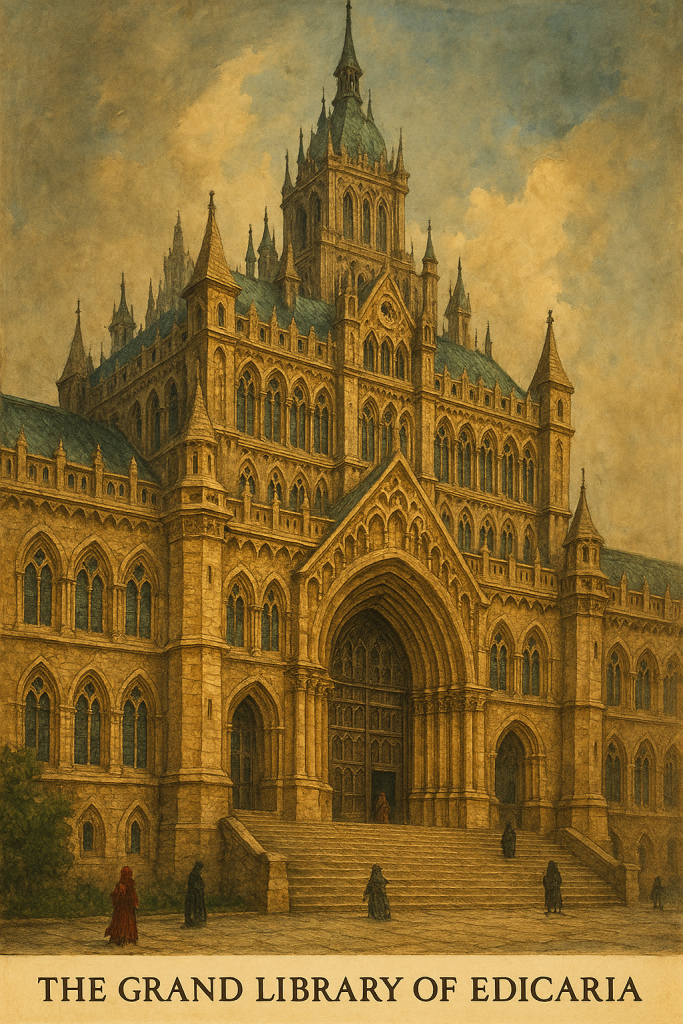
Tourists are allowed into the public galleries, which feature musty tomes, muttering archivists, and rotating exhibits such as “Binding Your Enemies: A History of Magical Book Covers” and “The Righteous War, As Told by the Winners, Again.”
The process for requesting a book involves three forms, two queues, and one silent prayer to Thornak, god of procedural redundancy.
The library also features a Restricted Section that is so tightly guarded that even asking about it is considered poor manners, if not actual sedition. Admission is theoretically possible, provided one possesses an impeccable reputation, three letters of noble reference, and absolutely no curiosity.
The War Department Museum – Attached to the heavily fortified and thoroughly restricted Ministry of Defense compound, this public-facing museum serves as both a monument to Archea’s martial greatness and a subtle warning to would-be malcontents.
It boasts a sprawling collection of uniforms, weapons, and dioramas depicting famous battles (with Archea always emerging victorious, even in the ones it definitely lost). Popular exhibits include “Spellwork of Victory: A Pyrotechnic Timeline”, “Make Your Own Siege!” (a Children’s Interactive Zone), and “Magic and Munitions: Fifty Years of Fireball-Adjacent Mishaps.”
Docents, drawn from the children of mid-ranking officers, deliver passionate but wildly inaccurate lectures about Archea’s military history, complete with scripted “enemy surrender reenactments” and frequent reminders to report suspicious behavior.
The gift shop stocks propagandistic coloring books, recruitment pamphlets, stuffed orc slave dolls, and other tasteful souvenirs.
Visitors hoping to learn actual military facts will be gently escorted to the exit by a polite man in uniform who asks for their full name and address “just for our records.”
The Monument of National Rectitude
This towering statue depicts King Harold I (or possibly II—the plaque is ambiguous) standing victorious atop a pile of badly proportioned barbarians. Designed to inspire patriotic awe, the monument now mostly serves as a popular lunch spot and romantic rendezvous. Small placards describe each historical enemy in terms best described as “creative nonfiction.”
Children enjoy sliding down the Monument’s back leg, which has been unofficially renamed “The Royal Shin.”
The Avenue of Ministries
A smugly straight boulevard of pomp, power, and papercuts flanked by white marble buildings dedicated to such public functions as Transportation, Censorship, Salt Weighing, Arcane Measurement, and Agricultural Praise. The Avenue features:
- 86 separate Ministry buildings (44 of which have changed names in the past five years),
- A pigeon-based message relay system that somehow still functions,
- And a decorative Arch of Eternal Oversight
Of particular note is The Fountain of Administrative Glory which depicts the personified Spirits of Policy Drafting, Interdepartmental Memos, and Budgetary Compliance wrestling a hydra labeled “Public Confusion.” The water jets go off in bursts synchronized with the national anthem—twice daily, and once at 3 a.m. to remind the city who’s in charge.
The Grand Slavehouse of Edicardia
Euphemistically referred to by some government brochures as “The Nonvoluntary Labor Coordination Center,” the Grand Slavehouse looms just south of the Avenue of Ministries in a complex of sun-bleached stone, iron gates, and what architectural scholars have generously called “grim institutional enthusiasm.”
It is the central node in Archea’s legally sanctioned slave trade and the largest structure of its kind in the known world. Boasting high walls, guarded platforms, and an administrative wing staffed with notaries, heralds, and entirely too many pens, the Slavehouse operates with the procedural rigor of a shipping port—and roughly the same amount of emotional warmth.
Visitors may tour the following areas:
The Hall of Ancestral Labor
This museum-like exhibit attempts to “contextualize” the history of slavery in Archea. Expect oil paintings of smiling slaves, informative plaques that are 90% footnotes, and a live-sized magical illusion of King Harold II giving a speech entitled “Our Civilizing Mission.” Curators emphasize the “economic rationality” of the institution and regularly delete visitor book comments that use the word “horrifying.”
The Auction Arena
An open-air coliseum with raised platforms where weekly public auctions are held to considerable fanfare. Bidders arrive wearing embroidered tokens indicating their “preferred traits.” The arena also includes a “quiet bidding” gallery for nobles who wish to purchase slaves discreetly, and a snack cart operated by the same vendor who serves the Avenue of Ministries (try the oat biscuits, just don’t ask what the filling is).
The Classification Galleries
A series of chambers where slaves are evaluated, branded, and catalogued. A bureaucratic marvel, the system organizes slaves by:
- Species
- Breedline (“pure” or “feral”)
- Labor aptitude (Strength, Dexterity, Charisma for house service, etc.)
- Degree of defiance (“Low,” “Manageable with beatings,” “Currently on fire”)
Tourists are encouraged not to interact with slaves unless accompanied by a licensed Broker of Sentient Assets (Form SH-18 required).
The Hall of Paperwork
A multi-tiered registry office where ownership is formalized. Here, dozens of clerks work in long rows beneath murals titled “The Rule of Order is the Rule of Law.” Visitors may observe sample forms, such as:
- Transfer of Property (Living, Sentient)
- Import Tariff Declaration (Beastfolk, Non-Union)
- Form 42-B: Death by Misadventure Waiver
A magical clock at the entrance gives a cheerful rhyme every hour on the hour:
“To sell a soul, just sign below!
Don’t forget to dot the ‘oh!’”
The Gift Shop
Tacky and disturbing in equal measure. Popular items include:
- “My Cousin Went to the Grand Slavehouse and All I Got Was This Lousy Shirt” tunics
- Miniature slave auction gavels (100% ivory)
- A children’s picture book, Blinky the Compliant Orc
- Scented candles named after famous historical slave uprisings (e.g., “Stenian Uprising: Burnt Mahogany”)
Traveler’s Advisory:
While tours of the Slavehouse are legal, they are frowned upon by international observers. Embassies from abolitionist nations have issued statements ranging from “grave concern” to “polite retching.” Fizzbuzz recommends a brisk walk past the complex and a long bath afterward.
The Edicarian Branch of The Adventurer’s Guild
Located two alleys down from the Ministry of Arcane Measurements and directly across from a tavern with surprisingly good stew, the Edicarian branch of the Adventurers’ Guild serves as the capital’s primary hub for all manner of bright-eyed, questionably-prepared would-be heroes. If you’ve ever dreamed of swinging a sword, slinging a spell, or looting an ancient ruin in search of cursed trinkets and traumatizing backstory, this is where the dream begins—assuming you’ve paid your membership fee.
What Is It?
A global franchise operated by retired adventurers with too much money and not enough sense. Part private club, part mercenary union, part overpriced magic gear rental depot, the Adventurers’ Guild is equal parts essential service and bureaucratic obstacle course. It exists to support adventurers and to make sure adventuring remains profitable—for the Guild, not necessarily for you.
Why Go?
Because trying to adventure without Guild membership is a great way to have your kneecaps cursed. Adventuring is a licensed activity in Archea, and the Guild takes a dim view of freelancers. A very dim view. The sort of dim view that involves bounties, spellcasters with grudge-based memory, and the phrase “We’re just here to talk.”
Membership
Initial fee: 10 gold pieces
Annual dues: 100 gold × Your level
Emotional cost: Priceless
Membership grants access to a dizzying array of services, most of which seem helpful until you read the fine print.
Services for Members
- Jobs Board: A constantly updated posting of available quests, ranging from “escort this goat” to “defeat the howling abyss.” No fee to browse. No refund if you pick poorly.
- Item Vault: Secure storage for equipment, documents, or ominously glowing orbs. Vault guards are incorruptible, but only because they’re enchanted that way.
- Equipment Rental: Need a grappling hook, silvered sword, or invisibility-cloaked donkey? It’s probably in the basement. But beware: all rentals are magically trackable, sometimes sentient, and occasionally bite.
- Healing Services: Administered by underpaid clerics and overworked paladins. Prices vary based on injury, attitude, and how loudly you’re screaming.
- Spell Instruction: Want to learn a new spell? You’ll need time, money, and the patience to endure three hours of lecture from a wizard who hasn’t adventured since King John I.
- Identification and Appraisal: “Is this cursed?” – they’ll tell you. “Should I keep it?” – they’ll smirk and say, “That’s your problem.”
- Library and Knowledge Access: The Guild’s library contains thousands of tomes, maps, and ominous warnings. It also grants access to GOOGLE—the Grand Omnipathic Online Guild-Linked Encyclopedia. Only accessible on-site and only by members. Use it to research monsters, locate magical herbs, or look up that weird rash you got after licking the glowing altar.
- Talent Network: Need a cartographer, a demonologist, or a bard with flexible morals? The Guild will introduce you… but disclaims any responsibility for subsequent fire, haunting, or marriage.
Atmosphere
The Edicarian Guildhall is a chaotic mix of optimism, bloodstains, and suspiciously cheerful bards. Inside, you’ll find adventurers of all levels—wet behind the ears rookies, veterans trading war stories, and that one guy in the corner who claims to be a dragon in disguise but definitely isn’t.
Traveler’s Advisory
Tourists are welcome to look around the main hall, admire the monster trophies, and purchase branded merchandise such as “I Rolled A Natural 1 in Edicaria” mugs or plush mimic pillows. Non-members are strictly prohibited from accessing the job board, library, or equipment lockers. Violations will result in fines, banishment, or a very polite adventurer showing up at your door with a scroll labeled “Gentle Reprimand” (Level 5 Evocation).
Visiting Cambria
Two words are sufficient to characterize Cambria for the prospective tourist – “Don’t bother”. The only reason travelers come here is to pass through the provincial capital (whose name escapes us) en route to somewhere more civilized, more scenic, or at least less damp. The region is famous for its bottomless mud, argumentative frogs, and a population that has never once apologized for the smell.
Technically rich in natural resources and ancient ruins, Cambria has resolutely failed to convert either into tourist revenue. There are whispers of political unrest, ghost sightings, and administrative irregularities, but these are almost certainly just local color—like the region’s seven distinct words for “mildew.” If you must explore Cambria, bring boots, bug repellent, and low expectations. And maybe a shovel, just in case the rumors are true.