September 18th, 973
Morning found the adventurers at the Rusted Nail, fortified by porridge of dubious provenance and bread that seemed to resent being eaten. The day’s itinerary, reviewed between sips of burnt coffee and complaints about the eggs, began with a polite call on the Monpierres — Captain Émile’s surviving kin. “If anyone can provide clarity,” Pfinder declared with theatrical optimism, “it will be the family of a military man.” This sentiment, repeated with varying degrees of conviction (and in the face of Captain Arbuckle’s previous warnings), carried them out into the streets of Edicaria and up to the Monpierre residence — where clarity, as it turned out, went to die.
The Monpierre residence was less an apartment than a shrine to poor decisions in furniture arrangement. Chairs were scattered everywhere but declared un-sittable: one had “emotional resonance,” another “lingering mildew vibrations,” and a third was prophesied to collapse the monarchy if anyone so much as perched on it.
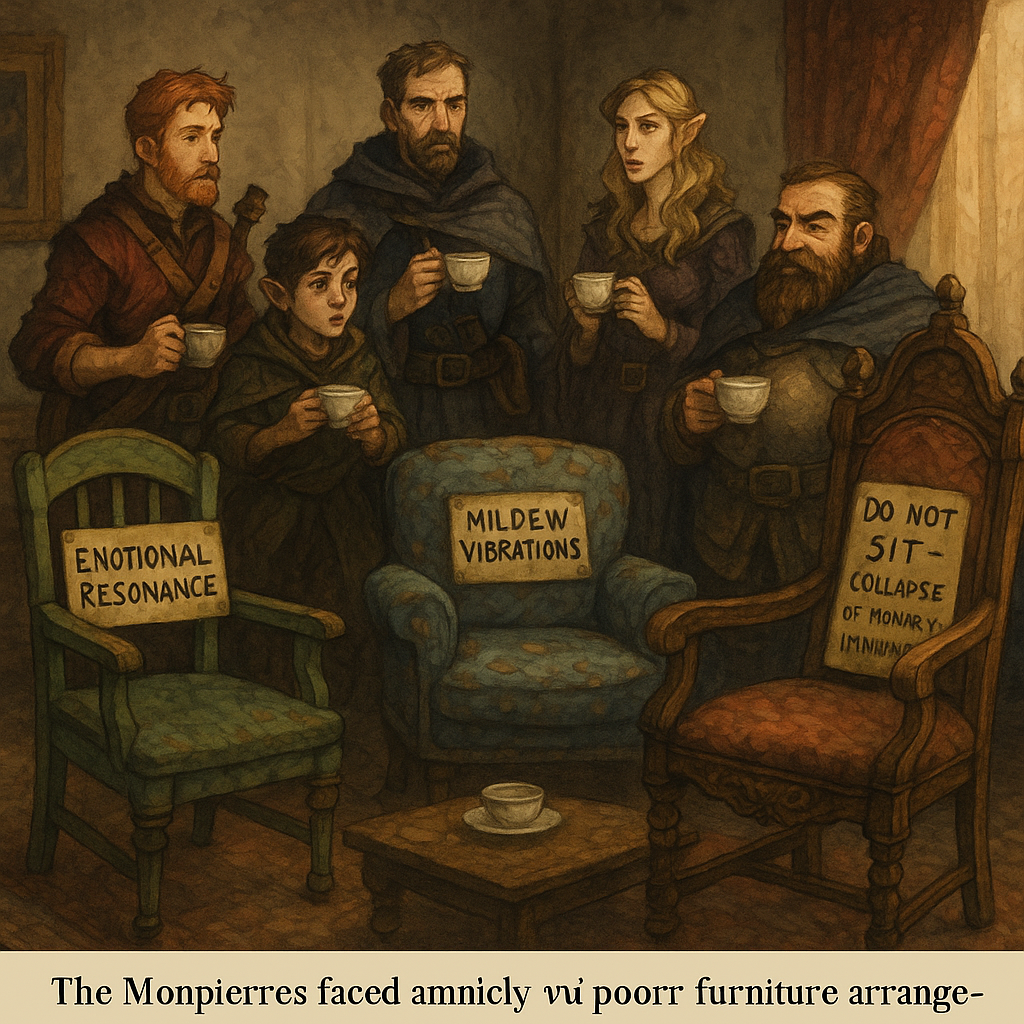
Etienne Monpierre greeted them with the pomp of a man about to deliver a parliamentary speech on the importance of quill shortages. He removed his monocle — which he did not need — before declaring, “Visitors! You arrive at the very moment the tea has achieved bureaucratic perfection.” Auralise immediately countered that the teapot was haunted and possibly conspiring with the wallpaper. She lit another cigarette in her swan-shaped holder to make the point.
What followed was an hour of exquisite nonsense. Etienne produced a letter from a Ministry no one had ever heard of. Auralise whispered conspiracies about dentists, pigeons, and a secret moon that controlled upholstery patterns. Cousin Gérard was invoked no fewer than three times, always in connection to duels, debts, or both.
Wolfgang, however, kept his focus. While the others were drowned in talk of mildew uprisings and candle conspiracies, he caught a passing phrase: the Red Ledger. His ears pricked. Persistence — and perhaps a discreet pinch of thaumaturgy from time to time — turned the conversation back again and again until, at last, Etienne reluctantly shuffled to a bookshelf and produced a battered red notebook.
It was, alas, not the Red Ledger. It was a red ledger: Captain Émile Monpierre’s own notebook, mottled with age, stained by years of careless handling both in the field and in storage, and bearing the faint aroma of onions. Its pages, where legible, recorded only scattered thoughts — fragments of duty rosters, half-sketched diagrams, and what might have been a shopping list (“Bread, onions, vinegar (cheap)”).
Yet within the confusion lay confirmation. The Red Ledger existed, properly titled Standardized Use of Magic in Archean Battlefield Contexts. Captain Monpierre had worked on it alongside Nelson and the enigmatic Warlord-Colonel Scarn. A small thread pulled from the tangle, but a thread nonetheless.
The others were quick to credit “the party’s efforts” for this discovery, but everyone knew it was Wolfgang who had wrestled order from chaos, persistence from distraction. In fact, it had been so squarely his doing that Pfinder — never one to miss a chance for drama — declared: “It is ever thus! The one who shoulders the labor receives a polite nod, while the rest stand about preening and signing their names to the bottom of the report.”
It was a dig aimed sideways, sharp enough to raise guilty smirks from certain party members, but Wolfgang only smiled and tucked the notebook away. For all its stains and scribbles, it was proof that even in the Monpierre household, clarity could be wrung out of madness — provided one had the patience to do the work.
Notebook in hand, they stepped out of the alleyway back into the daylight, trading the Monpierres’ tobacco haze and haunted teapots for Edicaria’s brisk air and blinding bureaucracy. Their next stop was the Ministry of Defense, that august institution where dust gathered faster than decisions and clerks could outlast marble. Whatever scraps of clarity the Monpierre household had yielded, the Ministry promised to bury them again beneath stamps, forms, and the sighs of men who had misfiled their ambition decades earlier.
The party, however, had come armed with the deadliest weapon of all: paperwork.
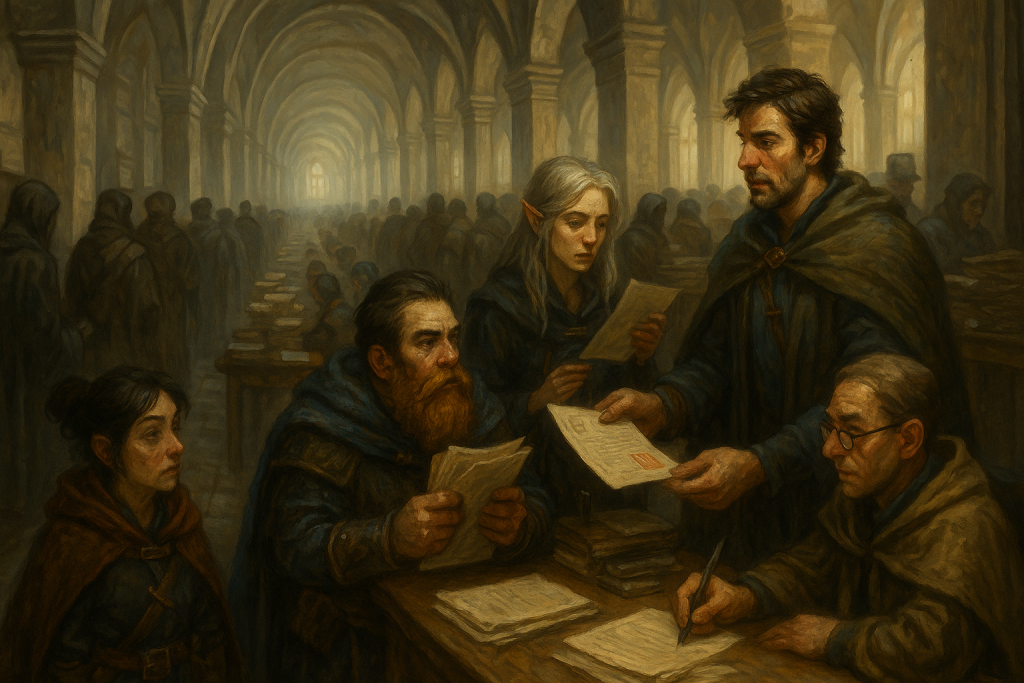
Wolfgang, quill already inked, flourished a stack of communiqués that appeared, at a glance, to have been stamped by half the Ministries on the Avenue. In truth, they were cobbled together from old notices, polite demands, and one very convincing requisition order for fifty barrels of salted lamp oil. The heading was clear enough: Clerical Error — Immediate Rectification Required.
“Monpierre’s death improperly catalogued under ‘Mundane Accidents,’” Pfinder intoned with operatic sorrow, brandishing one sheet. “Surely the man deserves more than to be filed beside a stable-hand who tripped over a pig?”
“Nelson’s record appended with notes that clearly belong to someone else,” added Cassyndra, tapping the margin with theatrical precision. “Do you mean to tell us Captain Nelson moonlighted as a ferryman in Stennia? No? Then correct it. And bring me the proof of the correction.”
Ant, her noble upbringing flashing through, gazed up at one junior clerk. “My dear, this error bears the mark of negligence. If you delay in correcting it, your superiors will be forced to ask why.” Her tone made clear that why was not a question anyone in the Ministry wanted asked.
The clerks blanched, shuffled, and muttered. Somewhere, a ledger was checked. Somewhere else, a stamp thudded three times in quick succession. Papers were produced, amended, and thrust forward in the desperate hope that the problem — whatever it was — would vanish with the adventurers.
From that paper blizzard emerged first an official citation lauding Captain Monpierre’s last stand at Stennia. It spoke of wagon timbers turned to barricades, of a handful of men rallied into defiance, and of a captain who chose to hold the ground beneath his boots until it swallowed him. By royal decree, his gallantry was commended, his sacrifice immortalized.
Nelson’s file told a darker tale. His long and once-sterling record bent under the weight of his Cambria posting: erratic reports, excessive suspicion, increasing agitation. Peers whispered, subordinates flinched. Though no crime was named, his decline was undeniable, his reliability questioned. The matter, the notes concluded, had been quietly referred to the Office of Extraordinary Review — findings sealed, unless deemed “material to broader security interests.”
And then there was Scarn. Buried in bureaucratic phrasing was the admission that Warlord-Colonel Scarn had indeed authored the Standardized Use of Magic in Archean Battlefield Contexts. A manual so classified that even its title drew glances from nearby desks. Yet the clerk, weary from the shuffle of forms and lulled by the party’s counterfeit authority, let slip a muttered nickname that had clearly taken root in the barracks: Some Useless Manual About Blasting Crap. He coughed immediately, fixing his eyes on a misaligned paperclip, but the damage was done. The SUMABC was both doctrine and punchline — and neither inspired confidence.
By the time the party left, the Ministry’s clerks were half-convinced they had been correcting their own mistakes, errors so glaring it was a miracle no one had been fired already. The adventurers, meanwhile, departed with arms full of documentation and the faint satisfaction of having beaten the bureaucracy at its own game.
Escaping the Ministry’s marble labyrinth, the party found themselves blinking in the late-afternoon sun, stomachs rumbling and heads buzzing with equal parts triumph and tedium. For a few hours, they scattered: some in search of food that didn’t taste like ink, others in pursuit of a nap or a quiet corner to tally their winnings from the great clerical heist. Pfinder declared it a victory worthy of song (though mercifully postponed the performance), while Wolfgang grumbled that paperwork was best celebrated with strong drink and stronger seasoning. By the time the city’s lamps were lit and shutters drawn, they reconvened with the easy smugness of conspirators who had tricked the system and lived to tell about it.
The streets of Edicaria always felt a little different after dark: shadows lengthened, shutters closed, and respectable citizens developed a sudden interest in not noticing anything at all. Which made it the perfect hour for five slightly disreputable adventurers (and a few GUCs) to amble up to a door that was not so much a door as a stubborn brick wall that had decided to hinge itself out of sheer stubbornness.
It was, in fact, a golem. The kind that looked as though it had once aspired to a career in masonry but, after a humiliating written exam, had been reassigned to “entryway.” Its stony features shifted as the sign-and-countersign was given; then, with the faint crunch of limestone resignation, it swung open to admit the party.
Inside, the speakeasy revealed itself as a smoky underworld of clinking glasses, quiet conversations, and shadows that politely refused to disclose their owners. The air was thick with pipe smoke, candlewax, and the faint smell of illicit substances that everyone agreed not to name. Patrons hunched over tables like conspirators in an opera no one wanted to sit through.
And then, as if on cue, he rose.
Kardan.
Tall, composed, and dressed in clothing that managed to look neither expensive nor cheap but somehow inevitable. His eyes scanned the group with a professional’s ease, and when he spoke, it was not with the bluster of an orator but with the precise courtesy of a man who already knew the answer to his own questions.
“Welcome,” he said, inclining his head. “Wolfgang. Cassyndra. Shamus. Antoinette. Pfinder. And… companions.” He gestured lightly to the GUCs, naming them as well, each with an accuracy that suggested either a prodigious memory or a very effective network of informants.
Without consulting a menu, he ordered drinks — not the house specialties, but their favorites. A gesture that required no flourish. Just fact.
When mugs and glasses had been set before them, he leaned forward slightly. “I’ve been looking forward to this meeting. Allow me to be plain: I am a broker of knowledge. Secrets, truths, whispers, things you can neither buy nor steal in the open market. But today, I have a problem of my own.”
He drew from his pocket a small gem, dull and unremarkable — the kind of trinket one might dismiss as decoration on a particularly tasteless chamber pot. He set it gently on the table. The room went on murmuring around them, but no one turned an ear. Privacy here was currency, and everyone respected the exchange rate.
“This,” he said, “is a key. It opens a pocket dimension: a maze. Harmless, but maddening. Within lies an artifact I require. I cannot traverse it. You, however, possess talents – lateral thinking, puzzle solving, persistence – that may allow you to succeed where I cannot.” His eyes lingered on them, weighing, measuring.
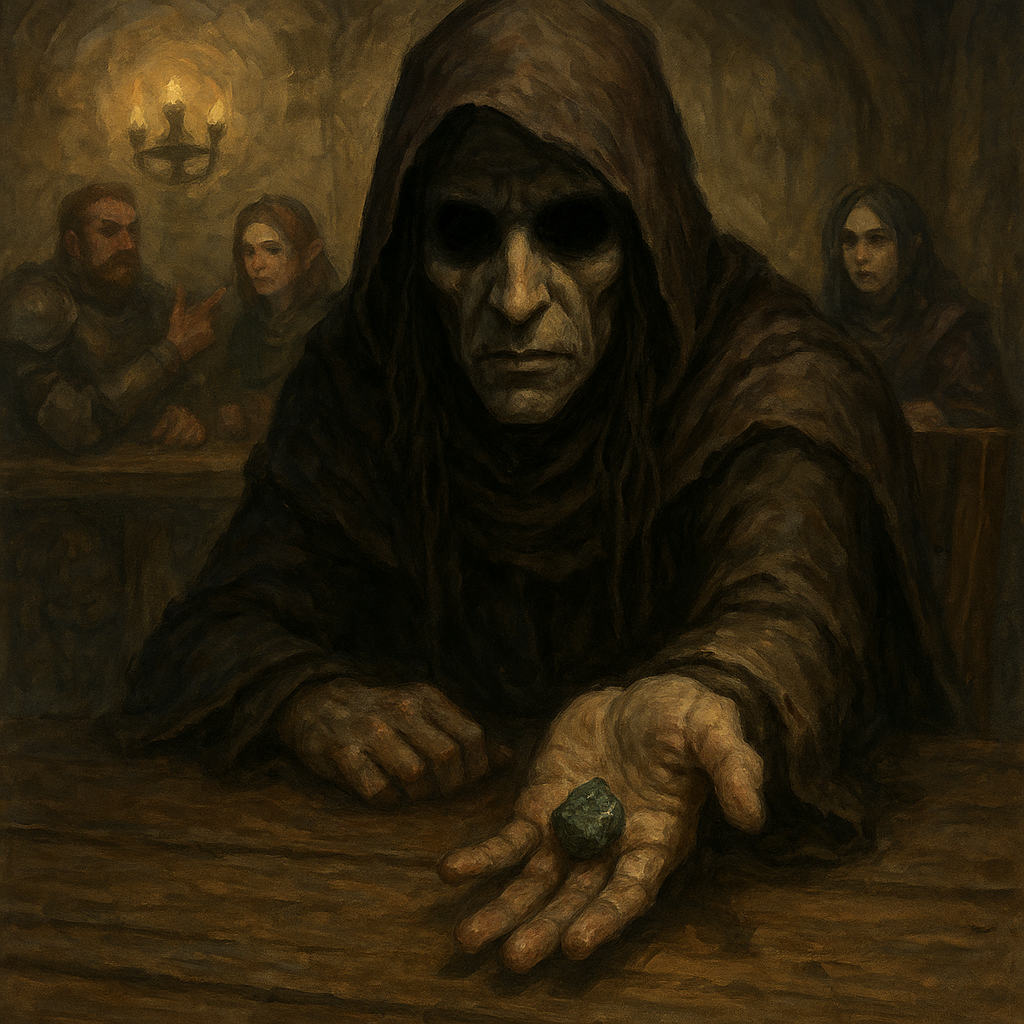
The gem caught a flicker of lamplight, a cold promise in miniature.
“Should you reach the heart of the maze, I will claim what I need. In return, I will provide you with what you seek: a copy of the Standardized Use of Magic in Archean Battlefield Contexts.” He let the cumbersome title fall like a hammer on stone. “Yes — the Red Ledger. You may ask how I know you desire it. The answer is simple: it is my business to know.”
His voice was calm, assured, businesslike. A slight twitch of the mouth — not quite a smile — betrayed that he took some satisfaction in knowing more than they expected.
He pushed the gem an inch closer to them, the stone scraping faintly against the table.
Naturally, questions followed. What was the artifact? Why all this secrecy?
Kardan swirled his drink, gaze steady. “What it is matters less than where it is. In truth, names and labels obscure more than they reveal. Better you see with your own eyes than inherit my assumptions.”
Cassyndra leaned forward. “And how do you know this maze is safe?”
A small, indulgent smile crossed his face. “I make it my business to know what others overlook. My inquiries, my… investigations, have convinced me that the maze poses no threat to life or limb. Confusion, yes. Frustration, certainly. But danger? No. You may step boldly.”
Shamus, ever blunt, asked if Kardan himself had tried. For a moment, his gaze went distant. “I have walked its corridors — and been turned back. But impressions gathered in failure are unreliable. I would not burden you with them. Go unclouded, unshaped by my shortcomings.”
Wolfgang, more cautious, wondered if others had been sent in.
At this, Kardan leaned forward, voice lowering to something close to a confidant’s whisper. “No. Others lack… the necessary qualities. You, however, are different. You move at the hinge of things — a point where choices press down and futures turn. Call it instinct, or calculation, or both. But I have chosen you because I believe history itself may have chosen you.”
The words lingered in the smoky air, heavy as stone and light as rumor, while the gem in his hand gleamed faintly — a promise, or perhaps a warning. They left the speakeasy not long after, the night air cool against faces still warmed by candlelight and Kardan’s words. None spoke much on the walk back; each turned the gem and its implications over in their minds, like gamblers fingering dice they had not yet thrown. By the time they reached their lodgings, fatigue settled in like a second cloak. Whatever revelations or arguments might have been had were deferred until morning, left to mingle with dreams and the faint smell of smoke still clinging to their clothes.
Breakfast at the Rusted Nail was its usual carnival of minor indignities. Pfinder had just begun declaiming that the sausage was “a metaphor for the state of the kingdom” when Shamus, with the patience of a chess player and the timing of a stage magician, leaned across the table to point out an imaginary spot on Pfinder’s sleeve. “You’ve spilled mustard—right there.” Pfinder glanced down, affronted at the very suggestion of condiment on his waistcoat. In that heartbeat of self-inspection, Shamus swiped half his toast clean off the plate and was chewing with suspicious innocence by the time Pfinder looked up again.
The realization dawned slowly, then all at once. Pfinder slapped the table, rose halfway out of his chair, and proclaimed: “Villain! Highwayman! I shall reclaim my bread by force of arms if necessary!” He lunged with a theatrical flourish of his fork, but Shamus leaned back out of reach, savoring his prize bite by bite. Pfinder sagged back into his seat, affecting a wounded dignity. “Very well,” he sighed. “Let it be known that I magnanimously donated to the Paladin’s Dietary Relief Fund.”
The table’s talk drifted inevitably back to the prior day’s encounters.
“What do you suppose the artifact is?” Wolfgang mused aloud. “Some kind of weapon? A jewel? A recipe?” He brightened. “Imagine if it’s a recipe. The kind you can’t trust to mortals, only to pocket dimensions.”
“One hopes it’s not a chamber pot,” muttered one of the GUCs. “Broker of knowledge, he calls himself. Looks more like a professional lurker who knows far too much about our drinking habits.”
Cassyndra, ever the scholar, tapped her quill against her notebook. “Pocket dimensions are usually woven by high-order spatial magic. Dangerous to attempt, difficult to maintain. Kardan having access to one at all suggests he has… let’s call it connections. And a talent for manipulating thresholds.”
“Stalker,” the GUC repeated sourly, dunking his bread in thin stew.
Wolfgang, for his part, was conducting an autopsy on the breakfast. “Overfried. Oversalted. Underwhelming. But salvageable.” He sprinkled herbs from his own pouch across the eggs with the air of a battlefield medic saving yet another life.
A weary-looking regular shuffled up to the table, plate in hand. “Master Wolfgang,” he begged, “these eggs are… they’re… look, they’re staring at me. Could you…?”
Wolfgang sighed the sigh of a man resigned to carrying an entire medical ward on his shoulders while the doctors drafted yet another report. “Slide them here.” He scraped, seasoned, and returned the plate with a crisp nod. “Better.” The man’s gratitude was embarrassingly profuse.
Through it all, Ant had been quiet. Too quiet. She toyed with the rim of her mug, tracing patterns in the condensation, letting the others’ chatter wash over her. When at last she spoke, it was not with her usual sharpness but with the careful weight of someone deciding just how much to share.
“So,” she began lightly, “you know how, after a day like yesterday, you expect the worst thing you’ll face at night is indigestion?” A faint smile that didn’t reach her eyes. “I… didn’t sleep much. Something happened. Something I can’t keep to myself.”
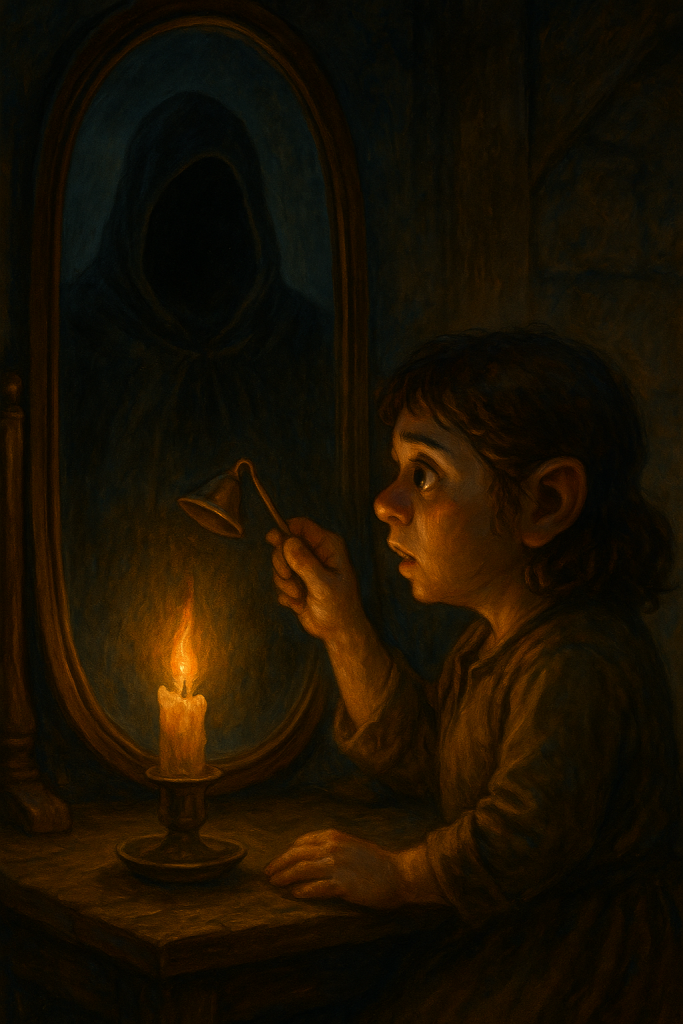
“It happened just before I was going to lie down. I was just about to snuff out the candle,” she said, voice low enough that the others leaned closer, “when I glanced in the mirror and saw… not me. It was someone… someone else there. A figure in a black cloak. Hood up, face hidden. About my height. They spoke. Not loud, but like they already knew me.”
Cassyndra’s quill stilled.
Ant continued. “Whoever it was said, ‘I know you better than anyone. I know your fears, your strengths, your hungers. And I know where your choices will lead.’ Then they told me: ‘You are different now.’”
She paused, eyes flicking to each of them in turn. “And that I should wait until morning to tell you.”
The Rusted Nail seemed to quiet around them, though the clatter of dishes and muttering patrons carried on at the edges as if the rest of the tavern had decided breakfast was more important than destiny.
Pfinder broke the silence first, eyebrows climbing toward his hairline. “A mysterious figure in a mirror? Antoinette, my dear, you’ve either acquired a patron… or a very judgmental piece of furniture.” His tone was airy, but his monocle nearly fell into his porridge.
Wolfgang leaned back, eyes narrowing. “A patron? Those aren’t… those aren’t real. At least, not in the sense of just appearing in your mirror for a chat.” He grunted, more to himself than anyone else. “And furniture doesn’t usually speak in riddles. I’ll give you that.”
Shamus frowned, palms flat against the table as though bracing for impact. “This was right after Kardan? Ant… that’s no coincidence. Patrons… they’re dangerous. They change people. I’ve only ever heard stories — half warnings, half fairy tales — but none of them ended lightly.”
Cassyndra looked directly at Ant. “Warlocks,” she murmured. “Pact-bearers. The theorists call them living conduits, chosen by powers outside the known pantheon. But I never thought…” She shook her head, more in wonder than disbelief. “I never thought I’d meet one.”
Even one of the GUCs muttered into his cup, “Gods save us. I thought patrons were just stories parents used to frighten children into finishing their chores.”
All eyes turned back to Ant, as if to see whether horns had sprouted or her reflection was still sitting with them.
Ant shifted in her chair under the sudden scrutiny, clutching her mug as if it might anchor her. “I don’t feel… cursed, if that’s what you’re thinking. I’m still me. But… different. Like a door has opened, and now I can’t un-know that it’s there.”
Shamus’s frown deepened. “Different how? Stronger? Touched? Marked?” His tone carried the wary weight of a man who had seen too much of the undead and didn’t want to see the same in his friends.
“Marked? Please,” Pfinder cut in, with forced lightness. “She’s been marked since the day she joined us — marked by destiny, by mystery, and, if I recall correctly, by at least three unpaid bar tabs. Why should one more mark alarm us now?”
Wolfgang snorted into his eggs. “Because this one whispers through mirrors and calls itself a patron. That’s rather more than a bar tab.” He jabbed his fork at Ant, though his eyes softened. “Are you sure it wasn’t just a dream? Or a trick? Illusions can be sly.”
Ant shook her head. “I know what I saw. What I heard. This wasn’t a dream.” She hesitated, then added, “And it told me not to wake the rest of you. That I should wait until morning to tell you.”
Cassyndra’s eyes gleamed with a mix of fascination and unease. “That’s deliberate, then. A patron who chooses silence and secrecy, who wants to control when and how their presence is revealed. That suggests… intent. Calculation.” She flipped back a few pages in her notebook, scribbling furiously.
One of the GUCs muttered, “Gods help us. First ciphers, then alternate dimensions, now patrons. At this rate, next week we’ll be collecting prophecies from chamber pots.”
For a moment, the table sat in the thick of it: the shock, the questions, the strange awe of realizing that their companion had been chosen — or claimed — by something beyond their understanding.
Then Shamus set down his fork with a soft clatter. “Well. Whatever this… patron is, you’re not facing it alone. Not while I’m at this table.” His tone was simple, but there was steel underneath.
Wolfgang gave a short nod. “Seconded. Though I’ll still keep an eye on the mirrors. Just in case they start offering unsolicited advice about seasoning.”
Pfinder leaned back, swirling the dregs of his tea with dramatic flair. “Then it’s settled: if Ant is to dance with shadows, we shall provide the orchestra. Destiny may have chosen her, but it will have to get through the rest of us to make the booking permanent.”
Cassyndra tapped her quill against her notebook. “Practical steps: the library. Maps of Cambria, yes, but also anything we can find on warlocks, patrons, mirror magic. If Archea has seen this before, there will be a record. Somewhere.”
Ant’s shoulders eased slightly at their words, though her eyes still flicked with unease. “Thank you. I… wasn’t sure how you’d take it.”
“With food, obviously,” said Wolfgang, spearing the last of his eggs. “That’s how we take everything.”
A ripple of laughter broke the tension, and just like that the Rusted Nail returned to its usual din. But beneath the jokes and half-stolen toast was a firmer bond — an unspoken agreement that whatever Ant had stepped into, they would face it together.
Plans were laid quickly: breakfast now, the library at midday, and then, in a quieter corner far from prying eyes, the gem would be set upon a table and the Maze of Kardan entered at last.
The day loomed with maps, mysteries, and mirrors — but the party faced it with the same stubborn resilience that had carried them this far.