September 11th, 973
Two days after the conclave at the Rusted Nail, Pfinder and Wolfgang set out upon their investigation. It was early afternoon on a bright late-summer day, the sort of day that inspired poets to wax lyrical and sensible people to close the shutters. Pfinder, naturally, saw it as an occasion to display his most flamboyantly season-appropriate attire. Wolfgang, ever the pragmatist, carried instead a curated selection of miniature spirit bottles, intending to use them as conversational lubricants should they succeed in cornering the elusive speakeasy owner.
After several false starts — owing largely to Pfinder’s ale-blurred recollections of his nocturnal wanderings — the pair at last located the proper alley. Wolfgang, pausing to assess the scene, admitted that the air was indeed every bit as malodorous as Pfinder had described: an aromatic mélange of cabbage water, mildew, and civic neglect. The iron-bound door itself, however, seemed less forbidding by daylight. Wolfgang chalked this up to a combination of bright sunshine and cultural differences; mountain dwarves and half-elves, after all, have vastly divergent views on the relative menace of closed-off spaces.
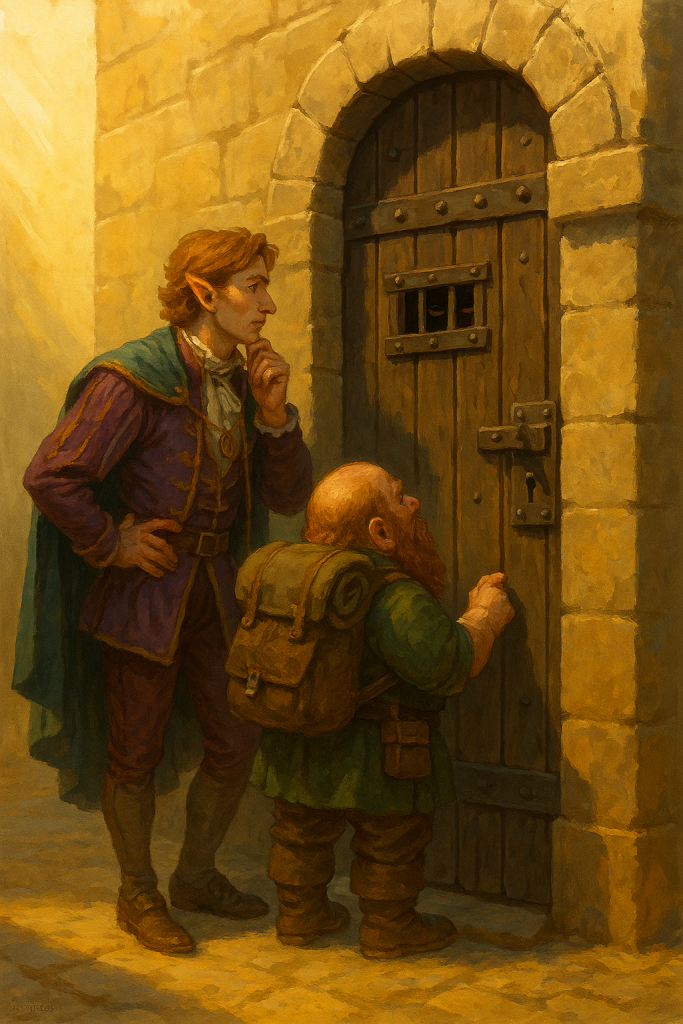
They knocked on the door and the slit briskly opened and the same stentorian voice as before intoned “Closed!” and the slit snapped shut once again.
The two exchanged a look.
“Even less inviting than before,” Pfinder observed, “an achievement I would scarcely have believed possible.”
Wolfgang shrugged, knocked again, and received the identical rebuff. Frowning, he repeated the experiment five more times.
“Curious,” he said at last. “If someone were to knock on my closed seven times, the seventh attempt would produce something different from the first — swearing, a kick in the pants, or at the very least an exasperated silence. Here, however, the reply is mechanically identical each time. The same cadence, the same timbre, the same aura of a tavern-keeper announcing ‘Last call’ on yet another night.”
Pfinder tilted his head. “Are you suggesting, dear comrade, that this door is not manned at all but is in fact some form of construct?”
Wolfgang stroked his beard, either in contemplation or in an effort to wring out whatever miasma of the alley had lodged there.
Pfinder leaned forward until his nose nearly scraped the iron, rapped once more, and fixed his gaze on the slit as it snapped open. For a heartbeat, he studied the void beyond. Then he stepped back, smoothing his cravat.
“Comrade Wolfgang, I must confess — your theory has merit. The responses of this portal are so rigid, so utterly devoid of variation, that one would think them machine-wrought. Rarely does one find such consistency among living beings… unless, of course, one includes the monks of Cassabria. Though after reviewing the particulars of their indoctrination — hours of chanting vowels, punctuated by beatings with inspirational texts — I remain unconvinced they qualify as ‘living’ in any sense worth envying.
“I had hoped to glimpse some clue within the slit, but alas! Nothing met my eye but the most uncompromising blackness — the sort of blackness that seems not merely the absence of light, but its sworn enemy. As for you, my stout friend, your height spares you the experience entirely. Believe me when I say you are not deprived, but rather blessed.”
Finding the door unyielding, the pair wandered the surrounding neighborhood for several hours in hopes of gleaning more. Pfinder’s memory failed to produce the taverns of Admiral Teeth or of Kardan’s first mention, but they did collect a handful of rumors — none entirely reliable, but all too intriguing to ignore.
Rumors of the Speakeasy and Kardan
- A ragged street urchin swore that everyone who entered the speakeasy came out lighter: sometimes missing a purse, sometimes a memory, once (he whispered) an entire shadow.
- A fishmonger claimed Kardan had purchased a barrel of salted eels, counted out payment coin by coin, then leaned over the barrel and whispered to the eels before releasing them back into the river. “Sales dropped that week,” she muttered, “because the eels wouldn’t stop screaming.”
- An elderly washerwoman, lips pursed with relish, reported seeing black-eyed men slink through the alley at night. “Not men,” she corrected. “Man-shaped. There’s a difference.”
- A cobbler insisted the door itself could smell intentions. Patrons with honest hearts were admitted, he claimed. The dishonest were not barred, but rather given a drinks list with mysteriously higher prices.
- A scarred veteran swore Kardan had once furnished intelligence that saved an entire campaign. Pressed for which campaign, he narrowed his eyes and muttered: “Whichever one you weren’t in.”
Having exhausted rumor and patience alike, Pfinder and Wolfgang repaired to the Grand Library of Edicaria. They paused for a brief luncheon at the Monument of National Rectitude, watching children clamber over the marble effigy of the Royal Shin while discussing bibliographic strategies.
They arrived at the Library shortly before two, where the reference desk was presided over by Madam Scriptra, Chief Archivist and terror of ill-behaved patrons. Once a demon of the Abyss, now on her second career, she presented a formidable spectacle: six muscular crimson arms, a barbed tail that lashed like punctuation, and a glare magnified by the glasses she wore not from need but for emphasis.
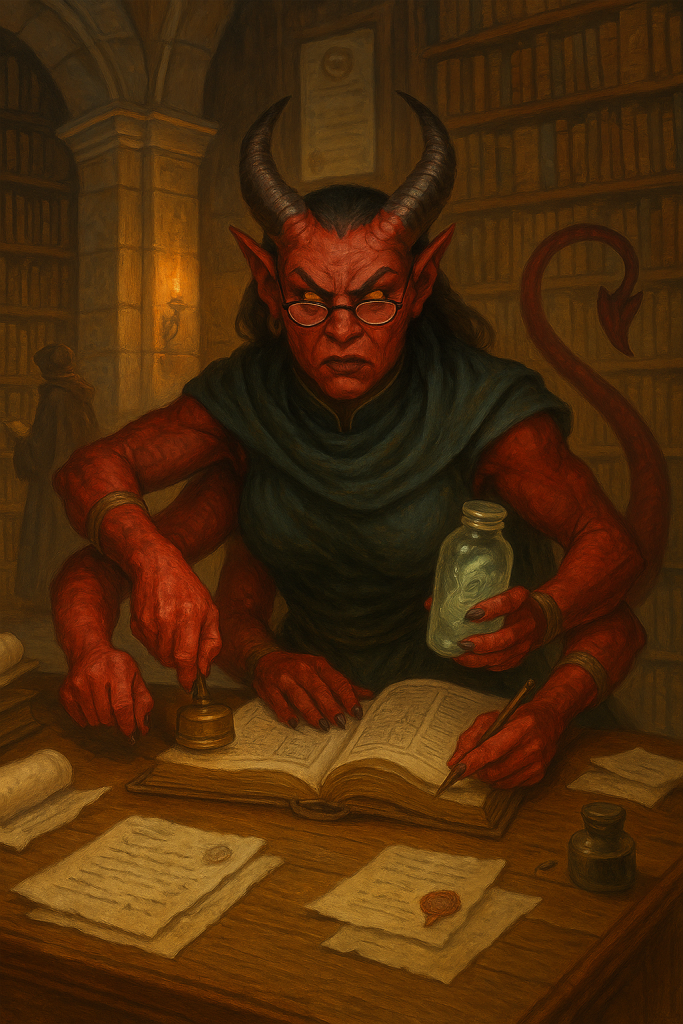
Beside the desk a hand-written set of library rules was prominently posted,
Rules of the Grand Library of Edicaria
1. Silence is Golden.
So is platinum. So is your spleen. Don’t tempt me.
2. Return All Items on Time.
Late returns will incur a fine of 1 silver per day or the temporary forfeiture of your dominant limb, whichever is more convenient.
3. No Food, No Drink, No Beverages That Are Technically Sentient.
If your tea whispers arcane secrets to you, leave it in the vestibule.
4. Re-Shelve Nothing.
You are not qualified. You will do it wrong. You will make me angry. You won’t like me when I’m angry. Category error is violence.
5. The Restricted Section Is Restricted.
Yes, even to you. No, I don’t care who your patron is. Even if it’s Asmodeus. Especially if it’s Asmodeus.
6. Scribing Copies of Dangerous Texts Requires Approval, a License, and a Waiver.
The Library is not responsible for psychic backlash, curse contagion, or spontaneous dragonhood.
7. Do Not Attempt to Befriend the Index Spirits.
They are under strict contract, and flattery only encourages rebellion.
8. Necromantic Rites May Be Performed in Study Carrels 12B–12M Only.
Clean up after yourself!
9. Do Not Remove Magical Items from Display Cases.
No, not even the talking sword. Especially not the talking sword. He’s a liar and a thief and he still owes me three scrolls and a bookmark.
10. If You Hear Whispering in the Stacks, Do Not Respond.
It’s either the books… or something that used to be a patron.
11. Madam Scriptra Is Always Watching.
Even when you think she’s not.
Especially when you think she’s not.
12. Suggestions for New Acquisitions May Be Submitted in Writing.
Use Form 27-B (in triplicate), sealed with your blood and the blood of your dissertation advisor (if still living).
She was multitasking with balletic ferocity. One upper arm thumped due-date slips with a sigil that glowed faintly ominous, each stamp sounding like a tiny death knell. Another snapped its fingers to re-shelve tomes at a distance; the volumes shot into place with deliberate silence. Her central hands handled more delicate matters: one dashed off a formal citation against a scholar who had dared to flirt with an index spirit, while the other uncorked a bell jar and inhaled the rebellious spirit with a slurp that suggested long practice.
Meanwhile, her tail lashed out like an editor’s red pen, tripping a student attempting to smuggle in a sugared bun. The confiscated pastry was dropped neatly into a bin labeled: Offerings to Beelzebub (Non-Refundable).
And all of this she accomplished without breaking her glare, which now pivoted to settle on Wolfgang and Pfinder.
“May I help you gentlemen with something?”
It was, Wolfgang later reflected, the single most terrifying display of customer service he had ever witnessed — and he had once been thrown bodily out of a tavern by a halfling waitress armed only with a ladle.
Our heroes, careful to obey every rule and not step on any metaphysical toes, asked for aid in their inquiries. They sought:
- Records of any Warlord-Colonels tied to a particular book,
- Knowledge of a chapel on Nareen’s Hill in Cambria,
- General background information on Cambria, and
- Reference guides to symbols.
Madam Scriptra, mollified by the impeccable library-appropriateness of these questions, proved surprisingly helpful.
- On the subject of Warlord-Colonels, she reported that only one remained active: Warlord-Colonel Scarn. The archives held only a short entry — Scarn was awarded the title not for a single feat but for an ongoing career of distinction, especially in shaping doctrine for the use of magic in battle.
- The chapel on Nareen’s Hill, however, yielded nothing. “The Central Library does not, as a rule, carry pamphlets on obscure local shrines,” she noted dryly, “unless the shrine happens to explode or sue somebody.”
- On Cambria, she provided more substance: a northwestern province, blessed with a long coast, producer of raw materials, and vital to trade since much of the rest of Archea is landlocked. It was seized from the orcish nation of Goghnol Mogh during the Righteous War and, outside of the capital of Manchester and a handful of towns and cities, has remained largely unsettled (in both senses of the word) ever since.
- As for symbols, she gestured to an entire wall of reference guides. “Runes, heraldry, trademarks, graffiti. Be specific,” she advised. “Otherwise, you will drown in indexes.”
Finally, she added: military records for Warlord-Colonel Scarn — and for Captains Nelson, Arbuckle, and Monpierre — would be held not here, but by the Ministry of Defense.
Her tail flicked once more, striking the marble floor of a quietly murmuring reading room like a gavel of judgment; silence fell, swift and absolute, before she returned to her paperwork. Pfinder and Wolfgang bowed themselves out with the utmost grace and alacrity.
That evening, Wolfgang made the rounds of his colleagues in the restaurant trade. A few bottles were opened, a few mugs clinked, and soon tongues loosened as they always do when a dwarf brewer has questions and good liquor to share. None of them knew Kardan personally — though one or two lowered their voices when the name was mentioned, as if the syllables themselves might be overheard — but they had plenty to say about the world of Edicarian speakeasies.
“Every last one of them pays the Civil Guard,” grunted a tavern owner, leaning on his mop. “Not out of generosity. It’s protection money by another name. Pay enough, and the Guard patrols the other street.”
“Bribes, sure,” added a pastry-seller, flouring her counter with sharp thumps. “But it’s the rules that keep them safe. Strict as monastery vows. You get drunk and loud, you don’t ever come back. You start a fight, you don’t get tossed — you get kept, until you’ve learned your lesson. And then you don’t ever come back.”
None of the places had names, but the regulars couldn’t help themselves from whispering nicknames. “There’s the Velvet Cellar where the wine flows too smooth, the Ash Door where the sorcerers get smoky-eyed, the Knife Bin where the cooks all go to curse their employers,” muttered a fishmonger, plucking bones from a tray. “Say those names too loud, though, and the place vanishes like it never was.”
Wolfgang asked about the sign systems, and the room brightened with laughter. “Oh, there’s all kinds,” chuckled a brewer, tugging his apron. “One place shouts a number, you reply with the right sum. Another wants you to whistle the second bar of a tavern song. There’s a cellar where you show a colored scrap of cloth that changes every week. Me, I heard tell of a place where you’ve got to sniff a spice and name it. Wouldn’t last long there myself — all I’d smell is profit.”
“And if you get it wrong?” Wolfgang asked.
“You don’t get corrected,” the brewer said, suddenly serious. “You get forgotten.”
When the dwarf asked who frequented the upper-end establishments, the answers grew quieter. “Oh, plenty of government men,” whispered the pastry-seller. “Nobles too. They find them convenient. It’s where the bribes get whispered, the plots get spun, the alliances get toasted. The real work of statecraft,” she added with bitter amusement, “is done on chairs with loose legs and tables that wobble.”
As for Kardan, what little Wolfgang gleaned was spoken with a shiver. “A customer,” said the tavern owner at last, “but not like the rest. Doesn’t drink. Doesn’t joke. Pays whatever price is asked for food and drink, then trades in something heavier than coin. Some come to drink, some to plot, some to hide. He comes only to deal. And every speakeasy needs a man like that.”
By the time Wolfgang returned home, he had no easy way to Kardan. But he carried with him the outlines of Edicarian speakeasy life: bribery as lifeblood, rules enforced without mercy, anonymity preserved by silence, and a clientele ranging from common cooks to the very nobles who claimed to despise such places.
Later that evening, over a modest supper and a less modest pint, Wolfgang unfolded his notes. He ran his finger down the column of numbers Pfinder had recorded from the alley. One detail struck him, small but insistent: in every case, the countersign was greater than the sign. Every time. That seemed to rule out subtraction and division. Addition? Multiplication? Something of that sort, surely. He chewed his quill thoughtfully, leaving an inky moustache on his beard, and decided the group would need to put their heads together. The code was there — he could feel it — and once cracked, the door would open.