September 17th, 973
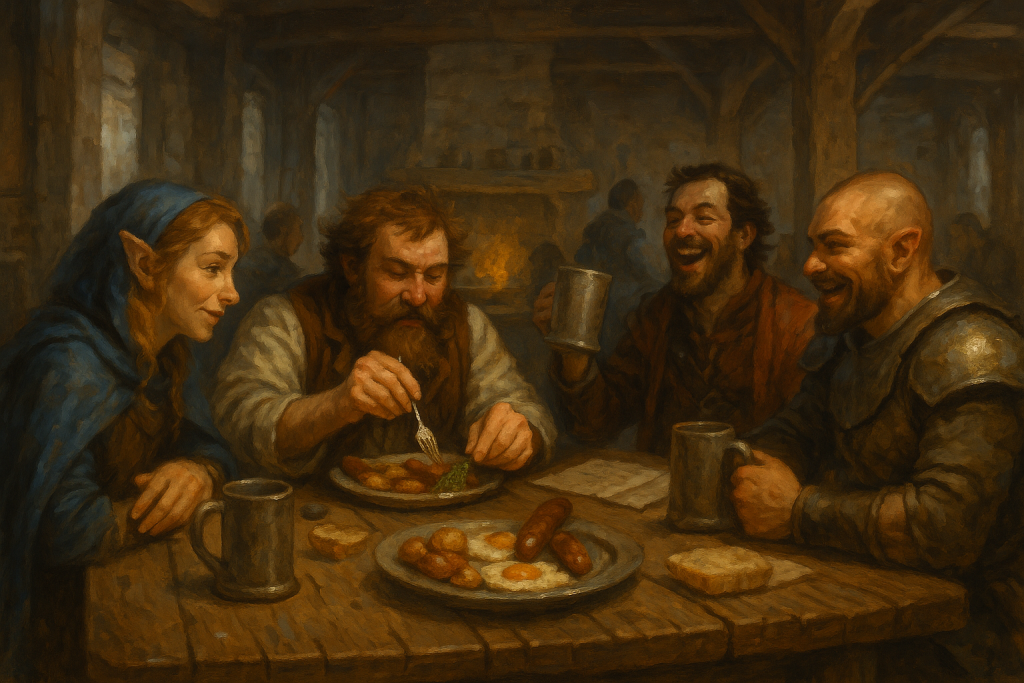
The morning light slanted into the Rusted Nail with the apologetic quality of a debtor delivering bad news: bright enough to sting the eyes, not bright enough to justify being awake. The party gathered around their usual battered table, a surface that bore knife marks, mug rings, and, if one squinted closely enough, the faint outline of the words “Don’t trust the stew.”
From the kitchen came a sudden whoosh and a crackle of flame. Heads shot up all across the taproom, eyes bright with anticipation. At last, some spectacle! But alas — the cook smothered the fire in a single efficient motion, leaving behind only the faint smell of charred onions. A collective groan rippled through the room. “Not even a proper blaze,” muttered one patron, sinking back into his chair.
At the party’s table, however, Wülfgang (today spelled with two umlauts, for emphasis) arrived late but triumphant, hair only moderately chaotic and beard only moderately ink-stained. He dropped into his seat with the theatrical sigh of a man who had single-handedly wrestled secrets out of stubborn paper, and possibly out of the gods themselves. Then, with the reflexive authority of a master chef, he began rescuing breakfast.
“Not that one,” he said firmly, nudging aside a sausage with his fork. “That’s ninety percent gristle and ten percent regret.” He lifted another, examined it critically, and pronounced: “Edible, provided one doesn’t mind a faint aftertaste of despair.” With deft hands, he produced a pinch of dried rosemary from his coat pocket — “always carry herbs, comrades, for one never knows what tavern kitchens will attempt” — and scattered it over the eggs, transforming them from bland to tolerable.
As he worked, he muttered almost wistfully, “Imagine what I could do with a dash of true fire-pepper from the Southern Isles, or just a vial of storm-wine vinegar… ah, well. One day.” He sighed, then salvaged a questionable potato with the precision of a surgeon.
The others greeted his culinary and intellectual heroics alike with applause — heartfelt, if somewhat muffled by mouthfuls of bread. Pfinder, ever the master of ceremony, rose to his feet, lifted a half-empty mug, and declared:
“To our stout comrade, who, armed with only ale, quill, and unending patience, has cracked not one, but one-and-a-half ciphers — and the infernal sign-and-countersign of Edicaria’s most inhospitable door! May his beard remain fashionable, his quill ever sharp, his ale ever replenished, and his sausages forever seasoned to his exacting standards!”
There was a cheer, followed by the clatter of mugs. Cassyndra, with a faintly rueful smile, added, “And may he continue to do so, because the rest of us have been too busy working to pay the innkeeper to contribute anything useful.”
It was true. The days since their last gathering had been consumed not by glorious adventure but by the mundane demands of coin: Antoinette had taken odd jobs in kitchens, Cassyndra had consulted on horoscopes (inaccurate but lucrative), Shamus had stood guard outside a warehouse of suspiciously unlabeled crates, and Pfinder had made the rounds of the local taverns telling stories and singing for tips. Each endeavor had yielded just enough silver to keep them in bread, beer, and the occasional questionable stew.
Apologies were murmured — albeit with the sort of tone that suggested everyone knew Wülfgang secretly relished being the center of intellectual triumph. He waved them off with mock solemnity. “Think nothing of it, comrades. Not everyone is blessed with the prodigious intellect required to wrestle with numerals until they confess — or the palate to wrestle a halfway decent flavor out of this place’s sausages.”
And so, breakfast continued in a cheerful muddle of eggs, ale, and speculation. Pfinder filched half of Shamus’s bread roll, announcing loftily that it was “a tax levied on the humorless.” Wülfgang seasoned, corrected, and salvaged the meal with the grace of a professional and the party enjoyed a breakfast that was — if not extraordinary — at least edible. And in Wülfgang’s eyes, that was a victory worth toasting.
The talk of sausages and smoke finally gave way to weightier matters. Plates were pushed aside, mugs refilled, and Pfinder ceremoniously cleared his throat as if announcing the second act of a play.
“All very well and good, comrades,” he intoned, “but unless my eyes deceive me, one stubborn letter remains uncracked. And lo! It has the odious air of a book cipher.”
The others groaned in unison.
“Yes,” Cassyndra sighed, “and unless someone here has memorized every book in Archea, we’re not cracking it without the original volume. And that volume almost certainly has something to do with Nelson, Monpierre… or our ever-enigmatic Warlord-Colonel Scarn. Or perhaps all three.”
“Unfortunately,” recalled Wülfgang, “there wasn’t any such volume at the library. Or so Madam Scriptra assured us. And when she assures you of something, you stay assured… or else.”
At this, Shamus cleared his throat in the way of a man politely waiting for the spotlight. “Speaking of assurances, Vren and I took the liberty of calling on Captain Arbuckle at his barracks yesterday.”
Vren nodded. “Not the most comfortable of conversations, mind you, but informative.”
Arbuckle, they explained, hadn’t known Nelson personally. But he vouched for Nelson’s reputation as a solid officer — not one to see shadows where none existed, not one to indulge in fancy or paranoia. The sort of man whose complaints, once dismissed, were dismissed at peril.
More than Nelson, however, Arbuckle had spoken of Monpierre. His tone there had carried real weight. “The sort of officer you wanted beside you when things went bad — and they always do.” He described a career spent mostly at frontier posts: drilling raw recruits into passable soldiers, steadying panicked men under fire, and filing endless reports that, Arbuckle wryly noted, were almost literate.
“He was no glory-seeker,” Arbuckle had said, “but if you wanted a position held, you gave it to Monpierre, and it got held. He had a gift for turning a ditch into a fortress and a farmboy into a veteran, usually in the same week.”
The captain’s tone had grown heavier then. Monpierre’s death, he declared, was “a terrible loss for the Army, and a worse one for Archea.”
Then came the slip. Arbuckle had been recalling Monpierre’s influence on military thinking when he said, almost casually, “Of course, his essays on the use of battlefield magic were still cited in Scarn’s Red—” and then stopped cold. His jaw tightened.
“The what?” Shamus had asked.
Arbuckle’s expression had softened into an apologetic smile, but it was the smile of a man closing a door. “Nothing I can discuss. You understand. Some things aren’t for public ears.” He spread his hands in regret. “Best to say Monpierre’s thoughts carried weight in high places, and leave it at that.” No amount of nudging from Vren moved him further.
As for family, there was little to tell. His only living relative was a married cousin — Arbuckle had jotted down the address and passed it along with the same grim practicality that colored all his words.
“Not much,” Shamus concluded at the breakfast table, “but it’s something. And something is better than staring at numbers until they mock you.”
The table was quiet for a beat, save for the scrape of Pfinder delicately extracting butter from someone else’s roll. Then Cassyndra tilted her head. “This ‘Red—’ he mentioned. Any guesses?”
“‘Redemption?’” suggested Pfinder, mouth full. “Perhaps Monpierre was a theologian in secret.”
“‘Redoubt,’ more like,” said Shamus. “Military sort of word.”
Wülfgang snorted. “Red Sausage. Sounds like a menu item here, and just as classified.”
Cassyndra arched an eyebrow. “Or, more ominously, ‘Red Ledger.’ Something you don’t write in unless you plan never to share it.”
That hung in the air a moment. Even Pfinder didn’t make a joke.
“Whatever it was,” Shamus said finally, “Arbuckle wasn’t about to tell us more. But he slipped enough to show Monpierre’s thinking mattered. Still does, maybe. And if Scarn’s name is tied to it…”
“Then Scarn is no longer just some name in an old service record,” Cassyndra finished.
The table nodded, the cheerful muddle of breakfast having given way to the quiet weight of intrigue. For all the laughter and banter, it was clear: the next thread in their unraveling tapestry lay with Monpierre’s cousin — and with whatever secrets Scarn kept hidden in that Red—something.
The speculation hung over the table like steam over the Rusted Nail’s dubious stew. At last, Vren set down his mug. “So. We’ve got Nelson’s letters pointing one way, Arbuckle’s hints pointing another, and a cousin’s address burning a hole in my pocket. Where do we start?”
Cassyndra tapped her quill against the edge of her notebook, sketching a rough outline. “If we’re to make progress, we need order. Arbuckle gave us the cousin’s address — the Monpierres. Let’s begin there in the morning. They may be eccentric, but eccentricity sometimes hides truth.”
“Quite so,” Pfinder declared. “Family before bureaucracy. Besides, morning is when eccentrics are at their most conversational and least likely to demand receipts.”
“Then,” Wülfgang added, “once we’ve pumped them dry of information, we march to the Ministry of Defense. Nelson, Monpierre, Scarn — the records will be there, if anywhere. By afternoon the clerks will be sluggish, and sluggish clerks make fewer excuses.”
Shamus leaned in, lowering his voice though the tavern’s patrons were still sulking about the lack of explosions. “Evening brings us back to the speakeasy. We’ve got the countersign now. Time to see what Kardan’s really selling.”
Vren raised a hand. “And Madam Scriptra? Maps of Cambria, Manchester, the trade routes?”
“Tomorrow,” Cassyndra said firmly. “One does not exhaust one’s patience for librarians and demons in the same day as one bribes soldiers and parries questions in alleys. That way lies folly.”
“That’s settled then,” said Pfinder, filching the last of Shamus’s bread roll as if punctuating the decree. “Morning tea, afternoon ink, evening secrets, tomorrow maps. A schedule both dignified and doomed to disaster — just the way I like it.”
The table agreed. Two days ahead: eccentric relatives, military records, a shadowy broker, and finally the quiet menace of Madam Scriptra’s glare. And, if fortune smiled, at least one door finally opening.