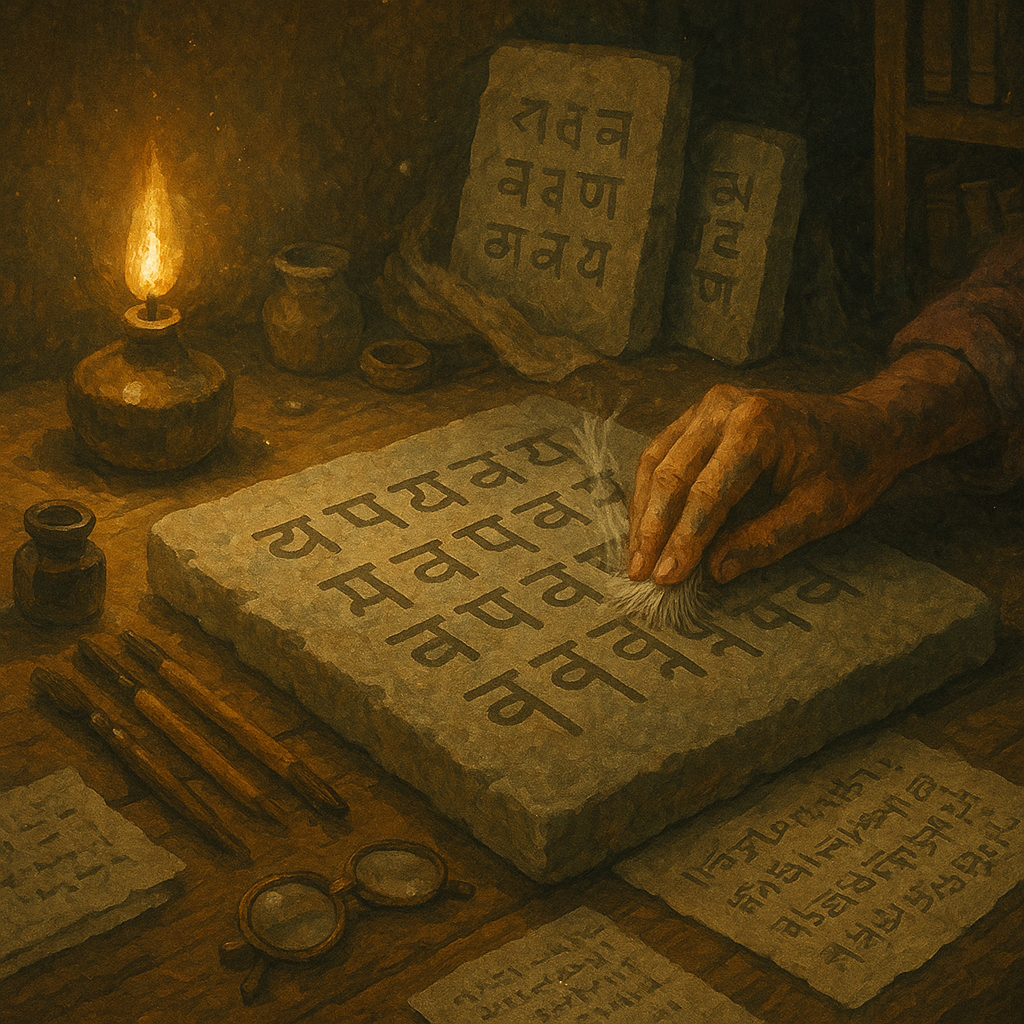
A Preliminary Report on the Teaching Tablets from the Tomb of the Teacher
Prepared for Internal Circulation Only
The Society for the Study of Orcish
Manchester, October 973
I. Introduction
In the tenth month of the current year, our Society was approached quietly by a group of sympathetic adventurers who had recently returned from an excavation in Cambria. These individuals—whose names we omit here for their protection—entrusted us with a selection of artifacts recovered from a site now known as The Tomb of the Teacher.
Among these objects were several stone teaching tablets, evidently instructional aids used to teach Orcish children the fundamentals of reading. Uniquely, each tablet presented:
- an Orcish letter,
- and the corresponding Common transliteration revealing its sound.
No similar bilingual instructional materials have ever been recovered.
These tablets therefore represent the first authenticated Orcish–Common teaching tools discovered since the Conquest. Their scholarly value cannot be overstated.
Possession or study of Orcish artifacts remains politically sensitive.
Accordingly: This manuscript is for members of the Society alone. It is not to be copied, circulated, or removed from our rooms without explicit permission.
What follows is a neutral and accurate summary of the phonetic system reconstructed from the tablets. It should be understood solely as a linguistic document and not as a political one.
II. The Orcish Alphabet
(Reconstructed exactly as presented on the teaching tablets)
Each row lists:
- Orcish Letter
- Orcish Name of letter (Society reconstruction)
- Pronunciation
- Transliteration to Common
- Other Orcish Letters That Look Similar
| Letter | Name | Pronunciation | Transliteration to Common | Similar Letters |
| ਓ | Oo’rhaa | o as in room | o | – |
| ਅ | Ai’rhaa | a as in hat | a | Similar to ਘ |
| ੲ | Ee’rhee | e as in energy | e | – |
| ਸ | sas’saa | s as in same | s | Similar to ਜ, ਮ |
| ਹ | haa’haa | h as in home | h | Similar to ਕ, ਰ |
| ਕ | kak’kaa | k as in kite | k | Similar to ਹ, ਰ |
| ਖ | khakh’khaa | aspirated kh, as in khan | kh | Similar to ਧ, ਪ |
| ਗ | gag’gaa | hard g as in God | g | – |
| ਘ | ghag’ghaa | gh, like aghast | gh | Similar to ਅ |
| ਙ | ngan’ngaa | ng as in sing | ng | – |
| ਚ | chach’chaa | ch as in change | ch | Similar to ਢ, ਦ |
| ਛ | chhachh’chhaa | aspirated ch, like cheddar | chh | – |
| ਜ | jaj’jaa | j as in Japan | j | Similar to ਸ, ਮ |
| ਝ | jhaj’jhaa | aspirated j, “jolt” | jh | – |
| ਞ | njan’njaa | palatal nasal | ny | Similar to ਵ |
| ਟ | tain’kaa | retroflex ṭ, hard t | ṭ | – |
| ਠ | thath’thaa | aspirated ṭh, like Thames | ṭh | Similar to ਨ |
| ਡ | ddad’daa | retroflex ḍ, “daddy” | ḍ | Similar to ਭ, ਤ |
| ਢ | dhad’daa | aspirated ḍh | ḍh | Similar to ਚ, ਦ |
| ਣ | nhaa’nhaa | retroflex ṇ | ṇ | – |
| ਤ | tat’taa | unaspirated t, “Tim” | t | Similar to ਡ, ਭ, ੜ |
| ਥ | thath’thaa | aspirated th, “Thailand” | th | Similar to ਬ |
| ਦ | dad’daa | soft d/th, “then” | d | Similar to ਚ, ਢ |
| ਧ | dhad’daa | heavy dh, “seventh” | dh | Similar to ਖ |
| ਨ | nan’naa | n as in name | n | Similar to ਠ |
| ਪ | pap’paa | p as in papa | p | Similar to ਖ, ਧ |
| ਫ | phaph’phaa | ph as in “philosopher” | ph | – |
| ਬ | bab’baa | b as in baby | b | Similar to ਥ |
| ਭ | bhab’baa | bha, aspirated | bh | Similar to ਤ, ਡ, ੜ |
| ਮ | mam’maa | m as in mother | m | Similar to ਸ, ਜ |
| ਯ | yay’yaa | y as in yellow | y | – |
| ਰ | ra’raa | r as in run | r | Similar to ਕ, ਹ |
| ਲ | lal’laa | l as in lake | l | – |
| ਵ | vav’vaa | v as in victor | v | Similar to ਞ |
| ੜ | rhar’rhaa | hard rolled rr | ṛ | Similar to ਤ, ਡ, ਭ |
| ਸ਼ | shash’shaa | sh as in shade | sh | Written like ਸ with a dot |
| ਖ਼ | kha’khaa | deeper kh | khh | Written like ਖ with a dot. Sound is very similar. |
| ਗ਼ | gag’gaa | deeper gh | ghh | Written like ਗ with a dot. Sound is very similar. |
| ਜ਼ | zaz’zaa | z as in zebra | z | Written like ਜ with a dot. |
| ਫ਼ | faf’faa | f, true fricative | f | Written like ਫ with a dot. Sound is very similar. |
| ਲ਼ | lal’laa | heavy l | l̤ | Written like ਲ with a dot. Sound is very similar. |
III. Three Plus Ten Orcish Vowels
The Orcish letters ਓ, ਅ, and ੲ are vowels but all of the other letters are consonants.
Additional Orcish vowel sounds appear as one of ten diacritics written around a consonant.
Using ਸ (sa) as the example base:
| Vowel Sign | Pronunciation | Name | Example |
| (none) | a | mukta | ਸ = sa |
| ਾ | ā | kannā | ਸਾ = sā |
| ਿ | i | siharī | ਸਿ = si |
| ੀ | ī | bihārī | ਸੀ = sī |
| ੁ | u | auṅkaṛ | ਸੁ = su |
| ੂ | ū | dulaiṅkaṛ | ਸੂ = sū |
| ੇ | ē | lā̃vā̃ | ਸੇ = sē |
| ੈ | ai | dulā̃vā̃ | ਸੈ = sai |
| ੋ | ō | hoṛā | ਸੋ = sō |
| ੌ | au | kanauṛā | ਸੌ = sau |
These diacritics can combine with any consonant.
IV. Nasalization and Special Marks
ਂ — bindī
Sound: n as in land
ੰ — ṭippī
Sound: n in punch
ੱ — adhak
Doubles the consonant it is attached to. Sound is very similar to the original.
Students should expect these occasionally in adult inscriptions, though rarely in the children’s tablets.
V. Constructing Syllables & Reading Orcish
In the simplest structure:
Consonant + (optional) Vowel Sign/Nasalization/Special Mark = Syllable
Examples:
ਕ + ਿ = ਕਿ
ki
ਮ + ਾ = ਮਾ
mā
ਨ + ੋ = ਨੋ
nō
This makes decoding straightforward once the alphabet is learned.
VI. Sample Nouns from the Teaching Tablets
The children’s reader recovered from the tomb displayed each word beside a simple carving or line drawing. All words are concrete nouns suitable for early education.
| Orcish Word | Transliteration | Meaning |
| ਪਾਣੀ | pāṇī | water |
| ਘਰ | ghar | house |
| ਦਰਵਾਜ਼ਾ | darvāzā | door |
| ਕਿਤਾਬ | kitāb | book |
| ਕਲਮ | kalam | pen/quill |
| ਰੁੱਖ | rukh | tree |
| ਫਲ | phal | fruit |
| ਅੱਖ | akh | eye |
| ਕੰਨ | kann | ear |
| ਨੱਕ | nakk | nose |
| ਮੂੰਹ | mū̃h | mouth |
| ਹੱਥ | hath | hand |
| ਪੈਰ | pair | foot |
| ਰੋਟੀ | roṭī | bread |
| ਗਾਂ | gā̃ | cow |
| ਘੋੜਾ | ghoṛā | horse |
| ਬੱਚਾ | bachchā | child |
| ਤਲਵਾਰ | talvār | sword |
| ਅੱਗ | agg | fire |
| ਚੰਦ | chand | moon |
This vocabulary appears consistent with a foundational instructional text for children seven to ten years of age.
As an aid to successful study, the Society will provide Common transliterations alongside any further Orcish script.
VII. Concluding Note
This primer is only the beginning. The teaching tablets offer us a rare glimpse into a culture that our institutions have striven for centuries to erase. The Orcish script—curving, elegant, utterly distinct from Contemporary Common—remains alive today only in inscriptions and memories.
We hope this report serves not merely as an academic tool, but as a small act of restoration.
May knowledge be preserved,
even when its people are not.
— Archivist V. Dumanth,
Society for the Study of Orcish
Manchester, 973 A.E.