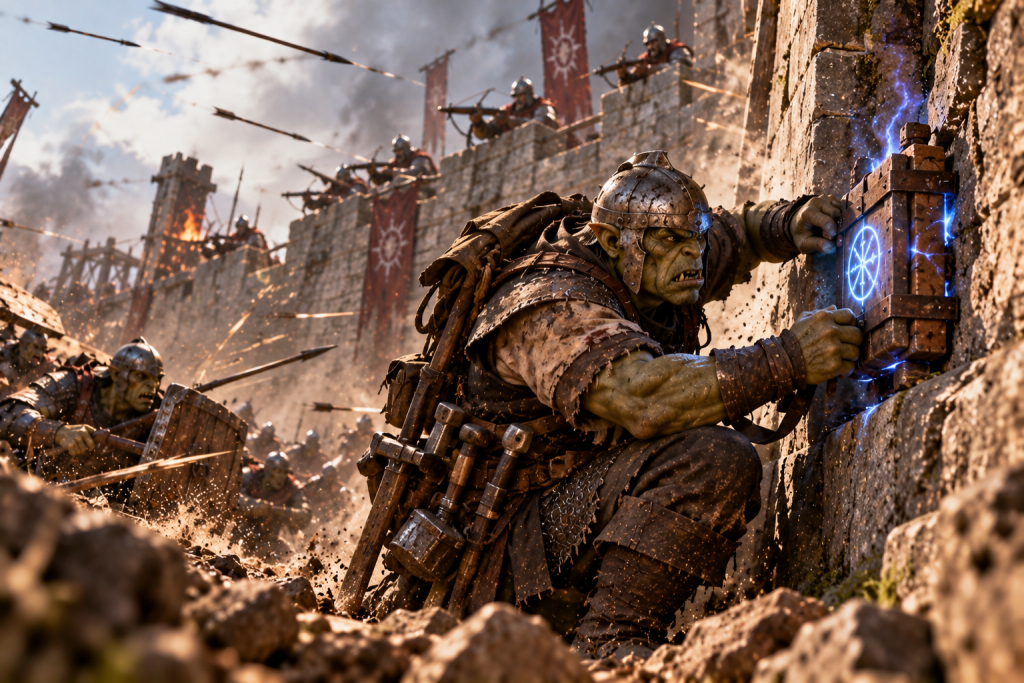
ORCISH ARMY | NEWLY TRAINED SOLDIER
Combat engineers prepare defenses, clear routes, repair crossings, breach fortifications, and improvise solutions under fire. You are a soldier trained to alter the battlefield using tools, engineering judgment, and carefully rationed magic.
Starting character statistics
| Statistic | Starting rule |
| Hit points | 14 + 2 × CON modifier; no Hit Dice healing |
| Proficiency bonus | +2 |
| Spellcasting ability | Intelligence (INT); spell attack bonus = +2 + INT modifier; spell save DC = 10 + INT modifier |
| Saving throw proficiencies | Strength, Intelligence |
| Skill proficiencies | Survival (basic army fieldcraft), Athletics, Investigation |
| Tool proficiencies | Mason’s tools, carpenter’s tools |
| Field Engineering | Add double proficiency bonus to checks using engineering tools to construct, inspect, repair, or deliberately destroy structures. |
| Armor proficiency | Light armor, medium armor |
| Weapon proficiency | Simple weapons and martial melee weapons |
| Weapon mastery | Warhammer (Push); light crossbow (Slow) |
| Basic first aid | Add proficiency bonus: stabilize (action, DC 10 Medicine); field dressing (1 minute, DC 10 Medicine, restores 1d4 HP, once per injury episode). Each attempt uses 1 kit use. |
Issued arms and equipment
| Item | Standard issue |
| Weapons | Warhammer (1d8 bludgeoning; versatile 1d10), light crossbow (1d8 piercing) with 20 bolts |
| Protection | Chain shirt (AC 13 + DEX modifier, maximum +2), helmet; no shield |
| Engineering tools | Mason’s tools, carpenter’s tools, hammer, chisel, small saw, measuring cord, folding shovel |
| Medical supplies | Healer’s Kit (5 uses, including bandages and field dressings) |
| Field kit | Uniform, boots, bedroll, blanket, mess kit, waterskin, 3 days’ rations |
| Identification | Identification tag and unit insignia |
Weapon mastery training
Warhammer (Push): On a hit, push a Large or smaller creature up to 10 feet straight away. Light crossbow (Slow): On a hit, reduce target’s Speed by 10 feet until the start of your next turn.
Military spells taught during training
All five spells use Intelligence. Mana costs are paid normally; if mana is insufficient, the shortfall is paid from actual HP under the general Orcish magic rules. No material components are required.
Earthshape • 4 mana
Casting: Action | Range: 30 ft | Duration: Instantaneous
Move up to one cubic yard of loose earth, sand, or gravel into a new shape or position within range. Cannot affect solid stone or living creatures.
Stonefracture • 5 mana
Casting: Action | Range: Touch | Duration: Instantaneous
Deal 3d8 force damage to one nonmagical unattended object or section of masonry.
Reinforce Structure • 4 mana
Casting: Action | Range: Touch | Duration: 1 hour
Strengthen a nonliving section of wall, door, bridge, barricade, or other structure no larger than a 10-foot cube. The section gains 20 temporary HP, has advantage on saving throws against damage or collapse, and can support twice its normal load.
Bridgework • 6 mana
Casting: Action | Range: 30 ft | Duration: 10 minutes
Create a sturdy magical bridge or ramp up to 20 feet long and 5 feet wide, angled no more than 45 degrees, capable of supporting 5,000 lbs. It vanishes when the spell ends; anything still on it may fall.
Demolition Charge • 5 mana
Casting: Action | Range: Touch | Duration: Delayed detonation (maximum 10 minutes)
Create a compact magical charge attached to a solid surface or unattended object. Choose a delay of 1, 2, or 3 rounds when casting; it detonates at the end of your turn after that many rounds. Once attached, it cannot be moved or disarmed by its caster. The charge visibly glows and ticks or hums faster as detonation approaches. Resolve damage to the attached structure first: it takes 4d8 force damage. Each creature within 10 feet not protected by at least 3 inches of solid stone or 1 foot of packed earth makes a Dexterity saving throw, taking 3d6 force damage on failure or half on success. Comparable substantial barriers may also protect at GM discretion. If the blast breaches the intervening barrier, creatures newly exposed within 10 feet are subject to the same damage and save. The GM adjudicates collapse, debris, and other secondary hazards separately.
Engineer’s note: Structural knowledge and sound judgment matter as much as magic. Coordinate with your unit before placing charges or removing a load-bearing obstacle.