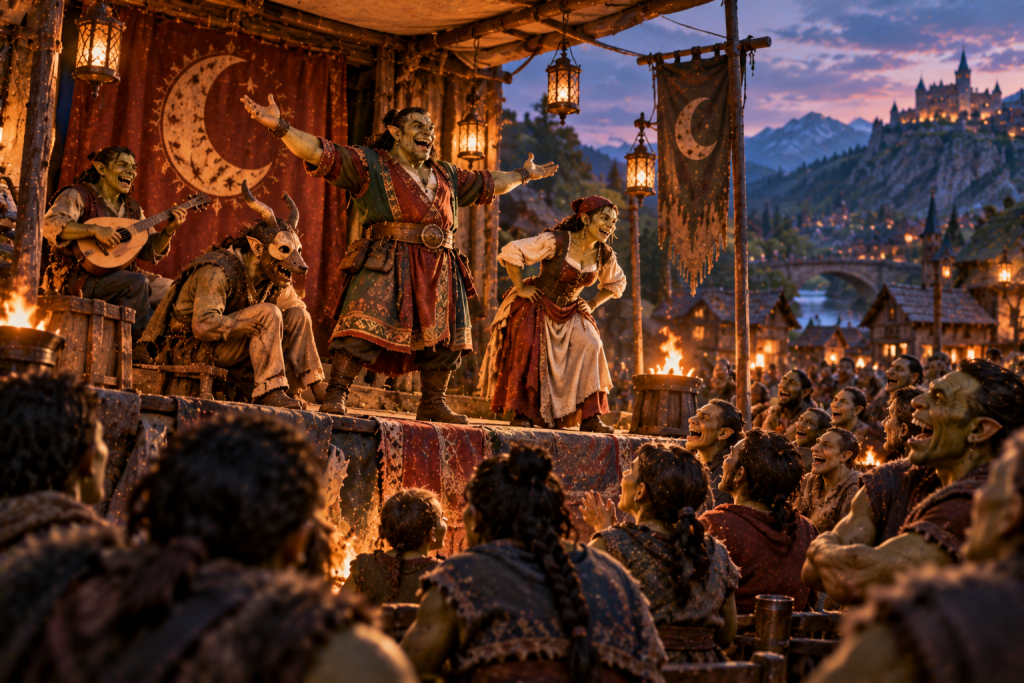
Creating your Orcish soldier—and helping create Orcish civilization
You are about to play an Orcish soldier during a desperate war. Your character has a military assignment, but also a childhood, family, friends, ambitions, habits, and a life they hope to return to. Those things are yours to invent.
You can also help decide what Orcish society was like: its expressions, holidays, military customs, songs, professions, prejudices, and small everyday rituals. Your inventions will become established facts of the campaign world, so long as they fit what we have already established. The GM may ask questions or suggest adjustments to keep ideas compatible.
How to use this guide
Choose the questions that interest you; you do not need to answer them all. Start with a character name, a few defining details, and one or two connections to other people. Add more during play. A short, vivid answer may be better than a long biography. You can leave things undecided until an interesting moment arrives. And, of course, your character will change in response to external events.
1 The person beneath the uniform
The future. What do you intend to do when the war is over? Who knows about that plan?
Someone important. Who would be most relieved to see you come home? Who might not be?
A contradiction. What admirable quality do you possess that sometimes causes trouble? What flaw has occasionally served you well?
A small possession. What ordinary item did you bring from home, and why can you not bear to lose it?
A memory. What is the last entirely happy day you remember?
An unfinished matter. What did you leave unsaid, unpaid, or unresolved before you departed?
An unexpected talent. What are you good at that has nothing to do with soldiering?
A private belief. What do you believe about duty, loyalty, death, or the gods that you rarely say aloud?
Your specialty. Were you allowed to choose your military specialty or was it chosen for you? What do you think of it?
2 Where you came from
- What did your home look, smell, and sound like? A crowded city street, a hillside farm, a mining settlement, a riverside market?
- What work did your household do? What civilian spell or practical skill did you learn there?
- What food, game, saying, or superstition instantly reminds you of home?
- Who taught you your first spell? What happened the first time you got it wrong?
- What part of Orcish society did your family admire? What did they grumble about?
- What is one custom from your hometown that Orcs from elsewhere find peculiar?
3 Your fellow soldiers
If another player agrees, make a connection between your characters. These are invitations, not obligations: nobody gets to dictate another character’s history or feelings.
- Which comrade knew you before you enlisted? What do they know that you wish they did not?
- Who once helped you out of trouble? What do you owe them?
- With whom do you disagree about how the war should be fought, despite mutual respect?
- Who has a talent you envy? Who relies on a talent of yours?
- What shared joke, ritual, or memory makes your group feel like a unit?
- Who do you trust to tell you when you are wrong?
4 Invent a piece of Orcish culture
You are invited to introduce a detail about Orcish life. Small details are particularly welcome: they are easy to remember and often suggest larger truths.
Words and names. What is an Orcish nickname for a sergeant, an affectionate insult, a common blessing, or a phrase shouted before a difficult task?
Food and hospitality. What meal is associated with homecoming? How does a host show that a guest is welcome?
Celebrations and mourning. What does a wedding, birthday, funeral, or coming-of-age celebration include?
Family and community. Who raises children? How are elders treated? What is considered a generous gift?
Magic in daily life. What civilian spell does your family use constantly? What magical practice would an outsider find surprising?
Art and recreation. What song, sport, story, board game, or festival does everyone know?
Regional differences. What do people from your province insist is the proper way to do something? What do their neighbors say instead?
Beliefs and disagreements. What widely held custom does your character question? What do different Orcs think about it?
5 Invent a military tradition
We will use familiar English names—private, sergeant, captain, company, infantry, scout, engineer—so everyone can follow what is happening. These are convenient translations. If you decide a sergeant is called a krongar in Orcish, that term can become part of the world without forcing us to rewrite the army’s organization.
- What informal name does your specialty have? Is it affectionate, proud, or insulting?
- What initiation, graduation, or first-deployment custom does your unit observe?
- What does a good sergeant do that regulations never mention?
- What does your company call an incompetent officer—or a remarkably good one?
- What small object or marking identifies veterans of a particular campaign?
- How does a soldier respectfully disagree with a superior? What happens if they do not?
- What does your unit do for the wounded, missing, or dead?
- What superstition persists despite every soldier knowing better?
- What military spell has acquired a nickname from the troops?
6 Consider adding evocative details
An evocative detail often contains a person, a habit, and a complication. Instead of “my family values honor,” try “my grandmother insists that a guest must eat before discussing bad news, and I still obey even when there is no time.” Instead of “our unit is brave,” try “before an assault we exchange buttons, so someone else will carry a piece of us home.”
You can invent something at the table by saying, “Where I grew up, we always…” or asking, “Could our regiment have a tradition that…?” Other players can build on it. The GM will help decide whether it is a local custom, a widespread tradition, or something peculiar to your family or unit.
A quick start: five things to bring to the table
- Your character’s name and one memorable personal trait.
- What you intend to do when the war is over.
- One person, place, or possession that matters to you.
- One civilian skill or spell that says something about your upbringing.
- One Orcish custom, saying, or military tradition you would like to introduce.
You do not need to know the ending of your character’s story. You only need to know why their life matters to them now.