October 26th, 973
The Long Road to Northmarch
For the first time in weeks, Miley was quiet.
The Broken Handle stood whole again—windows scrubbed, tables righted, the sign rehung (with extra nails, and a warning glare from Finnan that suggested this better stick). Patrons drank cautiously, like people who had survived a natural disaster and were unsure whether it might happen again if they laughed too loudly.
The heroes rested, healed, counted coin, and inventoried and maintained their equipment. They also attempted, unsuccessfully, to ignore the eight rum gremlins now technically under their supervision.
The Never-Ending Gremlin Problem
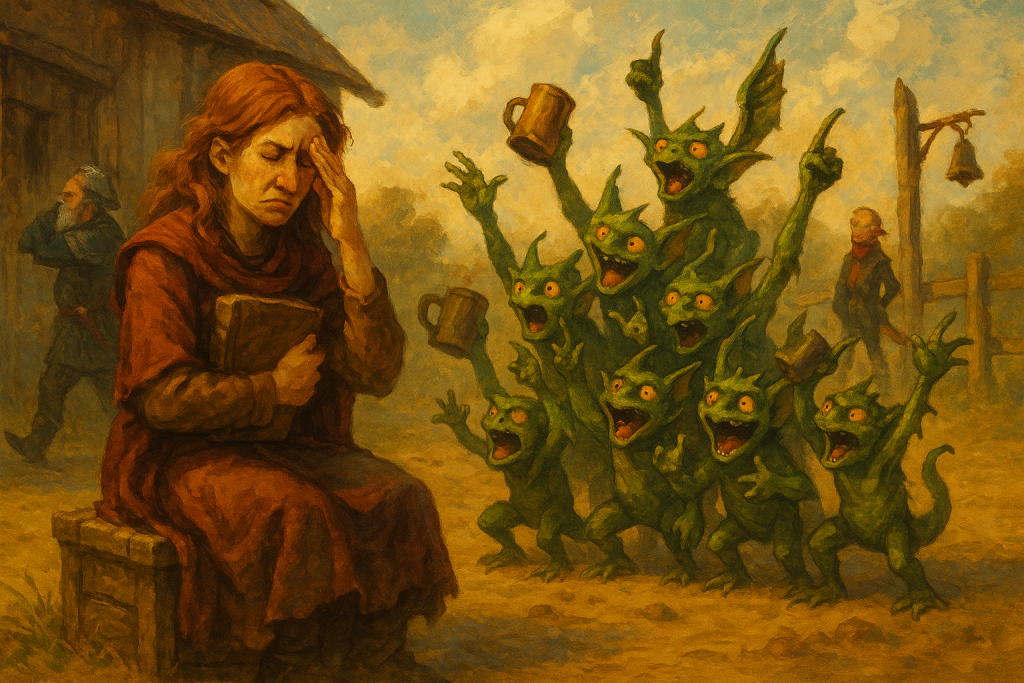
Spillgut, former would-be founder of the Independent Nation of Rumistan, had been stripped of his bottle crown and now sat on a crate behind the tavern, arms folded, glaring at destiny.
The other gremlins… adapted.
Coors, Pabst, Bud, Miller, Mad Dog, Thunderbird, and Skol roamed the yard in loose formation, bound by oath, rope, and the general understanding that bell-related violence would resume if they stepped out of line.
One morning—far too early for moral responsibility—Pabst approached Wolfgang and stared up at him with enormous, watery eyes.
“I never had a dad,” he announced. A beat. “You’re my dad now.”
Wolfgang stared back. “No,” he said firmly.
Pabst nodded. “Classic dad response.”
Wolfgang walked away muttering darkly about mistakes and ear necklaces.
Elsewhere, Cassyndra found herself seated on a crate, suddenly surrounded. “Do you know Fireball?” Bud asked eagerly.
Cassyndra did not.
“Oh,” said Miller, crestfallen. “Because we were really in the mood for Fireball Cinnamon Whisky.”
Cassyndra explained—again—what Fireball actually did and there was a moment of stunned silence. Then the gremlins erupted with delight. Mad Dog leaned forward, eyes shining.
“That’s AWESOME! Can you throw one? Can you? Can you?”
“THROW A FIREBALL!” Thunderbird chanted.
“THROW A FIREBALL!” the others echoed.
Cassyndra stood up and left.
They followed her, still chanting.
Oban Intervenes (With Experience and Regret)
The party’s initial plan—to seal the gremlins inside liquor casks and roll them all the way to the Northmarch Correctional Bastion—was presented with confidence.
Oban listened, nodded, and then winced. “No,” he said. “Absolutely not.” He gestured vaguely, as though sketching horrors in the air.
“If you seal rum gremlins inside casks, they will drink the liquor. Then they will urinate. Then they will drink that and repeat the cycle while arguing all the while about which one of them drank whose urine.” He shuddered. “By the time you arrive, the casks will contain… something else. Something no tavern should ever see.”
Instead, Oban laid out reality – the gremlins must travel outside of the casks and under constant supervision. They could only be sealed inside the casks just prior to… er… delivery. And while they required no food, they needed constant booze but carefully rationed.
“One pint per day keeps them cantankerous but upright,” he explained. “A quart makes them cooperative—as best as they can manage, anyways. Anything more than that and you will regret your life choices… even more than usual.”
He stressed one rule above all others – “Give them no more than two hours’ worth of alcohol at a time. If you give them more, they will immediately drink it all, go feral, and start looking for something to break.”
The Question of Who Pays
This was the point at which Merrythought and Wolfgang expressed the opinion—loudly and at length—that Miley owed them everything they needed.
“We saved the tavern,” Merrythought said. “Surely the village can spare a few barrels.”
Wolfgang crossed his arms. “And a wagon. And a driver. And animals.”
Gareth sighed the sigh of a man who knew exactly what happened when revolutions went off the rails.
“We freely accepted an offer of two hundred gold for what we did,” he said evenly. “Changing the terms of payment now would be… unwise.”
When pressed, Gareth invoked history — “There was an elven revolutionary commander once—Maor Zedren. Wrote a little pamphlet about how armed groups survive among civilians. Three rules. Eight points. Sensible ones.”
He recited them from memory,
The Three Rules of Discipline
- Obey orders in all your actions.
- Do not take a single needle or piece of thread from the masses.
- Turn in everything captured.
The Eight Points for Attention
- Speak politely.
- Pay fairly for what you buy.
- Return everything you borrow.
- Pay for anything you damage.
- Do not hit or swear at people.
- Do not damage crops.
- Do not take liberties with women.
- Do not mistreat prisoners.
The gremlins listened with rapt attention. “Who’s Maor?” Pabst whispered. “Sounds like a buzzkill,” Bud replied.
“He was,” Gareth said dryly. “Especially after he won. Went completely off his rocker, in fact, and drove his whole nation into the ground. But during the revolution? He was remarkably effective.”
He shrugged. “We could do worse.”
Unavoidable Practical Matters
Miley, being small and sensible, could only supply so much,
- Items worth 10 gp or less, at standard prices.
- Gareth, once again, strongly recommended that everyone acquire a whistle (5 cp each).
- The borrowed bells would be returned to Gizi—new bells would need to be purchased to control the gremlins at 1 gp each.
- Barrels cost 2 gp each and held 40 gallons apiece.
- A reasonable local price for beer or mead was 3.3 sp per gallon (discounts possible with charm, honesty, or fear).
- Fortunately, there were villagers interested in buying some of the booty that the heroes had ‘liberated’ from the tax collectors (GM Note – you can choose up to 1/4th of the booty that you’re carrying to be sold here. Have a credible story ready about where you got it from).
A full barrel weighed about 400 pounds and a wagon could handle 2,000 lbs. Renting wagon, animals, driver, and lodging ran 5 gp per day, with the villagers strongly recommending an additional 50% hazard pay for “live gremlin cargo.”
The road to Bastionstead—just outside the Northmarch Correctional Bastion—was 120 miles. Five days, if all went well.
The villagers advised that, while there was a village to stay in every 1 day’s travel along the way, living expenses for the players would apply nightly at 2 sp/day for 4-6 creatures sharing a room, 1 gp/day for 2 creatures sharing a room or 2 gp/day for a single room.
Oban nodded grimly. “And if you’re sleeping indoors, you’d better make sure that the gremlins are too so you can keep an eye on them. And make sure someone gets up every 2 hours to feed the gremlins or no one’s going to get any sleep.”
Bastionstead Beckons
As plans took shape and coin changed hands, the party found that nearly everyone in Miley had an opinion about Northmarch—and they were eager to share it.
It usually started the same way. “You headin’ up to Bastionstead?” someone would ask, tone casual but eyes sharp.
When the party nodded, the response was never quite enthusiastic.
Finnan leaned across the bar one evening, polishing a mug that didn’t need it. “Orderly place,” he said carefully. “Very… tidy. Folks there like things tidy.”
Tilly chimed in from behind the counter. “They don’t smile much. Not at strangers. Not at each other, really.”
A farmer nursing a drink added, “You’ll know you’re close when you start feelin’ like someone’s already decided whether they trust you.” He paused. “And decided they don’t.”
Another villager snorted. “They say ‘Order above all.’ Mean it too. Crown first. Law second. People… well. People come after.”
Someone else leaned in conspiratorially. “They’ve got posters everywhere. Big ones. Security Is Serenity. Stuff like that. You can’t walk ten paces without bein’ reminded that someone’s watchin’.”
“And magic?” asked Merrythought.
A ripple of discomfort passed through the table.
“Oh, they allow it,” Finnan said. “Strictly. With forms. Permits. Witnesses. They’ve got Crown mages on staff—watch the prisoners, watch the guards, watch the skies. I hear they use familiars to spot other familiars.”
A blacksmith muttered, “Had a cousin there once. Guard work. Said the children play Guard and Prisoner in the streets.”
“Yeah,” another added. “One kid yells, ‘Stop resisting the Crown!’ and the other one yells back, ‘I want my tribunal!’ Thought it was a joke till I saw it.”
That earned a silence.
Finally, someone summed it up. “Bastionstead’s not cruel,” they said. “It’s worse than that. It’s certain.”
The gremlins listened with growing fascination. “Oooh,” said Bud. “They sound like they could use some fun.” Oban sighed into his drink.
The Hinge of History. Again.
The morning of the party’s departure was greeted by a shared breakfast at The Broken Handle. The atmosphere was the pleasant, dishonest calm of a place that wanted to be ordinary. The stew was honest. The bread was warm. The ale had the comforting personality of a reliable farm tool. Outside, Miley went about its morning business with the serene confidence of a village that had never once hosted a warlock visitation in a mirror and, frankly, didn’t intend to start.
The party, as always, brought the wrong kind of weather with them.
Ant sat with her mug cupped in both hands, staring into it the way one stares into a well: cautiously, and with a suspicion that something might stare back.
Merrythought noticed first, of course. She had the predatory instincts of a bard who’d survived three career-ending social disasters and one near-miss with a tax ledger.
“Well,” she said brightly, buttering her bread with the air of someone arranging a duel. “Someone’s been visited.”
Gareth looked up from his plate. “By who?”
“By something,” Merrythought corrected. “You can tell because Ant is doing the ‘I have information that will ruin breakfast’ face.”
Ant sighed. “It wasn’t meant to ruin breakfast.”
Shamus, who had long ago learned that “it wasn’t meant to” was the anthem of their lives, set down his spoon. “Last night?”
Ant nodded once.
Wolfgang leaned back. “Mirror again?”
“Mirror again,” Ant confirmed. “Right before I blew out the candle. I glanced up and—” She made a small motion with her fingers, like plucking a thread from the air. “—there he was.”
“The world’s worst boyfriend,” Merrythought supplied.
Ant grimaced. “Not… exactly.”
“Oh?” Merrythought’s eyebrows rose. “Did he bring flowers? Did he apologize? Did he stop speaking in vagaries about the future?”
“No,” Ant said. “He did that thing where he acts like he’s addressing a nation instead of a person.”
Wolfgang snorted. “Ah. So he’s a politician.”
Cassyndra’s quill had already appeared, as if it lived in her sleeve and only needed the scent of prophecy to wake. “Describe.”
Ant took a breath.
“It was the same as always. My reflection, and then not my reflection. A hooded figure where I should be—my height, my shape, like he’s wearing my mirror as a doorway. No face. Just… darkness under the hood. And no way to know what he’s thinking underneath.”
Gareth’s mouth tightened. “What did he say?”
Ant hesitated, and for once the delay wasn’t theatrical. It was… careful. Like stepping onto ice.
“He started with my father.”
The table went still.
Even Hunkle—mid-reach for a second helping—paused, as though his appetite had briefly consulted his conscience.
Ant’s voice stayed level, but her thumb worried the rim of her mug.
“You know what Finnan told me. About my father. That he thought Archea was coming apart.”
Shamus’s expression softened, the way it did only when he spoke of Getty or prayer.
Ant nodded once, as if bracing herself. “The patron confirmed it. He said—” She swallowed. “He said my father knew the collapse was coming. Not just political trouble. Not just unrest. He meant… an empire going over the edge.”
Merrythought opened her mouth, thought better of it, and closed it again—an act of restraint so rare it deserved a medal.
Ant continued, eyes fixed on her mug as if it were safer than anyone’s faces. “He said my father did what he could. He gathered evidence. Tried to warn people who wouldn’t listen. Tried to… put a hand on the wheel.” Her laugh was thin. “And then history did what history does. It rolled over him.”
Cassyndra’s quill scratched once, hard. “And the patron’s conclusion?”
Ant exhaled.
“He said the collapse is still coming… that it’s too late to stop it. That the only question left is… what it crushes on the way down. And what comes next.”
A hush settled. The tavern’s clatter and chatter continued around them, but their table felt like an island—one with a storm building just offshore.
Then Merrythought, because she was who she was, said softly, “So your patron has upgraded from ‘moody boyfriend’ to ‘doomsday town crier.’”
Ant’s mouth twitched despite herself. “Yes.”
Hunkle blinked. “Did he at least say when the empire collapses?”
Ant spread her hands helplessly. “No. Of course not.”
Wolfgang stabbed his bread with unnecessary force. “Naturally not. Why give us a date when he can give us a vibe.”
Ant nodded. “He said that we’re the hinge of history.”
Gareth made a face. “Again with the hinge.”
Shamus rubbed his forehead. “What does he even mean by that?”
Ant’s voice became a near-perfect imitation of the patron’s tone: calm, absolute, maddeningly unhelpful, “‘A door swings whether it understands the carpentry or not.’”
Merrythought stared. “That’s not a metaphor. That’s an insult wearing a metaphor’s hat.”
Cassyndra, still writing, muttered, “It’s also structurally inaccurate. Hinges do understand load-bearing stress.”
“Tell that to him,” Ant said dryly. “He’s obsessed with hinges.”
Wolfgang leaned forward, elbows on the table. “So what does Mister Hinge-of-History want?”
Ant’s expression tightened. “He wants obedience.”
She looked from face to face, making herself say it aloud.
“He said we’re to do what he says exactly how he says. Whether or not we understand why. That if we try to improvise, we’ll—” she paused, then added with bitter precision, “—increase the suffering.”
Gareth’s eyes narrowed. “And what did he say to do?”
Ant released a breath.
“He said going to the Northmarch Correctional Bastion—dropping off the gremlins—fulfills our individual needs.” She glanced at Cassyndra. “He actually used the phrase ‘individual needs.’ Like he’s reading a Ministry pamphlet.”
Merrythought lifted her mug in salute. “Always nice when destiny respects personal growth.”
Ant went on. “But he said we mustn’t linger. We do that job quickly, without getting distracted, and then we go to Hollowmere.”
Cassyndra’s quill stopped. “Hollowmere.”
Ant nodded. “He said our destiny—and the next of our critical choices—awaits there.”
A beat.
Then Wolfgang, with the bleak practicality of a dwarf who trusted tools more than prophecy, said, “So he’s giving us an itinerary now.”
Merrythought added, “And still not paying for breakfast.”
Ant let out a short laugh that was almost real.
Shamus’s voice, when he spoke, was quiet and steady. “Did he say anything else? Anything… personal?”
Ant hesitated. Then, softly, “He said my father failed, but he wasn’t foolish. That he loved me, even when he was preoccupied with the fate of the kingdom. And that the Crown’s version of him…” Her mouth tightened. “Was convenient.”
The table stayed silent for a moment longer than comfort.
Then Hunkle cleared his throat with the solemnity of a man attempting wisdom.
“So,” he said, “to summarize: Ant’s mirror boyfriend is now Ant’s mirror history professor, and he wants us to do chores before we go save the world.”
Merrythought leaned back, satisfied. “That’s the spirit of it, yes.”
Gareth finally cracked a small, humorless smile. “At least he’s consistent.”
Cassyndra capped her ink. “I hate him already. Still.”
Ant took a sip of her cider. “Get in line.”
Wolfgang shoved his plate away and stood. “Fine. We drop off the gremlins. Quickly. Then Hollowmere.” He glanced at Ant. “But if your patron shows up again, tell him this: if he’s going to call us hinges, he can at least provide oil and a schematic.”
Merrythought raised her mug again. “To being the hinge of history,” she declared. “May we creak with purpose.”
Shamus, after a moment, added quietly, “And may we choose mercy when the door swings.”
Outside, Miley’s morning sun climbed higher, warm and indifferent. Inside, breakfast ended the way it always did for them: with half a plan, a full stomach, and the faint sense that something unseen had just moved a piece on the board.