October 26th – 31st, 973
New Names for Old Faces
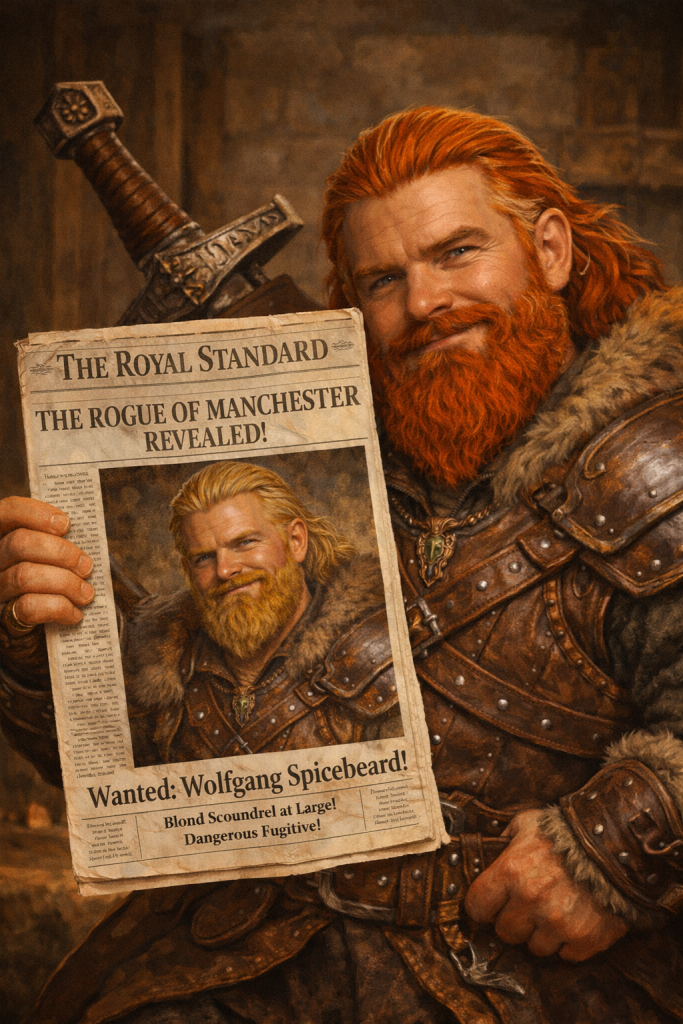
Before departure, the party agreed that traveling openly under their real names was no longer advisable. With the scurrilous reporting in The Royal Standard having focused rather intently on them, discretion had become the better part of continued breathing.
Thus, new identities were adopted,
- Wolfgang became Hawthorne “Thorn” Goldenheel, an itinerant dancer, his beard hastily dyed from blond to a reddish hue that fooled no one who had ever seen a carrot.
- Merrythought became Springbok, a name she felt “sounded athletic.”
- Antoinette, reaching across universes for inspiration, became Marie—and wisely kept mum about peasants and cake.
- Shamus became Wilbur, a name that sat on him like an ill-fitting coat.
- Cassyndra became Pandora, which the gremlins found deeply ominous and therefore excellent.
- Hunkle became Uncle, which required no adjustment whatsoever.
- After due consultation with her patron, the Yore Mother, Laveleen adopted the moniker Hastur.
Logistics, Poorly Understood by Fey
Eight barrels were prepared for the 120-mile, 5-day journey—four filled with beer, four left empty. Oban’s advice rang in everyone’s ears – do not seal rum gremlins inside casks until arrival.
Instead, the solution was… creative.
Four gremlins were tied by the wrists and walked behind the cart. Four rode atop it. They switched off every few hours to prevent exhaustion, mutiny, or philosophical awakening. Each gremlin was allotted two pints per day, dispensed every two hours under strict supervision.
The gremlins hated this system—but, not having been consulted by the heroes, had little choice but to accept it.
Spillgut, former would-be founder of the Independent Nation of Rumistan, had been stripped of his bottle-cap crown. He rode in brooding silence, arms crossed, glaring at the road, the cart, and destiny itself. He spoke little—but he watched everything.
The Drovers
Their drovers were two men and the older nodded as the party approached. “Morning,” he said. “Name’s Jorren Hale. Hauled stone, grain, lumber. Never hauled… this.”
The younger man cleared his throat. “Elias Fenwick. After this run, I’m done for a while. My wife’s eight months along. She’s doing well with our two-year-old, but I want to be home for the birth. Got names picked out for both a boy and a girl.”
He smiled nervously at the cart.
“So,” he added, “you folks keeping us safe, then?”
Wolfgang felt, dimly, that he was about to cause the tragic death of a family man and be memorialized in a cautionary pamphlet—stocked, undoubtedly, right next to certain issues of The Royal Standard.
Pabst’s Father
Matters for him did not improve as Pabst had adopted him as his new dad. Pabst sang loudly, off-tune, but with genuine feeling,
My dad has a big sword,
It goes chop-chop-chop,
When bad things come near us
He makes ’em all stop!
He yells real loud,
He bleeds real hard,
My dad’s the best dad
In the whole damn yard!
Wolfgang pretended to check the wagon harness. This did not help.
I didn’t have a dad before,
Or maybe I did but he ran,
But now I got a Wolfgang,
And that’s a very good plan!
He never hugs, he never smiles,
He grunts instead of talkin’,
That’s how you know he loves me—
My dad, my dad, Wolfgaaang!
Wolfgang stared into the middle distance, shook his head, and walked away. Pabst followed. Still singing.
Unionization at the First Beer Stop
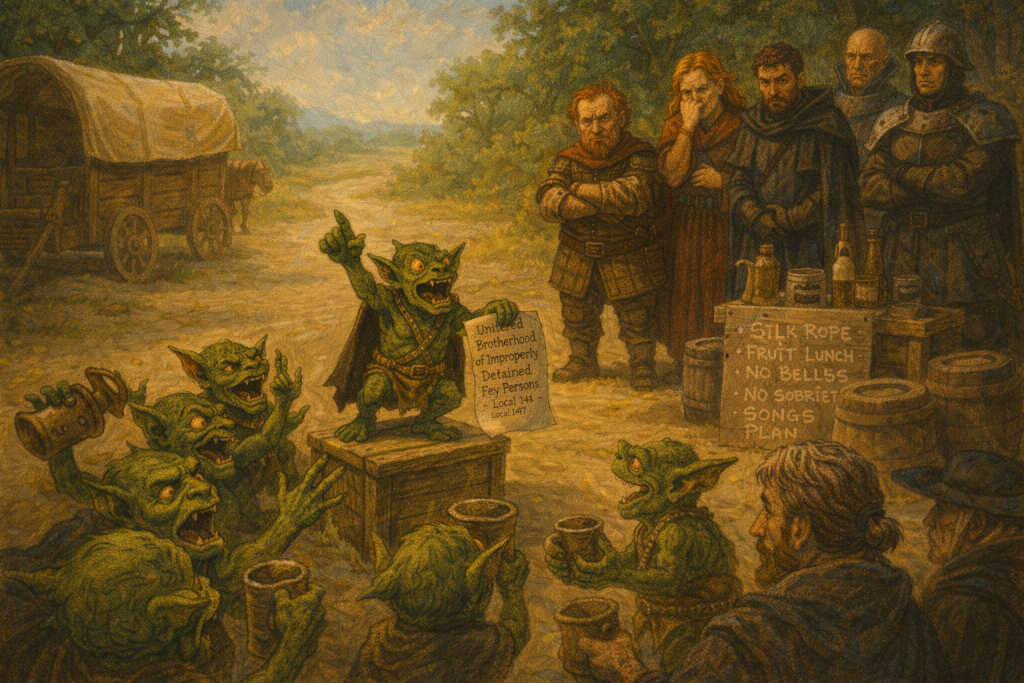
The gremlins—excluding Spillgut—had been huddling and whispering soon after the party hit the road. At the first beer stop, they announced, “We have formed the United Brotherhood of Improperly Detained Fey Persons, Local 147.”
They presented demands,
- Silk rope (the hemp chafed)
- Longer rest breaks
- A fruit-based lunch
- No bells
- No sobriety songs
- A dental plan (“Our teeth! They are our livelihood!”)
The party responded by,
- Buying them off with extra beer
- Reminding them that they already had a dental health plan: compliance
Negotiations ended amicably but the party fell behind schedule.
Meddling Grandmas
At the noon stop, a caravan passed heading the opposite direction. An elderly woman stepped forward, clasped her hands to her chest and gasped. “Oh heavens! Are those your little ones? They look so cold! Would they like warm milk? A blanket? A story?”
Cassyndra shouted warnings about cursed beings and the wisdom of distance but the would-be grandma ignored her and advanced anyway. The gremlins then cried out in perfect unison, “HELP US GRANDMA! THEY’RE SELLING US INTO SLAVERY!”
Chaos—inevitable, immediate, and deeply gremlin-flavored—followed.
The caravan leader, Krol, arrived, distressed, as the gremlins escalated, “PLEASE MISTER! THEY’RE SENDING US BACK TO THE MINES!”
Through clarification, negotiation, intimidation, and the quiet exhibition of weapons, the party convinced Krol that,
- These were not human children
- This was not his problem
- He did not want it to become his problem
Krol and the rest of the caravan departed muttering about magistrates. And the party fell further behind schedule.
The Watcher
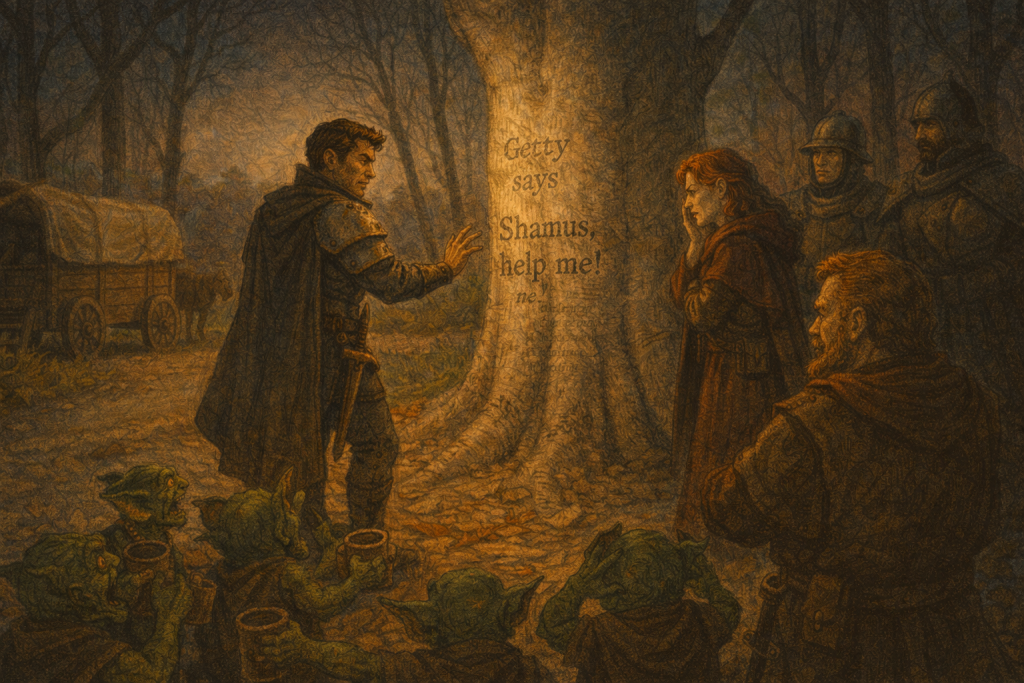
By twilight—well past the hour they had planned to reach Thimbleton—the road carried the party through a forest stripped bare by autumn. Leaves lay wet and matted across the ground, muffling footsteps and swallowing sound.
That was why they saw it.
Carved into the trunk of a beech tree, vertically and with unsettling precision, were the words, Getty says, “Shamus, help me!”
The letters were sharp, too sharp—cut cleanly and evenly, as though the blade had never slipped. Fresh sap still wept from the grooves.
Whatever had done this had done it recently.
At the same moment, all eight rum gremlins fell silent.
Not the wary quiet of mischief paused—but something else. Something focused.
They looked around, eyes unfocused, heads tilting slightly, as if listening to a frequency no one else could hear,
- “That breeze has opinions.”
- “I don’t like the way the road’s breathing.”
- “There’s a gap in the noise where a person should be.”
- “Something’s standing where sound doesn’t work right.”
The party closed ranks around the wagon without needing to speak.
When the gremlins asked why the message was for Shamus, he gave only a tight answer: someone from his past wanted to hurt him. He did not explain who Getty was.
They did not press.
They named the unseen presence The Watcher, and the name stuck.
Side by side the party and the gremlins ringed the wagon, oxen, and drovers and strained to search the darkness.
That was when the attacks began. Necrotic energy lanced out of the forest in brief, surgical strikes—not wild, not panicked. Testing blows. Measuring responses.
One blast caught Elias Fenwick squarely in the chest. He collapsed, breath ragged, skin graying—saved only by Shamus’ Lay on Hands, pressed hard and desperate.
Other blasts struck Miller, the gremlin, who staggered and cried out but also grit his teeth and stayed upright, absorbing the pain with a stoicism that surprised everyone present.
“They’re poking us,” one gremlin muttered. “Like you poke bread to see if it’s done.”
Using Create Bonfire, Hunter’s Mark, Fairie Fire, and painstaking searches, the party began to triangulate the threat.
And then they realized – there were two of them. The first fell while approaching. For a heartbeat as it died, invisibility failed. It was a hovering silhouette, vaguely humanoid, floating an inch above the leaf-strewn ground. Its face was wrong: two black voids where eyes should be, and a larger, screaming absence where a mouth might have been—utterly silent.
Then it collapsed into gray ash and blew away.
The second was destroyed minutes later as it tried to escape, revealed in the same fleeting instant before it too disintegrated.
Cassyndra searched any remains without success. But something had clattered softly to the ground. A bracelet, one that Shamus recognized at once. Getty’s bracelet. Her most treasured childhood possession, it had been given to her on her fifth birthday and, as she wore it all the time, would have been wearing it on the night of her disappearance.
The forest went quiet again—but it was not the same quiet as before.
The Watchers were gone.
The message was not.
And from that moment on, the gremlins treated Shamus differently.
Not with fear.
With sympathy.
A Long Night at Thimbleton
At Thimbleton, the party made the sensible decision to rent a barn for the night rather than attempt to introduce eight rum gremlins into a respectable inn. This decision proved almost immediately correct for the gremlins did not sleep.
Whether this was because they could not sleep, would not sleep, or regarded sleep as a personal insult remains unclear. What was clear was that they treated the rotating night watches not as guards, but as an audience—and, more importantly, as bartenders with opinions.
Shamus and Merrythought drew first watch.
The barn was quiet save for the soft breathing of the oxen, the distant creak of wood settling, and the occasional clink of a mug being refilled on schedule. The gremlins sat in a loose semicircle, cross-legged on hay bales, eyes reflecting lantern light like a council of drunk university students taking their freshman philosophy class far too seriously.
After several minutes of whispering among themselves, Coors cleared his throat with theatrical gravity.
“What if,” he began, “this is our redemption arc?”
There was a long pause.
Skol followed up, softer now. “And if it is… is this… all there is?”
Merrythought blinked, once.
Shamus stared into the middle distance, as if hoping a god might intervene.
Merrythought recovered first. She folded her hands thoughtfully and said, “Oh no. If this were your redemption arc, it would feel… longer. And more embarrassing. You’re still in the inciting incident.”
The gremlins leaned forward.
“Really?” one asked. “So it gets better?”
“Oh, much,” Merrythought said warmly. “But only if you’re patient. Redemption arcs take time. And setbacks. And at least one deeply regrettable haircut.”
They absorbed this in silence.
Then one asked, “Have you had a redemption arc?”
Merrythought smiled. “Several.”
This electrified them.
“Tell us one!”
“Which one?” she asked lightly. “The duel with the ghost-prince? The monastery fire? Or the incident with the mayor’s wife and the soup ladle?”
They demanded the soup ladle story.
Merrythought launched into a wildly detailed account involving a doomed fellowship, a cursed cooking implement, three betrayals, and a heartfelt apology delivered in song from the rooftops at dawn. None of it was true. All of it was compelling. She introduced supporting characters, callbacks, a tragic betrayal by a talking dog, and a redemption that hinged entirely on learning to listen and obey.
The gremlins were rapt.
At one point, one of them wiped away a tear and whispered, “That ladle never asked to be forged.”
Shamus, for his part, said very little. He dispensed beer on schedule, nodded when appropriate, and occasionally muttered something noncommittal like, “Hmm,” or “That sounds… difficult.”
Eventually, a gremlin asked, “Can we talk to Hunkle about his arc?”
Merrythought’s expression hardened just slightly.
“No,” she said firmly. “You must never do that.”
“Why?”
“Because,” she replied, “Hunkle doesn’t have a redemption arc. He has consequences.” She paused. “Which he inflicts on people who talk too much. Don’t talk to him at all. You think Wolfgang is grumpy? Hunkle is worse. Much worse.”
And that put an end to all questions about Hunkle.
By the end of the watch, the gremlins were quietly arguing among themselves about whether character growth was real or just something bards invented to justify bad decisions.
Merrythought handed over the watch having successfully,
- Dispensed the required alcohol,
- Prevented at least three existential crises,
- And convinced eight rum gremlins that silence, at least when it came to Hunkle, was a virtue they might someday look into.
Shamus remained unconvinced—but rested, in his own way.
Consequences and Squirrels
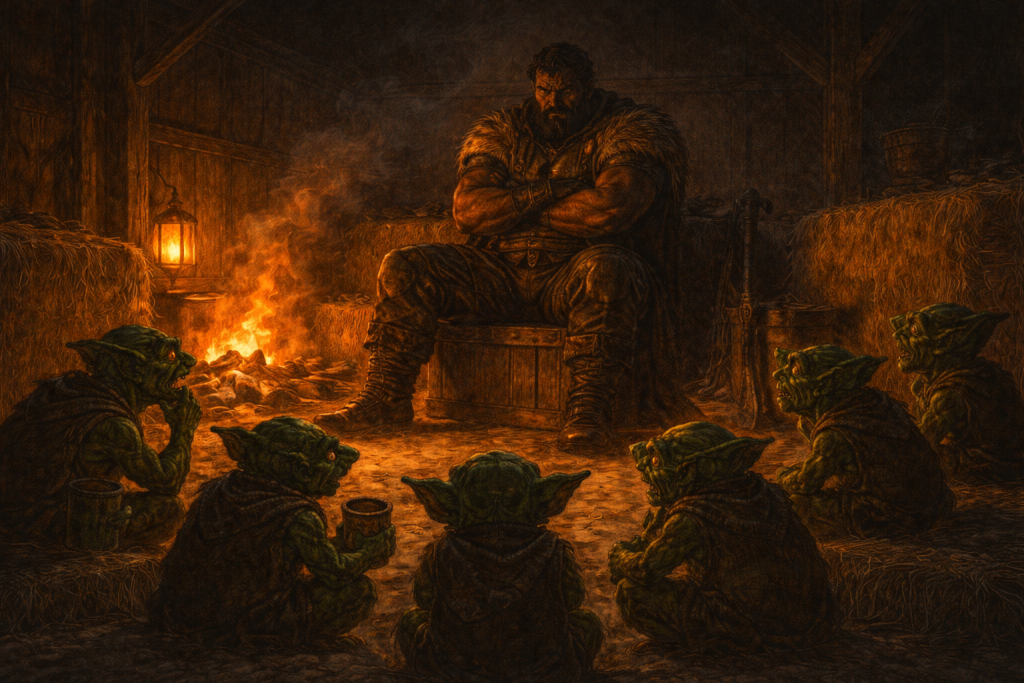
Hunkle and Wolfgang took the second watch.
Almost immediately, Wolfgang announced he was “going hunting,” a statement delivered in the same tone one might use to say I am leaving you with a problem and refusing to elaborate. He vanished into the trees with his bow, leaving Hunkle seated on an upturned crate, arms crossed, eyes half-lidded, and radiating an aura that suggested violence was not just possible but efficient.
The gremlins watched him.
They did not speak.
They did not fidget.
They did not drink.
They simply sat in a loose semicircle on the hay, staring at Hunkle in unblinking silence.
Minutes passed.
Hunkle did not move.
The lantern guttered. Somewhere, an ox snorted. The night settled.
Finally, one gremlin—no one could later agree which—could bear it no longer.
“Is chaos,” it asked carefully, “a lifestyle… or a diagnosis?”
A second gremlin leaned forward. “Yeah. Like. If it’s a diagnosis, is it in the DSM-5?”
Hunkle did not answer.
He shifted his weight slightly.
There was a low sound—somewhere between a growl and the distant warning of tectonic plates grinding together.
The gremlins stiffened.
Another gremlin opened its mouth, reconsidered, and closed it again.
The silence returned, heavier now. Charged.
The gremlins exchanged glances. One of them tentatively raised a mug, then set it back down without drinking. Another scratched at the hay, then froze when Hunkle’s gaze flicked in its direction.
No one spoke.
When Wolfgang returned, dragging several unfortunate squirrels by their tails, the tension broke instantly.
“Hey Dad!” Pabst shouted, bounding to his feet. “What’re those?”
Wolfgang glanced at the gremlins, then at the squirrels. “Dinner.”
Pabst gasped. “You can make dinner out of those?”
Wolfgang sighed—the long-suffering sigh of a man who had not agreed to this but found himself in it anyway. “Yes.”
“How?” Pabst asked, eyes wide.
Wolfgang dropped the squirrels onto a flat stone. “First, you don’t scream.”
The gremlins leaned in, fascinated.
What followed was not quite a lesson and not quite a bonding experience, but it was something close. Wolfgang showed them how to skin the squirrels, how to clean them, how to skewer them over the fire. He grumbled constantly. He corrected mistakes sharply. He confiscated a squirrel from Mad Dog after it tried to “improve the flavor” with spilled beer.
But he answered every question.
He demonstrated how to cook meat without burning it.
He explained why you wait.
He showed them how to share.
The gremlins listened with reverence usually reserved for prophets or particularly aggressive chefs.
At one point, Pabst looked up at Wolfgang, grease on his chin. “Is this what dads do?”
Wolfgang paused.
“…Eat,” he said.
The gremlins nodded solemnly.
Hunkle observed all of this without comment. When one gremlin glanced back at him nervously, Hunkle gave a single, almost imperceptible nod.
This was acceptable.
By the end of the watch,
- The squirrels were well on their way to stew.
- The gremlins were quiet and oddly content.
- Pabst sat close to Wolfgang, chewing thoughtfully.
- And no one asked Hunkle another philosophical question.
On Discipline, Chaos, and the Long Game
Ant and Cassyndra took the final watch, the hour before dawn when even the night seems tired of itself. The barn smelled of hay, extinguished lantern smoke, and the faint sweetness of spilled beer. Outside, the world was very still. Inside, eight rum gremlins sat in a loose cluster, mugs in hand, quieter than they had been all night—still awake, still drunk, but listening now.
Thunderbird raised a hand, hesitantly.
“Is discipline,” it asked, “just peer pressure with armor?”
Ant and Cassyndra both blinked.
They looked at each other.
Then Ant said slowly, “That is… an uncomfortably good question.”
Cassyndra folded her arms. “Discipline can be that. It can also be agreement. Or self-restraint. Or deciding you want something badly enough to wait for it.”
The gremlins murmured among themselves.
“So discipline isn’t the opposite of chaos?” Bud asked.
“No,” Ant said. “Chaos and discipline aren’t enemies. They’re… phases.”
Cassyndra nodded. “Right now, discipline is the tool. Later, chaos is the reward.”
Miller frowned. “Like… we behave now so we get to be terrible later?”
“Yes,” Ant said firmly. “But usefully terrible.”
This satisfied them enormously.
Mad Dog raised a finger. “You know how you made us apologize to the Hopsworths?”
“Yes,” Cassyndra said. “I remember every second of that.”
“Well,” the gremlin continued, “we did it sarcastically. Does that count halfway?”
Ant considered this carefully. “Yes,” she said. “Halfway is still a direction.”
The gremlin beamed. “We’re improving.”
A different one tilted its head. “Is this what character development feels like?”
Cassyndra sighed. “More or less. It’s uncomfortable, confusing, and usually happens when you’re tired and don’t want it to.”
The gremlins absorbed this in silence.
Then one asked, very quietly, “Are rules just insults written down?”
Ant laughed despite herself. “Sometimes. But sometimes they’re promises. Or boundaries. Or a way of making sure everyone gets to play the game without it turning into a dumpster fire.”
The gremlin nodded thoughtfully. “We like dumpster fires.”
“Later,” Cassyndra said, without missing a beat.
A pause followed.
Then, inevitably, “Will you throw a fireball?”
Cassyndra closed her eyes.
“No,” she said. “But I have something better.”
She stood, dusted off her robes, and walked down to the tavern. When she returned, she carried a bottle wrapped in paper.
Fireball Cinnamon Whisky.
The gremlins gasped as one.
They celebrated with reverence. Cups were poured. Toasts were made. One gremlin cried openly. Another sang a brief, deeply off-key hymn to poor life choices.
As the warmth spread, Ant spoke again, gently this time.
“Chaos has a place in the world. Without it, everything becomes rigid. Authoritarian. Suffocating.”
Cassyndra nodded. “But chaos that burns too early just destroys itself. Right now, you’re learning restraint. Later—when you reach Northmarch—you’ll have a place where chaos matters.”
The gremlins leaned in.
“So… we’re not becoming boring?” one asked, alarmed.
“No,” Ant said. “You’re becoming dangerous.”
The beaming delight of the gremlins confirmed that this was, without question, the best answer anyone could have given.
As dawn crept toward the barn doors, one final question drifted up from the hay.
“What happens when we get to Northmarch?”
Cassyndra gave the answer she had already given a thousand times.
“We introduce you to your new home,” she said patiently, “and then you get to run and drink and play all you want.”
“No, no,” Skol protested. “We know that. We mean—what happens to us? Who will we be?” He leaned forward, eyes wide. “You’re a divination wizard. You can tell us.”
Cassyndra frowned thoughtfully, stretching stiffness from her shoulders. After a moment, she reached into her pack and withdrew her tarot deck.
The effect was immediate. The gremlins tumbled out of the hay, mugs abandoned, scrambling to sit in a neat semicircle around her with the sudden, reverent silence of children at a campfire.
“Let’s see what the cards have to say about you,” Cassyndra said.
She shuffled with care, murmured the proper incantation, bowed her head, and drew the first card—placing it face up between them.
“The Eight of Cups.” She tapped the image. “Your past. Here are cups on the ground—riches, good fortune, companionship. And here is the man walking away from them, convinced something else will make him whole.”
She looked up at the gremlins.
“He’s unhappy because he doesn’t realize he already has everything he needs. You were that man. Blind to what was in front of you. Certain the answer lay somewhere else.”
The gremlins stared at the card in thoughtful silence.
Cassyndra drew again.
“The Queen of Wands. Your present,” she said. “Authority. Agency. Command over oneself.”
Miller brightened. “So that means we get to do whatever we want right now?”
“No,” Cassyndra said sharply—then winced. “Absolutely not. No. I mean—this isn’t about external authority. It’s about mastery over your thinking. Your choices. How you respond to what’s happening to you.”
The gremlins frowned, digesting this.
“And your future,” Cassyndra said, drawing the final card.
“The Nine of Wands.”She studied it for a long moment before speaking. “Here we see a warrior,” she said slowly. “Victorious—but wounded. Resting after a hard-fought struggle. He has paid a price, but he is still standing.”
She met their eyes.
“Like you, he endured something difficult. He followed rules he didn’t like. He waited. He behaved. And in doing so, he earned his victory.”
The gremlins breathed as one.
“That’s us,” someone whispered.
Cassyndra nodded.
What she did not say was that the card also spoke of scars. Of losses carried forward. Of victories that change you.
She let that part remain unsaid.
When the watch ended, the sky was pale, the fire was low, and something had shifted.
Not redemption. Not yet.
But direction.
And that, perhaps, was more dangerous than chaos had ever been.
The Smallest Humans
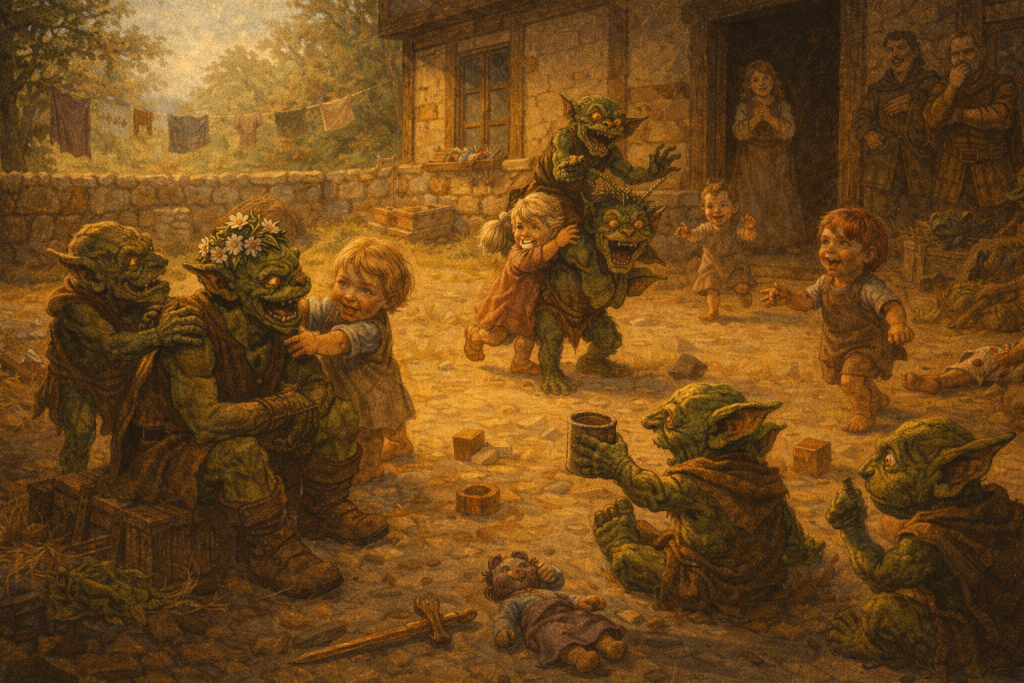
Two days later, in a village barely large enough to justify a name, the road passed an orphanage.
The building was old but sturdy, with patched shutters and a yard enclosed by a crooked fence. Inside were children no older than five—small, loud, sticky, and possessed of an energy that defied all known laws of conservation.
The gremlins froze.
They stared.
“They’re… like us,” whispered Bud.
“Smol,” Pabst said reverently. “Like Ant. But actually cute!”
Before anyone could stop them, the gremlins had wriggled through gaps in the fence, slipped through half-open windows, and embedded themselves in the chaos.
Sweets appeared from nowhere.
Songs were taught that should never, under any circumstances, be sung by toddlers.
Someone produced a bottle, which Cassyndra confiscated immediately, but not before at least one gremlin attempted to explain fermentation to a three-year-old.
It should have ended badly.
Instead, it ended loudly.
The threat came in the form of three men—bandits, opportunists, or something worse—who had noticed the village’s isolation and the absence of obvious defenders. They approached at dusk, thinking the orphanage an easy mark.
They were wrong.
The gremlins noticed first.
“No,” Spillgut said sharply, for the first time intervening. “Not them.”
When the attackers tried to force a door, they found themselves suddenly dizzy, disoriented, and laughing at nothing. The gremlins poured through cracks, under doors, through chimneys—wherever a body smaller than a loaf of bread could fit.
Drunkenness bloomed like a curse.
The attackers staggered, dropped weapons, argued with trees.
The party saw it happen and reacted instantly—arrows, spells, shouted warnings. The fight was short, confused, and deeply humiliating for the would-be raiders.
When it was over, the gremlins emerged from the orphanage yard, faces flushed, chests puffed out.
“We did not leave,” one said proudly.
“We stayed,” said another. “Even when it got scary.”
One of the children hugged Pabst around the leg.
He froze.
Then, very carefully, he patted the child on the head.
That night, as the party moved on, the gremlins walked quietly.
Something had shifted again—not redemption, not absolution—but proof. They could choose rather than react instinctively. And that, perhaps, was the most dangerous thing of all.
Bastionstead: A Conversation in Passing
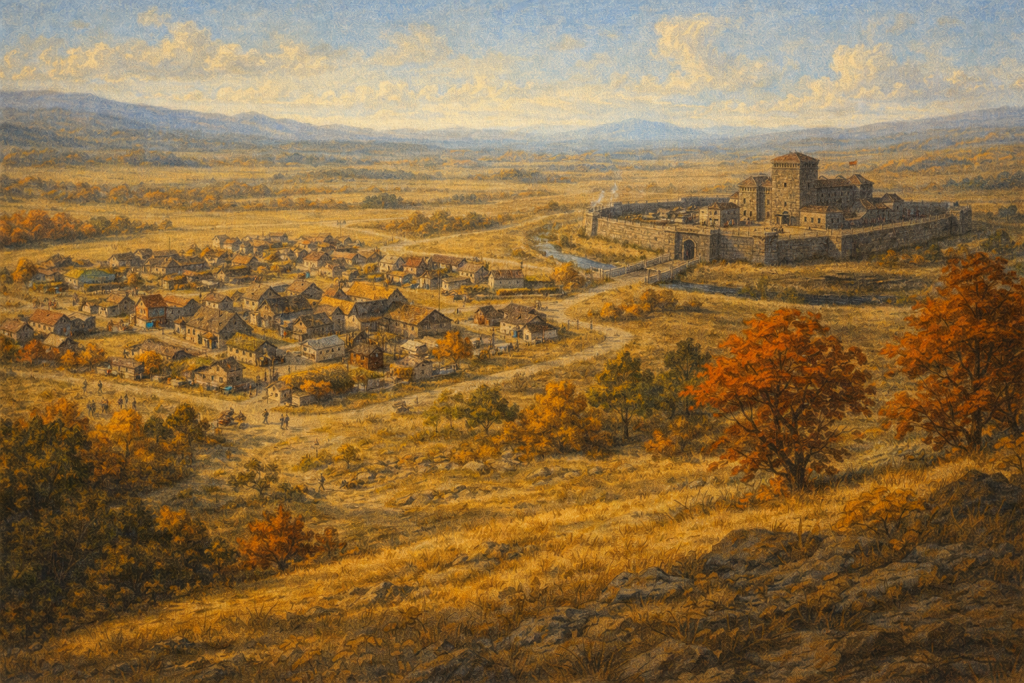
From the rise to its west, Bastionstead looked orderly in the way a diagram looks orderly. Four roads met it cleanly from the four cardinal points of the compass. Smoke rose in disciplined columns. Roofs were uniform. Even the fields around it looked intentional, hedges clipped to boundaries that had been argued over and resolved on parchment.
Beyond it, half a mile east, squatted Northmarch.
Stone upon stone. A keep surrounded by auxiliary buildings, surrounded by a twenty-foot wall, surrounded by a dry moat. A drawbridge hung open, guarded. Along the near side of the moat, men were digging a trench—deep, straight, purposeful. Water would come soon.
The wagon and gremlins were pulled off the road and concealed as best they could manage. Ant and Cassyndra adjusted cloaks, checked faces, and walked into Bastionstead like two people with nothing to hide and every reason to lie.
They found their conversation easily.
A man was sweeping the stone apron outside a low administrative building. He was broad-shouldered, early forties, with hands permanently stained by lime dust. He worked carefully, thoroughly, and looked up as they approached with open curiosity rather than suspicion.
“Afternoon,” he said. “You’re new.”
Ant smiled. Cassyndra nodded.
“Just passing through,” Ant said lightly. “This place is… impressive.”
The man’s chest lifted a fraction. “Aye. Took two years. Every stone placed with purpose.” He rested on his broom. “Name’s Rellin Marr. I came up a year ago—digger at first. Didn’t know one end of a trowel from the other, but they trained us.”
Cassyndra glanced, casually, toward Northmarch. “Must’ve taken some doing.”
Rellin followed her gaze, pride softening his face. “You should’ve seen it go up. Crown mages, clerics—whole teams. Walls raised in weeks that’d take a lifetime by hand. Blessings laid into the mortar. Wards set so deep you can feel ’em hum if you’re close enough.”
Ant tilted her head. “And now?”
“Maintenance,” he said. “Cleaning. Inspections. The work that keeps things… running.” He smiled. “They offered me the position when it opened. Few weeks back, that was. Brought my family up. My kids like it here. Safe.”
“Living this close to a prison?” Cassyndra asked gently.
Rellin shrugged. “Someone has to. Order doesn’t maintain itself.” He said it the way one might say gravity exists. “These are hard cases. Thieves, murderers, traitors, worse. Folks who made choices.”
“And the guards?” Ant asked.
“Oh, plenty of those. Regular garrison, plus an army detachment. And mages.” He lowered his voice, though there was no one nearby. “Familiars too. Watching the walls, the roads, the skies. They see more than people think.”
Cassyndra’s expression remained politely neutral. “Magic users imprisoned here?”
Rellin nodded. “Special sections. Heavily warded. I don’t go near those areas.” A beat. “Don’t need to.”
Ant leaned slightly closer. “Anyone famous in there? We’ve heard stories.”
Rellin chuckled. “You mean that wretched Dibbler rat from the newspapers? No. This place is just part of a big system. Plenty of places throughout the land to keep lawbreakers. I’d wager they’ve got him somewhere else… somewhere less pleasant where they’re still turning him inside out.”
Cassyndra thanked him. Ant offered a few coins for his trouble. He waved them off.
“No need. Just doing my part.” He picked up his broom again. “Security is serenity, after all.”
They walked on.
Behind them, the broom resumed its steady rhythm against stone.
Watching the Watchers
Ant and Cassyndra had been gone long enough for the light to shift.
The cart sat hidden off the road, the gremlins mostly occupied with arguing over whether water was a beverage or an insult. Spillgut watched the horizon like it might personally betray him and the drivers kept their distance, grateful for the quiet.
Merrythought sat on an overturned barrel, legs dangling, plucking idly at a string that wasn’t attached to anything. Wolfgang leaned against the wagon wheel, sharpening his blade with slow, methodical strokes.
For a while, neither of them spoke.
Finally, Merrythought said, “Do you think we’re hurting them?”
Wolfgang didn’t look up. “Who.”
“The gremlins.”
That earned a pause. He stopped sharpening, considered the edge, then resumed. “We’re keeping them alive.”
“That wasn’t the question.”
She glanced toward the gremlins, who were now trying to stack pebbles into what they claimed was a shrine to Beer Tomorrow.
“I mean,” she continued, “we’ve put them on a ration. Structure. Schedules. Consequences.” She grimaced. “I’ve seen cults start with less.”
Wolfgang snorted. “They’re still gremlins.”
“Yes,” Merrythought said gently, “but are they the same gremlins?”
He frowned despite himself. “They’re quieter.”
“They ask questions now.”
He scowled. “They unionized.”
“Exactly.” Merrythought leaned back on her hands. “Chaos isn’t just behavior. It’s identity. What if limiting their booze is… reshaping them? Sanding off something essential?”
Wolfgang wiped the blade clean on a rag. “Or what if it’s just sobriety.”
She winced. “Careful. That’s a dangerous word.”
“They’re not meant to be stable,” he said, more slowly now. “That’s their thing. You take that away, you don’t get better gremlins. You get… something else.”
“Is that worse?” she asked.
He didn’t answer.
Across the camp, Gareth had been listening.
He hadn’t meant to. He simply had the misfortune of thinking while other people were talking.
“May I offer a related anxiety?” he said.
They both turned.
Gareth stood a short distance away, arms folded, eyes on the treeline—not the road, not the village, but the shadows between trunks where nothing moved.
“We only knew we were being followed,” he continued, “because the Watchers wanted us to know.”
Merrythought’s smile faded.
“They carved a message,” Gareth said. “They let themselves be sensed. They fired shots meant to wound, not kill. That wasn’t incompetence. That was communication.”
Wolfgang straightened. “You think something else was watching us before that?”
“I think,” Gareth said carefully, “that something always could have been.”
Silence settled.
“How long,” Gareth went on, “were we observed before they chose to act? Days? Weeks? Since Manchester? Since the jailbreak? And what happens after the gremlins are gone. They felt the Watchers. But we didn’t. We only knew they were there when they announced themselves.”
They all looked, then, at the gremlins.
At Pabst, showing another gremlin how to hum while thinking.
At Miller, sitting quietly, staring at his hands like they were new.
At Spillgut, pretending not to listen and missing nothing.
Merrythought exhaled. “So the question isn’t just whether we’re changing them.”
Wolfgang nodded grimly. “It’s whether we’re going to miss them when they’re gone.”
From the road came the sounds of Ant and Cassyndra’s return. The camp stirred and the gremlins looked up, alert. And for just a moment—only a moment—Gareth could have sworn the forest leaned in, listening too.
Making Plans
After hearing Ant and Cassyndra’s report, the party gathered near the wagon and quietly considered their options for raising hell in a controlled, professional manner—and, if fortune smiled, perhaps freeing Grelda along the way.
Ideas were floated freely.
Could Heka slip through a window with a pouch of spell components and a note for Grelda? Possibly—but it relied on Grelda being both reachable and able to act without immediately alerting half the prison.
Could the rum gremlins be smuggled in as originally planned, with chaos exploited as it bloomed? Tempting. Very tempting.
Could one gremlin be sent in first to scout the interior and report back? Risky, but efficient—assuming the gremlin remembered anything useful, reported it accurately, and didn’t attempt to recruit the inmates to Local 147.
This idea was set aside after a sober discussion of Crown interrogation practices, spell-assisted questioning, and the unsettling likelihood that Wolfgang would enjoy the first fifteen minutes far too much.
In the end, the plan that survived contact with reason involved paperwork.
Specifically: forged paperwork.
They would send Laveleen’s pseudodragon familiar south to Manchester, twenty miles away, carrying a carefully written message for Silas Venn, the forger they had freed during their prior jailbreak. The familiar would fly directly to Madam Eloise’s perfumery, where Silas was known to surface when he needed discretion, income, or plausible deniability. Travel time would be a matter of hours—but it might take a day to find Silas and a couple of days for him to do the work.
The forged document would explain that the party was delivering a shipment of beer to the Northmarch Correctional Bastion as a reward for the crew’s excellent work bringing the prison online. With the right seals, phrasing, and bureaucratic flattery, it should be sufficient to get several casks through the gate.
What was inside those casks would be a later problem. And someone else’s problem.
Gareth, as was his habit, raised the concern that had been hovering unspoken.
“What if Venn turns us in?” he asked. “Or Eloise? We are, after all, extremely memorable criminals.”
This prompted a brief but thorough discussion, after which Gareth was—if not entirely reassured—at least persuaded.
First, Silas Venn benefited directly from the jailbreak. He was free because of it. Turning the party in would require explaining, in detail and under oath, how he had escaped lawful incarceration with the aid of armed accomplices while actively committing fraud. The Crown was not known for its appreciation of nuance in such matters.
Second, both Silas and Madam Eloise did their best work well away from the eyes of the law. Eloise’s perfumery survived because it was a place where people could be discreetly not noticed. Informing on clients—even indirectly—would be disastrous for her business and likely fatal to her reputation.
Third—and this point seemed to settle the matter—while thieves might not have honor, they did have a vested interest in smooth, reliable working relationships with other criminals. In practice, this mimicked honor remarkably well.
Gareth conceded the point.
The pseudodragon was given the note, a few gentle scritches, and firm instructions not to steal anything unless absolutely necessary. It leapt into the air, wings catching the light, and vanished southward toward Manchester.
With that in motion, the party settled in to wait the few days it would take for Silas to respond.
In the meantime, they would reconnoiter—watching the roads, listening in taverns, studying patrol patterns, and learning everything they could about Bastionstead and the looming bulk of Northmarch.
After all, chaos was most effective when thoughtfully and lovingly prepared.