November 3rd – 8th, 973
Meanwhile, back in Manchester… (GM note – I started sketching the map of the area based on what I told you about distances between various points in the past and the result clearly shows it’s five days of travel from Bastionstead to Manchester and not the single I day I said earlier. The pseudodragon, however, using its wily and mysterious fey ways, managed the trip in only three days. Here’s what happened after it arrived).

Pfinder trudged home beneath a sky the color of damp newsprint, his boots tapping out a tired editorial against the stones of Manchester. The day had been long in the precise way that only institutional obedience could manage: long sentences praising short-sighted policy, long meetings concluding with no action, long pauses in conversation where one was meant to nod gravely and write steadfast instead of stagnant.
At The Royal Standard, he had spent the afternoon watching senior correspondents bow to the Crown with the supple enthusiasm of reeds in a floodplain. The Editor-in-Chief had smiled his genial, vacant smile and suggested—once again—that Pfinder’s phrasing might benefit from being “less… alert.” Pfinder had responded with a nod, a note in the margin, and a quiet vow to deploy the word “inevitable” in a way that could be plausibly read two ways by any reader with a pulse.
The day was not a total loss. Several sheets of fine vellum had migrated from the Standard’s supply room into Pfinder’s satchel, quite without explanation. A bottle of ink had done the same. A spare seal stamp—purely by accident—had found itself nestled among his notes. The Ragged Quill would eat well tonight.
And of course, there was the small, sustaining pleasure of having signed his latest piece – Mr. Pfinder, Provisional Correspondent for Civic Temperament (Acting)
He smiled faintly at the memory.
Lost in these comforts, Pfinder reached the narrow doorway of his apartment building—a tired brick structure that leaned slightly left, as if perpetually listening to a more interesting conversation elsewhere—and raised his hand to push the door open.
That was when something struck him squarely in the back of the head.
Not hard. Not gently. Precisely enough.
Pfinder staggered forward with a startled yelp, hat skidding across the stones. He spun, already composing a scathing internal monologue about the decline of public courtesy—only to find, at his feet, a small shape sprawled indignantly on the pavement.
It was a pseudodragon.
A very small one.
A very dazed one.
It lay on its side, wings twitching, eyes blinking in wounded affront. One claw rose weakly into the air, trembling with heroic effort. Tied to that claw—secured with careful string and a neat knot that spoke of intent—was a folded scrap of parchment.
The pseudodragon hissed, a sound that conveyed both pain and what Pfinder could only interpret as deep professional disappointment.
Pfinder stared.
The pseudodragon stared back.
Slowly—very slowly—Pfinder’s expression shifted from alarm to astonishment, and finally to something dangerously close to delight.
“Well,” he murmured, stooping to retrieve his hat and dusting it off with exaggerated care, “the day has suddenly justified itself.”
He crouched, peering at the creature with the practiced eye of a man who had once traveled with wizards and therefore considered nothing impossible—merely inconveniently timed.
“You know,” he added conversationally, “most messengers knock.”
The pseudodragon responded by sagging dramatically and waving the parchment again.
Pfinder’s eyes flicked to the message. His smile sharpened.
“Ah,” he said. “Yes. Of course you’re a courier. I should have known. You’ve got the look—union work, I’d wager.”
He scooped the pseudodragon up gently, tucking the creature into the deep folds of his coat where it immediately curled, still sulking but clearly relieved. Pfinder adjusted the lapel to give it air and a modicum of dignity.
At that precise moment, the front window creaked open above him.
“Mr. Pfinder?” came the voice of Mrs. Harrowby, whose defining traits included a passion for boiled vegetables and an unwavering faith in the surface explanation of all phenomena. “What was that noise?”
Pfinder looked up, pseudodragon eyes glinting faintly from within his coat.
Thinking quickly, he offered her the first explanation that came to mind.
“My dinner,” he said.
Mrs. Harrowby blinked.
“Well,” she said after a moment, “best not let it get cold.”
“Quite,” Pfinder agreed, already turning toward the door. “Terrible waste, otherwise.”
He slipped inside, heart quickening, fingers already itching for the parchment.
Behind him, Mrs. Harrowby closed her window, satisfied that the world had once again made sense.
Inside the dim stairwell, Pfinder paused, one hand resting lightly over the pocket where the pseudodragon nestled—and where the message waited.
He exhaled, slow and pleased. “Now then,” he murmured, “let’s see who’s remembered that the pen, when properly sharpened, is still mightier than the sword.”
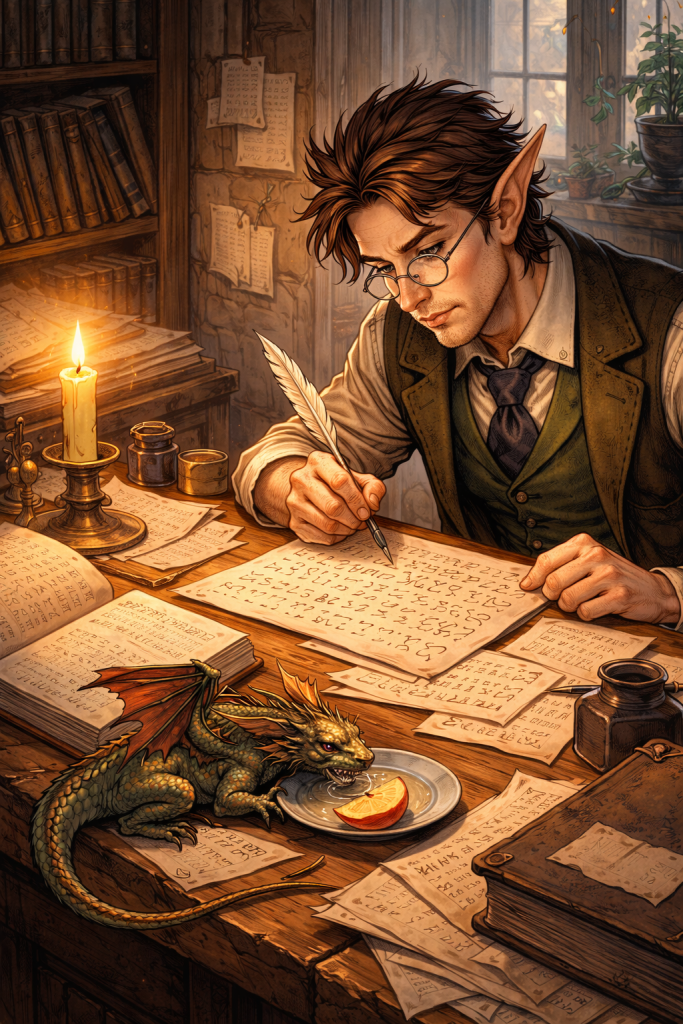
Pfinder’s apartment was, by any charitable definition, cozy.
By any honest one, it was a filing cabinet that had developed opinions.
He nudged the door shut with his heel, shrugged out of his coat, and carefully extracted the pseudodragon, who emerged blinking and affronted but clearly pleased to be indoors and no longer colliding with journalists.
“Right,” Pfinder said briskly, shedding his hat and hanging it on a peg that had been threatening to resign for months. “You are a guest, not a headline. Try not to immolate anything, deface anything, or form opinions about municipal governance.”
The pseudodragon chirruped weakly and promptly curled up atop a stack of old proofs labeled EDITORIALS THAT MADE THEM NERVOUS. Pfinder fetched a saucer, poured a little water into it, added a sliver of apple he’d been saving for a more optimistic evening, and slid it toward the creature.
“There,” he said. “Room service. Five stars, if one grades on intent.”
Only once the pseudodragon had settled—tail flicking contentedly, wings tucked—did Pfinder allow himself to sit at his narrow desk. He lit a candle, trimmed the wick with a practiced hand, and unfolded the parchment.
His eyes skimmed the surface.
Symbols. Neat. Deliberate.
And then—there it was. Plain as daylight in the middle of night:
Our friend Vigenere
Pfinder laughed aloud, a soft, delighted sound that echoed faintly off the walls.
“Oh, you beautiful, reckless fools,” he murmured.
Captain Nelson’s letters flickered through his mind: long nights, shared ciphers, the particular joy of cracking something meant to be hidden. Pfinder pulled a scrap of paper toward him, wrote the keyword without hesitation—
KESTREL
—and began.
The cipher yielded quickly. It always did, once you knew where to press. Within minutes, the message lay bare before him, ink steady, meaning sharp.
Pfinder read it once.
Then again, slower.
Then he leaned back in his chair, steepled his fingers, and smiled the sort of smile that had once gotten him expelled from a salon and later promoted to the margins of history.
Below is the full decrypted message, exactly as Pfinder read it:
To our memorably loquacious friend,
We hope this note finds you in good health, adequate ink, and tolerable company.
Recent events have made correspondence… challenging. You will understand, we trust, that circumstances beyond our control have required a certain discretion, and that our silence should not be mistaken for forgetfulness.
We write now because we find ourselves in need of a particular service—one that requires delicacy, plausibility, and a hand well practiced in official falsehoods.
Specifically, we require a document attesting that the Crown, being exceedingly pleased with the exemplary conduct and results achieved at Northmarch Correctional Bastion, has authorized a shipment of fine spirits to be delivered there for the morale and enjoyment of the staff.
The document should bear all appropriate marks of authenticity, gratitude, and bureaucratic inevitability.
We believe one Silas Venn, presently of the Black Lily, would be ideally suited to craft such a forgery. We are confident that he will look upon this request favorably, given that a great and timely favor was done for him during the recent and much-discussed disturbance at the Hammermill lockup.
Silas is most reliably reached through Madam Eloise of Eloise’s Perfumery, whose establishment lies immediately adjacent to said lockup. The proximity is… inconvenient inasmuch as the lockup itself is very likely still the focus of an energetic and magically assisted investigation.
Accordingly, we judged it unwise to direct our courier there directly. Instead, we ask you—trusted intermediary—to make the approach and arrange matters as you see fit.
Once completed, the forgery may be returned to us by the same courier who bore this message. You may assure him that all manner of outrageous indulgences shall be supplied upon his return.
We trust all is well with you, and that you will forgive the infrequency of our letters of late. History has been uncooperative, and the hinge upon which it turns has been creaking rather loudly.
As always,
Your admiring fellow travellers
Pfinder let the parchment rest on the desk.
The pseudodragon lifted its head, watching him with bright, curious eyes.
“Well,” Pfinder said at last, “it appears journalism has once again intersected with crime, forgery, and destiny. Which, frankly, is where it belongs.”
He tucked the message safely away, rose to prepare his own dinner, and glanced back at the tiny creature.
“Get some rest,” he added lightly. “Tomorrow, we knock on the door of perfume, politics, and plausible deniability.”
The pseudodragon chirped.
Pfinder smiled.
Adventuring, it seemed, had not finished with him yet.
Pfinder, a creature of refined habit, if nothing else, resolved to deploy his usual weapons – pleasant conversation and chutzpah bordering on ridiculous levels.
Thus, late the following morning, he strolled into Eloise’s Perfumery in his usual attire: clean but unremarkable coat, sensible boots, and the air of a man who believed—without evidence—that circumstances would naturally bend toward him if addressed politely.
The shop was warm, orderly, and fragrant in a way that suggested deliberate curation rather than indulgence. Glass bottles lined the shelves in tidy ranks, each bearing a neat handwritten label. The air held layered notes—floral, resinous, faintly spicy—none of which Pfinder could have identified under oath, but all of which conveyed expense.
At the counter stood Clover.
She was efficient in the way of someone who had learned exactly how pleasant to be, and no more. Somewhere between twenty and twenty-five, neatly dressed, alert without appearing so. Pfinder registered—vaguely—that she was likely attractive, though the impression was muddied by the more pressing fact that she seemed to be working.
“Good morning,” Pfinder said. “I was hoping to speak with Madam Eloise.”
Clover smiled kindly, professionally, and with no hint of apology.
“I’m afraid Madam isn’t available at present,” she said. “Nor is she expected to be, for the foreseeable future.”
This was delivered with the gentle finality of a closed ledger.
Pfinder inclined his head. “Of course,” he said easily. “Entirely understandable.”
He did not leave.
Instead, he wandered the shelves, hands clasped behind his back, studying the bottles with the air of a man who might conceivably buy one. He neither loitered nor rushed. He neither pressed nor sulked. He simply was, which experience had taught him was often the most unsettling posture of all.
Several minutes passed.
Then the bell over the door chimed again and a very well-dressed gentleman entered.
The difference was immediate. The man’s coat was tailored to within an inch of smugness. His boots shone. His gloves were removed and tucked away with practiced ease. He approached the counter directly.
“Good morning,” he said. “Might I speak with Madam Eloise? It’s a somewhat urgent personal matter.”
Clover’s response shifted—not in words, but in tone.
“Madam will be available in approximately an hour,” she said. “If you would care to return.”
The gentleman seemed pleased.
“Perfect,” he replied, already turning. “I shall do precisely that.”
He left.
Pfinder continued to examine a bottle labeled Dew After Mourning, his expression unchanged. He had kept a scrupulous distance. He had made no effort to overhear. He had, by all reasonable standards, done nothing at all.
And yet—
Clover now appeared mildly anxious.
Not alarmed. Not frightened. Simply… eager for resolution.
Her eyes flicked toward Pfinder once. Then again.
Ah, Pfinder thought. So that’s how the door opens.
He turned back to the counter with an easy smile. “May I trouble you?” he asked. “Of these, which do you like best?”
Clover blinked, momentarily wrong-footed. Then she gestured toward a modest bottle tucked slightly behind the others.
“That one,” she said. “It’s subtle. Most people overlook it.”
“Most people are fools,” Pfinder said warmly.
They spoke for another minute or two—nothing consequential. Pleasant things. Neutral things. The sort of conversation that left no hooks but established tone.
Pfinder thanked her, nodded once more, and departed.
Outside, the city air felt dull by comparison. He walked a full block before smiling. Confidence, he had learned throughout his life, was useful. But here… presentation would be everything.
The following morning, Pfinder prepared himself properly.
The coat was better—cut finer, brushed carefully, and chosen to suggest both wealth and the habit of expecting doors to open. His boots were polished. His gloves were new. And upon his upper lip rested a mustache of such distinguished falseness that it radiated authority by sheer audacity.
He examined himself in the mirror, tilted his head once, and smiled.
“Unrecognizable,” he murmured approvingly.
This optimism lasted exactly three seconds.
As he stepped out of his apartment building and drew the door shut behind him, a voice rose from above with the speed and certainty of civic judgment.
“Excuse me?” Mrs. Harrowby leaned out her window, eyes narrowed.
Pfinder turned.
She blinked, visibly recalibrating. This was not Mr. Pfinder. This man was taller. Broader. Mustached. Important. And yet—
“I don’t believe we’ve met,” she said carefully. “And yet you seem to have come from Mr. Pfinder’s apartment.”
Pfinder felt a flicker of pure delight. She doesn’t recognize me at all.
He bowed slightly. “Percy Bullstrode,” he said smoothly. “Boiled Vegetable Inspector. Newly appointed.”
Mrs. Harrowby froze. “Inspector,” she repeated, with reverence.
“Indeed,” Bullstrode replied. “District level.”
Her suspicion transformed instantly into interest. “Oh my,” she said. “And how did Mr. Pfinder fare on his inspection?”
Bullstrode’s expression shifted—not enough to be explicit, but enough to imply. A tightening at the mouth. A glance aside. The faint sorrow of a man bound by duty.
“I’m afraid,” he said gravely, “that inspection results are confidential.”
Her lips pressed together.
“But,” he added, adjusting his gloves, “I will say that compliance is… not universal.”
Mrs. Harrowby gasped. “Dear me.”
Bullstrode inclined his head. “I have a very busy day ahead of me,” he said. “Many vegetables. Many standards.”
“Of course,” she said quickly. “I wouldn’t want to keep you.”
He departed at once, leaving behind a woman already composing several stern opinions.
Fifteen minutes later, he entered Eloise’s Perfumery.
The bell chimed.
Clover looked up—and straightened.
This was a different man.
Pfinder approached the counter with the same controlled confidence as the well-dressed gentleman from the day before, pausing just long enough to be seen, but not long enough to seem uncertain.
“I’d like to speak with Madam Eloise,” he said.
Clover regarded him carefully. “May I ask the nature of your business?”
Pfinder hesitated. Just enough.
He cleared his throat. “A personal matter,” he said. “Of a… delicate nature.”
Her expression softened by a fraction.
“I see.”
He leaned in slightly, lowering his voice. “I believe,” he added, with the air of a man mortified by his own circumstances, “that I may require professional assistance with a romantic situation that has become… complicated.”
Clover studied him for a long moment.
Then she nodded. “Madam will be available in approximately thirty minutes,” she said. “If you care to wait.”
Pfinder smiled—grateful, restrained, relieved. “That would be most appreciated,” he said.
He stepped aside, removed his gloves, and allowed his attention to drift as he casually perused the store once again. Glass bottles caught the light. Labels promised transformation, reconciliation, regret, and optimism in varying ratios. He paused once, as though reading out of idle curiosity, then again, as though reconsidering.
When he sat in a chair to wait further, his posture had not changed.
Nor had his expression.
Only the subtle weight of one small bottle—Clover’s favorite, as she had mentioned the day before—had joined him, settling comfortably into the inner pocket of his coat, where it belonged now, having clearly grown tired of the shelf.
Behind the counter, Clover carried on with her daily responsibilities.
Some doors, Pfinder reflected, did not open to confidence alone.
They opened to presentation.
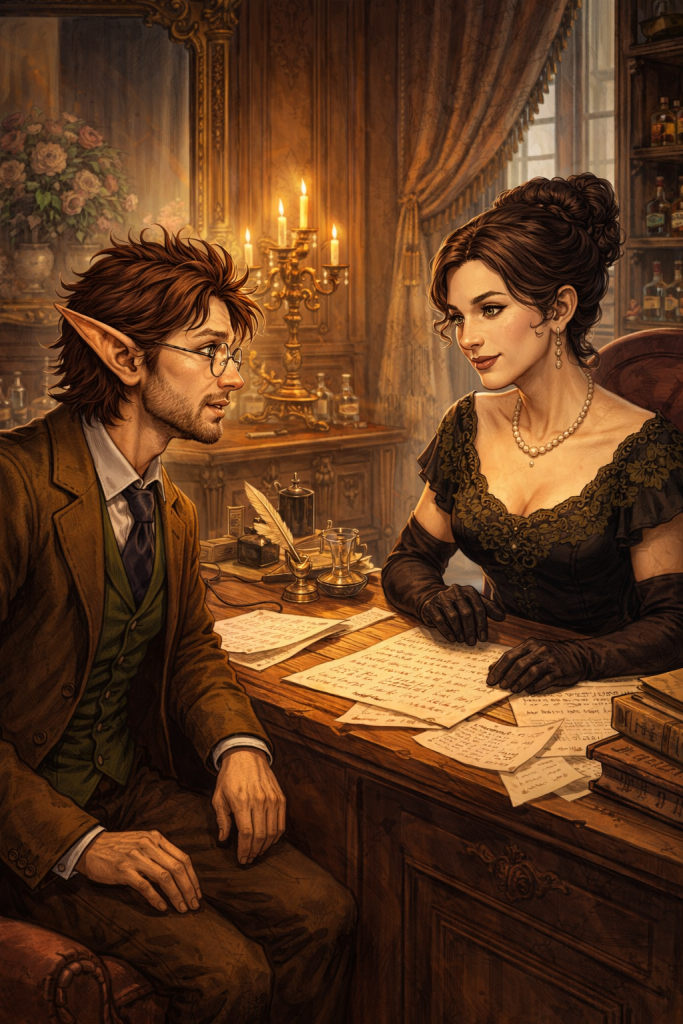
Madam Eloise received him in rooms that were private in the way only successful illicit businesses could afford to be private: softly lit, comfortably appointed, and arranged so that every chair implied both discretion and consequences.
As the door closed behind them, Pfinder waited exactly long enough for silence to settle.
Then he reached up and removed the mustache.
It came away cleanly.
“I should explain,” he said at once, folding it with care and slipping it into an inside pocket, “that this was adopted partly to gain entry, and partly to ensure that—should matters take an unexpected turn—you would be afforded a degree of plausible deniability. One never knows who may be watching the doors of a perfumery with… something extra in the back… and I would hate to be the cause of unnecessary inconvenience.”
Madam Eloise regarded him without surprise.
“Do go on,” she said.
Pfinder inclined his head. “I am Mr. Pfinder. Journalist by trade. Intermittent nuisance by reputation. And I am—how shall I put this—well connected to the group of adventurers with whom you have previously enjoyed a… mutually advantageous collaboration next door.”
Her expression changed very slightly.
“I believe,” Pfinder continued, “that you know the incident to which I refer.”
“I do,” Madam Eloise said calmly.
“Splendid. Then I will spare us both the recitation. Suffice it to say that my associates now find themselves in need of the professional services of Mr. Silas Venn.”
At the name, Eloise’s eyebrow rose a fraction—an economical gesture, but an eloquent one.
“I am confident,” Pfinder went on smoothly, “that discretion will not be an issue. Nor will loyalty. This is an enterprise driven far more by idealism than by profit, and I expect the financial outcome to be, at best, theoretical.”
He paused, then added, helpfully, “With that in mind, I propose a division of said nonexistent profits as follows: sixty percent to Master Venn, whose talents will, of course, do the heavy lifting. Thirty percent to yourself, in recognition of your indispensable role as intermediary. My comrades would retain the remaining ten percent of nothing, which they have found to be both manageable and philosophically sound.”
“And you?” Madam Eloise asked.
Pfinder smiled, genuinely.
“I find that the honor of this conversation,” he said, “more than compensates me.”
There was a moment’s silence.
Then Madam Eloise laughed—softly, but without restraint.
“You are correct,” she said, “Both Silas and I remain in the debt of your… comrades.”
She considered him for another moment, then nodded decisively. “We will see it paid.”
She rose, crossed to a small writing desk, and selected a card.
“Where should you meet him?”
“I leave that entirely to Master Venn’s comfort,” Pfinder replied at once. “I find that people do their best work when they feel safe, respected, and reasonably well fed.”
“Very well.”
She took his address, committing it to paper with professional efficiency.
“A note will arrive shortly,” she said. “Date, time, and location.”
“I shall await it with enthusiasm,” Pfinder said, standing and inclining his head once more.
As he was shown out, he reflected—not for the first time—that adventuring had many forms.
Some of them, it seemed, required nothing more than honesty (tempered judiciously with misdirection, of course) and an agreeable willingness to profit from nothing at all.
The Silver Eel had earned its reputation honestly.
It was the sort of tavern where conversations ended precisely where they should, where the walls had learned long ago not to listen, and where the staff possessed the rare and valuable talent of remembering faces while forgetting names. The lighting was warm, the ale dependable, and the tables arranged at distances that discouraged eavesdropping.
Pfinder arrived early, chose a corner table, and ordered something that suggested patience.
Silas Venn arrived exactly on time.
He was unremarkable in the particular way that spoke of careful effort. Well dressed, but not memorably so. Clean, but not fussy. His eyes, however, missed nothing.
They exchanged pleasantries, tested one another with polite conversation, and then—having mutually determined that neither was an idiot—dispensed with ceremony.
Pfinder explained the request plainly. What was needed. What it was meant to accomplish. And, most importantly, what it was not.
“No violence,” he said. “No extortion. No enrichment. Merely a correction to the natural order of things. A document that wishes very strongly to exist.”
Silas listened, fingers steepled, expression thoughtful.
When Pfinder finished, Silas nodded slowly.
“I can do this,” he said. “Easily. But if it’s meant to survive scrutiny—and I gather that it is—then I’d prefer to do it properly.”
“That is a relief,” Pfinder said warmly. “I had begun to worry that I was the only one who cared about quality.”
Silas allowed himself a small smile.
“I would need,” he continued, “a few additional materials. Certain papers. Seals. Inks. And I’d like to know precisely how this sort of proclamation is generally worded—what they say, what they imply, and what they pretend not to notice.”
He paused. “Do you happen to know anything about that?”
Pfinder spread his hands.
“Like any good journalist,” he said, “if I don’t immediately know the answer, I know where to find it. And failing that, I can always make it up. In this case, however, I believe accuracy will serve us better.”
Silas nodded, satisfied.
They drank to healing, beneficial reciprocity—made all the sweeter, Pfinder observed, by a generous tincture of sticking it to the man—and parted on excellent terms.
What followed was a series of interviews.
Pfinder presented himself to the appropriate departments of Crown functionaries with the easy authority of a journalist conducting a “complementary spotlight” on unsung but crucial bureaucratic labor. He asked intelligent questions. He nodded gravely. He praised precision. He expressed interest in process.
The functionaries, long unused to such attention, responded with enthusiasm.
By the end of it, Pfinder possessed a thorough understanding of proclamation protocols: the phrasing, the formatting, the cadence of official gratitude, and the particular seals that signaled inevitability rather than urgency.
He also possessed, quite without planning to, a small collection of materials that Silas had mentioned in passing.
A sheet of vellum here.
A sample seal impression there.
A vial of ink, identical to the one used for endorsements that no one was meant to question.
They found their way into his pockets with remarkable ease.
At one point, Pfinder found himself reflecting—philosophically—on the similarity between the migration of stationery from The Royal Standard to The Ragged Quill, and the present, equally innocent relocation of Crown supplies into Silas Venn’s capable hands.
History, after all, had always relied on the movement of paper.
When next he met Silas, Pfinder brought not only answers, but tools.
Silas examined them with professional delight. “These,” he said finally, “will do very nicely.”
Pfinder smiled.
Adventuring, it seemed, now involved less steel and more filing.
He found the trade agreeable.

In the days that followed, Pfinder attended to loose ends.
Some of them were personal.
He paid a visit to Mrs. Harrowby, who received him with the cautious warmth reserved for neighbors who might, at any moment, become topics of conversation. Pfinder sighed heavily, sat at her small kitchen table, and confided—under strict assurances of confidentiality—that he had failed his most recent boiled vegetable inspection.
Mrs. Harrowby gasped.
Pfinder went on, explaining that a reinspection was imminent, that the standards were exacting, and that failure would be… professionally awkward. He admitted, with practiced humility, that his own attempts had been deemed “structurally unsound.” He then added, as though it had only just occurred to him, that he had heard—from numerous people at The Royal Standard and elsewhere—that Mrs. Harrowby’s boiled vegetables were, quite simply, unparalleled.
Mrs. Harrowby beamed.
She insisted he take a generous portion. Several, in fact. For safety.
Pfinder thanked her profusely and departed with a basket heavy enough to suggest civic pride.
Back in his apartment, he set the vegetables down before the pseudodragon—whom he had taken to calling Eloise, never having been corrected, and seeing no reason to invite the matter. To his astonishment, she devoured them with gusto. Broccoli. Cabbage. Even the sprouts.
Pfinder watched in mild horror.
He himself had been deeply scarred by broccoli, and indeed most of the brassica family, in his youth. That the pseudodragon not only tolerated them but appeared to enjoy them suggested either a constitution of remarkable resilience or a fundamental moral difference between them.
He made a note to adjust her diet accordingly.
Other loose ends were professional.
Silas Venn delivered the document precisely when promised. It was flawless. Weighty. Inevitably grateful. The sort of proclamation that did not ask to be believed so much as assume that disbelief would be inconvenient.
Pfinder read it once, then again, and nodded.
Silas departed with Pfinder’s sincere appreciation, admiration, and the beginnings of a friendship founded on mutual respect and a shared fondness for exactitude applied in morally flexible contexts.
Madam Eloise required no further persuasion. Their dealings concluded with professional courtesy, mutual discretion, and the unspoken understanding that favors repaid need not be discussed—only remembered.
And then there was Clover.
Pfinder took her out to dinner—nothing ostentatious, but thoughtfully chosen. Conversation flowed easily. When the moment felt right, he produced a small bottle and set it on the table between them.
Her favorite perfume.
Clover stared. Then she laughed. Pfinder said nothing at all.
Eventually, at last, everything was ready.
Pfinder affixed the forged proclamation carefully to the courier’s harness, checked the knot twice, and crouched before the pseudodragon.
“You’ll want to head north,” he said gently. “There will be people waiting who pretend not to be.”
She chirped, flexed her wings, and leapt to his shoulder.
Pfinder hesitated, then scratched beneath her chin.
“Do try not to collide with anyone important,” he added. “Or if you do, make certain they deserve it.”
The pseudodragon launched herself into the gray Manchester sky, a small, determined shape carrying paper, mischief, and the quiet rearrangement of power.
Pfinder watched until she vanished from sight.
Then he turned back inside, to ink, vegetables, and a city that still believed it understood itself.
It did not.
But it would soon.