November 1st, 973
Justice, Inverted
The party left the flashing ALARM behind in what they had—after brief but spirited discussion—dubbed the Combination Crown Interrogation Chamber and Junk Drawer of Magical Broken Items, and continued on in silence.
The passage doubled back on itself in a tight hairpin turn, and the earlier sense of magical suppression eased—then faded entirely.
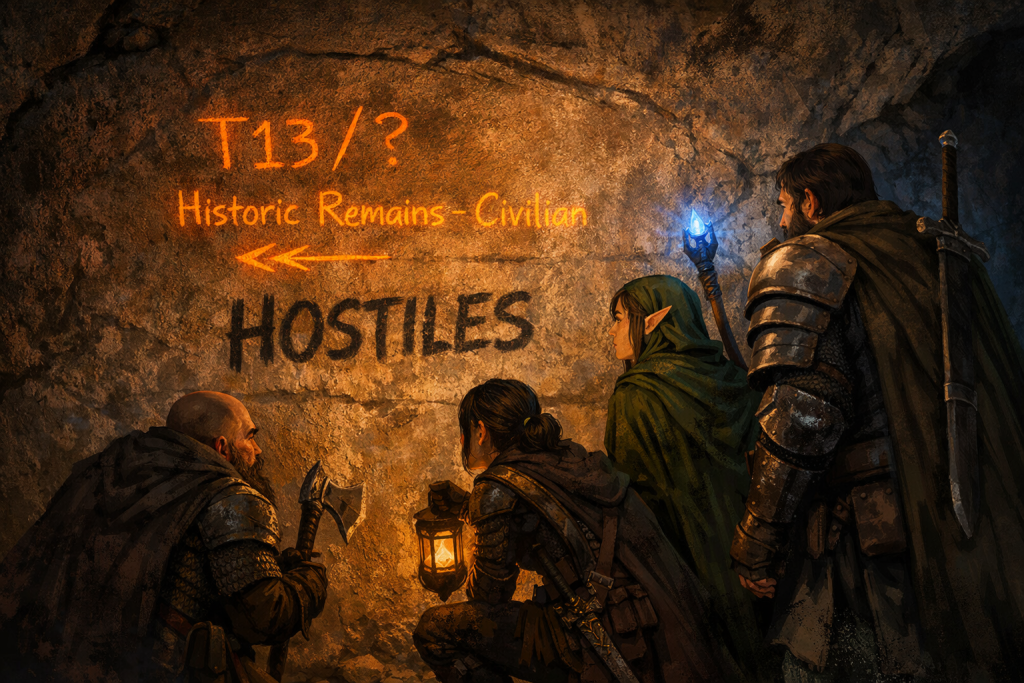
Some distance on, they paused at a branch leading left, notable for a recently cleared path through ancient rubble. The surveyors’ familiar orange phosphorescent chalk marked it neatly,
T13 / ?
Historic Remains – Civilian
Beside the notation was the double arrow that had, by now, come to reassure them: no unusual difficulty, no special danger. A route meant to be traversed, not feared.
Beneath the chalk, however—scratched in thick charcoal, clumsier and more forceful, and unmistakably not in a surveyor’s hand—was a single word:
HOSTILES
The word prompted the party to pause and plan their entry carefully.
Merrythought and Wolfgang moved ahead first, darkvision sweeping the corridor as the others followed at a careful distance. No movement greeted them. No ambush. No sound beyond the quiet press of stone and the party’s own breath.
The corridor itself was linear and deliberate, cut straight through the rock. The near end had been opened and measured by the Plumbline Four. The other remained sealed by a collapse of rubble, left untouched.
Between the two lay the dead.
Not soldiers.
Not arranged.
Between fifty and a hundred human skeletons filled the corridor, some piled haphazardly, others sprawled where they had fallen. Skulls crushed. Ribs shattered. Long bones cleaved cleanly or broken with excessive force. In places, the violence had been indiscriminate; in others, chillingly precise.
One adult lay draped over two smaller bodies, arms curved protectively even in death.
Scattered among them were the quiet signs of life interrupted rather than battle joined: improvised bedding, cooking pots blackened by use, a cracked hand mirror, children’s toys worn smooth at the edges. Trade tools lay where they had been dropped. Boots were mismatched, patched, resoled, and shared. A few utility knives appeared—but no armor, no weapons, no insignia of rank or service.
The clothing told its own story. Civilian garments predominated, though some bore the practical cut and reinforcement of camp life—military-adjacent rather than military itself.
Here and there, the brutality escalated beyond necessity. Overkill. Rage. Bodies that had been struck again and again long after death was assured.
Elsewhere, restraint of a different and equally unsettling kind: wrists bound, bodies executed with minimal trauma. Efficient. Intentional.
Fragments of weapons lay among the remains, broken or discarded. Their inscriptions were Orcish.
There were no Orcish dead.
Careful inspection found a page from a logbook, somehow preserved from the ravages of the centuries,
The xiv Day since we left the Waggons
Washing done this morn.
The Officers’ shirts first, as commanded.
Hose to be boiled longer, for the lice are again upon us.
The blue threed is almost spent.
Mending after the mid hour:
ii soles of boots
ii straps of armour
i scabbard seam
Nails few.
The awle yet holds.
Leather nearly gone.
Pottage this night, thin.
Keep the fat for bread if the waggons come.
If they do not, broth only.
The little ones first.
The Captain burned rags for warmth, though he was warned.
The ash spoiled the wash, and the bandages are lost.
I shall speak with him again, the gods grant he hearken.
Surveyors’ bootprints skirted the edges of the carnage. They had not disturbed the bodies beyond what was necessary to take measurements and note the space. Professional. Minimal. Respectful in the only way left available.
On one section of wall, written in the same faintly glowing chalk as the surveyors’ marks, was a single line:
May those who found no shelter here find it elsewhere.
Scrawled over it in charcoal, heavy-handed and furious:
THE ENEMY SHOWED NO MERCY
A small cairn of stones had been erected nearby, careful despite the circumstances. Beside it lay a carved wooden giraffe—crude, animal-shaped, worn smooth by handling. No magic clung to it. Just use. Just care. Scratched faintly along its side, barely legible:
For luck.
A child’s trinket.
Among the debris were coins—old, worn nearly flat with age. A mixture of ancient Archean and ancient Orcish currency, perhaps twenty-five pieces in all. Worth little in common trade, potentially worth a great deal to the wrong collector. Valuable less for what they could buy than for the questions they might provoke.
The party gathered the coins and passed them quietly to Shamus for safekeeping.
Laveleen cast Detect Magic. Nothing answered. She then took careful rubbings from the weapon fragments, preserving what details she could.
No one spoke for a long moment.
The conclusion suggested itself without effort: this was the site of an ancient massacre. Camp followers, civilians, or refugees—humans—slaughtered by Orcs. Not a battle. Not a mistake.
Before they moved on, Cassyndra asked for time.
She prepared her divination ritual with care, laying out her tarot deck amid the stone and the dead. One by one, the cards were drawn.
For the past: Justice, inverted.
A perversion of justice. Law turned against those it was meant to protect.
For the present: The Magician, inverted.
Power present—but misapplied. Capability without wisdom. Action without understanding.
For the future: The Fool, inverted.
Not the gentle stumble into fortune, but the dangerous insistence on pushing forward regardless. Naïveté sharpened into recklessness.
The cards were gathered. The silence returned.
Whatever else this place had been, it was not merely a footnote in the tunnels. It was a reminder—etched in bone and stone—that by a certain point, the war had ceased to be about military advantage and had turned into simple annihilation.
With nothing more to be gained here without disturbing what little dignity remained, the party turned back toward the passage, leaving the dead as they had been found.
The chalk continued onward.
So did the questions.
Professional Habits
Some distance on, the passage sloped gently upward and widened into a chamber that felt—almost immediately—different.
It was dry.
Not merely less damp than the tunnels before it, but genuinely dry: the stone underfoot pale and powdery rather than slick, the air still and cool without the constant breath of water. The ceiling arched high overhead, free of fractures or recent falls. No drip marked the floor. No mineral sheen dulled the light.
Little wonder, then, that the Plumbline Four had chosen it.
The signs of an overnight camp were everywhere, laid out with the quiet efficiency of people who had done this often and expected to do it again. Four bedrolls rested in a tidy row along one wall, spaced evenly, each beneath a lantern hook that had been hammered directly into the stone. Nearby sat a small, cold fire ring—carefully constructed—with soot blackening the surrounding rocks. At its center, the party could still see the outline where a lantern had once been set to provide steady light rather than heat.
A shallow latrine trench had been dug off to one side, discreetly placed and properly filled in afterward.
Surveyor’s gear lay stacked neatly together, their contents mostly intact. Extra torches. Rations. Coils of rope. Most telling of all: several sticks of thick, waxy orange chalk, their ends worn smooth from use, the phosphorescent compound still faintly glowing in the dark.
Two exits led out of the chamber.
One bore the unmistakable prints of boots—heavy, regular, and numerous. Soldiers had passed through that way without stopping, their path direct and purposeful.
The other entrance told a quieter story: cool air flowed steadily from it, just enough to be noticeable. Someone—almost certainly the surveyors—had piled loose stones across part of the opening, blocking the draft to make the chamber comfortable enough for sleep.
The party chose that passage.
The chalk marking above it read:
T15 // → →
There was a familiar double arrow underneath as well but this time, for the first time, there was exclamation point next to one of the arrows.
The tunnel beyond was deceptively benign. Wide enough for two to walk abreast. A gentle downward slope. Smooth, water-polished stone underfoot, faintly damp with a mineral sheen that caught lantern light in subtle colors. The passage stretched perhaps forty feet before opening abruptly into a vertical chamber.
It rose thirty feet overhead.
Near the top, another passage vented sharply elsewhere, air rushing through it with enough force to stir cloaks and hair. The party paused, instinctively trying to orient themselves—to place this space in relation to the fields and ridge above.
Merrythought volunteered to climb.
She scaled the stone carefully, fingers finding purchase in natural seams, until she reached the narrow opening—barely three feet across. She heaved herself inside and followed the passage until it narrowed beyond her ability to proceed. Heka, shifting into rat form, was dispatched to scout the rest.
The familiar returned with good news. The tunnel led all the way to the surface, emerging through a mound of rubble and debris in an open field. Artificial. Deliberate. And—most importantly—distinct. The party was confident that, with a bit of searching, they could locate it again from above.
That confidence dimmed slightly when they turned back around.
Going down had been easy.
Going up was not.
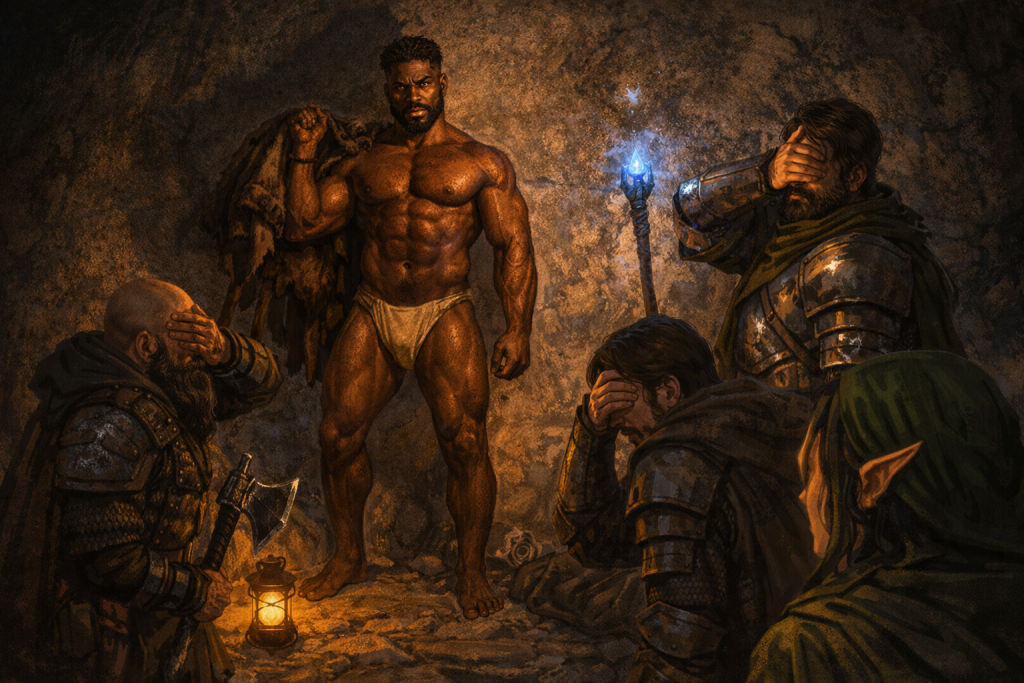
The smooth stone, damp and sloped, offered little traction. In the end, it was Hunkle who solved the problem—by stripping down to his loincloth, an act the rest of the party later agreed had been gratuitous. With slow determination, he climbed the incline, hammering pitons into the rock and stringing rope as he went. One by one, the party hauled themselves—and then their gear—back up to the surveyor camp.
A closer inspection of the passage told the rest of the story.
The Plumbline Four had done exactly the same thing—but in reverse. Piton marks were visible near the top, though the hardware itself was gone. They had prepared the route for ascent, descended, and then—when they returned—removed every rope and spike with them.
Not for the first time—and perhaps not the last—Merrythought found herself marveling at the fact that the Plumbline Four seemed, on balance, smarter than the party.
Resolving to correct this imbalance in the future, she quietly “acquired” a generous supply of the orange phosphorescent chalk before they moved on. She also resolved—silently and with some embarrassment—to outfit herself with twine, fishing line, a compass, and the other unglamorous essentials of competent exploration before descending into the depths again.
It was only later, however—well after they had left the chamber behind—that the thought finally settled into place.
The surveyors had slept here on the night between their two days underground.
Whatever they had seen after leaving this camp had been enough to send them straight back to the surface without delay, without cleanup, without even this small concession to habit.
And whatever that was, it had been enough that they were soon ordered back underground—this time with two full squads of soldiers.
Whatever it was, it still lay ahead.
The Shortcut That Cost Too Much
Following the soldiers’ trail was, at first, uncomplicated.
Bootprints pressed deeply into softer stone, marching forward with the confidence of trained troops who believed themselves in control of the situation. The surveyors’ chalk marks—measurements, arrows, confirmations of safe footing—must have reinforced that confidence. This was not a retreat. It was an advance that expected to succeed.
Then the passage split.
To the left, the route was wide, level, and clearly marked by the Plumbline Four. Measurements ran neatly along the walls. Arrows guided the way. Reassuring annotations suggested a long but safe loop—time-consuming, yes, but reliable.
To the right, the tunnel narrowed sharply.
Painted in thick charcoal across the stone, hurried and emphatic, was a single instruction:
PIKE FOR RETRIEVAL
The bypass itself rose at an angle, six to eight feet tall and no more than three or four feet wide. Its walls bore the scars of boots and hands, of effort expended quickly and without elegance. It was not a passage meant for comfort. It was a gamble.
From somewhere ahead—below—the party heard a voice.
“Is anyone there?”
When they answered, the voice carried unmistakable relief. It identified itself as Corporal Isembard Pike—Ise—a member of the most recent expedition into the caves. She explained her situation with the calm precision of someone who had already rehearsed the words many times, alone.
She was alive.
She was trapped on a stone outcropping with a broken ankle.
And she was very much aware of how close to death she had come.
The surveyors, Pike explained, had known that the left-hand passage formed a half-day loop back to the main route. Lieutenant Armand Kessler, however, had been unwilling to accept the delay. The surveyors had discovered something directly beneath the prison—something Kessler believed posed an imminent threat. If the surveyors had been seen exiting the caves, then whatever lay below might already be preparing.
Speed mattered.
So Kessler ordered a shortcut attempted.
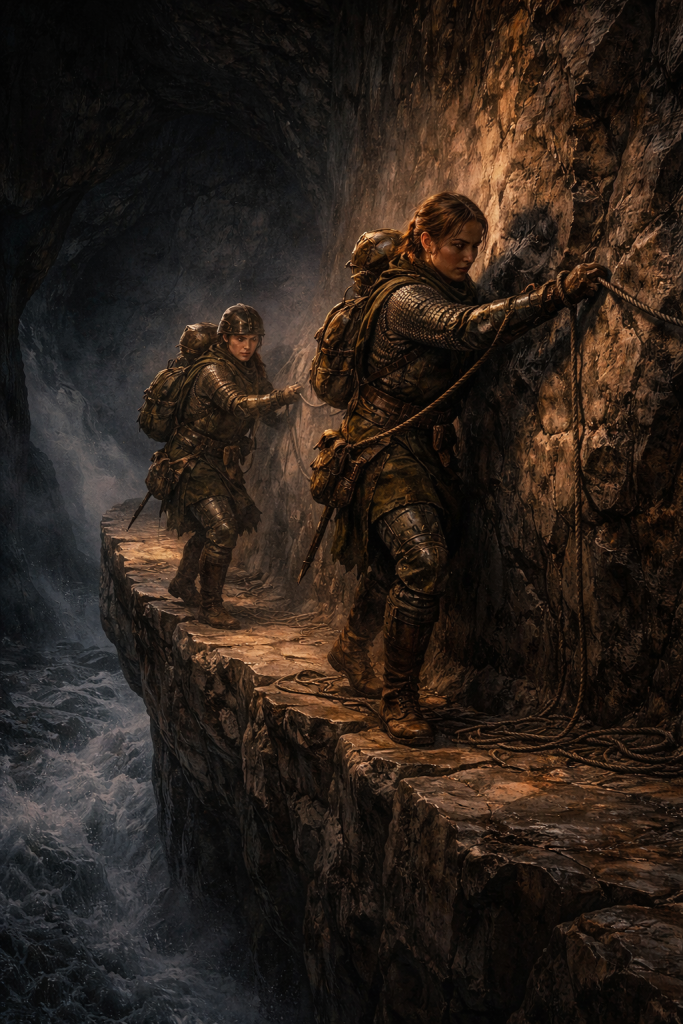
Private Maren Holt and Corporal Pike—the smallest members of the patrol—were chosen to cross first. The bypass narrowed into a sheer ledge: three feet wide at best, slick with mineral sheen, bounded on the right by an unyielding stone wall and on the left by a chasm plunging into the roar of a distant underground river.
Holt crossed first.
She made it.
On the far side, she secured the rope to a natural anchor and signaled Pike to follow.
Pike stepped out onto the ledge with additional equipment, inching forward, guided by Holt’s steady instructions.
Her foot slipped.
The anchor tore free.
She fell—only eight feet but enough. She landed hard on a lower outcropping, her ankle shattering on impact.
Private Ahab was sent after her. He nearly reached her before his own footing failed. He fell into the ravine, bouncing from wall to wall before vanishing into the river below. Pike never saw him again and held no hope that anyone ever would.
At that point, Pike said, Lieutenant Kessler made a decision.
Food, water, medical supplies, and a modest healing potion were lowered to her. Kessler told her they would take the long route, meet Holt on the far side of the bypass, deal with the threat beneath the prison, and retrieve Pike on the way out.
It was, Pike acknowledged without bitterness, a hard choice.
But a necessary one.
While the patrol made the half-day loop, Holt waited alone on the far side of the shortcut.
She did not remain alone for long.
Something attacked her.
Pike never saw it. She only heard it—felt it, really—through vibrations in the stone. After Holt was killed, the creature moved to the ledge above Pike’s position. It listened.
It listened.
Very carefully.
Pike learned quickly that silence caused the creature’s attention to wander. So she made noise—soft, irregular sounds, just enough to keep it focused on her. When the patrol finally reached Holt’s body, Pike warned them not to speak, not to clatter, not to draw the creature’s attention away from her.
They buried Holt, moved on, and never came back.
When Pike finished speaking, the party crept forward and saw the truth of it laid out before them.
The ledge was exactly as she had described: narrow, slick, and sloping gently toward the open chasm. The stone wall to the right offered no handholds. The drop to the left vanished into darkness and noise. Somewhere below and around a bend to the right, Pike lay stranded on a lower shelf—her voice echoing faintly upward.
Above her, out of sight, something waited.
Heka volunteered to scout in rat form, rounded the bend, and promptly died.
The silence that followed was heavy, broken only by the distant rush of water and Pike’s careful, deliberate breathing.
At her urging—and after grim consideration—the party chose not to fight here. Not on this ground. Not with this margin for error.
Instead, they did what the soldiers had done.
They turned back.
They took the long way around.
And began the half-day loop, hoping—very much hoping—that they would arrive before the thing listening in the dark decided it had waited long enough.
The Long Way Around
The party did not linger.
With Corporal Pike’s voice still echoing faintly in their minds, they took the long route at a brisk, purposeful pace. The surveyors’ chalk guided them unerringly—arrows clean, distances measured, warnings precise. This path was safe.
That, more than anything else, made it feel slow.
Time pressed in ways that had nothing to do with fatigue.
Along the way, they passed a small clearing where the soldiers had paused briefly—a hasty meal, a moment of rest. Crumbs, scuffed bootmarks, the ghost of impatience. The urgency that had driven Lieutenant Kessler onward had not permitted long reflection.
At one point, they noticed a vertical opening high above the passage, a pale breath of daylight filtering down from a place well beyond reach. Another possible way out. Another route not taken.
The caves themselves told a deeper story. Much of the loop consisted of natural passages—water-carved stone, slow curves, patient geology—but these were punctuated by stretches of unmistakably constructed corridors. The stonework was old. Very old. And they had never seen it before.
Not Archean.
Not dwarvish.
Not Orcish, as Wolfgang had come to recognize it.
The proportions were off. The joins too deliberate. The angles subtly hostile to comfort. The party speculated that whatever civilization had built these passages had done so long before the orcs ever came here.
At the far end of the loop, the party found what they had been expecting.
And what they had been dreading.
The cairn was small and careful.
Stacked stones formed a low mound, with larger markers at the head and feet. An upright helmet—cracked but respectfully placed—stood at the head. Charcoal markings nearby read simply:
Holt KIA – For Recovery
Beneath it, in steadier hand:
Maren Holt – She crossed first
Her armor and weapons were gone, taken by the patrol for reuse or necessity. But her personal effects had been left behind, arranged with quiet intention.
A rock with a natural hole through it, threaded with a loop of red cord. A lucky charm.
A small carved wooden token bearing a laughing face. On the back, scratched deeply:
Holt – Don’t Lose Again!
And one more thing.
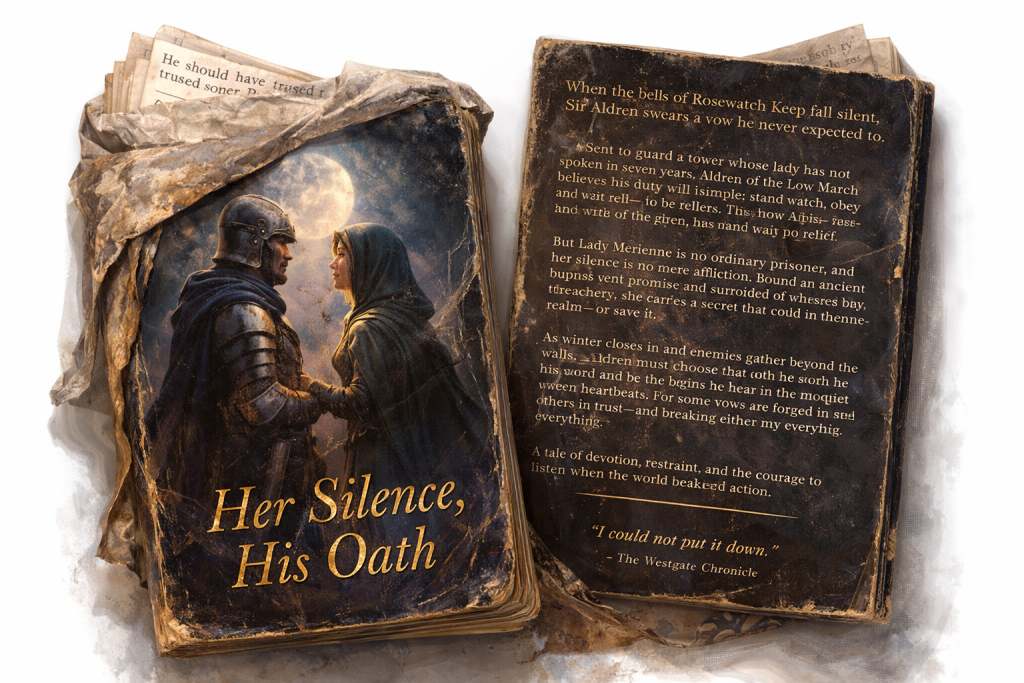
A small, badly creased paperback wrapped carefully in oilcloth. Cheap print. Mass-produced. The sort of book sold at roadside stalls and market corners. The sort that did not survive unless someone wanted it to.
The title read:
Her Silence, His Oath
The cover showed a knight and a cloaked figure facing one another beneath a full moon, faded but still legible. Several pages were dog-eared. In one margin, a single note had been written in pencil:
He should have trusted her sooner.
Merrythought sniffed and dismissed it immediately as an exemplar of the Lust for Luann genre. Nevertheless, the party kept it feeling that GM had described it with far too much care for it to be meaningless.
A closer examination of Holt’s remains told a more unsettling story.
There were no bite marks.
No tearing.
No crushing trauma from above.
Instead, her most of her injuries were on the left side of her body. Fractured ribs and clavicle. Deep, curved lacerations along her shoulder, upper arm, and flank—irregular, asymmetrical, nothing like claws raking downward.
Her clothing was torn and the right side of her body was abraded and bruised as if she’d been dragged across the ground. Something heavy had struck her on her left and dragged her on her right side.
There was blood in her ear canals.
This had not been a simple mauling.
Whatever killed Private Holt had hit her sideways—hard enough to break bone, fast enough to rupture balance and sense alike.
The party stood quietly for a moment longer then reburied her carefully.
Then they turned their attention to the bypass.
From this side, the bypass told a different story.
The ledge was still narrow and treacherous, but the approach was better. The angles made more sense. Pike’s outcropping was visible now, and above her—barely discernible against the stone—something stood.
Something that was not quite stone.
Wolfgang closed his eyes and focused, shutting out sight entirely. Through tremor sense alone, he fixed its exact position—weight distributed unnaturally, motionless but alert. He called it out softly. Cassyndra followed his indication and summoned fire, shaping Create Bonfire directly onto the unseen shape.
Flame licked stone.
The illusion shattered.
The fight that followed was ugly and constrained, fought on treacherous ground with no room for flourish or error. Throughout it all, the creature made no sound—not a roar, not a hiss, not even a breath. It did not threaten. It did not react to pain. It simply moved.
Missiles flew where blades could not reach. Spells cracked and flared in tight arcs, their echoes swallowed by the chasm. The creature charged despite the footing, crossing the ledge with terrifying certainty.
In the chaos, Cassyndra went down.
A misjudged angle, a split second of confusion—an Eldritch Blast, meant for the creature, caught her squarely in the back. The impact drove the breath from her lungs and sent her stumbling forward just as the beast surged toward her.
She scrambled backward, hands slipping on the slick stone, and for a heartbeat found herself face to face with it—too close, too exposed. One hooked limb struck her hard. Bone rang against stone.
Cassyndra fell.
For an instant, the fight teetered.
Shamus stepped in, steel meeting stone, and for a moment the two traded blows that could each have been fatal. Then Chorizo launched himself forward in a blur of teeth and fury, finding purchase where steel and spell had struggled.
The creature fell.
Silence returned all at once, broken only by the distant roar of the river below.
Shamus reached Cassyndra first, laying hands upon her with urgent precision. Lay on Hands pulled her back from the edge, and her own Healing Word, hoarse but determined, sealed what remained. She gasped, eyes snapping open, very much alive.
Later, the party would joke that now that she’d brushed death, her divinations ought to be sharper. At the time, no one laughed very hard. It had been far too close.
Pike was rescued immediately after. A healing potion was administered, and the transformation was immediate and unsettling. The contaminated, open fracture of her ankle cleansed itself and knit back together before their eyes. She stood shakily, very much alive.
Only then did they take a proper look at what had hunted her.
At rest, it was almost indistinguishable from the stone around it—a slab of fractured rock whose hide was uneven and mineral-textured, dotted with lichen-like growths. Limbs folded inward so tightly that its silhouette broke into meaningless angles.
When it had moved, however, the illusion had collapsed – stone had unfolded, long, hooked forelimbs flexed outward, and a head emerged from what had seemed like nothing more than a crack.
In death, its eyes told the final story: vestigial, recessed, clouded. Nearly blind. The creature was only able to sense the direction of light and the language of vibration.
With Pike alive, the creature still, and Cassyndra breathing once more, the party gathered themselves and prepared to move on—knowing they had arrived too late for some, but not for all.
And knowing, too, that deeper in the caverns, answers still waited.
Stones Thrown, Stones Returned
The party advanced cautiously, senses stretched thin by habit rather than immediate threat.
Without warning, a stone clattered across the floor from somewhere ahead, skidding to a halt just short of their boots. It had not been thrown with enough force to injure—only enough to be unmistakable.
They stopped.
No second stone followed. No hiss, no shout, no charge from the darkness. Whoever had thrown it had succeeded in its purpose: they had the party’s full attention.
After a moment’s consideration, Wolfgang bent, picked up the stone, and tossed it gently back in the direction it had come from.
Nothing happened.
They advanced another careful thirty feet and noticed a crude figure scratched into the wall at about waist height: a stick figure, no more than a foot tall, its lines rough but deliberate.
As they studied it, a small shape detached itself from the shadows ahead. A kobold crept forward with exaggerated caution, laid something on the stone floor, and immediately scurried back out of sight.
The offering was an ancient awl—iron once, now little more than rust and memory. The tool was broken, useless by any practical standard, but clearly meaningful.
The party took it for what it was.
Despite the reputation of kobolds as malicious trap-layers and irredeemable nuisances, they responded in kind, placing a small offering of their own on the stone floor and stepping back.
Two kobolds emerged this time, watching closely.
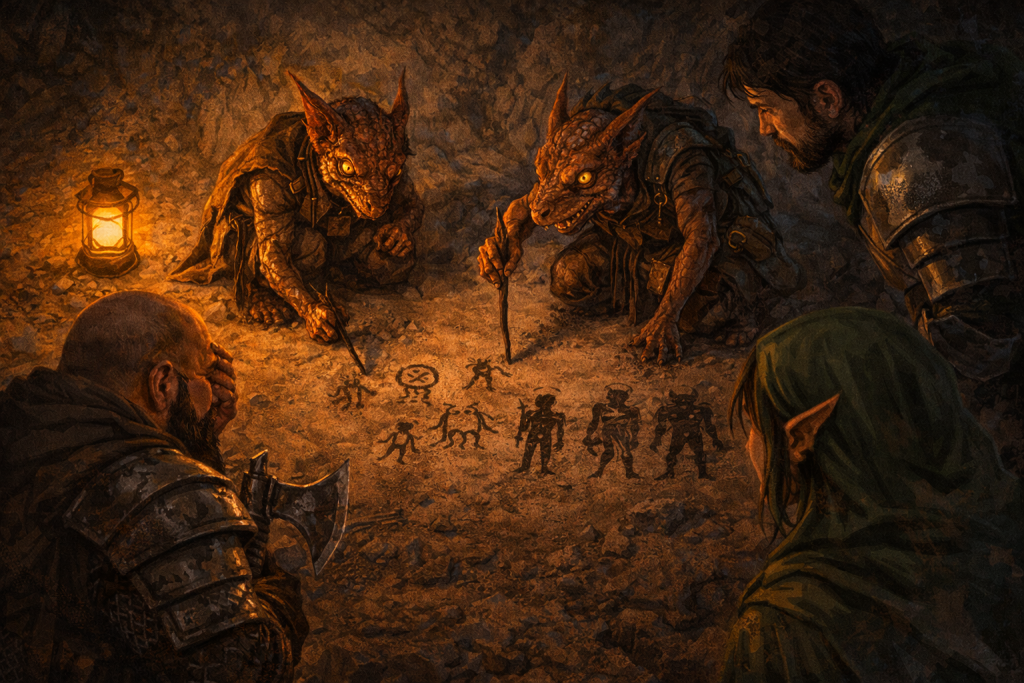
What followed was not so much a conversation as a negotiation conducted in fragments: single words, gestures, and rough drawings scratched into the damp earth with sticks and claws.
Laveleen frowned thoughtfully.
“Kobold language is palindromic,” she recalled. “Words invert to mean their opposite.”
Unfortunately, her attempt to cast Comprehend Languages failed outright. Whatever dialect this was, it seemed too insular, too localized, for the spell to find enough shared understanding in the world to translate.
It did not matter.
Patience, friendliness, and a shared willingness to look ridiculous proved more effective than magic. Gradually, meaning took shape. The kobolds relaxed. Weapons stayed sheathed. And eventually, the party found themselves gestured forward—invited, unmistakably, to follow.
The kobold colony lay deeper in the stone.
They did not see all of it—nor were they meant to—but what they glimpsed made the scale clear. Living quarters carved from narrow passages. Communal spaces worn smooth by countless feet. Fifty to a hundred kobolds, at least, moving quietly and purposefully through their lives.
There were eggs. Many of them.
Communication improved as they went. The party learned a handful of kobold words. The kobolds learned a few of Common. Everything else was accomplished through drawings, repetition, and a remarkable amount of goodwill.
From them, the party learned much.
Four humans had passed through earlier—almost certainly the surveyors. The party recognized their chalk symbols, including a circle with a check next to it.
Their visit had been brief and, by kobold reckoning, peaceful.
Later, soldiers came and there was a fight.
Many kobolds were slain. One soldier fell as well. The bodies of all the dead had been carried out, and the soldier’s armor bore the name Private Kass.
The kobolds showed where ears had been taken from the kobold dead.
Pike explained grimly that bounties were paid for kobold ears, and others like them—Creatures of the Dark, according to Crown accounting. Hastily, Wolfgang adjusted his necklace of rum gremlin ears so that it sat beneath his armor rather than above it.
When the party explained—through gesture and shared symbols—that they had found a dead kobold among the giant spiders in the ancient Orcish storerooms, the kobolds accepted the news with stoic grief. Life, it seemed, was often short underground. Loss was expected. Mourning was brief but sincere.
Trade was attempted next.
The kobolds had difficulty understanding that the party did not wish to trade, but rather to give. This caused some confusion and considerable discussion.
Eventually, food changed hands. Pickled herring was received with enthusiasm. Hardtack, sampled once, was politely returned.
The kobolds then drew maps—simple but effective—indicating the direction the surveyors and soldiers had gone. No one, they emphasized, had returned.
In that direction, they drew tall, six-limbed figures that stood upright.
The party exchanged looks.
Formorians.
Interestingly, the kobolds did not consider these creatures a threat. Distant, uninterested. The eight-legged spiders at the Orcish storerooms, by contrast, were drawn with unmistakable hostility.
The kobolds did not trade with the six-legged beings. Neither side interfered with the other.
The kobolds offered to guide the party there.
They moved quietly, as kobolds always did. Sound, they seemed to understand instinctively, was danger.
Before departing, the party was given a rough map of the route ahead—etched into damp stone and memorized carefully. The direction matched what they already suspected.
The surveyors had gone that way.
So had the soldiers.
And whatever waited there had not yet been persuaded to let anyone leave.