November 1st – 5th, 973
“Doorkna”
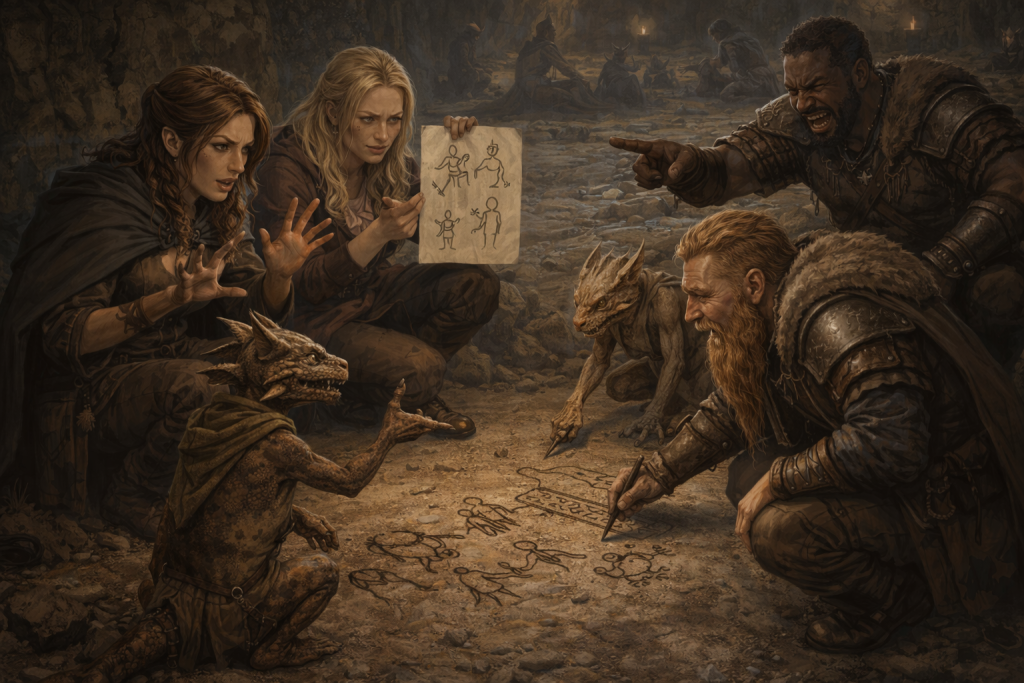
By the time the party felt confident enough to accept the kobolds’ offer of guidance, what they had established could only generously be called a shared language.
It consisted of:
- A handful of actual kobold words
- A slightly larger handful of Common
- Elaborate pantomime
- Aggressive drawing in the dirt
It was, against all odds, working.
Cassyndra paused before they set out and consulted the fates with Augury, laying out the situation with careful specificity. The answer, when it came, was almost… encouraging. Not a promise of safety, exactly—but a strong sense that if the party continued doing what they had been doing so far—moving slowly, showing restraint, thinking before acting—the near future held no great calamity.
Which, for divination magic, counted as ringing praise.
Reassured, the party left a final round of gifts for the kobolds. Merrythought took a moment to demonstrate the intended use of the crowbar they’d offered, which prompted a short but intense kobold discussion, culminating in enthusiastic nodding and one kobold immediately attempting to use it on a completely inappropriate rock.
Then they moved on.
The kobolds ranged ahead, silent as habit, while the party followed the descending passages toward the same chamber the surveyors had been leading the soldiers to.
Somewhere along the way the kobolds had acquired a new word. No one was entirely sure who taught it to them. It might have been Ant. It might have been Merrythought. It might have been Shamus, who denied everything with suspicious firmness. But however it happened, the phrase “dead as a doorknob” had entered the kobold lexicon.
Naturally, they shortened it to the minimum required for comunication.
“Doorkna,” said the lead kobold, holding up three claws.
The party froze.
Ahead lay three bodies.
Their armor marked them clearly as soldiers. Their nametags read:
- Private Elian Rowe
- Corporal Tamsin Kull
- Private Jorek Vann, ironically known among his unit as the expedition’s best swimmer
They had drowned.
The passage bore unmistakable signs of having recently been completely flooded—waterlines reaching the ceiling, silt clinging to walls, debris jammed into cracks. The water had come and gone with terrifying speed. Jorek’s fingers were torn and bloody, as though he’d tried desperately to cling to the stone while the current tore him free.
Wolfgang examined the stone carefully and came to a quiet but important conclusion: whatever had caused the flood had come from ahead, not behind. The passages they’d already traversed were dry. The ones before them were still slick and wet.
Laveleen cast Detect Magic as a ritual. The kobolds watched with intense interest and attempted to copy her motions, achieving nothing except a very earnest-looking kobold semicircle.
The spell found nothing.
Which, in context, was worse than finding something.
They pressed on
Not far beyond the drowned soldiers, the air changed again—not in any way that could be measured, but in a way that could be felt. When Laveleen reached for her magic once more, the familiar ease was gone. The spell still answered her call, but sluggishly, as though dragged through resistance.
Cassyndra noticed it next. Then Merrythought.
Casting here felt like pushing one’s hands through fine netting—no single strand strong enough to stop the motion, but collectively tugging, catching, dulling precision. The magic bent. It obeyed. But it did so reluctantly, as though the space itself resented being shaped.
No words were spoken, but glances were exchanged.
They had felt this before.
Whatever caused it was close now.
Tapping in the Dark
Some distance ahead, the kobolds halted again—this time not to speak, but to listen.
The party did the same.
At first, there was only the river: the constant, distant roar of water moving with indifferent force. Then, faintly, threaded through it, came another sound.
Tap.
Pause.
Tap-tap.
Irregular. Unsteady. Metal on stone. Or metal on metal.
It took several heartbeats before recognition landed.
“That’s…” someone whispered.
Private Ahab.
The memory came back unbidden: the sound of his armor striking rock as his body had been battered downstream, helpless in the flood.
With hearts lodged firmly in throats, the party followed the sound into a narrowing side passage. It twisted, constricted, and then opened abruptly onto a rushing underground river—and a narrow ledge on the far side.
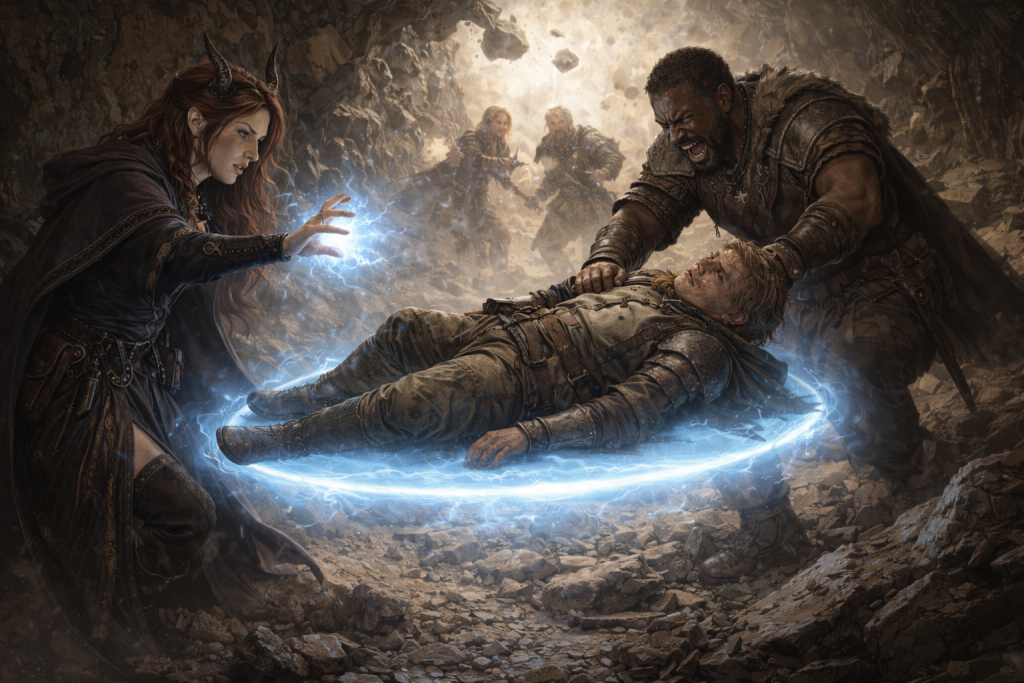
Lying there was Private Renn Ivar. He was barely alive. He was pale, soaked, and shaking, one arm wrapped tightly against his ribs, a utility knife clenched in numb fingers. When he saw them, his shoulders sagged with relief.
Laveleen conjured Tenser’s Floating Disk, and with careful coordination they ferried him across. The kobolds, recognizing his armor, watched warily. This was one of the soldiers involved in the earlier massacre. But they did not interfere.
Ivar collapsed once he was safely across—exhausted, wounded, and shivering uncontrollably—but coherent enough to speak once warmth and a bit of care were applied.
In his words, the encounter with the kobolds had been a “pure clusterfuck.”
The surveyors and soldiers had been actively trying to avoid the kobolds when both groups blundered into one another unexpectedly in the darkness. Someone yelled “CONTACT.” That was all it took. Steel came out. Curses flew. Panic did the rest.
Lieutenant Kessler—and the detachment sergeant soon after—had screamed themselves hoarse trying to regain control. After several kobolds and one soldier were dead, they finally managed to pull the troops back and allow the kobolds to flee.
Kessler had not ordered the taking of ears.
But when the soldiers—already keyed up, already angry—mentioned the bounties, he permitted it. Their pay was poor. The losses were mounting. No one wanted to walk away empty-handed.
By then, Ivar said, Kessler seemed… different.
Agitated. Pressed. He spoke about making the deaths mean something. About speed. About striking before the enemy could fully prepare.
The faster they moved, he believed, the fewer soldiers would die in the end.
Eventually, they had reached their objective: a passage opening into a large, self-lit cylindrical chamber. The platoon formed up to assault it. Ivar was placed in the second echelon, just ahead of the surveyors.
The signal was given and they screamed a warcry and advanced.
Thirty seconds later, the lights went out.
There was shouting. The clash of weapons. Confusion layered atop confusion.
And then the flood.
A massive deluge tore through the chamber, sweeping Ivar off his feet and hurling him down the corridors and into the river. He remembered Kessler shouting orders—trying to rally his command against something—before the current tore them apart.
He never saw the enemy but from briefings, he believed they were supposed to be giant spiders.
He washed downstream until, by chance or stubbornness, he managed to claw his way onto the ledge where they found him—wounded, hypothermic, and alone.
So he tapped.
Knife to stone.
And waited.
Professionals. Waiting Patiently.
From there, the party pressed on—and eventually found the Plumbline Four.
They were ensconced in a dry, stable chamber, very much alive, not particularly surprised to see the party, and immediately curious about how Harlan Vetch was doing.
As it turned out, long ago, the Four had recognized the risks inherent in exploring dangerous tunnels on behalf of the Crown and made arrangements accordingly. They had left Vetch a thousand gold and a simple agreement: if they ever failed to return, he was to hire the very next group of adventurers that passed through and send them looking.
Professional habits, after all, involve robust contingency planning.
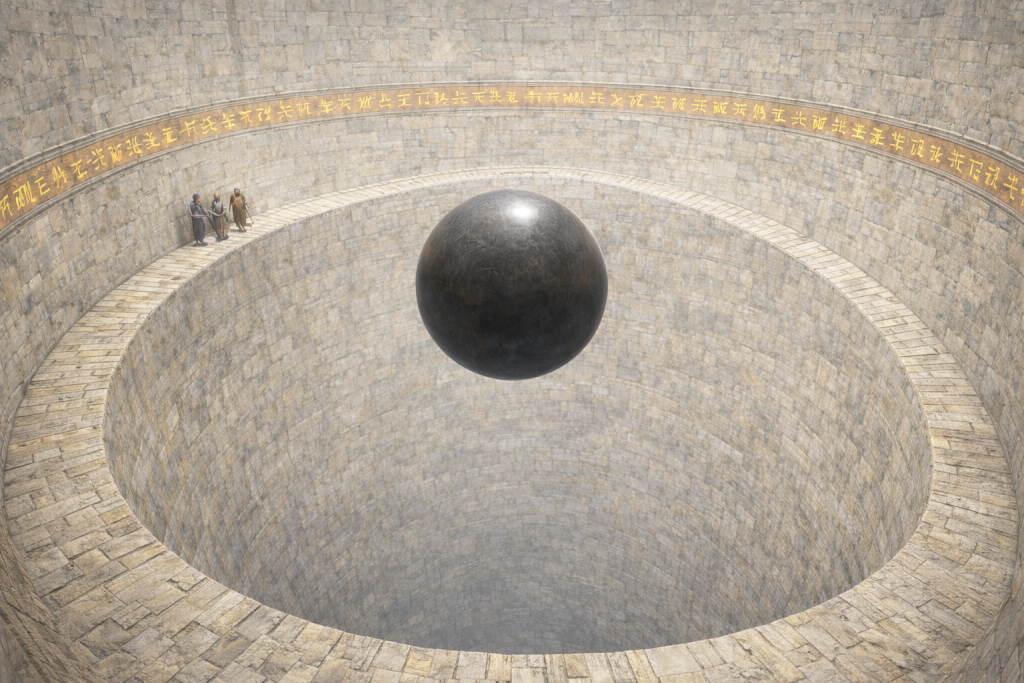
Their account confirmed much of what the party already suspected. The initial survey had been entirely routine—measurements, chalk marks, careful notes—until they came upon something wholly unprecedented: a vast cylindrical self-lit chamber some sixty feet across, extending far above and below their point of entry.
Suspended at its center hovered a smooth, polished sphere roughly five feet in diameter. Metal? Stone? Something between? They could not say.
A corkscrewing ramp ran along the chamber’s walls, with radial corridors extending outward like spokes. Six-legged, spider-like creatures worked methodically along the stone, maintaining runes and glyphs etched into the surface. They took no notice whatsoever of observers.
And magic did not function there.
That fact alone had convinced the Plumbline Four to abort their mission and report. It was while preparing that report that they realized the chamber lay directly beneath the prison. They noted this carefully—and soon after, orders came down to return and guide two squads of soldiers to the site.
And it seemed that someone, somewhere up the chain, had noticed the absence of magic in their report. All of the soldiers assigned to the expedition were non-spellcasters.
At this point, Rhea Calder—one of the Four—interrupted the story by producing her personal stash of pickled cave eel strips and insisting everyone try them.
“It’s my own recipe,” she explained cheerfully. “I collect the eels underground, cold-smoke them, then pickle them topside. They keep indefinitely.”
The party dutifully—and skeptically—sampled the strips.
They were chewy.
Very chewy.
Chewy for an impressively long time.
Intensely sour. Vinegar-forward, with an undernote of iron. After several seconds, most mouths went numb.
Seeing this, Calder reassured them, “You chew it longer than you think you need to. That’s how you know it’s working” opining still further, “Better than rations. At least this fights back a little.”
The party concealed their disappointment when it became clear that the strips possessed no restorative properties whatsoever—no healing magic, no alchemical benefit—only distressing persistence.
Continuing, the Four confirmed what the party had already learned about the second expedition: the haste, the disaster at the attempted shortcut, the accidental clash with the kobolds, and finally the assault on the cylindrical chamber itself.
They had been at the very back of the formation and saw none of the actual fighting. Like Private Ivar, they remembered only that it lasted less than a minute before a sudden, overwhelming deluge tore through the space. They stayed together only because they had roped themselves together as a matter of course while exploring caves.
A thoughtful silence followed.
Toven Isen broke it.
He introduced himself as “something of a poet” and explained that caves were a great source of inspiration for his work. With little to do while awaiting rescue, he had composed a new piece and was keen to get “honest reactions”.
He cleared his throat.
And read.
“Stone That Listens”
O stone, thou patient archivist of feet,
Who know’st the weight of men and beasts alike,
Attend my tread and keep me from the fall
As chalk attends the wall and does not lie.
Thy angles speak in quiet rectitudes,
Obtuse with age, acute with hidden spite,
Yet still thou stand’st where lesser soils would flee
And crumble into metaphor and mud.
Here flows the water, faithful in its course,
Unthinking yet possessed of ancient will,
It sings to rock, and rock replies in turn
(Though I confess I cannot hear the words).
Below, above, the measures disagree,
My numbers quarrel with the plumb and line,
For depth resists the tyranny of math
And mocks my compass with a dampened grin.
O stone, if thou should’st one day let me pass
Not downward but to supper and to sun,
I swear I’ll mark thee kindly on the map
And name thee Stable, Though Suspicious Still.
But if I fall, remember that I tried
To love thee as a surveyor should:
With care, with chalk, with fear, and with respect,
And only minimal poetic excess.
When he finished, the silence returned—thicker this time.
The others apologized with their eyes.
“It starts out strong,” one confided afterward, “but unfortunately, it continues.”
Eventually, one of the Four recognized Wolfgang.
“Wait,” Calder blurted out. “Now I know where I recognize you from! You’re that guy from The Royal Standard, aren’t you? The prison breakout?”
There was an awkward pause.
Simple denial failed. Misdirection fared no better. Eventually, the truth—carefully partial and deliberately incomplete—emerged. Reasons were not shared. Silence was sworn.
The Plumbline Four, for their part, were quick to agree that relationships with the Crown could be… complicated. Best kept quiet. Especially when one’s survival had just hinged rather directly on the people standing in front of them.
The Chamber Beneath the Prison
Together, they pushed on to the cylindrical chamber itself—and the party confirmed everything they had been told.
The space was vast and quietly lit, a smooth-walled cylinder some sixty feet across, extending far above and far below their point of entry. The structure itself was unmistakably artificial, yet alien in its logic: not Archean, not Orcish, not dwarvish, nor anything Wolfgang could place. It felt engineered, but by a hand long absent from history.
Along the walls, six-legged, spider-like creatures moved with deliberate precision. They maintained glowing glyphs and runes etched directly into the stone—ancient Orcish script, meticulously preserved. They worked alone or in pairs, occasionally coordinating on complex sections, their movements synchronized with uncanny efficiency.
They did not speak.
They did not react.
They did not acknowledge the party’s presence in any way.
The adventurers, the kobolds, Pike, Ivar, and the Plumbline Four were able to move freely along the corkscrewing ramp that traced the chamber’s interior. Radial passages branched outward like spokes, each terminating in small chambers lined with more runes, sigils, and softly glowing constructs. All were dead ends. None showed signs of habitation—only maintenance diligently administered by the spiders.
Above, the cylinder ended in smooth, uninterrupted stone. The Four estimated it lay roughly sixty feet beneath the prison proper. Disappointingly, there was no entrance to the bottom of the prison from here. On hearing the party discussing this quietly, Maris Quell cocked an eyebrow and asked if they were professional prison breakers moonlighting in cave between jobs.
Merrythought cracked a smile. “You might be best off thinking of us as jacks of all trades.”
Below, the chamber transitioned into something else entirely: a mining operation. The caretakers extracted raw material directly from the rock and processed it into unfamiliar components, feeding the ongoing upkeep of the chamber above. Whatever the purpose of the structure, it was ongoing. Active. Maintained.
The Plumbline Four went to work.
They tested the space methodically, casting cantrips at carefully marked points, mapping not success or failure but resistance—the subtle sense of effort, as though spellcasting required pushing one’s will through a taut net or submerged current. At one point, they roped themselves together and sent one of their number out over the open space on a rickety folding ladder, much to everyone else’s visible discomfort.
The conclusion, when it came, was elegant.
The antimagic field projected downward from the hovering sphere in a clean, cylindrical column—precise, absolute, and clearly intentional. Upward, however, the field widened into a cone, weakening as it rose but still present, still suppressive.
The downward projection made immediate sense. It was clearly designed to contain something ancient beneath the chamber—something sealed deep within the rock.
The upward projection was harder to explain.
Why suppress magic toward the surface at all?
No one had a satisfying answer.
While the Four finalized their notes, the party examined the corridor through which the soldiers had entered during their abortive attack. Near its ceiling, they found a patch of mismatched stone—subtly different in texture—and traces of residual moisture clinging where no water should have remained. Elsewhere in the chamber, the walls were dry.
This, they concluded, was the origin of the flood.
Not a failure or an accident. A deliberate response on the part of the caretakers.
And so long as the party did not interfere with the work being done here—so long as they remained observers rather than disruptors—it seemed they had nothing to fear.
That realization, somehow, was not reassuring.
The Way Out
On the long, winding ascent back toward the surface, the danger receded—but the questions did not.
With the caves behind them and time enough to think, the party spoke in low voices, trading concerns the way soldiers trade rumors after a battle: carefully, and with an eye toward who might be listening.
The first and most obvious problem was Wolfgang.
The bounty on his head—ten thousand gold—was not the sort of number that invited casual moral heroics. It was the sort of number that ruined friendships and rewrote loyalties. Quietly, cautiously, Laveleen brushed the edge of Detect Thoughts across the Plumbline Four as the subject arose. What she found was not calculation or temptation, but anxiety—raw, immediate, and entirely self-directed. They were already rehearsing explanations, weighing which truths could be spoken aloud and which would only make things worse. Eighteen dead out of the twenty they guided into the caves was a reckoning all its own.
When the party addressed the matter directly, the Four did not hesitate. They owed their lives to the adventurers, and they understood—perhaps better than most—how perilous entanglements with the Crown could become. They agreed to say nothing of Wolfgang. Some debts, they acknowledged, were best repaid with silence.
That led naturally to the next concern: reports.
Who would say what, and to whom?
The party and the Plumbline Four compared notes, aligning their accounts where they could and leaving deliberate gaps where certainty would only invite scrutiny. There was no appetite for contradiction. Too many eyes would be looking for inconsistencies. Better to present a single, incomplete truth than several competing ones.
And beneath it all lay the most unsettling question of all.
Would the regime decide that the disaster itself was not the problem—but the witnesses were?
The possibility was discussed without melodrama, because none of them needed to imagine it very hard. The Crown had buried inconvenient truths before. It would do so again if the calculus demanded it. The party resolved to listen carefully in the days ahead—for rumors, for sudden reassignments, for quiet disappearances that spoke louder than proclamations ever could.
By the time they emerged into daylight, decisions had been made. Lines drawn. Stories agreed upon. There was a brief and joyous reunion with Pabst at the surface who was pleased to announce that due to his fierce and diligent guarding of the entrance… absolutely nothing had happened.
The soldiers and the Plumbline Four were escorted home as outlined earlier—alive, shaken, and carrying far more weight than they had brought with them underground.
Behind them, the caves closed once more. But nothing about them felt finished.
Borrowed Stone, Borrowed Purpose
In the lull that followed their emergence from the caves—when wounds had been bound, packs repacked, and the body finally began to remember what daylight felt like—Laveleen and Wolfgang took advantage of a resource that most adventurers never thought to use properly.
The Adventurers’ Guild network.
The great, humming lattice of scrying mirrors, index crystals, annotated spellbooks, and mutually hostile scholarly addenda—known formally as the G.O.O.G.L.E. (Grand Omniversal Oracle for Geographical Lore and Erudition) and informally as the World Wide Wizards Web—was as close to institutional memory as the Guild possessed. If anyone, anywhere, had written something down and not actively tried to hide it, there was at least a chance it was referenced there.
They started with the obvious inconsistency.
The architecture of the cylindrical chamber—the precision-cut stone, the geometry, the smooth curvature—did not resemble known Orcish construction. The Orcish ruins the party had seen in the recent past had been awe-inspiring in their way but blunt in their engineering. Built to endure, not to impress. Built differently from the cylindrical chamber.
The runes and glyphs, however, were unmistakable. Ancient Orcish. Functional rather than decorative. Maintained, not merely inscribed.
Laveleen pursued a simple question first: Was there evidence of cohabitation?
Joint settlements. Shared iconography. Transitional styles. Any sign that Orcs and the unknown builders had lived side by side, exchanged ideas, or collaborated.
She found nothing.
No hybrid sites. No blended traditions. No shared burial grounds or layered habitation. Wherever this other civilization had been, it had vanished cleanly—either before Orcish ascendancy or precisely as it began.
The prevailing academic theory—such as it was—described the earlier civilization as local, advanced, and extinct. Its fall was poorly documented, not because it was secret, but because it occurred in a period Orcish historians regarded as pre-history: the era before the Orcs believed themselves important enough to record the world.
Wolfgang, meanwhile, followed a different thread.
He focused not on who built the cylinder, but on who maintained it.
Maintenance scaffolding. Access ramps. Service corridors. All Orcish additions. Practical. Modular. Built to allow inspection, repair, and ritual upkeep long after the original builders were gone.
That pattern was seen in one other Orcish site – the ruins at Gignan Ronch – in the unsettled west of Cambria. There it appeared that the orcs had discovered some artifact, understood it just enough, and then wrapped it in layers of Orcish responsibility. Not ownership. Stewardship.
By the time they compared notes, a provisional conclusion had taken shape.
The cylinder was not Orcish in origin.
It was Orcish in custody.
The unknown civilization had built it—for reasons lost to time—and then vanished. Centuries later, the Orcs discovered the structure, discerned its function, and made a choice to preserve it.
They did not rebuild it.
They did not repurpose it.
They maintained it.
They added scaffolding, runes, caretakers, and systems designed to keep the thing functioning far beyond the lifespan of any single culture.
Whatever the cylinder was meant to contain, suppress, or regulate, the Orcs had decided it was safer left intact.
That, more than anything else they found, unsettled Laveleen.
Because it meant the Orcs had known exactly what they were doing.
And had chosen, deliberately, to make sure it continued into eternity—long after the world above forgot why.
A Debt Paid Forward
After the heroes had had time to rest and relax a bit, they received the message from Harlan Vetch about the anonymous senior sergeant who wanted to meet them. That night, the night of the fourth, they kept their appointment.
The oak stood where Vetch said it would: old, broad, and solitary, its branches spreading wide against a sky just shy of moonrise. In daylight it would have been picturesque. At night it was simply exposed—plains on all sides, no cover worth speaking of. A place chosen not because it was safe, but because it was honest.
Wolfgang and Ant ranged ahead, circling wide, eyes open for anything out of place.
They were not the only ones.
Ant nearly collided with a figure moving low through the grass, just far enough from the tree to see without being seen. Hands froze. Weight shifted. Then both sides did the same thing at once: palms raised, weapons deliberately not drawn.
The junior sergeant they nearly ran into blinked, then exhaled softly.
“Well,” he muttered, “that’s a relief.”
It emerged quickly that he had been sent ahead for precisely the same reason—to ensure the meeting was not a trap. The coincidence did more than any oath could have. By the time both scouting parties returned to the oak, the sharpest edge of suspicion had dulled.
First Sergeant Elowen Thatch arrived alone.
She exchanged a glance with her junior sergeant—brief, practiced. A nod passed between them. The junior sergeant melted back into the darkness without a word.
She had the look of someone who had been in uniform long enough that the uniform had learned to behave around her. Nothing about her was showy. Her rank insignia was worn, not polished. Her cloak hung the way it would on campaign, not on parade. She did not raise her voice when she spoke, and she did not lower it either.
When she stopped beneath the oak, she regarded them calmly, then nodded once.
“Thank you for coming,” she said. “I’ll be direct.”
No one interrupted her.
“I’m currently filling a lieutenant’s berth,” she continued. “Vacancies have a way of appearing after expeditions like the last one.” Her mouth twitched, but only briefly. “Tomorrow, I receive orders. The day after, I take a forty man platoon into the caves.”
Shamus folded his arms. “To do what?”
Thatch did not soften it.
“To wipe out the kobolds.”
The words landed heavily. The party exchanged shocked glances.
“For what possible reason?” Ant asked.
“Because the prison command sees them as a liability,” Thatch replied. “Creatures living beneath a Crown facility. Potential collaborators. Potential informants. A risk.” She shrugged slightly. “And risks get eliminated.”
She went on, measured and unflinching.
“From where I stand, however, they might be a military threat down there. But they don’t need to be dead. They simply need to be elsewhere.” Her eyes hardened. “The order won’t say that. It’ll say exterminate, secure, report compliance.”
Cassyndra watched her carefully. “And you don’t intend to comply.”
“I intend,” Thatch said evenly, “to do my job without spending lives that don’t need to be spent. Mine or theirs.”
She paced once beneath the oak, boots soundless on the packed earth.
“I can delay departure until the day after tomorrow. I can advance slowly. Very cautiously. I can take the long routes. Triple-check hazards. Write reports that justify every hour lost.” She stopped and looked at them directly. “But every delay carries a cost. If I delay an order by six hours… who dies and who lives because of that choice?”
No one answered. She hadn’t asked for one.
After a moment, she spoke again—more quietly this time.
“Seventeen years ago, I was a corporal. Third Border Clearance. Never mind if you haven’t heard it; I’m told it’s been officially demoted to a ‘footnote to history.’” A quirk of the eye showed that for her it was anything but a footnote. “My unit was sent to pacify a river settlement that wouldn’t meet labor quotas. Intelligence said armed resistance.”
Her jaw set.
“What we found was mud, water, and people both literally and figuratively trying to keep their heads above water.”
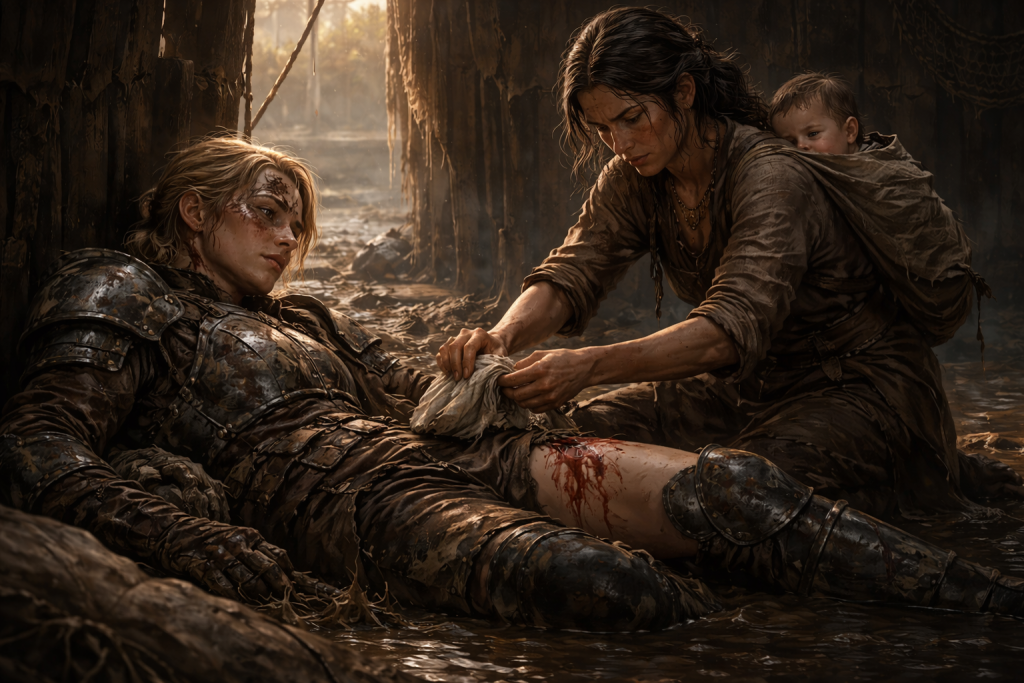
She told them what followed without embellishment: the spear in her thigh, the mud and reeds, the certainty that she would bleed out alone while the fighting moved on. And then—an enemy woman, unarmed, carrying a child. The rough binding of a wound. The hiding beneath nets. The charm pressed into her hand at dawn.
Live. Remember.
“No surviving villagers were reported,” Thatch said. “But I survived. Even though it wasn’t militarily advantageous me to do so.”
She met their eyes again, one by one.
“I learned a few things that day. Orders are written far from consequences. Obedience and honor aren’t the same thing. And sometimes survival depends on restraint, not force.”
She let that sit.
“The kobolds aren’t a threat,” she said at last. “They’re a problem someone wants solved quickly. And quick solutions always cost lives.”
Ant tilted her head. “So what are you asking us to do?”
Thatch didn’t beg. She didn’t posture.
She said simply, “Move them. Somewhere else. Quietly. Before I arrive.”
A pause.
“The Crown doesn’t need them dead,” she added. “They just need them not here. And I need my troops to be able to say the tunnels were empty when we got there. Or flooded. Or collapsed. Or already abandoned.”
Another pause—longer this time.
“Someone once spared me when they had every reason not to,” she said. “I’ve been waiting a long time to return the favor.”
The night wind moved through the oak’s branches, leaves whispering overhead.
It was Ant who asked the next question. “You’ve told us what you’re ordered to do. And what you don’t want to do. But why us?”
Thatch studied them for a moment longer.
“I was given the survivor reports,” she said. “Corporal Pike’s. Private Ivar’s.”
“They were matter of fact,” Thatch continued. “They didn’t embellish. But they mentioned what mattered. You disengaged when you could have escalated. You pulled people out who’d already been written off. You chose routes that cost time to save lives.”
She folded her hands behind her back.
“Between the lines, I saw restraint. The sort of restraint those kobolds need.”
“And if that weren’t enough,” she added dryly, “who else would I turn to? Officers won’t hear this. Clerks will bury it. Anyone inside the chain of command will be forced to obey it.”
Merrythought spoke up.
“If you’re reading reports now and will be writing them again shortly,” she said lightly, “then you should know Corporal Pike held herself together under circumstances that would’ve broken most people. Clear-headed. Responsible. She took ownership even when it hurt.”
Thatch’s expression softened, just slightly.
“She did,” she agreed. “Good soldier. Promising leader.” A pause. “I’ll make sure that’s remembered.”
Cassyndra inhaled slowly.
“I’ve seen you before.”
Thatch’s brow furrowed. “Have you?”
“In a dream,” Cassyndra said. “Or a vision. You were wearing that uniform. I didn’t understand it at the time. Thought I might have been seeing something from the past.” She hesitated, then added, “But you were asking us to exercise restraint on behalf of the helpless.”
The night seemed to still.
Thatch held her gaze for a long moment, then nodded once.
“That seems,” she said quietly, “appropriate.”
Professionals At A Premium
The following morning—the fifth—the party made their way to the Plumbline Four’s quarters.
Cassyndra and Wolfgang walked the familiar corridors with studied neutrality, making no comment on the fact that they had, only a few days earlier, spent a very productive afternoon rummaging through these same rooms without permission. That particular detail was filed away under Information Best Left Unshared.
The Four received them warmly, though the mood shifted the moment the party explained why they were there.
Hale listened without interrupting, arms folded, expression carefully neutral. When Cassyndra finished outlining the situation—the kobolds, the impending military action, the narrow window for evacuation—he sighed and leaned back against the table.
“It certainly sounds like you and the kobolds need us,” he said. “And under other circumstances, we’d be with you already.” He exchanged a look with the others. “Unfortunately, we’ve been ordered back underground.”
That got everyone’s attention.
“A different expedition. Leaving tomorrow. Maybe even at the same time as your senior sergeant?” Hale continued. “We’re going back to the same place as before.”
“The cylinder?” Shamus asked.
Hale nodded. “The very one.”
The Crown, it seemed, had decided the anomaly beneath the prison warranted further attention. The Four didn’t know the mission’s ultimate goal—no one had bothered to tell them—but the composition of the team spoke volumes. This time, there would be spellcasters. Scholars. A few non-combatants whose job descriptions almost certainly included words like observe, catalog, and advise.
“Which suggests,” Merrythought said mildly, “that this isn’t meant to be a frontal assault.”
“Probably not immediately,” Hale agreed. “Reconnaissance first. Then… something.” He shrugged. “The Crown isn’t big on sharing its intentions.”
That said, the Four were not about to leave the party empty-handed. Although they had known nothing of the kobold extermination mission, they had plenty of ideas about how to slow it down.
They sat down together, pushed aside papers and mugs, and sketched a rough map of the caves from memory—passages, slopes, choke points, flooded sections, and places where sound carried farther than it ought to. They marked areas where footing was treacherous, where water tended to gather, and where a smaller group might slip past a larger one unnoticed.
“This isn’t complete,” Hale cautioned. “No one’s ever mapped the whole system. Not even us.”
Quell nodded. “And that’s not a flaw. That’s just caves.”
As the discussion deepened, Calder offered an observation that dampened the room further.
“Kobolds live on a knife’s edge,” she said. “Extinction is their default state. What keeps a colony alive is usually one very specific thing—an air current, a fungus bed, a nesting wall that stays just warm enough.” She tapped the map. “Two chambers can look identical to you. To them, one is death in a season. The other is survival.”
“In other words,” Ant said slowly, “they’re not going to like the idea of moving.”
“Not unless they believe the alternative is worse,” Calder replied.
“And it is,” Wolfgang said.
Calder inclined her head. “Then you’ll need to convince them.”
She also mentioned the eggs.
Kobold eggs, it turned out, were roughly the size of a football and extremely sensitive to temperature changes. Too cold, and development halted. Too warm, and the embryos failed outright. Moving them was possible—but it would require care, planning, and more time than anyone wanted to admit they had.
Which led naturally to the question of where to move them.
Calder favored a clean break.
“If you can get them into an entirely separate cave system—one that doesn’t touch the prison at all—the Crown will lose interest. Problems only exist for them when they’re nearby.”
She sketched several potential sites from memory: narrow, marginal systems that might just sustain a small population.
Isen disagreed immediately.
“The nearest of those requires a three-mile trek on the surface,” he said. “With kobolds. And eggs.” He winced. “That’s a bounty hunter’s dream.”
His preference was to go deeper instead.
“Hide them where no one from the Crown would ever think to look. Somewhere inconvenient. Somewhere unprofitable. Somewhere boring.”
Quell stared at the map for a long moment, then shook his head.
“I don’t know,” he admitted. “Both options are terrible in different ways.”
Hale, who had been quiet, finally spoke again.
“Time,” he said. “That’s what you’re really short on.”
They all looked at him.
“Unless,” Hale went on, voice dark but matter-of-fact, “the platoon sent to deal with the kobolds simply… fails to report back.” He let that hang for a moment. “An ambush underground. Complete loss. It would take days—maybe longer—for anyone topside to understand what happened.”
Silence followed.
“No one’s suggesting that,” Hale added, just a bit too quickly. “I’m only saying that time is the most valuable resource you have. And it’s the one the Crown is worst at accounting for.”
When the meeting finally broke up, the party left with maps, warnings, and more hard choices than they’d arrived with.
The Plumbline Four would do what they could—just not where the party needed them most.
As ever, the rest would be up to the adventurers.
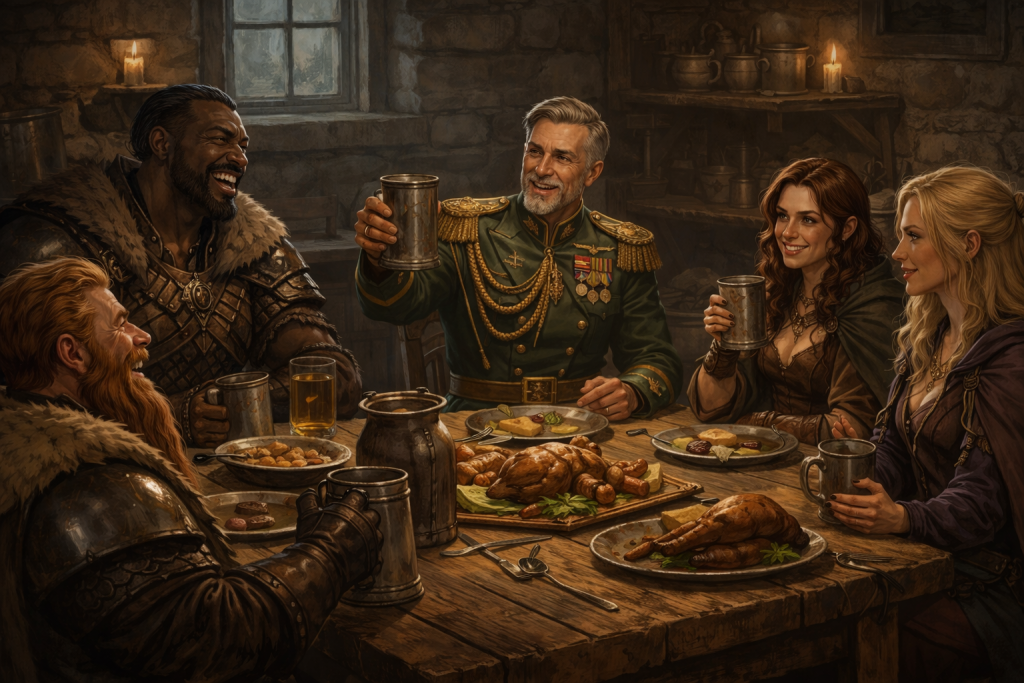
The Loquacious Major
Later that same day, the party accepted Major Edric Valmorne’s invitation.
He greeted them personally in the reception hall—warm, expansive, and visibly pleased that they had come. Valmorne was the sort of man who believed good manners were a form of command presence, and he wielded them with practiced ease. He ushered them past the front desk and deeper into the prison complex with the air of a host showing off a well-run estate.
A step behind them—shielded by an Invisibility spell—Ant slipped through as well.
The Major led the party to what appeared to be an officers’ and senior civilians’ mess: stone-walled but comfortably appointed, with polished tables, decent lighting, and the unmistakable scent of food prepared by someone who knew their audience. He arranged a meal with brisk efficiency and settled in opposite them, hands folded, eyes bright with anticipation.
“Now,” he said, smiling, “I understand you’ve had quite the adventure.”
He listened raptly as the party recounted their time underground, interjecting at appropriate moments with sympathetic murmurs, sharp intakes of breath, and well-timed expressions of concern. At every point where the heroes had chosen risk over retreat—saving soldiers, pressing on where others would have turned back—he offered sincere praise.
“You’ve done the Crown a real service,” he said more than once. “My people don’t forget things like that.”
And perhaps he meant it.
As the meal progressed, conversation widened—ostensibly a professional exchange of observations and impressions. In practice, it became something else entirely. Valmorne, it turned out, was an inveterate gossip: the kind who absorbed information eagerly and redistributed it elsewhere with equal enthusiasm, always convinced he was strengthening the system by doing so.
From him, the party learned quite a bit.
Yes, there was indeed a platoon being sent into the caves the following day to deal with the kobolds.
“Oh, that’s routine,” Valmorne said, waving a hand dismissively. “Minor subterranean non-humans. Kobolds. We’ve had reports before. Usually easily handled.”
He appeared to lose no sleep over it whatsoever.
At the same time, he confirmed, a separate expedition was being dispatched to the cylindrical cavern—also departing tomorrow. This one, he admitted, he knew less about.
“But it makes perfect sense,” he said cheerfully. “An anomalous structure directly beneath the prison? Of course someone’s going to want eyes on it. You don’t leave something like that unattended.”
He doubted it would be an immediate assault. More likely, a reconnaissance. Perhaps the establishment of a permanent outpost. Study first, decisions later.
As for whose decisions—well, that was above his pay grade.
Over dessert, Valmorne confirmed something the party had already suspected: the prison had been built here because of the anti-magic field.
“It’s quite economical, really,” he said, clearly proud. “Why invest in expensive collars and manacles for every caster when you can simply build where magic doesn’t function properly? Underground facilities are cheaper in the long run.”
He didn’t know the source of the field—nor did he seem especially bothered by that fact.
“Curiosity is healthy,” he said mildly, “but my mission is to facilitate its use for Archea’s benefit, not to indulge speculation.”
He did, however, share one point of concern circulating among the arcane consultants.
“The spiders,” he said, lowering his voice just slightly. “The caretakers, as some are calling them. The wizards can’t categorize them cleanly. Not undead. Not constructs. Not beasts, exactly.”
He frowned, just a touch.
“That makes people nervous.”
Elsewhere, Unseen
While Valmorne talked, Ant worked.
Invisible and careful, she ranged through as much of the prison as she dared—offices, barracks, mess halls, storage rooms, cleaning facilities. She learned the rhythms of the place quickly – where clerks lingered, where guards chatted, and where work was taken seriously.
Every entrance to the cell blocks, however, was another matter entirely.
Each was guarded by paired sentries, reinforced doors, and layered security measures—including wards designed specifically to detect magic. Ant gave those a wide berth. Invisible did not mean foolish.
She did manage to explore the first underground level: a broad supply basement stacked with crates, tools, preserved food, and—most importantly—alcohol.
An absolute treasure trove, she noted privately, already imagining the rum gremlins’ reaction.
Deeper levels were off-limits. Locked. Guarded. Warded.
Whatever lay below was not meant to be stumbled into.
By the time the party took their leave, Major Valmorne was all smiles and gratitude, convinced he’d had a productive lunch with capable allies.
And in a sense, he was right.
Between his easy disclosures and Ant’s quiet reconnaissance, the party walked away with a clearer picture of what was coming—and how little time they had to stop it.