November 5th, 973
Standard Techniques, Non-Standard Circumstances
November 5th started out with frenzied activity and somehow managed to get more hectic as it went on.
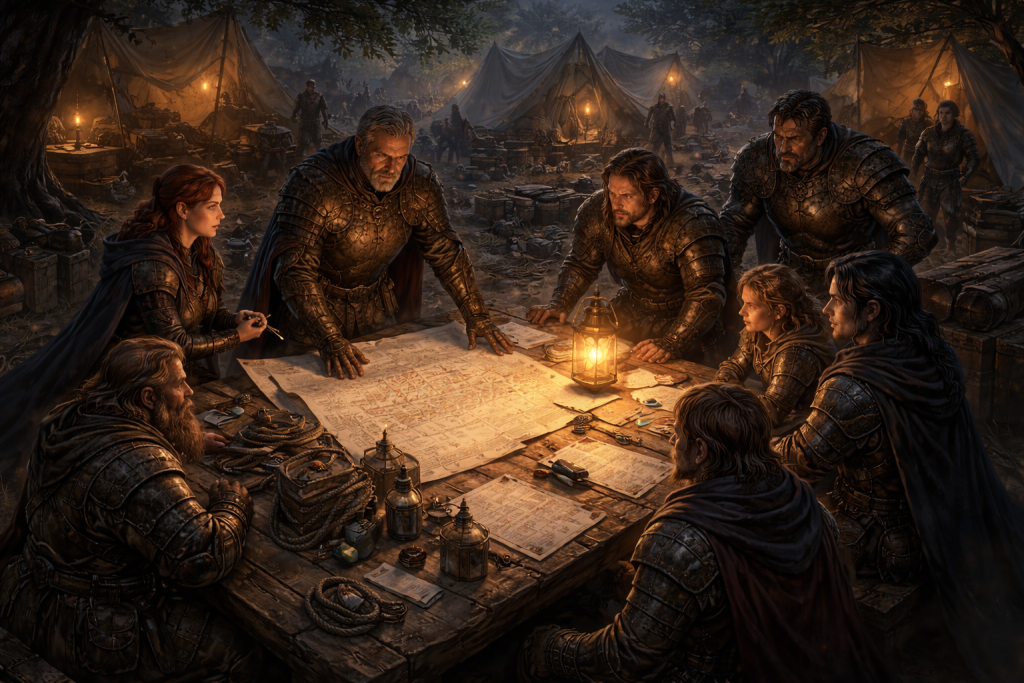
Gear lay everywhere—stacked, sorted, resorted, and argued over. Lists were chalked, erased, rewritten. Someone had tied three separate knots in the same length of rope because no one could remember who was responsible for it.
Tomorrow—November 6th—they would enter the caves ahead of First Sergeant Thatch’s platoon, racing a forty-person military formation whose orders were written with a brutal kind of efficiency.
Tomorrow, Plumbline Four would also descend—leading a Crown expedition toward the caretakers.
Despite this, Edrin Hale and Rhea Calder had somehow carved out an hour. Toven and Maris were busy elsewhere, supervising the preparations of Crown personnel who had no idea how close their mission was to becoming very complicated.
Hale arrived with rolled maps under one arm, looking like a man who had not slept but had made his peace with that fact. Calder arrived already chewing something aggressively vinegary.
“Right,” Hale said, setting the maps down and flattening them with a practiced hand. “Let’s talk about your plan to slow down a platoon of professional soldiers using physics, water, and optimism.”
Calder grinned. “I like it already.”
The party explained. Eldritch Blasts to fracture the stone. Shape Water to force clean water into the cracks. Freeze. Expand. Collapse. Repeat as needed.
Hale listened without interrupting, nodding occasionally.
When they finished, he said, “Yes. That makes sense.”
There was a pause.
“…Really?” someone asked. It may have been the first time any of their plans had ever been described that way by an outside observer.
““Oh, absolutely,” Hale said. “It’s in the mining literature. Standard technique.” He tapped the map once. “If memory serves, creating a tunnel collapse this way takes about an hour—two if the stone’s being uncooperative—and roughly five to ten gallons of water.”
“Clean water,” Calder added. “Freezes faster. Expands more. Muddy water just sulks.” She shrugged. “Decide in advance whether you’re carrying water in with you or hauling it from the underground stream once you’re there. Buckets as a backup wouldn’t hurt.”
Merrythought raised a hand. “And the noise?”
Hale smiled thinly. “Spectacular.”
“Define spectacular,” Hunkle said.
“Echoing,” Calder said. “Long-distance. Invites company.” She ticked the possibilities off on her fingers, “Giant spiders. Ettercaps. Carrion crawlers. Rats—big and small. Stirges. Bats.”
She paused, then added, almost casually, “And umber hulks, if the caves are feeling particularly malicious.”
There was a beat.
Wolfgang muttered, “I hate caves.”
Hale sighed. “I knew a team once—excellent team—ran into an umber hulk unexpectedly. Spent three days convinced their maps were wrong.”
“They weren’t,” Calder said. “The hulks were turning them.”
“…None of them survived,” Hale finished.
Shamus cleared his throat. “So awareness. Discipline. Staying together.”
“Precisely,” Hale said. “And not panicking.”
Ant snorted quietly, which no one chose to comment on.
General Preparation (or: Everything You Will Forget)
Calder straightened, and the humor drained out of her expression as cleanly as a cork pulled from a bottle.
“Make sure to being food and water,” she said. “Plenty of it. For you and the kobolds.”
She looked around the table to make sure she had everyone’s attention.
“Not just for the journey. You leave extra behind when they’re settled. Wherever they end up, it won’t be producing enough food right away. It’ll take time for them to map forage, establish traps, find fungus beds, figure out what’s safe.” She paused. “Every extra ration you bring buys them days. Maybe weeks.”
She didn’t soften the conclusion.
“How much you leave them with will be the difference between a successful relocation and a slow extinction by starvation.”
Silence followed—brief, but real.
Then Calder moved on, brisk and precise.
“Multiple picks. Crowbars. Shovels.”
“Redundancy,” Cassyndra murmured.
“Exactly,” Hale said. “Tools break. People drop things. Caves don’t care.”
“Rope,” Calder continued. “Twine. Chalk.”
She slid a bundle of phosphorescent orange chalk across the table.
“Take ours.”
Merrythought turned it over in her hands. “Special?”
“Doesn’t lie,” Calder said. “Even when the walls do.”
Hunkle grinned.
“Pitons. Climbing spikes. Hammer. Mallet,” Hale went on. “Knives. Everyone. Every person needs to be able to cut themselves free.”
Laveleen tilted her head. “Roped together?”
Calder nodded. “Annoying. Effective.”
Wolfgang rubbed his beard. “Kobolds carrying their own gear?”
“If you give them packs that fit,” Calder said. “Slings. Frames. Otherwise they’ll improvise.”
“And improvisation underground,” Hale added dryly, “is how you die creatively.”
The Eggs
Hale cleared his throat.
“Eggs are… delicate,” he said, after a moment. “Handling them is bad. Stress is bad. Temperature swings are bad. Shock is very bad.”
No one made a joke.
“An incubator is best,” Calder said quietly. “Carried or wheeled. Wheels are tricky underground, though. Broken ground, slopes, debris.”
“Build it sturdy,” Hale added. “Wood frame. Padding. Insulation. Wool. Felt. Straw. Fungus fiber. Moss. Clothing. Kobold bedding. Blankets. Anything that keeps heat in and impact out.”
“Spare incubator, if you can manage it,” Calder said. “Redundancy again.”
That word landed differently here.
Someone finally asked, softly, what happened if an egg cracked.
Calder winced.
“No idea,” she admitted. “Wax might help. Resin. Pitch. Might seal it. Might suffocate it. We don’t know.” She shrugged, unhappy. “But having the option is better than staring at a crack and wishing you’d brought wax.”
Hale nodded once.
“This part,” he said, “isn’t logistics. It’s responsibility.”
No one argued.
The Rest of the List
Hale and Calder finished the remainder from memory, voices overlapping now as if momentum itself mattered:
“Med kits.”
“Light sources—redundant.”
“Face coverings,” Calder added. “Especially near the cave-in. Dust’ll get everywhere.”
“Wedges. Spare wood.”
“Whistles.”
“Bells.”
“Fire starters. More than you think you need.”
By the end, the table was crowded with chalk marks, half-scribbled notes, and the uneasy sense that no list was ever truly complete.
Hale rolled the maps back up with a practiced motion as Shamus asked, “How many kobolds do you think we’re looking at down there?”
“Our best guess as to population?” Hale said. “Eighty to one-twenty kobolds.”
Calder didn’t hesitate. “Add twenty to thirty eggs.”
She paused, then added—matter-of-fact, not unkind—“High mortality demands high reproduction. That’s how they’ve survived this long.”
No one spoke for a moment.
Those weren’t numbers anymore. They were hands to carry. Packs to make. Food to stretch. Time that could not be replaced.
Hale tied the maps shut and slid them back across the table.
“That’s everything we can give you,” he said. “After that, it’s judgment.”
Calder gave them a thin, crooked smile. “And luck. But you’ve been rationing that carefully so far.”
Outside, the day was already thinning toward evening.
Tomorrow—November sixth—the caves would fill again with boots, orders, and urgency. By then, there would be no more planning. Only choices made under pressure, and the consequences that followed them.
For now, though, there was still light.
Still time to prepare.
And still a chance—however narrow—to make sure that when the soldiers arrived, there was no one left underground to die for their efficiency.