November 6th – 9th, 973
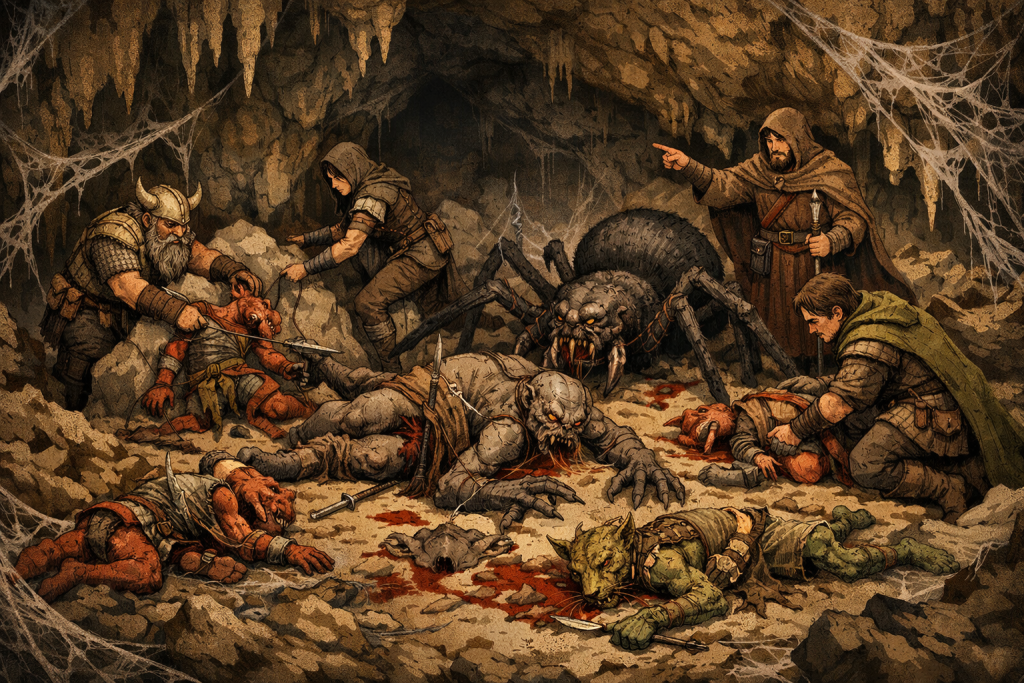
The Theater of Extinction
The party spent a long stretch of time debating timing.
The staged “massacre” of kobolds needed to be completed soon if it were to greet First Sergeant Thatch’s detachment convincingly. On the other hand, the anticipated Crown expedition to the cylindrical chamber—led by the Plumbline Four—could pass through at any moment and it would certainly be… awkward to be discovered dragging kobold, ettercap, and giant spider corpses through the tunnels like amateur undertakers.
They chose speed, discipline, and watchfulness.
Merrythought took up position at a critical junction—one that commanded sightlines in four directions and offered enough shadow to disappear into if needed. The others moved the bodies with grim efficiency, arranging the scene to suggest violence, confusion, and finality. Blood was placed carefully. Claw marks were emphasized. Kobold bodies were intermingled with occasional spiders and ettercaps to imply that while the kobolds fought bravely, they were completely wiped out.
It was a macabre bit of set dressing.
As it turned out, their caution—while admirable—proved unnecessary as the approaching Crown expedition made no effort at stealth whatsoever.
Long before Merrythought saw them, she heard them: boots, hooves, shouted corrections, metal striking stone, the unmistakable clatter of overconfidence.
She concealed herself and observed.
The procession, led by the Plumbline Four, was enormous. Fifty at the low end. Perhaps closer to a hundred. Spellcasters were visible among them—many scholarly, some of them already winded by the terrain. Porters labored under loads of equipment. Mules picked their careful way through the uneven rock. Soldiers marched in loose but competent formation. Civilians of uncertain purpose—administrators, perhaps, or scribes—moved in clusters.
The expedition did not move like something cautious. It moved like something that believed itself untouchable.
Merrythought noted the figure being addressed as “Chief Arcanist”—clearly in authority over the magical contingent. She also noticed something more troubling.
A prisoner.
Shackled. Manacled. Dressed in the unmistakable orange of Northmarch custody. A heavy collar at his throat. A blindfold secured firmly over his eyes. Two guards marched him between them with deliberate proximity.
The implication was obvious: the Crown intended to make use of him at or near the antimagic field.
The entire procession passed slowly, noisily, and with the air of ownership.
When Merrythought rejoined the others, her report silenced any lingering debate.
Dropping a tunnel collapse now was out of the question. The noise would draw attention from the caretaker detachment—and possibly from umber hulks, whose interest none of them were eager to rekindle. And while First Sergeant Thatch’s platoon had not yet arrived—delayed, no doubt, by her careful pacing—they might be near enough to hear something significant and feel compelled to investigate.
The decision was unanimous.
No collapse today.
Instead, they took smaller precautions. The chalk markings along the branch leading toward the kobold colony were adjusted—carefully annotated to suggest geological monotony and utter lack of interest. Boring rock. No anomalies. No reason to explore here.
They trusted both in the misdirection and in the Crown’s narrow focus. The kobolds were off the main arteries of interest. If no one had cause to look for them, they might remain unseen.
For now.
They would return in a few days—after a proper rest—with a barrel of gunpowder and a long fuse. The collapse would be decisive. And ideally performed from a safe distance.
For the moment, both the tunnels and the party held their breath.
Gunpowder, Bureaucracy, and Other Explosives
The following morning, the party returned to the Adventurer’s Guild with a singular and enthusiastic question:
“Where can we buy a barrel of gunpowder?”
Harlan Vetch did not answer immediately.
He removed his spectacles.
He polished them slowly.
He replaced them.
Then he looked at them over the rims.
“Of course you want gunpowder.”
After a brief but eloquent eye roll at the direction their strategic planning had taken, Vetch explained that gunpowder was tightly regulated by the Crown. Not because it was rare, but because it was decisive.
“If a common laborer can collapse a tunnel,” he said mildly, “then so can a rebel.”
If they were determined, however, he could suggest three avenues:
1. Steal it from the Crown.
The nearest stockpile was at Fort Arcadia — three days north of Bastionstead. Less a fort than a major base, it served the mountain passes between Devon and Cambria. The powder was stored there in case it ever became necessary to destroy a pass quickly.
“Which,” Vetch added dryly, “is a big decision. Expect similarly big protections of the gunpowder”
2. Acquire it from the underground.
Which meant Manchester — provincial capital and thriving criminal artery. All manner of illicit substances flowed there through unofficial channels.
“Gunpowder would cost more than gold,” Vetch warned. “Expect to have to do some favors as well.”
3. Convince the Crown to authorize it.
He let that one hang in the air.
After a few seconds, Ant began laughing.
All three options were deemed more trouble than they were worth.
And so, the dream of a thunderous, gunpowder-fueled tunnel collapse went up — forgive the expression — in smoke.
Spell Components and Suspicion
The party’s 100 gp pearl had arrived, however, and they paid for it without incident.
While tallying the transaction, Vetch mentioned something else. “The prison,” he said casually, “is placing an unusually large order for standard spell components.” That alone might not have been notable. But the volume was. And the pattern.
They were also posting fetch quests — small acquisitions appropriate for low-ranked Guild members. Things that, individually, meant little. Together, they suggested something else.
Laveleen reviewed the list and frowned.
Binding salts. Anchoring sigils. Conductive metals. Rare chalks. Stabilizing resins. “This isn’t routine ward maintenance,” she murmured. Her conclusion was quiet but firm: the Crown was experimenting. Likely with magic designed to bind creatures — or manipulate magical fields.
Neither possibility was comforting.
The Nymph’s Kiss
From there, the party decamped to The Nymph’s Kiss to gather intelligence the traditional D&D way.
Merrythought and Ant were delighted to find Eric and several familiar prison guards occupying their usual corner.
Merrythought swept in grandly. “Tell me, Eric,” she inquired, “do you ever work?”
Eric grinned without standing. “Not if I can help it.”
Chairs were rearranged. Ale was procured. Gossip began flowing.
The rumor mill at Northmarch was grinding at full speed.
The four authorities at the top — Warden Celene Rauth, Colonel Bastian Holt, Chief Arcanist Maelis Thorne, and Administrative Prefect Lucien Varo — were not, by most accounts, cooperating smoothly.
There had been:
- Closed-door meetings.
- Contradictory public directives.
- Orders quietly rescinded.
- Staff reassigned without explanation.
“Lot of tension,” Eric said, lowering his voice. “Feels like everyone’s waiting for someone else to blink.”
They confirmed that Chief Arcanist Thorne herself was in the tunnels with the expedition bound for the cylindrical chamber.
But no one among the guards there knew anything about a First Sergeant Thatch or a kobold detachment. The prison guards and the army, it seemed, occupied overlapping geography but separate social ecosystems.
Then came the rumors.
What Is Thorne Doing Down There?
No one agreed.
Everyone speculated.
One theory held that the antimagic field beneath the prison was the only thing keeping an ancient red dragon imprisoned in the rock below — and that Thorne intended to weaken the field just long enough to bind it, securing glory, promotion, the favor of the Crown, or all three at once.
Supporting “evidence” included:
- Low, subsonic vibrations in the deepest cell blocks — felt, not heard.
- Hairline cracks in basement stone that “weren’t there last year.”
- One guard rotated to an assignment out of the basement after having mentioned dreams of heat, wings, and fire.
Another theory suggested ambition was not the motive — fear was.
Thorne, some said, was being pushed by higher authority. The Crown… or someone else that didn’t have to sign their letters.
Evidence offered:
- She’d been drinking more.
- Snapping at subordinates.
- A courier arriving at night and leaving without ceremony.
- Repeatedly muttering: “We don’t have time.”
No one could explain what that meant.
Other oddities circulated:
- Prisoners claiming to hear whispers that didn’t use words.
- The possibility that Thorne was attempting to weaponize the antimagic field — make it portable, directional. Something that could be unleashed on a battlefield. Or a rebellious city.
Whatever the truth, the scale was undeniable.
Supplies were already being staged in the courtyard in careful stacks, awaiting transport into the caves. This may have started out as a medium sized expedition but it was quickly snowballing into a major operation.
A Way In
The party expressed interest in work — any work — even porter duty given all of the piles of supplies.
The guards exchanged glances.
“Yeah,” Eric said finally. “They’re going to need hands. Lots of hands.”
He leaned in.
“If you want in on that job, don’t talk to the army. Talk to the Administrative Prefect’s people. Varo’s office handles intake, labor assignments, that sort of thing.”
Which meant paperwork. Which meant proximity. And perhaps, if fortune tilted their way, it meant a way to see what the Crown was truly doing beneath Northmarch.
With that in mind, the party rose from The Nymph’s Kiss and set out for the prison.
Not as infiltrators. But as helpful, willing labor. For now.
The Wagon in the Cut
When the party reached the prison, however, they found not order but agitation.
The administrative wing — normally a place of ink, murmurs, and measured irritation — had become a hive. Clerks hurried with armfuls of ledgers. Messengers ran without dignity. Two junior officials were arguing in hushed but intense tones over a stack of sealed documents.
Upon announcing themselves, the party was directed to a bench.
“Have a seat. Someone will be with you.”
No one was.
As minutes stretched and the promised “someone” failed to materialize, the party began to piece together the situation from overheard fragments.
A routine wagon bound for Manchester had departed that morning.
A familiar patrol — one of the aerial watchers — had stumbled across it several hours south of Bastionstead. Everyone aboard was dead.
The staff were scrambling to determine whether Warden Celene Rauth had been among them. She had received a message requiring her return to Manchester for consultations, but it was unclear whether she had boarded that specific wagon.
Clearly someone would have to go out to the wagon to see what happened but the administrative staff didn’t seem able to make any headway on dispatching a patrol. Shamus stood.
“We’ll go check it out for you.”
That cut through the administrative static.
A functionary named Vaerun — pale, ink-stained, and visibly overwhelmed — blinked at them.
“You… would?”
He gathered himself quickly.
“I would be personally grateful,” he said carefully. “But I cannot promise compensation. That would require authorization. And review. And—”
“We understand,” Ant said breezily. “Just get started on all of that and we’ll head out now.”
Gallantly — and perhaps unwisely — the party accepted the promise of possible compensation in the ill-defined future (pending submission and approval of paperwork) and departed at once.
The Ambush
The countryside south of Bastionstead was gentle: rolling plains, shallow hills, broad sky.
But two hours out, the road narrowed through a cut in a low ridge.
There was a bend there. A perfect bend. And the wagon lay just beyond it.
It had been struck hard. Arrows bristled from the frame. The wood was scorched in places by spell residue. One wheel was shattered. The horses lay in twisted stillness beside it.
Two guards, four civilians, and Warden Celene Rauth. All dead.
The wagon’s cargo — raw materials and unremarkable mail — had been left untouched. The belongings of the slain were likewise undisturbed.
Except for one detail.
Rauth’s right hand was missing, cleanly amputated at the wrist.
Ant swore softly. Whoever had done this had not come for loot. They had come for Rauth’s death – and to bring proof back to someone.
The Trail
Tracks led away from the cut — four sets of bootprints — toward a distant stand of trees roughly a mile off the road.
From there, the pattern shifted – the foot tracks ended and horse tracks began.
“They left their mounts hidden during the ambush,” Wolfgang muttered, “and used them to expedite their withdrawal.” A proper ambush, then, clean and planned.
Shamus insisted they follow.
“If someone paid for this assassination,” he said grimly, “we need to know who or else we won’t understand what’s happening in the prison.”
The others attempted to argue but Shamus would not be deterred and the others were eventually obliged to fall in step behind him.
Four Professionals (In Theory)
A few hours later, they found the assassins by a stand of trees.
Four men, four horses tethered nearby, a fire, a stew pot that smelled aggressively enthusiastic.
And an alarming quantity of liquor, already half gone despite the relatively early hour.
Merrythought slipped ahead under Invisibility and positioned herself quietly behind the group while the rest of the party approached openly and introduced themselves while the assassins were mid-toast.
With their state of inebriation, it did not take long for the truth to spill out. Five hundred gold to kill the Warden and to bring her right hand to Manchester as proof.
Deliver it to a tavern in the underworld — unnamed, but described with enough confidence to suggest prior familiarity.
They had even been provided a scroll — a modified version of Gentle Repose — to preserve the hand during transport.
Proudly, one of them produced the hand. Still wearing its ring.
Ant, thinking faster than her caution, breathed, “It would be great if we could get our hands on that—”
There was a pause. All four assassins stared then drew their weapons.
The Shortest Fight of the Week
The assassins were drunk, outnumbered, and unprepared for a bard materializing behind them with steel already in motion.
Merrythought struck first.
The rest followed and within moments, it was over. Four more bodies had joined the tally of the day.
The party, being adventurers of practical temperament, conducted a thorough review of the fallen.
Spoils included:
- 50 gold pieces
- Four reasonably healthy horses
- A crossbow that Wolfgang adopted immediately
And, of course, the preserved hand itself. Clearly, this had not been mere banditry. It had been procurement. And someone in Manchester was looking forward to delivery.
For now, however, the party elected to return to Bastionstead to report their findings and defer the question of visiting the masterminds in Manchester for another day.
Aftermath
On their return to the ambush site, the party encountered a prison relief detachment finally making its way south—late, tense, and braced for worse.
The heroes reported that they had tracked down the assailants and dealt with them taking care to neglect mentioning the 500-gold contract, Manchester, or the preserved hand. Some details, they agreed silently, were best handled later.
The relief party accepted the explanation with visible relief. Bodies were counted. Statements were taken. Gratitude was expressed in clipped, professional tones.
Back at the prison, they gave Vaerun the same account. The administrative corridors were still in quiet chaos—runners moving briskly, doors closing mid-conversation, tension humming beneath polite speech.
Vaerun clasped his hands with bureaucratic intensity.
“You have done the Crown a service,” he assured them. “The paperwork for compensation has been submitted.”
Which, as everyone present understood, was not the same as approved, but it was as much as anyone could reasonably expect that day or, really, that week.
They inquired—casually—about the possibility of work as porters on the caretaker expedition.
“Yes, yes,” Vaerun said, distracted but encouraging. “There will certainly be need for you as porters. Return in a day or two, if you would. Once this current matter is… stabilized.”
The word hung in the air longer than it deserved.
Identifications
They returned to their campsite at dusk with Eloise arrived shortly thereafter via the expedient of practically falling out of the treeline and faceplanting gracelessly ten feet from the fire. After she was revived, watered, and scolded in approximately equal measure, attention turned to quieter matters.
Silas Venn’s forgery was everything the party could have expected and was passed around with solemn admiration and set aside as gently as a work of art of that caliber deserved.
The long-awaited 100 gp pearl, The Ring of Dawn, and Getty’s bracelet were then produced. Cassyndra began with the bracelet. The ritual was clean and efficient. The pearl clouded, shimmered, and then resolved into dull certainty.
Entirely mundane.
There was a small but collective deflation of expectation.
Then came the ring. The pearl’s glow shifted. Conjuration. Enchantment. And—oddly—a distinct flavor of what could only be described as… customer service.
“It has one charge per long rest,” Cassyndra concluded. “No curse detected.”
There was a pause.
Wolfgang cleared his throat and, with the gravity of a man who has lived long enough to know better but refuses to learn, slid the ring onto the traditional finger used for trying out suspicious magical items provided by the GM – his right middle finger.
The effect was immediate.
With a soft pop and the faintest scent of spilled ale, a pleasant blonde woman appeared beside the fire. She was taller than average, medium build, dressed in the uniform of a well-kept tavern barmaid. She held an empty tray in one hand and an empty pitcher in the other.
She blinked cheerfully at the assembled heroes.
“Hey, what’s up, guys!” she said brightly. “I’m Dawn. What can I do for you?”
The silence was broken only by the crackling of the fire.
Dawn, Apparently
If adventurers possess one universal trait, it is this: the ability to recover from shock in under ten seconds. The appearance of a fully formed blonde barmaid holding a tray and an empty pitcher in the middle of their campsite certainly qualified as shock. But it only lasted eight seconds.
Then the questions began.
Dawn, as she cheerfully introduced herself, regarded her situation as entirely ordinary.
She believed herself to be:
- A barmaid.
- Employed.
- Currently between tables.
She did not believe herself to be:
- Magical.
- Trapped.
- A construct.
- A fragment of some ancient intelligence.
- Particularly unusual.
If asked politely, she was happy to attempt almost any task she was given, even if not within the traditional purview of barmaids. She possessed no special powers beyond the ordinary — unless one counted resilience of personality as a power.
When asked what she experienced while not manifested, she blinked and said: “Oh! I’m just… not here.” There was no sense of continuity. No suspended awareness. No void.
She had never heard of Kardan.
The newest song in her repertoire had been popular roughly one hundred and fifty to two hundred years ago, which strongly suggested the Ring of Dawn had been resting in the Maze for at least that long.
If provided privacy, she was perfectly willing to change clothing for specialized tasks. “Uniform flexibility is important in service,” she explained brightly.
Ant, perhaps testing the boundaries of service, said, “Show me your—” but never finished the sentence as Dawn slapped her hard enough to inflict 1d6 bludgeoning damage. Laveleen’s expression suggested permanent approval.
Dawn resumed holding her tray. “So,” she said pleasantly. “What can I do for you?”
The ring was not cursed. But it was not passive, either.
Paperwork and Promises
The following day, the party returned to the prison and Vaerun greeted them with the exhausted enthusiasm of a man drowning in forms.
The paperwork for their assistance at the ambush site was “progressing admirably,” he assured them, which appeared to mean that it had not yet disappeared entirely.
As for porter work?
“Almost certainly,” he said. “Probably even better paid armed escort given the talents you displayed yesterday. We simply need… another day.”
There was always another day.
More interesting, however, was the chance encounter that followed.
Major Edric Valmorne appeared in the corridor with impeccable timing and just enough surprise to seem genuine.
“What extraordinary fortune,” he said warmly. “I was just wondering how I might locate you.”
It turned out Colonel Holt wished to see them
Colonel Holt’s Office
They were escorted into his office in short order and the colonel did not waste time. He informed them he required a message delivered quietly and unofficially to Inspector Fenworth at Fort Arcadia — three days north.
Fort Arcadia anchored the Archean border with Devon along the mountain passes. It was a serious place. A real command. Not a political installation masquerading as one.
Holt cautioned them that Willowhollow lay along the route and that while, officially, no undead roamed the countryside, unofficially, the army had been obliged to intervene there several times. The party would do well to be prepared for that eventuality.
The party skillfully turned the conversation to the state of the prison and Holt did not hide his displeasure.
Since the Plumbline Four’s discovery of the cylindrical chamber beneath the prison — the one maintained by six-legged caretakers and apparently the source of the antimagic field — discipline and cooperation had eroded into politics and a scramble to either profit from the situation or deflect blame for it onto someone else.
Orders had been issued to his soldiers behind his back. Reconnaissance had been skipped. Unnecessary risks had been taken. The resulting losses had been reframed and blame redirected.
And now, he said flatly, prisoners were being removed from their cells and taken down into the cylinder for hasty and ill-advised “experiments.”
He mentioned one name in passing. Grelda. The party reacted with masterful nonchalance.
Holt continued.
He believed civilian oversight had become competitive rather than cooperative. That his soldiers were being used. That failures were being prepared in advance as documents rather than prevented in advance as events.
At last, he produced the sealed envelope. Type set. Unsigned.
Fifty gold accompanied it. “Discretion,” he said simply.
They accepted.
The prison was fracturing.
And now, for the first time, they held something that could split it open.
Editorial Services Included
The first thing the party did once they were safely clear of the prison walls was not to debate loyalty, morality, or political consequences.
It was to figure out how to open the letter. After all, fifty gold pieces should purchase not only discretion — but editorial review.
Gareth, practical as ever, suggested purchasing similar envelopes in town and experimenting on those first. The party procured a small stack and returned to camp where, over the course of an industrious afternoon, they subjected paper and glue to steam, patience, blades, pressure, and no small amount of muttered profanity.
Several envelopes did not survive – one caught fire, one dissolved, and one achieved a level of dampness that suggested it might confess to crimes unprompted.
Eventually, however, a technique emerged.
Confident in their method, they applied it to Colonel Holt’s sealed letter. The seal parted and the contents were scrutinized carefully.
Colonel Holt’s Letter
To the Inspector Whose Memory Extends to the Floodplain at Dunmere,
There are not many who stood ankle-deep in river silt debating whether a bridge should stand long enough to save our own or be burned to deny the enemy a crossing. Fewer still who remember which choice was made—and why.
I have not forgotten that you remained behind after the last wagon crossed. Nor that your report named the fallen before it named the victory.
If this letter reaches the intended reader, then you understand both its author and its urgency without need of signature.
I write because the situation here has deteriorated beyond what ordinary channels can correct.
My soldiers are being directed by civilian authorities whose interests are procedural, reputational, or experimental rather than strategic. Units are committed without adequate reconnaissance. Objectives shift after deployment. Losses are reframed as discipline failures. Blame flows downward; decision-making remains comfortably elsewhere.
It is not defeat that concerns me.
It is waste.
The men and women under my command are not counters to be repositioned for the sake of interdepartmental advantage. They are soldiers. They deserve clarity of purpose and honest accounting when risks are assumed.
As matters stand, I am constrained. My authority over walls and patrols does not extend to the mandates that place my people in untenable positions. Each incident becomes a memorandum exercise rather than a lesson learned.
This installation could function effectively under civilian oversight—provided that oversight were vested in individuals prepared to coordinate rather than compete.
A change at the top would alter the incentives beneath it.
You are positioned to understand how such changes occur.
Officially, there is no scandal.
Unofficially, pressures are accumulating that will not remain contained indefinitely. Should an undeniable event occur—particularly one involving a detainee whose custody cannot be satisfactorily accounted for—external review would become unavoidable.
I do not advocate chaos.
I advocate clarity.
If oversight were recalibrated before further unnecessary losses, the Crown’s interests would be better served—and so would those who bear its banners.
I am prepared to provide documentation, testimony, and whatever corroboration is required, provided such exchange remains insulated until formal review is initiated.
You once told me that the strength of a system is measured not by how it performs in ceremony, but by how it responds to strain.
The strain is here.
If you judge this message ill-advised, burn it.
If you judge it timely, you will know how to reach me.
Options (Too Many)
With Holt’s message now known to them, the party surveyed a widening field of possibilities:
- Return to the caves and collapse the tunnel leading to the kobolds before any other Crown detachments got it in their heads to explore the caves further.
- Accept porter duty and embed themselves in the Crown’s expedition to the cylindrical chamber, waiting for Grelda to be brought below and seizing an opportunity.
- Travel to Manchester to follow up on the assassin contract and the preserved hand.
- Use Silas Venn’s forged letter to introduce rum gremlins into the prison and wait for the inevitable chaos.
- Deliver Holt’s letter to Fort Arcadia and see what doors that opened — perhaps even securing regulated items such as gunpowder while there.
They even consulted Augury regarding whether they might get away with telling Inspector Fenworth that, in addition to the written message, they were asked to deliver a verbal one as well. The omens suggested suspicion. Messages between the two, it seemed, were expected to remain typeset.
Naturally, combinations were discussed. They could pretend to travel north while instead delivering rum gremlins and completing the collapse while working on a forged reply from the good Inspector. Six days later, they could assume an appropriate weather beaten appearance and return to Colonel Holt’s office with the forgery in hand.
The possibilities multiplied like kobolds.
A Decision
In the end, they chose the boldest option.
Most of the party would make the journey to Fort Arcadia and deliver the letter as requested while a smaller contingent would remain behind at the campsite.
Officially this was to maintain operational flexibility. Unofficially, it was to continue attempting to civilize the rum gremlins — or at least maintain them in the precise and carefully calibrated state of drunkenness that experience had proven safest.
By now, through trial and painful error, they had mastered the delicate balance between “mischievous” and “apocalyptic.”
The letter was resealed.
The envelope bore no visible tampering.
And as the party divided itself for the coming days, the prison behind them continued to fracture.