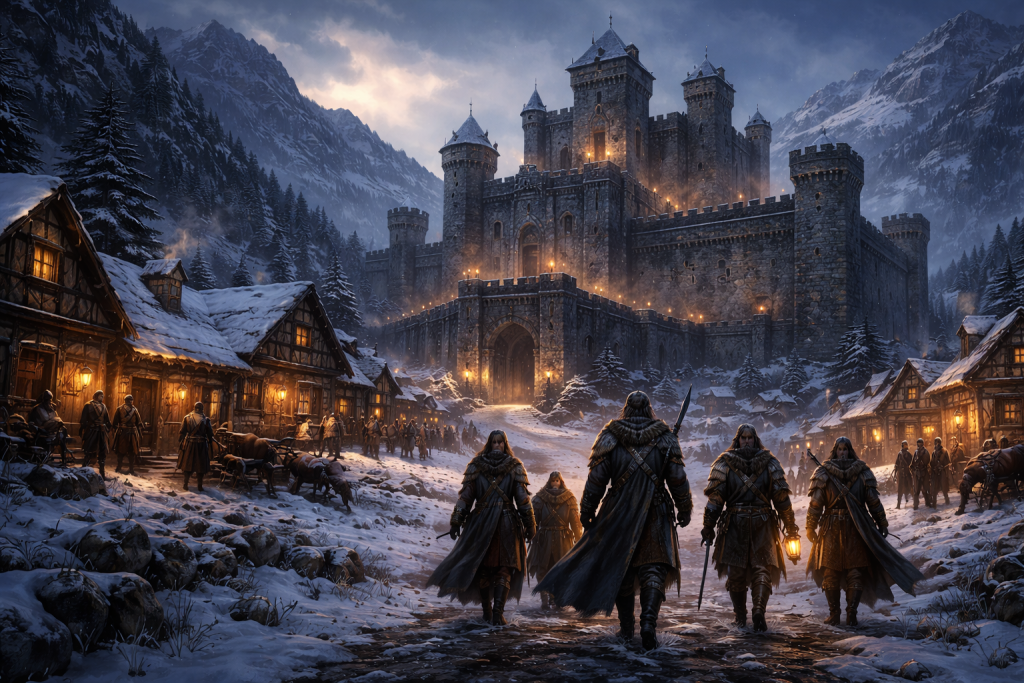
November 11th – 12th, 973
The village of Willowhollow smelled faintly of turned earth and boiled linen.
The fighting had ended last night but the recovery continued.
The peasants moved carefully among the party, offering what little skill and supply they possessed. A pot simmered over a low fire, its contents more water than broth. Clean cloth was a relative term; it had been scrubbed, wrung, and held up to weak light in hopeful defiance.
An old woman with hands like knotted roots pressed a poultice against Wolfgang’s shoulder. “Comfrey,” she explained, as if apologizing for it. “Or something like it.”
Wolfgang winced. “If it’s ‘something like it,’” he muttered, “let us hope it’s ambitious.”
Ant sat rigidly while a shepherd girl—no older than fourteen—wrapped her forearm with linen that had once been part of a curtain. The girl’s hands trembled only once. Ant pretended not to notice.
Shamus cleaned his own blade before tending to his ribs. The liquor provided by the village burned with democratic enthusiasm. He accepted it without complaint. Pain meant he was still here.
Cassyndra stood near the edge of the ruined cemetery fence, watching the disturbed soil as if it might reconsider its decisions. The morning light revealed too much. Nothing moved. That did not reassure her.
No one mentioned the skeletons.
No one mentioned how close it had been.
The village did what it could. It was not much but it was enough.
By midday, the party had gathered what strength they could gather and turned north.
The road to Fort Arcadia rose steadily, trading gentle hills for sharper inclines. Sleep after the fight last night had been theoretical and now, the next day, muscles complained and armor felt heavier than it had any right to be.
They spoke little at first.
The sky was clean and piercingly blue. Frost clung to the shaded grass like a stubborn memory. The trees stood stripped and skeletal, their branches etched black against the light. In the distance, the land folded upward into real mountains, the sort that did not negotiate.
It was Gareth who noticed the first irregularity.
“Has this road always been so… social?” he asked mildly.
They slowed.
At first it seemed nothing more than the normal detritus of rural travel — a cart rut wandering too far off, a shepherd’s track slipping into brush. But the further they climbed, the more it became difficult to ignore.
Narrow paths split from the main road at irregular intervals. Some angled sharply uphill before vanishing into tree cover. Others slipped downhill into folds of terrain where the frost lingered longer. A few rejoined the road farther ahead, as if embarrassed by their excursion.
Most were poorly marked. No signposts. No milestones. No official stonework. Just earth pressed by repeated passage.
Wolfgang crouched beside one of the intersections, prodding the ground with the blunt end of his dagger. “Not deer,” he muttered. “Too wide. Too regular.”
Shamus studied the treeline. “They’re not military either. No discipline to the cuts. No clearing of sight lines.”
Ant stood still for a long moment, counting. “They intersect too frequently to be coincidence.”
Indeed they did. Every quarter mile or so, another faint artery branched away. Some were half reclaimed by brush, others freshly pressed. A few bore the subtle scars of recent repair — stones kicked back into place, branches dragged aside, a shallow rut discreetly filled.
Yet none of it had the sanctioned feel of Crown infrastructure.
Cassyndra turned slowly, taking in the pattern. “It’s like the road has veins.”
“That is an unsettling metaphor,” Merrythought offered.
Gareth’s expression tightened slightly. “Fort Arcadia sits astride the primary mountain pass. Patrols would move this road frequently. Inspection points. Taxes. Questions.”
Ant’s eyes flicked toward him. “You think these are avoidance routes.”
“I think,” Gareth replied evenly, “that someone prefers not to be asked.”
They passed a section where three such trails braided together before splitting again — one up, one down, one curving parallel to the road just beyond the treeline. From the main path, it was nearly invisible unless one knew to look.
Wolfgang stood and dusted off his hands. “If I were moving something delicate,” he said thoughtfully, “something taxable, or frowned upon, I might like options.”
Shamus frowned. “Why so many? One hidden path would suffice.”
“Unless,” Cassyndra said softly, “you never wish to use the same one twice.”
A silence followed that.
It was not fear. Not exactly.
But this was not how Crown roads usually behaved. South of Bastionstead the routes had been clean, official, intentional. Here, the land seemed threaded with alternatives — unofficial, unacknowledged, patient.
As they climbed higher, the pattern continued.
Occasionally they glimpsed movement far off in the trees — a flash of canvas, perhaps, or merely imagination arranging shadows into shapes. Once, they found the faint impression of a wagon wheel on one of the side trails, narrower than a standard trade cart but too heavy to belong to a farmer’s barrow.
No patrols appeared.
No toll markers.
No posted decrees warning travelers to remain upon the King’s Road.
Only the main road — broad, well-kept, unmistakably official — and the quiet suggestion that many preferred not to use it.
“It’s almost admirable,” Wolfgang said after a time. “Such industrious creativity.”
“Or organized defiance,” Shamus replied.
Gareth adjusted the strap at his shoulder. “If Fort Arcadia controls the pass, then this is how the pass controls Fort Arcadia.”
Ant glanced back down the slope, where one of the narrower trails slipped between two frost-silvered boulders and vanished into shadow.
She then broke the quiet in a more practical direction. “We should align our accounts,” she said evenly. “We’ll be meeting a person named Inspector Fenworth and it’s not likely that the title ‘Inspector’ is honorary We should expect lots of carefully phrased questions about what’s going on in Bastionstead.”
Hunkle brightened. “So we tell the truth.”
“Yes,” Gareth said. “But we all need to tell the same truth.”
They did so as the road climbed. They reviewed Bastionstead. The letter. The cemetery. The skeletons. Who saw what. Who struck first. Who noticed the ground felt wrong.
Minor disagreements were negotiated. Emphases adjusted. Omissions considered and rejected.
By the time the hills gave way to mountains in earnest, their story stood upright on its own legs.
It would walk, if required.
Fort Arcadia announced itself before it revealed itself.
The road bent around a ridge, and there it stood—stone upon stone, angular and severe against the mountain slope. Towers rose like clenched fists. Smoke drifted from within its walls. Pennants snapped in disciplined wind.
Despite its forbidding posture, life clustered at its base.
A small town—no more than a hundred or two hundred souls—pressed itself against the outer perimeter. A tavern. A smithy. A cooper. A chapel. A row of sturdy cottages whose windows suggested both commerce and caution.
Travelers moved freely between town and fort gate. Wagons creaked. Soldiers laughed. Somewhere, someone argued about bread.
Safety radiated from proximity to stone. Clearly overland travelers felt safe stopping here to rest and refit.
The party secured modest lodgings, acquired proper bandages that did not apologize for themselves, and replaced what small supplies had been spent the previous night.
Then they presented themselves at the gate.
The officer on duty—Lieutenant Arlen Vey—was a square-shouldered man with frost already threading his hair despite his youth. He listened without interruption as Ant described the letter for Inspector Fenworth and Shamus detailed the necromantic activity at Willowhollow.
His expression did not change. His posture did.
“That is… concerning,” he said at last, with the careful neutrality of a man trained not to alarm a courtyard full of soldiers.
“You’ll arrange lodgings in town,” he continued. “Return at 0900. Inspector Fenworth will be informed of the letter and the brigadier informed of the necromancy. I’ll wager both will want to speak with you in person.”
At precisely 0900 the following morning, the gate was staffed by a different officer.
Lieutenant Corvin Hale was leaner and wore fatigue like a second uniform. He studied them briefly before nodding.
“Inspector Fenworth and Brigadier Malrec Vorn will receive you shortly,” he said. “You’re invited inside. Breakfast at the mess while they clear their schedules.”
Inside, Fort Arcadia revealed itself as less a fortress and more a beehive.
Courtyards thrummed with motion. Supply carts threaded between formations. Engineers argued over measurements. Messengers moved at speeds that implied disapproval of gravity. Space was scarce. Purpose was not.
An enlisted soldier was assigned to them before they could obstruct anyone important. “Private Tomas Rell,” he introduced himself briskly. “If you’d follow me, I’ll keep you from being trampled by something official.”
He guided them through corridors that smelled of ink, oil, and boiled oats. At the mess, he ensured their orders were recorded without coin exchanging hands.
“Visitors on brigade business,” he explained to the cook, which appeared to function as currency.
As they waited, they inquired—casually—about the soldiers stationed here.
Rell straightened immediately.
“Fort Arcadia’s home to the Royal 3rd Infantry Brigade,” he said with unmistakable pride. “The Winter Line.”
He gestured toward a wall where a formal summary of the brigade’s history had been mounted—lettered in careful script beneath the emblem of a stark black winter tree rooted against a pale hill and backlit by a red dawn
Rell’s voice carried the cadence of memorization. “We were raised before the Righteous War. Held Greyfen Ridge when the line nearly broke. Stood at High Fen during the Devonian Incursion. We endure.”
The brigade history read,
The Royal 3rd Infantry Brigade
“The Winter Line”
In Frigore Constamus
In the Cold, We Stand.
Founding
The Royal 3rd Infantry Brigade was raised in the final season before the outbreak of the Righteous War, when tensions between Archea and the Orcish Kingdom had grown beyond diplomacy and into mobilization.
Unlike the great cavalry houses that formed the glittering vanguard of the Crown, the 3rd was drawn from Arcadia’s foothill provinces:
- Orcharders
- Shepherds
- Lumbermen
- Tenant farmers
- Millhands and carters
They were not promised glory. They were promised necessity.
Initially formed as a levy regiment intended to reinforce supply lines and fortifications along the western frontier, the brigade had barely completed basic drill when hostilities erupted in full.
They would not remain in reserve.
The Stand at Greyfen Ridge
In the first year of the Righteous War, Crown forces advanced rapidly into contested territory, but their momentum faltered when an Orcish counteroffensive struck along the Greyfen Ridge — a narrow escarpment controlling the road network feeding the Archean advance.
The Orcish assault was sudden, coordinated, and overwhelming. Three veteran regiments were shattered in two days.
The Royal 3rd, scarcely blooded and outnumbered nearly two to one, was ordered to hold the ridge while the main army regrouped. They did so.
For six days and six nights they endured repeated assaults in sleet and freezing wind. Their supply wagons burned. Their officers fell. Improvised barricades were raised from broken carts and orchard timber.
When reinforcements finally arrived, fewer than half of the original brigade remained fit for duty. But the line had not broken.
That stand prevented the collapse of the Archean western advance and stabilized the front long enough for Crown forces to reorganize and resume offensive operations.
In recognition of their discipline under impossible pressure, the Crown granted them the honorific:
“Royal“
It was the first time such a distinction had been bestowed upon a formation raised almost entirely from common birth.
From that campaign onward, veterans referred to the brigade as:
“The Winter Line.”
Not for the season alone — but for the cold certainty with which they stood.
The Devonian Incursion
Two and a half centuries later, during the Devonian Incursion, the brigade would once again prove its name.
Assigned to hold High Fen Pass during winter probing actions by Devonese forces, the Royal 3rd endured nineteen days of sustained pressure in waist-deep snow, suffering catastrophic losses but preventing a breakthrough into Arcadia’s interior valleys.
The enemy withdrew. And the Winter Line held.
Character and Tradition
Across centuries, the Royal 3rd has retained its character:
- Drawn heavily from rural Arcadia
- Known for endurance rather than spectacle
- Disciplined, pragmatic, unadorned
- Loyal to the Crown, but not sentimental
It is said among the officer corps:
“Other brigades win battles. The Third prevents disasters.”
Their culture prizes survival, cohesion, and memory. They commemorate not victories — but stands.
Insignia: The Black Winter Tree
The brigade’s emblem depicts a stark black tree in winter, rooted upon a pale hill beneath a red dawn line.
Symbolism:
- The tree — Arcadian orchards, the brigade’s agrarian origin
- Winter branches — hardship without collapse
- Iron-black trunk — discipline under pressure
- Exposed roots — loyalty to homeland
- Red dawn — the Crown preserved through sacrifice
The tree does not bend in storm. It does not bloom for applause. It stands.
Present Posting
Now stationed at Fort Arcadia, guarding the northern frontier, the Royal 3rd Infantry Brigade continues its centuries-long mandate:
To hold. To endure. To be the line that will not break.