November 19th, 973
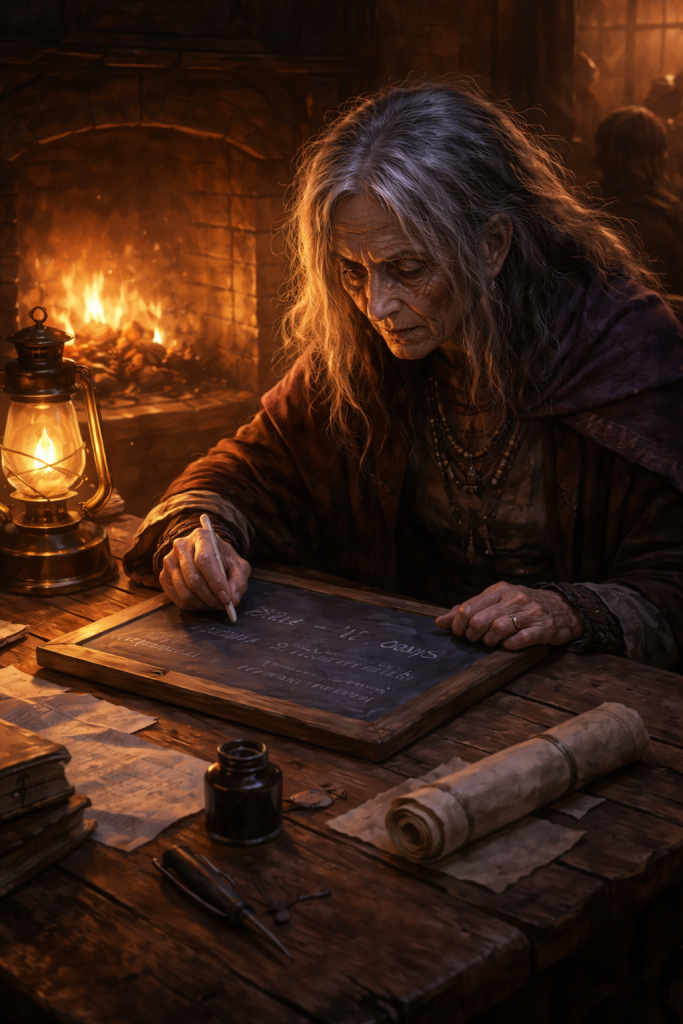
Grelda’s Story
The road away from the Northmarch Correctional Bastion was long and quiet.
Grelda was in poor condition. The years in prison had been hard on her, and the weeks spent within the anti-magic field of the Northmarch Correctional Bastion immediately before her release had only worsened matters. She was thin, pale, and often exhausted. Speaking was impossible.
But she was determined to tell her story.
Over the course of the journey —during halts by the roadside and slow evenings beside the fire—Grelda communicated with the party the only way she could. She wrote slowly with shaking hands, pausing often to rest. At other times she used gestures, diagrams drawn in the dirt, and the occasional impatient glare when someone misunderstood her meaning.
What follows is the account she gradually pieced together.
The Even Briefer Revolt
Grelda began by writing a date.
928
Then she wrote two words beneath it.
11 days
Most histories, she indicated with a dismissive wave of her hand, describe the Even Briefer Revolt as a trivial disturbance.
“A brief and regrettable disturbance of the public peace caused by several misguided provincial nobles.”
She tapped the words sharply after writing them, making clear that she did not believe a word of it.
Among ordinary people, she wrote, the revolt is remembered differently.
“The week the kingdom almost broke.”
The Seeds of Rebellion
Grelda explained that the revolt began during a period when the Crown was rapidly centralizing power. Over the years before the revolt, many old provincial authorities had been replaced with ministry officials appointed from the capital. Taxes, courts, land registries, and even military levies were increasingly controlled through bureaucratic offices rather than local rulers.
For many noble families this change was tolerable at first.
Then came the Edict of Rational Governance.
This edict required every noble title, estate, and hereditary privilege in the kingdom to be revalidated through ministry records.
For many families this was merely irritating paperwork. For others, however, it was catastrophic. Titles vanished from records, estates were reassigned, and entire lines of inheritance simply… disappeared.
Whether this was corruption, incompetence, or deliberate policy, Grelda could not say.
But a number of families discovered that the kingdom’s paperwork had quietly erased them.
The Charter of Provincial Liberties
Some of those families gathered together and drafted a document. Grelda wrote its name carefully.
The Charter of Provincial Liberties
The document demanded that the Crown place limits on ministerial authority and recognize the rights of provincial nobles and common citizens alike.
The charter proposed several reforms which Grelda listed slowly,
- Local courts should be restored in the provinces
- Taxes should be approved by provincial councils
- Ministry records should be subject to independent review
- Prisoners held without trial should be reexamined
One proposal in particular drew considerable attention. Some of the nobles involved in drafting the charter promised that if the Crown accepted their demands, peasants would gain new rights as well, including:
- Protections from arbitrary seizure of property
- The right to appeal unjust rulings
- Limits on forced labor obligations
- Protection of village commons
Grelda indicated that not every noble involved supported these ideas. But some did. And her family was among them.
House Kasivar
Grelda then turned the conversation to her own family: House Kasivar.
It had once been a small provincial noble house controlling a modest estate and several villages in the western provinces. The Kasivars were not especially wealthy or powerful, but they had a reputation for maintaining good relations with the local peasantry.
Grelda’s grandfather, Lord Albrecht Kasivar, had been one of the signatories to the Charter of Provincial Liberties.
Unlike some of the other conspirators, Albrecht believed the revolt could only succeed if it had the support of ordinary people.
So when the charter was proclaimed, the Kasivar estates announced a series of reforms. Several taxes were reduced, and village councils were granted greater authority over local disputes involving commoners.
Albrecht also publicly declared that if the Crown accepted the charter, he would formally grant additional rights to the peasants living under his jurisdiction.
Grelda made a small shrugging gesture after writing this. Her grandfather, she implied, may have been an idealist.
Eleven Days
The revolt began with optimism.
Several noble families declared support for the charter, messengers were sent across the provinces, and for a few brief days it appeared possible that the Crown might be forced to negotiate.
But most of the nobility did not join the rebellion.
Many had grown wealthy through cooperation with the ministries and the Crown. Others feared that granting rights to peasants would destabilize the entire social order. Still others simply believed the revolt was doomed.
When the Crown called for loyal forces, most noble houses answered. Furthermore, the national army remained firmly under royal control.
Within days royalist troops moved against the rebels, and the revolt collapsed with startling speed. Some rebel leaders were captured and executed. Others died in brief and hopeless skirmishes as royalist forces retook rebellious territories.
Many families attempted to negotiate surrender.
They failed.
The Crown had no intention of allowing the rebellion to become a precedent.
The Fall of House Kasivar
Lord Albrecht Kasivar was captured on the tenth day of the revolt and executed the following week.
Grelda’s father and several other relatives were imprisoned for supporting the charter. Their estates were confiscated, and their title was erased from official records.
The surviving members of the family scattered. Some became merchants and others became musicians and traveling performers. Stil others born well after the revolt’s failure—like Grelda herself—learned trades that required fewer questions about one’s past. Fortune telling, she implied, was a convenient profession for someone whose family history had been declared illegal.
She also explained that many peasants remembered the Kasivars with a degree of affection.
For a brief moment during those eleven days, they had been promised a different kind of kingdom—one where common people had rights alongside nobles.
The revolt failed. But the memory lingered. As did the prisoners.
Many of the nobles imprisoned after the revolt were never released. Some died in captivity in prisons scattered throughout Archea. Others grew old behind stone walls where they remain to this day.
Cassyndra Takes Up the Tale
Grelda wrote one last sentence before setting the chalk aside.
“The kingdom destroyed our family with records.”
She looked toward Cassyndra and wrote again.
“You tried to fight them with the same weapon.”
She paused.
Then added one final line.
“Now tell them what happened next.”
And Cassyndra took up the tale.