November 28 – 29th, 973
Splitting the Party
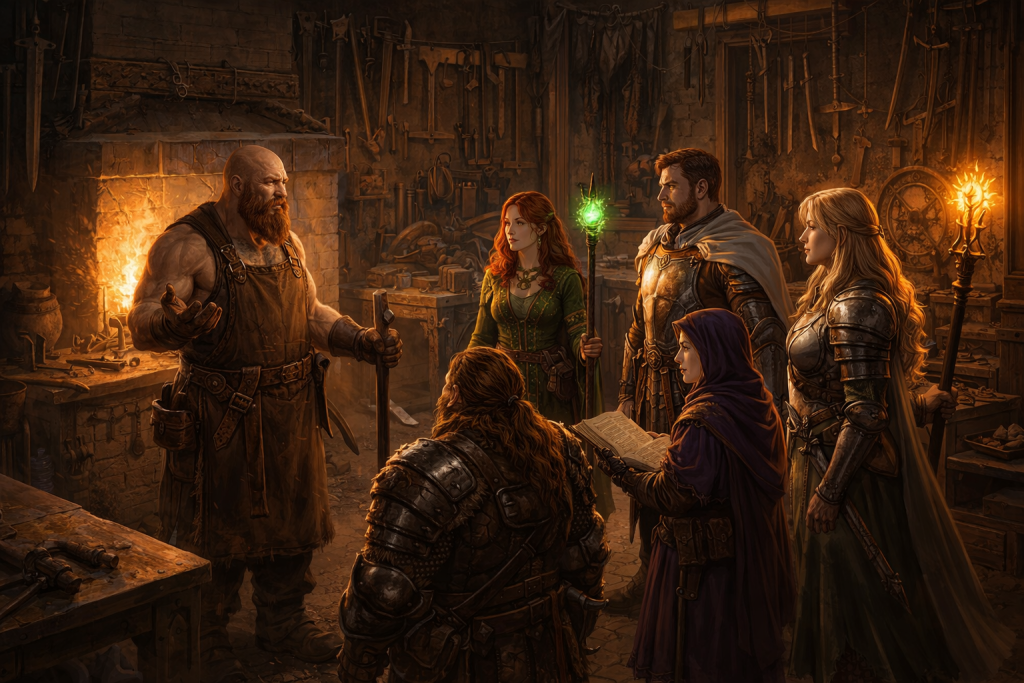
The party, having recently resolved a minor administrative matter involving the nature of time itself, elected to pursue a variety of lesser but still worthwhile objectives.
Cassyndra, guided by instincts that have rarely led her anywhere predictable but often somewhere interesting, departed for a nearby clothing-optional festival.
Merrythought, meanwhile, remained in Dolven’s Hollow to recover from a surgical procedure; Gareth and Pabst stayed with her, dividing their attention between her convalescence and arranging for supplies for Grelda’s upkeep and recovery.
All four planned to rejoin the others at Nareen’s Hill.
The remainder of the party, having fewer immediate obligations and a professional inclination toward problems best solved in person and with violence, made plans to investigate Barrow’s Edge, a nearby village called to their attention by one of Captain Nelson’s letters.
They visited Barin ahead of time to pick his brains.
Barrow’s Edge lay a day’s walk away, a small settlement positioned—both geographically and philosophically—at the boundary of a place people preferred not to examine too closely. The barrows to its north predated the village itself, and the village, at the time of its founding and ever since, had been careful to keep its distance.
Despite that, for the past year or so, the village had been plagued with an unusual agricultural blight that turned its fields black. About six months ago, the local Ebon Blades cell learned that the Crown had sent a team to the area.
Naturally, the Blades wanted to know what they were up to, so they dispatched one of their operatives to watch the Crown at work. He observed them for several days and reported that the team consisted of agricultural and druidic specialists investigating changes in the land and declining crop yields. Finding nothing overtly suspicious, he returned to Dolven’s Hollow and filed his report: benign Crown activity.
Judging from the various timelines laid out in letters and by Barin, it seemed entirely possible to the group that this agent was the one Captain Nelson had seen—not watching Nelson, but watching someone else.
This, if true, would resolve one of Nelson’s quieter mysteries—though not in a way that made the present situation any more reassuring.
That being said, the Crown was not known for doing things without reasons of its own, and if the party was heading to Barrow’s Edge, Barin would be keenly interested in hearing what else they learned.
The Black Fields
The journey to Barrow’s Edge confirmed that something was very wrong.
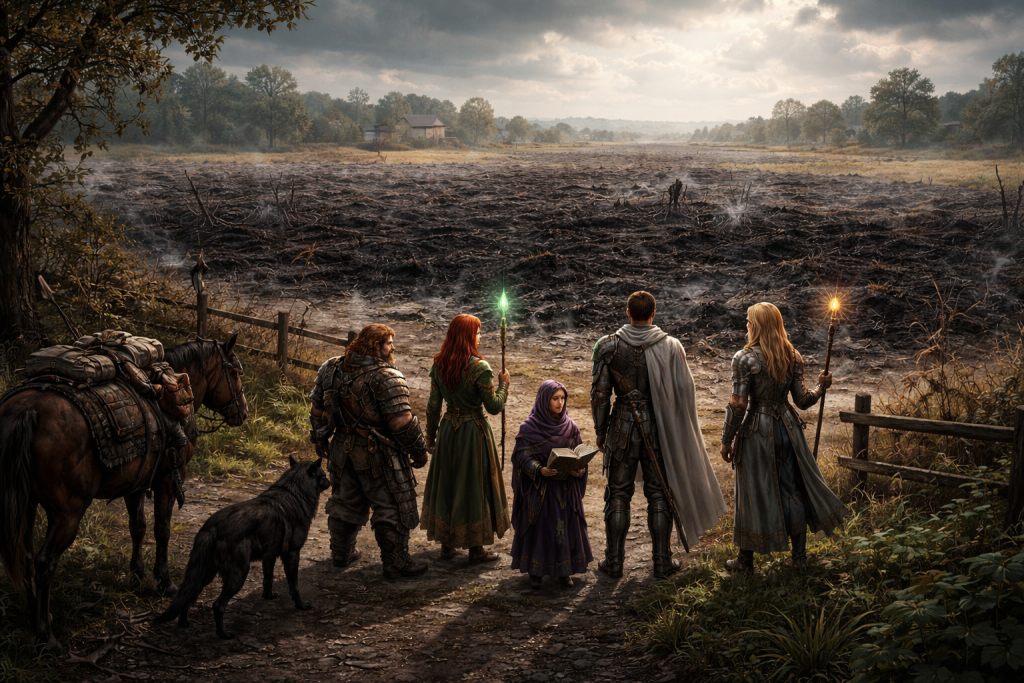
Irregular patches of land appeared intermittently along the road—blackened, lifeless, and profoundly unnatural. These areas were not burned; there was no ash, no charcoal, no suggestion of fire. Instead, everything within them had died in place—blackened, and left untouched by decay.
The borders of these patches faded gradually into the surrounding land, as though whatever had occurred there respected neither geometry nor property lines. Within them, all life had ceased. Plants, insects, even the unseen industry of the soil had been reduced to stillness. Digging revealed that this condition extended at least three feet underground.
Animals avoided the areas when given the choice. When denied it, they complied with the situation in the manner of creatures who would prefer not to be there but, being unable to articulate a formal objection, made concerted personal efforts to depart as soon as possible.
Laveleen confirmed what the eye already suspected – the effect was magical.
It was also, notably, unlike the desolation seen at the ancient battlefield north of Willowhollow. There, life had thinned to the level of simple mosses and such. Here, all of it had been removed. Additionally, the Willowhollow battlefield had shown numerous exhumations of varying ages; here there was no sign of digging at all.
A Village in Decline
Barrow’s Edge itself proved to be a settlement of two to three hundred people, presently engaged in the quiet and thankless work of watching their livelihoods collapse.
The villagers confirmed that the blight had begun roughly a year prior. Since then, no farmer’s property had been spared. There were no feuds to explain it, no strangers to blame, no precedent to consult. The phenomenon appeared to be both universal and entirely novel.
The Crown’s investigative team had arrived six months earlier and had been, by all accounts, precisely what one hopes for in such circumstances: competent, polite, and thorough.
On the other hand, they had, after a week or two of work, vanished completely. One day they headed out to the fields as usual. That night they did not return. Nor the night after. Nor the night after that.
The Crown had not inquired after them.
This struck the party as either highly unusual or entirely consistent, depending on one’s view of the Crown.
The Missing Expedition
What remained of the Crown team’s work had been preserved, with mixed success, in the leaking cellar of the local inn. Six months of dampness had done what it does best but, still, fragments survived.
Natural Philosopher Dain Halveth’s journal indicated no conventional agricultural explanation. Soil quality, nutrient levels, and moisture retention all fell within expected ranges. The pattern of the blight, however, did not.
Although the patches were not contiguous, there was a structure. It wasn’t random as might be suggested by an initial glance but, rather, distributed according to some unseen logic.
Sister Elowen Briar’s notes were more direct.
The land is not sick. It is being emptied.
There is a pull here… inward.
Apprentice Perrin Hale’s enthusiastic observations confirmed only that something was wrong, though not what.
A sketched map of affected and unaffected fields made the pattern unmistakable: the barrows north of town lay at the center of it. An unsent letter from Halveth suggested the matter might extend beyond agriculture entirely and confirmed that the team had intended to investigate those barrows directly.
It was, at this point, difficult to avoid the conclusion that the barrows were the answer to the question—and, therefore, almost certainly the problem.
Father Alric, the village priest, provided what history he could. The barrows were ancient—older than the village by at least decades if not centuries. The founders of Barrow’s Edge had settled at a deliberate remove, even curving the road to ensure it did not pass too near.
The town’s own dead, by contrast, were interred in a modest cemetery nearby, which—unlike Willowhollow—had remained entirely undisturbed.
As for the barrows, no one went there. This was not a rule so much as an understanding that the dead should remain where they were laid.
The party, having built a career on disagreeing with such understandings (especially where treasure might be involved), made plans to depart the following morning and test the proposition.
The Barrows
The land surrounding the burial site bore the most concentrated expression of the blight yet observed—a half-mile radius of blackened sterility that strongly suggested the Crown team had been right to investigate.
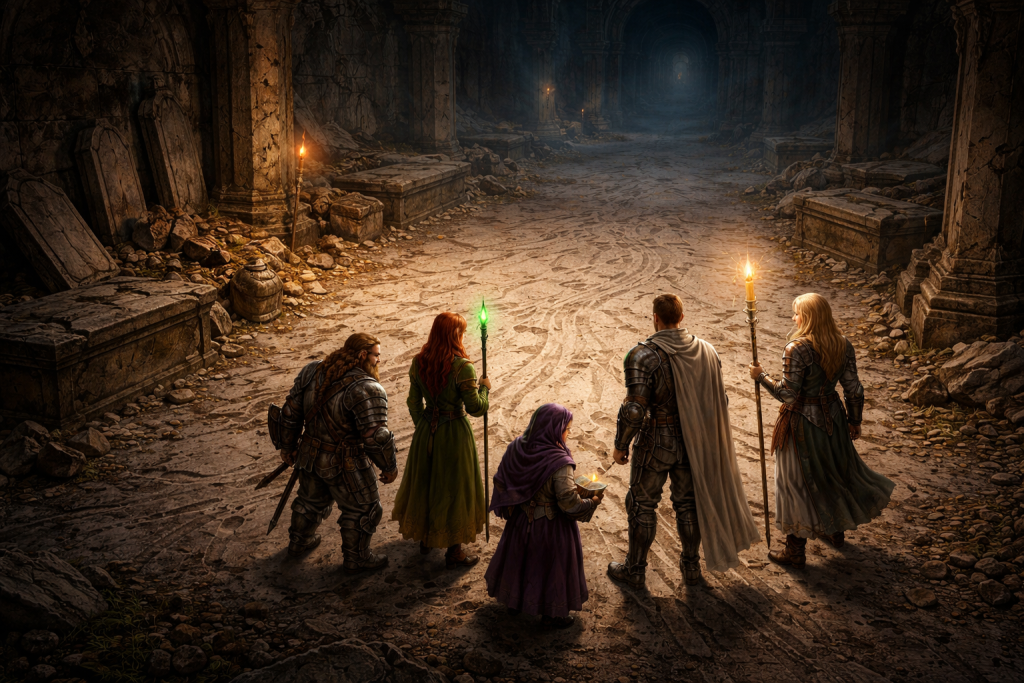
The barrows themselves were cut into chalk and limestone, cool and dry within. Dust lay thick upon the floors, disturbed by many tracks.
The chambers were lined with shelves and sarcophagi. Inscriptions, broken weapons, and remnants of armor indicated this had once been the resting place of honored warriors.
The honored warriors themselves, however, were no longer present. None of them could be found—only tracks leading away from their resting places toward the outside.
At least a thousand of the dead, once carefully laid to rest, were now conspicuously absent.
At the heart of the complex stood a ruined statue upon a pedestal. Around it lay the missing Crown team—more recently deceased, but no less carefully arranged.
The cool, dry air of the barrows had preserved them well. Mummified, they permitted close inspection. Identification was made, in part, by Perrin Hale, who had thoughtfully written his name on his underwear; various monogrammed articles confirmed the identities of the others.
Each body had been placed flat on its back, hands folded in a posture suggestive of prayer, head oriented toward a cardinal direction. Their expressions had been fixed into unnatural smiles. Each was missing the left ear.
No other parts had been taken. Nor had they died here.
The wounds told a different story: strangulation, blunt force trauma, slashing injuries. These were deaths of pursuit, struggle, and violence—not ritual conducted in situ.
They had then been brought here afterward and posed carefully by someone with time, intent, and a very particular sense of presentation.
The Thing Below
In a deeper chamber of the barrows, the party found the source of the blight.
It was not, strictly speaking, a creature, but rather a mass.
A ten-foot-high, twenty-foot-wide conical accumulation of unnatural matter, homogeneous in structure save for a hardened outer rind. It did not move in any conventional sense. It did not speak. It did not display anything so reassuring as anatomy.
It simply acted.
The battle that followed introduced new variations on familiar problems. Patches of toxic matter detached themselves from the mass and crawled across the floor toward the party, while the creature itself projected what could only be described as concentrated beams of lethal corruption.
At the height of the engagement, the fallen Crown team rose and descended upon the party from the rear.
The response was immediate and characteristic: spells, steel, and moments of inspired recklessness.
Shamus closed to point-blank range to the mass and delivered a searing Divine Smite with his longsword, only to be struck in return with sufficient force to bring him uncomfortably close to the afterlife. (He later reported that the experience, while educational, had not been especially illuminating. Nor, at this stage of his adventuring career, had it been particularly novel).
Observing the creature’s dry, fibrous nature, the party called for fire. Torches were brought to bear, and Ant stepped forward with Scorching Rays, inflicting significant damage. The creature’s attempts to retaliate were repeatedly thwarted by her Mirror Images as she drifted from side to side, humming—whether for magical or personal reasons—U Can’t Touch This.
Elsewhere, matters were less controlled. Laveleen came within moments of being beaten to death by the reanimated Crown team, an experience which further reinforced her preference for non-frontline combat participation. She was rescued at the last possible moment by Hunkle, Chorizo, and Wolfgang. Chorizo launched himself at a zombie, tore out its throat, and brought it crashing down; Wolfgang followed instantly, finishing the creature with a decisive strike from his paired blades.
In the end, the zombies were (re)slain, and the mass was destroyed.
Wolfgang declined the opportunity to experiment with the culinary applications of zombie flesh, though others noted—quietly—that Chorizo did not share this restraint.
Examination of the remains revealed a uniform structure beneath the hardened rind. There was no central body, no core from which the mass had grown. This eliminated certain possibilities without offering better ones.
After due consideration, it was burned.
The chamber itself bore signs of relatively recent labor—scrapes, drag marks, and the absence of what had once been fixed in place. The sarcophagi here had not merely been opened. They had been removed, clearing space for the mass and whatever work had accompanied it.
Carved into two walls was a symbol the party recognized: a divided circle split by a lightning bolt—the same mark seen on Rudric and among the undead at Willowhollow.
The symbol had now appeared in three separate locations across several days’ travel.
This suggested, rather uncomfortably, that the work being done here was neither local nor incidental.
Aftermath
After exiting the barrows, the party conducted a simple experiment. They marked the edges of several blighted areas and returned the following morning to find that the blackened zones had receded—only slightly, but unmistakably.
The conclusion was a relief. The thing beneath the barrows had been the cause, and its destruction—while not an immediate cure—had begun a recovery.
The villagers were informed. Relief was cautious, tempered by the knowledge that whatever had been happening beneath their feet had not been natural—and had not acted alone.
Still, for the first time in months, there was measurable improvement.
Ant’s mood brightened considerably at the realization that the party had, once again, saved a village. It was not a world-shaking achievement, but it was, to those involved, everything.
Even Wolfgang permitted himself a quiet smile and refrained—briefly—from commenting on the absence of treasure in the barrows.
Yet several matters remained unresolved.
The blight creature had not killed the Crown team. Someone else had—someone who had taken the time to arrange the bodies, remove the left ears, and, in so doing, leave behind a message equally gruesome and obscure.
And why had the Crown never followed up on the disappearance of its own investigators?
Was this negligence? Incompetence? Something more deliberate?
Or had the team simply not been employed by the Crown at all?
Onward
The party departed for Nareen’s Hill.
Along the road, their conversation turned—as it increasingly did—to patterns.
Rudric. Willowhollow. Barrow’s Edge.
Sites separated by days of travel, yet linked by shared symbols, by death, by blight, and by the steady accumulation of the dead into something larger.
By now, coincidence was no longer a credible explanation. Something was being prepared.
And whatever it was, it was not being assembled in one place.
It was being built everywhere at once—quietly, deliberately, and far too quickly.