December 1st, 973
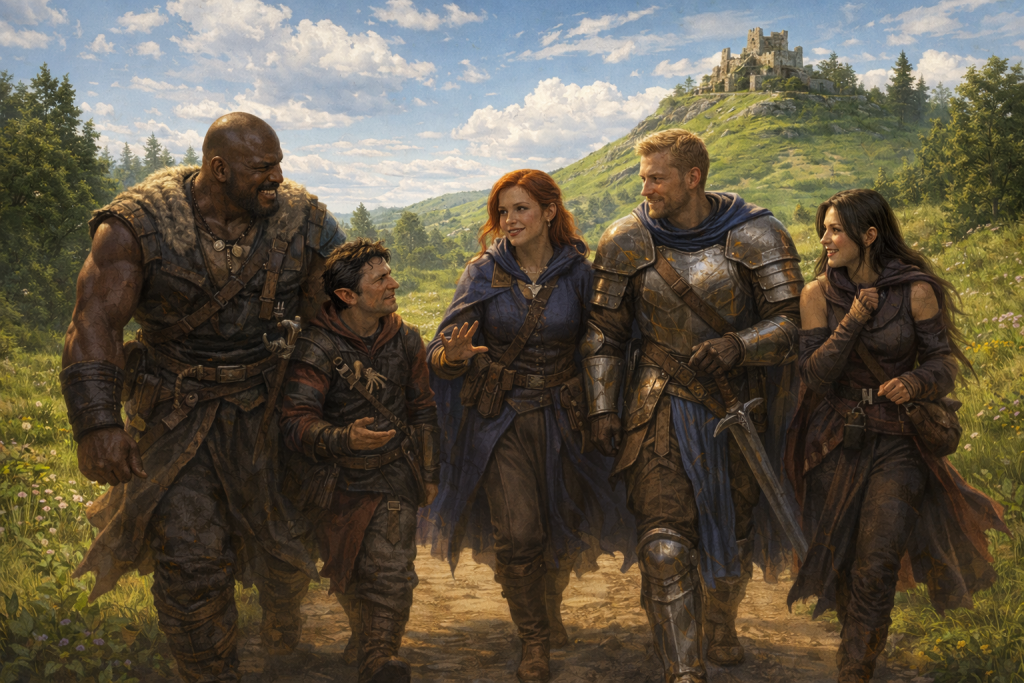
As they made their way toward Nareen’s Hill, the party took stock of what little they truly knew of the village—and how much of it refused to sit comfortably.
Captain Nelson’s letters had been their first thread to pull. He had described Colonel Varnes arriving in Manchester under the guise of a routine inspection, unremarkable at first. But something had shifted after a brief detour to Hollowmere. When Varnes returned, Nelson wrote, he was… not the same man.
He moved differently—slower, more deliberate—as if each motion were being chosen rather than lived. His gaze lingered too long without blinking, and he kept to the shadows with an unnatural aversion to sunlight, not like a man in pain, but like one who no longer remembered how to endure it. More unsettling still was the effect he had on others. Officers who once questioned orders now obeyed without hesitation, their resistance replaced by something quieter, more absolute.
Nelson had not written those words lightly. By the end of the letter, he was no longer certain Varnes served the Crown at all.
There had been other discoveries. In Varnes’s quarters, Nelson had found the remnants of a burned map—damaged, but not beyond recognition. Marked upon it was a symbol the party had since come to associate with the growing, coordinated efforts to raise undead forces across Cambria. That alone would have been troubling. But it was not the end of it.
Nelson had dispatched a runner—Farris—to investigate the chapel archives at Nareen’s Hill.
Farris returned… changed.
He arrived near moonrise, soaked through and barely coherent, unable to speak at first, as if language itself had slipped beyond his grasp. When he finally managed words, they came haltingly, circling the same phrase again and again: “It remembers.” Even after rest and drink, his account remained fragmented. The chapel, he said, had been emptied—archives removed under the pretense of renovation, doors sealed, no clergy or guards in sight. And yet, at dusk, the bells still rang, though no hand pulled their ropes.
He had broken inside.
What he found there had unsettled him more deeply than he could clearly explain. The chapel interior bore signs of deliberate destruction—soot and scorched stone suggesting burn patterns. He’d also found a scrap of a record from the Righteous War with references to something called Option Black, to the release of a “Bound Cohort,” and, most chillingly, to Hollowmere itself. Whatever had been buried there, the document insisted, was never meant to be disturbed.
They had also heard Barin’s account—less frantic than Nelson’s, but no less troubling in its implications.
Nareen’s Hill, he had said, was the sort of place people overlooked by design. A quiet, out-of-the-way village centered around a modest chapel—nothing remarkable, at least on the surface. The Brethren of the Veiled Bell had tended it for years, performing the expected duties: services, burials, the quiet maintenance of rural life.
But that had never been their true purpose.
Beneath the chapel lay a repository—an archive of records the Crown preferred to keep at a distance. Not destroyed, not forgotten, but carefully misplaced. Close enough to be accessed by those who knew to look. Far enough that no one else ever would.
But in recent months, something had changed.
Travelers had spoken of it. Quietly. The chapel was closed, they said—under renovation. The Brethren had been reassigned, officially. Crown business. Unofficially, they’d left hurriedly and no one seemed to know where they had gone.
Nareen’s Hill proved, at first glance, to be exactly what Barin had promised—and exactly what he had warned against trusting.
The village was small, two or three hundred souls at most, set amid broad, patient fields that stretched outward in neat, uninspired rows. Turnips, mostly. An entire landscape given over to them, as though the earth itself had long ago settled on a single, reliable answer and saw no reason to reconsider.
On its periphery, upon a low rise, stood the chapel.
It was modest to the point of anonymity—stone walls, a handful of windows, a single door, and a bell tower scarcely larger than a storage shed perched atop it. Twenty feet by thirty, perhaps. The sort of structure one might pass without a second glance, were it not for the way it seemed to sit just slightly apart from the rest of the village, as though the land had raised it there for reasons no one still recalled.
Their arrival drew attention.
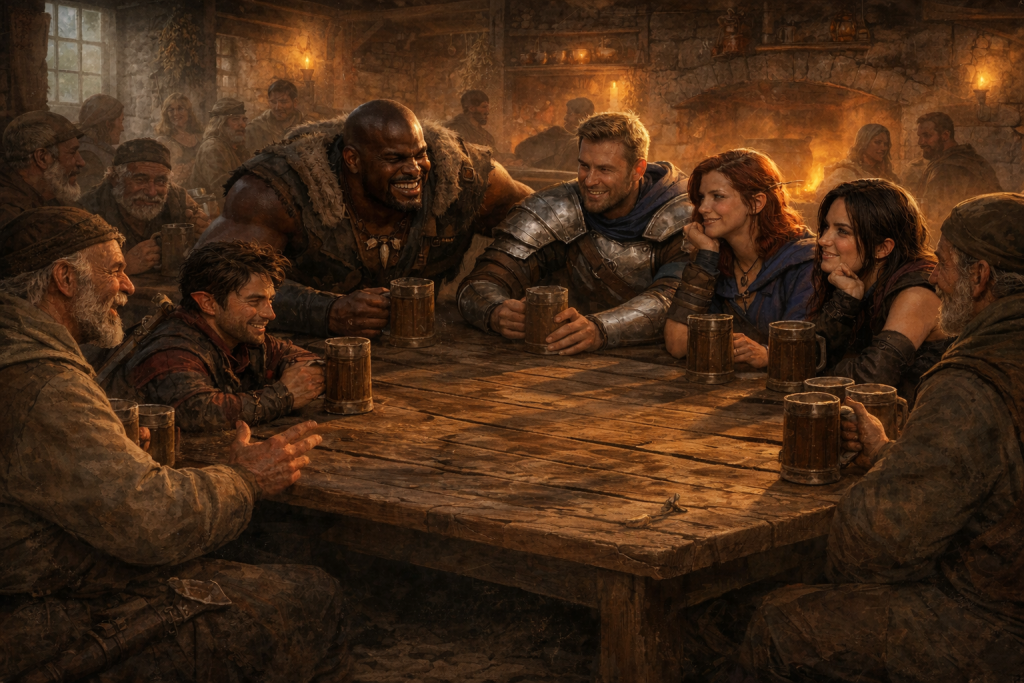
Not alarm—nothing so dramatic—but curiosity of the quiet, communal sort. Strangers in the village itself were rare here, and seven of them together rarer still. By the time they had settled into the village’s lone tavern, a modest place that served as inn, meeting hall, and rumor exchange in equal measure, they found themselves surrounded by questions gently asked and more gently deflected.
They answered little, offered less, and accepted drinks that proved, somewhat surprisingly, to be quite good. Conversation came easily after that.
The villagers spoke of crops, of seasons, of the coming turnip festival—described with a pride that bordered on the absurd, and with a timing that, mercifully, placed it safely months in the future.
When asked about the chapel, however, the tone shifted—not into silence, but into something narrower, more carefully shaped.
On one point, they were unanimous: both the village and the chapel had stood there for as long as anyone could remember—hundreds of years, at least. But which had come first, no one could say. The two seemed to have grown together, each lending the other a kind of quiet legitimacy, as though neither could quite be imagined without the other.
As for the Brethren of the Veiled Bell, they were not newcomers, not recent caretakers, but part of the place itself—present for as long as the chapel had stood, and perhaps longer, if one listened to the more speculative among the villagers.
“The Bell-Brethren?” one man said, scratching thoughtfully at his beard. “Quiet folk. Kept to themselves. They handled the chapel. Burials, services, records… offerings to Chauntea. That sort of thing.”
“Never caused trouble.”
“They kept the bells,” another added. “That was their business.”
There was a faint note of amusement there, or perhaps mild discomfort.
“Strange hours, sometimes. But that was their way. Rituals.”
No one, it seemed, had ever thought to question it.
They spoke of the Brethren collectively, never individually. No names surfaced. No anecdotes. No small human details that might anchor memory to a face. Only the role remained—the function—preserved in broad strokes and nothing more.
Every few weeks, someone said, the Brethren would receive a visitor. The pattern was consistent: a quiet arrival, a few days spent entirely within the chapel, and then a departure just as quiet. Whoever these visitors were, they had no dealings with the village itself.
When asked what had become of them, the answers came more quickly—but less cleanly.
“Crown business,” said one.
“Renovations,” said another. “That’s what they told us. Chapel needed work.”
“It was about a year ago. Maybe a bit more.”
From there, the account sharpened—not into certainty, but into something closer to shared memory.
A detachment of Crown soldiers had arrived, led by a colonel. With them came laborers and carts. They kept largely to themselves, camping near the chapel rather than in the village, and gave no cause for complaint. Polite enough, but distant.
Their work, such as it was, never extended beyond the chapel grounds.
They kept the villagers back—not forcefully, but firmly—and though no one was permitted too close, it was still possible to see enough. The laborers were loading things. Crates, bundles, whatever could be carried. The contents of the chapel, by all appearances.
No explanation was offered beyond the renovations.
After a few days, the soldiers and their entourage departed.
The Brethren left that same day.
No farewells. No explanations. Not even a token gesture to the village they had served for generations. The two groups departed at different times, but no one could say whether they had gone in the same direction.
And then, almost as an afterthought, “Strange thing, though… the bells didn’t stop after they left.”
That gave them pause. “They still ring. Not right, maybe. But they ring.”
And when pressed, the villagers elaborated—haltingly, uncertainly—that the bells had once followed patterns. Clean, deliberate sequences that, with enough patience, might be mistaken for meaning—short clusters, no more than a handful at a time. Since the Brethren’s departure, that structure had dissolved. The bells still rang at all hours, but the rhythm had broken down into something irregular, almost careless.
One older woman, who had been listening more than speaking, finally leaned forward.
“They wouldn’t have left the bells,” she said quietly. A silence followed that seemed, for a moment, less comfortable than the topic itself.
“They said the bells meant something,” she added. “More than we understood. It doesn’t make sense that they left them behind.” No one argued with her—but no one could explain why the bells remained.
And the promised renovations never came. Whether they might in the future, none could say.
When Farris’s name was raised, the atmosphere shifted again—not dramatically, but enough.
“A man did come through,” someone said. “Some months back. Not from here—but asking questions. Like you.”
The details came unevenly, as though each speaker held a different fragment of the same memory.
“He stayed a day.”
“No, less than that.”
“Didn’t talk much.”
“Seemed in a hurry.”
And then, “He went to the chapel.”
That much, at least, was agreed upon. What followed was less certain. One of the villagers—a younger man, uncertain of himself even as he spoke—hesitated before continuing.
“He came back,” he said. “But wrong.”
A few turned to look at him.
“After. He was wrong after he came back.”
“How d’you mean?” someone asked.
The man frowned, searching for the right words.
“Like he wasn’t hearing properly. And kept losing his place mid-sentence. Like he’d forgotten what he meant to say.”
Another nodded.
“It was like he’d forgotten why he went in.”
There was a murmur of agreement at that.
“And he kept saying something,” the older woman added.
“What was it?”
She shook her head slowly.
“Don’t remember it right,” she said. “But… something about remembering.”
A pause.
“‘It remembers,’ I think.”
That phrase hung in the air longer than it should have.
One of the men—broad-shouldered, with the look of someone who noticed more than he spoke—cleared his throat.
“Didn’t look like much,” he said, “but he stood like a soldier.”
A few glances turned toward him.
“What makes you say that?”
He shrugged.
“Way he held himself. Even when he was tired. Hands where he could use them quick. Eyes always moving.” He looked down into his drink. “Not a farmer. Not a merchant.”
No one argued that either.
By now, the attention of the group—and perhaps something more subtle—had shifted toward the party in earnest. And with it came a suggestion, offered casually, as though it had only just occurred to them.
“If you’re asking about all that,” the bartender said, “you should speak to Perrin Gage.”
“Aye,” someone else agreed. “He was here when the Crown came through. Had dealings with them.”
“Knows more than most. And is careful to remind us not to go up there.”
A boy was sent to fetch him.
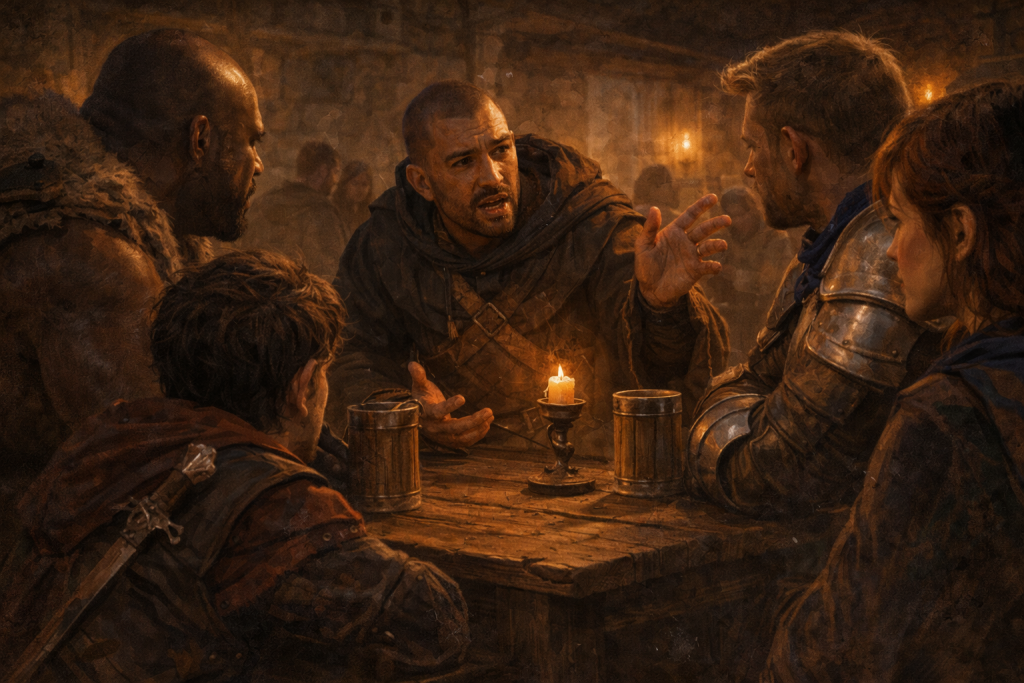
Perrin Gage arrived not long after, moving with an unhurried, economical ease that seemed entirely appropriate for a man who had nothing to prove and nowhere in particular to be.
He introduced himself simply—Perrin, a travelling merchant who had settled here a year and a half ago.
He was, on the surface, exactly what he claimed: practical, unassuming, and willing to speak without embellishment. He answered their questions patiently, neither evasive nor overly forthcoming, his tone that of a man who had told this story before and seen no reason to improve upon it.
“That crypt wasn’t abandoned,” he said at last. “It was sealed.”
A small pause.
“By the Crown.” That drew the attention he had been waiting for. “There was an order,” he continued. “Not a public one. Some things get handled quietly.”
“What was inside?” someone asked.
Perrin gave a small, almost apologetic shake of the head.
“They never told me. But they said that as long as we left it alone, there was nothing to worry about.”
He let that settle before going on.
“Whatever it was, they couldn’t kill it. They had to contain it.”
“And the Brethren?”
“Reassigned,” he said. “Officially.”
“And unofficially?”
Perrin’s expression did not change, but something in his gaze sharpened, just slightly.
“Crown business is Crown business,” he said.
Then, after a moment:
“You don’t seal a place like that unless what’s inside is worse out than in.”
There was no drama in the statement. No attempt to persuade. Only certainty.
“If you break that seal,” he added, “you’re not just trespassing. You’re interfering with something the Crown decided should stay contained.”
A brief pause.
“I’d leave that place alone.”
It was not a warning.
It was, somehow, less than that—and more.
As for Perrin’s background, he spoke readily and without apparent strain. A wandering trader, he said, dealing primarily in tools, dried goods, and the sort of agricultural necessities that moved quietly between villages without attracting much notice. His routes, by his account, took him mostly north—toward Hollowmere and beyond—though he made occasional trips to Manchester when business required it. He was, in fact, expecting a shipment from Manchester within the next few days and anticipated escorting part of that cargo north himself.
It was all perfectly reasonable.
And yet.
It did not escape the party’s notice that Perrin’s hands told a different story. The calluses were real enough—but wrong. Not the slow, uneven wear of trade, but something more disciplined. Repeated. Intentional. The hands of a man who practiced, rather than labored.
That, combined with his measured insistence that the chapel was best left alone, was enough to raise quiet suspicion.
They did not confront him directly, however. Instead, they performed.
Rooms were taken. Drinks were finished. Goodnights were exchanged with just enough theatrical fatigue to suggest the matter had been set aside. And while the others settled in, Merrythought slipped away, wrapped in invisibility and purpose, to follow Perrin at a distance.
She returned near midnight. Perrin had gone home, as expected—to a small, unremarkable hut that offered nothing to distinguish it from its neighbors. But not long after, an owl had left it.
Not the soft, unremarkable sort that belonged to fields and hedgerows, but something sharper in its movement, more deliberate in its flight. It had departed cleanly and directly, winging its way toward the chapel with a purpose that left little room for coincidence.
A familiar.
The party’s interest sharpened immediately. Perrin, Shamus observed, was almost certainly “a watcher”—someone placed not merely to live in the village, but to observe it. And more importantly, to discourage any interest in the chapel.
Merrythought was dispatched again, returning shortly thereafter to report that the owl had come back.
Which, if anything, was worse.
Despite the hour, sleep was no longer a serious possibility. The room hummed with low conversation and rising speculation. Laveleen suggested that Perrin might be a warlock—his secrecy, the familiar, the general air of something concealed. This was considered, then complicated by the observation that his hands bore little resemblance to those of Ant or Laveleen herself. The theory was not discarded so much as broadened; it was agreed that if one thing could be said of warlocks, it was that they resisted tidy categorization.
Wolfgang, for his part, arrived quickly at a more direct solution.
“Let’s burn his house down.”
This proposal, while not adopted, was not dismissed with the speed one might have hoped. He later refined it.
“Sometimes a flashbang is a good idea.”
To general surprise, Shamus found himself in agreement with this second formulation, though perhaps not with the same enthusiasm.
In the end, cooler heads—if not entirely cooler impulses—prevailed. The party resolved to approach Perrin openly in the morning, under the far more respectable guise of conversation. Clearly he was holding something back and the party aimed to find out what it was… and to ensure that when they entered the chapel, Perrin would not be skulking behind them.
And so, despite the mounting tension, the remainder of the night passed without incident. Which, under the circumstances, felt less like a relief and more like a pause.
At a civilized hour—by mutual agreement and some effort—after breakfast, the party made the short walk to Perrin’s modest hut. He answered their knock promptly. After a brief exchange of pleasantries that fooled no one involved, they came directly to the point.
They intended to visit the chapel. Why, they asked, did he so strongly advise against it?
Perrin hesitated—just enough to suggest reluctance, not enough to suggest indecision. Then, with the air of a man about to share something he very much should not, he asked for their discretion.
What the Crown had left in the chapel, he said, was not an empty crypt but a prison. Within it were wights—several of them. Perhaps as many as ten. Some, he added, had been altered in ways he did not fully understand—made resistant, even immune, to destruction. The Crown, unable to destroy them, had instead chosen to contain them. The chapel, for reasons unknown to him, served as that containment.
He was here, he explained, to ensure that it remained so. A mechanical arrangement in the chapel ensured that the bells continued to ring without anyone appearing to do so… a ruse calculated to keep superstitious villagers away.
Given their party’s recent—and extensive—experience with the undead, the mention of wights had the opposite of the desired effect. Rather than being frightened away, the party’s Interest in the crypt sharpened immediately.
They showed him the red-and-blue circle bisected by a jagged lightning mark; the same symbol they’d seen associated with the undead across Cambria. Had he seen it before?
He said no. He was lying. Not egregiously. Not flamboyantly. But clearly lying.
The party called him on it.
They accused him—not of a single falsehood, but of a pattern. Of shaping the truth, of steering them away, of telling a story that did not quite hold together. And they made it equally clear that, whatever his reasons, they intended to go to the chapel and see for themselves.
Perrin’s expression tightened, just slightly.
He observed, with a measured tone, that such accusations might provoke an honorable man to take violent offense. Outnumbering him seven to one, the party was not impressed and Perrin said nothing further, simply closed the door in their faces.
Laveleen, dispensing with subtlety, reached for Detect Thoughts and what she found was not indignation but alarm. For a moment, there was stillness. Then, as if on cue, the now-familiar owl emerged from the hut and took flight—fast, direct, and unmistakably purposeful—toward the chapel.
That, more than anything, settled the matter.
Laveleen and Cassyndra dispatched their own familiars in pursuit, and the party, abandoning all pretense, forced their way into the hut. Perrin, for his part, had no intention of being found waiting. He had already fled out the back.
He did not get far.
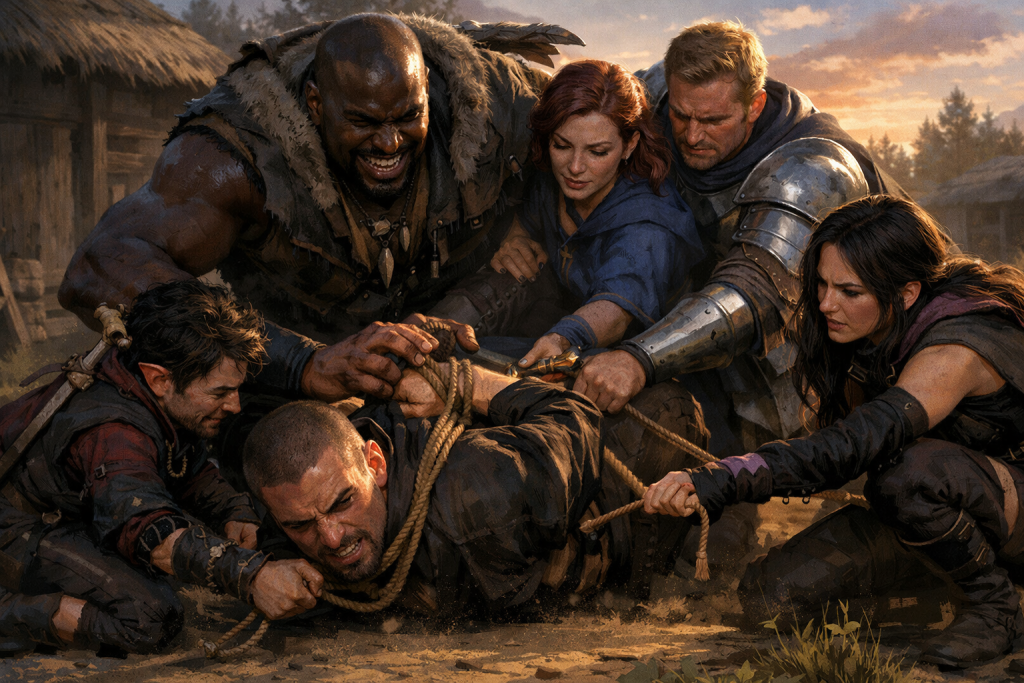
Cassyndra’s Sleep spell dropped him before he could make meaningful distance, and the rest of the party descended upon him with admirable efficiency. He was restrained quickly, if not gently.
A quick assessment followed. Detect Magic revealed nothing. Which, rather than reassuring anyone, only deepened the mystery. If Perrin was not a wizard with a familiar, then he was—at minimum—a man who lived with a wizard’s familiar. And with the wizard in question nowhere to be found.
This was, if anything, worse.
The disturbance had not gone unnoticed. Villagers gathered at a cautious distance, watching with open curiosity—but not intervening. Whether out of deference, uncertainty, or simple unwillingness to involve themselves was unclear.
Interrogation, such as it was, proved fruitless. Threats were issued—some more convincingly than others—but Perrin refused to speak. The party, for the moment, stopped short of carrying their threats out. Whether out of restraint, principle, or the lingering hope that words might yet suffice, they held the line.
Not long after, Laveleen’s familiar returned. Alone. And with a brief and alarming report.
Perrin’s owl had flown directly to the chapel’s bell tower. Laveleen’s familiar and Heka had attempted to follow—but someone had been waiting. An archer in the tower had loosed a single, precise shot and Heka had been shot out of the air.
Laveleen’s familiar, demonstrating commendable instincts for self-preservation, had withdrawn immediately.
The party was now in no doubt whatsoever. The chapel was not abandoned and whatever waited there was now fully aware of their presence and intentions.
What followed was, for a time, less action than argument.
The chapel lay ahead, exposed, with a full hundred feet of cleared ground surrounding it on all sides. Whether this was an intentional design or not, the party realized it offered no cover and little ambiguity. Anyone approaching in broad daylight would be seen. And, given recent developments, very likely shot.
There were, naturally, proposals. Some were cautious. Some were creative. Some were Wolfgang.
“We could use him,” Wolfgang suggested, gesturing toward their bound prisoner with a practicality that bordered on enthusiasm. “Walk him out in front and we follow behind. Let them think twice about firing.”
This line of thinking found some support but Shamus put an end to it.
“No,” he said, simply. There was no anger in it, no moral grandstanding—just a quiet certainty.
“We keep him alive,” he continued. “If not for mercy, then for usefulness. I won’t hand them the chance to solve our problem for us.” That settled it. Mostly.
The debate lingered, looping through variations of the same ideas, while the village—having sensed that something worth witnessing was unfolding—gathered in ever greater numbers. By the time the party reached a decision, they had acquired an audience consisting of the entire population of the village.
No one intervened or offered advice. They simply watched.
At last, with no better option presenting itself, the party chose the simplest course available: they would advance carefully, together, and see whether the threat remained.
Step by measured step, crossing the open ground, every eye on the tower, every expectation bent toward the inevitable moment when the first arrow would fall.
It did not come. The tower remained still.
No movement. No sound. No second shot. The archer in the bell tower had chosen, for reasons unknown, to withdraw.
If this was a reprieve, it was not a reassuring one.
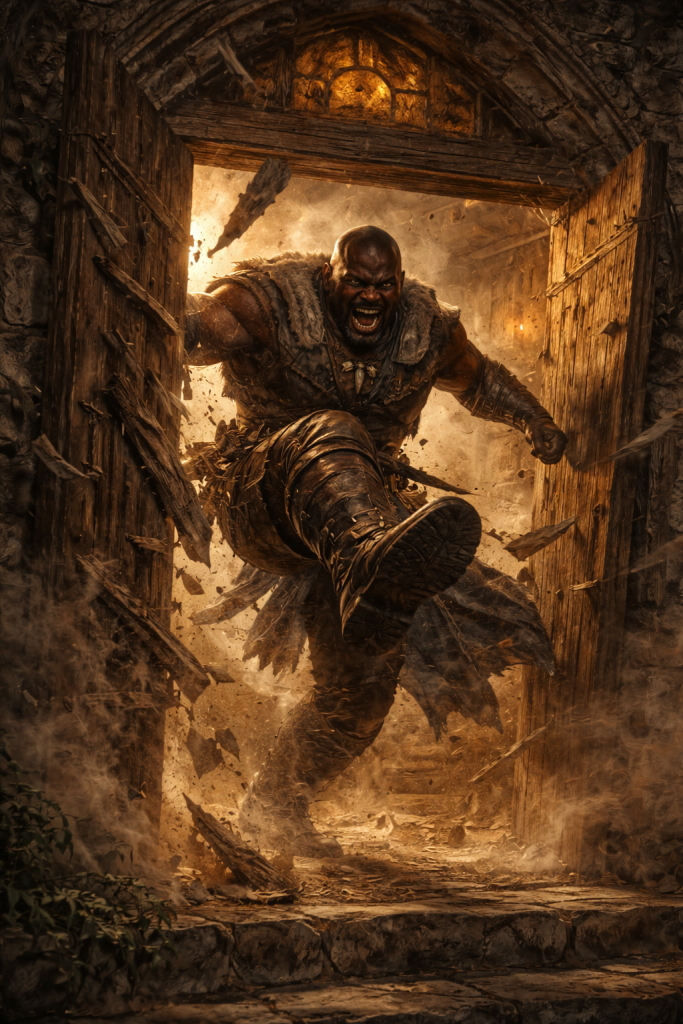
The front door told its own story.
The bolt had been replaced—recently, and with care—but not well enough to withstand Hunkle’s particular approach to problem-solving. He regarded it briefly, considered it in the abstract, and then removed it from the realm of abstraction entirely.
The door gave way with a satisfying finality.
Inside, the chapel was empty. Not neglected. Not abandoned. Emptied.
Every piece of furniture had been removed—benches, altar, fixtures, anything that might suggest function or history. What remained were the marks.
Scorching along the walls. Blackened streaks across the stone floor. Not the residue of a single fire, but many—set deliberately, in different places, at different times. Whatever had been burned here, it had been done in stages, with intent, and in a manner that made some party members think of a book burning.
And then, just as deliberately, the ashes had been taken away. Nothing remained to examine. Only the absence.
A ladder rose in the center of the room, leading upward into the bell tower. Ant checked it out.
Above, the tower was as spare as the room below. Two large bells hung in place, each fitted with rope in the traditional manner—meant to be rung by someone standing there, hands on the lines, pulling in rhythm.
Except that was not how these had been rung recently.
A hole had been cut through the floor of the tower—cleanly, efficiently—and another through the floor below. The rope passed through both, disappearing downward into darkness. It was clear what had been done. The bells could now be rung out of sight from the basement – invisible hands pulling on concealed ropes. The chapel’s hauntings, it seemed, had been engineered. At least Perrin had been telling the truth about that.
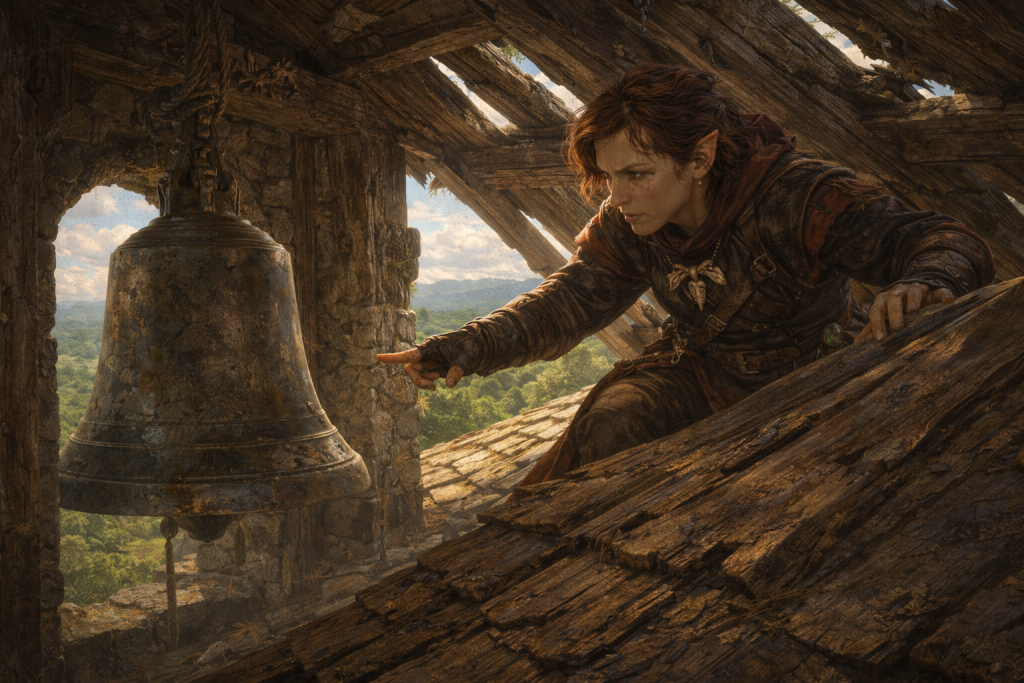
Ant took her time in the bell tower.
Where others saw emptiness, she saw interruption—patterns disturbed, surfaces altered, the small betrayals of presence. Dust told its own story, if one knew how to read it, and she read it carefully.
The archer, whoever they had been, had not escaped by the obvious route.
There were ways down from the tower—over the roof, across the stone, into the surrounding fields—but those paths left traces. Scuffs. Displacement. Something.
There was nothing.
No signs of descent. No disturbance of the accumulated dust. No indication that anyone had left by any path that led outside.
She straightened slowly.
“He didn’t leave,” she said.
Which left only one alternative.
Just below the tower, on the first floor, was another ladder. One that led down into a space that swallowed light almost immediately—a darkened room beneath the chapel, untouched by the morning and unconcerned with it.
Whatever the archer had done, wherever they had gone—it was down there.
The ladder led down into a narrow anteroom—ten feet by twenty, enclosed and airless in a way that suggested it had not been meant for comfort, only for function. The stone here was older, rougher, less concerned with appearances. A single wooden door stood at the far end. No other exits. No ornamentation.
The rope from the bell tower ended here.
It had been knotted at waist height, the fibers worn smooth where hands had pulled it. From this room, the bells above could be rung unseen, their voices carried outward while the one who summoned them remained hidden below.
Cassyndra approached the door carefully.
At first glance, it appeared ordinary enough—aged wood, iron fittings, nothing remarkable. But her attention lingered, sharpened, narrowed. There—just at the edge of perception—something in the grain did not behave as it should.
She leaned closer. A pattern, almost lost in the natural lines of the wood. Subtle. Intentional.
A glyph.
“Something’s here,” she said quietly.
Laveleen stepped forward to examine it more closely, tracing the faint contours with her eyes rather than her fingers.
“It’s layered,” she murmured after a moment. “Abjuration, certainly. But not just that. There’s… more. It’s not meant to stop you from entering.”
A pause. “It’s meant to do something when you do.”
Behind them, Perrin said nothing. He had been silent for some time now, and remained so even as the party turned their attention toward him. Questions were asked. Directly, then pointedly, then with increasing emphasis.
He did not answer.
Even when the tone shifted—when the possibility of consequences was allowed to enter the conversation—he remained unmoved. If he was afraid, he did not show it. If he knew something, he was determined not to share it.
At last, Shamus gestured toward the door. “You’ll open it,” he said.
Perrin inclined his head slightly. “If that’s what you intend,” he replied.
The acceptance came too easily.
That, more than any refusal, gave them pause and suspicion deepened, not diminished.
A brief debate followed—options weighed, risks considered, trust withheld. In the end, they settled on a compromise of sorts.
Perrin wouldn’t touch the door but if it held danger, he would meet it first.
They positioned him accordingly.
Hands bound, posture less than cooperative, but no longer in control of his immediate circumstances, Perrin was guided forward. The others took what cover they could behind him, bracing for whatever might follow.
The door opened.
There was a flash and a sharp, concussive pop that seemed to strike not the ears but the mind itself—
—and then everything slipped.
Thoughts fractured. Memory loosened its grip. For a moment—perhaps longer—nothing connected cleanly to anything else. Purpose dissolved. Time folded inward. The world became a series of impressions without continuity.
It was, in every meaningful way, exactly as Farris had described.
“It remembers.”
The phrase hovered at the edge of comprehension, unmoored from context.
And then—motion.
Perrin, unaffected, moved immediately, decisively, breaking into a sprint down the corridor beyond the door. Bound though his arms remained, his legs served him well enough. He vanished into the darkness ahead before most of the party had even reassembled their sense of direction.
Recovery came in fragments.
Cassyndra forced herself back first—grasping at the threads of thought before they could slip away entirely. Ant and Laveleen followed close behind, their own training and discipline dragging them back into coherence.
“Snap out of it,” Ant muttered, already turning to shake the others from their fugue. Laveleen moved with her, restoring clarity one ally at a time.
Cassyndra did not wait.
She raised a hand, fixed her gaze down the corridor, and spoke a word that carried weight beyond sound.
Perrin rose.
The Levitate spell caught him mid-stride, lifting him cleanly from the ground and leaving him suspended some twenty-five feet down the passageway. His forward motion ceased instantly. His retreat, equally impossible.
He hung there, helpless.
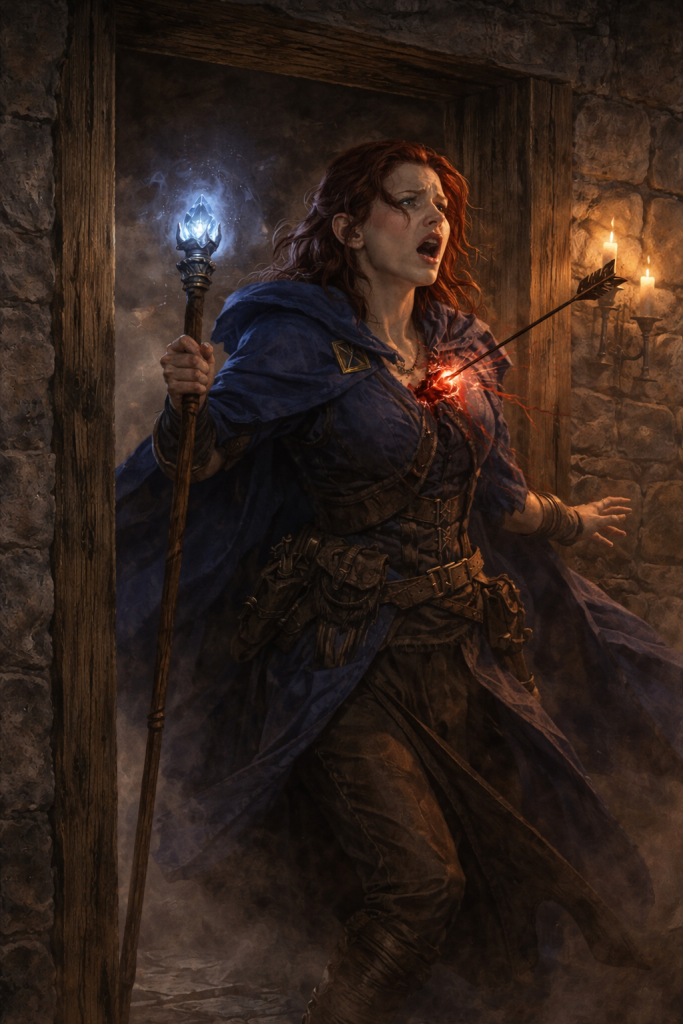
The corridor beyond stretched long and narrow—nearly a hundred feet in total, dimly lit, terminating in a circular chamber whose details remained just out of reach.
From that darkness came the movement of an archer. Cassyndra saw the motion, began to react—
—and the arrow was already in flight.
It struck her cleanly, directly, with a force that spoke of both strength and precision. For a moment, it seemed less like a wound and more like a statement.
Her breath left her, her vision narrowed, and somewhere, distantly, she heard a voice from the archer, “Balrog Six.”
Then the world threatened to drag her to whatever afterlife Heka was already in.
But Cassyndra held.
Through will, training, or simple refusal, she remained present. The Levitate spell did not falter. Perrin continued to bob helplessly in the corridor, a prisoner of gravity denied.
She staggered back, finding cover by instinct rather than sight, and forced magic into herself—enough to stabilize, enough to survive. The arrow came free in a wet, unpleasant motion. Blood followed, but less than it might have.
She was still here but barely.
In the anteroom, crouched out of the archer’s line of sight, the party regrouped. Plans were considered, discarded, reconsidered. The enemy was prepared, positioned, and aware. The corridor ahead offered no concealment, no advantage, and very little mercy.
Time passed.
A minute. Perhaps two.
And then—movement again.
From the far end of the corridor, shapes emerged.
The first was unmistakable.
A two-headed warg, massive and unambiguous in its intent, charged forward with both heads fixed on the party. Behind it came others—figures moving with discipline and purpose, their formation tight, their advance coordinated.
The party responded as one.
Spells, steel, and instinct met the charge head-on. The warg took the brunt of it—struck, burned, battered—but it did not slow. Pain registered only as momentum.
Behind it, Cassyndra cast Cloud of Daggers, the swirling blades carving into those who followed. The effect was real, but not decisive. The advance continued and, in moments, the party would be overrun.
Wolfgang made a decision. He stepped forward, seized the door, and with a force born of both urgency and preference, slammed it shut.
The sound echoed through the chamber.
Behind it, the party scrambled—repositioning, preparing, bracing for impact.
They waited but nothing came. Seconds stretched into something longer. No pounding on the door. No renewed assault. No sound at all beyond their own breathing and the fading echo of what had nearly happened.
At last, cautiously, the door was opened again.
The corridor lay empty. Their antagonists had retrieved Perrin and withdrawn. They were at the far end of the corridor, regrouped, waiting, and in determined possession of the better terrain.
It was Shamus who said it first. Not loudly. Not dramatically. Just… plainly.
“We can’t take them.”
The statement settled over the group with the uncomfortable weight of something already known but not yet spoken. The exchange at the corridor had made it clear enough—whoever waited at the far end was disciplined, coordinated, and prepared to fight on ground of their own choosing. Another advance would not be a battle.
It would be a massacre.
“And they didn’t press,” he continued after a moment. “They could have.”
That, too, was true.
Their charge had come fast, decisive—and then stopped. Withdrawn. Not broken, not scattered, but chosen.
“They’re either trapped,” he said, “or they’re guarding something they won’t leave. Either way, we’re not getting through them by force.”
No one disagreed. For a moment, the only sound was the distant, patient quiet of the corridor beyond the door.
Then Shamus stepped forward. “I’ll speak with them.”
He opened the door and moved just far enough into the corridor for his voice to carry.
“We would parley,” he called.
The word hung there—formal, deliberate, and, perhaps, unexpected.
For a heartbeat, nothing answered.
Then, from the far end, a voice returned.
“Accepted.”
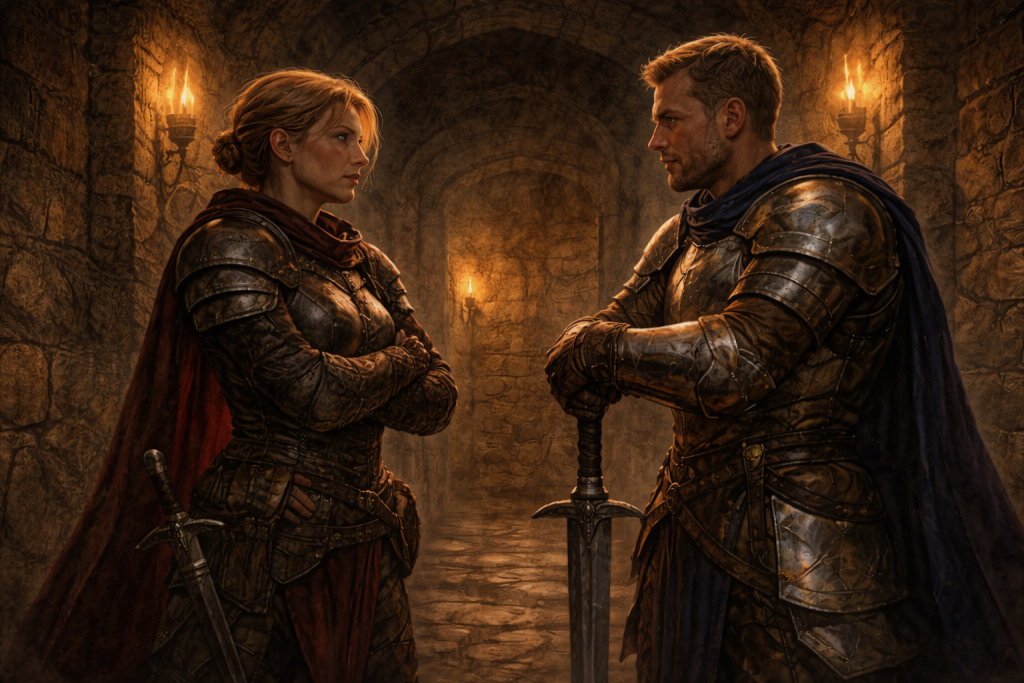
Shamus went alone.
The others watched him go—halfway down the corridor, to a place where both sides could see but neither could easily strike without consequence. The distance was carefully chosen. Not too close. Not too far. The geometry of mutual risk.
From the far end, a figure stepped forward to meet him.
The leader.
She moved with the same controlled economy the party had come to associate with the others—no wasted motion, no unnecessary display. Up close, there was nothing overtly remarkable about her. No obvious sign of corruption, no visible mark of allegiance beyond the company she kept.
“Captain Varric,” she said, by way of introduction.
Shamus inclined his head.
There was a brief pause—one of those quiet moments where something unseen but meaningful passed between two people who understood, at least in part, what the other was. Shamus reached inward, calling upon that quiet sense that had guided him before. Divine Sense.
What it revealed was… unremarkable. Not holy. Not profane. Not twisted or corrupted. Simply—neutral. Alive, human, and—by whatever strange arithmetic governed such things—unclaimed.
Varric, for her part, seemed to come to her own conclusion just as quickly.
“A paladin,” she said. Not a question. “Yes,” she added after a moment, with the faintest hint of something like approval, “you’re not likely to lie to me.” It was not quite trust but it was enough.
They spoke carefully, at first. Each word measured, each statement tested for weakness or deception but then, gradually, with increasing clarity.
Shamus stated their purpose plainly.
They were not here for conquest, nor for whatever larger game might be unfolding beyond the village. Their concern was immediate, and specific: the chapel, the crypts, and the possibility that something within them posed a threat to the people above.
“If there are undead here,” he said, “or anything that might harm those who have no part in this, we will deal with it.”
A simple line drawn without embellishment.
Varric listened and nodded, once. “There is no such threat here,” she said. “No creatures waiting to be unleashed. No hidden dagger aimed at your villagers.”
Asked what her own group might be doing in these tunnels and if the party might help, she demurred, steering the conversation into a careful assessment of Shamus’ attitudes toward the Crown. Finding only some common ground, she paused then said, “What is here is ours.” She did not elaborate but, instead, offered her own terms.
“We leave,” she said. “My people. Our equipment. No pursuit. No interference. No questions.”
“And in return?” Shamus asked.
Varric considered him for a moment longer.
“You verify what you need to verify,” she said. “You see enough to convince yourself that your concern is misplaced. And then we are gone.”
It was neither a perfect agreement nor comfortable agreement. But it was… workable. A narrow bridge between two groups who had the ability to destroy one another and, for the moment, had chosen not to.
Shamus inclined his head once more.
“Agreed.”
The tour, when it began, was conducted with efficiency and no ceremony. Captain Varric did not attempt to impress them. She did not embellish. She simply led.
The corridor they had fought over opened into the circular chamber the party had glimpsed from afar—a space that felt less like a room than a junction, its curved walls giving way to four passages. Beyond the passages were four chambers which, Varric explained, had once been filled with shelving—rows upon rows of books and records.
Now, the rooms had been repurposed. “This room,” she said, gesturing toward the first, “is living space.”
It showed. Bedrolls, personal effects, the small, practical clutter of people who intended to remain long enough to require routines. Nothing extravagant. Nothing sentimental. Just enough to function.
The second chamber had been adapted for more operational needs. Maps—now removed or concealed—had once covered the walls. Tables held instruments, carefully covered notes, and a modest but well-maintained collection of arms and equipment. Not a full armory, but sufficient for a group that expected to move quickly and fight only when necessary.
“The rest,” Varric said, indicating the remaining two chambers, “hold what was moved.”
Those rooms were crowded with shelving—all of them empty, the absence of their contents more striking than their former presence might have been.
And it did not take long for the party to realize that the space had been reorganized not just physically, but conceptually.
“You name everything,” Ant observed.
Varric glanced at her, then nodded once.
“It’s easier,” she said. “Faster in crisis situations.”
The names, as it turned out, were not subtle.
“Arcane,” she said, indicating one chamber. “Balrog,” the anteroom. “Effreeti,” for the central room.
There was a brief pause.
“Balrog Six,” Wolfgang said.
A faint, almost imperceptible smile touched Varric’s expression. “Six intruders in Area Balrog,” she confirmed. “Clear, immediate, no ambiguity.”
One mystery, at least, resolved.
As they moved, the nature of the Varric’s defenses became clearer. They had been designed for deception, not slaughter. At least, not at first.
“We prefer not to kill people who don’t need killing,” Varric said, in a tone that suggested this was a principle rather than mere convenience.
Perrin—one of her own—had been placed in the village for that very reason. His role was to shape behavior, to ensure that curiosity never became investigation. Rumors, suggestions, quiet discouragement. Enough to keep most people away.
The bells had been part of that design. “People believe what they expect to believe,” Varric said. “If they’re told a chapel is haunted and hear bells ringing on their own, well, they come to understand that the chapel is full of ghosts.” The illusion of haunting had served its purpose well.
The glyph, too, had been intended as a deterrent rather than a weapon. “It disrupts,” she said. “Confuses. No one is supposed to push past that.”
In truth, it had only been tested once before—when Farris came. For the first time, Varric allowed a trace of something like reflection to enter her voice. “He was determined,” she said. “More than most. We thought he might push all the way through.”
“And if he had?” Shamus asked.
Varric met his gaze evenly.
“Then we would have killed him.” There was no hesitation in the answer. No apology. Just the final layer of the defense—the one they had hoped not to use, but had always been prepared to.
By the time the circuit was complete, the conclusion was difficult to avoid.
Whatever Varric’s group had been doing here, whatever their larger purpose might be, it did not involve the village above.
There were no wights, no hidden horrors waiting to be unleashed, and no imminent threat to the people who lived their quiet lives among the turnip fields.
Something shifted after that.
Not dramatically, but perceptibly.
The tension that had defined the earlier exchange eased—just slightly. Weapons remained close at hand, but no longer hovered at the edge of use. Voices softened. Postures relaxed by degrees.
It was Cassyndra who moved first.
Conversation, for her, was as much a tool as any spell, and she used it now with deliberate care. Not interrogation, not quite—but something adjacent. Questions asked lightly, answers offered in return. A gradual exchange of information, each piece building on the last.
She spoke of Nelson’s letters.
Of Varnes.
Of Hollowmere.
Of the fragments Farris had carried back—broken, incomplete, but unmistakably pointing toward something older, darker, and far more deliberate than any of them had initially assumed.
And, at last, she showed them the symbol – the red and blue circle, split by a jagged line. The same one they had shown Perrin, the one that made him afraid.
This time, the reaction was different – no denial, no deflection, no attempt to minimize or dismiss. Varric saw the symbol and understood.
Around her, the others reacted in kind—quietly, but with a clarity that needed no words. Whatever they had believed themselves to be part of, whatever they had thought they were preparing for, this… was something larger.
They had seen the symbol with their leaders and thought it nothing of significance. But now, seeing it and being told that it was associated with numerous revivals of the undead throughout Cambria, they realized that there was something critical had been withheld from them.
The careful distance they had maintained—the insistence on secrecy, on limited disclosure, on controlled engagement collapsed. Varric exhaled, slow and measured, as though arriving at a decision she had hoped not to make.
Then she looked back at the party. “All right,” she said. And for the first time since they had met her she spoke without holding anything back.
Elite military units, from the age of yore to the present, have always shown a certain fondness for codenames. This unit was no exception. Whether out of discipline, habit, or a perfectly reasonable desire not to be identified later, they introduced themselves to the party using those names alone.
There was the wizard, Veil Arcanist—a title that sounded less like a name and more like a professional condition.
The rogue archer, Silent String, who spoke rarely and, when she did, seemed to consider it an unnecessary concession.
The barbarian, Iron Targe, whose name suggested defense but whose manner suggested a far more aggressive interpretation of the concept.
The monk, Quiet Step—known to the village, with equal plausibility, as Perrin Gage.
And the fighter who led them, Captain Varric. Of all the names, it alone carried the reassuring cadence of something genuine—rank, surname, perhaps even a past that could be verified. It would only be later, through Merrythought and a translation delivered with entirely too much enthusiasm, that the party would learn “Varric” meant, in Elvish, something closer to “the Circumciser.” The revelation did little to clarify matters, but it did suggest that the name, like the woman herself, was not chosen lightly.
And, of course, there was the two-headed warg, Tooth and Nail.

Readers of a more optimistic temperament might, at this point, expect such a creature to reveal a softer side once properly introduced—perhaps a fondness for scraps, a wagging tail, or a tendency toward misplaced affection. It must be reported, in the interest of accuracy, that Tooth and Nail had not read those stories. Throughout the party’s entire interaction with the squad, both heads remained in full and unapologetic agreement on one point: they were dangerous, and eager to make that fact known. Hunkle, for his part, regarded them as something of a kindred spirit.
The need for concealment, at last, set aside, the squad spoke more freely.
They did not dramatize it. They did not attempt to justify it. They simply… explained.
They were members of the Cambrian Compact, they said—a rebel organization devoted, in its own telling, to the liberation of Cambria from Archean rule. They had been operating in the region for over a year, under the direction of Colonel Varnes.
The archives at Nareen’s Hill, though not widely publicized, had long been known to the Compact. They were believed to contain records pertaining to the Righteous War—material the Crown had chosen neither to destroy nor to publicize. Instead, after the war, it had been placed here: close enough to Manchester to be accessible to those with proper authority, but far enough removed that no one without reason would ever think to look for it.
A deliberate obscurity.
The Brethren of the Veiled Bell had been established alongside the archive itself. To the village, they were a minor religious order—caretakers of the chapel, keepers of the dead, and, in their quieter moments, custodians of ritual. In truth, their purpose had always been more precise. They maintained the archive. They protected it. And, when necessary, they communicated among themselves using the bells—patterns and sequences that passed unnoticed by those who did not know to listen for meaning.
It was this archive that had drawn Varnes’s attention—five centuries later.
The military and magical knowledge contained within—including records describing how the Crown had once resisted the use of undead forces during the Righteous War—was assessed as strategically significant. In the hands of the Compact, such information might prove invaluable. In the hands of the Crown, it represented a potential advantage that could not be allowed to persist.
So Varnes made a decision. The archive would be taken well before the outbreak of fighting.
And in its place, something else would be left behind—something that would serve the Compact’s purposes rather than the Crown’s.
Quiet Step had been sent first.
Nearly a year and a half ago, he arrived in the village under the guise of a traveling merchant—a role that afforded him both mobility and a subtler kind of invisibility. He observed. He mapped routines. He established patterns of movement in and out of the region, quietly passing information northward to Compact-aligned holdings.
About a half year later, the rest followed.
Varnes himself arrived with a small contingent—soldiers, laborers, and the remainder of the squad. The operation, by all accounts, was swift and efficient. Varnes dealt personally with the Brethren, informing them of new orders—secret, official, and not to be questioned. The nature of those orders, the squad admitted, was never shared with them.
While that conversation took place, the others set to work emptying the archive. Records were removed from the vault below and loaded onto waiting carts. Not all of the records made the journey intact. Some, under Varnes’s direct instruction, were burned on the chapel’s main floor—destroyed in place, for reasons not fully explained to those carrying out the task.
When it was done, Varnes departed along with the soldiers, laborers, carts, and the remaining knowledge of the archive. The Brethren, obedient to their new instructions, also left—though where they had been sent, none of the squad could say. They had not been told, they had not asked, and they had not seen them again.
The squad, however, remained with a threefold purpose,
First, to ensure that what had happened to the archive remained undiscovered for as long as possible.
Second, to conduct strategic reconnaissance—quietly assembling a picture of the region’s defenses. Troop strength. Fortifications. Road networks. Morale. Government presence. Everything that might prove useful in what was intended to be an overwhelming and decisive first strike.
Third, to prepare for that strike itself.
Arrangements had already been made for a ship—Marybelle’s Ambition—to arrive in Manchester’s port on the first day of the war. To outward appearance, it would be a trading vessel. In truth, it would carry a commando unit tasked with destroying the port from within. The squad would ensure that the ship docked without interference and then lead the commandos to their targets.
Elsewhere, other similar units were preparing their own first strikes; the sum total of which would allow an army in waiting to rise up and throw Archea out of Cambria.
But now—set against Nelson’s letters and the accumulating evidence from across the Cambrian countryside—the story Varric’s squad had been told no longer held. The soldiers had believed themselves to be working toward something just – the overthrow of the Crown and the establishment of a fairer government in Cambria. That belief had sustained them—through secrecy, through risk, through the quiet compromises such work demanded.
Now it was unraveling.
Piece by piece, they had come to understand that they had been used. Whatever cause they had thought they served, it was not the one guiding their actions. They had been operating in service to something far more shadowed—and far less principled—than they had been led to believe.
An organization willing to raise armies of the undead, willing to blight fields and starve villages, willing, it seemed, to do whatever was necessary—and to call it strategy.
And whatever its goals might once have been, they no longer appeared to have anything to do with justice.
Worse still was what had been taken—and what had been lost.
The archives at Nareen’s Hill had not merely contained history. They had contained answers. Records of how the Crown had once fought—and survived—against the use of undead forces during the Righteous War. Methods. Countermeasures. Hard-won knowledge, preserved precisely because it might one day be needed again.
And Varric’s squad was slowly coming to the realization that those were the very records that Varnes had ordered burned. The implication settled heavily over the group. If those documents had contained effective means of resisting the undead—and if they were now gone—then it was not merely that someone intended to raise such forces again.
It was that they intended to do so without effective opposition.
Together, the two groups turned their thoughts to Varnes.
If even a fraction of what they had pieced together was true—and it was becoming increasingly difficult to argue otherwise—then he stood at the center of it. Yet his purpose remained elusive.
Was he still acting in the Crown’s interest, raising forces in secret for some future war? Had he broken from it entirely, pursuing independence with a zeal that had curdled into something far darker? Or had he abandoned both causes alike, becoming something else altogether—an actor unto himself, gathering power for reasons known only to him?
None of the possibilities were reassuring.
But whatever the truth, Varric and her squad had reached their own conclusion. They were done. With Varnes. With the operation. With whatever this had become.
Their mission, as they understood it, was finished—not because it had succeeded, but because it no longer made sense to continue. Their intention now was simple – to disappear. To melt back into the countryside before whatever came next had a chance to find them.
Careful questioning revealed that they had no knowledge of the Ebon Blades. When the group was described—cautiously, and without revealing more than was prudent—the squad listened with quiet interest. The possibility of aligning with another force, one that still claimed a purpose they could recognize, was not dismissed.
Plans, accordingly, were made.
First, the villagers.
By now, word would already be spreading: seven strangers had entered the chapel, and none had yet returned. Curiosity would gather, and curiosity, if left unattended, had a way of becoming something less manageable. An explanation would be required—plausible enough to satisfy, restrained enough to discourage further inquiry. With care, and a measure of stagecraft, Varric’s squad could be slipped from the village under cover of night.
After all, the less the villagers knew, the less they could reveal—whether by accident or design—should Varnes’s agents ever come asking.
After that, careful introductions. And then, once those threads were secured, there remained one destination that could be ignored no longer – Hollowmere.
A place that was beginning to feel less like a location and more like a convergence—where something set in motion a year or two ago was now accelerating toward a collision none of them yet fully understood.