December 14th – 16th, 973
Dawn’s Big Day
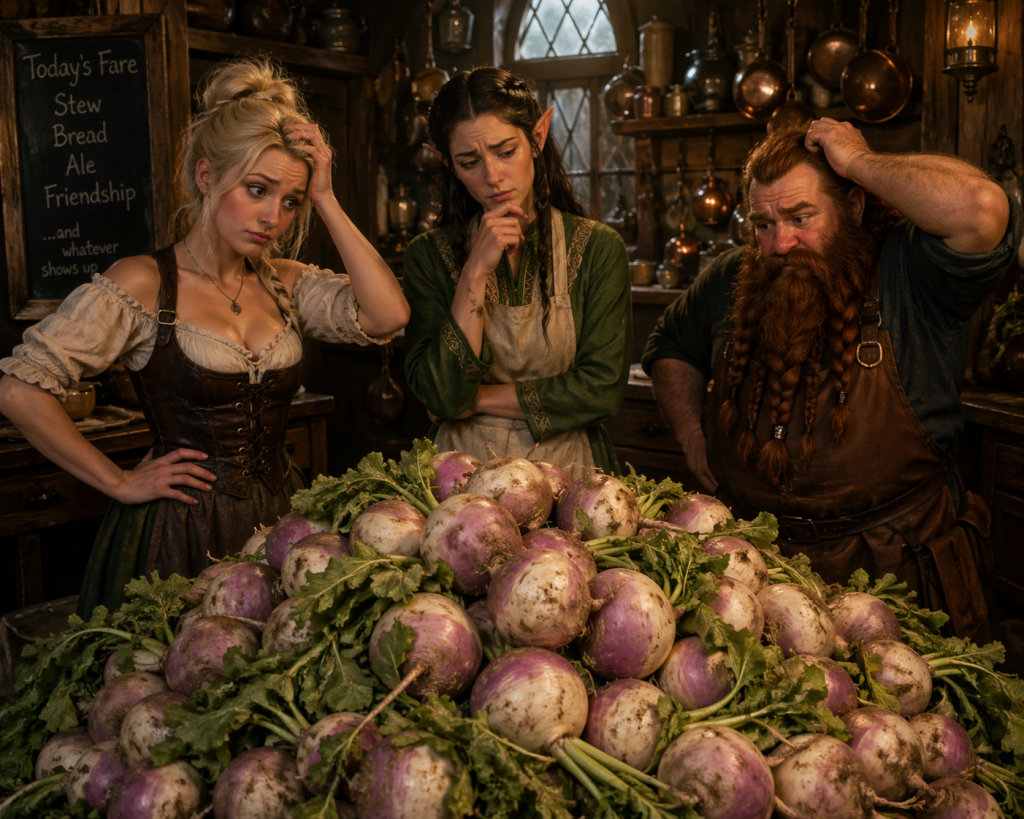
Dawn integrated into the kitchens with remarkable ease. She introduced herself, as she always did, with an unaffected brightness that felt at once entirely natural and just slightly too consistent to be so.
“Hey, what’s up guys! I’m Dawn. What can I do for you?”
The elven cook—whose name the party would later learn was Ilyra—regarded her for a moment, as one might regard an unexpected but not unwelcome addition to an already busy day. The dwarven assistant, Colm Ash, was less reserved.
“What you can do,” he said, gesturing broadly toward a series of crates that had only recently been delivered, “is explain this.”
Dawn followed the gesture.
Turnips.
Not one turnip. Not several turnips. A volume of turnips… no, a presence of turnips. A situation of them.
“What,” Colm continued, after a moment, “is a dwarf doing, traveling the road, carrying enough turnips to provision a modest uprising?”
Dawn considered this with admirable seriousness.
“Well,” she said, “I think he’s a chef. Of some sort. Fairly, uh, committed.”
Ilyra allowed herself a small smile. “Committed,” she repeated. “Yes. That is one word for it.”
The kitchen work began and Dawn proved, as advertised, helpful.
Not especially skilled—her knife work lacked precision, and her understanding of proportion was at best approximate—but enthusiastic, attentive, and remarkably willing to take direction. She chopped, stirred, fetched, and—perhaps most importantly—listened.
The conversation, as it so often does in kitchens, drifted to matters of culinary improvisation.
“We can roast them,” Colm said.
“We can stew them,” Ilyra added.
“We can mash them,” Dawn offered.
“We can only mash them so many times,” Colm replied, with the air of a man who had already explored this possibility to its natural conclusion.
There was a pause.
“We could,” Ilyra said slowly, “attempt to present them as something else.”
“Such as?”
“A pie of some sort?.”
Dawn nodded.
“Rebranding,” she said. “Very important.”
At some point, the question of Wolfgang himself arose. Again.
“I mean this respectfully,” Colm said, “but why would anyone carry this many turnips unless they intended to solve a problem that had not yet been identified?”
“Or create one,” Ilyra added.
Dawn tilted her head slightly.
“I think,” she said, “he just really likes being prepared.”
This was accepted, not because it was convincing, but because it was the only explanation that didn’t require consideration of issues of mental instability.
As the work continued, however, the conversation shifted gradually to other matters.
“They’ve been arguing,” Colm said, lowering his voice slightly. “The senior ones.”
“About what?” Dawn asked.
Ilyra hesitated, then answered. “The paper.”
Dawn blinked. “The paper?”
“Yes,” Ilyra said. “Some of the recent batches… haven’t come out right. Fibers not binding properly. Ink behaving oddly. Sheets that should be sound, failing for no clear reason.”
Colm nodded. “Some think it’s tied to the animals. Same underlying problem—whatever’s causing the disturbances, the lights, all of it. That it’s… affecting everything.”
“And others?” Dawn asked.
“Others aren’t convinced,” Ilyra said. “There was a batch that failed three days after the last animal episode. No unrest. No lights. Nothing.”
Colm snorted softly.
“And some of the druids say if it’s not that, then it must be someone tampering with the inputs. Pulp, water, additives. Something upstream.”
“Sabotage,” Dawn said.
“Maybe,” Ilyra replied. “Quiet sabotage.”
There was a pause.
“They’ve started talking about watching the stored inputs more closely,” Colm added. “Posting people. Using the animals. Even magic, if they can agree on how to do it without… interfering with the system.”
It was at this point that one of the druids entered the kitchen.
He was older than most the party had seen—though not in a way that suggested frailty. His presence was measured, his movements deliberate. He observed the room for a moment before his attention settled, quite precisely, on Dawn.
“Ah,” he said. Not surprised nor alarmed. But… interested.
“You,” he said, stepping closer, “are not one of ours.”
Dawn smiled. “Nope! Just helping out.”
He studied her more closely now. “And where, precisely, do you come from?”
Dawn considered this.
“Uh,” she said, “to the best of my knowledge? A ring. A Ring of Dawn.”
There was a pause.
“I’m usually around for about an hour at a time and then—”
She stopped and looked down at her hands.
“Oh,” she said.
“Looks like that hour is just about—”
And then she was gone.
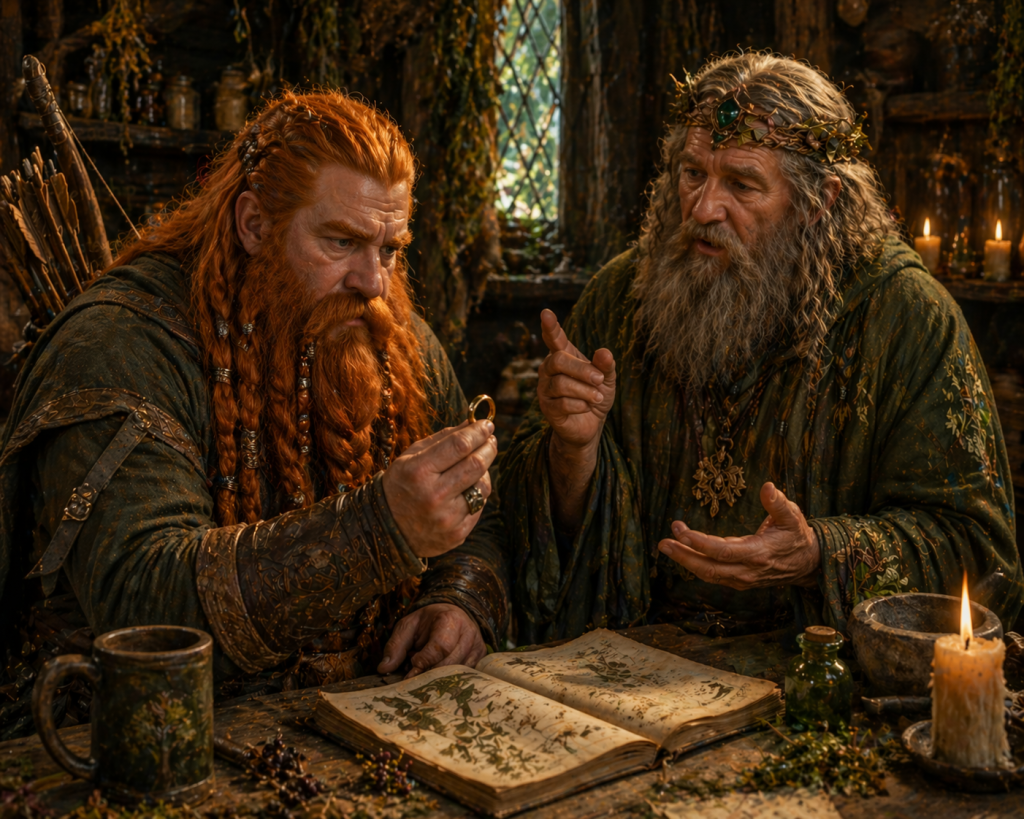
Later, when Wolfgang returned, the same druid sought him out to introduce himself. His manner was calm and purposeful.
“I understand that you carry a ring called the Ring of Dawn,” he said. “It sounds fascinating. Might I examine it?”
Wolfgang, after a moment, produced it. The druid examined it closely, turning it once, then again, and then again. Eventually, he handed it back.
“It appears to be imbued with the magic of illusion. But an unstable type. Dawn is an illusion sustained by social interaction. The more you converse with her, the more ‘real’ she becomes. You’ll want to be careful how often you use it and to be sure dismiss her before she destabilizes.”
There was a pause. Then, with quiet authority, “Also, limit eye contact, do not ask her personal questions, and, above all, absolutely do not introduce her to other summoned entities.”
Wolfgang received the ring back with a small, thoughtful nod, turning it once between his fingers as though weighing not the object itself, but the explanation that had been offered.
“I see,” he said.
There was no immediate contradiction. No visible skepticism. Only a pause—long enough to suggest consideration, but not long enough to invite debate.
“That is… very helpful,” he added, with a courtesy that was entirely genuine in tone, if not necessarily in conclusion.
The druid inclined his head slightly, satisfied.
Wolfgang slipped the ring back onto his finger.
“I shall be sure to exercise appropriate restraint,” he said, after a moment. “Limit eye contact. Avoid personal inquiry. And, of course, take care not to introduce her to any… colleagues.”
There was just enough weight on the last word to suggest he was repeating the advice faithfully.
Whether he was accepting it was less certain.
The druid appeared content with this.
Laveleen’s Long Night
When the others left for the Sacred Grove of General Sherman, Laveleen remained behind.
The decision was not made lightly, but neither did it require much discussion. The others had chosen to return to the grove before nightfall, drawn by a sense—difficult to articulate, but increasingly difficult to ignore—that whatever lay at the center of the forest’s disturbances would reveal itself there, if it revealed itself at all.
Laveleen, however, had found a different thread – the Orcish language itself.
And the druids, for their part, were more than willing to follow it.
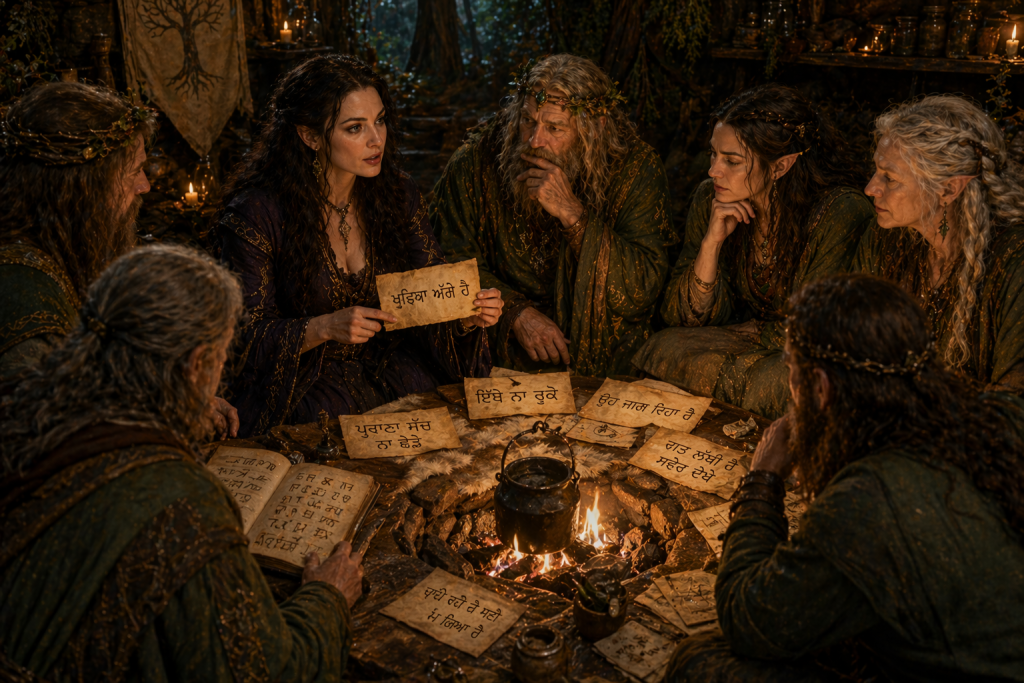
Arrangements were made without ceremony. A space was cleared near the hearth, and materials were brought forward—scraps of bark, strips of parchment, charcoal sketches, and, in a few cases, careful rubbings taken from carvings found deeper in the forest.
Neither Laveleen’s collection nor that of the druids could be considered a formal archive. But neither were they a careless heap of papers. Rather, both collections had been lovingly cared for and closely—at times, obsessively—studied.
Samples were passed around and handled with exquisite care.
For their part, the druids explained that the markings they’d copied had been found sporadically at first—isolated carvings, easily overlooked, and not immediately distinguishable from the many incidental scars that marked older trees. Over time, however, as they grew to recognize the style, they found many more examples and were even able to infer the meanings of a few.
For instance, a recurring phrase, found along several outer paths—always just before areas where the ground gave way to rockfall, unstable footing, or the hunting grounds of predators:
ਖ਼ਤਰਾ ਅੱਗੇ ਹੈ (khatraa agge hai)
“We believe this means ‘Danger ahead,’” one of the druids said.
Another, consistently found near abandoned campsites:
ਇੱਥੇ ਨਾ ਰੁਕੋ (itthe na ruko)
“We think it means ‘Do not remain.’”
A third, found near narrow passes or areas where movement seemed constrained:
ਚੁੱਪ ਰਹੋ ਤੇ ਲੰਘੋ (chupp raho te langho)
“We believe this means something like ‘Be quiet and pass through,’” another offered. “It appears in places where sound might carry.”
Another, appearing near water sources that showed signs of disturbance:
ਪਾਣੀ ਮਰ ਗਿਆ ਹੈ (paani mar gaya hai)
“This one was more difficult,” a druid admitted. “But based on where we found it… we think it may mean ‘The water is dead’—or perhaps ‘Do not trust the water.’”
Others had appeared more frequently in recent weeks, though not confined to any single location:
ਉਹ ਜਾਗ ਰਿਹਾ ਹੈ (uh jaag riha hai)
ਪੁਰਾਣਾ ਸੱਚ ਨਾ ਛੇੜੋ (puraana sach na chhedo)
“These,” one of the druids admitted, “we have not been able to place.”
The discussion continued in this way for some time. Samples were compared. Hypotheses offered, refined, and set aside. The druids’ field observations—where each inscription had been found, what had been nearby, how the animals had behaved—were laid against Laveleen’s growing understanding of structure and sound.
The work was careful, incremental, and collaborative but it was Laveleen’s pronunciation guide that shifted everything.
The druids had, until now, treated the symbols as shapes—repeatable, meaningful, but fundamentally silent. Laveleen, drawing on what she had learned from the scholars in Manchester, began to give them voice.
It was then that she approached the inscription the party had found earlier in the day—an inscription that the druids had seen several times as well but never understood:
ਜਨਰਲ ਸ਼ਰਮਨ
Laveleen leaned in and slowly sounded it out.
“Ja… na… ral…”
A pause.
Then:
“General.”
The room stilled.
She continued, more carefully now.
“Sher… man.”
The reaction was immediate, though not dramatic. More a shift than an outburst.
Several of the druids leaned forward. Others exchanged glances, their expressions tightening—not with fear, but with recognition.
“General… Sherman,” one repeated, testing the shape of it.
“You’re certain?” another asked.
Laveleen nodded.
“As certain as I can be,” she said. “The scholars in Manchester provided a pronunciation guide. This matches.”
A longer silence followed.
“The Sacred Grove,” one of the druids said at last.
“Yes,” another replied. “That is the name we have for it—handed down over the centuries.”
They looked again at the inscription.
“And these orcs have the same name for it as well. That would mean—”
“—that they’ve remembered it as well,” another finished.
There was something like astonishment in the room then—not loud, not overt, but present.
The tribe they had taken such care not to disturb—small, mobile, living with minimal material—had nonetheless retained something older than the Archean presence in Cambria itself.
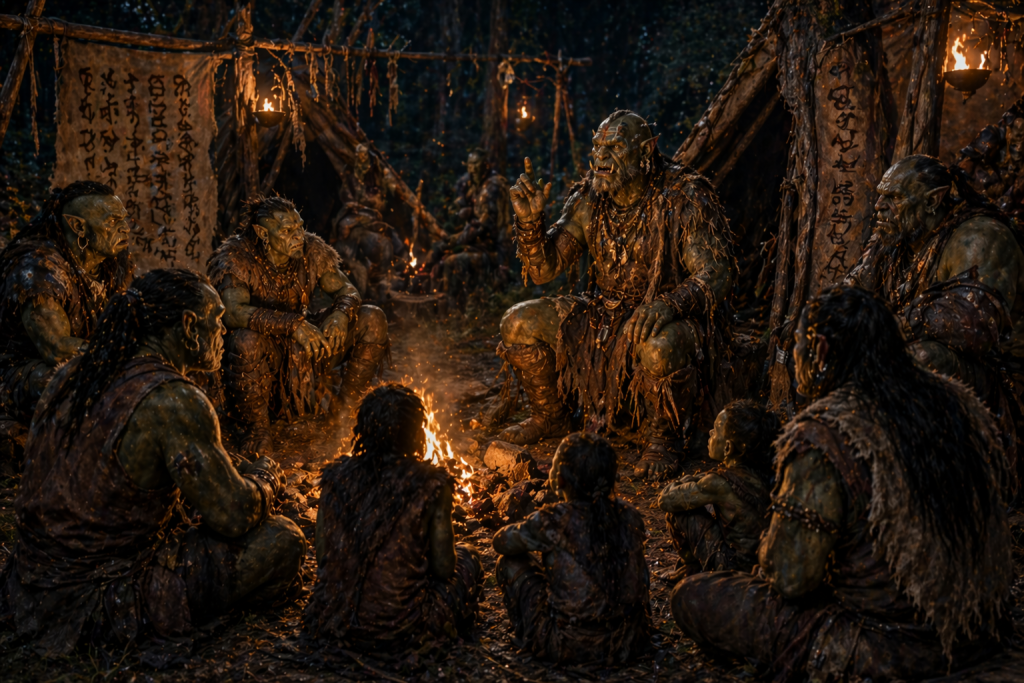
The conversation shifted after that.
The orcs, the druids agreed, were not primitive.
Their way of life—temporary shelters, minimal possessions, frequent movement—was not a sign of incapacity, but necessity. A response to conditions that did not permit stability. Their tools were simple, but effective. Their markings consistent. Their behavior deliberate.
Their carvings were too consistent to be improvised. The same phrases appeared across wide areas, in the same forms, with only minor variation. This suggested teaching—repetition—not coincidence.
More tellingly, older carvings had sometimes been reworked. Lines deepened. Edges sharpened. As though the marks were not merely placed, but maintained.
“Someone is preserving them,” one of the druids said. “Deliberately.”
There were other signs.
On several occasions, the druids had observed the orcs at a distance—not clearly, never for long—but enough to note patterns of behavior.
They saw structured gatherings. One individual speaking while others listened. Gestures repeated and responses given in unison.
“Storytelling,” another suggested quietly.
“Or instruction,” said a third.
And then there was the matter of the magic.
The druids spoke first of fire. Not campfires themselves—those were ordinary enough—but of how they were made. On more than one occasion, they had come upon sites that had been abandoned too quickly for proper preparation. No kindling gathered. No fire-starting tools left behind.
And yet—there had been fire, cleanly lit, even in the dampest of conditions, even where no means of ignition was present.
“We thought at first they carried flint,” one of the druids said. “Or something similar. But we have found no trace of it. Not once.”
Another added, more quietly, “And there are no repeated strike marks. No charring patterns consistent with that method.”
There were also the disappearances.. tracks that led clearly into an area—and then simply… stopped. Not scattered. Not concealed in any conventional way. Just gone.
At first, the druids had assumed careful movement. Stepping on stone. Doubling back.
But over time, that explanation had begun to fray.
“We have followed them,” one admitted. “At a distance. Carefully. We do not intrude—but we observe.”
A pause. “And there are moments where they are simply no longer where they should be.”
Another druid spoke of sound. “There are times,” she said, “when the forest should carry noise—and does not.”
She described a moment—some weeks prior—when she had been positioned downwind of a small encampment. Close enough that she should have heard voices, movement, something.
Instead—nothing. Not silence but, rather, absence. “As though the sound had been… kept close,” she said.
There were smaller things, too.
Animals that behaved differently near the orcs—not with fear, but with an unusual stillness. Birds that did not take flight when they should have. Insects that seemed to avoid certain areas entirely.
None of it, on its own, was conclusive. But taken together, it all led, inevitably, to the final conclusion.
“They have magic,” one of the senior druids.
“Not as we practice it,” another clarified. “Not formalized. Not structured in the same way.”
“But present. And used,” the first said.
“Embedded,” said another. “In their practices. Their… traditions.”
No one spoke for a moment after that.
The fire shifted in the hearth, settling in on itself. A few embers broke free and drifted upward, their light briefly catching on the scattered scraps of bark and parchment laid out before them.
From there, the work resumed and the hours passed without much notice. The fire burned low, was rebuilt, and burned low again. At some point, tea appeared.
Laveleen did not lead the work.
Nor did the druids.
But between them, something took shape and by the time the night gave way to morning, while nothing had been solved definitively, much had been clarified. And the work, it was understood, was not finished – it was only begun.