December 14th – 18th, 973
Of Martyrs and Sausages
The news—reported, with deeply unsettling composure, in The Royal Standard—of CMOT Dibbler’s death spread through the party like a sour taste that refused to leave.
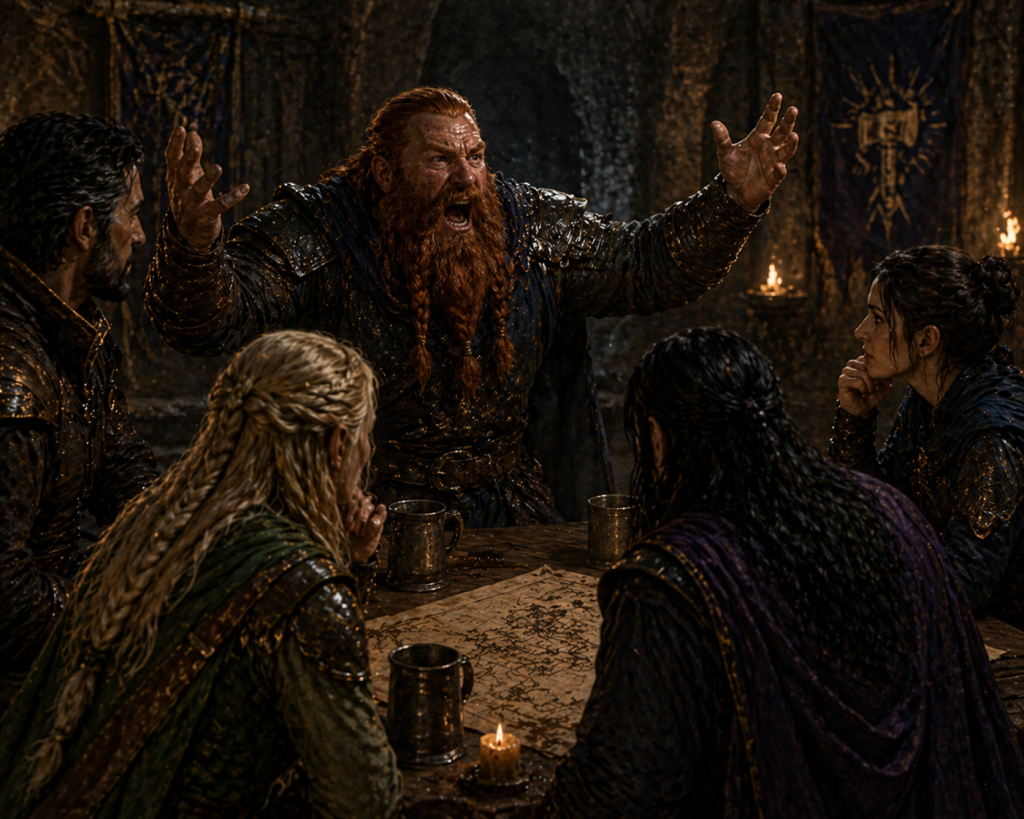
Wolfgang took it the worst.
“No one,” he said, with uncharacteristic quiet, “should die like that.”
What followed was a speech of considerable length and variable focus, touching in turn upon the indignities of empire, the moral failings of the Crown, and—most unexpectedly—the revolutionary potential of itinerant sausage merchants. By its conclusion, Wolfgang had assembled a working theory in which, if enough people simply claimed to be Dibbler, the Crown would find itself unable to suppress them all.
“Dibbler is not a man,” he declared, with mounting conviction. “Dibbler is an idea.”
There was a pause.
“That idea,” Merrythought observed gently, “appears to involve questionable meat products.”
“Well, let’s not be so hasty,” Ant replied, folding her arms. “The meat products were suspicious at best and a crime against nature at worst, yes—but he was a well-traveled itinerant peddler. Half of Manchester knows him. Or thinks they do. And more importantly, they’ll think he didn’t deserve what happened to him.” She tilted her head slightly. “That’s the sort of thing that makes a martyr.”
Wolfgang stood very still for a moment.
Then, with great deliberation, he began gathering his things.
“We’ll need posters,” he said.
A pause.
“And better sausages.”
The Passing of the Burden
It was in this atmosphere that Calder Voxx arrived.
He did not announce himself so much as appear—tall, composed, and possessed of the faint, unsettling calm of an elf who had recently taken his entire moral framework apart and reassembled it with deliberate care.
He introduced himself without flourish. When Shamus had turned from vengeance to devotion, Calder explained, the burden had not disappeared. It had merely… become left unattended.
“Someone must carry it,” he said.
He glanced briefly at the space Shamus had once occupied—not with sentiment, but with acknowledgment. “I came to do so. His death, while tragic, does not alter the necessity.”
There was no heat in the statement. No anger. No grief. Only certainty.
Hunkle regarded him for a long moment. “Then you understand the cost,” he said.
Calder inclined his head. “I understand the terms.”
A pause.
“Whether I understand the cost,” he added, “remains to be seen.”
He did not elaborate.
Of Fundamental Irrelevance
The party chose to spend the night staking out the Sacred Grove of General Sherman. The reasoning, as such things go, was sound.
The disturbances among the animals had shown a pattern—every few nights—and the last such episode had been… a few nights ago. The strange inscriptions, too, were most concentrated here. If something was happening, it would happen again. And probably here.
So, they waited and, at approximately two in the morning, eight cultists arrived.
They did not sneak. They did not whisper. They walked directly into the grove with the confidence of people who believed not only that they belonged there—but that everyone else did not.
“Evening,” Merrythought offered, in her most agreeable tone.
The responses were immediate, unified, and impressively hostile.
- “You should not be here.”
- “You are in the way of something important.”
- “Leave.”
There was no curiosity. No caution. Only irritation.
Wolfgang attempted diplomacy. “Now see here—”
“You are irrelevant,” one of them cut in.
“Fundamentally irrelevant.”
Another added, with visible satisfaction: “In the coming revision, you will not even be remembered. Leave.”
The party began, slowly, to pack their things.
Very slowly.
“So,” Merrythought said lightly, folding a blanket that did not need folding, “important business?”
“You would not understand,” one replied.
“Because you are—” another began.
“—temporary,” they finished together.
The Limits of Certainty
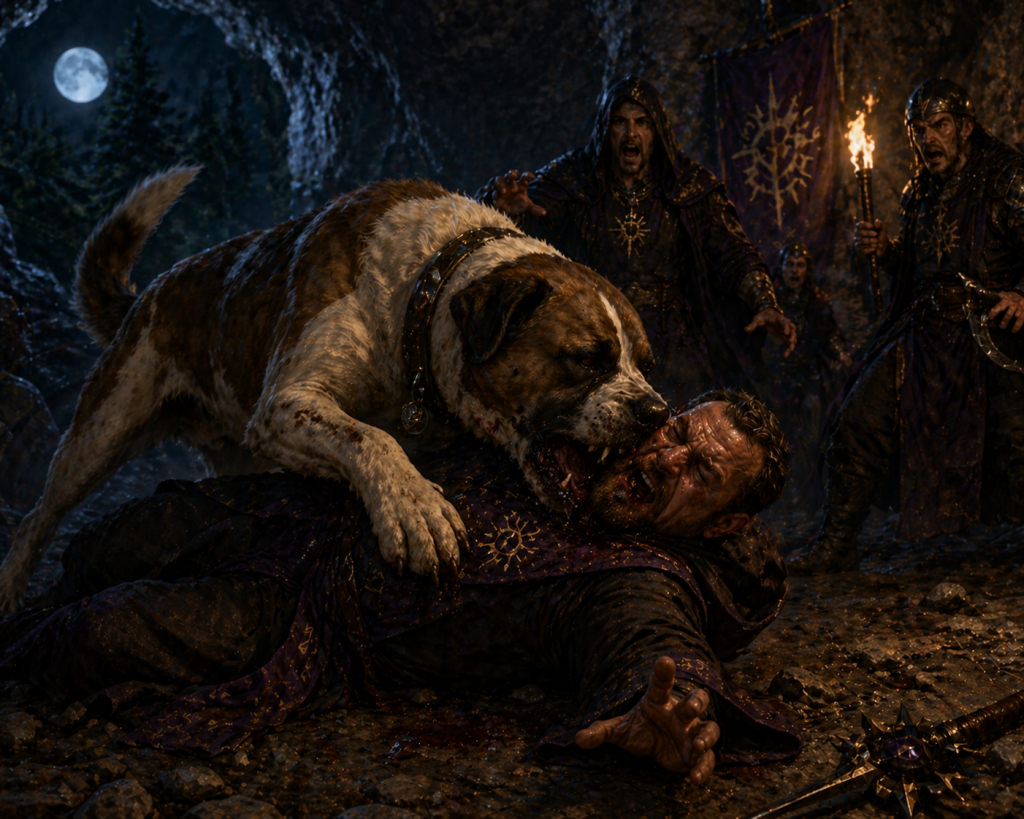
Wolfgang sighed. “Chorizo,” he said, “bite the man.” The dog did and knocked him flat while he was at it.
The cultists fought with absolute conviction and manifest lack of skill.
They charged when they should have retreated. They shouted when they should have coordinated. They declared philosophical positions in the middle of being struck.
“You cannot stop—”
thwack
“—the inevitable—”
thud
“—collapse of—”
crunch
Within moments, six were slain and two were captured.
Bound, disarmed, and placed before the party, the two survivors drew themselves up with what dignity they could manage.
“I am,” said the first, “The Loosener.”
“I,” said the second, “am The Unbinder.”
There was a pause.
The first frowned.
“You are not.”
“I am,” the second insisted.
“No, you’re not. You’re The Apprentice Unbinder.”
“That was provisional—”
“It was not provisional, it was explicitly stated—”
The argument might have continued indefinitely had the party not intervened.
Definitely a God
Unlike nearly every other prisoner the party had encountered in Cambria, these two were eager—almost desperate—to talk.
“Oh, you don’t understand anything,” The Loosener said, shaking his head. “This is important.”
“We are members of the Cult of the Unmaking,” The Unbinder added proudly. “We serve Zaldru.”
They explained, with increasing enthusiasm,
- Rivets held the multiverse together
- General Sherman was one such Rivet
- Destroy enough Rivets and the multiverse would collapse
- And Zaldru would remake everything – properly this time – in a form that suited him and his followers.
“And then,” said The Loosener, eyes shining, “I won’t be… this.” Bound as he was, he managed only a vague gesture in his own direction.
“I’ll be something important.”
“Perhaps a god in your own universe,” The Unbinder added.
“Definitely a god,” said The Loosener.
Further questioning—particularly regarding the location of their camp—proved less productive, notable chiefly for the sheer variety of grammatical contexts in which the prisoners found occasion to employ the phrase, “my hairy-ass scrotum.”
Merrythought closed her eyes briefly. “I miss the silent prisoners,” she said.
Meanwhile, the leader’s body yielded several scraps of paper. Whether these represented sincere expressions of belief or execrable attempts at poetry was, perhaps, immaterial.
Reality is a wheel fastened by recurring forms…
Pull enough nails and the wheel comes apart.
And,
Some things are like roots. But grow deeper than the very worlds themselves.
And,
Patterns repeat across the worlds.
Remove the pattern and the worlds unravel.
Wolfgang read them aloud. “…well,” he said, “at least there’s nothing about scrotums here.”
“That’s only because nothing rhymes with ‘scrotum’!” spat The Loosener, with surprising venom.
Ant rolled her eyes and took the party aside to remind them that this was not the first time they’d heard of the Cult of the Unmaking. Their raid on the Sovereign Street lockup had, inadvertently, led to the release of several members of the cult. Perhaps it was for the best, however, that that raid was chaotic enough that the party members never had a chance to meet them in person at the time.
The Search Narrows
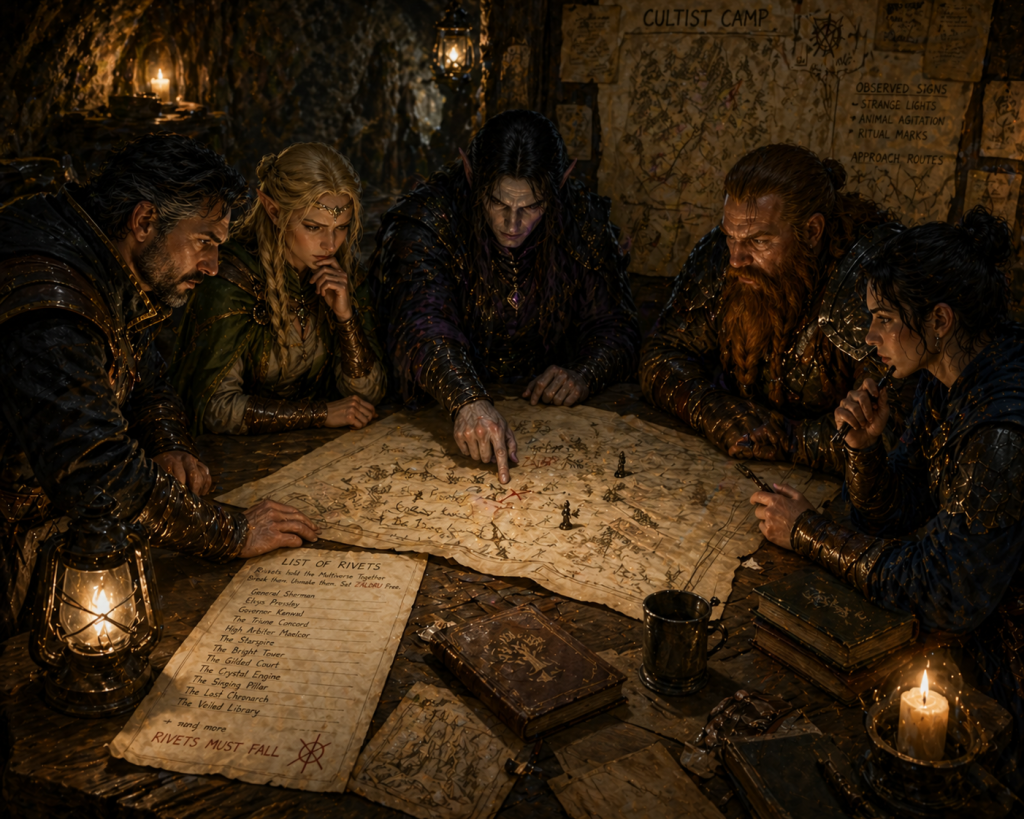
The party returned to the druids, eager to present their findings, and somewhat less eager to present their prisoners.
The reaction was immediate—and varied. There was relief, first, at last understanding the cause of the animal disturbances. That relief gave way quickly to alarm as the implications became clear. General Sherman was not merely threatened; it had been targeted.
And with that realization came motion.
The prisoners were taken into custody for further questioning. The party was granted a magically assisted rest—swift, deep, and without interruption. And the druids themselves dispersed into the forest with quiet urgency.
By morning, they had returned, having spoken with the birds, the animals, and—so far as such things could be said—the forest itself. The result wasn’t certain but it was a step forward – the possible location of the cultist camp had been narrowed to an area approximately six by four miles. Still large but not impossible, especially not with the addition of three pairs of druids assigned to assist in the ground search.
A map was produced and the party studied it carefully, applying both logic and experience to the problem. A long-term camp—particularly one supporting ritual activity—would benefit from certain features,
- Access to trails, especially those leading toward the Sacred Grove of General Sherman. Wolfgang had already identified the route used by the previous night’s cultists.
- A reliable source of water.
- Elevation, if possible—some means of observing the surrounding terrain.
- And, importantly, a certain distance from the main road. The cultists would not want to be seen by travelers but neither would they want to hike their supplies through five miles of forest trails.
The druids were dispatched in pairs and the party divided itself to increase the ground searched. Familiars were sent ahead to scout. Birds, provided by the druids, carried messages between the scattered groups, maintaining a loose but effective coordination.
The forest, once inscrutable, began to yield its hints – distant smoke, a single, waterlogged sock drifting downstream, and tracks—faint at first, then clearer. Each clue, taken alone, might have meant little. Together, they sharpened the picture that logic had already begun to draw.
By mid-afternoon, Calder had found it – a cave entrance watched by two guards dressed similarly to The Loosener and The Unbinder.
Notifying the rest of the party and awaiting their arrival took them to late afternoon, during which time, nothing happened other than the two cultists being replaced with two others during an apparently routine rotation, executed with the same confidence—and the same lack of caution—that had characterized their brethren in the grove.
The druids, their job complete, returned to Briarfall.
The Approach
Sheltered by the forest—and by the cultists’ apparent disinterest in basic caution—the party gathered to plan. Would they take the guards by storm, or by stealth? The answer, after a brief discussion, was stealth. More specifically, Merrythought.
Once her companions were properly positioned, she stepped onto the trail and began to walk toward the cave with quiet confidence, adopting the unmistakable manner of the cultists they had encountered earlier. When the guards noticed her, she smiled as though this were all entirely routine.
“I found something,” she said, lowering her voice conspiratorially. “Something valuable. You’ll want to see it.”
The guards approached eagerly.
They came close enough to see her clearly. Close enough to notice.
They looked at her, looked at each other, looked back.
“…you’re not—”
Too late. They were already in range for Cassyndra’s Sleep spell and the magic settled over them and then… and then… amazingly, both guards shook it off.
It became, at that point, a matter of storm.
The fight, however, was gratifyingly brief with one guard killed, one captured by Calder’s Hold Person spell… But the cave was alerted by the shouting.
To keep the cultists in the cave from boiling out, the party took positions on either side of the cave entrance and Cassyndra used Create Bonfire to set a fire in the cave entrance. And then a idea struck her. “Hey guys,” she shouted, “gather wood! As much as you can! Throw it in the fire!”
There was a moment followed by quick understanding.
Unencumbered by druidic sensibilities regarding which pieces of wood were prepared, spiritually or otherwise, to contribute themselves to combustion, the party set to work with enthusiasm. The fire grew then surged then began to move steadily inward, spewing smoke all the while.
The party called into the cave. “Come out and surrender!”
“Your efforts are meaningless!”
“Submit and be unmade!”
“My hairy-ass—”
The smoke thickened. Inside, voices turned to coughing. To confusion. To something approaching panic. And then— movement.
Figures emerged from a heretofore unseen rear entrance, staggering into the open air, choking and half-blinded. One attempted to run and did not get far before collapsing. He was taken prisoner.
“I am,” he managed, between coughs, “the Apprentice of Collapse.”
There was a pause.
“I can certainly see that,” Merrythought said.
Bad Art
It took some time to douse the fire and allow the smoke to clear, but when at last the air grew breathable, the cave was theirs.
They explored and what they found was, in its way, entirely consistent with what they had come to expect.
There was a chamber that served as a dormitory—bedrolls, personal effects, and the general accumulation of people who believed themselves destined for greatness but had not yet achieved it.
A second chamber functioned as a kitchen. A rough hole in the ceiling vented smoke upward—the same smoke that had, inadvertently, betrayed the camp’s location.
There were also a series of passages marked by rises and narrow chokepoints. Poorly skilled though the cultists had been, the terrain itself would have made a direct assault a costly affair.
And finally—A chamber that could only be described as a temple.
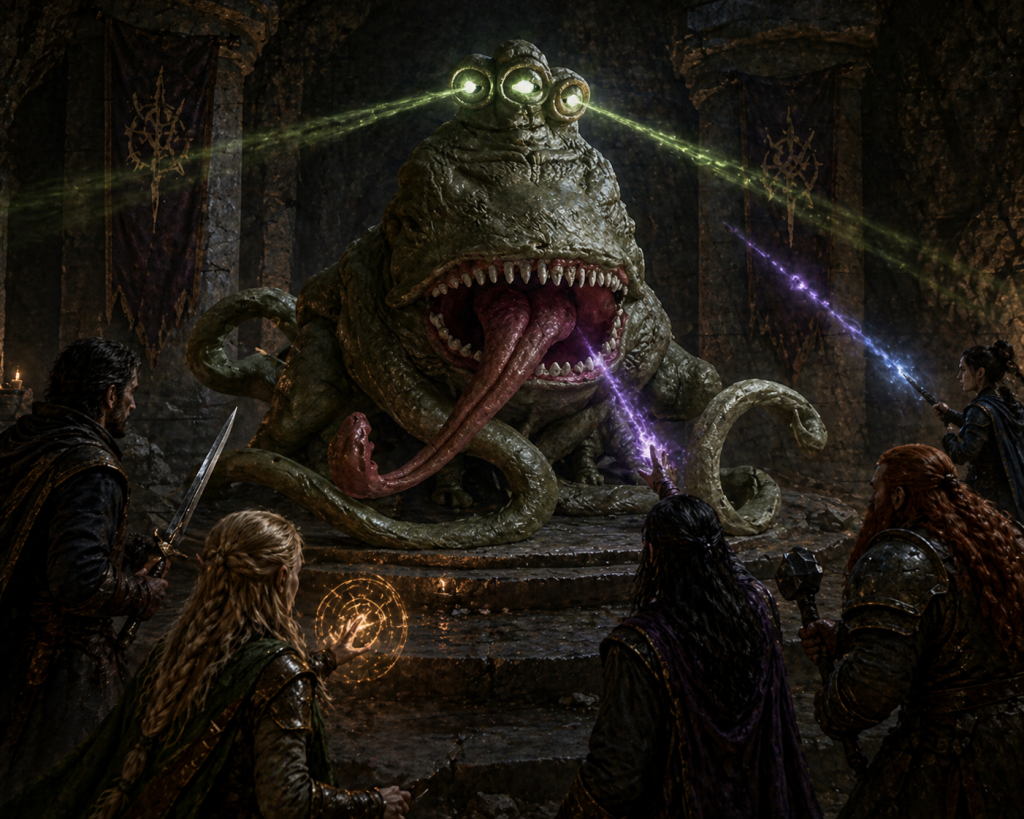
At its center stood a large stone statue which, by any reasonable standard, was rather unpleasant to look at.
The closest approximation was that of a frog—if one imagines a sculptor of questionable judgment working under the enthusiastic influence of substances not generally associated with good decisions. Limbs emerged at improbable angles. The proportions resisted interpretation. Three eye-like protrusions crowned its upper surface, each set at a different angle, as though unable to agree on what they ought to be seeing.
Calder studied it briefly.
“Zaldru,” he said. “A minor god. Favored, where he is favored, by those who believe their circumstances to be the fault of others.”
There was a pause.
“…that tracks,” Merrythought said.
And, at that moment, the eyes flared to life. Beams of sickly light lanced outward—some falling upon the remaining cultists to bolster them, others striking toward the party with a distinctly hostile lack of ambiguity.
“Ah,” Wolfgang said. “It’s one of those statues.”
Exploiting the statue’s immobility, they withdrew to a safer distance and considered carefully. When they returned, it was armed with Cassyndra’s Mage Hand placing blankets over the eyes and Calder’s Blindness serving as much needed backup.
Once the statue was blinded, it fired its beams at random as the party scrambled over it securing the blankets in place. From there, it was just a matter of time. The statue was unable to defend itself meaningfully as the party attacked it from all sides, quickly coming to learn that it was immune to piercing and resistant to slashing.
It was perfectly vulnerable, however, to bludgeoning and Eldritch Blast and soon the statue lay in pieces, each of which was no more aesthetically defensible than the whole had been..
A more thorough search of the cave yielded modest but tangible rewards: some five hundred gold pieces in coin and gems, and—of greater interest—a list.
A list of Rivets. Or, more precisely, what the cultists believed to be Rivets and, therefore, future targets.
Some names were curiosities while others were concerning.
The inclusion of Elvys Pressley gave the party pause.
The inclusion of the noble Governor Kanwal of Cambria, for some reason, did not.
What remained of the camp—bedrolls, supplies, personal effects—had been thoroughly compromised by smoke and fire. They were left where they lay as there are limits, even to salvage.
Gratitude
The druids received the party’s report in silence. Not the silence of confusion, nor even of shock—but the quieter, more deliberate kind that follows when disparate concerns resolve themselves into a single, coherent understanding.
The disturbances among the animals, the strange lights, the mysterious inscriptions, and the unease that had settled, slowly but unmistakably, over their work.
All of it, now, had a shape.
“Thank you,” said Bramble at last. It was not a grand statement but it did not need to be.
What followed was more formal.
The party was invited to the central clearing, where the senior members of the Circle had gathered. There, with a degree of ceremony that suggested both gratitude and intent, the druids presented each member of the party with a gift.
When the last gift had been presented, Bramble said, “These are given in recognition of your efforts.” Another pause, slightly longer. “And in acknowledgment of certain… understandings.” The matter of the orcs was not mentioned directly and it did not have to be.
“You have seen more than most,” Bramble continued. “And understood more than we expected.”
A faint smile.
“We trust that this understanding will remain… appropriately managed.”
“Should you encounter others in your travels,” another druid added, smilingly turning the conversation to more familiar business, “who find themselves in need of similar items as these… the Second Circle is always receptive to new referrals.”
As for the cultists, the druids doubted the Cult of the Unmaking had been responsible for the acts of sabotage that had plagued their operation. The cultists had been disruptive, certainly—but their ambitions ran toward the abstract and catastrophic, not the precise and material.
“With our attention no longer divided,” Bramble said, “we expect to be able address the matter directly.”
Surveillance would be increased. The forest would be watched more closely. Patterns, once obscured, would be allowed to emerge.
“And the matter of the robbed wagon,” another added, almost as an afterthought, “will be taken up as well. Such things leave traces, even when they are meant not to.”
A small inclination of the head.
“We expect to find them. And if it proves necessary,” Bramble continued, with mild understatement, “we are not without recourse.” She spoke, then, of a long-standing relationship with another group of adventurers – The Argent Company.
There remained, perhaps, one small irregularity that the party was prepared to let go. The matter of Barin. That so many among the druids seemed unfamiliar with the name might have given pause under different circumstances. As it was, the party found itself inclined toward a simpler explanation.
Barin was, as befitting his sub-rosa profession, a very cautious man. It seemed reasonable, then, to ask no further questions about him.
And so, with gifts accepted, understandings in place, and new questions waiting at Hollowmere, the party prepared to depart.
The forest, for its part, appeared content to let them go.
For now, at least.