December 24th – 25th, 973
The session opened in the dim aftermath of slaughter.
Beneath the hills outside Hollowmere, amidst goblin corpses, cooling blood, and the lingering smell of burnt fur and smoke, the party interrogated the lone surviving goblin from the cave assault. Unlike his less fortunate companions, the goblin—who eventually identified himself as Kesh—had survived only because illness had left him bedridden when the fighting began. He coughed frequently, struggled to breathe, and appeared alarmingly frail, though he seemed genuinely confused that the heroes considered this noteworthy. To goblins, apparently, occasional respiratory misery of this sort was simply part of life.
The revelation that this was not, in fact, another magical plague on the scale of the Withers came as an enormous relief.
Bound and thoroughly outmatched, Kesh nevertheless proved unexpectedly practical. He calmly offered the party his services as a spy if they spared his life explaining, “I keep ears. I keep life. I like this.”
It rapidly became clear that Kesh knew very little beyond the local level of the conspiracy. He had been as far as a local supply headquarters and had seen goblins, hobgoblins, occasionally orcs, and even less occasionally humans passing through. He was dimly aware of a hierarchy that stretched above him but the only part he had direct knowledge of was his own, recently deceased, hobgoblin commander.
The one thing he did possess of real value—the location of that headquarters—he absolutely refused to reveal. If he betrayed the location, he explained matter-of-factly, either, his own people would kill him or the humans would. “Kesh no stupid,” he said, tapping the side of his head as best as possible while bound.
Efforts to reassure him that the party would let him go after revealing his information failed to budge him. Goblins live and die by their tribe and a lone goblin in the wild would, very soon, be a dead goblin.
After concluding, quite accurately, that Kesh’s primary motivation was to save his own skin, the party spent considerable time debating what exactly to do with him. Suggestions ranged from,
- Releasing him,
- Turning him over to the Crown,
- Magically compelling loyalty,
- Or attempting to follow him back to his headquarters.
Unfortunately, every possibility seemed laden with risk. Magic would only last 8 hours after which Kesh would be free (and perhaps even more highly motivated) to embrace the lifestyle of a double agent.
And what if Colonel Varnes controlled both the Crown dig and the clandestine goblin excavation? What if the goblins were merely another arm of a Varnes driven conspiracy? Then handing Kesh over would provide that enigmatic but likely evil figure information about the party’s activities.
Alternatively, if Varnes was not involved with the goblins and hobgoblins, then turning Kesh over to the authorities simply handed an asset—and that asset’s knowledge of the cave—to the Crown, something increasingly viewed by the party as practically an enemy in its own right.
Once again, the party discussed torture seriously before collectively recoiling from the idea. Some lines, at least for now, remained uncrossed.
In the end, they released Kesh and attempted to shadow him using Cassyndra’s familiar, Heka, on whom an invisibility spell had been cast. To everyone’s mild surprise, the goblin proved remarkably easy to track. Winter terrain, sparse vegetation, patches of snow, and Kesh’s own illness combined to make stealth somewhat academic. After several halting pauses to cough and rest, Kesh eventually disappeared into another cave system somewhere beneath the barren hills.
He did not emerge again and Heka was not directed to follow him.
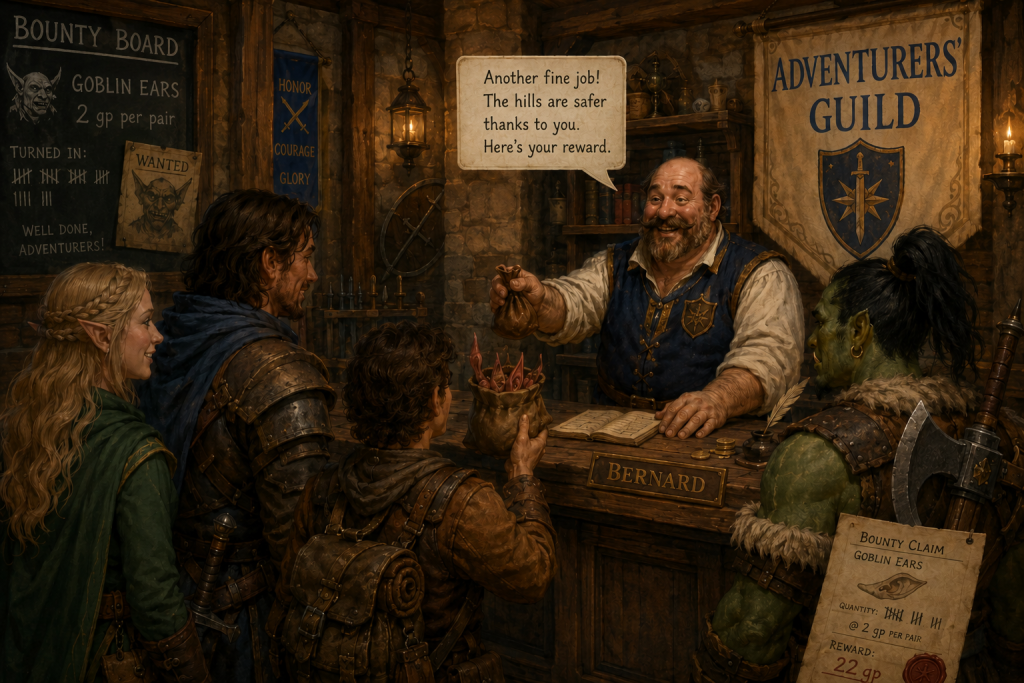
Returning to Hollowmere with sacks full of severed goblin ears, the party made what would prove to be a rather annoying mistake. They visited Bernard. The Adventurers’ Guild functionary paid their goblin bounty enthusiastically and then—perhaps under the impression that he was helping—proceeded to tell absolutely everyone in town about the heroes who had discovered organized goblins operating in a cave in the hills.
By the following morning, the party had become local celebrities. And not necessarily in a good way.
The first to approach them over breakfast was “Professor” Aldren Marrow, a self-declared scholar of Orcish ruins with an eye to turning a profit where possible. Thanks to the rumor mill, Marrow already knew of the party’s discovery of a new cave being worked by goblins and a hobgoblin. He was immediately interested in their discoveries and proved knowledgeable enough to be credible. For instance, he knew:
- Of an adventuring party’s discovery of the Tomb of the Teacher and delivery of the artifacts to Professor Marseth and the clandestine Society for the Study of Orcish.
- Enough Orcish to make his claims of following the Society’s discoveries believable.
Convinced that he was unlikely to be a Crown agent, the party provided him with a copy of the Orcish letter recovered from the cave. Marrow thought he might be able to arrange a partial translation within a day or two.
He theorized that the Crown was excavating in search of some ancient weapon and described increasingly frightened workers whispering about voices underground, tools that moved themselves, and bizarre disturbances in the lower tunnels.
When asked how one might gain access to the excavation, Marrow suggested the simplest route would be to volunteer their services directly to the Crown.
Not long afterward came Serik Johnson, also tipped off by the Bernard-driven rumor mill. He identified himself as the leader of the five-person Blackvein Company, another adventuring band that had spent the last three months treasure hunting around Hollowmere.
Johnson explained that the region had become “honeycombed” with caves and tunnels over centuries of excavation and warfare, making it an ostensible paradise for treasure hunters. Unfortunately, the reality had proven less lucrative. Blackvein Company had found little of value and was prepared to give Hollowmere perhaps another month before trying their luck elsewhere—possibly Bastionstead.
At present, Johnson explained, the most popular rumor among adventurers was that the Crown was attempting to enslave a dragon beneath the hills. Some of the courtesans, meanwhile, favored the theory that two nobles were racing one another to reach a specific point inside the mountain in pursuit of some extravagant prize.
Johnson proved both pragmatic and refreshingly honest. He dismissed Marrow as a man possessing genuine facts but an unfortunate tendency to wrap them in increasingly ridiculous speculation. Following Marrow had already led Blackvein Company into two or three dry holes and Johnson was reluctant to repeat the experience without stronger evidence.
Like the party, Blackvein had not yet entered any Crown tunnels but had no future intention of doing so. The reason, he explained, was that his company had experienced certain unfortunate interactions with the Crown in the past and now operated under aliases while attempting to stay out of trouble.
Asked for his thoughts regarding the apparent cooperation between goblins and hobgoblins, Johnson favored the theory that they were racing the Crown toward whatever was buried beneath the mountain. That said, he admitted that the party’s alternative theory—that Varnes might somehow be directing both operations simultaneously—was not impossible.
The party and Blackvein Company cautiously agreed to exchange information and perhaps cooperate on future “scores,” though both sides were clearly aware that they might someday become competitors.
Finally free of their new interlocuters, the party returned to the constabulary and found the head of that tiny department, Constable Pike, on duty. He greeted them warmly enough and thanked them for their interest in finding Lysa and Corvin but admitted that he sincerely hoped they would prove to be the sort of visiting adventuring party that did not bring trouble with them.
Experience, one suspected, suggested otherwise.
Asked to speculate as to what could have triggered their disappearances, Pike openly admitted his suspicion that Corvin had discovered something interesting and been silenced either by:
- The Crown or
- Treasure hunters
Alternatively, he said, thoughtfully, it could have been that Vale stumbled upon goblins in the hills who killed him to conceal their operations; a theory that had much more going for it now that the party had followed Corvin’s map and found, well, goblins of a violently secretive nature. That would certainly explain why they couldn’t find Corvin’s body in town.
The party’s theories grew increasingly tangled:
- Was Varnes secretly coordinating the goblins?
- Had Corvin stumbled upon the hidden goblin dig accidentally?
- Were the goblins and the Crown rivals, allies, or both?
No theory yet entirely fit. Before they departed, Pike was able to confirm one useful detail, however. In his efforts to secure cooperation for the investigation, he had visited the Crown compound repeatedly. He had never seen goblins or hobgoblins inside. Orcish slaves, however, were another matter. Those he saw regularly.
Later that day, Merrythought paid a second visit to Barnard. Having observed his performance over the previous twenty-four hours, she had come to regard him less as a guild functionary and more as a public utility/nuisance.
Accordingly, she supplied him with carefully selected misinformation.
The party, she explained, had become convinced that Corvin Vale and Lysa Harrow were still alive and being held somewhere beneath Hollowmere. Indeed, they were preparing to depart almost immediately to secure their freedom.
Barnard received this news with considerable interest but little insight. He agreed that ransom seemed an unlikely motive and speculated briefly before exhausting his supply of useful observations.
That was quite sufficient.
Merrythought departed confident that, by nightfall, every tavern, mine, workshop, boarding house, and questionable establishment in Hollowmere would be discussing the matter. If someone knew something, perhaps they would reveal it. If someone had something to fear, perhaps they would make a mistake.
Either way, Barnard had become a valuable investigative resource.
One merely had to accept that he functioned less like a detective and more like an enthusiastic epidemic.
The party then turned its attention to the Crown miners themselves, lingering discreetly near the excavation site at shift change. Most of the workers departed in small groups, but one weary laborer trudged home alone. The heroes singled him out and followed at a respectful distance until he was beyond sight of his coworkers.
Despite their friendly approach, the miner—Dannel Crewe—jumped at their greeting and immediately blurted out:
“I didn’t say nothing about the sounds!”
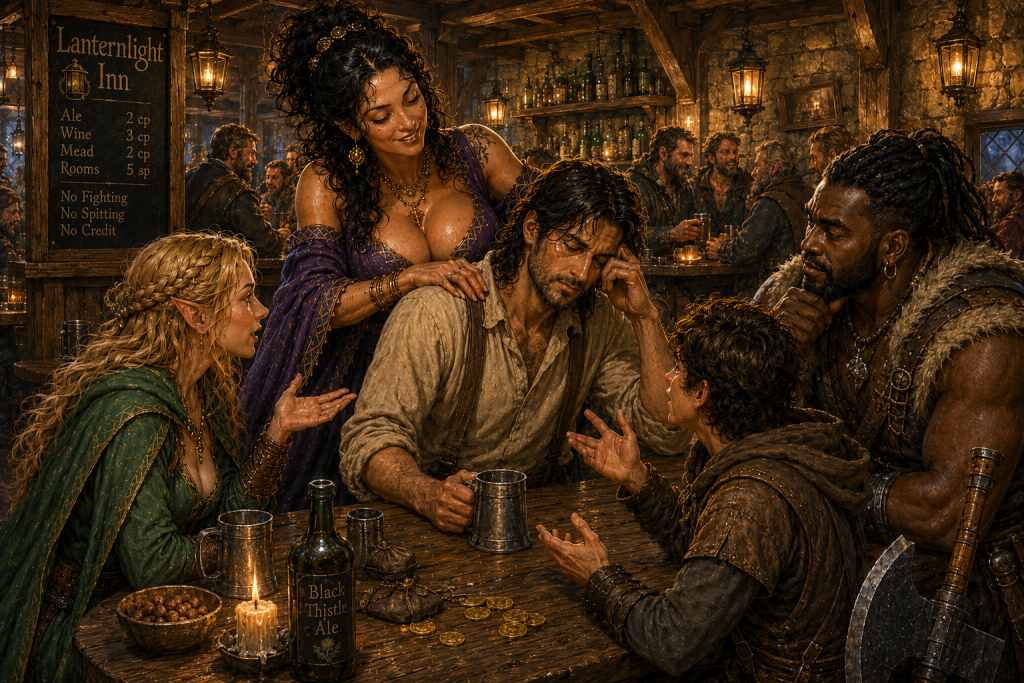
It quickly became apparent that Dannel had mistaken the party for Crown operatives. Given his exhausted and anxious state, convincing him otherwise proved difficult. The heroes persevered, however, and eventually invited him for a drink. He accepted with the air of a man who believed it safest to agree with whatever his emotionally unstable supervisor suggested.
Once settled in the tavern, aided by strong drink, sympathetic conversation, and the attentions of the courtesan Dovanna, Dannel gradually began to share fragments of what he had witnessed during the past year of excavation.
- Workers frequently heard voices underground. The deeper the dig, the louder the voices became, though never clearly enough to distinguish any words.
- The excavation was directed by surveyors and scholars—known to the miners simply as “the boffins.”
- The boffins determined where the miners dug and what areas received priority.
- At times, they seemed uncannily certain that a crew was about to break into an ancient corridor or chamber and would ensure they were present when it happened.
- At other times, discoveries came as a complete surprise.
- Regardless, soldiers were always the first to enter any newly uncovered section. Only after the area had been declared secure would the boffins follow.
- The scholars would then examine the site, confer among themselves, and issue new instructions based on whatever conclusions they reached.
- Artifacts and strange machine-like devices were almost always removed from these newly discovered areas.
- Every step of the process was conducted under intense and oppressive security.
The conversation came to an abrupt halt when one of Dannel’s coworkers entered the tavern. Spotting Dannel seated with a group of strangers, the newcomer approached and asked:
“Everything alright here, Dannel?”
After that, Dannel clammed up, drank up, and made himself scarce.
The party waited a few minutes before turning their attention to the second miner, who had settled by himself with a drink of his own. They struck up a conversation by expressing interest in finding work at the excavation.
Eventually the discussion turned to Corvin Hale, one of the boffins Dannel had mentioned. According to the miner, Corvin stood apart from the others. Unlike most of the scholars, he was cordial, respectful, and genuinely curious about the people around him. The miner had occasionally seen him arguing with his colleagues from a distance, but never with the sort of bitterness or hostility that would suggest someone might wish him dead.
Unlike Dannel, this miner seemed largely untroubled by the voices underground or the excavation’s relentless secrecy. In his view, such things were simply part of the profession.
Cave-ins. Gas pockets. Ancient hauntings. Hyper-secretive bosses.
Just another day’s work for a miner.
The pay was good, and that was reason enough to keep showing up.
One final detail proved particularly interesting. The miners were indeed finding traces of copper ore, but the Crown appeared completely uninterested in it. Rather than being collected, the ore was discarded along with the rest of the rubble and dumped into the tailings pond without any attempt to recover the metal.
Before leaving, Cassyndra made sure to tip Dovanna a little extra with the understanding that anything she heard that might of interest to adventurers would find its way to Cassyndra’s ear.
The following day brought yet another colorful figure into the growing web surrounding the party – Brennic Rusk, a local fence and black-market dealer interested in cultivating a business relationship with the heroes.
During the conversation, Brennic casually admitted that artifacts routinely disappeared from the Crown excavation. Whether lifted by workers, pocketed by guards, or merely “misplaced” somewhere between discovery and inventory, a steady stream of relics found its way into Hollowmere’s unofficial economy and, from there, into Brennic’s hands.
What happened next was perhaps the most remarkable part of the arrangement.
Brennic’s primary customer for these stolen artifacts was, apparently, the Crown itself.
A buyer associated with the excavation purchased virtually every artifact he acquired and did so with remarkably few questions. As a result, workers stole artifacts from the Crown, sold them to Brennic, and Brennic then sold them straight back to the Crown. Thus, through a triumph of bureaucratic inefficiency, the right hand of the Archean government routinely paid the left hand for property it already owned.
The party reflected that if someone had invented such a system as satire, it would have been dismissed as entirely implausible. Shrugging philosophically, they took the opportunity to unload their own particular black-market goods – the silks obtained from the smugglers’ convoy near Fort Arcadia. Brennic offered 100 gp, a fair price given luxury silks not being particularly in demand in Hollowmere, and the party quickly accepted.
Finally, the party found themselves with only two leads remaining:
- Present themselves at the Crown excavation in search of either employment or clues regarding Corvin Vale’s disappearance.
- Spend the day crawling through muddy, filthy tunnels likely inhabited by carrion crawlers, slimes, oozes, and various other creatures whose chief virtues were their enthusiasm for violence and their remarkable odor.
Such was the party’s regard for the Crown that they selected the tunnel unanimously.
The passage proved to be ancient Orcish construction and, at one time, had clearly served a military purpose. The heroes encountered several abandoned choke points and defensive positions, all seemingly designed to funnel intruders toward a single route.
That route became progressively wetter, fouler, and more unpleasant the deeper they ventured and soon the floor was littered with rotting refuse, animal carcasses, gnawed bones, and other substances that were perhaps best left unidentified.
Eventually the corridor widened into a vast chamber that appeared to have spent centuries collecting every unpleasant thing that had ever entered it. Rot. Sewage. Wet fungus. Carrion. Garbage. The accumulated filth formed three enormous mounds scattered throughout the cavern.
The party’s immediate assumption was that Kesh must surely lie beyond. Which was, in retrospect, something of a curious thought.
There was, after all, no particular reason to believe Kesh remained here. More than twenty-four hours had passed since the goblin entered these tunnels. For all they knew, he could be miles away by now.
Despite that, the thought that Kesh was just past this chamber felt entirely reasonable.
Which was precisely the problem. As was the fact that nobody could quite remember thinking that thought.
A moment later another thought drifted through several minds. Treasure. Then another. A hidden passage beyond the chamber with interesting things ahead.
The party paused and after some hurried discussion they realized that something in the cavern was attempting to communicate with them. Or, more likely, lure them into some hideous fate.
Thoroughly alerted, the heroes advanced more cautiously into the chamber and began examining the immense heaps of refuse and for several seconds nothing happened.
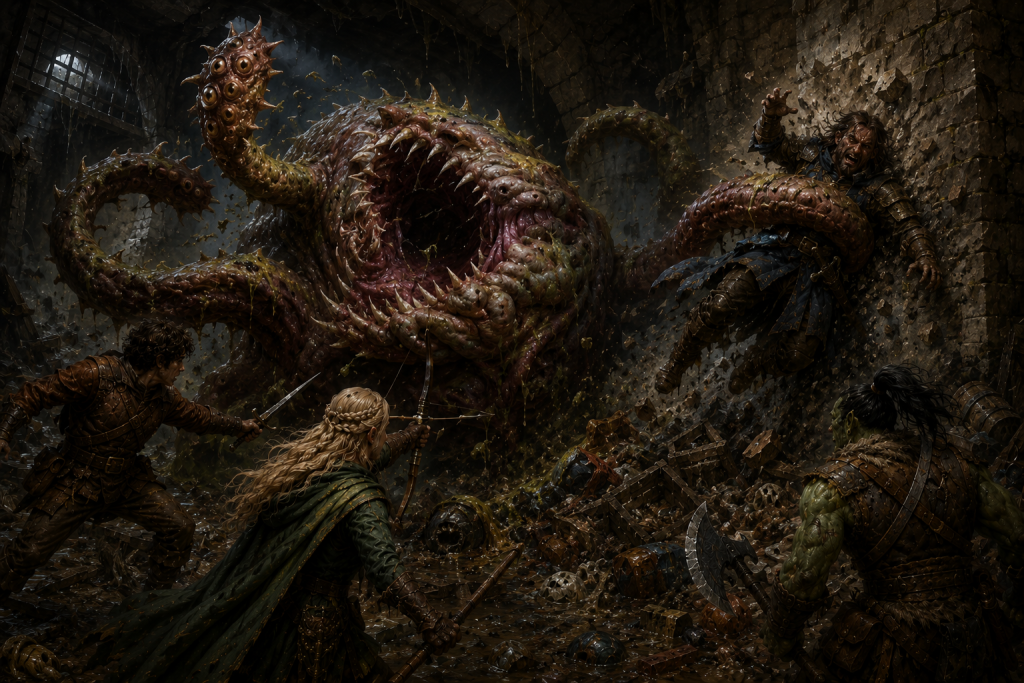
Then two of the piles stood up – otyughs.
The battle that followed was chaotic, grotesque, and characterized largely by Wolfgang and poor Chorizo being battered around the cavern like festive meat piñatas while enormous tentacled monstrosities attempted to drag screaming adventurers into heaps of sewage and garbage.
Eventually victory—and a considerable amount of healing directed toward Wolfgang—prevailed.
When the dust settled, one otyugh lay dead while the second remained unconscious.
Unfortunately, otyughs are not renowned for,
- Their cooperativeness as prisoners,
- Their usefulness during interrogation,
- Or for being safe to leave in one’s rear.
After a brief discussion, the unconscious creature was dispatched as well and attention turned to the crack in the far wall that Merrythought had discovered. She passed through the crack and glimpsed in the chamber beyond motionless skeleton sentries and a single quiescent orc zombie with the now-familiar jagged circle emblazoned on its chest – the very same symbol seen during the fight outside of Willowhollow.
The dead, it seemed, were guarding something beneath Hollowmere and the session ended with the party battered, filthy, exhausted, and faced with a difficult decision,
Push deeper immediately into whatever ancient horror awaited ahead…
…or retreat, regroup, and descend once more another day.