December 26th – 29th, 973
This session began with the party attempting to decide the fate of the goblin soldier captured during their battle with the 1st Company, 3rd Fist, 2nd Claw.
Meaningful interrogation proved impossible. The prisoner spoke no Common and was illiterate in Goblin. Despite possessing a Common-Goblin dictionary, the party quickly discovered that Goblin writing relied heavily upon pictograms and ideograms, making the dictionary of little help in verbal communication. Beyond a few simple gestures, little information could be exchanged.
The heroes therefore found themselves confronting a more practical question.
Turning the prisoner over to the authorities would almost certainly place him in Crown custody, where he would be interrogated and might reveal everything he knew about the party’s discoveries beneath Hollowmere. Killing him was unacceptable. On the other hand, releasing him seemed unlikely to provide his people with any significant new information.
In the end, the party chose a middle path. The goblin’s legs were shackled to slow his movement and he was released. Heka followed at a discreet distance to ensure that no immediate threat emerged from the decision… and to see if the soldier would lead them to another clue.
The soldier hobbled steadily away from the abandoned outpost until he reached a remote location well removed from any known goblin positions. There he simply stopped.
He made no attempt to seek help and no attempt to return to friendly forces. Instead, he appeared prepared to wait for death rather than risk leading enemies back to his comrades.
The party could not help but respect the grim discipline such a choice implied.
While awaiting Heka’s report, the heroes discussed the larger mystery of the abandoned outpost. Why had Kesh’s people evacuated so completely and so quickly?
One possibility was obvious. Kesh had warned his comrades that the party was coming. They may have concluded that Crown forces would soon follow and elected to withdraw before they were discovered.
Another possibility was more troubling. Perhaps the Crown had already achieved a breakthrough elsewhere in the underground network, forcing a broader retreat.
Perhaps both explanations were true.
The evidence supported any of them, and by the end of the discussion the party remained uncertain. All they knew for certain was that someone had abandoned a substantial installation in great haste rather than taking a chance on standing and fighting for it.
After a night’s rest, the party awoke sore, stiff, and slow moving to a common room abuzz with the latest information – someone had ambushed a caravan headed toward Hollowmere and apparently part of the cargo belonged to the Crown. Several townsfolk quietly speculated as to whether the attack was the work of “the Zeppies” but none would explain to the recently arrived party who “the Zeppies” were.
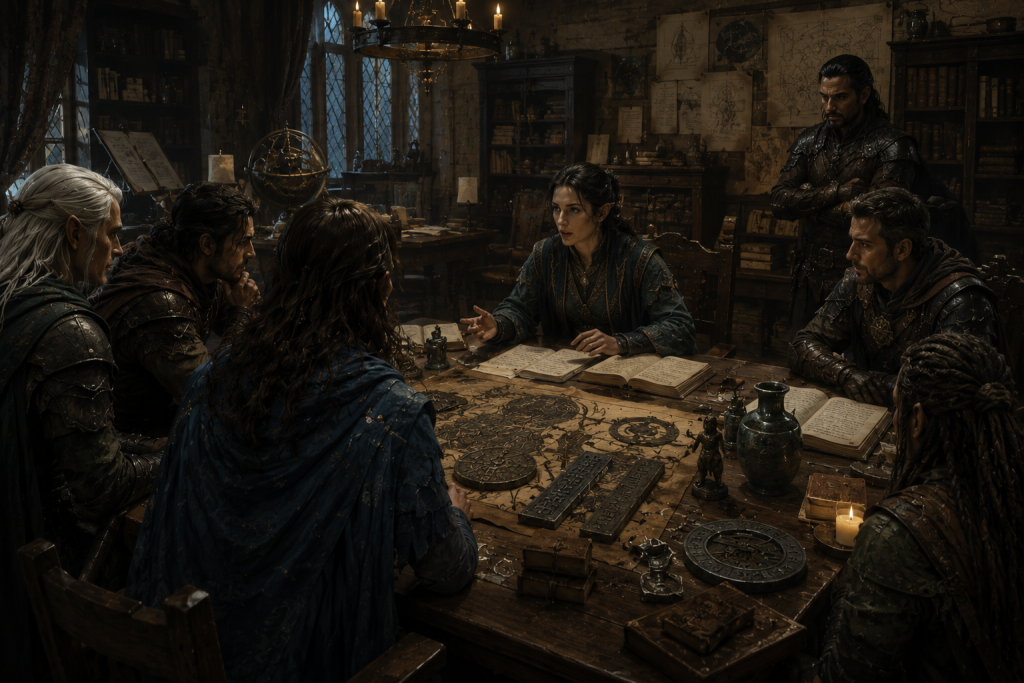
After breakfast, the party met privately with Professor Harrow and Serik Johnson to discuss the artifacts recovered from the abandoned outpost. Against the background of Harrow’s excitement about the historical significance of the artifacts, the discussion ranged widely,
- Could Mira’Thar be an ancient Orcish complex buried beneath modern settlements?
- Had Archean history been rewritten after the Righteous War?
- What exactly were both sides searching for beneath Hollowmere?
Several theories regarding the latter emerged,
- Perhaps a powerful artifact lay hidden in the depths.
- Perhaps a means of controlling dragons.
- Perhaps a means of controlling the undead.
- Perhaps something far worse.
Calder noted that both the use of undead and the initiation of war represented bright moral lines for him. Yet nobody present could determine which side, if either, had crossed those lines first and Professor Harrow noted that the historical record might never provide definitive answers.
Particularly troubling was the timeline regarding the undead. The history they had all grown up with said that they had been used extensively by the orcs during the Righteous War and then they seemed to have vanished… until reports cropped up from villagers starting about four years ago.
The Crown, meanwhile, had begun excavating near Hollowmere approximately eight years earlier which did not match up with that timeline.
By the end of the discussion, the group had tentatively concluded that some dangerous relic or weapon might lie beneath Hollowmere and that allowing either side unrestricted access to it would likely be disastrous.
The artifacts themselves were left in Professor Harrow’s care. He cited the advancement of knowledge as his motivation. Serik Johnson immediately raised an eyebrow until Harrow admitted that academic advancement was also part of the appeal.
For his part, Serik told the party that his own hopes for advancement were pinned on a hot tip he’d received on the recent caravan attack. Blackvein Company would be checking it out today and were hopeful that it wouldn’t prove to be another dry hole. Asked whom the Zeppies were, Serik advised that they were reputed to be a local group of bandits who made themselves available for murder-for-hire schemes as well as other, miscellaneous, skullduggery. He himself wouldn’t put it past them to be involved in the caravan raid but if they were, he was determined to put an end to it.
A visit to Bernard at the Adventurers’ Guild followed.
The party explained that their efforts to track Corvin Vale and Lysa Harrow had ultimately led them into conflict with organized goblin and hobgoblin forces but had otherwise failed to produce any useful answers regarding the missing pair.
Bernard accepted this update with the philosophical patience of a man convinced that if today failed to deliver interesting gossip to his doorstep, tomorrow almost certainly would.
The party then sold an assortment of captured equipment and collected bounties on goblin and hobgoblin ears recovered during their recent fighting. Much to Bernard’s delight, they also proceeded to purchase virtually his entire stock of healing potions.
Bernard informed them that another shipment was expected soon and strongly encouraged them to continue risking their lives in ways that would require additional purchases.
This was not his exact wording, but the general sentiment seemed clear.
Later that afternoon, Brennic Rusk sought the party out during lunch.
The fence had apparently noticed both their recent injuries and their closed-door meeting with Professor Harrow and Serik Johnson and quickly reached a conclusion.
Orcish artifacts had been found.
Committed to the belief that all valuable artifacts discovered beneath Hollowmere should eventually pass through his hands on their way to the Crown—at a modest and entirely reasonable markup, of course—Brennic was interested in seeing whether that process could be accelerated.
The party declined to sell for the moment. Professor Harrow still wished to examine the finds in detail and the heroes themselves suspected that artifacts of this significance might prove more valuable later than they appeared now.
Nevertheless, they did not close the door on future negotiations. Given both their anticipated need for healing potions and Brennic’s talent for turning archaeological discoveries into liquid assets, maintaining cordial relations seemed prudent.
Brennic departed appearing entirely satisfied.
From his perspective, the difficult part had already been accomplished. The party had not denied finding artifacts.
They had merely postponed selling them.
Seeking both answers and employment, the party next approached the Crown excavation site.
The corporal on duty at the gate escorted them to the current duty officer, Lieutenant Tavin Rowe, then settled into the background with the practiced invisibility of a veteran noncommissioned officer who had long ago mastered the art of listening without appearing to do so.
Unfortunately, Lieutenant Rowe proved polite, professional, and entirely unhelpful.
The disappearance of Surveyor Vale, he explained, remained an internal Crown matter. While he appreciated the party’s initiative, unauthorized civilian involvement would only complicate an already sensitive situation. The meeting ended with a courteous refusal and the distinct impression that Rowe intended to reveal absolutely nothing.
As the corporal escorted the party back toward the gate, however, his professional reserve cracked. Quietly, and only once they were out of earshot, he admitted that something was very wrong. The workers and the soldiers were frightened and many of the officers seemed unable or unwilling to make decisions.
Lieutenant Silas Veck, he explained, was one of the few officers still willing to stick his neck out and try to solve the problem. If the party truly wanted answers, they should return after sunset when Veck came on duty.
The party took his advice and Veck proved considerably more forthcoming. After hearing an account of the party’s recent adventures beneath Hollowmere, he agreed to meet them away from the excavation site the following morning where they could speak more freely.
It was during that conversation that the true extent of the Crown’s difficulties began to emerge.
For approximately two weeks, workers in the deeper sections of the excavation had reported hearing faint voices underground. The deeper the excavations progressed, the louder the voices became. No one, however, could make out what was actually being said.
Then an excavation broke unexpectedly into a previously unknown corridor. Following standard procedure, a squad of soldiers accompanied by several specialists entered to investigate and only one of them returned, unable to provide any coherent explanation of what had happened.
A larger force was subsequently dispatched and none of them returned.
More troubling was that Colonel Varnes, his second in command Lieutenant Colonel Halifax, and a third officer, Captain Billings could no longer be found. With Varnes missing, command of the operation had fallen to Major Elric Thorne, an experienced officer who nevertheless found himself responsible for a growing crisis that no one seemed to understand.
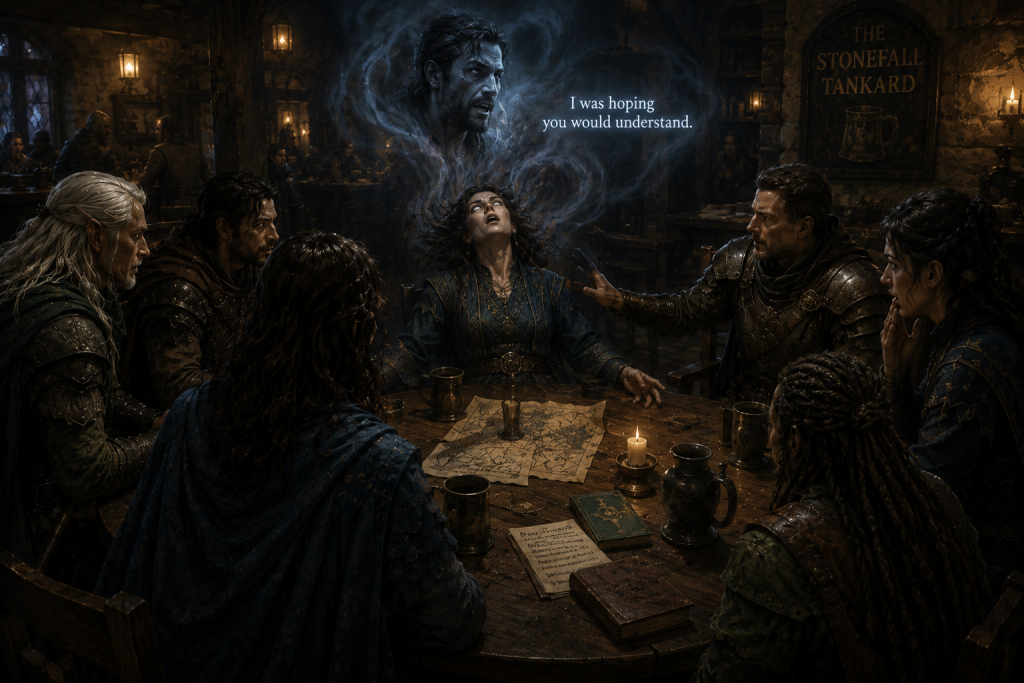
The conversation then took an unexpected turn with the mere mention of Varnes triggering a violent reaction from Cassyndra. Her eyes rolled back, her posture stiffened, and in a male voice that was unmistakably not her own, she spoke a single sentence, “I was hoping you would understand.”
The episode lasted only moments before passing, but it left the entire table unsettled. Cassyrndra reported that during the episode she’d seen an older version of Varnes uttering the sentence; something that went against the party’s hypothesis that Varnes was an ageless vampire. And whether the experience had been a vision, a direct message from Varnes, a possession by somebody, or something else entirely remained unclear.
And since bizarre supernatural experiences had already become an established theme of the expedition, the discussion naturally expanded to include Ant’s recent visitation and the strange maps her patron had shown her.
Did the maps represent possible futures? Or perhaps multiple parallel futures or timelines? Or something else altogether? No one could say.
By the end of the meeting, however, Veck had reached a conclusion of his own.
The party had already become entangled in whatever was happening beneath Hollowmere and, unlike most of the Crown’s personnel, they had repeatedly demonstrated a willingness to go toward danger rather than away from it.
Veck promised to speak with Major Thorne and the party suspected they had not heard the last of the matter.
The following morning, the party received word that Major Thorne would meet with them that afternoon and they were to bring all of their gear with them. Experienced by now in the fine art of receiving arrows fired at long range down a narrow corridor and not eager to do so again, they made arrangements for two wooden pavises to be constructed by a local carpenter in the hours remaining before their visit.
Grim news arrived later that morning. Serik Johnson reported that Blackvein Company had spent the previous day following the trail of the recently ambushed caravan. Their pursuit eventually led them to a cave occupied by the bandits the locals had taken to calling the Zeppies.
Negotiations, if any occurred, were brief with the Zeppies losing their lives in the subsequent fight and Blackvein Company claiming both the cave and its contents.
While searching the site, however, they made a more troubling discovery – buried in a shallow grave nearby was the body of Lysa Harrow. Johnson admitted that he had left her where she lay. Recovering the treasure and securing the area had seemed the more urgent task at the time, and in fairness, the dead rarely became less dead while waiting.
The circumstances of her death appeared straightforward – Lysa’s search for Corvin Vale had led her into the hills where she stumbled upon the Zeppies’ hideout and, evidently, the Zeppies had evidently decided that preserving their secrecy was more important than preserving her life.
The news struck the party hard. For days they had followed fragments of Lysa’s investigation, spoken with her family, retraced her movements, and hoped that the mystery might end with a rescue. Instead it ended with a grave.
Although Johnson offered to notify the family himself, the heroes felt that responsibility belonged to them. Before doing so, however, they first visited the crime scene alongside Constable Mara.
Blackvein Company had already rendered what assistance they could to the legal process by killing all six suspects and leaving their bodies exposed to the elements. Examination of the corpses yielded little beyond confirmation that the bandits bore the distinctive Zeppie tattoos which were carefully copied into the party’s notes for future reference.
Afterward, the party recovered Lysa’s remains and brought them home to a most unhappy reunion.
For a family that had spent weeks balancing hope against fear, uncertainty against grief, the arrival of answers brought little comfort. The mystery was solved, but only in the cruelest possible way.
Lysa Harrow had been found but not in the way that anyone had hoped.
The party’s meeting with Major Elric Thorne proved both informative and deeply unpleasant.
Although the discussion itself took place privately within the Major’s command tent, it was difficult to ignore the unusually large number of soldiers lingering nearby. None appeared overtly threatening. Most seemed occupied with entirely legitimate military business. Nevertheless, the impression remained that a great many armed men had suddenly discovered reasons to spend time within easy shouting distance of the conversation.
Once inside and away from the ears of the rank-and-file, Thorne explained the situation in full. Following the disappearance of most of the first expedition into the newly discovered passages, a second and larger force had been dispatched.
They too vanished.
In response, Colonel Varnes had personally entered the tunnels accompanied by Lieutenant Colonel Halifax and Captain Billings. Before departing, Varnes had issued standing orders that all excavation activity was to cease until further notice.
Like the expeditions before them, none of the three officers returned.
Thorne had already sent reports up the chain of command but had yet to receive a response. Until one arrived, he intended to ensure that he could demonstrate progress rather than merely catastrophe. To that end, the party was presented with a mission.
Their objectives were straightforward:
- Determine the fate of the missing expeditions.
- Identify structural hazards and make the tunnels safe for Crown personnel.
- Eliminate any hostile presence encountered.
- Locate and recover Colonel Varnes and his officers.
The conversation remained cordial until the party brought up the subject of compensation. Thorne informed the party that he possessed no discretionary funds with which to hire them. As such, there would be no payment.
The significance of the soldiers outside the tent suddenly became much easier to understand – the Major was not offering employment. He was assigning responsibilities.
To his credit, Thorne did make a few concessions. Any artifacts, treasure, or valuables recovered that were not deemed important to the Crown would belong to the party. When the heroes suggested that Colonel Varnes might possess funds capable of rectifying the compensation issue upon his recovery, Thorne acknowledged that such an outcome was entirely possible.
For the moment, however, the arrangement remained distinctly one-sided – the party would receive information and the Crown would receive assistance. What the party thought of the deal was academic, a realization that left a decidedly sour taste.
Additional details emerged during the discussion.
According to Thorne, Colonel Varnes had behaved normally until approximately two years ago. Since then, something had changed. The Major declined to speculate further, but it was clear that Varnes inspired unease—even fear—among many of the officers who served under him.
The conversation also touched upon Corvin Vale. Contrary to the party’s assumptions, the Crown had not secretly imprisoned or silenced the surveyor. Corvin had disappeared approximately seven weeks earlier while away from the excavation site and Crown personnel had been unable to locate him either.
Finally, the party was permitted to speak with Engineer Howell, the sole survivor of the first expedition.
The man had clearly endured a terrible ordeal. His body was covered in scrapes, bruises, and healing wounds. His mind appeared no less damaged. Most of his speech consisted of confused rambling about voices speaking from the darkness and only once did he display a moment of genuine lucidity. Looking directly at the party, he exclaimed, “Can you believe they’ve got a laboratory down there?!?”
When pressed for clarification, he immediately returned to incoherent muttering and no further explanation was forthcoming.
Shortly thereafter, the party was escorted to the breach through which so many others had entered and failed to return. With every appearance of courtesy, professionalism, and official encouragement, they were invited to proceed into the darkness.
They did so while entertaining increasingly creative fantasies involving Major Thorne and a very deep hole.
Upon entering the newly discovered passage, the party immediately recognized something familiar. The walls had been lined with approximately two feet of basalt backed by one to two inches of lead inscribed with magical runes. It was the same construction they had previously encountered at the Orcish waterworks occupied by the Sereth.
That realization did little to improve anyone’s mood. Nor did the faint whispering drifting through the corridor.
At first the party assumed the voices were being carried by sound and experimented with plugging their ears with wax. The results seemed encouraging until subsequent reflection—and a modest retcon by the GM—revealed that the wax accomplished absolutely nothing.
The voices were not being heard; they were being experienced. The whispers came directly into the mind.
The breach opened roughly midway along a corridor nearly twenty feet wide. To the right, the passage gradually ascended toward the surface. To the left, it descended deeper into the mountain.
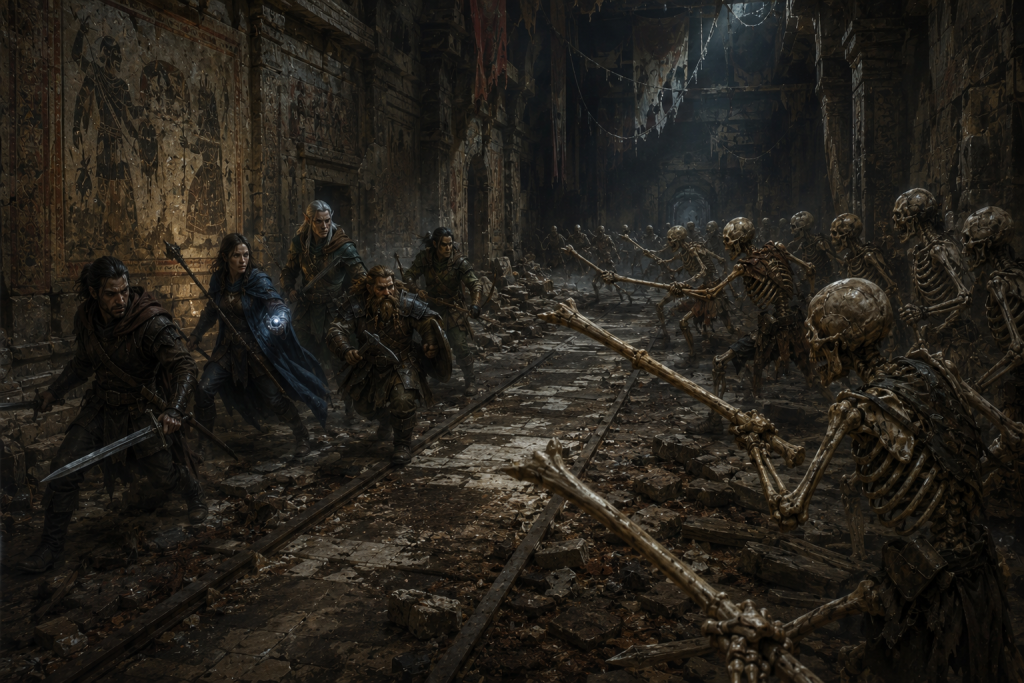
The corridor itself had clearly once been impressive. The floor consisted of polished quartz, though subsequent looting and centuries of decay had taken their toll. Numerous empty sockets marked places where gems or decorative inlays had once been set before being pried loose by ancient thieves. Rusted rails ran down the far side of the passage while faded murals lingered upon the walls, damaged by time, war, and vandalism.
Ancient debris littered the floor – fragments of armor, broken weapons, arrowheads, scorch marks, and other accumulated detritus of old battles.
Taken together, the evidence suggested that this had once been a principal entrance to a much larger underground complex and, still later, the site of a good deal of fighting.
Most curious of all were drag marks in the dust – something substantial had been moved through this corridor relatively recently but unfortunately, it was impossible to determine in which direction.
The party elected to investigate the route toward the surface first but after a considerable distance, however, they encountered an immense ancient rockfall that completely sealed the passage.
More interestingly, however, the drag marks ended at an arrangement of a large collection of skeletons just ahead of the collapse. Clearly someone had gone to considerable effort to position them there.
The party’s collective sense of foreboding immediately justified itself as the skeletons rose.
Like the skeletons in the waterworks, they were armed with sharpened long bones and slings fashioned from smaller skeletal remains. They advanced toward the party but did not attack – merely walked. Relentlessly and silently.
The heroes, greatly outnumbered, retreated and the skeletons followed. Like sheepdogs herding particularly stubborn livestock, they steadily drove the party back down the corridor and deeper into the complex.
As they passed the Crown position guarding the breach, the soldiers observed the entire affair with remarkable professional detachment and made no effort whatsoever to assist, entirely failing to improve the party’s opinion of Major Thorne.
Eventually the skeletons herded the party into a vast ruined atrium at the opposite end of the corridor.
There the undead stopped and formed a silent barrier at the entrance. They appeared entirely content to allow the party free rein within the chamber itself.
The party was therefore entirely unsurprised when the other shoe finally dropped and the Sereth emerged. This manifestation appeared as little more than a drifting cloud of pale mist suspended above the floor, yet its voice echoed clearly within the minds of every member of the party.
Curiously, it showed no sign of recognizing them and whether this represented a different Sereth, a reincarnated Sereth, or merely one suffering from a spectacularly selective memory remained unclear.
A cautious conversation followed.
The Sereth explained that they had once been summoned by warm-blooded beings resembling the party to destroy their enemies. After doing so, they had been imprisoned here and abandoned.
They wished to be released and offered rewards for the party’s help – power, wealth, knowledge, assistance, the death of the party’s enemies. The usual collection of promises made by ancient imprisoned horrors.
The party responded by asking questions and carefully avoiding commitments and eventually the Sereth concluded that they were being stalled and drifted away. Moments later, eight skeletons accompanied by two wight-like creatures emerged from a side passage and advanced.
The resulting battle was brief and featured the aggressive use of area of effect spells such as Ice Knife, and Radiant Dawn with devastating effect.
Afterward, the party glanced back toward the corridor from which they had come.
The skeletal blockade remained exactly where it had been – silent, motionless, patient. Just more spread out than before as though adapting to and learning from what they had just seen and preparing for whatever came next.
Following the left hand passage out of the atrium, the party explored a series of adjoining chambers that appeared to have once served as laboratories.
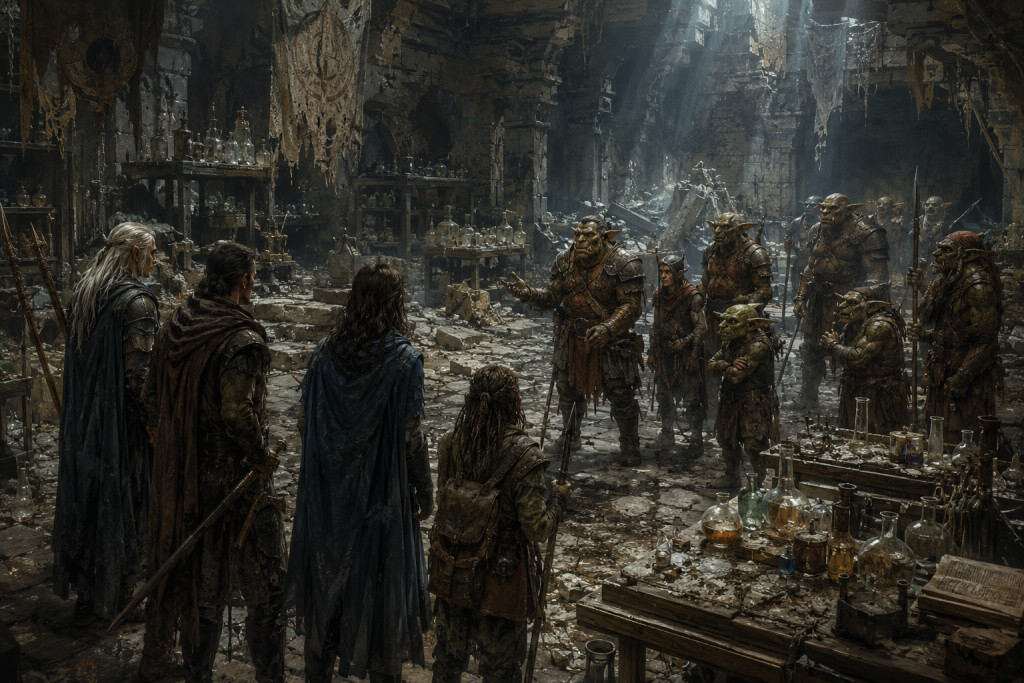
Time had not been kind to them. Worktables had collapsed. Shelves had rotted away. Glassware and delicate instruments had long since been reduced to unidentifiable fragments. Yet enough remained to suggest the facility’s original purpose. Some rooms appeared devoted to mundane engineering and craftsmanship. Others showed signs of magical experimentation. Whatever this place had once been, it had clearly been more than a fortress.
Perhaps Engineer Howell’s lone lucid statement had not been madness after all.
As the party explored, an unexpected sound echoed through the ruins – a cough. Not the dramatic cough of someone attempting to conceal their presence, nor the ominous cough of a lurking villain. It was a genuinely unhealthy cough…. And, yet, one that sounded strangely familiar.
Following the sound cautiously, the party eventually discovered its source.
Kesh.
The goblin informant looked no healthier than the last time they had seen him; in fact, if anything, he looked worse. Gathered around him was a mixed group of goblins and hobgoblins. Most appeared to be laborers rather than soldiers. They looked exhausted, dirty, and more than a little trapped.
Kesh looked up as the party approached.
“Oh. You’re alive.” The statement carried all the enthusiasm of someone discovering that, despite their best efforts, there were weevils in their bread.
The group’s leader proved to be a hobgoblin named Throk—fortunately not to be confused with Captain Tharok, whose nameplate the party had previously recovered from the abandoned outpost.
With Kesh serving as translator, a lengthy discussion followed which proved remarkably informative.
Throk confirmed that Kesh’s warning had indeed triggered the evacuation of the previous installation. Once they realized the party had discovered the outpost, they concluded that Crown forces could not be far behind. They removed everything they could carry, destroyed what they could not, and withdrew before they could be trapped.
As for the larger organization operating beneath Hollowmere, he confirmed the party’s suspicions. There was, indeed, an alliance between orcs, hobgoblins, goblins, and a handful of humans. When asked what this alliance was doing elsewhere in the world, Throk declined to answer. When asked what they were doing in Hollowmere specifically, however, he proved considerably more forthcoming.
They were searching for Mira’Thar. Or, more precisely, they were standing inside it.
According to Throk, Mira’Thar had originally been a center of research and learning. Prior to the Righteous War, scholars, engineers, artificers, and mages had worked there on both magical and mundane projects. Only later, as the war worsened, had the facility been converted to military purposes.
Its underground location had made it one of the last Orcish strongholds to fall.
Their current mission, he explained, was to recover what remained – knowledge, artifacts, records, history, anything that had survived.
The explanation cast many of the discoveries from the previous session in a new light – the school slate, the census tablet, the memorial banners. None had been collected by accident. Someone had been deliberately preserving them.
Throk then explained how his own group had become trapped.
They had spent months methodically removing useful materials from the facility and carried on despite increasing reports of strange voices over the past few weeks. Knowing that the Crown was excavating nearby, they had been reluctant to leave anything behind.
Then the Sereth appeared and faced with mounting losses, Throk ordered a withdrawal.
He personally remained behind in an attempt to rescue additional personnel and found himself trapped alongside the workers he had tried to save.
The Sereth had made them the same offer they had made the party. Release us. Tell us how to escape. And we will give you whatever you desire.
Like the heroes, Throk had declined. He believed the only reason any of them remained alive was because the Sereth required living agents to free them.
When asked whether he was considering helping them escape, his answer was immediate.
Absolutely not.
The discussion gradually broadened with the party explaining what they had learned about the human use of Sereth during the Righteous War. Throk listened quietly and then reciprocated by acknowledging that the war had been savage and that the Orcish side had employed undead extensively during the conflict. He also acknowledged, without apology, that they had resumed doing so in recent years.
Eventually the discussion drifted toward larger questions. Politics, history, and the future. It was then that Throk offered perhaps the bleakest observation of the day. “War is coming.”
The party objected – surely it could still be avoided; surely there had to be another path.
Throk did not appear convinced. Five centuries of conquest, resentment, and competing versions of history were not easily undone.
When the party suggested that perhaps they might meet with his superiors and help prevent such a conflict, Throk did not answer immediately. Instead, he asked a question of his own.
What did they think of the Crown?
The answers, particularly those provided by Merrythought regarding the treatment of her people, appeared to interest him and he listened carefully then nodded once and declined to pursue the matter further. There would be time for politics later. For the moment, everyone was trapped in a haunted ruin filled with ancient horrors and practical concerns had to take precedence.
By session’s end, the party found itself in an increasingly uncomfortable position. The goblins and hobgoblins wanted their help while the Crown and the Sereth demanded it. And somewhere in the depths of Mira’Thar, perhaps alive and perhaps not, Colonel Varnes waited.