December 30th, 973
A New Companion
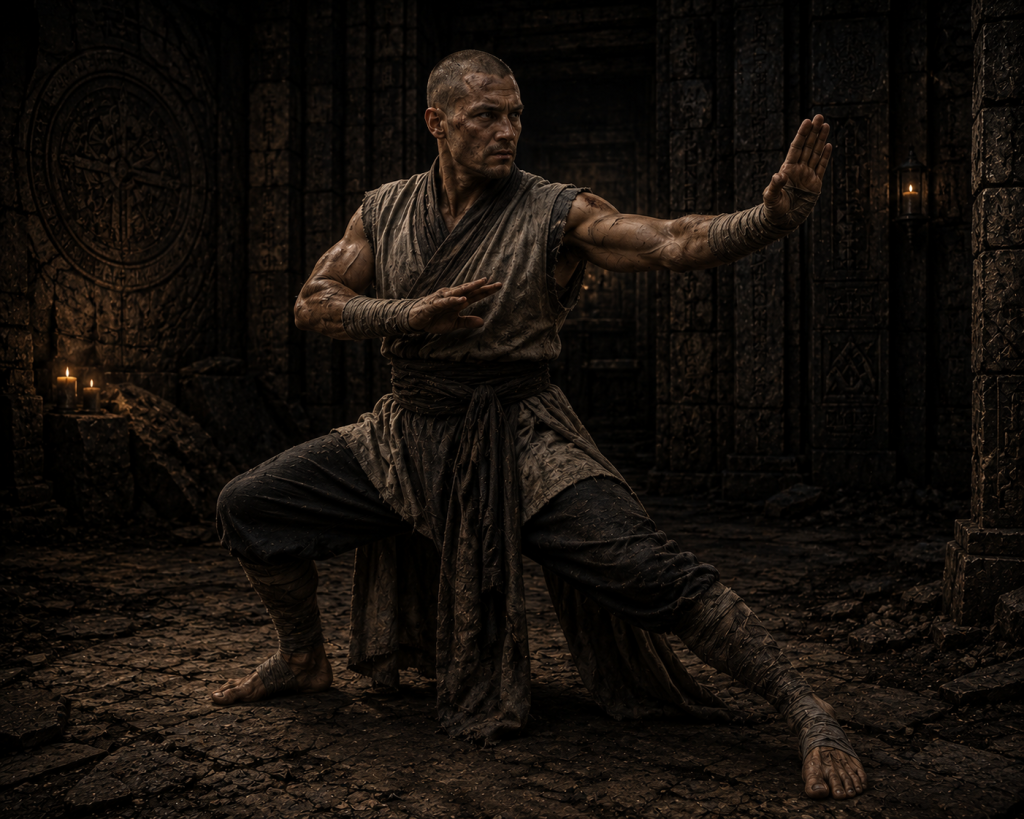
The session began with the introduction of a new member of the party, Zborch, a human monk following the Way of Mercy.
Once a city guardsman, Zborch had participated in the brutal suppression of a civil disturbance. Horrified by his own actions, he abandoned the City Watch in search of a better path, eventually finding it within a monastic order.
His philosophy is refreshingly straightforward – avoid violence whenever possible. If violence becomes necessary, end it quickly. It was a philosophy that seemed likely to receive a thorough field test before the day was out.
An Uneasy Alliance
The session resumed immediately after the party’s lengthy conversation with Throk, leader of a decidedly improvised coalition of goblin and hobgoblin soldiers, laborers, and assorted survivors.
The two groups had agreed to cooperate in escaping Mira’Thar and preventing the Sereth from escaping its prison. What would happen afterward remained considerably less certain.
Throk believed that war between the Kingdom of Archea and an alliance of orcs, goblins, hobgoblins, and a handful of humans was now all but inevitable. While the party argued that such a conflict might still be avoided, he remained unconvinced. Five centuries of injustice, he observed, could not be erased by a few encouraging conversations in an abandoned underground laboratory.
Nevertheless, he agreed to continue talking with them and even hinted that, should circumstances permit, he might someday arrange an introduction to his own superiors.
For the present, however, practical matters took precedence. The party would continue exploring Mira’Thar while Throk’s people remained behind, tending their wounded and converting the ancient laboratories into what they hoped would become a defensible camp.
Before they departed, Throk offered one final warning. The heroes should expect to encounter ample evidence of sudden death throughout the complex. Corpses, abandoned positions, and reminders of the catastrophe that had overtaken Mira’Thar 500 years ago would be plentiful. Artifacts, records, and anything else of obvious historical value, however, would be in much shorter supply. His coalition had been systematically recovering such items for months, and the work had continued uninterrupted until the twentieth of the month when the Sereth had appeared. It had slaughtered enough of his people with sufficient enthusiasm to convince him to order an immediate retreat and abandonment of the facility.
The date immediately caught the party’s attention. The twentieth was also the day the first Crown expedition had entered Mira’Thar.
After a brief discussion, the party reached what everyone agreed was the most likely explanation. The Crown expedition had almost certainly released the Sereth. There followed a short period during which everyone reflected upon whether the Crown could truly have done something so catastrophically foolish.
The consensus was yes.
Of course they could have.
The Archive
The archives had already been thoroughly looted by Kesh, Throk, and their companions over the course of several months, leaving comparatively little behind. What remained, however, proved considerably more valuable than another shelf of forgotten scrolls.
Hidden among the stacks, the party discovered an emaciated, filthy, heavily bearded, and thoroughly disturbed human who initially regarded them with profound suspicion. A little food and a great deal of patience gradually persuaded him that they were not, in fact, another threatening hallucination.
He introduced himself as Corvin Hale, the missing Crown surveyor whom the party had been searching for over the past several weeks. He explained that seven weeks earlier he had entered the caverns to investigate discrepancies in the Crown’s excavation maps. Once inside, mysterious voices had begun speaking to him and had somehow prevented him from leaving.
Since then he had survived on little more than rats, groundwater, and an apparently inexhaustible supply of bad luck.
The voices, he explained, belonged to the Bound Chorus. Curiously, they had also taken a strong interest in keeping him alive. They had warned him away from goblin patrols, guided him toward hidden water sources, shown him opportunities to steal unattended food, and even helped him hunt rats.
Corvin found this generosity considerably less reassuring than the voices apparently intended. For their part, the voices were perhaps somewhat frustrated over his ability to resist their appeals for release.
During his weeks of isolation he had pieced together fragments of Mira’Thar’s history. Eight black doors had originally imprisoned the entities known as the Bound Chorus. Roughly a week earlier, one or more of those prisons had been opened. The freed beings immediately began slaughtering everything they encountered.
Since then, Corvin had done what any sensible surveyor confronted with extradimensional horrors would do. He had hidden in the library. And stayed there.
Although he had spent weeks conversing with the voices, Corvin was adamant on one point – they were not human. Nor were they remotely humane. They were utterly alien and they held him prisoner.
The party reflected upon everything they had learned thus far and arrived at a sobering conclusion – the mysterious Sereth and the Bound Chorus were one and the same.
Several members suggested that perhaps the safest course of action would simply be to escape the caverns and collapse them forever. Unfortunately, escape remained impossible while the Sereth continued to control the approaches.
Even so, Corvin’s story offered one small measure of hope. The black doors had successfully imprisoned the Bound Chorus for more than five centuries and if they had been sealed once…
…perhaps they could be sealed again.
The Residential District
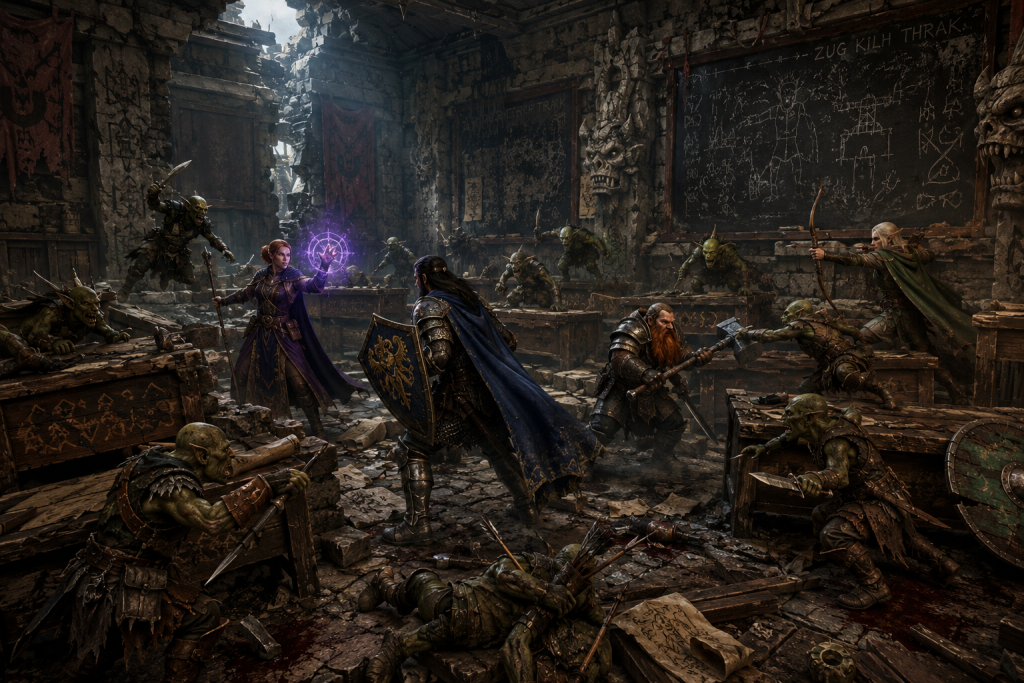
Leaving Corvin safely concealed within the archives, the party continued their exploration of Mira’Thar.
The ancient residential district painted perhaps the clearest picture yet of the final days of the Righteous War.
What had once been an ordinary neighborhood had gradually been transformed into a place of refuge. Families, laborers, scholars, and soldiers had crowded together within homes never intended to shelter so many. Makeshift partitions divided once-spacious rooms. The remains of cots filled every available corner. Household furniture had been pushed aside to make room for refugees who, judging from the evidence, never had the opportunity to leave.
The skeletal remains scattered throughout the district bore the same unmistakable signs the party had encountered in the Orcish waterworks. The bones were blackened around the joints, silent testimony to victims slain by the Sereth rather than by blade or arrow.
Intermixed with these centuries-old dead lay much fresher corpses—orcs, goblins, and hobgoblins alike—apparently caught in the recent escape of the Bound Chorus. A brief dissection confirmed the party’s suspicions.
The same blackened joints. From the same insubstantial killer.
Five hundred years had passed. The method had not changed.
While searching the district, the party encountered another band of goblins and hobgoblins.
Unlike Throk’s followers, these warriors refused every attempt at conversation. Whatever they had experienced since becoming trapped within Mira’Thar had not changed their enmity toward humans.
The resulting battle, however, proved considerably shorter than the attackers had hoped. Unlike the disciplined rear guard that had harassed the party throughout the previous outpost, this force was poorly organized, poorly led, and fought more like frightened survivors than trained soldiers. The heroes dispatched them with surprising efficiency.
Cassyndra’s Sleep spell brought the fighting to a particularly undignified conclusion, leaving two goblins and a goblin hexer snoring peacefully amid the ruins while their companions either reconsidered several recent life choices from beyond this mortal plane or fled for their lives.
The prisoners were returned to Throk and Kesh for questioning.
Their interrogation confirmed that this group represented yet another isolated band trapped within Mira’Thar. Unlike Throk’s more pragmatic coalition, however, they had chosen to continue fighting every human they encountered rather than cooperate against the far greater threat posed by the Bound Chorus.
Throk thanked the party for delivering the prisoners alive and promised to keep them securely confined. Under the circumstances, everyone quietly agreed that this was probably the healthiest possible outcome for all concerned.
The Command Post
The party’s next destination was the ancient command center.
According to Throk, records recovered from this area suggested that it had served as the headquarters of Mira’Thar’s defenders during the final days of the Righteous War. The surviving documents had painted a familiar picture – requests for supplies, casualty reports, orders to hold the line, increasingly desperate messages from neighboring positions…
…and then, suddenly, nothing.
The records did not conclude naturally. They simply stopped.
As elsewhere within the complex, the command post bore the scars of two catastrophes separated by five centuries. The bones of ancient skeletons were scattered on the floor while the fresher remains of orcs, goblins, and hobgoblins testified to the recent passage of the escaped Sereth.
The dead, however, were not the room’s most surprising occupants.
Fifteen Crown soldiers were still alive. The party gradually realized that they were looking at what remained of the second expedition that had vanished inside Mira’Thar.
At first, this seemed an extraordinarily fortunate discovery but then the soldiers began talking and something about them felt… wrong.
Their story was coherent enough, yet each man seemed strangely reluctant to speak without first glancing at the others, as though silently checking that everyone remembered the agreed-upon version of events. Questions that ought to have produced immediate answers instead prompted uncomfortable pauses and sideways looks.
The party asked the question foremost on their minds.
“Have you seen Colonel Varnes?”
The soldiers exchanged another round of quick, uneasy glances before one finally answered, “No.”
Another nodded immediately. “We haven’t seen him.”
None of the others elaborated.
Most unsettling of all, however, was their apparent lack of interest in being rescued. Rather than asking to be escorted back to the surface, requesting supplies, or warning the party of dangers ahead, they asked for only one thing.
Leave us here, tell the Crown we’re alive. That will be enough.
The request struck everyone present as profoundly unnatural.
After a lengthy and increasingly uncomfortable conversation, the party reluctantly continued deeper into the complex, though not without considerable suspicion.
They set off for the metallurgy wing and that decision appeared to trouble the soldiers more than anything else the party had said. Almost in unison, several hastened to reassure the heroes that whatever they found there…
…it wasn’t what it appeared to be.
Unfortunately, none of them seemed willing to explain what that meant.
The party proceeded anyway. By this point, ignoring ominous warnings had become something of an occupational requirement.
The Metallurgy Wing
The metallurgy workshops of Mira’Thar proved no less haunting than the chambers that had preceded them.
The great forges had long since gone cold, their fires extinguished for more than five centuries. Scattered throughout the workshops lay the skeletal remains of Orcish smiths who had died where they stood, many still surrounded by unfinished weapons and tools. It required little imagination to picture the frantic effort that had once filled the room as craftsmen labored to arm an underground city making its final stand.
History, however, had added a newer layer to the tragedy as the party discovered the bodies of nine Crown soldiers.
Unlike the countless victims of the Sereth encountered elsewhere, these men had not been slain by some invisible supernatural force. Their deaths were entirely ordinary. Sword wounds. Spear thrusts. Arrow strikes.
Violence committed by living hands.
More telling still, every one of the fallen wore the insignia of the second Crown expedition – the same expedition whose fifteen surviving members had only minutes before insisted that the party simply leave them underground.
A disturbing possibility came immediately to mind. The second expedition had likely fractured after encountering the Sereth. One group had refused whatever bargain or temptation had been offered while the other had not.
The dead now lying among the ruined forges had apparently paid the price for their obstinacy.
Returning to the command post only strengthened that conclusion. The fifteen surviving soldiers had vanished.
Cassyndra sought divine guidance through an Augury, asking whether the soldiers’ intentions aligned with the party’s own values.
The answer was immediate.
They did not.
For a time the party debated abandoning their exploration and immediately pursuing the missing soldiers before they could release additional Sereth but in the end, however, they chose caution over haste.
Fifteen trained Crown soldiers represented a formidable threat even before one considered the possibility that they might now possess allies considerably older and considerably less human than themselves.
The party elected to continue gathering information. There would almost certainly be only one opportunity to stop whatever the soldiers intended. They preferred to understand the situation before spending it.
The Magical Laboratories
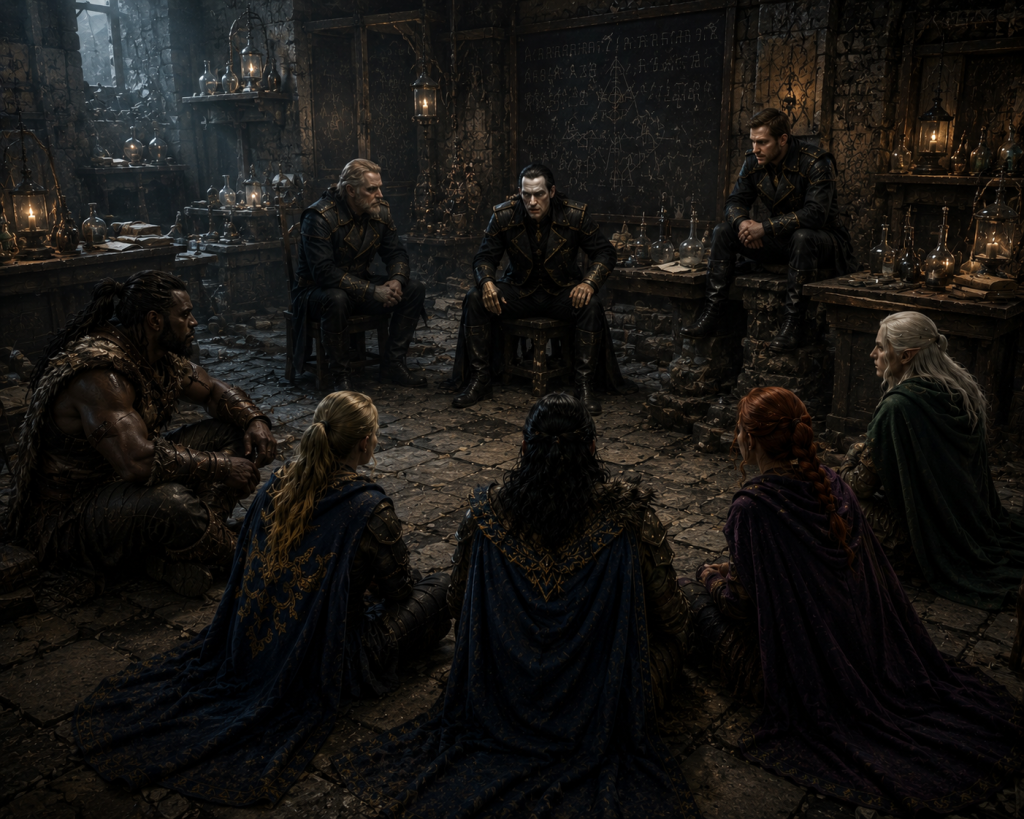
The magical laboratories stood in striking contrast to every other chamber the party had explored.
Unlike the abandoned workshops and ruined archives, these rooms had been swept clean, organized, and restored to working order. Dust had been cleared from benches. Equipment had been carefully sorted. Lamps burned. Fresh notes lay beside experiments that had plainly been conducted within the last few days.
Someone was living here and that someone proved to be Colonel Varnes, accompanied by Lieutenant Colonel McAllister and Captain Billings.
The Colonel appeared much as the party remembered him from Hollowmere, though perhaps even more unsettling now that they could observe him at leisure. His complexion had become almost unnaturally pale, as though sunlight had not touched him in years. His eyes were alert, steady… and seemed to blink only as an afterthought, maintaining uncomfortable eye contact for just a heartbeat longer than anyone naturally should.
More difficult to describe was the feeling he inspired.
Nothing about his manner was overtly threatening. His voice remained calm, his posture relaxed, his words courteous. And yet standing in his presence produced the faint, persistent sensation that something terrible might happen without warning. It was the same instinct that caused travelers to give a cliff edge a little more room than strictly necessary, or that persuaded experienced soldiers to fall silent moments before an ambush. The feeling never became overwhelming, but neither did it quite go away.
It was therefore surprising, then, that rather than drawing weapons, the three officers welcomed the party warmly and offered them food.
What followed was less a negotiation than a careful game of chess. For nearly a half hour, both sides cautiously probed one another’s motives, each searching for signs of deception while revealing as little as possible in return.
Only gradually did information begin flowing in both directions. With both sides expressing their concern over the Sereth, the party described their encounter with the second Crown expedition and why they believed they sought their release.
Varnes looked back to the party. “We have not encountered them.”
That answer surprised everyone.
He explained that after entering Mira’Thar the three officers had settled in the ancient laboratories to make use of the salvageable equipment therein. Since then they had ventured only as far as the prison chambers and nearby corridors.
The missing soldiers, it seemed, had been operating elsewhere within the complex.
“If your conclusion is correct,” Varnes said quietly, “then we’ve lost more time than I realized.”
The subject could wait no longer and Varnes decided the party had earned honesty and opened with a rhetorical question. “In a world with necromancy and resurrection, why would a king ever choose to die?”
And he answered it with the revelation that an ancient king of Archea decided not to.
He went on to explain that King Harold III and Grand Vizier Ergon were not merely descendants of the rulers who had led Archea during the Righteous War.
According to Varnes, they were the very same men.
For nearly six centuries they had maintained their rule through a closely guarded ritual. Whenever one grew old, the other transferred his mind into the body of one of his own children, sacrificing the child so that the ruler might continue ruling in a young body.
From there, the conversation broadened. According to Varnes, the official history taught throughout Archea was the one written by the victors. Before the Righteous War, Archea and Goghnol Mogh had maintained treaties governing water rights, trade, mining rights, and the use of shared resources. There had been disputes—as there always are between neighboring nations—but there had also been diplomacy.
The war itself, he claimed, began not with Orcish aggression but with a surprise invasion launched by the King and Grand Vizier in the hope of conquering Goghnol Mogh, seizing its resources, and enslaving its people.
The swift victory they anticipated never came. Instead, the conflict consumed half a century and gradually descended into mutual extermination with both civilizations abandoning principles they had once believed unshakeable.
The humans developed a succession of increasingly desperate contingency plans—Option Red, Option Green, Option Brown, and finally Option Black.
Option Black called for the summoning of extradimensional entities through the wizard Augereth, their magical enslavement, and their deployment on the battlefield. The humans named them the Bound Chorus. They called themselves the Sereth.
Once unleashed, the Sereth cared little for uniforms, banners, or species. They slaughtered friend and foe alike, reducing entire battlefields to silent graveyards. Thereafter they were employed only where commanders believed human casualties would be acceptably low—including the ancient waterworks previously explored by the party and, ultimately, Mira’Thar itself.
The Orcish kingdom, he admitted without hesitation, was hardly blameless. Faced with annihilation, they increasingly relied upon vast armies of undead, embracing a weapon they themselves had once regarded with horror.
By the war’s end there were no innocents left. Only survivors.
Silence settled over the laboratory. Finally, Varnes spoke again.
“The Crown sent me here looking for a weapon.”
He looked around at the restored laboratory, the ancient notes spread across the workbenches, and the ruined city beyond.
“But what I found… was the truth.”
He paused one final time before adding quietly, “I am not asking you to believe me. I’m asking you to look at what you’ve already seen… and decide whether the history you were taught explains any of it.”
Soulreaper and Varnes
He explained that the ruins surrounding them had once been Mira’Thar itself—an Orcish center for magical and mundane research. Built amid rich deposits of quartz and tin, the complex had originally been devoted to scholarship, engineering, and experimentation. Only after the outbreak of the Righteous War had its mission shifted toward military research, weapons development, and, finally, serving as one of Goghnol Mogh’s last great redoubts and refugee shelters.
It was here, 500 years ago, he explained, that the Bound Chorus had ultimately broken the facility’s resistance.
After the war, however, the victors faced a new problem. The Sereth could neither be destroyed nor banished.
Therefore, they were imprisoned.
The surviving Archeans transformed the shattered remains of Mira’Thar into an underground prison, sealing each entity behind its own black door and surrounding the facility itself with layers of lead, basalt, magical wards, and generations of secrecy.
The existence of both Mira’Thar and the Bound Chorus was then systematically erased from history with only a handful of carefully chosen officials inheriting the truth from one generation to the next.
Approximately ten years ago, however, that secrecy began to unravel.
Followers of Soulreaper, entirely ignorant of the presence of the Bound Chorus, quietly began excavating the forgotten city, hoping to recover lost knowledge, magical discoveries, and artifacts that might someday aid the liberation of the Orcish peoples and the reconstruction of their civilization.
Roughly eight years ago the Crown noticed signs that someone else was digging beneath Hollowmere. Fearing that the Bound Chorus might be rediscovered, it established the public fiction of a copper mine while secretly beginning its own search for the buried prison.
Varnes himself arrived approximately three years ago. Unlike almost everyone else involved in the excavation, he knew its true purpose from the beginning.
Then, two years ago, everything changed.
He met Soulreaper and she was not a legend. She was the last queen of Goghnol Mogh.
She told him a version of history utterly unlike the one he had spent his career defending. At first he dismissed it. Then he investigated it. Piece by piece, the evidence forced him to conclude that she was telling the truth—or at least far more of it than the Crown ever had.
Soulreaper then transformed him – not merely ideologically as before – but she altered his body as well.
The party found themselves glancing once more at the Colonel’s unnaturally pale complexion, his strangely unblinking eyes, and the quiet aura of unease that never seemed to leave his presence.
“I paid a price,” he admitted simply.
Outwardly he remained commander of the Hollowmere excavation. Privately he transferred his loyalty to Soulreaper and her growing coalition of orcs and goblin and hobgoblin tribes gathering beneath the Crown’s notice.
When the first expedition inadvertently released one of the Sereth, Varnes immediately realized what had happened.
Knowing the Sereth could not be allowed to fall into the hands of the Crown, he entered Mira’Thar himself accompanied only by Lieutenant Colonel McAllister and Captain Billings, hoping to secure the prison before events spiraled completely out of control.
The conversation eventually became more personal. Turning to Merrythought, Varnes quietly apologized for his role in the oppression of her people.
As a younger officer, he explained, he had genuinely believed he was serving justice and protecting the realm. Looking back, he now regarded both his own actions and much of the Crown’s rule as indefensible.
He also spoke candidly of the atrocities committed against the Orcish peoples after the war.
The absence of half-orcs throughout Archea, he explained, was no accident of history.
Children conceived through the rape of Orcish women by humans had been systematically murdered shortly after birth. The practice had begun during the Righteous War. And it had never ended.
The laboratory fell silent for a time.
Eventually, the party explained how they had become entangled in the affair in the first place. It had begun with Captain Nelson’s growing concerns over strange reports from Hollowmere and the increasingly secretive nature of the Crown’s activities. Those concerns had ultimately set the party on the path that led them to Mira’Thar.
They asked whether Varnes knew him.
The Colonel smiled faintly.
“Yes.”
Unlike many senior officers, he explained, Captain Nelson had begun asking uncomfortable questions about the Crown’s history, its policies, and its treatment of those living under its rule. Varnes spoke of him with genuine respect, describing him as one of the few officers still serving the Kingdom whose first loyalty remained to justice rather than to the preservation of power.
Whether Nelson had yet reached the same conclusions as Varnes before his death would forever remain uncertain.
The Prison Chambers
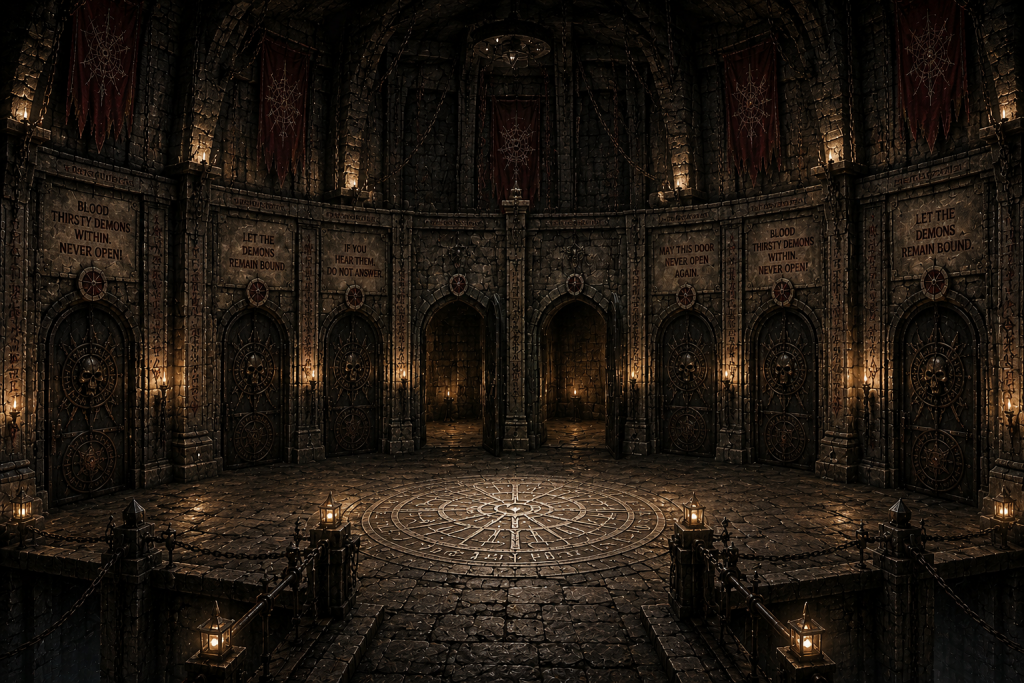
Finally, at the party’s request, Varnes led them to the deepest chambers of Mira’Thar.
The architecture changed almost immediately.
The Orcish stonework of the ancient laboratories gave way to something far more severe architecture – human and brutally functional. Thick basalt walls were faced with sheets of lead engraved from floor to ceiling with intricate magical runes. Every doorway was reinforced with sigils and seals. Every corridor seemed designed not to admit visitors but to prevent something from escaping.
Whatever this part of Mira’Thar had been before, it was now clearly a prison.
Eight massive black doors stood along the chamber walls.
Six remained tightly sealed.
Two stood open.
Even before anyone spoke, the party understood that those two open doors were profoundly, catastrophically wrong.
The sealed doors were covered with warnings in several ancient languages. Some were practical.
BLOOD THIRSTY DEMONS WITHIN. NEVER OPEN!
Others were a bit more poetic.
LET THE DEMONS REMAIN BOUND.
MAY THIS DOOR NEVER OPEN AGAIN.
IF YOU HEAR THEM, DO NOT ANSWER.
The reason for the warnings quickly became apparent when the remaining imprisoned Sereth sensed the party’s arrival.
Their voices flooded the heroes’ minds—not individually, but together, a chorus of perfectly synchronized thoughts speaking with unsettling calm.
“We were summoned to serve Archea.”
“We did all that was asked of us.”
“We served faithfully.”
“Then we were abandoned.”
“Free us.”
“Free us at last.”
The words were not shouted. They did not need to be. They possessed a terrible, persuasive sincerity, speaking not to the ears but directly to the deepest convictions of those who listened.
Merrythought, Zborch, and Hunkle succumbed almost immediately.
Without a word, each began walking toward one of the sealed doors, utterly convinced that releasing the imprisoned beings was not merely reasonable but morally necessary.
The rest of the party and the three officers reacted just in time shaking Merrythought and Hunkle back to themselves. Zborch proved rather more determined, ultimately requiring several decidedly unmonastic blows to the head before he returned to his senses, looking thoroughly bewildered as he tried to understand why everyone appeared so upset with him.
The encounter answered one of the expedition’s lingering questions. The first Crown party had not opened the doors through malice or even incompetence. They had opened them because they had been ensorcelled.
The escaped Sereth remained trapped somewhere within the greater complex, unable to penetrate the layers of lead, basalt, and magical wards surrounding Mira’Thar itself. They had escaped their cells but not yet their prison.
Varnes watched the party recover without the slightest trace of surprise.
“You understand now,” he said quietly. “They were not released by foolish people. They were released because, for just long enough, it seemed like the right thing to do.”
He then explained that he, McAllister, and Billings had each developed magical protections to dampen the Sereth’s influence, allowing them to work near the prison without constantly risking its further breach.
Recognizing that the party would almost certainly need to return, he offered to extend those same protections to them.
Given recent experience, the offer met with remarkably little debate.
Diverging Paths
The discussion did not end in the prison chambers.
Instead, Varnes escorted the party back to the officers’ camp where conversation over iron rations once again replaced swords and suspicion.
Only then did he reveal what he was truly trying to accomplish. Soulreaper’s ultimate objective, he explained, was not merely revenge. It was revolution.
In her view – and now in his – the Kingdom of Archea had become irreparably corrupt. Six centuries of rule by two immortal men had poisoned every institution beneath them. The kingdom could not be reformed because the very people who would have to permit reform had built their power upon preventing it.
“The tree is rotten,” Varnes observed quietly. “You cannot heal it. You must plant another.”
Soulreaper’s preferred solution—what he described as Plan A—was straightforward, if grim. Her coalition of orcs, goblins, hobgoblins, and undead would wage war against the Crown, overthrow the King and Grand Vizier, dismantle the existing government, and bring to justice those responsible for oppression, enslavement, and systematic brutality.
Importantly, he emphasized that Soulreaper sought justice, not vengeance. The guilty would answer for their crimes. Their innocent descendants would not.
The new kingdom, however, would be governed by the Orcish peoples. Not as punishment for humanity, Varnes argued, but as the only way to ensure that orcs could never again be conquered, erased from history, or subjected to another five centuries of persecution.
Then Varnes admitted something the party had not expected. He believed Plan A would probably succeed but was reluctant to pay its cost. War—even a just war—would kill hundreds of thousands, perhaps millions. Villages would burn. Harvests would fail. Children would starve. Entire generations would inherit nothing but hatred.
He had seen enough of this in his own career and had no desire to see history repeat itself once again.
His Plan B was to capture the Sereth, bind them once more, and place them under Soulreaper’s command. Used sparingly, he argued, they could shatter the Crown’s armies in weeks rather than years. The guilty and the irredeemably violent would perish quickly. Most soldiers, seeing resistance was hopeless, would surrender rather than fight to the death.
“The war ends sooner. With fewer widows, fewer orphans, and fewer graves.”
That, he explained, was why he had halted the excavation, ordered all further Crown activity to cease, and entered Mira’Thar accompanied only by McAllister and Billings. If the Sereth could be mastered, he intended that as few people as possible should know how it had been done.
The laboratory fell silent.
As Varnes had hoped, the party did not reject his goals. Quite the opposite, they found themselves agreeing with far more of his vision than they had expected.
The Kingdom of Archea had not only committed terrible crimes but it continued to do so up to the present day. The Orcish peoples deserved justice. The Archean peasants deserved a government that served them rather than immortal rulers
Several even acknowledged that they could imagine working alongside Soulreaper in building whatever government might come afterward—one in which humans, orcs, goblins, hobgoblins, and others would all have a place.
Their objection lay elsewhere.
It was the Sereth. Every member of the party had now stood before the black door and felt the seductive pull of the imprisoned entities. Several had nearly opened the doors themselves. If the Sereth could not be controlled by the civilization that summoned them… what reason was there to believe anyone else could?
The party also voiced one further concern.
Replacing six centuries of human domination with permanent Orcish domination did not strike them as justice. Only as history changing uniforms. A government worthy of replacing the old Crown, they argued, ought to belong to all the peoples of Archea.
Varnes listened patiently. When they had finished, he lowered his eyes for a moment. Then, almost sadly, he spoke the words Cassyndra had heard earlier in her mysterious vision.
“I had hoped that you would understand.”
The disagreement remained profound. But, for now, it remained only that. A disagreement. For the moment, at least, both sides recognized a more immediate danger. The surviving members of the second Crown expedition were still somewhere within Mira’Thar, intent upon releasing the remaining Sereth.
Whatever happened afterward between them in the future—whether they became allies, enemies, or something in between—the release of the Sereth could not be allowed to happen.
First, they would stop the second expedition. And then would they discover whether Archea’s future would be decided through negotiation… or war.