December 31st, 973 (Meanwhile, back in Manchester… Part 1)

Manchester had developed a smell.
Not one smell, naturally. Manchester possessed dozens, perhaps hundreds, all competing for civic recognition. Coal smoke fought bravely against damp wool. Horse manure contended with industrial runoff. Fried onions dueled nightly with sewage, while somewhere beneath them all lurked the old river smell—the stubborn, fungal odor of water that regretted its career choices.
No, this was newer. And it had edges.
It crept upward through drain grates and cellar cracks. It lingered in alleys after rain. It rode the evening fog through Gutter’s End and settled against the lower stories of buildings like an unwelcome political opinion. It smelled faintly vegetal, faintly rotten, and faintly chemical in ways that strongly suggested someone, somewhere, had recently assured the public there was absolutely nothing to worry about.
Pfinder noticed it immediately.
This was partly because he was observant by profession, and partly because he had stepped directly into a puddle of it while attempting to avoid a wagon advertising PATRIOTIC TURNIPS.
He arrived at The Royal Standard in a dark mood.
The newsroom hummed with the usual orchestrated urgency of institutional journalism – editors hurrying importantly toward meetings that would produce no action whatsoever, junior correspondents composing passionate descriptions of civic triumph beside windows through which one could literally see smoke rising from fires in the sewers, and somewhere in the distance the printing presses pounding out tomorrow’s certainties before today’s had finished collapsing.
Pfinder hung up his coat, sat at his desk, examined the assignment waiting for him, and sighed.
“Ah,” he murmured. “Propaganda.”
Across from him, a younger reporter looked up nervously. “Sorry?”
“Nothing,” Pfinder said pleasantly. “I was merely greeting the morning.”
The assignment sheet bore the unmistakable fingerprints of the editorial board – “REASSURING PIECE REGARDING CONTINUED SUCCESS OF SUBTERRANEAN RECTIFICATION INITIATIVE”
Below that, in smaller script:
- Avoid sensationalism.
- Emphasize confidence.
- No casualty estimates without Ministry approval.
- Avoid use of phrase “meat fungus.”
Pfinder rubbed his eyes. Last week, according to the official reports, the Civil Guard and Army engineers had successfully “contained several isolated disturbances” beneath the city.
Last night, according to the woman Pfinder had interviewed in Gutter’s End, something with six legs and too many human teeth had climbed from a storm drain and attempted to eat her husband. The husband, she had noted bitterly, was now being fined for “interfering with municipal operations.”
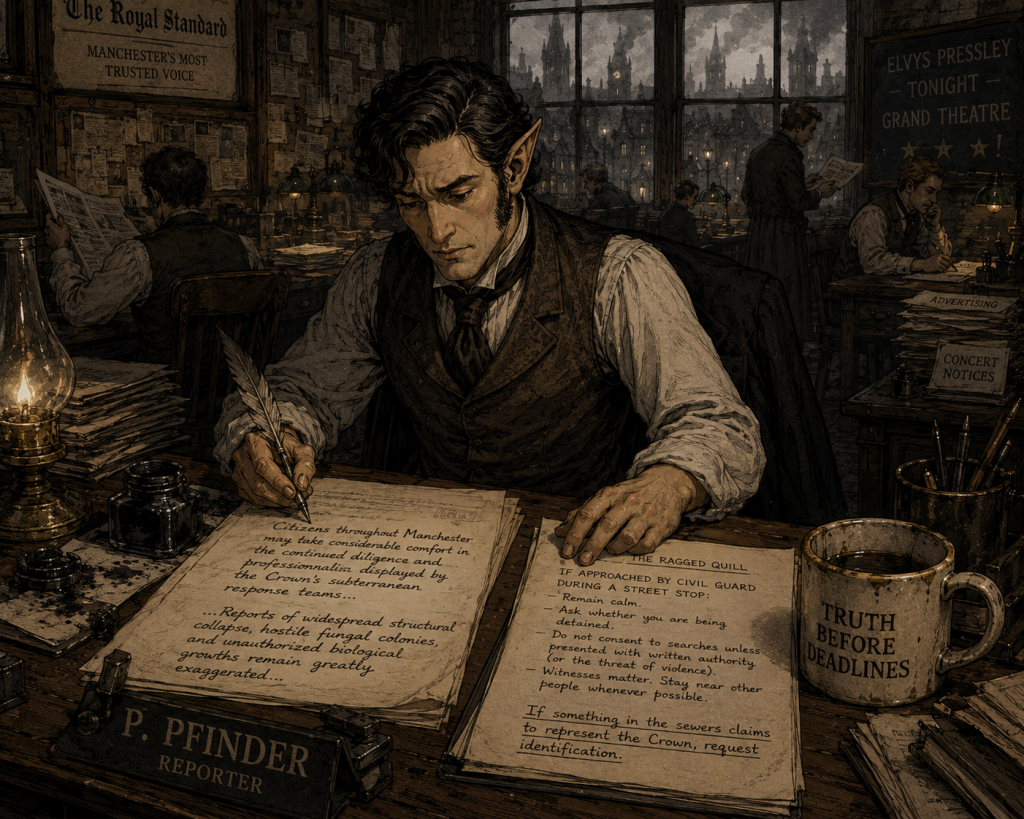
Pfinder dipped his pen and stared at the blank page. Then, with the calm resignation of a man selecting which moral compromise would least damage his digestion, he began writing,
“Citizens throughout Manchester may take considerable comfort in the continued diligence and professionalism displayed by the Crown’s subterranean response teams…”
Three desks away, someone coughed wetly into a handkerchief.
Outside, somewhere beyond the fogged windows, concert bells rang. Elvys Pressley was playing again tonight. The newsroom had spent most of the week pretending not to notice this fact while discussing little else.
Pfinder himself had developed what he considered a perfectly balanced professional opinion regarding Mr. Pressley – the young man was simultaneously ridiculous, talented, culturally important, and almost certainly one pelvis movement away from provoking a parliamentary inquiry. Worse, Pfinder had caught himself humming one of the songs yesterday – quietly, in private. Like a shameful medical condition.
He resumed writing.
“…Reports of widespread structural collapse, hostile fungal colonies, and unauthorized biological growths remain greatly exaggerated…”
A pause.
Then, underneath the half-finished article, on a separate sheet intended for rather different readership, Pfinder quietly began drafting notes for the next issue of The Ragged Quill.
IF APPROACHED BY CIVIL GUARD DURING A STREET STOP:
- Remain calm.
- Ask whether you are being detained.
- Do not consent to searches unless presented with written authority (or the threat of violence).
- Witnesses matter. Stay near other people whenever possible.
He paused again then added another line.
- If something in the sewers claims to represent the Crown, request identification.
That one pleased him.
Pfinder leaned back slightly, flexing ink-stained fingers. This, he reflected, was the exhausting part of modern journalism – spending mornings describing reality incorrectly and evenings trying to repair the damage before anyone noticed.
The day proceeded accordingly. At noon he interviewed a Ministry clerk who assured him the sewer situation was “well within projected tolerances,” despite possessing the haunted expression of a man who had personally seen those projected tolerances devouring livestock.
At two o’clock Pfinder narrowly avoided being assigned a secondary article on patriotic root vegetables.
At three he slipped away briefly to Gutter’s End, where he quietly handed Quill drafts to a washerwoman named Brin who organized three apartment blocks, two labor circles, and—according to rumor—a surprisingly competent knife militia.
At four he returned to discover his editor waiting beside his desk.
Editor-in-Chief Brevin possessed the unique expression shared by all senior bureaucrats who secretly believed themselves humane because they preferred repression to be grammatically correct.
“Pfinder,” Bellweather said warmly, “your sewer article.”
“Yes?”
“The tone.”
“Ah,” Pfinder nodded. “Too reassured?”
Bellweather ignored this. Years of practice had rendered him selectively deaf to insubordination unless paperwork required it.
“The Ministry would prefer stronger emphasis on stabilization.”
“Of course.”
“And perhaps less implication that conditions are ongoing.”
Pfinder considered this. “Would the Ministry prefer the conditions themselves be less ongoing?”
Bellweather stared at him.
Pfinder smiled pleasantly.
Bellweather sighed the sigh of a man who had long ago accepted that Pfinder could not be improved, only redirected.
“Just… soften it.”
“Like overcooked vegetables,” Pfinder agreed.
Bellweather frowned faintly, uncertain whether he had been insulted.
By the time Pfinder finally left the offices of The Royal Standard, dusk had settled over Manchester in layers of smoke, fog, and industrial disappointment.
He walked home beneath flickering gas lamps, collar turned against the damp evening air. Somewhere in the distance came the muffled roar of a crowd gathering for Pressley’s performance. Somewhere else came the sharper sound of whistles and shouted orders from the direction of the lower sewer works.
Manchester, Pfinder reflected, increasingly resembled an orchestra in which every section had been given different sheet music and several had developed ideological objections to the conductor.
He turned onto his street and, above him, unnoticed among the crooked rooftops and chimney shadows, a small shape stirred. Eloise, for her part, had learned three things on her last visit to Manchester,
- First, humans were astonishingly slow at looking upward.
- Second, Pfinder only ever received messages at home.
- Third, while landing politely nearby was theoretically possible, experience suggested that direct cranial delivery was, personally, much more satisfying.
From her perch atop a leaning brick chimney, the pseudodragon watched Pfinder approach with the patient focus of a tiny reptilian artillery officer calculating trajectory.
Pfinder, below, remained blissfully unaware. He was instead occupied with thoughts of dinner, deadlines, whether cabbage qualified as a hate crime when boiled improperly, and the increasingly troubling realization that he could now identify Elvys Pressley songs after hearing only their opening chords.
Above him, Eloise launched herself from the rooftop and descended like a very small, highly determined comet. At precisely the moment Pfinder reached his front steps, instinct—or perhaps accumulated trauma—caused him to pause.
He looked upward slowly and there was just enough time to make eye contact.
Pfinder sighed, “Oh no.”
Eloise struck him squarely in the forehead.

Pfinder hit the steps hard enough to dislodge several philosophical lines of thought. His satchel flew sideways. Papers erupted into the evening air like startled bureaucrats. Eloise rebounded from his forehead with the crisp efficiency of a projectile scoring a direct hit and landed atop his chest looking deeply satisfied with herself.
For a long moment neither moved.
Then Pfinder groaned. “Marvelous,” he muttered toward the heavens. “Killed by correspondence.”
Eloise chirruped brightly.
A folded packet dangled from the harness tied carefully around her middle. Pfinder stared at it, then at her, and then back at the packet. “You know,” he said slowly while sitting upright and gathering windblown pages, “I continue to entertain several theories regarding this delivery methodology.”
Eloise blinked.
“One possibility is that pseudodragons possess some instinctive understanding that urgency is best communicated via brain injury.”
The pseudodragon cleaned one wing.
“Another is that this constitutes a formal courier tradition among your people. A ritual perhaps. ‘The message must strike true before the words may do likewise.’ Something ceremonial and deeply inconvenient.”
Eloise yawned.
“Alternatively,” Pfinder said, narrowing his eyes, “you may simply find this funny.”
At that, Eloise tilted her head in a manner so suspiciously neutral that Pfinder pointed accusingly.
“Aha.”
The window above him burst open.
“MR. PFINDER!” Mrs. Harrowby leaned halfway into the night air, spectacles gleaming with investigative fervor.
Pfinder closed his eyes briefly.
“Yes, Mrs. Harrowby?”
“It happened again!”
“Yes.”
“The flying creature struck you!”
“Yes.”
“With paperwork!”
“Yes.”
Mrs. Harrowby lowered her voice dramatically.
“…is this related to that pelvis man?”
Pfinder blinked.
“The… what?”
“The singer!” she hissed. “The one causing moral deterioration downtown! They’re shouting his name three streets over!”
As if summoned by narrative timing itself, a distant roar rolled faintly through the evening fog. “ELVYS! ELVYS! ELVYS!” Pfinder glanced vaguely toward the noise, then back upward.
And in that instant—perhaps concussed, perhaps inspired—he made a terrible decision.
“Yes,” he said gravely. “It’s part of the concert.”
Mrs. Harrowby froze. “The concert,” she repeated faintly.
“Promotional work.”
“The lizard hit you for promotion?”
“Modern entertainment is very competitive.”
Her mouth opened slightly.
Eloise hissed at her from Pfinder’s shoulder.
Mrs. Harrowby recoiled. “It recognizes me.”
“She’s with the tour.”
“The tour has reptiles?”
“But, of course.”
Mrs. Harrowby stared in mounting horror as distant music drifted faintly through Manchester’s smoky evening air.
Pfinder rose, collected the last of his scattered papers, and nodded politely. “Well,” he said, “show business waits for no man. Or reptile”
Then he retreated inside before reality could organize a rebuttal.

His apartment greeted him with its usual atmosphere of organized collapse. He lit the lamp, locked the door, and set Eloise upon the table.
She immediately marched toward the kitchen area with the purposeful determination of a creature who believed herself entitled to vegetables.
“Yes, yes,” Pfinder sighed, removing the packet from her harness. “One moment. Some of us must first take custody of the secret message and make it secure.”
Eloise thumped her tail impatiently. Experience had taught Pfinder that hungry pseudodragons possessed very little respect for operational security, so he prepared her meal first. Tonight’s offering consisted chiefly of cabbage, carrot scraps, and several pieces of broccoli acquired from Mrs. Harrowby under circumstances Pfinder preferred not to reflect upon too deeply.
Eloise attacked the broccoli enthusiastically and Pfinder watched with lingering unease.
“I continue,” he informed her while untying the packet, “to find this morally troubling. No creature should enjoy boiled brassicas voluntarily. It suggests either remarkable resilience or catastrophic deficiencies in character.”
Eloise ignored him in favor of cabbage. Pfinder unfolded the packet. As before, there was no greeting and no plaintext. Nothing but dense cipher text written in neat, disciplined lines.
Except for a single phrase centered carefully at the top of the page – “As ever, history refuses to proceed in a straight line.”
Pfinder stared then slowly smiled. “Oh, very good,” he murmured.
Eloise chirped proudly through a mouthful of broccoli.
“A rail fence cipher,” Pfinder said, already crossing toward the desk. “Or something adjacent. Honestly, your employers are becoming show-offs.”
He sat, pushed aside drafts for The Ragged Quill, and began working. Outside, Manchester murmured and rattled around him. Somewhere distant, Elvys Pressley’s concert audience erupted into thunderous applause. Somewhere else came whistles from the sewer cordons.
Inside, candlelight flickered across encoded text as Pfinder patiently unwove the message strand by strand. At last the cipher yielded. Pfinder leaned back slowly and read,
To our memorably verbose friend,
We trust this message finds you alive, employed, and only partially buried beneath bureaucracy.
We write to you from Briarfall, where events have recently taken a turn both alarming and absurd, which we recognize narrows the possibilities only slightly.
During our investigations here we uncovered an organization calling itself the Cult of the Unmaking. We believe their intentions genuine, their membership substantial, and their collective sanity catastrophically compromised.
The Cult’s central belief is that all worlds, histories, and realities are held together by certain fixed and recurring points which they refer to as Rivets. These Rivets may be people, places, objects, institutions, or events whose existence serves—metaphysically, symbolically, or otherwise—to stabilize the structure of reality itself.
The Cult believes that by systematically destroying these Rivets, the barriers separating worlds will weaken and eventually collapse, allowing existence to be remade according to the desires of whatever dreadful entity they have mistaken for a deity.
One such Rivet was the great tree known locally as General Sherman here in Briarfall. Through our usual combination of determination, questionable judgment, cunning, and violence, we succeeded in preventing its destruction and dispersing the cultists assigned to the task.
Unfortunately, documents recovered afterward referenced another target located in Manchester – one Mr. Elvys Pressley.
We are aware that this sentence resembles the opening stages of a nervous breakdown. Regrettably, the evidence is persuasive. The Cult appears convinced that Pressley constitutes some form of cultural or emotional Rivet—an individual whose influence binds people together across divisions of class, generation, region, and perhaps even world.
Apparently, reality itself occasionally develops an unfortunate tendency to hinge upon musicians.
We ask that you locate Mr. Pressley immediately and warn him discreetly. We have no evidence that Pressley himself knows anything regarding the Cult, Rivets, or his apparent metaphysical significance. However, public alarm would likely produce confusion, opportunism, mass hysteria, several new religions, and what we can only assume would be the loudest concert in recorded history.
We suspect the Cult will attempt to arrange his death in a manner appearing accidental, criminal, or politically motivated. The organization has demonstrated patience, intelligence, and a deeply troubling willingness to infiltrate legitimate institutions while pursuing its objectives.
Please also continue caring for the courier. She has become extremely opinionated and now appears to believe herself management.
Your affectionate fellow travelers
Silence settled over the apartment broken only by the sound of Eloise contendedly crunching broccoli. Pfinder remained motionless for several seconds and then removed his spectacles, rubbed the bridge of his nose, and finally said, with immense dignity, “Oh, for heaven’s sake.”
Eloise chirped sympathetically.
Pfinder stared at the letter again and then toward the distant noise of cheering crowds rolling faintly through Manchester’s night. Elvys Pressley, pelvis menace, singer, and now, possibly metaphysical lynchpin of existence.
Pfinder sighed deeply. ”Well,” he said aloud to the universe in general, “there goes the week.”
Eloise looked at her empty bowl, then at Pfinder, and then at the pantry.
Pfinder awoke the following morning with a feeling he’d not experienced since descending into the Manchester sewers in search of giant rats several months before. It was the peculiar sensation of setting off to do something manifestly unreasonable—and he realized, with some surprise, that he’d missed it.
He dressed, fed Eloise another helping of vegetables, and reviewed his own carefully constructed plans over his own breakfast. Once finished, he tucked the decoded letter safely inside his coat, and set off toward the district where Mr. Elvys Pressley’s professional affairs were conducted.
It proved surprisingly respectable.
Given the concerts, Pfinder had expected something louder, more theatrical, and considerably less organized. Instead, the offices occupied the second floor of a dignified brick building above a music publisher. It looked less like the headquarters of Manchester’s most celebrated performer than the offices of a particularly competent solicitor.
Nothing suggested that Manchester’s most discussed entertainer conducted his affairs here. On the bright side, however, nothing suggested impending metaphysical catastrophe either. Pfinder considered that encouraging.
Pfinder straightened his coat and stepped inside and the receptionist looked up. “Good morning.”
“Good morning,” Pfinder replied with warmth. “Mr. Pfinder, The Royal Standard. I wonder if someone might spare a few moments concerning a matter of some urgency relating to Mr. Pressley.”
She consulted a ledger. “One moment.”
Pfinder waited with a sense of quiet surprise. He had expected questions. Requests for credentials. An offer of an appointment several weeks hence. Above all, he had expected to need the carefully constructed plan that had occupied most of his breakfast.
Instead, scarcely two minutes later, a neatly dressed gentleman emerged from an inner office.
“Mr. Pfinder?”
“I am.”
The gentleman smiled pleasantly and extended a hand. “My name is Adrian Mercer. I handle Mr. Pressley’s relations with the press. Won’t you come through?”
Pfinder blinked. “Certainly.”
As he followed Mercer down a tidy corridor lined with framed concert posters, he found himself oddly disappointed. He had rather hoped to deploy at least one of the elaborate contingency plans he had prepared during the night. Instead, the front door had simply… opened.
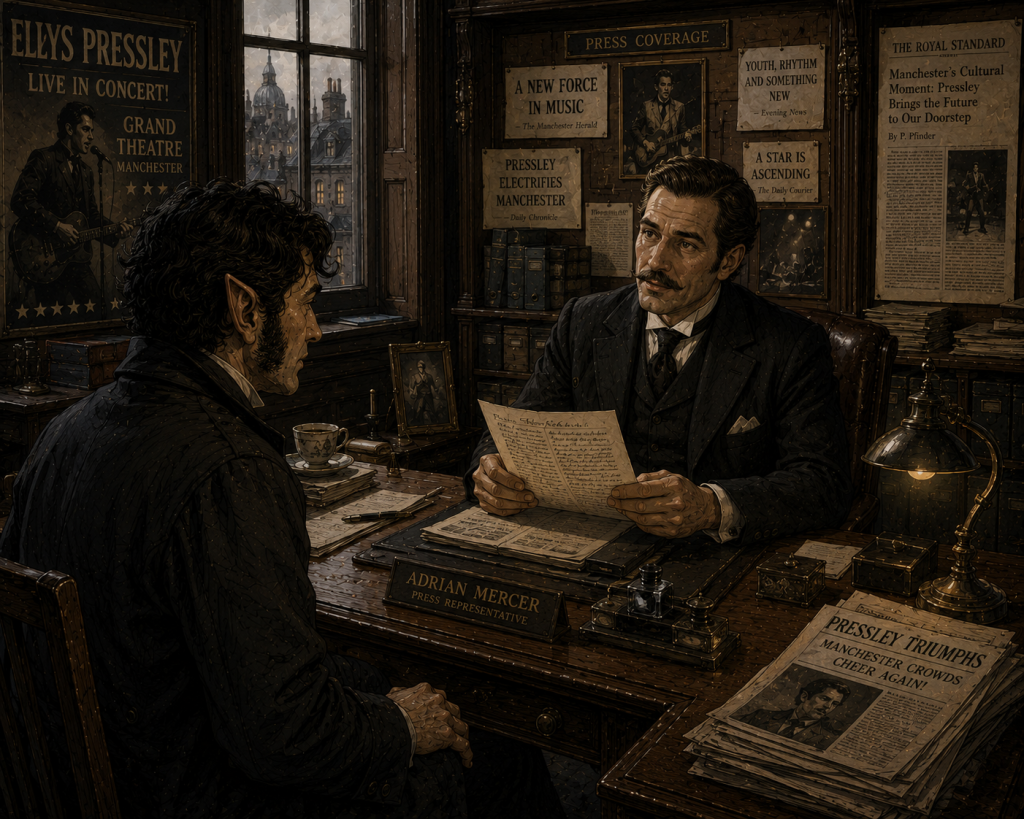
Mercer’s office was orderly without being sterile. Shelves bore newspaper clippings, letters, programs, and reviews. One entire wall had been devoted to Pressley’s recent press coverage and to Pfinder’s mild embarrassment, his own article occupied a prominent place among them.
Mercer noticed his glance.
“I hope you don’t mind,” he said.
“Not at all.”
“It was one of the first reviews that understood what Mr. Pressley is actually trying to do.”
Pfinder inclined his head modestly.
“That is gratifying to hear.”
Mercer gestured toward a comfortable chair.
“Now then…” He folded his hands. “…what seems to be the trouble?”
Pfinder hesitated only briefly. Everything about Mercer suggested a man who solved problems before other people knew they possessed them. His desk was tidy without being fussy. His notes were dated. Even the ink bottle sat square to the edge of the blotter. If one could not trust a press representative with an urgent warning, one might as well correspond by semaphore.
He withdrew the letter. “I’m afraid,” he began, “that what follows will sound profoundly unreasonable.”
Mercer smiled. “I work in entertainment, Mr. Pfinder.”
“Quite.”
Pfinder laid the letter carefully upon the desk. “Recently, several close acquaintances of mine uncovered an organization known as the Cult of the Unmaking…”
Mercer listened without interruption or skepticism. He asked intelligent question, clarified timelines, and requested spellings as he took notes. Twice asked Pfinder to repeat particular passages concerning the Rivets.
When Pfinder had finally finished, silence settled over the office. Mercer remained thoughtful for several moments and then nodded. “I see. I understand your concern and share it entirely.”
He reached for the letter, “May I?”
“Certainly.”
He read it carefully once. Then again. Finally, he looked up.
“Mr. Pfinder, thank you.” The sincerity in his voice was entirely genuine. “If even half of this proves accurate then you’ve done precisely the right thing by bringing it directly to us.”
“I confess I was uncertain whether anyone would believe me.”
Mercer smiled faintly. “My profession requires that I take improbable things seriously before they become tomorrow’s headlines.”
Pfinder laughed. “An admirable philosophy.”
“I’ll see that Mr. Pressley receives this personally.”
Relief washed over Pfinder.
“Excellent.”
Mercer stood.
“So that no misunderstandings arise, I should ask one favor.”
“Name it.”
“Until we’ve had an opportunity to investigate…” He chose his words carefully. “…please keep this matter confidential.”
“Naturally.”
“I shouldn’t want an unfounded rumor to cause unnecessary alarm.”
“Nor I.”
They shook hands. Mercer possessed the reassuring handshake of a man who could be trusted with both confidential correspondence and respectable silverware.
He escorted Pfinder back through the reception area. “Thank you again for coming directly to us.”
“The pleasure,” Pfinder replied, “is considerably greater if it prevents murder.”
Mercer smiled politely. “Nothing of the sort will happen. You have my word.”
Pfinder departed into the morning sunshine considerably encouraged. Perhaps, he reflected, civilization functioned rather better than cynicism allowed.
Behind him, the front door clicked shut.
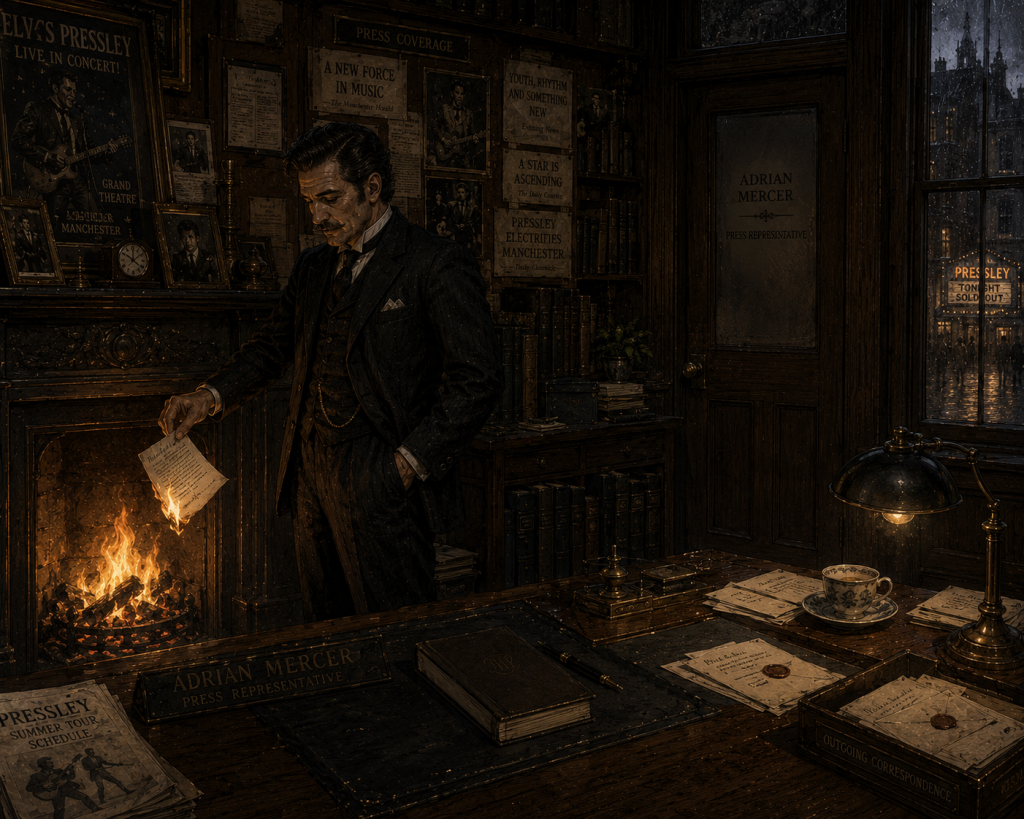
Mercer remained motionless until the sound of Pfinder’s footsteps had faded from the street below. The pleasant smile disappeared as he returned to his office and closed the door. He walked without haste to the fireplace where a small coal fire burned in recognition of the season.
For several seconds he regarded the folded letter resting in his hand. Then, with the same calm efficiency one might devote to filing a completed expense report, he dropped it into the flames. The paper curled almost immediately, ink blackened, and edges glowed orange.
Within moments the words Rivets, Cult, and Elvys Pressley had become drifting ash. Mercer watched until the last fragment vanished and then returned to his desk. He opened a locked drawer, removed a small leather notebook, turned to a blank page, and, in neat, disciplined handwriting he wrote Pfinder’s name and The Royal Standard.
Then he closed the notebook, rang for the secretary, and resumed the ordinary business of arranging interviews, answering correspondence, and helping make a famous man available to the public.
Between those responsibilities and the regrettable necessity of dealing with Mr. Pfinder, it promised to be a very full week.