January 23rd – 26th, 974
The battle was over, but there was very little time to savor the victory as the sounds of the rapidly approaching Crown relief force grew louder.
Of the twelve Ebon Blades who had waited beside that road to ambush Helen’s convoy, three were still alive.
For several moments, those three seemed almost incapable of understanding what had happened. Nine friends lay dead among the Crown soldiers. Men and women with whom they had planned the ambush, ridden the road, eaten breakfast, complained about the cold, and waited through the long hours for a convoy that might never come were simply gone.
But whatever else could be said of the Ebon Blades, they had prepared for the possibility that someday an operation would end like this one, and training supplied instructions when grief supplied none. One of the survivors, Margaret, recovered first and began snapping out orders to sanitize the battlefield.
The dead Blades carried little that could readily identify them, but weapons, personal effects, and anything else that might lead the Crown from a body to a name, and from a name to a village and a family, were collected. Useful equipment was taken. Nothing that might identify another member of the organization could be left behind.
There would be time later to discover what losing nine friends had done to the three survivors. For the moment, training gave them somewhere to put their hands and a sequence of necessary things to do. At Margaret’s direction, the heroes assisted.
Then came the part nobody wanted to do. There were nine dead Ebon Blades and not enough time to carry nine bodies away for proper and discreet burial.
The heads and hands were removed and carried with them.
Helen presented a simpler problem. The Crown had been imprisoning dangerous magic users for centuries, and the convoy had made use of the necessary equipment while transporting its prisoners. One set of its restraints now found a new owner.
Helen’s wrists were manacled. Rigid gloves enclosed her hands and fingers, making the movements required for spellcasting impossible. Anything that might serve as a focus or material component was taken from her. Finally, she was gagged.
Helen offered no resistance. She did not struggle. She did not threaten. She did not attempt some desperate final spell or make a futile attempt to escape.
She simply watched.
Carefully.
Then the Ebon Blades led everyone from the road in a hurried retreat. Healing magic was spent where necessary, not to make anyone comfortable but to make certain everyone could keep moving. The wounded walked. Those who could help the more badly wounded did so. The rescued prisoners came with them. Helen walked where she was directed.
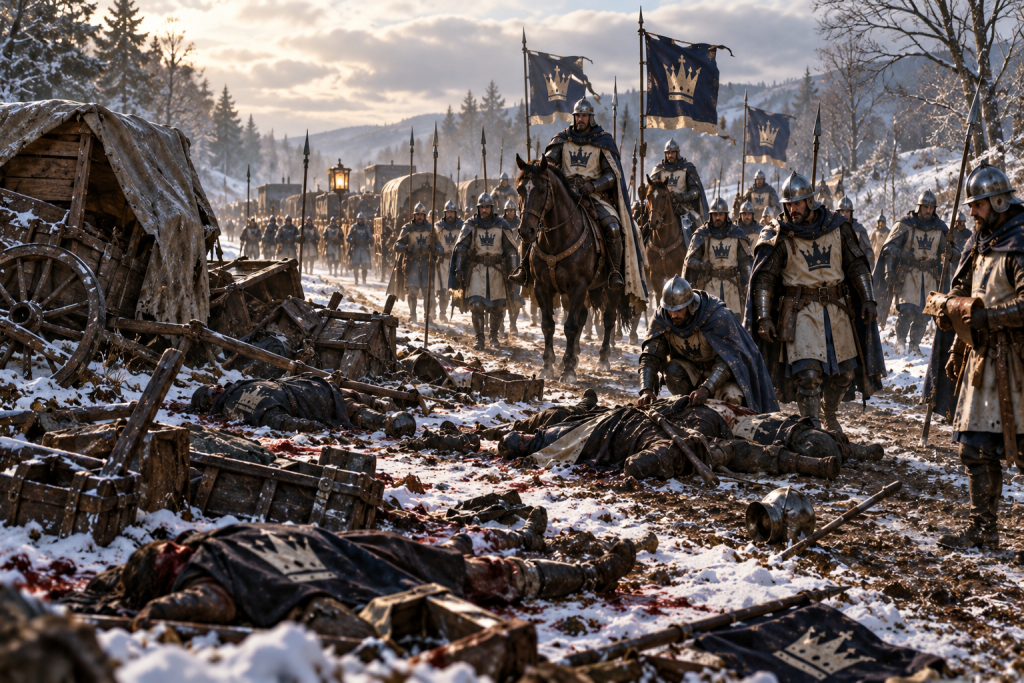
Behind them, the relief force from Manchester reached the battlefield and stopped. The soldiers found overturned wagons, dead Crown troops, dead Ebon Blades, scorched earth, abandoned equipment, blood, tracks, and the remains of a battle large enough that no competent officer was going to gallop blindly onward without first discovering what had happened.
That delay was enough.
By the time the first questions were being asked on the road, the fugitives were well away from it, headed toward an Ebon Blade safe house hidden off the road roughly halfway between Three Oaks and Barrow’s Edge.
There, at last, they found Barin and Phineas. The second Ebon Blade force had spent the day waiting beside the road between Barrow’s Edge and Dolven’s Hollow for a convoy that never arrived. Barin, Phineas, and the other ten had eventually withdrawn according to plan and made their own way to the safe house.
They had sent twelve friends to the other road and only three came back intact.
The rescue had mostly succeeded. More than half the prisoners—Oakbeard, Mossyrock, Laveleen, and the tribal Orc—were alive. Helen herself, the Crown agent who had led the convoy, had been taken prisoner.
But Tom, Judy, the other captured orc, and nine—nine—Ebon Blades were dead.
Of the twenty-four members the organization had committed to the operation, more than a third had been killed in a single afternoon, losses far heavier than the Ebon Blades had ever suffered before.
For the heroes, it had been a victory purchased without another death among their own company.
For the Ebon Blades, it felt rather different.
The first two days in the safe house passed quietly, but not peacefully. Once the immediate danger had receded, the discipline which had carried the Ebon Blades through the retreat began to fail them.
Grief took different forms. Some talked. Some did not. One found work whenever work could possibly be found and invented more when it could not. Another spent long periods staring at nothing. Tempers occasionally flared over matters which plainly had nothing to do with whatever argument had begun them.
Sleep came poorly.
There remained, moreover, one final duty to the dead. The heads and hands brought from the battlefield could not remain at the safe house, nor could they simply be buried intact. They were burned until nothing useful for identification remained, and the remnants were buried.
It was not the funeral the nine would have received in another life. There were no bodies to lay beneath the earth and no public gathering at which families could mourn them. There could be no marker bearing their names.
But their friends knew who lay there.
For the moment, that had to be enough.
There was also much to talk about. It had been some time since the heroes and the Ebon Blades had last had the leisure to compare what each knew, and a great deal had happened in the interval.
Over those first hours, Barin, Phineas, and the others heard the whole story. They heard the secrets that the Briarfell forest had held—the uncontacted Orcish tribe, the Cult of the Unmaking, and the saboteurs disrupting the business of the Circle of the Second Growth.
They then heard what had been discovered at Hollowmere: how an investigation into a missing woman had led them to an underground Orcish base, a desperate Crown search for the lost Sereth, and the collision between Crown and Reclamation which had brought an early beginning to a long-planned war.
They heard what the heroes had learned about Soulreaper and the forces now calling themselves the Reclamation, and how the Cambrian Compact had been manipulated into spearheading the opening of their war.
They heard about the return to Briarfell, about Helen, and about the betrayal which had ended with friends and allies loaded into Crown wagons. Finally, they heard how those wagons had ended up on a road outside Manchester surrounded by dead soldiers and dead Ebon Blades.
The Ebon Blades, in turn, spoke more plainly than they had before about what they hoped would come after all of this. While they might regard the Reclamation as natural allies against the Crown, they made it clear that any such alliance would be an uneasy one. They supported the Orcish desire to be free of Crown rule, but had no desire to see Crown rule over Archean Humans replaced by Orcish rule.
If the Orcs wanted independence, Barin and Phineas believed they should have it. Indeed, several of the Blades spoke with genuine anger about the Crown’s conquest of their lands and the treatment of Orcs since. What they did not want was the future the Reclamation appeared to offer: Humans and Orcs brought together beneath a new state born out of rebellion, necromancy, and war.
Their preferred answer was simpler: an Orcish nation in which Orcs governed Orcs, and a Human nation in which Humans governed Humans.
The two could trade. They could negotiate borders. They could make treaties concerning roads, rivers, migration, commerce, or common enemies. Perhaps, in time, they could even learn to be good neighbors.
But the longer the conversation went on, the clearer it became that there was more behind this vision than a principled belief in self-determination.
The Blades had spent their lives hearing that Orcs were violent, clannish, backward, and too accustomed to settling disputes with strength rather than law. Most were sophisticated enough to reject the Crown’s claim that these qualities justified conquest. They were rather less inclined to question whether the qualities themselves were true. More than one observed that Soulreaper’s armies, necromancers, and cult of an ancient war were hardly encouraging evidence that five centuries had transformed Orcish political habits.
They believed the Crown had committed a historic injustice against the Orcs.
They also believed, with remarkably little sense of contradiction, that Humans would be fools to let Orcs govern them.
The surviving tribal Orc sat through some of these conversations without understanding a word of Common.
Laveleen understood every word.
From time to time she looked at him, then back at Barin or Phineas, with the expression of someone beginning to contemplate the considerable diplomatic challenge of deciding exactly how much of this she intended to translate later.
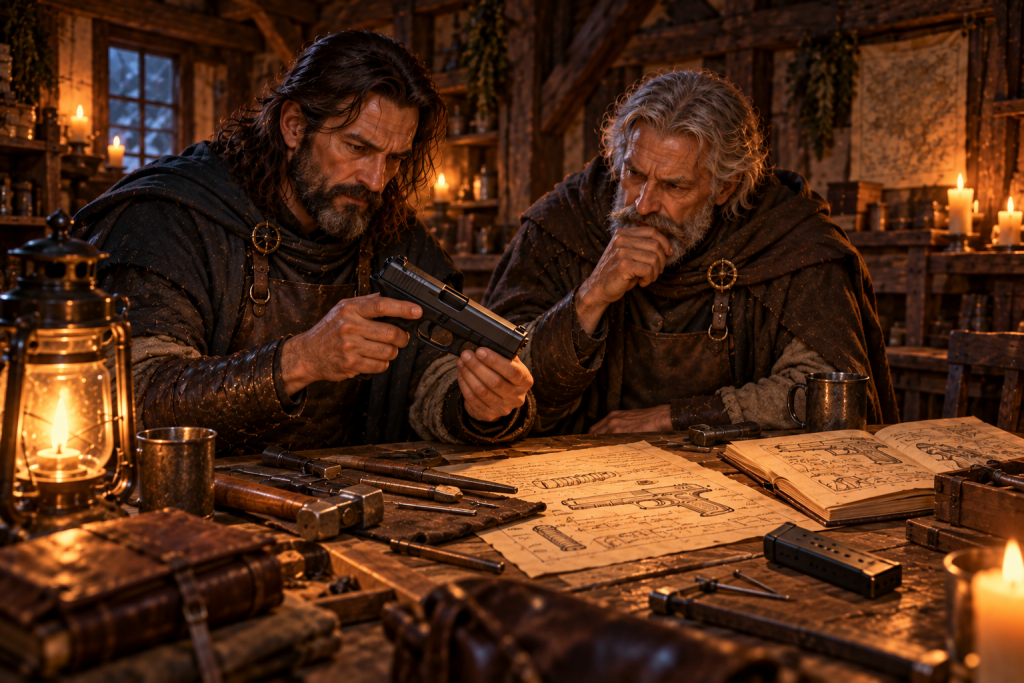
One part of the heroes’ account interested Barin and Phineas for another reason.
While the Forest Rangers were all dead, their belongings remained.
The strange weapons, devices, tools, and other objects brought from their distant home had already been curiosities when the Rangers were alive to explain them. With George, Tom, and Judy now dead, they had become something else as well: fragments of knowledge for which no teacher remained.
Barin’s interest was immediate.
He was a blacksmith. He did not pretend that looking at an unfamiliar object meant he could reproduce it, and some of what the heroes described seemed to depend upon principles he did not understand at all. But he understood what it meant for someone, somewhere, to have solved a problem.
A weapon that hurled a small piece of metal with lethal force without magic meant that such a thing could be done.
A device that allowed two people separated by miles to speak to one another without magic meant that such a thing could be done.
Lights without flame. Materials unlike those made by Archean craftsmen. Tools designed for purposes nobody present yet understood.
Barin did not look at these things as souvenirs.
He looked at them as ideas.
Phineas’s interest was less technical and no less intense. The Crown possessed soldiers, money, institutions, magical expertise, workshops, roads, messengers, and centuries of accumulated knowledge. The Ebon Blades had secrecy, sympathizers, and whatever advantages they could create for themselves.
If the Forest Rangers had brought knowledge from a place where people had learned to accomplish extraordinary things without magic, then even a fraction of that knowledge might matter.
Neither man suggested simply taking the Rangers’ possessions. Tom and Judy had died only hours earlier, and whatever else the objects might become, they had belonged to people.
But Barin and Phineas made no secret of their hope that, when the time came to examine what the Rangers had left behind, they would be permitted to participate.
A copied mechanism, a newly understood principle, a technique adapted to Archean materials—anything that could be reproduced without the Crown’s magical institutions might someday be bent to the cause.
News from outside arrived despite the isolation. The Ebon Blades had couriers, sympathizers, hidden routes, and the considerable advantage that most people walking down a road did not look like members of a clandestine revolutionary organization.
On the second day, one such courier brought Barin two documents.
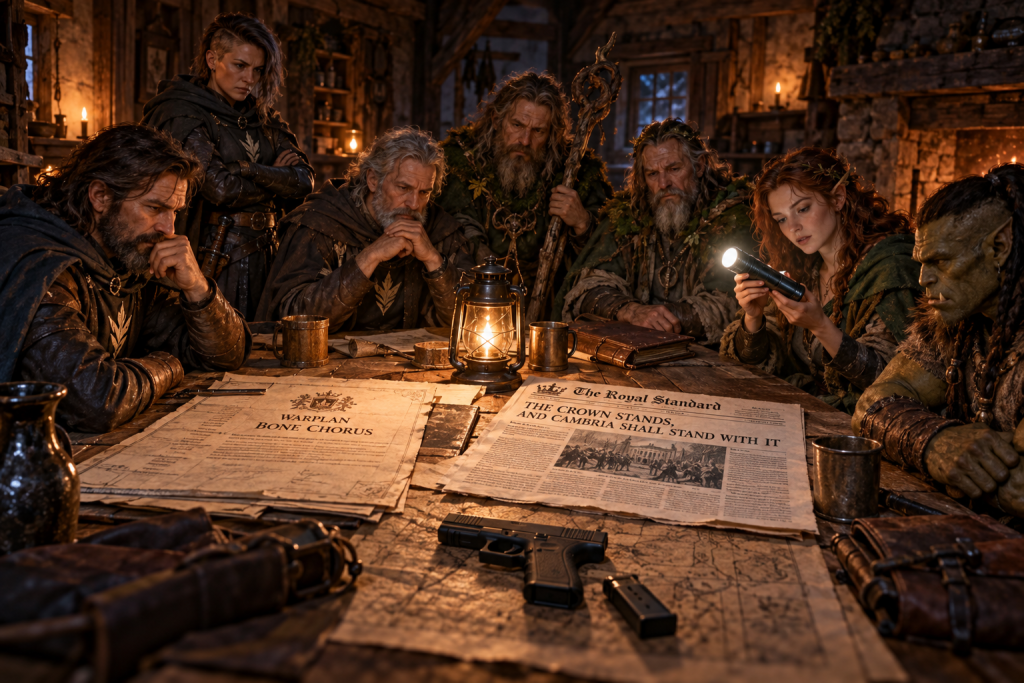
The first had been stolen from the Crown and was an introductory summary of an old Crown contingency plan for organized necromantic warfare—prepared from the lessons of the Righteous War, revised in later centuries, and now very plainly being put into effect.
The heroes recognized its name. Warplan Bone Chorus had first been mentioned to them by Balreth Korn at Fort Arcardia, back in Session 17. Now, for the first time, they had part of the plan itself in their hands.
It made sobering reading.
The Crown had thought about this before. It had thought about armies of animated dead, about cemeteries and battlefields, about magical countermeasures, about the disposal of bodies, about roads and refugees and requisitions and the mobilization of civilian labor.
What had seemed in Hollowmere like the beginning of something unprecedented had, somewhere in the files of the Crown, a plan waiting for it.
The second document was considerably less secret – the latest copy of The Royal Standard.
Its editorial proclaimed, THE CROWN STANDS, AND CAMBRIA SHALL STAND WITH IT.
The article described a province beset on every side. The Cambrian Compact was in rebellion. The so-called Reclamation had spread beyond Hollowmere. Plague continued in the west. The Druid of the Sewers remained a threat beneath Manchester. Devon was calling up reserves in the north. The Ebon Blades themselves were now sufficiently notorious to earn condemnation in the pages of the Standard. Economic unrest continued elsewhere in the Kingdom.
But the newspaper’s principal message was not one of despair. It promised eventual triumph, because reinforcements were coming. Troops, money, horses, supplies, engineers, healers, magical personnel, and the resources of the wider Kingdom were being directed toward Cambria.
The secret document and the public newspaper differed considerably in tone, but their message was much the same. The Crown might have been caught utterly by surprise, but it had a plan, was mobilizing to execute that plan, and was far from being out of the fight.
Still worse, the Crown was looking for them specifically.
Reports remained fragmentary, but the pattern was already clear. Soldiers appeared on roads where soldiers had not been before. Travelers were questioned. Descriptions circulated. Inns received visits from Crown officers. Patrols became more frequent.
No one needed much imagination to understand why. The elite cleric and rogue had escaped the ambush, and sooner or later they must have reached the relief force from Manchester and told its officers what had happened.
The Crown therefore knew that Helen had been captured, that the prisoners from Briarfell had been freed, and how much importance Helen had attached to those prisoners. It also knew that the adventurers and their clandestine allies from the area had been involved.
For now, the safe house remained safe. No patrol had come close enough to suggest that its location was known. No courier reported that the Crown had found the trail.
But somewhere beyond the walls, people were looking.
Helen appeared to understand this as well as anyone. For two days she remained in the Crown’s restraints. She cooperated when moved. She ate and drank when permitted. She slept when she could.
And she watched.
Carefully.
Oakbeard, Mossyrock, Laveleen, and the surviving tribal Orc had plans of their own.
They were willing to remain at the safe house while the immediate search subsided. Two weeks had been proposed, and none of them was eager to test the Crown’s roadblocks before then. Afterward, however, they intended to return to Briarfell by traveling cross-country, avoiding settlements, Crown patrols, and uncomfortable questions about their Orcish companion as much as possible until they were home.
For now, though, they remained with the others.
Which meant that on the morning of the third day, almost everyone with a stake in what happened next was gathered beneath the same roof.
There were no bodies left to dispose of, no wounded requiring immediate help, no report that the Crown had found the safe house, and no additional concealment measures demanding immediate attention.
For the first time since Briarfell, there was nothing that absolutely had to be done immediately.
There were, however, a great many things that had to be decided.
Helen remained downstairs, bound and gagged in her own government’s restraints. Barin, Phineas, Margaret, Oakbeard, Mossyrock, Laveleen, and the tribal Orc were waiting at the table. On that table lay a stolen Crown war plan and a copy of The Royal Standard.
And scattered throughout the safe house were the strange artifacts of three dead Forest Rangers, objects Barin and Phineas were very interested in discussing.
Outside, the Kingdom was prosecuting a war.
Inside, for the first time in days, there was time to think.
It was time to decide what came next.