January 23rd – 28th, 974
Previously in Archea…
The rescue outside Dolven’s Hollow had succeeded.
It had also been expensive.
Twenty-four Ebon Blades had taken part in the operation, divided between two possible ambush sites. The Crown convoy chose one, and nine of the twelve Blades waiting there died. The other ambush force, which included Barin and Phineas, never saw the enemy at all.
The heroes nevertheless accomplished part of what they had come to do. Oakbeard, Mossyrock, Laveleen, and one of the two tribal Orcs were rescued. Helen was captured alive. The Crown’s surviving rogue and cleric escaped, and somewhere behind the party a relief force from Manchester was already advancing toward the wreckage.
Not everyone survived the rescue. Tom and Judy, the two remaining Forest Rangers, were dead, along with the second tribal Orc. Their deaths had been particularly troubling. The Crown had been willing to transport the Rangers as prisoners while it still controlled them, but when rescue became likely, Tom and Judy suddenly became people the Crown could not afford to surrender.
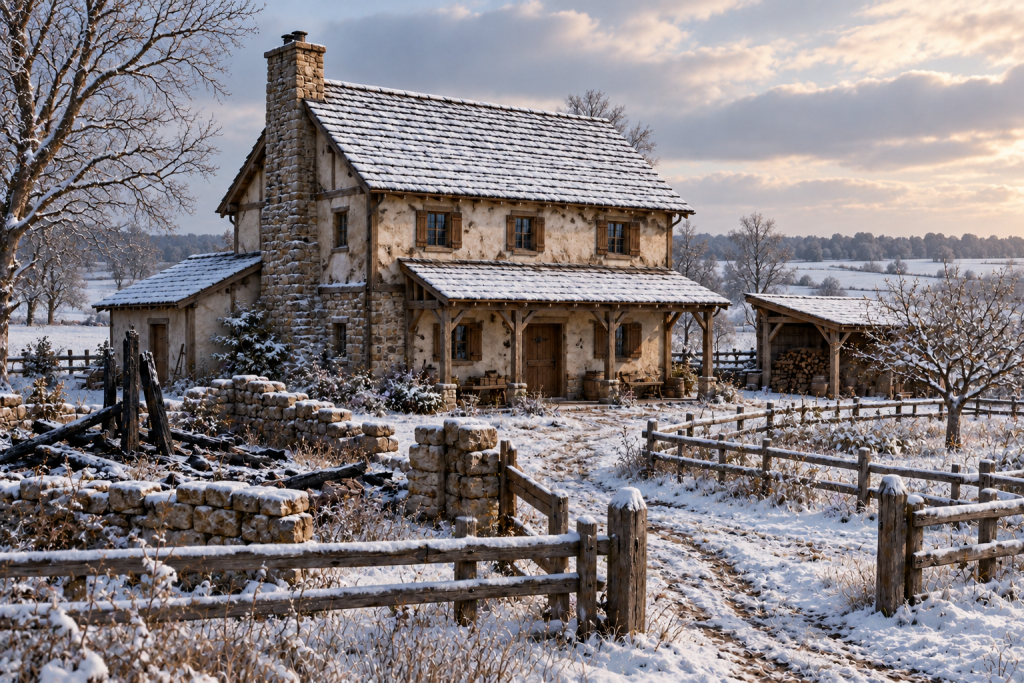
There had been no time to linger over any of this. The survivors withdrew cross-country some 25 miles to an Ebon Blade safe house near the village of Saint Mercy. The safe house was an isolated farmhouse which, according to local knowledge, had burned after a lightning strike ten years earlier.
Local knowledge was somewhat out of date thanks to the subsequent clandestine reconstruction efforts of the Saint Mercy cell of Ebon Blades.
There they reunited with Barin, Phineas, and the ten Ebon Blades from the unused ambush site. Together with the three survivors of the battle, fifteen Blades remained from the original twenty-four.
The farmhouse was intended to give everyone roughly two weeks to lie low, recover, and decide what came next.
For several of the rescued prisoners, the answer was already fairly clear.
Oakbeard and Mossyrock intended to return to Briarfell, taking the surviving tribal Orc with them. They would travel cross-country rather than use the roads. Archea had a long standing policy of converting tribal Orcs into enslaved ones and no one present wanted to see that policy put into action again.
Once safely back in Briarfell, Oakbeard and Mossyrock could return to the Circle and the Orc could continue the search for the rest of his scattered tribe.
Laveleen also intended to return to Briarfell, although her plans extended considerably farther.
Shortly before the battle at the Root Nexus, her patron had abruptly instructed her to leave that battle in the competent hands of the heroes. Its priorities, by contrast, was to have Laveleen reassemble the scattered Orcish tribe so that more could be learned from them.
Mukden’s death had made that task more difficult, but it had not made it disappear. Laveleen could still speak with the surviving Orc, help locate the others, and make arrangements for continued learning.
After that, however, her patron wanted her somewhere else entirely.
West.
There was a plague there, and Laveleen had been instructed to investigate its origins.
Find where it began. Find the first.
So, unless circumstances intervened, the two weeks at Saint Mercy were likely to mark the end of Laveleen’s time travelling with the heroes.
The nine who had died presented a more immediate problem. Their bodies could not safely be carried away, but neither could they be left behind for the Crown to identify. Their heads and hands were removed and carried on the retreat. At the safe house, those remains were burned beyond recognition and buried.
It was an ugly precaution.
There had been quite a few of those lately.
The party itself was temporarily incomplete. Ant was still on the road to Gozneth, carrying Gareth’s possessions home to his family. Cassyndra, suffering from what might reasonably be called divination sickness, had largely retired to bed upon arrival at the safe house. Wolfgang spent much of his time outside with the Ebon Blades, helping arrange watches and keeping an eye on the countryside.
That left the others with a prisoner.
Helen remained downstairs in Crown anti-mage restraints: manacled, deprived of her magical focus and components, and prevented from easily speaking or casting. She had already made one thing quite clear when Laveleen probed her thoughts.
Her first priority was still the same one she had possessed before her capture – Learn everything she could. Escape. Report back to the Crown.
And there was quite a lot in that farmhouse that the Crown would very much like to know.
Grelda, Getty, and the Lucid Dreams
While the heroes had been enjoying the Reclamation’s protective custody back in Hollowmere, Cassyndra had received a message from Grelda, “Return to Dolven’s Hollow as soon as you can. They’re ready.”
Now Barin had another message from her. Grelda was doing well, he reported, and had again asked that the heroes return to Dolven’s Hollow as soon as possible. Apparently, the lucid dreams were ready.
Barin had naturally asked what the lucid dreams were and Grelda had told him that he wouldn’t understand. Privately admitting that this was very likely, Barin had opted not to push the matter any further.
Cassyndra, however, had some news of her own concerning Grelda.
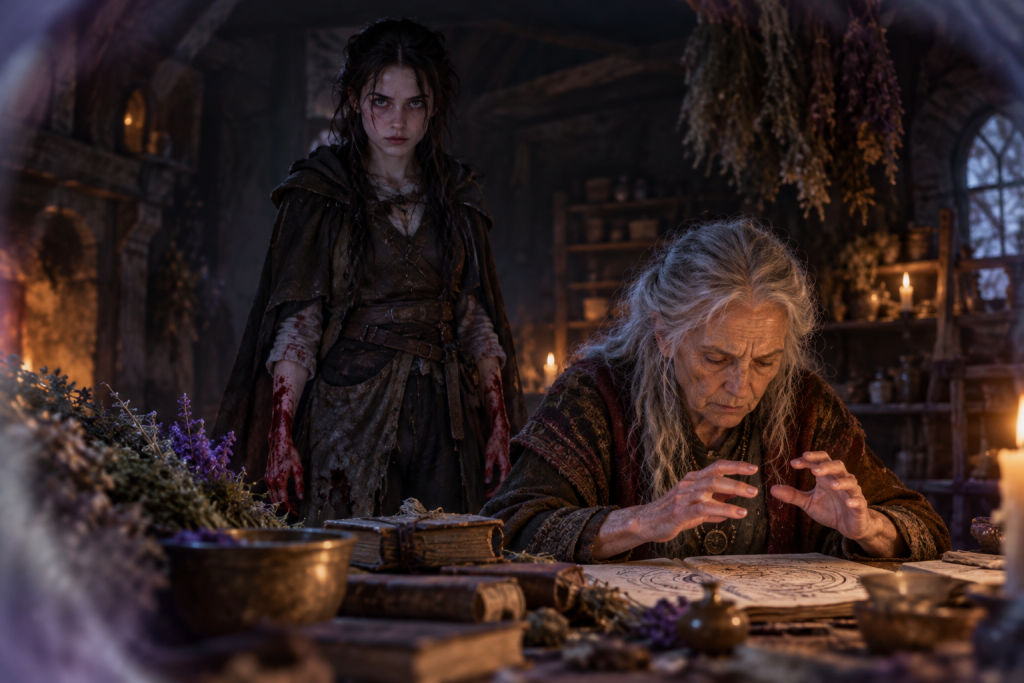
During one of her recent divinations, Cassyndra had seen the old woman seated at a table in Dolven’s Hollow, concentrating so intently on her own magic that she seemed oblivious to everything around her.
Then a young woman appeared behind her.
She was perhaps twenty years old, pale, dressed in dark and travel-stained clothing. There was blood on her hands and wrists.
Grelda did not seem to notice her but the young woman noticed Cassyndra. She turned and looked directly at her—not at Grelda, not merely out into the room, but through the divination itself.
“Who are you?”
Cassyndra knew better than to answer and tried not to. Despite this, she heard herself say, “Cassyndra. Who are you?”
“I’m Getty.”
That name needed no explanation. The entire party knew the story Shamus had carried with him since childhood: the creature that had murdered his parents, taken his younger sister, and left Shamus alive to remember it.
Getty had been that little girl.
She wasn’t little anymore.
“And I’m coming for you.”
Then the vision ended.
Grelda, so far as anyone knew, remained perfectly well. Barin’s message gave no indication that anything unusual had happened to her at all.
Cassyndra’s cards offered little comfort. The Tower had appeared first: upheaval, the collapse of an old understanding, destructive revelation, irreversible change.
Not necessarily death.
Which, under the circumstances, was about as reassuring as divination was prepared to be.
Interrogations and Executions
There remained the question of what to do with Helen.
Keeping her prisoner indefinitely was not practical. Releasing her was unthinkable. Barin raised the possibility of offering her back to the Crown in exchange for captured Ebon Blades, but arranging such an exchange would itself create another opportunity for the Crown to find them.
Nobody particularly liked the remaining alternative.
Nobody had a particularly good alternative to it either.
Helen would eventually have to die.
Questions First
Laveleen was quite prepared to skip directly to torture but the others were not.
There was no reason, Merrythought argued, to begin by hurting Helen when they had not yet established what she might willingly tell them. They could question her first. If ordinary interrogation failed, more unpleasant methods remained available later.
And Laveleen possessed a subtler tool in the meantime.
Detect Thoughts offered a way to check Helen’s answers without immediately resorting to violence. It was not foolproof. Helen was clearly a very intelligent Crown servant, knew full well that her captors had magic available, and had every reason to assume that some form of magical interrogation might be taking place. The heroes therefore considered the possibility that a sufficiently disciplined agent might control not merely what she said but what she allowed herself to think.
Nevertheless, the results were striking. Again and again, Laveleen found no surface evidence that Helen was lying.
On those occasions when she managed to probe more deeply, what she found also appeared consistent with Helen’s answers. Helen might omit things. She might refuse to answer – and did so when it came to the nature of her mission in the Briarfell forest.
Throughout almost the entire interrogation, however, when Helen actually answered a question, every indication available to Laveleen suggested that she was telling the truth.
That made some of her answers considerably more interesting.
A War Helen Hadn’t Known About
Helen claimed that when she first arrived in Briarfell, she had no idea there was a war going on.
At first this seemed difficult to believe. But Laveleen’s magic found no deception, and Helen’s account fit something the heroes themselves remembered.
It had been Heward who first told her.
When the Crown had begun asking questions about Mukden—an Orc who was plainly neither a Crown slave nor one of the isolated tribal Orcs—the conversation had turned to what he was doing there. Heward had remarked that, whatever Mukden’s business was, it was unlikely to be anything good considering the war.
That had obliged the heroes to explain that there was, in fact, a war.
Afterward Helen had checked what she was hearing against other sources. Oakbeard and Mossyrock confirmed the broad outlines. Villagers along the road were telling versions of the same story: Orcs, goblins and hobgoblins coming out of Hollowmere, undead, fighting, and the mysterious Cambrian Compact attacking the Crown.
The details were confused, but the central fact was not. There was a war underway, and Helen had stumbled into it in the middle of an entirely different mission. That new information had forced her to rethink almost everything.
Most importantly, it had changed the significance of Tom, Judy and George.
Why the Forest Rangers Had to Die
Helen admitted that getting the Forest Rangers into Crown hands would have been an extraordinary prize even in peacetime.
Once she learned there was a war, it became something still more urgent.
The Rangers came from another world. They possessed knowledge and perspectives that did not exist in Archea. Helen had seen clothing made from materials she could not identify and equipment whose principles she could not begin to understand. Even the things the Rangers took for granted suggested entire bodies of knowledge that Archea did not possess.
Helen had questioned them, although she believed she lacked the background necessary to ask the right questions. Tom and Judy had explained some basics about their organization and equipment, but they had been cautious and guarded. There were clearly things they knew that they were unwilling—or perhaps unable—to explain in a useful way.
Helen had been willing to be patient.
Her plan was to get them to Manchester and into the hands of people better equipped to interrogate them properly.
The Rangers had also spoken about the organization they belonged to and the forest they protected in their own world. Helen was struck by their conception of stewardship: they regarded the forest not simply as a resource to be exploited but as something to be preserved and passed on to future generations. It was an outlook she found distinctly foreign.
They had also been allowed to speak with the other prisoners, under observation. Their conversations with the druids and Orcs had often returned to forests and their care, although the Rangers and druids approached the subject from rather different directions.
None of that, however, was why Tom and Judy died.
Once Helen knew that Archea was at war, she regarded the Rangers’ knowledge as potentially war-changing.
While they remained Crown prisoners, that knowledge represented a possible strategic advantage for the Crown. When the ambush made it apparent that they were about to be freed, the same knowledge became a strategic advantage that might fall into somebody else’s hands.
Helen would have preferred to bring them to Manchester.
But she could not allow them to be fall into someone else’s hands.
So Tom and Judy had been killed.
Sister Eliria and Heward
The questioning then turned to two other people who had elected to work with Helen, Sister Eliria and Heward.
Helen said that they had been captured by General Sherman before she was. They had admitted to her that they were not what they appeared to be and that they had their own reason for operating in Briarfell Forest. They were willing to cooperate with Helen and the Crown contingent because doing so gave them the security and force they needed to accomplish their own mission.
Helen did not know what that mission was.
More precisely, she had been told not to ask.
But she did know when it ended because at some point, Eliria and Heward learned that General Sherman was dead and they were quite pleased. Almost immediately afterward, they announced that their business was finished and left.
Merrythought put those facts together with something else the heroes knew – the Cult of the Unmaking had been previously operating in the Briarfell area with the intent of killing General Sherman.
Helen herself appeared genuinely unfamiliar with the name. When Merrythought deliberately began feeding her suggestions about the Cult, Laveleen probed more deeply and found Helen intensely interested—not because she recognized the organization, but because she was trying to work out what Merrythought was talking about and whether this was useful new intelligence she could someday report to the Crown.
That, in itself, was useful information.
Helen had arrived after Eliria and Heward. The two had concealed their identities. They had a secret mission in Briarfell Forest. They needed armed protection while carrying it out. They departed as soon as they learned General Sherman was dead.
The inference seemed difficult to avoid.
Sister Eliria and Heward had been members of the Cult of the Unmaking, and their mission had been to finish the job the Cult had previously started and kill General Sherman.
Helen could shed no light on what connection, if any, existed between the Cult and Soulreaper. According to her, Eliria and Heward had never mentioned Soulreaper at all.
The Spy
Eventually Calder asked Helen directly what sort of work she did for the Crown.
Her answer was refreshingly uncomplicated. “I’m a spy.”
She had been one for years. And the longer the questioning continued, the easier that was to believe.
Helen did not simply sit there answering questions. She listened. She made deductions. She offered hypotheses and watched how her interrogators reacted to them. She tried to determine who they were, what they knew, how they were connected to Mukden and the Reclamation, and what information they possessed that the Crown did not.
Merrythought eventually realized that this was not really an interrogation at all.
It was a cross-interrogation.
Helen was questioning them every bit as much as they were questioning her.
Helen’s Other Mission
That still left a rather important mystery. If Helen had known nothing about the war when she arrived in Briarfell, then why had a Crown spy been there in the first place?
Helen would say only that she had been completing an unrelated mission and was waiting in Briarfell Forest to be picked up by her comrades. As for what that mission might have been, all she would say was that it had already ended and she was awaiting retrieval.
Merrythought pointed out that this was precisely the sort of information they needed before deciding what could safely be allowed to return to the Crown. If Helen’s original mission concerned something harmless to them, there was less reason to worry. If it concerned something dangerous, letting that information reach the Crown might be disastrous.
Helen still refused.
She did offer one important assurance – her original mission had nothing to do with Briarfell, the Cult of the Unmaking, Soulreaper, the Reclamation, or the outbreak of war. All of those things had been unexpected complications encountered while she was waiting to be retrieved.
Detect Thoughts again produced no obvious evidence that she was lying. Whatever Helen had originally been doing, the heroes never discovered it.
Then they asked about Colonel Varnes.
The First Lie
Helen said she didn’t know who he was.
Merrythought didn’t believe her.
Helen had been a Crown spy for roughly a decade. Varnes had been a Crown colonel and had continued operating within the Crown even while secretly working with Soulreaper. It strained belief that someone in Helen’s profession had simply never heard his name.
And there was another reason the answer stood out.
Merrythought had believed Helen through almost everything else.
The strange account of arriving without knowing about the war had checked out. Laveleen’s magic had repeatedly supported Helen’s answers. Even when Helen refused to reveal her original mission, she had generally done so openly rather than inventing a story.
Now, suddenly, she claimed never to have heard of Varnes.
Merrythought pressed and Helen retreated slightly. Perhaps somebody else had been assigned to matters involving Varnes. Her own work did not have much to do with that side of Crown operations.
Merrythought kept pressing.
Finally Helen conceded that, if Merrythought insisted, she could at least say that Colonel Varnes was a colonel in the Crown army.
It was the first point in the entire interrogation where Merrythought felt they had genuinely caught her. Helen had wobbled and started to give ground. They might finally have found a subject she was trying to conceal.
Laveleen telepathically told Hunkle to snap Helen’s neck.
When Hunkle did nothing, Laveleen drew a knife and drove it into Helen’s throat.
Helen died almost immediately.
The interrogation was over.
What the Hell, Laveleen?
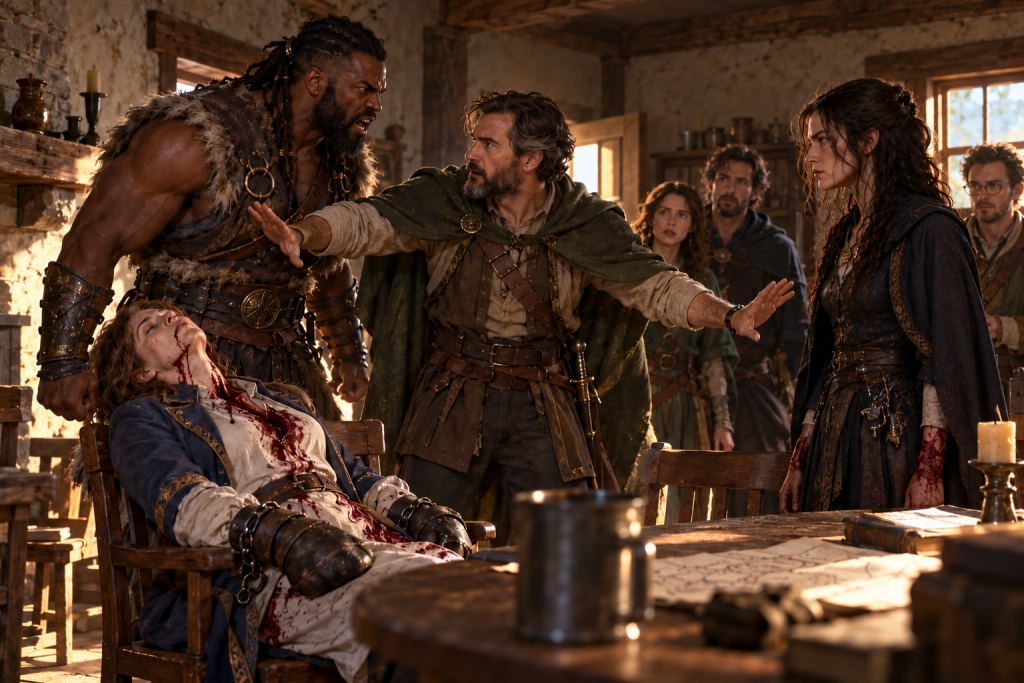
For a moment, nobody seemed entirely certain what had just happened.
Then Hunkle turned toward Laveleen with maul raised. “The fuck?”
Barin immediately stepped between tempers before the situation could deteriorate any further.
The problem was not simply that Laveleen had killed Helen. The heroes had already concluded that Helen could not be allowed to leave the farmhouse alive.
The problem was when Laveleen had killed her.
For most of the interrogation, Helen had appeared to be telling the truth. She had provided useful information about her motivations for handling the Forest Rangers the way she did, the identities of Sister Eliria and Heward, and what she felt the best interests of the Crown were. When asked about things she did not wish to divulge, she generally refused to answer rather than lie.
Then they had asked about Varnes.
For the first time, Merrythought thought they had caught Helen lying. When challenged, Helen had begun to retreat from her original denial. Merrythought thought she was finally getting somewhere. And at precisely that moment, Laveleen killed her.
Merrythought wanted to know why.
Unfortunately, Laveleen’s answers did not particularly help.
The interrogation had gone on too long.
They weren’t getting anything useful.
Helen was too dangerous to be allowed to keep talking.
And, at another point, Laveleen was simply sick of the whole thing. It had become boring.
Merrythought found the explanations increasingly difficult to reconcile. If Helen had been too dangerous to question, they should never have ungagged her in the first place. If the interrogation was producing nothing, why kill her at the exact moment she appeared to have been caught in her first real lie?
Laveleen countered that Helen was a powerful bard and that merely allowing her to speak was dangerous.
Merrythought acknowledged the point but disagreed with the conclusion. Helen had been giving them information. She had also been interrogating them at the same time, but that was a risk they had knowingly accepted when they began.
Hunkle had a more personal complaint. “I didn’t get my pound of flesh. You took it from me.”
He was not joking entirely.
Calder’s reaction was more measured. He agreed that they might not have gotten much more from Helen and was not convinced that continuing indefinitely would have accomplished anything. But he had not favored killing her when Laveleen did. Helen might still have possessed long-term intelligence value, and he was disturbed that Laveleen had made the decision unilaterally.
That was the point that began to turn an argument about Helen into an argument about Laveleen.
Was her timing merely impulsive?
Or did it mean something?
Merrythought could not answer that question.
She wondered aloud whether Laveleen might somehow be working for the Crown. Perhaps she had killed Helen specifically to prevent the heroes from learning something about Varnes. Perhaps her patron had ordered it. Perhaps there was some other explanation they had not considered.
But suspicion was not proof.
Barin had Laveleen leave the room with one of the Ebon Blades while the others discussed what to do.
What to Do with Laveleen
Although Merrythought was willing to consider killing Laveleen for denying the party critical information, she admitted reluctance to going that far in actuality. The evidence simply wasn’t there. Laveleen had done something rash, suspicious, and infuriating. That did not mean that she had betrayed them.
Calder was firmly against killing her. He saw Laveleen’s decision as hasty and ill-considered, but he was not convinced there had been any malign intent behind it.
Zborch agreed that she should live, for a somewhat different reason.
As Zborch saw it, Laveleen did not particularly want to remain with the party anyway. She had her own interests, her own patron and her own things she wanted to learn. She wanted to pursue knowledge about the Orcs and then move on. If the party wanted her elsewhere and Laveleen wanted to be elsewhere, there was an obvious solution.
Send her elsewhere.
Zborch thought that if they simply released her, they might never see her again.
Hunkle took the opposite position. As far as he was concerned, Laveleen could die. That initially left Merrythought uncertain between the two positions.
Then she asked Barin.
Barin’s Argument
Barin did not claim that Laveleen was a Crown agent nor did he claim that her patron had ordered Helen’s death. In fact, he did not claim to know why she had done it at all.
Instead, he changed the subject.
The heroes were no longer simply a band of adventurers who could allow companions to wander off whenever they chose. They were working with a clandestine organization fighting a ruthless Crown.
They were an insurgency.
And Laveleen knew an enormous amount.
She knew about the heroes. She knew about the Ebon Blades. She knew what they had been doing and who they had been working with. She knew about the Reclamation, Mukden, Hollowmere, the Forest Rangers and the people now gathered at the safe house.
Ideally, Barin said, someone like Laveleen would simply never have been read into that many secrets.
But she already had been and they could never undo that.
And that led to Barin’s real concern. Laveleen did not keep her mouth shut and she acted erratically.
Whether she had intended to help the Crown or not, her decision to kill Helen had potentially served the Crown’s interests by destroying a source of intelligence just as the heroes appeared to be learning something important.
She could make another decision like that in the future.
Then there was her patron.
Nobody really understood what Laveleen’s patron was, what it ultimately wanted, or what obligations Laveleen owed it. Even Laveleen had described the relationship principally in terms of its hunger for knowledge.
To Barin, that meant divided loyalty of an unknowable kind.
Speaking, as he put it, as the ruthless head of an insurgency, that mattered.
Calder pushed back.
There was still no proof that Laveleen had intended any harm. Her action might have been foolish, hasty and badly thought through rather than treacherous.
Barin agreed.
That did not change his conclusion.
Malign or hasty, she was still a liability.
Intent mattered less than what her behavior predicted about what she might do next.
Zborch continued to argue that the solution to that problem was simply to let her leave. Laveleen did not care about their war enough to betray them deliberately. She wanted to pursue her own interests. Once gone, she would probably keep going.
Merrythought conceded part of the point. She did not regard Laveleen as being as dangerous as Helen. But neither did she believe that releasing Laveleen meant they would cease to feel the consequences of whatever Laveleen did next.
And Laveleen’s behavior after Helen’s death had changed Merrythought’s assessment of her. It wasn’t only the killing itself. When challenged, Laveleen had moved among several explanations—boredom, wasted time, danger, lack of useful information—without giving Merrythought an answer that made the decision make sense.
Perhaps there was an innocent explanation.
Perhaps there wasn’t.
Either way, Merrythought no longer trusted what Laveleen might do next.
Barin’s argument had changed her vote.
The Decision
The division was now clear.
Hunkle believed Laveleen should die.
Merrythought, reluctantly, came to agree.
Calder opposed killing her. He believed she had acted hastily and foolishly, but he did not believe they had established malign intent.
Zborch also opposed killing her. His answer remained the simplest – let Laveleen go and allow her to pursue whatever interested her elsewhere.
Barin sided with Hunkle and Merrythought. He did not want to kill Laveleen. But he believed allowing her to walk away with everything she knew represented too great a danger to the Ebon Blades and to everyone associated with them.
The result was effectively three to two. Calder and Zborch did not change their mind but both made it clear that they did not intend to fight the others over the decision.
Merrythought acknowledged their opposition rather than dismissing it. She was, she said, “ambivalent and sad” about what they had decided. Calder and Zborch would not be asked to participate, and their unwillingness to do so was to their credit.
Zborch still thought they were making a mistake. If they released Laveleen, he believed they would probably never see her again.
Merrythought suspected that was true. “No, I probably won’t see her again. But I will feel her effects.”
Barin took responsibility for what came next.
He asked the heroes to wait upstairs and then he left. Soon afterwards there was a scream and thump from downstairs. Then silence. When Barin returned, Laveleen was dead. He did not disclose the details and the party did not ask.
There were, he said, traces downstairs that needed to be dealt with. Dinner would be brought upstairs and the party was encouraged to remain there for the time being.
Afterward
Calder remained troubled by the decision.
From his perspective, the events of the evening had cost them two potentially valuable assets: Helen, an enemy intelligence officer who knew things they badly wanted to know, and Laveleen, someone who had travelled with them for months and might still have been useful in the future.
The others disagreed about Laveleen.
Merrythought no longer regarded her as an asset at all. Laveleen had already intended to go her own way, and her patron represented an additional source of uncertainty. Killing her had not deprived the party of someone who was going to continue adventuring beside them.
It had removed a risk.
Hunkle’s objection was more fundamental.
Was Laveleen still an ally after what she had done?
That, ultimately, was the question on which the disagreement turned.
A few minutes earlier, Helen had died because everyone agreed that someone who knew that much and could not be trusted with the knowledge could never be allowed to walk away.
Now Laveleen was dead too. And for much the same reason.
What Comes Next
Wolfgang eventually came back inside, wondering how the interrogation had gone.
Quite a lot had happened while he was outside. Helen was dead. And so was Laveleen.
Once Wolfgang had finished processing the rather dramatic reduction in the farmhouse’s population, he had some news of his own.
While helping the Ebon Blades watch the surrounding countryside, he had noticed ravens.
Ordinarily there was nothing particularly remarkable about ravens. But these ravens turned out to be quite remarkable. They were not a kind he would normally expect to see in the area, and they seemed to be travelling rather than foraging. One had flown from the southeast toward the northwest. Later another travelled in the opposite direction. Wolfgang had seen several of them moving back and forth along roughly the same line, separated by hours.
That looked rather less like ordinary bird behavior and rather more like communication.
Exactly who might be communicating with whom remained unknown, but Wolfgang’s instincts told him that something was happening outside the safe house.
It was another reason to be cautious.
Gifts from Another World
The heroes also had to decide what to do with the equipment recovered from the Forest Rangers.
The collection included objects the party and Barin and Phineas understood at least in broad terms and others that were almost completely beyond them – black objects stamped “GLOCK”, black and yellow objects stamped “Taser”, flameless torches, spyglasses for use with both eyes simultaneously, non-magical sending stones, rectangular objects that demanded a “Passcode”, remarkable compact manacles, tools and other manufactured objects from a civilization whose capabilities Archea had only begun to glimpse.
Some of the devices had already demonstrated what they could do.
The heroes had seen the Rangers’ “GLOCKS” in action. They knew that the spyglasses allowed someone to see distant objects with remarkable clarity. They had at least some idea that the sending stones allowed people to communicate over distances.
Understanding what something did, however, was a long way from understanding how to make another one.
Barin was particularly interested in the objects as a blacksmith. Even where he could not reproduce a device, simply knowing that a particular thing could be done without magic was valuable information. A mechanism, material or manufacturing technique did not need to be understood immediately to provide a direction for experimentation.
Phineas saw the larger possibilities.
The Forest Rangers themselves were gone. Tom, Judy and George would never be able to explain the world that had produced their equipment. But some small pieces of that world remained behind and might yet yield new equipment of value to their insurgency.
The heroes decided to give almost all of it to the Ebon Blades. The Blades could study the objects, experiment with them, and decide whether anything useful could eventually be learned from their construction.
Merrythought kept one pair of binoculars. Everything else went to the Ebon Blades.
A War with More Than Two Sides
That led naturally back to the much larger question Barin and Phineas had been discussing with the heroes.
The Crown was now openly at war with the Reclamation.
The Ebon Blades were fighting the Crown.
That did not automatically make the Reclamation and the Ebon Blades allies.
Barin and Phineas had no objection to Orcs freeing themselves from Crown rule. Indeed, an Orcish rebellion against the Crown was entirely compatible with much of what the Ebon Blades themselves wanted.
What they did not want was to replace a Human king ruling Orcs with an Orcish government ruling Humans.
Their preferred outcome was something closer to two states.
An Orcish nation could govern the Orcish population. A Human nation could govern the Human population. The two would still have to negotiate all the ordinary problems that came with sharing a continent—borders, roads, rivers, trade, migration, treaties and common enemies—but neither people would have to live permanently under the rule of the other.
The heroes found that acceptable.
The Reclamation’s use of undead was another matter. On that subject there was considerably less ambiguity with the heroes universally appalled by it. They had seen enough of animated corpses, the Bound Chorus and the other consequences of necromantic warfare to have no desire to endorse Soulreaper’s methods.
But disapproving of the Reclamation’s methods did not mean that cooperation with the Reclamation was impossible.
Still worse, cooperation might even be required. The recent ambush had demonstrated the limits of the Ebon Blades rather brutally. Twenty-four Blades had been committed to rescue a handful of prisoners. Only twelve had actually encountered the Crown convoy.
Nine of those twelve had died.
The Ebon Blades could hurt the Crown. They could sabotage it, gather intelligence, hide people, raid vulnerable targets and make governing Cambria more difficult. They would not be able to defeat the Crown’s armies by themselves for years yet.
The Reclamation might be able to do it now. That created both an opportunity and a danger.
If the Reclamation did most of the fighting and won the war, there was no guarantee that the resulting peace would resemble the one Barin and Phineas wanted. The Cambrian Compact had already discovered what could happen to smaller movements caught between larger powers.
If the Ebon Blades wanted a voice in whatever came afterward, they needed some kind of relationship with the Reclamation before the war was decided.
Fortunately, the heroes already had one.
Back to Varnes
The obvious point of contact was Colonel Varnes.
Varnes had dealt with the heroes before. He knew who they were. They possessed the codes needed to pass through Reclamation lines, and unlike the Ebon Blades themselves, they had already demonstrated that they could move between people who would otherwise have little reason to trust one another.
Barin and Phineas therefore had a new role for them. When the heroes next returned to Hollowmere, they would do so not merely as adventurers with their own business there, but as representatives of the Ebon Blades.
Their immediate objective would not be to negotiate a grand alliance or settle the future borders of Cambria. It would be to establish communication. They would find Varnes, explain the Ebon Blades’ position, and determine whether some continuing channel could be created between the two movements.
There was, however, something else the heroes had promised to do first.
Grelda was waiting in Dolven’s Hollow. The lucid dreams, after all, were ready.
So the emerging plan was simple enough – Dolven’s Hollow first. Hollowmere afterward.
The Dragnet
And then they learned that getting out of Saint Mercy would not be nearly so easy.
The Ebon Blade safe house did not supply itself.
A small group of Ebon Blade supporters lived in Saint Mercy, and for the past several days they had been quietly providing food and other necessities. They did not come directly to the farmhouse. Supplies were left at a dead drop in the woods, where someone from the safe house could retrieve them later.
The couriers did not even know exactly where the safe house was. But this time, however, the man delivering the supplies did not immediately leave. He stayed at the dead drop because he had a warning to deliver.
The Crown had arrived in Saint Mercy.
In force.
Saint Mercy
There was now a significant Crown presence in the village. Most of those visible were ordinary Crown troops, but a sharp-eyed woman in civilian clothing appeared to be directing them and the local Ebon Blade supporters did not know who she was. They also had not seen either the Crown cleric or rogue who had escaped the ambush.
Be that as it may, the Crown was asking questions.
Had anyone seen strangers?
Armed adventurers?
People who didn’t belong in the area?
Had anyone passed through riding horses unusually hard?
The questions sounded uncomfortably like the Crown was looking for the heroes.
Still worse, there was another complication. One of the nine Ebon Blades killed in the ambush had been a grocer from Saint Mercy. His body had been stripped of identifying possessions, and his head and hands had been removed with those of the other dead Blades precisely to prevent identification.
But none of that changed the fact that a local grocer had left Saint Mercy and had not come home. Sooner or later, somebody would notice. And they might mention it to the Crown.
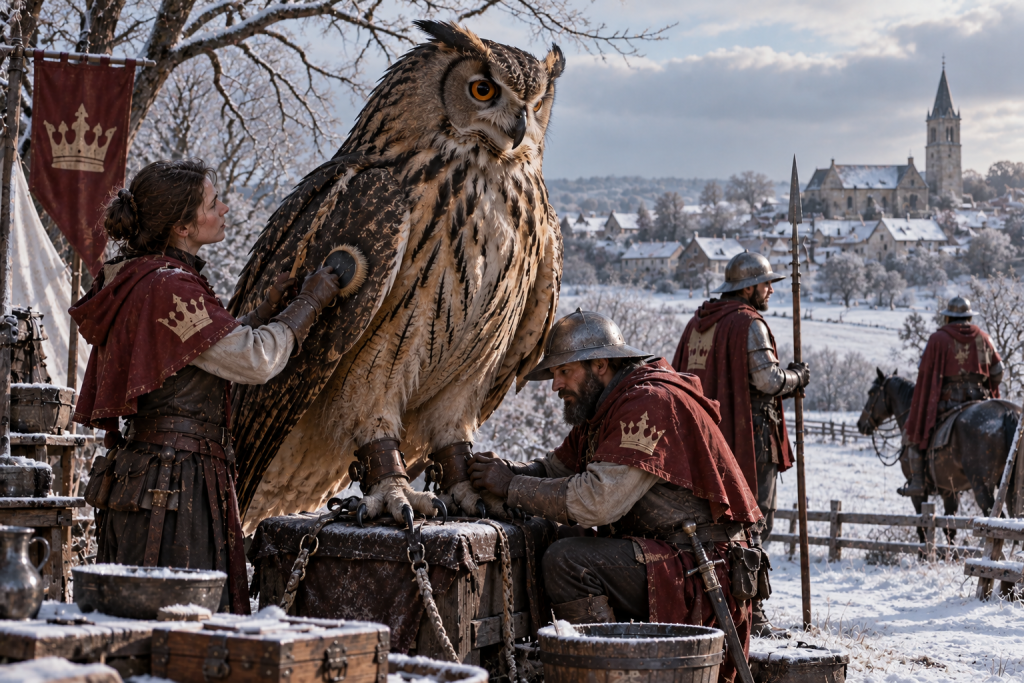
And just outside Saint Mercy was the owl.
A giant owl was working with the Crown. When it was awake, it patrolled the countryside both day and night. The heroes had not seen it themselves, but the reports were clear enough. Whatever else the creature could do, it was extremely well suited to searching from the air.
Wolfgang told them that it could not only see a long way but it could see just as well at night as in the day. And it was intelligent enough to accept direction and to clearly report what it saw.
The League of Avian Mysteries
Wolfgang had been watching the strange ravens for a couple of days. They passed south of the safe house every few hours, travelling back and forth along roughly the same line at considerable altitude.
The heroes did not know where they were going or who controlled them. They did not even know with certainty that they were carrying messages. But trained birds carrying communications seemed the most likely explanation.
Merrythought promptly united the ravens and giant owl into what she termed the “League of Avian Mysteries.”
Nobody had yet established whether the League had a charter but the important point was that the Crown appeared to possess both aerial reconnaissance and some potentially rapid means of communication.
And the heroes were sitting in a farmhouse in mostly open country.
The Map
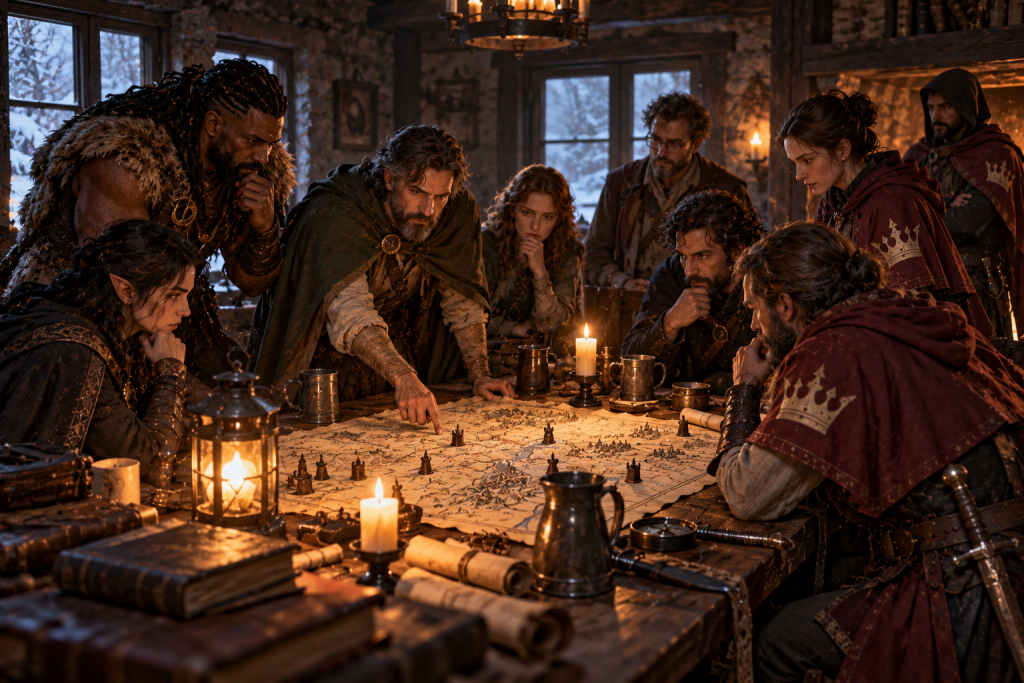
The Ebon Blades spread out a map of the surrounding countryside which failed to offer any further comfort.
Saint Mercy itself was a village of roughly three hundred people. The surrounding country was overwhelmingly agricultural: farms, fields, scattered buildings and only occasional patches of woodland. Low hills and ridges offered some concealment, but the woods were sparse.
There were roads and smaller tracks and while travelling on either was much faster than travelling directly across country, they were also where strangers were easiest to find. The streams presented another problem. They could not simply be crossed wherever convenient. Bridges and established crossings created natural choke points for searchers to exploit.
The heroes’ own retreat demonstrated the problem. Although their group and Barin’s unused ambush force had travelled to the safe house by different routes and at different times, both had nevertheless been forced to use the same bridge.
If the Crown managed to reconstruct enough of their movements from residents of nearby farms, that bridge might become a particularly interesting place to investigate.
The courier who had brought the warning offered at least one reassurance. He knew his business. He had not come directly from Saint Mercy to the safe house because he did not know where the safe house was. He had travelled to the dead drop by a circuitous route and intended to return by another, taking the long way and varying his route. That protected the farmhouse from one obvious trail.
But it did not make the heroes invisible.
The Search Widens
Then, after another day, more news arrived.
The Crown was no longer merely asking questions in Saint Mercy.
Patrols were moving through the countryside.
They were visiting farmsteads, knocking on doors and asking whether anyone had seen anything unusual. One reported patrol consisted of four armed people and, more troublingly, one of them had been seen using a familiar to scout beyond a hill.
The Crown’s searchers therefore did not necessarily have to expose themselves before seeing what was on the other side of a ridge.
The giant owl could search from above.
Patrols could search from the ground.
Familiars could look where the patrols themselves could not.
And the ravens continued flying.
The heroes began to feel that the Crown might know rather more about their general whereabouts than they realized. “We need to get out of here,” Zborch concluded and nobody disagreed.
Exactly how remained rather less clear.
Option One: Leave at Night
The simplest idea was to leave after dark.
Night would reduce the chance of being spotted by ordinary people, and the party could stay off the main roads and move cross-country toward Dolven’s Hollow.
Unfortunately, night did not solve the owl problem.
The creature could see in darkness.
And cross-country movement through cultivated terrain was slow. Much of the landscape offered little cover, and eventually streams would still have to be crossed.
They might leave unseen only to be found hours later in the middle of a field.
Option Two: Split Up
Another possibility was to stop looking like a party.
A large group of armed adventurers was conspicuous.
One or two ordinary travellers were not.
Some members of the group could probably move through the countryside fairly inconspicuously on their own. Zborch, in particular, looked very much like some fellow walking down the road with a staff and had little established association with the others.
Hunkle might have somewhat greater difficulty blending seamlessly into the Cambrian countryside.
Calder’s prospects inspired even less confidence. Merrythought offered odds of eight to one against Calder reaching Dolven’s Hollow alive, presumably after a sequence of events involving a fireball and several burning farms.
Calder accepted the general premise graciously.
But splitting up created a more serious problem than Calder’s relationship with fire – the heroes had no reliable way to communicate once separated. And while a four-person Crown patrol was something the entire party could probably handle, a lone adventurer unexpectedly encountering one was another matter entirely.
Splitting up made them harder to find.
It also made them much easier to kill once found.
Option Three: Become Penitents
Then came a rather different suggestion. They could stop looking like adventurers because they could stop looking like adventurers.
The Ebon Blades had some rudimentary disguise materials. The heroes could bury or conceal their weapons, armor and other conspicuous equipment, dress themselves as religious penitents or ordinary travellers, and simply take the road.
Instead of sneaking through fields while looking exactly like the armed people the Crown was hunting, they could walk openly. If stopped, they might even ask the Crown patrol what all the excitement was about.
There was an obvious price, however. Everything inconsistent with the disguise would have to be left behind – weapons, armor, equipment, and possibly even magical items.
Hunkle contemplated the prospect of abandoning his enormous magical maul with something less than complete equanimity.
Still, the idea had attractions. Merrythought was willing to consider it. Several of the others possessed relatively little equipment they regarded as indispensable.
And walking openly on roads would be much faster than creeping through fields.
Option Four: Send the Crown Somewhere Else
Perhaps the best way to escape the search was not to evade it at all. Perhaps they could move it. Barin suggested creating evidence that the fugitives had been in the area but had since departed in another direction.
Tracks could be manufactured. Rumors could be planted. Witnesses could hear that suspicious strangers had gone west toward Alderwick.
The Crown might then concentrate its search somewhere the heroes had no intention of going.
That had particular appeal because the heroes ultimately wanted to reach Dolven’s Hollow. Sending the Crown toward Alderwick would pull attention away from their actual destination.
Merrythought rather liked the idea. They could perhaps even genuinely move toward Alderwick first, strengthen the false trail, and then turn away once the Crown had committed to the wrong direction.
It would be slower. But a successful deception might accomplish something mere stealth could not – it could make the Crown confidently search the wrong place.
Option Five: Diversions
Calder was also interested in the problem of the river crossings. If the Crown understood the geography as well as the heroes did, it could watch the bridges and other crossing points rather than searching every field.
Perhaps the heroes could create a diversion near one crossing and use another.
The mill was discussed.
So was setting fire to a patch of forest.
The latter suggestion prompted the reasonable question of why escaping the Crown required burning down somebody else’s forest. Calder’s answer was essentially that a large fire would be difficult to ignore.
It was pointed out that Calder possessed a Fireball spell and was consequently beginning to perceive an unfortunate number of tactical problems as things that might be improved by setting them on fire. Nobody actually burned down the forest.
Yet.
No Decision
By the end of the evening, the heroes had identified plenty of possibilities.
They could leave at night, travel cross-country, split into smaller groups, could stay together so that Crown patrols could not overwhelm isolated members, disguise themselves as penitents and walk openly down the road, manufacture tracks and rumors pointing toward Alderwick, or create a diversion at one river crossing and use another.
They could combine several of those ideas. Or do something else entirely.
What they had not done was choose.
In the meantime, the Crown’s patrols were spreading through the countryside, the giant owl was still flying, the ravens were still passing overhead, and Grelda was waiting in Dolven’s Hollow.
And somewhere between the safe house and her stood an increasingly organized Crown dragnet.
The party knew where it wanted to go.
The problem was getting there.
Where We Left the Heroes
When we return in two weeks, the heroes are still at the Ebon Blade safe house outside Saint Mercy.
Their immediate and longer-term business looks something like this:
- Escape the Crown dragnet. The Crown is searching Saint Mercy and the surrounding countryside, questioning farmers and travellers, sending four-person patrols through the area, using familiars for reconnaissance, and employing a giant owl for aerial surveillance. The mysterious ravens may also be carrying messages. The heroes have discussed a number of ideas—but have not yet chosen a plan.
- Try not to destroy the local Ebon Blade organization while escaping. The Saint Mercy supporters have been supplying the safe house through a dead drop, and one of the nine Blades killed in the ambush was a local grocer whose failure to return home may eventually attract attention. Whatever escape plan the heroes choose should ideally avoid leading the Crown to the safe house, the local supporters, or anyone else who helped them.
- Decide what happens to everyone currently at the safe house. The heroes are not the only people who need to disappear. Barin, Phineas and the surviving Ebon Blades are there, along with Oakbeard, Mossyrock and the surviving tribal Orc. Getting the adventuring party away safely is only part of the problem.
- Reach Dolven’s Hollow. Grelda has sent word that the lucid dreams are ready and wants the heroes to return as soon as possible. Cassyndra’s disturbing vision of the now-adult Getty gives them another reason to find out what is happening around Grelda.
- Then return to Hollowmere. Barin and Phineas want the heroes to approach Varnes as representatives of the Ebon Blades and explore the possibility of cooperation with the Reclamation. The Ebon Blades are prepared to work with the Orcish rebellion despite their abhorrence of its use of undead, provided the eventual goal is something resembling two independent states rather than replacing Human domination of Orcs with Orcish domination of Humans.
- Decide whether Mukden’s unfinished mission still matters. Mukden had been carrying Varnes’s proposal to the isolated tribal Orcs of Briarfell. After Mukden died, Laveleen became the principal remaining link between that proposal and the tribe. Now she is dead too. The surviving tribal Orc speaks hardly any Common, while the heroes know hardly any Orcish. The party can try to reconstruct and continue Mukden’s mission, ask Varnes how he wants to proceed, find some other means of communication—or simply allow the effort to recruit the tribe to end with Mukden and Laveleen.
- Remember that the Crown is learning too. Helen is dead and cannot report what she discovered, but the Crown already knows there was a major ambush, knows that Helen was captured, and has two surviving agents from the convoy somewhere outside the party’s control. Exactly how much the searchers have reconstructed about the heroes’ retreat remains unknown.
There are larger questions waiting in Hollowmere.
There are lucid dreams waiting in Dolven’s Hollow.
There is unfinished business waiting in Briarfell.
But first – Get the hell out of Saint Mercy.