October 12th, 973
The rain had settled into its third straight day, a steady gray drumbeat that made even good news sound damp.
Kenning and Renn spoke quietly over breakfast while the rain muttered at the shutters. They explained that, though both were Ebon Blades, they’d never met before the jail. The Blades’ cell structure kept them deliberately separated: Renn worked the printing side of The Ember, setting type in hidden basements and carrying plates in flour sacks; Kenning handled distribution and field work—posting broadsheets on walls at dawn, smuggling bundles through checkpoints, and performing the kind of “errands” that required a sword as often as a quill. They’d recognized each other in prison by a single exchanged phrase, a code meant for exactly such moments,
“Is the ember still warm?”
“It never goes cold.”
That was enough to turn strangers into allies.
Renn described nights when the presses rattled like thunder and the air smelled of ink and candle smoke. “We wrote what others wouldn’t,” he said, “and Kenning here made sure people saw it before dawn patrol tore it down.” Kenning only smiled thinly. “Ink’s hope,” he said, “but hope needs legs.” Between them lay the entire anatomy of a revolution—Renn the voice, Kenning the hand that carried it through the dark.
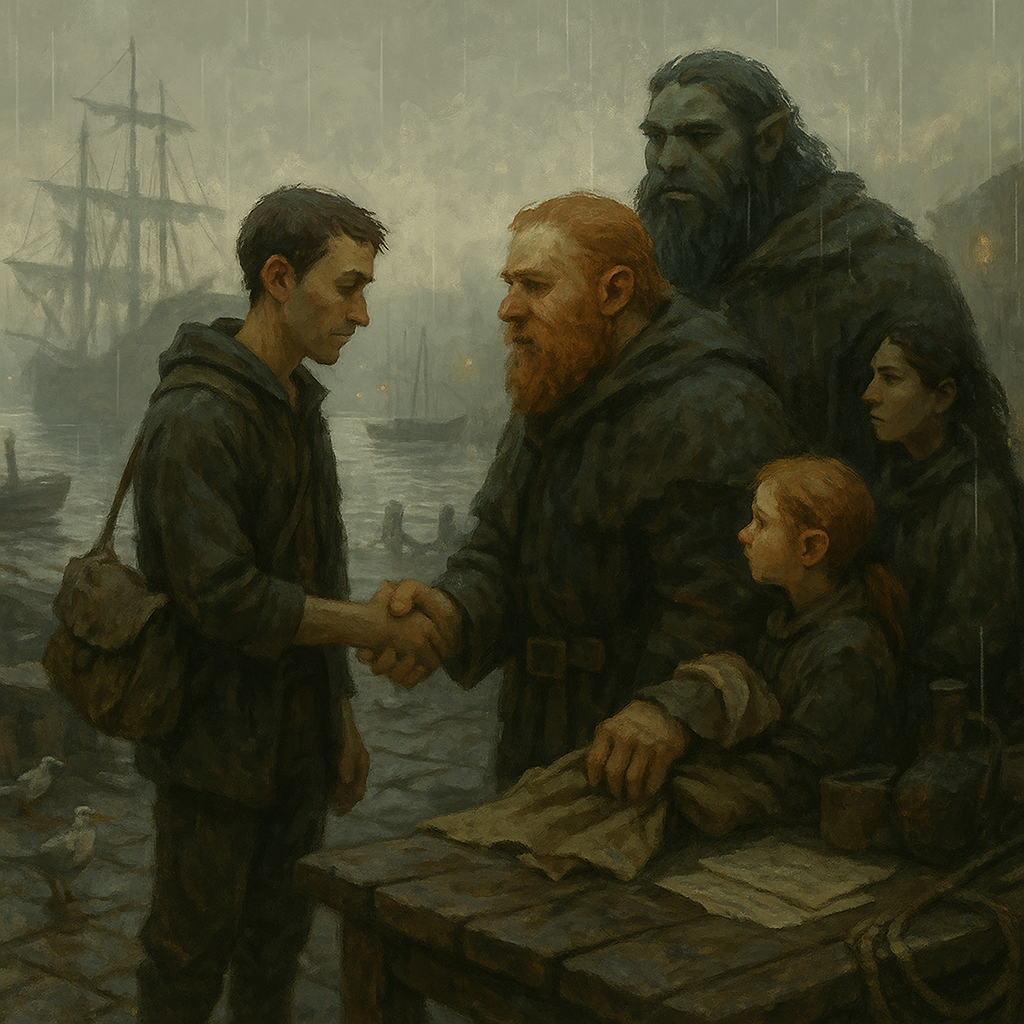
After that, there was a farewell at the docks. Silas Venn—clean-shaven, hair trimmed, dressed like any other clerk who’d lost an argument with laundry—accepted a plain cloak and a pouch with enough coin to rent a room and bribe a doorman.
“Back to the Perfumer, then?” Wolfgang asked.
Silas smiled thinly. “Back to my ledger. I owe Maris… accounting.”
“Settle it in ink, not blood,” Cassyndra said.
“If I have my way,” Silas replied, and vanished into the rain.
Hunkle stayed behind at the dockside inn to mind Kenning and Renn Talcott while Ironbark slipped into the market to buy clothing suitable for a man not impersonating a guard. He returned with a bundle that smelled of soap and old rope.
Kenning had already shed the prison orange for farmer’s brown; Renn, for his part, put on the clothes that Ironbark bought and looked like a printer on his day off: ink already finding him, as ink does. Ironbark tucked the stained orange into a sack and dropped it under a wharf-side crate where, he assuredly said, “rats and tides will have better use of it.”
Meanwhile, Cassyndra, Merrythought, Gareth, Laveleen, and Shamus took the long route toward the Hero’s Respite. The streets around the jail boiled with rumor—guards in tight knots, lanterns bobbing, a pair of greenhorn adventuring crews from the Respite trying to look invaluable while being mostly in the way. Word traveled quick as smoke: Riot. Breakout. Butchery. Half of it was false, all of it was fervent.
Near a rain-swollen gutter, they came upon a small knot of mourners in threadbare shawls, gathered about a woman and two children. The name Dorin carried on the air and fell at their feet like a dropped coin. Merrythought remembered his easy grin from the morning she’d “accidentally” met him on the road home, and for a moment the rain felt colder.
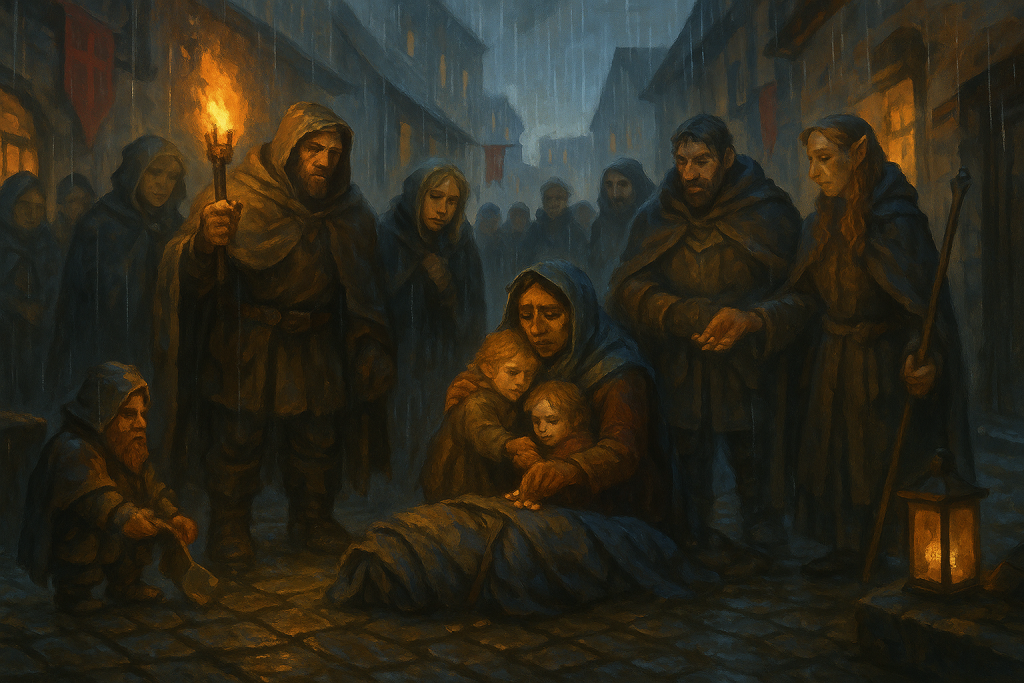
“He was decent,” Merrythought said softly. “We were decent, too.” No one argued with either claim. They left a little money, a gentler word, and moved on.
At the Respite, Ant and Wolfgang were already packed—beds stripped, debts settled, smiles suitably bland for anyone watching. When asked at the desk their next destination, Wolfgang said, “Rumors of feral orcs in the outlands,” and produced a face that suggested a professional willingness to investigate nonsense for a fee. The innkeep wished them luck the way one might bless a ship built of cheese.
In the meantime, Hunkle, Ironbark, Kenning, and Renn took a different route out of the city —cutting through the Gutter’s End, where the rain seemed to find more misery to soak. They passed into the Cinders, a two-by-two block scar left from a fire a decade past and still unrepaired. It had grown a city’s shadow: tarps sagging between broken chimneys, cookfires guttering in paint tins, children barefoot and quick-eyed, the living sifting the city’s leavings for anything that could be burned, bartered, or believed in. A child waved a splintered hoop as the party passed; an old woman cupped a bit of soup into a cracked bowl and smiled like it was a gift.
Renn’s thumb flicked across his fingertips, leaving black streaks. “Ink’s cheaper than blood,” he murmured, “but down here they’re both diluted.”
Kenning kept his hood low. “Remember it,” he said. “When someone asks you why we do any of this, remember this.”
They joined the others at the Broken Mill turn—mud-churned stone and the crooked sign of a half-rotated windmill—faces wet, boots heavy, the city’s uproar behind them and the slow-breathing fields ahead. The journey to Dolven’s Hollow was blessedly uneventful, save for the rain’s persistence and Gareth’s insistence on humming something that might one day become a tune.
On the road, stories surfaced. Renn spoke of midnight runs to hidden presses, of type that cut your fingers and opinions that cut deeper. “The Crown fears a paragraph more than a pike,” he said. “A pike wounds a body. A paragraph wounds an alibi.” Kenning added little, but when he did, it was with a Bladesman’s pragmatism: cells, cutouts, codes; the calculus of how long a person could hold out under “enhanced interrogation” before names began to spill. He and Renn had never shared a job—only the same cause and a long corridor of caution.
Rain-soaked and road-weary, they reached Dolven’s Hollow by late evening. Barin, Phineas, and a half dozen townsfolk met them like a door opening on lamplight: cautious smiles, careful embraces, the relief of seeing faces you feared you wouldn’t. There were words, then fewer words, then stew.
Barin’s warmth had an edge. He thanked the party for what they’d done, then thanked them again for not speaking of it loudly. As the evening wore on and no soldiers thundered into the square, his shoulders lowered half an inch. He put the party up for free at the inn—“as friends, not as customers”—and that was the whole speech.
The townsfolk needed less prompting. In twos and threes, they took the measure of the strangers who had walked a man home from prison. Pledges were offered without ceremony: We saw nothing; we know nothing; we’ll say less than that. The party understood the covenant and signed it with silence.
Morning came with continued rain but lightening faces. Barin had spoken privately with Kenning and Renn during the night, and whatever had been said washed something out of him. He was still the same careful man, but the care had shifted from suspicion to strategy.
Kenning and Renn took their leave soon after breakfast—no parade, no tears, only a packed satchel and Barin’s hand on each of their shoulders. “Go quietly,” he said. “Stay that way.” They promised to try and set off toward a safehouse neither the party nor the reader was invited to know.
When they were gone, Barin closed the door and turned to the party. “There’s a thing,” he said, “that needs doing. And if it’s not you, it’ll be no one.”
He spoke of The Crown’s Tithemen—known in these parts as the King’s Butchers—a five-person crew who turned arrears into atrocities. Where coin ran dry, they took payment in other currencies: fear, flesh, the kind of scars that change a town’s posture for a generation. They were returning to Manchester by a known road, at a predictable hour, with a chest heavy enough to slow a horse and consciences light enough to float.
“The storms give you cover,” Barin said. “But listen well. This isn’t a raid on a henhouse. It’s an execution you must perform in the dark and then swear you never attended.”
He set the terms with the clarity of someone who had already counted the graves:
- Do not return the money to the peasants. “You’ll paint targets on backs that have carried enough.”
- Do keep it—and spend it moving the needle that matters. “Ink. Safes. Food. Friends.”
- Do not take any prisoners. “There’s no gaol that can hold them that won’t turn into your gaol tomorrow.”
- Plan the strike for ambush and overwhelm. “Hit first, hit hard, hit till they quit moving.”
- Have a retreat plan ready. “If it goes wrong, live to be useful.”
- Bring carrying capacity. “Besides the treasure, their carriage will be carrying gear that you’ll want. Rations, torches, sleeping gear, and so on.”
He offered a cart and two mules on loan. “If anyone asks, you stole them. If you’re caught, we’ve never seen you. If you die, we never did.” There was no malice in it—only the arithmetic of survival.
Gareth looked around the room, gauging the faces of his new companions. “Sounds like a fair fight,” he said.
“Only if we cheat,” Wolfgang replied.
Laveleen’s eyes were distant, counting contingencies. “Rain for cover. Mud for silence. Darkness for confusion. Let’s make it look like the storm ate them.”
Shamus tightened a strap on his gauntlet. “Then we become the weather.”
They spent the rest of the morning with oilskins and ink, drafting a plan that smelled of wet leather and intention. By noon, a route had a name; by evening, it had a time.
When the rain thickened toward dusk, it felt less like fate and more like permission—and permission, the party thought, was best taken in a hurry.