October 15th, 973
With their pact sealed, both companies turned immediately to the question of next steps. At Captain Alaric’s suggestion, they made one last reconnaissance sweep of the second level to ascertain the location of the Sereth.
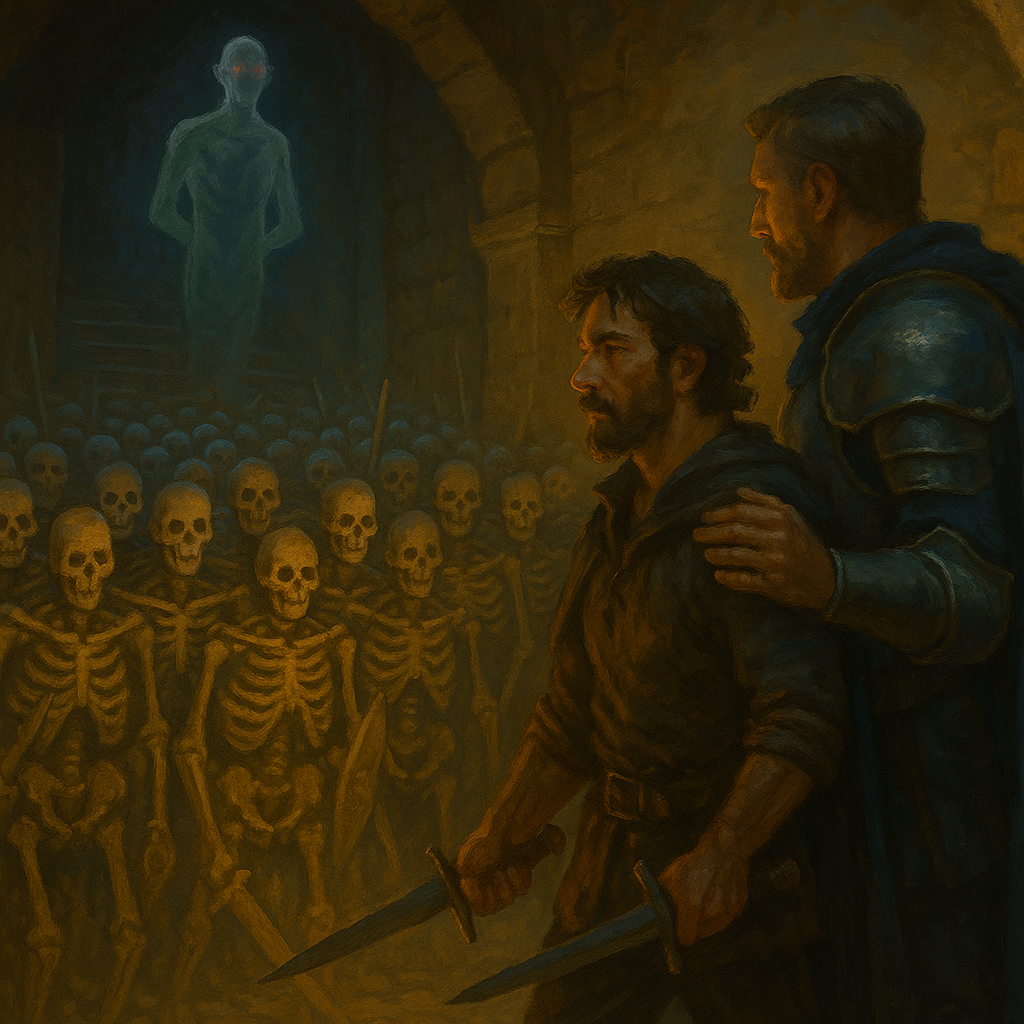
The answer was sobering – the stairs back to the first level was now choked with skeletons—scores of them—standing in silent ranks, motionless but unmistakably barring the way. The Sereth had entrenched itself.
And it had chosen a new form in which to greet them.
Rather than seizing Ironbark again, a translucent silhouette drifted out of the shadows: a faintly luminous shape hovering inches above the stones. Its voice remained the same calm, courteous cadence they’d heard through Ironbark’s throat—too even, too polite, too inhuman.
“Warm-bloods,” it said. “When will you arrange for our departure from this place?”
The companies exchanged uneasy glances. Several began to hedge, stalling for time. Alaric did not.
“Under no circumstances,” he said, stepping forward, “will we allow you to leave this facility.”
The Sereth turned its faceless attention toward the party.
“Do you concur?” it asked pleasantly.
Merrythought lifted her chin. “Aye. The Captain speaks for all of us.”
A silence followed—a dreadful, weighty silence in which no one breathed. Then the Sereth’s outline flickered, and without another word it dissolved into the air.
That was enough for everyone.
Judging that a second confrontation—or worse—was imminent, the combined group withdrew at speed, returning to the Argent Company’s base chamber. Once again… they were not pursued. And once again… no one understood why.
Wolfgang attempted to offer a theory involving the lingering aroma of wastewater exploration clinging to the Argent Company; Ant and Merrythought immediately smothered the idea before he could elaborate further in front of their new allies.
Ironbark, for his part, seemed surprisingly improved from his recent possession and near-death experience—still pale, nursing a headache, but alert. The others questioned him gently about his experience under the Sereth’s control.
He couldn’t explain why the creature hesitated to attack in the base chamber, but he described its mind as narrow and single-minded—mechanical in purpose, utterly fixated on its directive to kill all living beings within the facility. No malice. No passion. Just task.
With the stairway choked by undead and the Sereth insistent on their service, the choice became clear: down.
They gathered ropes and torches and approached the hole in the floor—the remains of a collapsed stairwell leading to the third level. A torch lowered on a line revealed movement, chittering, and shadows that proved to be…
Giant rats. What else could it possibly be?
Wolfgang, Alaric, and Kael volunteered for the initial descent. They went down in a controlled slide, hit the stone floor running, and dispatched a pair of rats quickly and cleanly. Their voices rose up moments later: “All clear.”
The rest of the combined company followed, leaving only Shamus, Ironbark, and Gareth above to keep watch for anything emerging from the darkness behind them.
What awaited below was a cavern vast enough to swallow a farmhouse.
The entry tunnel opened onto the midpoint of a long rectangular space, its far end sloping gently away into gloom. From alcoves set high in the walls, thick pipes disgorged constant streams of muddy water that trickled downhill in miniature rivers and deltas. A pale, white moss carpeted the stone—thriving on the moisture and making every step treacherous.
Support columns rose thirty feet to the ceiling… though age and erosion had gnawed at them badly. Several leaned at uneasy angles, their bases hollowed by centuries of water.
The cavern’s ecology was alive—viciously so.
As the two companies spread out, the moss proved not merely slick but hazardous. Certain patches teemed with pale, wriggling insects that burst into swarms when disturbed, gnawing at legs and armor straps. Other patches released clouds of spores that, when inhaled, sent victims reeling in brief, bewildered confusion.
From the alcoves along the walls, more giant rats poured out, emboldened by numbers and hunger.
The combined onslaught nearly cost Merrythought her life; she went down in a tangle of claws and insects before being dragged clear by her companions.
Just as the last of the rat packs broke away, a thunderous roar rolled through the cavern. Stones vibrated. Water shivered.
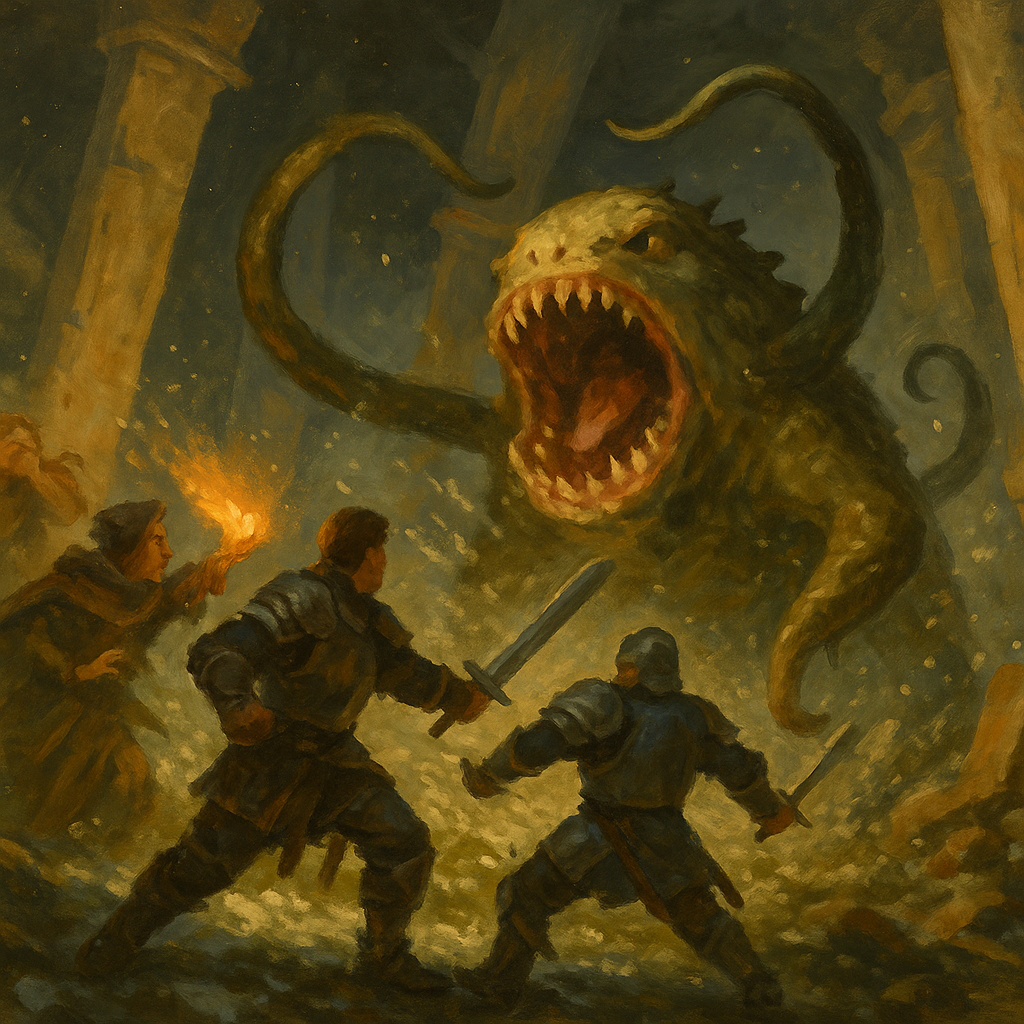
From the deeper dark heaved an otyugh—huge, hungry, stinking, its tentacles slick with rot.
It charged and the resulting battle was short and brutal. Steel and spell repeatedly tore through the creature’s hide and with a final convulsion, it collapsed—straight onto one of the weakened support columns.
The stone split with a sound like a tree cracking in winter. Dust and flakes of white moss rained from the cavern ceiling.
And the room shook.
The echoes of the otyugh’s fall faded slowly, replaced by the unsettling groan of stressed stone. The shattered column slumped sideways, shedding flakes of limestone like dying snow. For a full five seconds, every member of both companies stared upward.
The ceiling—thirty feet above—held.
Barely.
Cracks spidered through the moss-slick stone between the remaining pillars. Fine dust sifted downward in a lazy veil. The cavern trembled once more, a deep, unhappy shudder that ran from wall to wall.
“We should not rely on this roof to keep its manners,” Brother Caldus murmured.
“No,” Lira agreed quietly. “We should not.”
Pressing on with renewed haste, the two companies regrouped near the sloping far end of the cavern—breathing hard, armor scratched, boots caked with moss. Serafine, however, was practically glowing.
“Do you see?” she said, gesturing with her staff at the vast chamber. “The orcs built this deliberately. It’s a designed ecosystem. A defensive one.”
Wolfgang blinked. “Designed? This feels more like a long ignored compost heap.”
Serafine ignored him, sweeping her hand across the cavern.
“Lake water flows in constantly—nutrient rich, full of silt. The white moss thrives on it. The insects feed on the moss. The rats feed on the insects. The otyughs feed on the rats. And to prevent the otyughs from simply devouring every rat and starving to death, the orcs built those”—she pointed at the alcoves—“nests too small for an otyugh to reach into. That maintains the rat population. A stable food web. Sustainable.”
She beamed. “It’s genius.”
Ant stared at her. “You get excited about this?”
“Oh yes,” Serafine said warmly. “Nightmarish biology is still biology.”
Kael muttered, “The gods are testing us.”
At the lowest point of the cavern—where all the muddy water gathered—they found a wide, murky pool. Its surface rippled with sluggish, uncertain movement.
Something darted beneath the surface. Then another. Then dozens more.
Wolfgang squinted. “That’s too much motion for minnows.”
Kael, expression unchanged, agreed, “Best to doublecheck before going any further. Let us render an offering unto this pool and see what happens.”
He and Kael returned to the slain otyrug and removed a leg, Wolfgang offering advice on choice cuts of meat all the way. Together, they tossed it into the pool.
It vanished in an explosion of red froth.
“Piranhas,” Wolfgang said helpfully. “Hungry ones.” Kael nodded gravely.
Beyond the pool stood a massive set of double metal doors—engraved with flowing orcish script and fitted with a speaking tube shaped like a stylized fish’s head. The doors stood flush against the pool’s edge, offering no ledge, no foothold, no place for a living person to stand. The message was clear: If you wanted to reach those doors, you would have to brave both the water and its murderous contents.
Detect Magic revealed a distinct aura of abjuration on the doors—corrosion warding, strength reinforcement, and something else Laveleen couldn’t quite decipher. Whatever the orcs had been protecting beyond this point, they hadn’t wanted time, water, or invaders to open these doors.
The combined companies stared at the pool, the doors, and the endlessly churning piranhas.
“No ledge,” Lira muttered. “No beams. No stepping stones. And unless someone has wings tucked under their armor—”
Cassyndra raised her hand.
“I have an idea.”
Everyone immediately looked worried.
“Shape Water,” she said. “I can freeze patches of the surface. If I chain the spell, I can make stepping stones.”
Wolfgang’s brow furrowed. “We could have someone agile do the crossing. Merrythought? Hunkle? Lira?”
Cassyndra had already removed her cloak.
“No, no,” she said. “I’ve got this.”
Lira sighed. “Of course you do.”
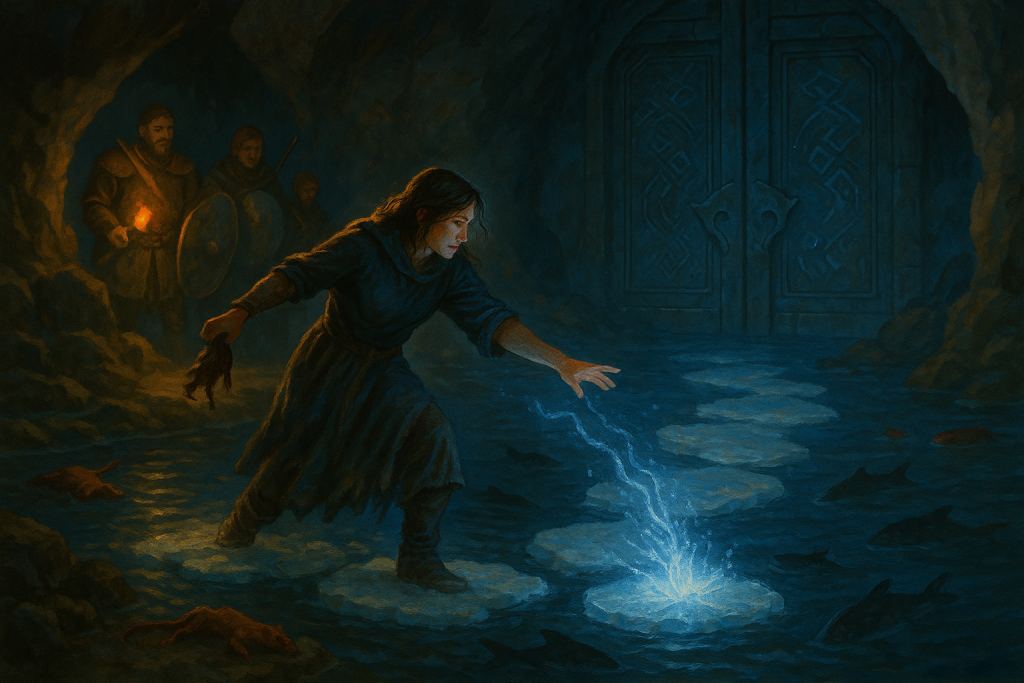
Cassyndra knelt at the water’s edge, muttering arcane syllables. Frost spread from her fingertips, crystallizing into a flat plate of ice. She stepped onto it delicately, wobbling slightly.
The second plate formed. She stepped onto it. Wobbled again.
By the third plate she slipped, arms pinwheeling as she splashed into the water.
The piranhas surged—
—but Ant, Lira, and several others were already tossing giant rat carcasses into the pool. The fish veered, frenzied, snapping at the easier meal.
Cassyndra dragged herself back onto her ice, drenched but uninjured except in pride.
“This is fine,” she said through clenched teeth.
She slipped two more times on her way across suffering a piranha bite along the way.
By the time she reached the far side—soaked, shivering, slightly blood-stained, but triumphant—Caldus gave a proud nod and cupped his hands around his mouth, “Well done! Not how I’d do it sober, but well done all the same!”
Cassyndra steadied herself on the final ice plate, dripping but resolute. The double doors loomed before her—ageless smooth metal that still seemed to breathe faintly with warding magic. The speaking tube—shaped like a wide-mouthed fish—jutted from the left door, green with patina. She leaned toward it.
“Ah… hello?”
Her voice echoed strangely inside the tube, as though swallowed by water.
For a long moment, nothing.
Then— A sound like shifting currents. A faint resonance. A voice, burbling, wavering, unmistakably alive— “Tusī̃ kauṇ ho?”
Orcish.
Cassyndra blinked. “Oh. Um. One moment.”
She glanced back helplessly. Laveleen, ever the linguist, stepped to the pool’s edge.
“Try saying you’re a friend,” she called softly. “Keep it simple.”
Cassyndra swallowed and leaned close again. “…Friend? We are… friends.”
Another warbling reply, sharp at the edges, like fear given sound: “Kī tusī̃ human ho? Ork kitthē gae?”
Cassyndra winced. “Yes. We’re… not orcs. But we’re here to help.”
The voice inside the tube rose into a trembling rush of bubbles and broken Common. A few words were clear enough to translate: orcs, long time, wait, danger, humans.
Cassyndra exhaled. “Laveleen… I think it’s scared.”
Laveleen nodded, her face softening. “Tell it the truth.”
Cassyndra did.
Slowly, gently, with the patience of someone trying to comfort a frightened child through a closed door, she told the being inside the simple truth of what had happened:
That the orcs who once tended this place were long dead.
That the war had ended centuries ago.
That the orcs who survived were enslaved, scattered, oppressed.
That the humans who were here now were very different from the ones who had come a half century ago and meant no harm.
“That’s why no one came back,” she finished softly. “No orcs. No rescuers. No one knew you were here.”
The answer came as a long, hollow note—like a deep river running through grief.
Then, shakily, in broken Common, “You… tell true? No orcs… no come back…? Long waiting…”
Cassyndra pressed her forehead lightly to the cold metal.
“We’re sorry. Truly. But we’re here now. And we want to help.”
Silence. Heavy. Trembling. Then— “…Are you… good humans?”
Cassyndra looked back. Shamus nodded solemnly. Wolfgang gave an encouraging thumbs-up. Merrythought murmured, “Tell it yes. And mean it.” Even Kael bowed his head, a gesture of solemn oath.
Cassyndra turned back.
“Yes,” she said simply. “We’re good.”
The mechanism behind the door clicked—soft, hesitant. A second click. A third. Then, with a shuddering groan that stirred dust across the cavern, the double doors unlocked and slowly swung inward.
Water rushed out around Cassyndra’s boots.
And from the darkness within… it emerged.
A shape of fluid light, rising like a figure sculpted from rippling glass. The air vibrated with the cool scent of a riverbed after rain. A dozen glimmering currents twisted around one another, merging, separating, weaving together like memories half-forgotten.
A water elemental—massive, trembling, beautiful, and afraid.
It drifted forward hesitantly, then crossed the moat without any trouble. It paused next to the group and then slowly extended one liquid tendril toward each person. The moment they touched, the world changed. The elemental’s thoughts were not words so much as images, feelings, and soft currents of memory.
A rush of sunlight filtering through water.
Small, playful shapes—childlike elementals—darting through streams like minnows, giggling in ripples.
Orcish workers laughing as the tiny elementals splashed them.
Buckets being carried. Troughs being filled.
Joy. Safety. Purpose.
Then— A shadow. Fear. Orcish voices hushed, urgent. Warnings. Humans coming. Bad humans. Destroying humans.
Sorrow, deep and heavy.
An orcish Elder kneeling, pressing a hand to the water, whispering promises.
“We hide you now. Many orcs come back. Soon.”
“But will you come back?”
A flash of sorrow and grief across the elder’s face followed by a steeling to tell the truth. “We will not be back. But others will and they will play with you again.”
“But we want you to come back!”
“We are sorry… we cannot come back… but we will see you again later… much later.”
A door closing.
Darkness. Grief.
Time stretching like an ocean trench.
Centuries of waiting.
Loneliness so deep it chilled the bones of everyone who shared the vision.
When the elemental released them, Merrythought wiped her eyes with her sleeve.
“They knew,” she whispered. “The orcs in this place… they knew they were going to die. They locked the little ones away so they could… keep on living.”
Caldus sniffed loudly. “Bloody hells.”
Even Kael’s expression cracked slightly—just enough to show pain.
The elemental lowered itself, touching the floor in a gesture that might have been trust, or entreaty, or simply exhaustion. “Please,” it said in wavering Common. “Take… me home. Outside. Away from dark.”
Hunkle was the first to recover. “I wonder if it knows that the Sereth is standing in its way.”
The elemental drifted fully into the cavern, its surface shifting constantly between shapes—a wave crest, a cupped hand, a childlike silhouette that dissolved into mist. Its voice, when it tried to form one, rippled like sound heard underwater.
“Sereth… bad thing… hurt orcs… hurt us.”
Serafine’s eyes sharpened. “So it knows the Sereth.”
At that, the elemental recoiled slightly, the memory of fear rippling across its body like stormlight. “Cold magic… bones walking… always coming. Fast water stops them. We made fast water upstairs to keep them away.”
Kael’s gauntleted hand tightened on his sword hilt. “Then we share an enemy.”
Lavelene said, “And we kniw why the Sereth approached us and not you. You happened to be near fast-moving water and the Sereth had no power there. And that’s why whenever we retreated to your camp, the Sereth left us alone.”
The Captain nodded, “And that makes the water elemental a powerful ally against the Sereth.” He approached the elemental directly—hands open, posture cautious but confident.
“Will you stand with us?” he asked. “If we destroy the Sereth together, you will be free of it—and so will we.”
The elemental paused, currents twisting inward as though thinking. Then it touched the floor in front of him—a gesture the party had come to recognize as its approximation of a nod. “Help… yes. Fight… Sereth.”
A breath seemed to release from everyone at once.
But the relief did not last long.
No sooner had the elemental drifted away from the group than Serafine cleared her throat.
“We can’t let it roam free afterward. A water elemental of this size holds enough raw arcana to destabilize half the county. After the Sereth is destroyed, we should bind it safely. Temporarily,” she added hastily, “until we can construct a proper containment vessel.”
Wolfgang’s eyes went wide. “Bind it? After it helps us? Absolutely not.”
“It’s not punishment,” Serafine insisted. “It’s public safety.”
“It’s slavery under another name,” Wolfgang snapped.
Laveleen folded her arms. “The orcs trusted these beings. They worked together. We are not going to repeat Archea’s mistakes.”
Serafine’s voice cooled. “You don’t even know what this creature is capable of.”
“I know what you’re capable of,” Wolfgang shot back.
Kael stepped subtly between them, shield half-raised. “Mind yourselves.” Hunkle, arms folded and eyes narrowed, remained otherwise relaxed but gestured subtly to the party to indicate that he was happy to fight now or fight later; whatever the group chose.
Alaric and Kael voiced their own concerns frankly—about danger, unpredictability, and the value of such a creature acting for Archea the way it had acted for the orcs. But they spoke without cruelty; grounding their arguments in practicality, safety, and conserving a valuable good for the benefit of the community.
Tension crackled through the cavern as hands drifted towards weapons and fingers folded themselves into patterns made familiar by prior spell-casting.
Merrythought stepped forward, palms raised. “Enough.”
She turned to Alaric.
“Now is not the time,” she said firmly. “If we start this argument before the Sereth is dead, we’ll be adding our bones to its collection.”
Alaric considered her for a long moment—then nodded.
“Agreed. The elemental aids us now. The question of its fate is postponed until victory is secured.”
Wolfgang bristled visibly, but nodded.
Laveleen’s jaw tightened, but she stepped back.
Serafine pushed up her spectacles, saying nothing.
A fault line had formed. Everyone felt it and everyone ignored it. For now.
The combined group ascended back into the second level, their ranks tightened, their weapons drawn, their muscles coiled with the tension of what was coming. This time, however, they did not skulk between corridors. They marched.
Behind them, the elemental flowed like a silent tide—luminous, fluid, shifting, its presence cooling the very air.
As they reached the long hall outside the control room, the skeletons turned as one—dozens of them. A wall of bone and empty sockets, armed with jagged femurs sharpened to cruel edges and slings loaded with their own phalanges.
The Sereth appeared behind them—a translucent silhouette of shifting lines, its presence bending the shadows like heat over stone. Its voice echoed through the chamber, too calm for the carnage it promised.
“Warm-bloods. We continue our discussion… now.”
Alaric raised Resolute. “Argent Company—advance!”
Merrythought’s daggers flashed. “For the waterworks!”
Shamus leveled his sword. “For the living!”
Wolfgang cracked his knuckles. “For the elementals!”
And the elemental surged forward like a tide unleashed. It raised both arms—if they could even be called arms—and slammed them into the stone. A wave of shimmering current rippled outward like a pulse.
Every skeleton within twenty feet froze mid-step and their bones vibrated, cracked, and seized. They were paralyzed by pure elemental force. The elemental then turned and hurled a blast of churning water straight at the Sereth. The demon rippled like smoke in a storm, its form flickering.
“Unacceptable,” it hissed.
But it could not retaliate—not fully—not while the elemental’s aura dampened its essence.
Serafine hurled a bolt of fire.
Kael’s sword blazed with radiant power.
Alaric drove Resolute straight through its ephemeral torso.
Merrythought’s daggers glittered like teeth of light.
What happened next was so sudden, so bizarrely unfortunate, that the survivors would later agree that the gods themselves must have had a vendetta.
As the Sereth disincorporated, a final wild surge of necrotic energy lashed outward.
Ironbark—still weakened from his earlier possession, skull wound, and brush with death—saw that it was flowing at Merrythought and stepped forward.
The blast hit him square in the chest and he staggered backward— into a jagged piece of ancient wreckage— which impaled him clean through.
The force of impact snapped the weakened metal holding the wreckage in place and Ironbark, still skewered, toppled backward—into the open elevator shaft behind him. He plummeted. A distant clang rang out as he struck something metal. Followed by a wet thump. Followed by a long, echoing silence. By the light of a torch, Gareth looked down and saw that he was impaled yet again on an upright piece of rebar, “By the gods… he’s been kebabbed twice.”
No magic could reach him in time.
No healing could repair what gravity—and rebar—had done.
Later, when grief dulled and wine loosened tongues, the party agreed that nothing short of divine spite could explain the chain of catastrophes required to kill a man that suddenly and that thoroughly.
When the last echoes of the Sereth’s scream had faded and the smell of scorched bone still lingered in the halls, the two companies stood in the dim light of guttering torches, bruised and breathing hard.
For a few fragile moments, there was only relief.
Then Serafine Dour adjusted her spectacles and said the words that cracked the alliance in two.
“We can bind it,” she said. “Ten minutes. A containment lattice anchored to the existing wards. Nothing permanent… at first. But enough to keep it from drowning half of Cambria by mistake.”
Wolfgang’s jaw tightened. “Bind it?”
Alaric said, “A being of this size holds enough raw power to flood towns or redirect rivers. I am not saying we harm it. I’m saying we secure it. Then the Crown, or someone with better infrastructure than us, can decide how to proceed.”
Laveleen folded her arms. “It trusted us. It helped us. And your first instinct is to chain it.”
“It is not a pet,” Alaric snapped. “It’s a strategic asset—and a potential disaster. We already have one ghost story in Cambria. I’d rather not create a second.”
The argument swelled—Wolfgang’s outrage, Lavleen’s fury, Serafine’s exasperated insistence that she was thinking like an engineer, not an inquisitor. Kael’s rigid insistence that the gods required this action. Caldus frowned into his beard as if the whole situation had personally insulted his own god.
At last, Alaric stepped forward.
His voice was calm. His eyes were not.
“If you wish to be part of this,” he said to the party, “you are welcome to stand with us and share in the rewards that follow. If you do not, you may go now with our blessing. But this ceremony is happening, and it is happening now.”
For a long moment, no one spoke.
Then Lavleen drew in a sharp breath.
“No,” she said. “Not while we’re here.”
Wolfgang’s hand went to his weapon.
Alaric’s fingers brushed the hilt of Resolute. Kael shifted his stance. Serafine’s grip tightened on her staff.
And in that brittle, hanging instant, the alliance finally snapped.
The next few heartbeats were chaos. Lavleen moved first—quick as a striking snake, spell already on her lips. Her magic lashed out, crackling toward the other party. Wolfgang surged forward at the same instant, blade flashing toward Alaric’s guard.
Alaric met the strike head-on, shield ringing, eyes blazing. He stepped to flank Hunkle and struck twice, leaving deep scores across his torso.
The elemental recoiled to the far wall, surface churning with a storm of fear as everyone in both parties joined in the melee. Cassyndra cast a sleep spell that staggered Kael and would have caught Serafine as well were it not for Caldus’ intervention.
Her spectacles slid down her nose, and for one moment she looked not like a learned battlemage but like a furious, frightened student.
“Enough,” she gasped, eyes flashing.
She spoke a single word of power.
Fire bloomed.
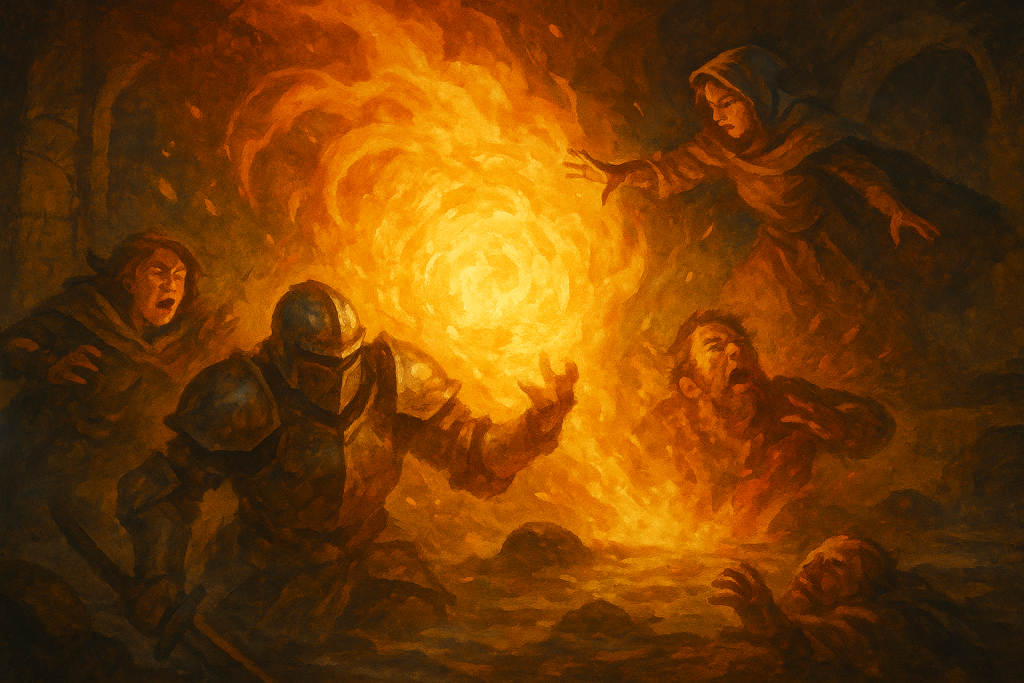
The explosion filled the corridor—rushing heat, blinding light, a roaring wave of force that turned arguments, alliances, and distinctions into one shared experience of pain.
Every single person in the party was caught in the blast. Armor blackened. Cloaks ignited. Hair singed. Spellbooks smoked.
Hunkle went down without a sound, flung into a wall and crumpling to the ground. Cassyndra’s world turned white-hot, then abruptly black as she collapsed in a tangle of scorched robes.
Several others staggered, faces ashen, barely clinging to consciousness.
When the ringing in their ears finally eased, the corridor was a charred, smoking ruin of people who had very nearly managed to destroy one another after surviving the Sereth.
Alaric was the first to move.
He ripped his half-plate’s warped buckle free, gestured his party back, and assumed a defensive posture. “Enough,” he said. His voice was hoarse, but the command in it cut through everything. “If this continues, we all die here. That is not happening.”
He faced the party.
“This is finished,” he said. “Argent Company will withdraw from this site. Whatever comes of loosening the elemental will be on your heads.”
His gaze softened, just a fraction.
“I do not want another drop of blood spilled between us.”
Silence spread through the corridor. And the party stepped back. Argent Company withdrew, backing away with weapons lowered but ready, before turning and making for the first level proper.
The water elemental watched them go, its surface churning with a rising panic.
When the last echo of Argent Company’s footsteps faded and the party was attending to Hunkle and Cassyndra, the elemental surged forward, its form flickering with agitation.
“Bind,” it whispered in broken Common. “They bind us. No more dark. No more walls. No more chains.”
Merrythought raised both hands, soothing. “They’re gone. We won’t let them bind you.”
The elemental twisted uneasily.
“Humans say things. Orcs said… ‘we come back.’ No come back. Long time. Long dark.”
The party exchanged uneasy looks.
Merrythought begged the elemental to give them the time to take down the lead-and-basalt wards on the first level to free the elemental. But the elemental, frantic now that it had been threatened with binding, refused to wait.
Without warning, it poured itself into the nearest pipe. There was a moment of shocked silence and then came a bang.
Metal screamed. Stone shook. A second pipe ruptured somewhere below, then a third. The facility’s veins—carefully laid centuries ago—burst one by one under the elemental’s furious pressure.
From far beneath, the heroes heard the snap of failing supports and the grinding cough of stone giving way. They heard the deep, unhappy groan of a structure that had been barely holding together for five hundred years and had suddenly been asked to endure one catastrophe too many.
“The whole place is coming down,” Wolfgang said. No one argued. They ran.
The combined party bolted for the stairs, racing to the first level and then toward the sinkhole. The ground lurched under their feet as columns snapped below. Cracks spidered across walls; dust fell in choking sheets.
In seconds, portions of the floor were already sagging—whole rooms dropping by inches, then feet, into the yawning void beneath. The carefully-engineered halls of the ancient orcs were dissolving into rubble and mud before their eyes.
They raced for the main passage to the sinkhole.
Behind them, the first level began to slump like wet bread dough—sections tilting, breaking, sliding down into darkness.
They reached the sinkhole at a dead sprint and skidded to a halt there. The walls of the sinkhole remained slick mud and exposed clay. Climbing out was suddenly not “difficult”—it was impossible.
The ground shuddered again. A deep rumble rose from beneath. For a heartbeat, it looked like that would be the end of it: heroes swallowed by the very site they’d just saved from an ancient demon.
Then something slapped Merrythought across the shoulder.
A rope.
It dangled from the lip of the sinkhole, coiled at her feet. Another dropped beside Wolfgang. A third near Shamus. All of them knotted and anchored to something above.
Alaric’s voice echoed down, clipped but urgent. “Climb!”
Hand over hand, boots slipping against wet rock, lungs burning. The sinkhole trembled around them as they climbed, pebbles and clods of wet earth falling past their faces. Above, silhouettes reached their hands down—Argent Company hauling the party out with everything they had.
Merrythought was the first out, scrambling onto solid ground and immediately helping Caldus drag the next person up. One by one, the party emerged—soaked, filthy, alive.
The moment the last of them cleared the edge, the earth shuddered with a final, catastrophic lurch. The ground where the sinkhole had been simply gave way.
The entire waterworks—rooms, barracks, murals, otyugh caverns, wards and all—collapsed downward in a slow-motion roar, swallowed by a churning mass of mud and water. In its place, a newborn pond frothed and boiled with silt and bubbles.
They watched in stunned silence.
Then, from the roiling surface, something rose. A familiar shape—fluid, glimmering, stretching itself tall in the air like a column of living river. The water elemental hovered for a heartbeat over the pond, then turned, flowing in a single smooth motion toward the nearby river. Within moments it had disappeared into the wider current, its form diffusing into the waters of Cambria.
Wolfgang exhaled, both awed and uneasy. “Well. It’s free.”
Alaric watched the distant shimmer, face unreadable.
“Whatever happens now,” he said quietly, “is on your heads.”
He did not shout. He did not accuse. He simply stated it as fact.
Once breathing slowed and the shock began to ebb, Alaric turned to them.
“There’s bad blood between us,” he said. “But I would rather not add more bodies to an already crowded field of ghosts.” He pointed southwest, toward Dolven’s Hollow. “That way lies your path. A day’s march, if you keep a good pace.”
He turned northeast. “We pledge that we will go that way for at least a day. Cambria is a wide province. From today onward, let us strive to keep most of it between us.”
The words were not spoken with anger, but with sober finality—a line drawn in mud and memory.
Merrythought stepped forward, still soot-streaked and exhausted.
Bad blood you say.
I say thee nay.
I beg you hear me if you may.
Still sister here to martial brother.
But I will not enslave another.
By only this does our bond bend.
Merrythought still calls you friend.
Alaric regarded her for a long moment then nodded once, gravely. Without further ceremony, Argent Company gathered their gear and set off to the northeast, fading by degrees into the broken farmlands and low mists of Cambria.
The party watched them go.
Then they turned their own steps toward the southwest.
The road back to Dolven’s Hollow was quieter than the one that had led them away from it.
They had done something few mortals could claim: defeated the Sereth, an atrocity conjured from the worst days of the Righteous War. They had freed an innocent being who had waited in darkness for five hundred years. They had survived collapsing stone, turning loyalties, and an argument that had very nearly killed them all.
And yet.
Questions walked beside them.
Had they unleashed a new danger upon the province? Would the elemental, scarred by betrayal and centuries of loneliness, bring life to parched lands… or ruin to riverside towns?
Had they truly destroyed the Sereth, or merely scattered it—its essence drifting unseen, waiting to knit itself back together in some distant, unlucky age?
They walked with their doubts and their bruises, the taste of ash still in their mouths, and the distant sound of running water whispering through the Cambrian dark.